In short
The Documentary Podcast - Episode Summary
Episode Title
The COP 30 Summit and the Climate Change Frontline
Overview This episode delves into the ongoing 30th Conference of the Parties (COP 30) climate summit taking place in Belém, Brazil. Hosted by Faranak Amidi, it features insights from BBC World Service Environment Correspondent Navin Singh Khadka, who shares his extensive experience with COP, alongside discussions about climate change impacts and community responses in regions affected by wildfires.
---
Key Topics
- Insights on COP 30
- History and Coverage
- Navin Singh Khadka has been covering COP since 2006, attending nearly every summit.
- The dynamics of COP have evolved, with around 200 countries participating in negotiations.
- Consensus is required from all participating nations, creating complexities in discussions.
- Challenges of Negotiation
- Primary issues include agreeing on carbon reduction commitments and financial contributions from developed to developing nations.
- Personal Reflection
- Navin shares personal observations on climate changes impacting his home region of Nepal, emphasizing the increased frequency of extreme weather events and wildfires.
- Wildfires in Algeria
- WISER Project
- Khadija Maalej from BBC Media Action discusses the WISER project aimed at improving communication regarding wildfires in Algeria.
- The Kabylie region, home to the Amazigh people, faced severe wildfires exacerbated by communication barriers due to language differences.
- Issues Faced
- Government updates primarily in Arabic and French left many residents uninformed, leading to tragic losses during the 2023 wildfires.
- Communication Strategy
- The project focuses on using trusted local influencers and social media to disseminate timely and relatable information in native languages, improving community response.
- Controlled Burning Practices in Brazil
- Jalapão and Quilombola Communities
- Joao Fellet from BBC Brazil reports on traditional controlled burning methods utilized by Quilombola communities to manage fire risks.
- These communities have practiced controlled burns for centuries to prevent larger wildfires by reducing dry grass that serves as fuel.
- Cultural Connection to Fire
- The Quilombola's relationship with fire is complex; they see it as a natural part of the ecosystem, essential for both land management and biodiversity.
- Government Policies
- Historically, controlled burns were banned due to fears of ecological damage, but recent policy shifts acknowledge their effectiveness in fire management.
- Fire as a Natural Element
- Biological Perspective
- Fire is an integral part of the ecosystem in Jalapão, with many species dependent on it for reproduction and survival.
- The shift in policy reflects a growing understanding of the role of fire in certain ecosystems compared to dense forest environments like the Amazon.
---
Key Takeaways
- The COP climate summits are complex, requiring consensus among diverse nations, reflecting the varying degrees of commitment and resources available.
- Effective communication in native languages is crucial during climate emergencies to prevent misinformation and improve community safety, as highlighted by the WISER project in Algeria.
- Traditional ecological knowledge, such as the controlled burning practices of the Quilombola, offers sustainable solutions to wildfire management and is increasingly recognized in policy-making.
---
Conclusion The episode emphasizes the multifaceted challenges posed by climate change, the importance of inclusive communication strategies, and how indigenous practices can contribute to modern environmental management. The insights from various correspondents underscore the urgency of addressing these challenges collaboratively on global and local levels.
Production Credits
- Presented by: Faranak Amidi
- Produced by: Caroline Ferguson and Laura Thomas
- Podcast: EcoAudio certified production from the BBC World Service
Written by AI. May contain mistakes. Listen to the episode to check what was said.
Transcript
Automatic transcript. May contain errors.0:00This BBC podcast is supported by ads outside the UK.
0:30Presented by the Department of Culture and Tourism, Abu Dhabi. Listen now, wherever you get your podcasts. America is changing. And so is the world. But what's happening in America isn't just a cause of global upheaval. It's also a symptom of disruption that's happening everywhere. I'm Asma Khalid in Washington, D.C. I'm Tristan Redman in London. And this is The Global Story. Every weekday, we'll bring you a story from this intersection, where the world and America meet. Listen on BBC.com or wherever you get your podcasts.
1:07Welcome to the documentary from the BBC World Service.
1:15Estás escuchando The Fifth Floor. The Fifth Floor dinliyosunos. Vizim le kalut. Tomiha ektai The Fifth Floor, farnak amidi sobat. This is The Fifth Floor, at the heart of global storytelling with BBC journalists from all around the world. I'm your host, Farhanak Amidi.
1:45The 30th COP Climate Summit, where countries from around the world come together with the aim of tackling climate change, is underway in the Brazilian city of Belem. And someone who knows all about this conference, what goes on there and how decisions are made, is my colleague and BBC World Service Environment correspondent, Navin Singh Khatka. And he is here in the studio with me. Navin, I would like to call you a sort of cop expert. When was the first one you covered? I don't know if that's a good thing to be called, but I think it was in 2006. And then, you know, here we are. So how many do you reckon you've covered so far?
2:24I've covered every single of them and covered from there. That is around, yeah, I think 15. And I want to get to that because you cover the COP conferences, but you do not necessarily fly there or go there. Tell me why. If you can do something without traveling, why not? The carbon footprint is definitely an issue. People ask me, what about your own carbon footprint? And, well, at least on this front, I can defend the kind of issues that I pursue. you, it doesn't matter if I'm here or there, because even there, the key negotiations happen behind the closed doors. And well, there is a plenary, of course, which is sometimes a high voltage drama.
3:07You get to see it firsthand. And that is something really, really good. But most of the key negotiations happen behind the closed doors. So Navin, just give us some details on how COP works up close. How many countries take parts in COP? Well, you see, we say around 200, close to that. And it's a massive number, as you can imagine. They all are there. And the thing is that the rule of the UN negotiation is there is no consensus until and unless every country agrees to it. So imagine what happens when even one country, no matter how small, is not happy about it. There's a plenary. If they raise their hand, then the entire process collapses.
3:49They have to go back and renegotiate. That's how it is. There's an agenda fight always in the beginning. What do we talk about? You know, it starts with that. What do we talk about? And sometimes there's this deep disagreement that, you know, it goes on for days. But thankfully, this time around, we haven't seen such intense fight. And they've kind of agreed what is to be discussed. It all boils down to now two things. So, you know, who is going to reduce carbon by how much? Because there is resistance by many countries. That's one point. That's why there's haggling all the time, there's fighting all the time.
4:20And the other part is who is going to pay how much. Those two things. That's what it boils down to. For you personally, Navin, over the years that you've been covering COP, how have you and your way of thinking about the issue changed? So, you know, I am someone from the Himalayan region, from Nepal specifically. Basically, things are changing. The weather is changing. That clear window we used to have during autumn season, just after monsoon, when everything was clear, we used to get the panoramic view, you know, mesmerizing view of the Himalayas. But then all of a sudden you get a storm from nowhere.
4:59The westerly disturbance is so-called. And monsoon is lingering, you know, until autumn, which was not common in the past. Now it's happening almost every year. And then again, like, you know, just before monsoon during spring, again, that season was another window where people could go enjoy. You know what happens then? Then comes the wildfires. The wildfires are there. You can smell it. And the smoke, the haze kind of, you know, blankets everything. So things are changing, you see. Things are really, really changing. This is what worries me. Thanks, Navin. I know that you're going to be staying with us for a little while.
5:34I'll come back to you and pick your brains on a couple of stories. Now, the rise in wildfires is an emerging climate change challenge globally. Joining me from Tunis is BBC Media Action's Khadija Malic, who's been involved in a project in Algeria to provide better information to communities who live with the threat of wildfires. Khadija, welcome to the fifth floor. Thank you so much. And thank you so much for inviting me. It's great to have you. Khadija, you work with a project called Wiser. Can you just explain what the name stands for and how the project works globally? Wiser is a global initiative led by the UK Met Office that helps countries turn complex weather, data, information into practical and life-saving information.
6:22It's not just forecast. It's giving people the right tools, the right messages at the right timing so that they know how to act, how to save lives, how to save everything around them. not just lives. So basically, its core aims to improve how weather information is communicated in ways that lead to behavior change and save lives during emergencies. And Khadija, what does your role involve? What do you do? So in the WISER program, my role basically aims at strengthening the communication side. So working with journalists, influencers, institutions, and communities, community-based organizations, for instance, to make weather and wildfire information clear, trusted, and accessible for everyone.
7:13So back in 2023, there were wildfires in Algeria in the Kabylie region. Why is that region particularly vulnerable to wildfires? So the Qabili region is heavily forested, a lot of mountains. And at the same time, it was and it is still linguistically diverse. So during the 2023 fires, officials updated in a specific language, which is Arabic, and then translated to French. And then from French to go to the Qabili and Tamazik language, it really took time. So people there in this region really didn't get the information on time that there is wildfires coming up and the whole weather situation that is going to cause wildfires there.
8:06So the complexity of the channels really led into misunderstanding. So this created kind of a tension. So at certain points, people in the Kabylie region were like, no way, this is happening to us by purpose. It is not something related really to weather and climate. Whatever being said through media channels was not really heard by the community at that specific moment. And a lot of people lost their lives, their animals, their families, their houses. It went through the whole part of East Algeria into Tunisia as well. So where that whole thing was burning literally in fire. and disinformation spreading with the wildfires as well.
8:53So how did Wiser, the project, tackle these challenges? How did you guys step in? So what happened is that a lot of people, because in the insights of the research showed us that people in the Kabyli region, they trust Facebook groups and they trust influencers circulating and producing content on social media like TikTok, for instance. So these guys, the influencers, so what they really capture through their cameras is that the moment where people from local authorities were doing something that we call backburning technique. Just to understand this, so some influencers were publishing these videos as evidence that authorities, local authorities are starting these wildfires?
9:44Yes, exactly. according to what they saw that specific moment not having the full image this is what created more of ways to disseminate fake news disinformation and also creating tension between the different parts in Nigeria so when we created the wiser project we really concentrated and put a lot of efforts and focus on disseminating content in the language that their audience understand, which is the tamazigh language. And also with the facility, you know, that very basic language and with images, pictures, etc. that allows everyone basically to understand it. And how do you build the trust that is needed?
10:31Because if you want them to trust your information, you have to build that trust. Basically, influencers had a credibility there, but no access to verified data. So by training them and connecting them to official sources, supporting them to communicate responsibly, we managed through our project to strengthen the two-way communication, basically. And this helped us a lot to reduce the misinformation circulating there. Great. Thank you very much, Khadija. Thank you. So, Navin, did you know about this project? Not particularly this one, but yes, I know that that region is highly, highly vulnerable to wildfires.
11:15What scientists are also telling me is, you know, these days, rivers not just flow on the ground. Rivers flow in the sky. Atmospheric rivers. It used to happen in the past as well. But now in the wake of this rising temperature, we've got massive, massive moisture in the air. So they all accumulate and they form a band and they flow from one place to another. But this place in particular, she's talking about the MENA region, it used to get some atmospheric flying rivers in the past. But now, because of the changes, those flying rivers have changed the directions, changed the routes. So as a result, some of those places are even more dry, drier.
11:56And as a result, they are very, very susceptible to wildfires.
12:05You are listening to the documentary from the BBC World Series.
12:34Paid and presented by the Department of Culture and Tourism, Abu Dhabi. Listen now, wherever you get your podcasts. America is changing. And so is the world. But what's happening in America isn't just a cause of global upheaval. It's also a symptom of disruption that's happening everywhere. I'm Asma Khalid in Washington, D.C. I'm Tristan Redman in London. And this is The Global Story. Every weekday, we'll bring you a story from this intersection, where the world and America meet. Listen on BBC.com or wherever you get your podcasts. I want to put all the issues on the table that keep me up at night.
13:14The interview brings you conversations with the people shaping our world. From global leaders... I've much more than fulfilled the promises that I've made. ...to cultural icons. I'm just interested in how it feels to be playing songs that are 50-odd years old. Songs are like children. They're with you forever. The interview from the BBC World Service. Listen now wherever you get your BBC podcasts.
13:44This is The Fifth Floor, and I'm Farina Khamidi. And staying with the problem of wildfires, I spoke to Joao Fellet of BBC Brazil, who's been reporting on an ancient system of fire control. It involves purposeful, controlled fires to prevent bigger, more destructive fires later in the year. It's a method which has been reintroduced in parts of the country, and Joao traveled to meet the people who use it. I went to a place called Jalapão, which is a very large ecosystem in Brazil. This ecosystem covers about 25 % of Brazil and is similar to the African savanna. So we're talking about vast grasslands with plenty of shrubs and also a lot of wildlife, many bird species such as toucans, macaws, many large mammals, antithers, capybaras, tapirs, monkeys.
14:39It's not a dense tropical forest like the Amazon. Its trees are not as concentrated and tall as you'd find them in the Amazon, but people would be amazed at how rich and beautiful this place is nonetheless. And when it comes to wildfires, how much of a problem are they over there and in general in Brazil? Well, wildfires are a major problem in Brazil. They're one of the main causes for deforestation in the Amazon, for instance. In the Amazon, wildfires are also a problem, a big problem in this place that I visited. There's a lot of grass there and this grass gets very flammable as it gets older and drier.
15:21So a single spark can cause a major wildfire during the dry season when there's almost no moisture in the soil. On this recent trip, I heard stories of major wildfires in this region that burned people's houses and some people even died fighting those fires. So it is a very serious problem. And Joao, what is the usual way of avoiding wildfires? The usual strategy in Brazil has been fighting fires after they start rather than preventing them. So during the dry season, thousands of firefighters are sent to places where wildfires are taking place. But this strategy, which has been used for decades, is not that successful.
16:07That's the truth. Many people who start a fire are never identified, so they're rarely punished. And it's very hard to fight a major wildfire after it breaks. You need lots of resources, planes, equipment. And many times there are multiple fires taking place at the same time. So you need to prioritize some and just forget about the others. Exactly. But you went to meet a community of people who live in that area. They are known as the Quilombola and they are doing things a bit differently. But let's start by you telling us who these people are. So the quilombolas are members of Afro-Brazilian communities that were founded by runaway slaves or former slaves who were freed and then moved to certain places to establish these communities.
16:57Brazil was the last country in Latin America to abolish slavery. It was abolished here in 1888. And until then, Black people, including those who had been freed or were born free, they weren't truly safe. They feared being captured and forced into slavery. So many Quilombola communities were established in quite remote areas, very far from major cities, which were the places where they felt safer. And this particular community I visited was one of them. And you met a man there. His name is Diosmar. We have a clip of the pair of you chatting. Let's have a listen first. It's a place isolated, like isolated in the world, right?
17:41A little bit of a half-file. Do you have any fear? No. So what are you guys talking about? So he was saying that the place where I live, it's just for warriors. This is a very isolated place. And then he was taking us on a tour, and suddenly he found a jaguar footprint. And he said, well, it's a small jaguar, you know, and it's probably young. And I asked, are you afraid? And he laughed and said, oh, of course not. Later, he told me that jaguars have actually killed some of his cows and horses. It happens every now and then. But he accepts that. He knows jaguars also belong to that place. And that's just how nature operates.
18:25And Diuzima, he uses this technique of controlled fires. How long have the Kelombala people been doing this and how does it help prevent wildfires? They say they've been using this technique for centuries and there's a lot of grass in this place, right? So when they see that the grass is getting old and dry, they feel there's a risk of a major wildfire because the dry grass is a major fuel for fires. and they believe it's impossible to avoid fires completely, whether it's caused by humans or by lightning, whether it's accidental or intentional. So what they do is they set this vegetation on fire preventively to remove this dry grass.
19:15But they do that when the weather is not so dry, when the temperature is not so hot, so that this burn won't get out of hand. This fire won't move as fast as a major wildfire. the animals will be able to escape and fire won't be so hot. There will be less carbon emissions. So this kind of fire basically just burns the grass, not the trees. Most trees there have thick bark that protect them from low-intensity flames. And so the damage is very limited compared to a wildfire. And after this controlled burn takes place, this area is no longer flammable for at least two years until the grass regrows and gets dry again.
19:55Throughout this film, I was watching it. He's very relaxed about setting the grass on fire. We have a clip of you, both of you chatting while there is this huge fire burning in front of you. Let's have a listen.
20:19What's going on there? He was telling me, look, this is a very controlled fire. We could even put it out with our boots if we wanted. And he was also referring to the fire noise. I asked him, well, what about this noise? And he said, that's music to my ears. So he really seemed to be enjoying that moment. So there are lots of other benefits with this controlled wildfire. It's for animals and birds. Can you tell us more about that? Yeah, so this particular ecosystem evolved with fires for millions of years. And since humans arrived there, when indigenous groups occupied Brazil at least 12 ,000 years ago, fires became more frequent.
21:00So the species that you find there, both plant and animal species, they are somehow adapted to fire. They only survived there because they developed strategies to deal with it. And not only that, some species there actually need fire to survive, to thrive. Many plant species in this place, they have seeds that only germinate after being burned. And many mammals, such as deer, they look for areas that have just been burned so that they can lick the salt and minerals in the ashes. They love that. There's also a very common bird in this place called Emma, which is a quite big bird, similar to an ostrich.
21:43And this bird normally lays its eggs in areas that were burned about a year ago. They look for these places because they know that this area will not face any other fires while they incubate the eggs. So many species have developed quite clever strategies to deal with fires and actually maybe even take advantage of it. But these controlled fires were prohibited by the Brazilian government. Why was that? Yeah. So many of the laws we have in Brazil about fires and conservation were inspired by laws from the United States and countries in Europe. And in many of these places, fire is seen as something bad for the environment, something you should avoid at all costs.
22:30So our legislation has reflected this idea for many, many years. and in the 90s and early 2000s when Brazil's government created many national parks across the country, the government started to enforce this fire ban in the communities that lived in these places. And in fact, fires can be very harmful if you're talking about dense tropical forests like the Amazon. But Brazil is so big, Brazil is about 60 times larger than England. And at some point, some people realized that that rule exists does not apply to each ecosystem we have. And the quilombola communities that we visited, they said it was very hard for them when the government agencies arrived, said they now lived in an area that was a national park and they could no longer use a tool that they had been using for centuries.
23:21You spoke to a biologist. We have a clip of them explaining how the thinking started to change regarding controlling wildfires. Let's have a listen. the police were implemented in Nordic countries.
24:04the government was supporting them and even encouraging the Aboriginal communities to promote controlled burns to prevent major fires. And they were having quite good results. And I think some Brazilian officials saw that and thought, well, Australia is a developed country and it has many similarities with Brazil regarding its landscapes and climate. So if they think some fires can be good, maybe we should reconsider our views as well. And after they returned from this trip in 2014, I believe, they started to test the same strategy in Brazil's savannas, allowing communities to use their traditional burns again, and actually working with them, providing equipment and resources to make sure that the strategy works.
24:49When you were with the Quilombola and watching these controlled fires in that environment, how did it feel? It must be a strange experience. Yeah, I did see the fires. I was invited to join them on expeditions to promote these controlled burns. And my first reaction was, wow, are they really doing this? Of course, I knew already what that trip would be about. But I grew up in a city. Well, having the background I had, I felt there was something very strange, you know, about birding nature. And at the same time, they were so relaxed. They were chatting. They were having fun. You know, I remember the first time I saw this fire, this controlled burn, it was lit at nightfall.
25:33But once I accepted that it was okay, the fires were controlled, I was actually able to sense a bit of the pleasure that those guys were experiencing and to see that fire with different lenses. Once I no longer felt threatened by it, I could notice how beautiful those flames were and how they blended with the colors of sunset. I could smell the scents of the plants released by the burn. And so I could understand a bit more why they were having such a good time. So do you think that this ancient technique will be more widely used around the country? It is already spreading quite fast because of the good results.
26:15This particular national park that I visited, it had a 97 % reduction in the intensity of wildfires after the controlled burns started. It's now being used in several national parks in this savanna biome and other similar ecosystems. But officials say there's still a lot of room for a much wider use because so far, not all environment agencies, especially those at state and municipal level, they still don't know how to use it. You know, you must make sure that the fire is kept under control. You must know the proper time, the proper weather. You must know how to monitor the fire and to put it out if you need it.
Read the full transcript
26:57As you mentioned, there are still a lot of people who are afraid and fear the fire. And they might be against this controlled fire technique. What is their argument? What do they say? Yeah, this is quite interesting, because a lot of the opposition against this technique, the controlled burn. It comes from a group that used fires widely in the past. I'm talking about large-scale farmers who are a quite powerful group in Brazil, and fire used to be a tool for them. They would use fires to clear their fields after the harvest, but now they rely on quite modern farming techniques, on heavy machinery, and fires became dangerous for them.
27:39They say that fire damages the soil where they grow their crops, and that fires started by smaller communities often reach their farms and cause them financial losses. And so, Joao, going and spending time with this community and seeing this ancient technique in action, has it made you change the way you think about fire? I think humans took a long time to control fire. And this ability somehow set us apart from other animals. Of course, we still rely on fire for many things, heating, cooking. But at the same time, we as individuals lost this ancient connection with fire. We know less and less about it.
28:23We came to fear it. And I think that by recovering this knowledge, we can maybe empower ourselves to live in a world where fire will always be present. Thanks to all of our guests, Naben Singh Khadka, BBC World Service Environment correspondent, Khadija Malij from BBC Media Action and Joao Fellet from BBC Brazil. And if you want to let us know what you think about the show or you have questions for our amazing correspondents, send an email to the fifth floor at bbc.co.uk. That's the fifth floor, all one word at bbc.co.uk.
29:06You've been listening to the documentary from the BBC World Service.
From the publisher
The 30th COP climate summit is under way in the Brazilian city of Belém. BBC World Service Environment Correspondent Navin Singh Khadka has been covering COP since 2006. He joins us to share his insights on the inner workings of the summit and how it has changed over the years.
In 2023, Algeria experienced devastating wildfires, particularly in the Kabylie region which is home to the Amazigh people. The Algerian government typically broadcasts brief updates in Algerian Arabic, which many people in affected regions do not speak. This lack of linguistic inclusivity means that vital information often fails to reach those who need it most. Khadija Maalej from BBC Media Action explains how a project called WISER has set about improving communications in order to save lives.
For centuries, people fleeing slavery lived in isolation in Jalapão, in the east of Brazil. They survived by raising cattle and used controlled fires to renew the natural pasture for their herds. Then, in 2001, the government banned burning. The ban had the opposite effect to what was desired: Jalapão began to face gigantic wildfires until, in 2014, the state relented and began to encourage controlled burns again. João Fellet of BBC Brasil has travelled to Jalapão, to speak to the Quilombola people, and watch their controlled burns.
This episode of The Documentary comes to you from The Fifth Floor, the show at the heart of global storytelling, with BBC journalists from all around the world.
Presented by Faranak Amidi.
Produced by Caroline Ferguson and Laura Thomas
This is an EcoAudio certified production.
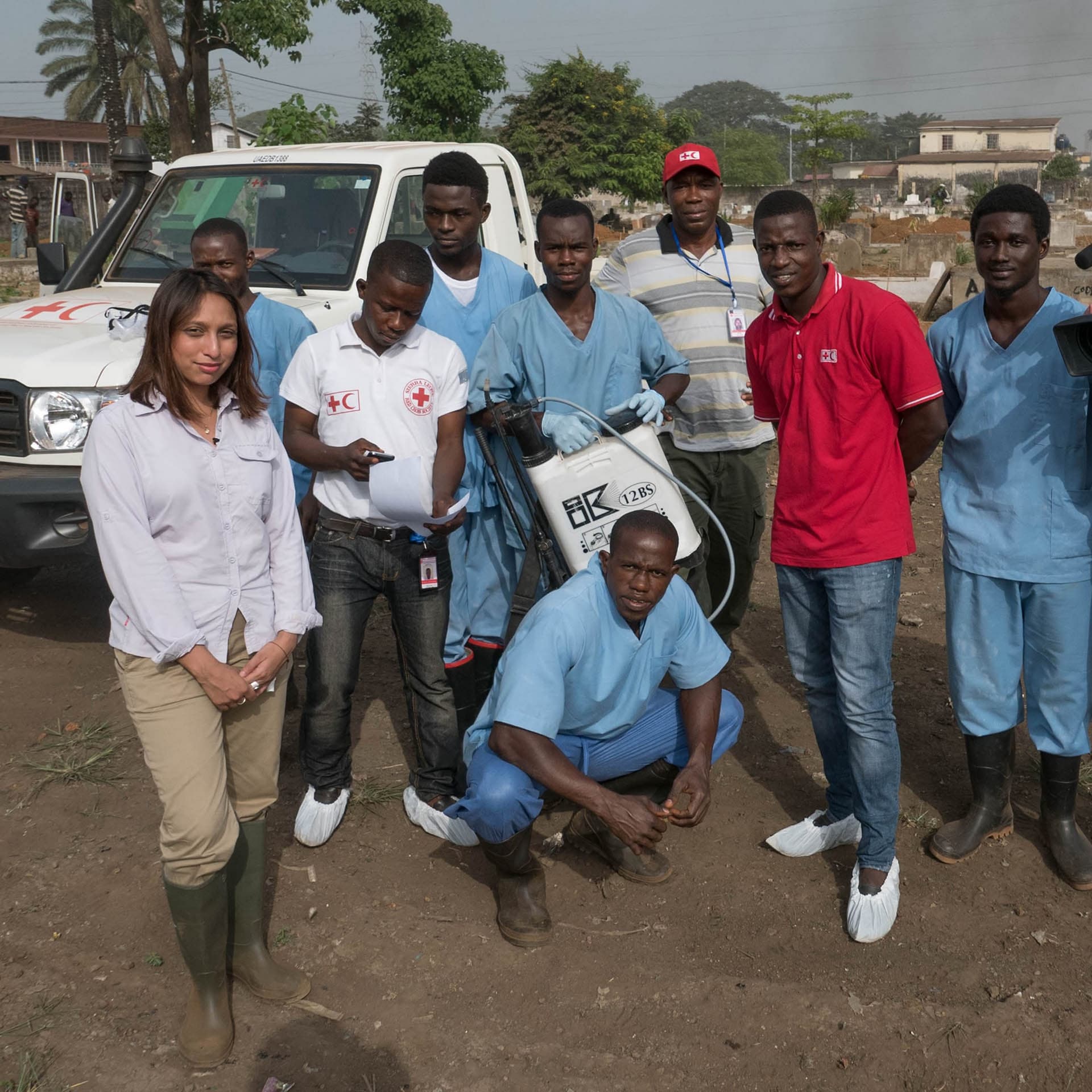
(Photo: Faranak Amidi. Credit: Tricia Yourkevich.)