In short
Two “no-words” solutions for disabled people: Books Beyond Words book clubs (picture-only books) and Tap SOS, a smartphone app to contact UK emergency services non-verbally.
Guest backgrounds
Natalie Duot is a BBC reporter and also a published author who wrote a children’s book explaining learning disabilities from her personal experience. Becca Hume is the creator of Tap SOS (Inclutec), originally for deaf/hard-of-hearing users. Jonathan Wright is a Tap SOS user with Crohn’s disease.
Key claims
Books Beyond Words publishes wordless books for people with learning disabilities; book clubs read together and discuss in sessions. Tap SOS is government-approved to connect digitally to 999 as if calling by phone, with location and visual emergency categories.
Notable examples
Amy’s story about online grooming/blackmail ending with police arrest; Tap SOS used during a Crohn’s-related cramp when Jonathan couldn’t speak, leading to hospital treatment within ~24 hours.
Written by AI. May contain mistakes. Listen to the episode to check what was said.
Chapters
Tap a time to open that second in VOIntroducing the Topic: Solutions for Disabled People
1:12 to 1:49
Explore projects aimed at helping disabled individuals through innovative solutions.
“While the world is fixated on problems, this is the programme that tells you about solutions.”
Natalie Duot's Reading Experience
1:49 to 2:54
Natalie shares her personal journey with reading and learning disabilities.
“Now Natalie, before we talk about the book club, I'm just wondering what's your experience like with reading?”
Understanding Learning Disabilities
2:54 to 3:57
Discussion on the differences in terminology and statistics related to learning disabilities.
“My learning disability impacts me on my day-to-day life so things like doing fancy hairstyles I can't do, doing my shoelaces I struggle to do.”
Exploring the Book Club Concept
3:57 to 4:32
Introduction to a book club that uses wordless books for discussion and engagement.
“This book club is run by a charity that is called Books Beyond Words and they publish special books that don't have any words.”
Reading a Story from the Book
4:32 to 9:02
Natalie recounts a story from a wordless book, discussing its characters and themes.
“So this book is called Going Into Hospital.”
Feedback on the Story and Its Impact
9:02 to 11:16
Discussion on the emotional responses and learning from the story shared in the book club.
“Because you learn about what's happening.”
The Origin of Books Beyond Words
11:16 to 13:44
Emily shares the beginnings of the charity and the importance of storytelling for those with learning disabilities.
“It's part of the requirement of having this job, really.”
Understanding Through Books
14:00 to 15:06
Learn how a book helped an individual understand a serious situation.
“This is the documentary from the BBC World Service.”
Book Club for Learning Disabilities
15:51 to 18:00
Discover how a book club creates a social and learning environment.
“We've just been hearing about a book club for people with learning disabilities from our reporter, Natalie Duo, who's still with me in the studio.”
Emergency Solutions Without Words
18:00 to 21:55
Explore innovative methods for communicating emergencies non-verbally.
“Natalie, for what you've shared with us, this book club with books that have no words.”
Show all 11 chapters
Real-life Impact of Tap SOS
21:55 to 24:25
Hear how Tap SOS helped a user during a critical medical emergency.
“Jonathan suffers from Crohn's disease, which can lead to his body becoming dangerously dehydrated.”
Transcript
Automatic transcript. May contain errors.0:00This BBC podcast is supported by ads outside the UK. Decisions made in Washington can affect your portfolio every day. But what policy changes should investors be watching? Washington Wise is an original podcast from Charles Schwab that unpacks the stories making news in Washington right now and how they may affect your finances and portfolio. Listen at schwab.com slash Washington Wise. That's schwab.com slash Washington Wise. If you are currently overpaying on software to run your business, remember this number, 10 ,000. That's the number of new businesses that join Odoo per month. Join Odoo today at odoo.com.
0:46That's O-D-O-O dot com.
0:51The Documentary, home of the best documentaries from the BBC World Service. Welcome to the documentary from the BBC World Service. I'm Myra Anubi and this is People Fixing the World.
1:12While the world is fixated on problems, this is the programme that tells you about solutions. Today we'll be finding out about two projects that can help disabled people. A reading club where the books have no words and a picture app that could save lives. Every day, many of us rely on words to communicate, to learn, to connect. But the solutions we'll hear about today have a big impact without any words. First, a book club with a difference. And here to tell me more is our reporter, Natalie Duot. Natalie, it's great to have you back. Hi, Myla. Thank you. Now Natalie, before we talk about the book club, I'm just wondering what's your experience like with reading?
1:56Well, my experience with reading, so I properly learned how to read in my late teens. And since then I can't stop reading. What sort of books do you like? I'll read anything from fiction to autobiographies. if you give me a recommendation or if I see any recommendations on social media I'll buy the book and then I'll just read it yeah and I mean we do know you love reading because you're now a published author I am yeah the the book is is about it's explaining to children what a learning disability is and I wrote my personal examples of how I've always struggled from being a child to where I am now in life.
2:53Tell us a bit more how does that impact you? My learning disability impacts me on my day-to-day life so things like doing fancy hairstyles I can't do, doing my shoelaces I struggle to do. So another example I can give you is public transport. Someone with a learning disability may not able to use the tube or the bus so they may need a taxi to take them everywhere. Right right and for people who can't see you I just want to say your hair looks lovely right but it's also worth saying that while we use the term learning disability here in the UK In many other countries, it's different. This kind of impairment is described as an intellectual disability.
3:41And that would include people with Down syndrome, right? Here in the UK, there are roughly 1.5 million people with a learning disability and a much larger group. About 8.5 million find reading very difficult. But now let's get back to the solution today, Natalie. Tell me about this book club. This book club is run by a charity that is called Books Beyond Words and they publish special books that don't have any words. They're published specifically for people who have a learning disability and people come together and read them in book clubs. Right. So instead of the traditional kind of book clubs where people read the book before and then discuss them later, here people read the book together and discuss it in the sessions.
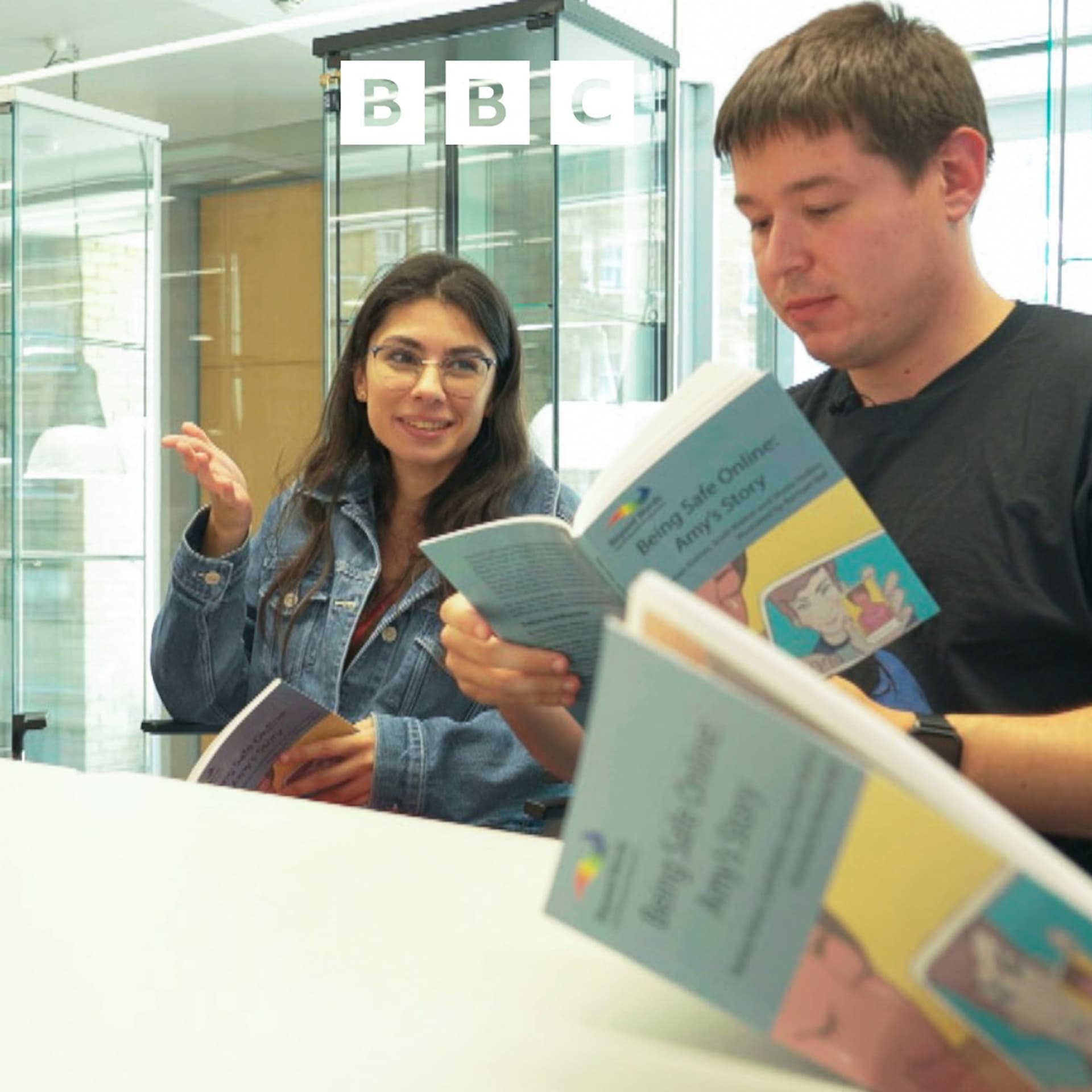
4:31Here's an example. Do you want to see? Yes, please. Let me see. So this book is called Going Into Hospital. And just kind of looking through the book, you've got illustrations, large ones on each page that continue, but no words, just pictures. but Natalie I'm just wondering how does it work just looking at this book how do you read this without any words well I went along to a book club to find out the group I joined met in a library in London and we were reading a new book called being safe online Amy's story. Hi everyone I'm Natalie can I please join in today? I joined about 15 people around a big table and we start to read a new book.
5:24Today the group is led by Robert, a project administrator. So I will start. So story starts with two ladies that are walking in a park, just having a nice walk and one of them seem to recognise a tall, slender man it is. I'm going to name the lady with the pink shirt Amy and the lady in the purple jacket, Rose. In these books the characters don't have any names. Instead, the group enjoys making them up themselves. And the man, what should we call the man? Would anyone like this? Ben. Ben. Let's go Ben. Yes. Everyone takes a turn reading the story. Some people at the book club have a more severe learning disability.
6:20Charlene has trouble speaking, but she can follow the story and is helped by a carer. Next page. Page 10. So see what she is looking on the phone. Oh. That's cute. Dog. Dog, yeah. Sending a picture to her. There is a man, yeah. I think they are on video call. On video call. He is showing her this dog. The story is about a woman called Amy who makes friends with a man online. We decide to call that man John. Amy and John send each other pictures of their pets. Amy, yes. I think she might be taking a picture of her cats as well. Yeah. But then I noticed that John sends Amy a picture of something else.
7:17John is, I think he's playing the game. Oh, taking a picture. Taking a picture of what? His foot. It's his foot. John wants Amy to send a picture of her foot too, but our group didn't like that. At this point, I'm starting to get worried about Amy. And sure enough, things get worse. John soon asks Amy to take her clothes off while on a video call.
7:59What's happening now? She hanged up on her. Yeah. And she's still in her undies. She is, yeah. And then John uses the pictures to try and get money from Amy. If you don't give me money, I'll show it to people. He'll show it to other people. It's blackmail. At first he was such a nice guy and then Mr Footsie turned into a monster. Yeah, yeah. At the end of the book, John is arrested by the police. Thank goodness. Look at that. The police came. The police came, yes. I'm very relieved by the happy ending. And that's the end of our story. Thank you. Good day everyone. Good day everyone. Good day everyone.
9:05Good day everyone. Good day everyone. Can you get a helpful book? Yes. Yes. Yes, I find it helpful. I find it helpful. You find it helpful? Because you learn about what's happening. Because it will happen to anyone around the world. It made me learn a lot of the things, what you should do when you're using your mobile phone or when you're online to stay safe. I enjoyed the book. I just think it's a very difficult topic to go through in general. thank you everyone to be honest I'm surprised about how much everyone loved reading Amy's story because I found it a bit upsetting I asked publishing manager Emily Hollins if other book clubs liked the same sort of stories Some of our book clubs, the longer standing book clubs that we've been meeting for years, they will actually say, oh, we want to do a book about, we want to read a book about having epilepsy or about a parent dying.
10:31And other book clubs just want to do the fun books like Lucy Goes Riding or Day at the Beach and Falling in Love. Is there a book that you wouldn't do because you would feel embarrassed to do or is completely out of your comfort zone? I mean, we cover so many different topics. One book we recently updated, which was a bit embarrassing for me, was Looking After My Balls. So it's lots of pictures of a man with his clothes off. So yes, that was a bit embarrassing to work on. But honestly, I can pretty much cope with anything. It's part of the requirement of having this job, really. And Emily was born to do this job.
11:24She grew up with a brother with a learning disability called Nigel. And 40 years ago, Emily and Nigel's mum, Sheila Hollins, started Books Beyond Words. Once Sheila is a doctor and now sits in the House of Lords, part of the UK Parliament. Well, my son has a learning disability and so that's how it all started. Because of his learning disability and I began to understand more about it, I used to be the child psychiatrist and then I started working just with people with learning disabilities. I, shall I tell you how I started making the books? Yes, please. Well, then I was a psychiatrist working in a long-stay hospital.
12:09And one day I was asked to see a man who didn't speak. And the nurses wanted me to give him some medicine to make him get out of bed because he was hurting himself. He was crying, he wouldn't eat and he wouldn't get out of bed. And when I made further inquiries, I found out that his dad had died. But nobody told him because nobody thought that he would understand. But his dad used to visit him every week. It was so sad. And so I tried to find some pictures that would show that story. And the children's publishers all said, we would never do a book about a father dying. That's far too complicated.
12:51That's far too upsetting. So I tried doing it in photographs. That didn't work. So I started working with an artist friend, Beth Webb, to see whether she could help me to create a story. And so we created the story. And it's still one of our most, if you like, popular books. That first story was called When Dad Died. After the story came out, they realised that people who struggled to read were unlikely to find out about the book. So that's when they had the idea of starting book clubs. Today there are more than 300 book clubs in the UK and Books Beyond Words have published 80 books. You could say that it all started with Nigel, Sheila's son and that first book when dad died is still a very special book for him and the whole family.
13:49I'm sure my son won't mind me telling you but my husband died last year his dad and when he died my son was there and then he came out of the room and a nurse had turned up and she was standing there waiting and so he went to my study and he got this book off the shelf I didn't suggest it to him but he went and found it and he came back and he gave it to the nurse and he said this is what happened which I think is wonderful because it meant that he understood and he was able to be there because he wasn't scared. He knew what was going to happen. He'd been prepared. That's what he said. This is the documentary from the BBC World Service.
14:38Self-directed investing, trading, full service wealth management, automated investing, financial planning, thematic investing, retirement planning. Phew. And to think, that's just a small taste of what Schwab offers. Because Schwab knows that when it comes to your finances, choice matters. No matter your goals, investing style, life stage or experience, Schwab has everything you need, all in one place, so you can invest your way. Visit schwab.com to learn more. Support comes from WISE, the smart way to manage the currencies you need around the globe. Fed up with losing out to hidden fees when you send money abroad with your everyday bank?
15:18Choose the smart way. Wise. You can count on the exchange rate you'd usually find on Google. No unwelcome surprises. Plus, ditch that where's my money feeling. Most transfers arrive in under 20 seconds. Join millions saving billions on hidden fees. Be smart. Get wise. Download the Wise app today. T's and C's apply.
15:44I'm Myra Anubi and on People Fixing the World Today, it's all about solutions that need no words. We've just been hearing about a book club for people with learning disabilities from our reporter, Natalie Duo, who's still with me in the studio. Natalie, you found Amy's story quite upsetting, but I wonder, what did you think about the book club? It was a very fun and interesting book club. There was a specifically lovely atmosphere. So it wasn't just about reading the book. It was very much them just having a chat, socialising, talking about their week and then getting on with the book. And just specifically with these books, what's the process of making one of them?
16:33Well, the artist does a first version of the book, then they test it with people who have a learning disability. And with this specific book being safe online, around 50 people tested this book and it took two years to make. Gosh, two years is a long time. How expensive is this to do? It can be expensive. Longer books can cost up to£70 ,000. Right, so that's around$100 ,000. Yep, and they are paid for by charities or grants, but they would love to do more books, especially fun ones that the group would love. Because I'm guessing the grants and all go towards the more serious books. I suppose, Natalie, some people might be wondering, why read such serious books?
17:28reading should be fun? Because it's important to talk about serious topics and for people who have a learning disability to understand serious topics like sexual abuse, online abuse. But what really fascinated me is that they all had fun. So even though it was a serious topic, they still had fun. Right, right. And that's what books should be. Thank you so much, Natalie, for what you've shared with us, this book club with books that have no words. Thank you. It's been a pleasure. Well, for my next story, I'm sticking with a theme of finding ways to communicate without words. Imagine having an emergency, an accident perhaps, or being the victim of a crime.
18:21Think about how you would alert emergency services. Now, ask yourself, how would you do that if you couldn't talk? Well, here in the UK, there are a few ways. There is a text message service. And two years ago, another service was introduced for deaf users to request a sign interpreter. But there's also a third alternative as well. It's called Tap SOS and it's the world's first smartphone app that's connected to emergency services. It was created by Becca Hume from the company Inclutec and I spoke to Becca down the line from Northern Ireland. So it's a smartphone app and it allows people to connect to 999 non-verbally, so 999 being our emergency number, any time that they feel that they're in an emergency and traditionally maybe would pick up the telephone and call 999.
19:14we are the digital alternative. Just looking at the app now, and I'm pretty sure I pressed the practice button. One of the things it asks immediately is for your location and what you need, which I think is quite key. There are four options here, all visual. There are these police, an ambulance, fire and rescue or coast guard. And you do have the words themselves, but all of these are images. So they are all buttons. Those pictures then are clickable. Once you select which service you require. That then opens up the categories that are relevant to any emergencies. So any police related incidents that you might be experiencing or ambulance situations, they're all presented there.
19:56It's interesting you said that because I just clicked on the image that shows a police car and already there's so many options, you know, damage, property, domestic abuse, drug, gangs. I wonder, does it take the same amount of time for these services to get to you if you call 999 or if you use the app? We are the only company in the UK that has been government approved to connect digitally into 999. So anybody that uses our app, it's treated exactly the same as lifting up the phone and calling 999. So you will get the same response from the emergency services by using our app as you would by making a 999 call.
20:36Part of the app, you have a profile in there and you can add in medical conditions or your own medical profile. And once you click on, I need help now, I'm about to make a report, it's then transferred to the emergency services themselves. So, Becca, the app was originally designed for people who are deaf, but then it's now being applied in other ways? So, yes, the starting point was deaf and hard of hearing community, but you very quickly consider those maybe non-verbal, those maybe experiencing choking, an asthma attack or a stroke. And in those circumstances, you're losing your ability to speak clearly or confidently.
21:16We've had users saying, you know, I'm autistic and this would work better for me. Like, I'm not comfortable picking up the phone and speaking to people. I prefer this method. Is that OK if I download your app? And I'm like, absolutely. This is designed for you. This is for anyone to download. So it's broad. At the moment, Tap SOS only works in the UK. But Becca says that there has been more interest from other countries and she's keen for it to become a way of contacting emergency services all around the world. It's worth saying that it's still quite small, with just 5 ,000 users here in the UK.
21:53One of those users is Jonathan Wright, who heard about TAP SOS because he used to work with Becca's father. Jonathan suffers from Crohn's disease, which can lead to his body becoming dangerously dehydrated. Partly out of curiosity, he downloaded Tap SOS to his phone a few years ago and was later very glad he had done so. Jonathan told me exactly what happened. I had spent a few days feeling just a little off, not feeling terrible by any means, still getting on with everything that I could, but just feeling a little bit under the weather. Then I went up to the bedroom, I lay down, and about 30 minutes after that there, I woke up screaming because my leg had went into a cramp.
22:40I couldn't speak a word. I could barely breathe. I don't know if you, I really hope you've never been in a position where you've been in so much pain that you can't communicate, you know, something that should be quite simple effectively. But I knew I wasn't able to communicate verbally what was wrong. so the phone 999 on the phone wasn't going to happen so I you know I'd been playing with the app a little bit and looking through it and I'd put all my details into the app just simply to make sure that everything worked so I was able to use the app and the app because it had a lot of information already there it made it a lot easier for me to go through and hit buttons and not have to type out stuff, but basically to get through to the emergency service what the problem was as quickly as possible.
23:32I mean, it's so time critical. And I was in hospital, treated and out within a matter of probably 24 hours. But if I hadn't got in as quickly as I got in, if they hadn't looked up the information as easily as they got the information, I am in no doubt that I would probably not be here. And I know you downloaded this app, not necessarily thinking you'd ever have to use it. But now that you have, what does it mean to you knowing that CapSOS exists? I have since put the app on the phone of just about everybody I know. And when I meet people, I will say, hey, have you seen this? Because once it's there, you might never need to use it.
24:20but it will be that moment when you do need to use it that you will suddenly realize I am so grateful this app exists. Jonathan Wright speaking to me recently and hopefully Tap SOS will one day be available wherever you're listening to this podcast. For now though it's just in the UK. Now what do you think about today's solutions? Let me know by sending a message or a voice note to the WhatsApp number plus 44 8000 321 721. That's all we have time for today, but join me again next week for more uplifting and interesting ideas that can make a difference in our world. Until then, thanks for listening to People Fixing the World on the documentary.
From the publisher
We look at two solutions that harness the power of pictures to help disabled people