
In short
Turkey’s justice system and how courts are used to control dissent, with three courtrooms across one summer—focusing on comedian Deniz Guktas, opposition mayor Ekrem İmamoğlu, and jailed district deputy mayor Ibru Özdemir. It argues that after the 2017 constitutional overhaul, the judiciary became politically influenced, enabling wide crackdowns on speech, politics, and even entertainers.
Guest backgrounds
The episode features Emily Wither (BBC World Service correspondent in Istanbul) and interviews with Deniz Guktas’ supporter Daria; actor Cem Yiğit Üzümoglu (Actors Union board member); court reporter Furkan Kanube; EU Parliament rapporteur Nacho Sánchez Amor; retired judge Aişe Sarazou-Palavan; and deputy mayor Ibru Özdemir (recently jailed). Also includes coup-survivor Safiye Bayet.
Key claims
Courts are not independent; prosecutions for “insulting the president” number about 59,000 (800+ children); judges are disciplined or reassigned for criticism; pre-trial detention functions as punishment; and mass trials target municipal leadership.
Notable examples
Deniz’s viral stand-up (arrest July 2, 2025) for insulting the president and inciting hostility; İmamoğlu’s espionage case and multiple charges at Silivri; Özdemir’s near-year detention without indictment; and July 15, 2016 coup attempt used as a pretext for purges.
Written by AI. May contain mistakes. Listen to the episode to check what was said.
Chapters
Tap a time to open that second in VOInvestigating Turkey's Justice System
0:57 to 1:30
Exploring the widening scope of trials against dissenters in Turkey.
“Thanks for choosing to listen to a Simon on the documentary podcast from the BBC World Service.”
The Case of Deniz Guktas
1:30 to 2:09
The story of comedian Deniz Guktas and his legal troubles.
“I've been investigating how Turkey's justice system came to work this way and what's left of freedom of speech.”
Comedy and Censorship in Turkey
2:09 to 3:56
How humor and satire are being suppressed in the current regime.
“It's a large multi-storey complex with a vast marble atrium connecting endless corridors.”
Public Sentiment and Dissent
3:56 to 4:25
Understanding the feelings of disappointment and hopelessness among youth.
“Millions of people are completely disappointed, hopeless and sad.”
Legal Crackdown on Dissent
4:25 to 6:39
Insights into the legal consequences of dissenting against the government.
“and the chief prosecutor's office said hundreds of complaints were filed.”
Trust in Turkey's Judiciary
6:39 to 7:55
Exploring public trust in the fairness of the judicial system.
“That's according to Justice Ministry figures published in March this year.”
Emotional Responses to Repression
7:55 to 8:10
Daria expresses anger and fear regarding the current state of affairs.
“Because the judicial system is a tool of the government to oppress people.”
The Journey to Imamoğlu's Trial
8:10 to 8:36
Following the journey to attend the high-profile trial of opposition mayor Imamoğlu.
“I'm simply angry because they try to feel everybody insecure in this way.”
Imamoğlu's Charges and Legal Battles
8:36 to 10:30
Detailing the charges against Istanbul's mayor and the implications.
“It's very early the following Monday morning, and I'm off to another court case, the most well-known of all of them.”
The State of the Judicial System
10:30 to 14:00
Observing the lack of independence in Turkey's judicial system.
“Lawyers and journalists covering these cases are often arrested too, including Furkan.”
Show all 18 chapters
Judicial Independence in Turkey
14:00 to 14:48
An overview of Turkey's judicial system and claims of independence.
“Turkey insists that its judicial system is independent, that the courts are free and fair and that they are following the rule of law.”
The Shift to Presidential Power
14:48 to 16:59
How the 2017 referendum reshaped Turkey's political landscape.
“That year, Erdogan won a referendum that reshaped the constitution.”
Consequences of Disagreeing with the Government
17:53 to 19:37
Aisha Sarazou-Palavan's experiences as a judge criticizing reforms.
“I did manage to track down a retired judge who was willing to be interviewed.”
Impact of Judicial Changes on Judicial Experience
19:37 to 21:13
Discussion on the decrease in experienced judges in Turkey.
“That's why the investigations were carried out in order to pull people like me out of the field, to make them fed up and make them give up.”
Anniversary of the Coup Attempt
21:13 to 23:11
The significance of July 15 in Turkey's recent history.
“But in spite of this, today there are more than twice as many on the bench than there were 10 years ago.”
Public Sentiment After the Coup
23:11 to 24:15
A citizen's perspective on Erdogan's governance post-coup.
“Has it strengthened democracy in Turkey, do you think?”
The Judicial System's Current State
24:15 to 28:00
Insights into ongoing court cases and the justice system in Turkey.
“I visit Safiye at her home, not far from the bridge, on the Asian side of the city.”
Conditions of Detention in Turkey
28:00 to 32:15
Explore the harsh realities of pre-trial detention in Turkey, including personal accounts of those affected.
“The families are just taking with them a binoculars.”
Transcript
Automatic transcript. May contain errors.0:00This BBC podcast is supported by ads outside the UK.
0:30Listen to Choiceology at schwab.com slash podcast or wherever you listen. How many streaming subscriptions do you have? Is it the same for your business? Avoid it by having all your business on one platform. Try Odoo for free at odoo.com. That's O-D-O-O dot com.
0:51The Documentary, home of the best documentaries from the BBC World Service.
0:57Ekrem İmamoğlu:Thanks for choosing to listen to a Simon on the documentary podcast from the BBC World Service. I've worked as a correspondent covering Turkey for years and live in Istanbul. I've seen how the legal net is widening here. Opposition mayors, journalists and increasingly performers and entertainers are finding themselves on trial. The government insists its courts are simply applying the law and the judiciary is independent. But critics say President Erdogan is using the courtroom to silence dissent and tighten his grip after two decades in power. I've been investigating how Turkey's justice system came to work this way and what's left of freedom of speech.
1:42Ekrem İmamoğlu:Oh my goodness, I cannot believe how many police there is. Is this normal? These are normal.
1:53Can I ask why you came today? I'm Daria. I'm here to support Deniz and demand his release because it is actually illegal what they are doing to Deniz. It is not illegal to make jokes. It is not illegal to say what you believe. It is not illegal to make some jokes as a comedian.
2:13Ekrem İmamoğlu:I'm outside Istanbul's main courthouse. It's a large multi-storey complex with a vast marble atrium connecting endless corridors. These days, it feels more like a prison surrounded by metal barricades and a ring of police. I've come here a lot over the years, following court cases in Turkey, and the cast of people appearing keeps widening. Opposition mayors, students, and today, a popular comedian called Deniz Guktas.
2:45Ekrem İmamoğlu:They are chanting freedom for art, freedom for humour and freedom for Deniz. A month earlier, Deniz was on stage.
2:56Ekrem İmamoğlu:He looks small at the front of an outdoor amphitheatre in Istanbul. He's dressed in black beside a giant model of his own severed head, backed by lavish red curtains. The 32-year-old pokes fun at Turkey's president Recep Tayyip Erdogan, who's ruled the country now for 23 years.
3:18Ekrem İmamoğlu:In one joke, Deniz compares Erdogan to a grumpy neighbour and describes how he's evolved from a shy dictator to one who is at peace with his own identity. For 90 minutes, he takes aim at everything. Society, religion, the jailed opposition, the kind of material that in today's Turkey gets you in trouble. He even laughs about that culture of fear. All was fine until his show was posted online. First the authorities here tried to block clips of it, citing national security. It didn't stop it going viral. It had struck a nerve with Turkish society. Millions of people are completely disappointed, hopeless and sad.
4:00What's happening to the country? A sharp regime change, full of oppression. We are on a survival mode in our daily lives, struggling to pay our rents, pay our bills to study. And Denis Goktas gives all our feelings and problems in his jokes. He spoke for a lot of what young people are feeling right now. Exactly, exactly. He became a symbol of the youth now.
4:27Ekrem İmamoğlu:Not everyone found the jokes funny. Many found them outright offensive. and the chief prosecutor's office said hundreds of complaints were filed. I asked Daria, one of his supporters, about that. Yes, offensive joke, but it is a joke. It was not insulting the religious people, it was not insulting the religion, it was not insulting the ordinary people's rights or beliefs. But I believe he's now in the court because he called Ardon openly as authoritarian. leaders. That is the main case.
5:11Ekrem İmamoğlu:When I saw the clips online, I got hold of his number and I sent Deniz a text asking him for an interview. I'm not sure he ever read it and I suspected there might not be much time anyway before he'd be arrested.
5:28Ekrem İmamoğlu:I'm Emily Wither and for assignment I'm in Turkey. I've been living and working in the country for years, and I've seen firsthand how the fight for this often polarised country's future is playing out in its courts. This is a story of three courtrooms recorded across one summer. I've covered hundreds of opposition politicians who are facing legal battles or are in jail here. And increasingly, it's not just the political opposition. It's anyone who challenges the government's idea of how the country should be and how its people should behave.
6:09Ekrem İmamoğlu:On July 2nd, Denis Guttash was arrested, and the very next day I was at the courthouse. Inside, supporters of the comedian crowded the corridor to hear the ruling. They're told Denis will be held in jail as he waits for a trial. The charge is insulting the president and publicly inciting hatred and hostility. He's not alone. Almost 59 ,000 people are under investigation in Turkey for insulting the president or the state. That's according to Justice Ministry figures published in March this year. More than 800 of them are children. The crowd have now come out of the court. They've walked down six flights of stairs with huge numbers of police trailing them.
6:59Ekrem İmamoğlu:There is a lot of anger here, a lot of disappointment. Some other entertainers have been handed long suspended sentences, a warning not to re-offend. Others face travel bans. Outside the court, I meet an actor who was subject to one. My name is Cem Yiğit Üzümoglu. A year and a half ago, I was here inside where now Deniz is waiting in a car. I am also in the board member of the Actors Union of Turkey. and a year and a half ago we have been protesting, making announcements for the protest and the ongoing situation in Turkey. So that's why I became a target. Without committing any crime, they tried to create a crime and they are still trying.
7:44The court is still on, but there is no result yet.
7:47Ekrem İmamoğlu:Do people have trust in the judicial system in Turkey? Do they trust that the trials here are free and fair? No, I don't think people trust. no one can trust. Because the judicial system is a tool of the government to oppress people. That's how they are using it. I asked Daria how she feels about the ruling. I'm angry. I'm simply angry because they try to feel everybody insecure in this way. They are trying to give a psychological war over society. So it's not surprising, but we will not normalize this. Thousands of people are in jail in Turkey, including political leaders and journalists. Tomorrow I can be jailed.
8:42Hi, nice to meet you. Morning.
8:45Ekrem İmamoğlu:How are you doing? It's very early the following Monday morning, and I'm off to another court case, the most well-known of all of them. The long journey from one side of Istanbul to the other begins crossing continents, from Asia to Europe by ferry. Yeah, good, thanks. Tired.
9:08Ekrem İmamoğlu:Furkan Kanube is a Turkish court reporter. He's heading to the court too, and I've brought a translator.
9:18Today, Imamoglu has three cases.
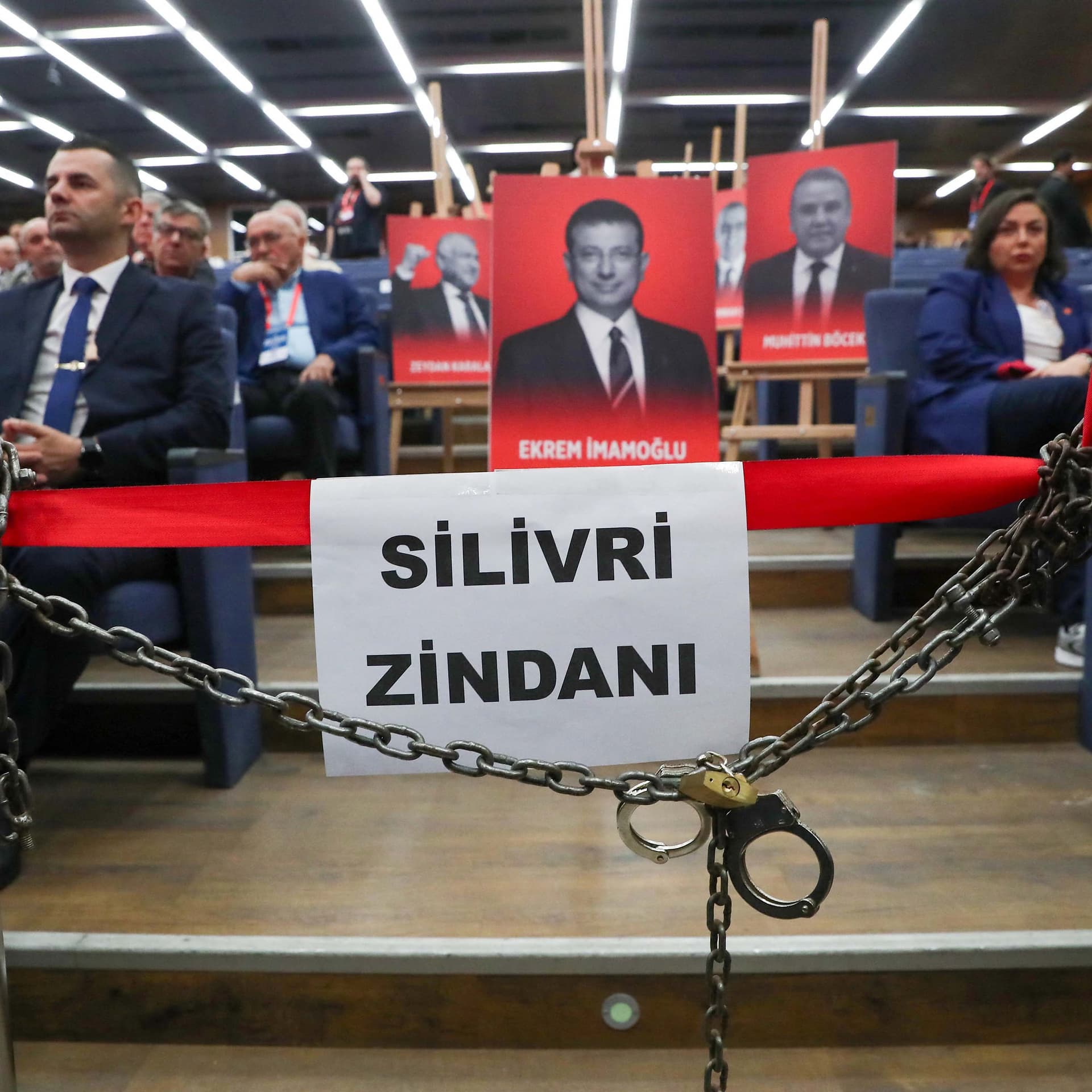
9:21Ekrem İmamoğlu:So he's in court on three separate charges today? Yes. We should probably go through, actually. It looks like the boat is nearly here. You might recognise that name, Ekrem İmamoğlu, the opposition's popular mayor of Istanbul. His arrest in March 2025 sparked mass protests across Turkey. Since then, he's been in prison facing charges from corruption to espionage. with prosecutors seeking sentences that add up to more than 2 ,000 years. He's also Erdogan's main rival. Polls suggest Imamoglu is the most likely candidate to defeat the current president. His arrest was part of a wider crackdown on the opposition that swept up hundreds of people.
10:11Ekrem İmamoğlu:I'm on my way to hear Imamoglu's defence. Furkan covers these cases every day. After the ferry we board a minibus to take us to the most remote district on the far western edge of the city Critics say it's no coincidence Imamoglu's trial is so hard to get to The government says it's simply that the prison has big enough courtrooms It's Europe's largest high security jail and is surrounded by barbed wire and fields of cheery sunflowers Outside a checkpoint are several courtrooms, which is where we're dropped off. This is Silivri. And three times I've been here. You've been held in here three times?
10:56Yes.
10:57Ekrem İmamoğlu:Lawyers and journalists covering these cases are often arrested too, including Furkan. He's been detained several times for publicly spreading disinformation. He switches to Turkish. I stayed here three times. One of them was seven months. At this point I considered this place like my home. Nearly 40 ,000, 50 ,000 people stays here. we have one room cells here. People stay in their rooms, small rooms. They also have bigger rooms and there are around 40 people. But now the population is so much in the prison. There are 70, 80 people staying. And some of them are on the sleeps next to the restrooms or they are on the ground.
11:51So it's over-prepated really. You are either super lonely or you have to stay with 80 people in one room.
12:01Ekrem İmamoğlu:Over the years, I've seen many journalists arrested here for doing their jobs, and most of the media is now state-controlled. I asked Furkan, who works for one of the very few remaining Turkish independent media outlets, how the cases are being covered. The government-aligned media basically looks out for what judges are saying. But us, as an independent, we look what the lawyers are saying, what proof is there, what kind of documents we can show. That's our difference. Should we go in? I probably have to put this away.
12:48Ekrem İmamoğlu:We go through security and inside it's sterile, crowded and chaotic. A small cafeteria serves tea and toast. The police block the doors as seats quickly fill up and supporters of the jailed mayor spill into the corridor. The first hearing of the day has just wrapped up. You're not allowed to record inside the court. When Imamoglu arrived, he had a big smile on his face and there was a standing ovation from the supporters that had crowded into the small courtroom to watch the proceedings. There was a huge round of applause and many of them were chanting President İmamoğlu. He told the court, how did the judiciary system in Turkey come to look like this?
13:38Ekrem İmamoğlu:İmamoğlu faces at least five separate cases plus further investigations. The one I just heard is an espionage case where he's accused of sharing the details of millions of Istanbul residents with foreign intelligence services. Among the crowd, observers from foreign governments also file out of the court. I grabbed the European Parliament rapporteur for Turkey, Nacho Sanchez Amor. Turkey insists that its judicial system is independent, that the courts are free and fair and that they are following the rule of law. you've come here to observe these cases. What do you make of that? There is no any hint of independent judiciary in Turkey.
14:19Not any hint. I have the list of the judge that has been removed only in the cases of Imamoglu, meaning if a judge acts independently, professionally, he's going to be punished. There are so many cases. There are so many examples.
14:37Ekrem İmamoğlu:It's really hard to find a judge to speak to you. In fact, in general, it's getting harder to interview anyone in Turkey, such as the fear of being publicly critical. To understand how the courts are run now, I need to take you back to 2017. That year, Erdogan won a referendum that reshaped the constitution. Out went the parliamentary system, in came an all-powerful presidency. Erdogan said it would replace unstable coalition governments with decisive one-man leadership. It handed him sweeping new powers, including over the courts. The board that hires and disciplines every judge and prosecutor, the HSK, was radically overhauled.
15:22Ekrem İmamoğlu:And now the president picks some of its members, and a parliament run by Erdogan's political party picks the rest. This is Matt Rogers from Las Culturistas with Matt Rogers and Bowen Yang. This is Bowen Yang from Las Culturistas with Matt Rogers and Bowen Yang. You know when people try on new food and suddenly it's like, wait. That's the reaction a lot of people are having when they first try Kewpie mayo. It's the one with the red cap and the little baby on the bottle. You've probably seen it in the grocery store before. And if you've ever just walked past it, some people would say that's a huge mistake.
15:58Because this mayo is different. Most mayonnaise uses whole eggs. Kewpie only uses egg yolks, which gives it this rich umami flavor. It's smoother, deeper, and almost buttery. Once people try it, they start putting it on everything. Egg sandwiches, fries, burgers. Some fans even swear by dipping pizza crust in it. And once you notice it, you start seeing it everywhere. Chefs use it. Restaurants use it. People who really care about flavor use it. Never tried it? Grab the bottle with the red cap next time you're at the store. Put it on just about anything. Then you'll understand. QP, the original Japanese mayonnaise.
16:31Self-directed investing. Trading. Full-service wealth management. Automated investing. Financial planning. thematic investing, retirement planning. Phew. And to think, that's just a small taste of what Schwab offers. Because Schwab knows that when it comes to your finances, choice matters. No matter your goals, investing style, life stage or experience, Schwab has everything you need, all in one place, so you can invest your way. Visit schwab.com to learn more. Support comes from WISE, the smart way to manage the currencies you need around the globe. Fed up with losing out to hidden fees when you send money abroad with your everyday bank?
17:11Choose the smart way. Wise. You can count on the exchange rate you'd usually find on Google. No unwelcome surprises. Plus, ditch that where's my money feeling. Most transfers arrive in under 20 seconds. Join millions saving billions on hidden fees. Be smart. Get wise. Download the Wise app today. T's and C's apply.
17:36Ekrem İmamoğlu:This is the documentary from the BBC World Service. I'm Emily Wither on assignment in Turkey. So we're definitely recording. Is everybody ready? Are you ready, Aisha? How's it going? How's it going? Okay, to mum. I think your connection is okay. I did manage to track down a retired judge who was willing to be interviewed. Aisha Sarazou-Palavan was a judge for more than three decades and now works as an independent lawyer in the coastal city of Izmir. When the 2017 changes were introduced, she criticised them in a newspaper interview and learnt the hard way that disagreeing with the government has consequences.
18:19At the time I gave that interview, I was the General Secretary of the Judges' Union and a national newspaper had requested an interview from me to explain the consequences of this constitutional amendment on the judiciary. Everything I said has really come true, step by step. I said that appointments and authorizations in judiciary would all be done based on politics. Because the judiciary is really being used in the country to change and regulate society. But that's not its fundamental duty.
18:55Ekrem İmamoğlu:It's to restore peace in society and it's based on the rule of law. A disciplinary investigation was immediately opened against Aisha. And she was eventually hit with a penalty. She wasn't paid for several weeks. She decided to fight it. I took that salary deduction penalty to the European Court of Human Rights. Finally, they ruled my human rights had been violated. But despite that ruling, my requests were rejected every time. In other words, they didn't implement the ruling. But I still stand by what I said and what I went through shows that every sentence I uttered turned out to be the correct observation.
19:37That's why the investigations were carried out in order to pull people like me out of the field,
Read the full transcript
19:43Ekrem İmamoğlu:to make them fed up and make them give up. But her problems didn't end there. Many people who claimed that they were not given a fair trial started a hunger strike. Because of these hunger strikes, I shared a few posts on Twitter. Then at the end of that, another investigation was opened against me. They suspended me from my court for about seven months. They prevented me from doing my job, which I love. I experienced a personal breaking point. I've heard lawyers complain about judges being taken off cases or reassigned if the authorities don't like how they are handling the case. Aysa was eventually forced to move to a different city.
20:28Ekrem İmamoğlu:And is that something that happens often here in Turkey? judges are moved if they find themselves disagreeing or in trouble with the system? Yeah, it exists. It's not just me. Many of my colleagues have been and continue to be reassigned to other positions against their will, following disciplinary or official investigations. The number of judges and prosecutors with 25-30 years of experience is very small now. So I've heard that a lot. Turkish lawyers increasingly voice frustration that judges are young and inexperienced. And I looked at the numbers myself. Since 2016, over 4 ,000 judges and prosecutors have been sacked.
21:16Ekrem İmamoğlu:But in spite of this, today there are more than twice as many on the bench than there were 10 years ago. One lawyer who heads up a firm here told me, we now have an army of judges, and many of them are new. A few weeks later, it's a national holiday. The courts are closed and many people are out marking an important day. There are thousands of people marching across the first of the three Istanbul bridges that connects the city's European and Asian side. They're walking over the Bosphorus Strait, one of the world's busiest shipping lanes. Everybody's got Turkish flags. They're wearing red T-shirts which say July 15 on them.
22:04Ekrem İmamoğlu:I've headed to a memorial to mark the 10th anniversary of July 15, 2016. That was the night a faction of the military tried and failed to topple Erdogan's government. Tanks rolled onto this bridge in Istanbul. And many ordinary people came out and stopped them. and so much of the modern story of Turkey's judiciary runs back to this night. This day is called Democracy and National Unity Day. It's presented as a day of remembrance rather than a party political event. But it doesn't quite feel like one. Watching the crowds, it feels as though only part of the country has come out to market. The crowd is clearly largely made up of government supporters.
22:53Ekrem İmamoğlu:The night of the coup attempt, more than 250 people were killed and thousands injured in the violence.
23:04Ekrem İmamoğlu:Safiya Bayet is one of them. She was shot on the bridge that night. She's one of the many who came out to defend Erdogan. Has it strengthened democracy in Turkey, do you think? I think it has strengthened. And why? Because you can see we're here in large numbers together with the people. What does democracy mean? It's people governing themselves according to their own will. Look at what Recep Tayyip Erdoğan said to us that night. He invited us to the streets. He called the public out. This clearly meant I am with you and the state and the people are one. Erdogan's government blamed Fethullah Gulen, a US-based cleric whose movement Erdogan said had infiltrated the state, a charge Gulen denied.
23:49Ekrem İmamoğlu:In the aftermath, hundreds of thousands were detained or sacked over suspected links to Gulen's group. The coup attempt was condemned across Turkey's political spectrum, but critics say Erdogan went on to use it as a pretext to silence dissent. The state was purged, then rebuilt around one man. This year, Erdogan called that system the coup attempt's greatest gain. Proof, he said, that it made Turkey stronger.
24:22Ekrem İmamoğlu:I visit Safiye at her home, not far from the bridge, on the Asian side of the city. I want to ask her why she supports Erdogan and why he remains so popular. She's a devout Muslim, housewife and mother of three. You can probably hear her youngest son playing with his toy cars in the background. He really makes you feel that he connects with people through his compassion, his love for his people. And we can also understand what he stands for through the authority he commands, particularly in the way he deals with his enemies. The way he looks at his enemies is one thing, but his attitude towards his own people is completely different.
25:02The social support he has provided to people, the particular attention he has given to our elderly and the people with disabilities, and his efforts to improve people's lives is truly admirable. None of those things existed before.
25:16Ekrem İmamoğlu:It feels to me sometimes that the country is quite divided. The elected mayor of this city is currently on trial. What do you think about all of the ongoing court cases and the divisions currently within the country?
25:34Some people have given in to their ambitions and worshipped money. The other side is constantly stealing. We put forward questions in the parliament, trying as much as we can to make sure good things happen, things that are good for our people. We have our armed drones. All the opposition does is oppose things. For example, they say Ekrem Imamog is currently in prison for fraud. Who reported him? His own colleagues, his own friends. the businessmen and the contractors he worked with. And who can oppose people who made the complaints turn to? The courts. But at the end of the day, who do they declare guilty?
26:08Erdogan. They say Recep Tayyip Erdogan interfered with the judiciary. He's a dictator. Do you know why they do this? To intimidate people, to hurt them.
26:23Ekrem İmamoğlu:When the courts reopen after the summer break, I make the long journey back to the sprawling prison and court complex, Salivri, where the jailed Istanbul mayor, Ekrem Emomolu, is on trial. It's September and the sunflowers in the surrounding fields are now picked or blackened. This time I enter a brand new courthouse opened earlier this year. The building looks so new. There's like plastic wrapping on the edge of the chairs still. Actually, it started to build, I think it's in January. But they opened it around 4 May. I'm with Ibru Ozdemir. She's a deputy mayor for a district in Istanbul and was recently jailed herself in Salivri.
27:08Ekrem İmamoğlu:I've never seen a courtroom like it. It's the size of a large sports hall and can seat nearly 3 ,000 people, suitable for a mass trial. This week, it's not only the case of the jailed mayor being heard, but also those of 414 of his municipal colleagues accused of running Istanbul's city office as a criminal enterprise. These are the people who had been running Europe's biggest city, home to over 16 million people. Now they're all giving their defence statements and hearings run late into the night. In the distance, I can see documents of evidence displayed on big screens at the front of the hall and there's an overwhelming number of gendarmer.
27:52Ekrem İmamoğlu:That's Turkey's militarised police. Ibru is here to support some of her colleagues. It's very big, so it's very hard to see the people. The families are just taking with them a binoculars. Oh, binoculars. Yes, binoculars, so they can actually have the chance to see their relatives. Now we are going to the bar room. It's a reserved area for the lawyers. We duck into the lawyer's room upstairs to talk. There are spare legal gowns hanging in the corner and occasionally a flustered-looking lawyer rushes in to print documents or grab coffee. Turkish law allows lengthy detention periods. Ibru was in prison for nearly a year without any formal charges being brought against her.
28:40Ekrem İmamoğlu:She's a former member of a Kurdish political party and is still being investigated for links to terrorism. In the first wave of operations, I was detained and I was in prison for 11 months. So I was released about six months ago. It's like a punishment. Pre-trial detention is the actual punishment. I was in the slavery campus with the others. But I haven't gone to a trial because I don't have any indictment yet. Can I ask you what conditions were like in the prison here? Actually, everybody's conditions is not the same. Some people is staying with so many people together. And I was staying by myself.
29:29But that must have been difficult too. Were you in isolation? Yes. I'm always saying that being alone for me was harder. There was nobody to talk to make you focus on some other things. You were always thinking about your situation, yourself.
29:48Ekrem İmamoğlu:Are these the same conditions that Imamoglu is also being held in? He's also in the same condition. I think all of the mayors is staying alone. In ourselves, we have a small garden. It's not green, of course. It's with the very long walls that you can not really catch the sun. I was just counting my steps so it was like I can finish it in 27 steps. So I was turning around, turning around, turning around. Dozens of elected mayors have been removed from office in recent years. Many are jailed or replaced by government-appointed trustees. The latter happened in Ibru's district. When you appoint a truncet, you are also cancelling all of the municipality council.
30:38So then the vote of the voters is becoming null.
30:42Ekrem İmamoğlu:I asked the Justice Ministry to respond to accusations it's using its courts to target government critics and opposition figures. They didn't respond.
30:59Ekrem İmamoğlu:It's now been more than two months since the comedian Deniz Guptas was arrested for a bold stand-up routine in which he joked about the opposition and President Erdogan. A small group of protesters are on the streets demanding his release. I estimate they're being watched over by five times as many police. The first hearing for Deniz will be at the end of the month He's had another charge added, praising crime and criminals And faces up to nine years in prison
31:33Ekrem İmamoğlu:The opposition mayor Emomolu and his co-defendants are still on trial It may be years before the cases conclude And that, his supporters say, is the point New investigations are opening up here pretty much every day and it's really hard to keep up. In democracies, courts are meant to implement the law, resolve disputes, uphold rights, and everyone is held to account, including the government itself. But here in Turkey, many have lost faith in the system and they're asking who the courts are really there to protect.
32:14Ekrem İmamoğlu:That's Assignment. It was made by me, Emily Wither. mixed by Neil Churchill and the editor is Penny Murphy.
32:47That's GoodRanchers.com and build your box today. Before summer's gone, make the last cookout count with Good Ranchers.
From the publisher
Political analysts and human rights organisations say Turkey's courts are increasingly being used to silence political dissent and to shape a more socially conservative society. The most prominent defendant is Ekrem İmamoğlu, the mayor of Istanbul, and the opposition figure opinion polls suggest is most likely to beat President Erdoğan at the ballot box. İmamoğlu has been held in Silivri prison since March 2025 and now stands trial alongside more than 400 co-defendants in a sprawling corruption case. Other elected mayors have been removed from office and replaced by government appointees. Emily Wither speaks to a former judge punished for criticising the changes to Turkey's judiciary, mayors held for months without conviction, court reporters accused of spreading "disinformation," and performers prosecuted for what they said on stage.