
In short
A BBC World Service documentary on Turkey’s rapidly growing sinkhole problem in Konya’s agricultural Konya Closed Basin, where fields collapse as groundwater is depleted.
Guest backgrounds
Zeynep Bilginsoy (reporter/narrator). Professor Erdek, faculty at Konya Technical University (Geological Engineering) and director of the Sinkhole Research Center; began studying sinkholes after the 2009 Yörümola collapse. Eren Atak, WWF Turkey water/nature conservation manager. Eren Atak’s claims are supported by a 2014 WWF report. Mohamed Gülbahar and Fatih Shuk, Konya farmers with multiple sinkholes in their fields. Ali İhsan Körpes, Konya director, Turkey’s Disaster and Emergency Management Presidency (AFAD).
Key claims
Sinkholes are mostly cover-collapse karst forms triggered by human overuse of groundwater for irrigation (sugar beet, corn), worsened by aridity/climate change. WWF estimates 6.5 billion m³ used vs 4.4 billion m³ sustainably available; many wells are illegal (about 130,000 vs 27,000 licensed). AFAD maps 739 sinkholes using drones/measurements and focuses on risk management rather than classifying them as a disaster.
Notable examples
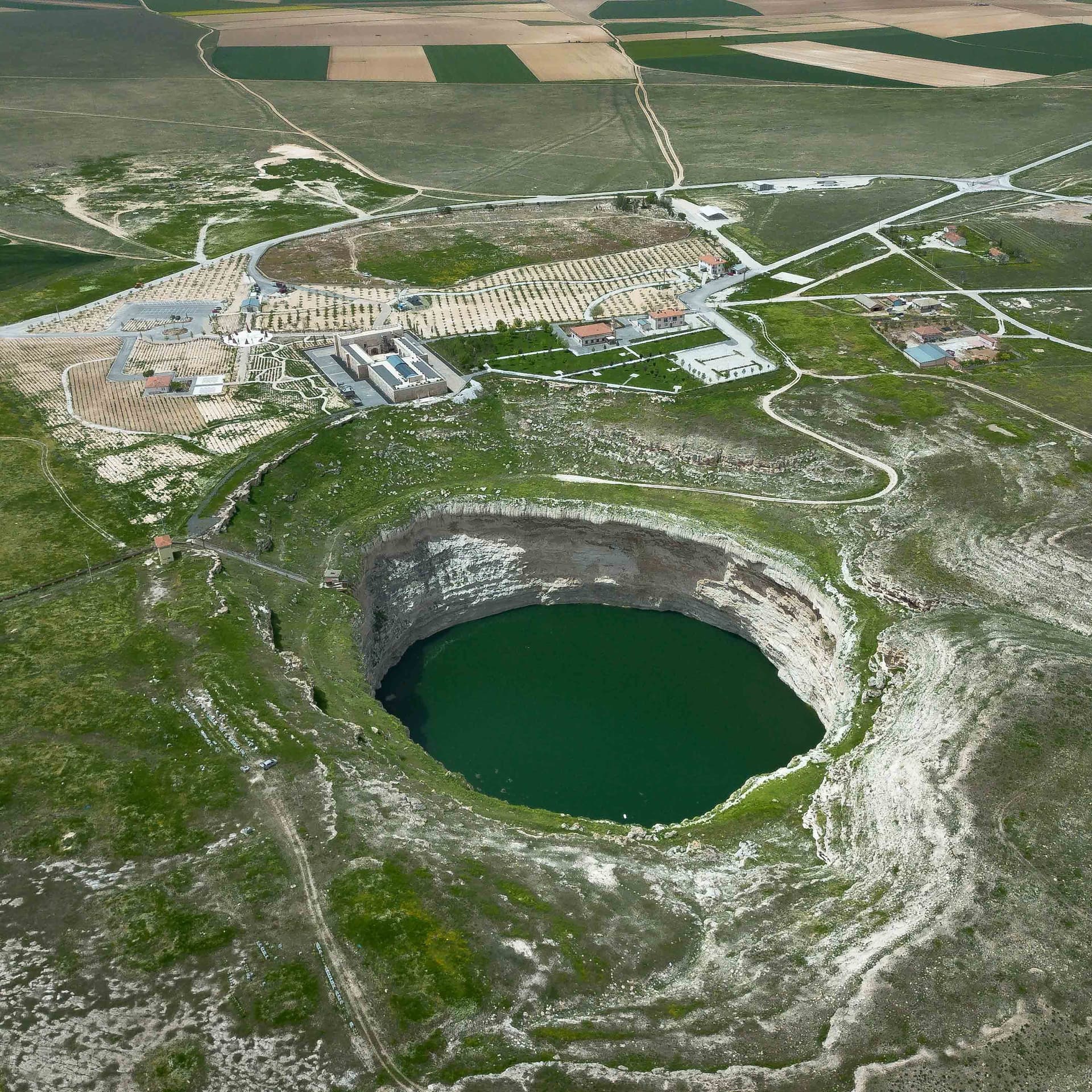
Kizoran sinkhole (nearly 300m wide, 145m deep) as a tourist “ancient” contrast to recent collapses; a Jan 3, 2025 social media video showing sudden field collapse; Fatih Shuk’s three sinkholes (Aug 2022/2023/2024) with early signs like cloudy well water and cracking.
Written by AI. May contain mistakes. Listen to the episode to check what was said.
Chapters
Tap a time to open that second in VOOverview of Konya, Turkey
1:16 to 2:07
Exploration of Konya's significance and its agricultural contributions.
“Home of the best documentaries from the BBC World Service.”
The Kizoran Sinkhole
2:07 to 3:22
Description of the largest sinkhole in Turkey and its geological features.
“It's famous as the resting place of the mystic Sufi poet Rumi, and home to the whirling dervishes who follow his teachings.”
Emergence of Dangerous Sinkholes
3:22 to 4:20
Discussion on the recent increase of dangerous sinkholes in the region.
“I'm watching a clip on social media dated January 3rd, 2025.”
Impact on Local Farmers
4:20 to 4:54
Insight into how sinkholes are affecting farmers and agricultural practices.
“there are 739 sinkholes in the area known as the Konya Closed Basin, which includes Konya itself.”
Personal Experiences of Farmers
4:54 to 8:07
Farmers share their personal stories and experiences with sinkholes.
“It's early morning, and I'm seeing tractors traveling through the flat plains where animals graze and green fields are dotted with thousands of water sprinklers.”
Geological Insights on Sinkhole Formation
8:07 to 8:23
Expert insights on how sinkholes form and early warning signs.
“Shook has three sinkholes in his fields that collapsed in August 2022, August 2023, and August 2024.”
The Role of Groundwater and Climate
8:23 to 10:37
Exploration of how groundwater depletion and climate impact sinkhole risks.
“Water accumulating in new spots, cracking cement, diagonal or stair-shaped cracks in buildings, and doors and windows that do not close.”
The Role of Groundwater and Climate
10:40 to 11:58
Exploration of how groundwater depletion and climate impact sinkhole risks.
“Every woman knows that feeling, and She's Birdie knows it too.”
Geological Factors Leading to Sinkholes
12:32 to 14:00
Discussion on the geological conditions contributing to sinkhole occurrences.
“I'm Zeynep Bilginsoy and this is Turkey's Growing Sinkhole Problem.”
Understanding Cover-Collapse Sinkholes
14:00 to 16:43
Learn about the formation and causes of cover-collapse sinkholes in Turkey.
“This causes the cavities formed underground to gradually expand and eventually suddenly collapse because it can no longer support the weight of the material on top.”
Show all 15 chapters
The Impact of Agriculture on Water Resources
16:43 to 19:10
Explore the relationship between agricultural practices and groundwater depletion.
“They could apply for licenses to dig their own wells, but as demand rose and supplies of water fell, these licenses became impossible to obtain.”
Farmers' Perspectives on Water Usage
19:10 to 22:22
Hear farmers discuss their challenges and the pressures of crop demands.
“Last year, that meant producing over 20 million tons of beet.”
Government Policy and Water Management
22:22 to 26:34
Investigate how government policies affect farming practices and water management.
“But the biggest factor in this is the lack of the blessing of rain.”
Sinkhole Risk Management and Community Impact
26:34 to 28:06
Learn about the measures taken to manage sinkhole risks and community responses.
“But here we require much deeper drilling to determine risk.”
Farmer Fatih Shuk's Struggle with Sinkholes
28:06 to 29:44
Discover the personal impact of sinkholes on a farmer's life and livelihood.
“Farmer Fatih Shuk lives and works on this land.”
Transcript
Automatic transcript. May contain errors.0:00This BBC podcast is supported by ads outside the UK.
0:30We do the things we do. And how to make better choices to help avoid costly mistakes. Each episode covers the latest research in behavioral science and dives into themes like the power of self-control, shaping your mindset for success, navigating new beginnings, and why starting over can feel so hard. Listen to choiceology at schwab.com slash podcast or wherever you listen. If you are currently overpaying on software to run your business, remember this number. 10 ,000. That's the number of new businesses that join Odoo per month. Join Odoo today at odoo.com. That's O-D-O-O dot com.
1:16The Documentary. Home of the best documentaries from the BBC World Service.
1:25I'm in Konya in central Turkey. It's the agricultural heartland of the country, and its farms contribute more to the national economy than any other provinces. Fields here stretch out for miles, growing wheat and barley, but most of all, sugar beet, 7 million tons a year. These are loaded into trucks on an industrial scale, heading to factories where they are processed, boiled, and refined into sugar crystals. Farming has fueled Konya for millennia, but now it's under threat. from sinkholes, as fields literally collapse. I'm Zeynep Bilginsoy, and this is the documentary from the BBC World Service.
2:07Konya is more than one big field. It's famous as the resting place of the mystic Sufi poet Rumi, and home to the whirling dervishes who follow his teachings. It's an ancient province that was a key stop on the Silk Road. About two dozen tourists are gathered and are renovated in from the 13th century that once served Silk Road travelers. They are here to see the Kizoran sinkhole. It's almost 300 meters in diameter and 145 meters deep. This is the largest sinkhole in Turkey. Where are you coming from? Hong Kong. Did you see the sinkhole? It's good. What do you think about it? It's so beautiful, beautiful.
2:47It's good, very good. Everything is good. From where I am, you can see layers and layers of exposed rock. It's like a CT scan of the land's geology. I've seen photos of it from the 1980s, which show that this sinkhole was once filled with water to the top. But now, the water levels have declined significantly. The remaining water changes color from green to blue, depending on the day. There's something mesmerizing about this sinkhole. And while this sinkhole is thousands of years old, stable, and even a budding tourist destination, this region has seen hundreds of dangerous new sinkholes emerge in recent years.
3:29I'm watching a clip on social media dated January 3rd, 2025. It's a sinkhole that formed in someone's field in Cronje. First you see and hear the initial fall of the rocks, and then suddenly it all collapses with a loud roar and a cloud of dust. And there are people screaming. Someone screams Allah or God. And in an interview afterwards, the farmer says he was just checking on his irrigation wells and then suddenly there's a sinkhole. I've seen many videos of sinkholes, but this is the first one I'm seeing that actually shows the moment of collapse. And it's very dramatic. According to the Turkish government's Disaster and Emergency Management Authority, there are 739 sinkholes in the area known as the Konya Closed Basin, which includes Konya itself.
4:27Experts at Konya Technical University's sinkhole resource center say their numbers have rapidly increased in the past 20 years, with 40 new sinkholes in 2025 alone. And the people who are being most impacted are the region's farmers. I'm now on my way to a district of Konya that's experienced the most amount of sinkholes. It's called Karapınar, which means Dark Creek, and I'm going to meet farmers there. It's early morning, and I'm seeing tractors traveling through the flat plains where animals graze and green fields are dotted with thousands of water sprinklers. I've also seen signs on city highways that talk about the water crisis that Turkey faces.
5:07One sign said, hear the screams of the dry earth, let's protect our water. I think I'm going to keep hearing about water while I'm here. I asked for directions to find sinkholes, and one man told me they're everywhere. A little bit later, I asked someone else.
5:30He told me not to fall into the sinkhole with the car. That was great. I'm walking through farmland. I smell fresh manure a dog is following me there is wheat on the left side it's still green there is a water sprinkler system and a field that's ready to be planted I hear there's a sinkhole quite nearby so I'm trying to go and see it
6:06that's a sinkhole there's a sinkhole in the middle of the wheat field it's quite a magnificent thing to witness the sinkhole was part of the field once and now there's a gaping hole in the middle of the field is that another sinkhole right next to the sinkhole that i'm looking at is another sinkhole there's barbed wire surrounding the sinkhole and the sign that says, Dangerous Zone, Do Not Enter. I wonder how the farmers who work here, who live here feel they are surrounded by this threat every day.
6:55Fatih Shuk is a 48-year-old farmer and has worked on this land for decades, growing wheat, barley, sugar beet and corn. He has cows that he dotes on and half a dozen dogs. His face is tanned and has the deep lines of a man who spends long hours working in the sun. I asked him to take me back to the day when the most recent sinkhole formed. Words are not enough to describe that moment. We were eating with friends over there and they said, Fatih, there's a sound. Boom, boom, boom sounds. and I remembered that the water had become cloudy. I thought something might happen, but I didn't know where.
7:39The evening prayer ended and it started. Suddenly, boom, an explosion of soil and mud. 10 or 15 meters high. It was dusk and the sky was getting darker. That night it was boom, boom, boom until the morning. We couldn't sleep that night, and we couldn't sleep for 20 days. Shook has three sinkholes in his fields that collapsed in August 2022, August 2023, and August 2024. Now he's anxious every summer. Geologists say sinkholes take a long time to form, and they can't predict the moment of collapse. But there are a few early warning signs. Water accumulating in new spots, cracking cement, diagonal or stair-shaped cracks in buildings, and doors and windows that do not close.
8:31Then, when collapse is imminent, just like Shik noticed, well water that turns cloudy and muddy. Shik's experience is far from isolated.
8:46My name is Mohamed Gülbahar. I live in Konya, Karapınar. I am married and have five children. I work in agriculture and livestock. I am 43 years old. There are three sinkholes in your field. Do they make you anxious? Of course it makes us anxious. There is a sinkhole 500 meters away. There is another one a kilometer away. There is one there, and there is another one across it, and there is one by the road. I ask the farmer what it's like to work near them. Oh, we're used to them. We drive along the edge and keep going. You drive a tractor next to a 10-meter deep hole. My wife is a little anxious because of the children.
9:31When they are in the field, she keeps saying, don't go there, watch out. It's hard to understand the scale of the sinkhole issue from the ground. I can't see how many there are. I can't see how deep they are. I can't see how big they are. because they're quite dangerous to get near. So I thought of a solution. And of course it's a drone.
9:56I see all shades of green on the fields. This is the height of spring after a rainy season. And that's a think-all. And then another one. I count 1, 2, 3, 4, 5, 6, 7, 8, 9, 10, 11, 12, 13, 14, 15, 16, 17, 18, 19, 21. There are at least 21 sinkholes in this one area. This is the documentary from the BBC World Service.
10:37This episode sponsored by She's Birdie. Every woman knows that feeling, and She's Birdie knows it too. The just-in-case feeling. Just in case I hear something. Just in case someone tries the door. Just in case I need to wake up fast. It's not fear, it's awareness. And Birdie Box from She's Birdie was made for exactly that. Birdie Box is a portable travel door alarm designed by She's Birdie for hotels, dorms, Airbnbs, and anywhere you're staying away from home. It installs in seconds on the doorframe, and if the door is opened, it activates a loud siren and flashing strobe to help draw attention instantly.
11:15She's Birdie. Because peace of mind should check in with you. Birdie Box by She's Birdie. Visit She'sBirdie.com. That's S-H-E-S-B-I-R-D-I-E.com. And order your Birdie box before your next day away from home. Self-directed investing, trading, full-service wealth management, automated investing, financial planning, thematic investing, retirement planning. Phew! And to think, that's just a small taste of what Schwab offers. Because Schwab knows that when it comes to your finances, choice matters. No matter your goals, investing style, life stage or experience, Schwab has everything you need, all in one place, so you can invest your way.
11:58Visit schwab.com to learn more. Support comes from Wise, the smart way to manage the currencies you need around the globe. Fed up with losing out to hidden fees when you send money abroad with your everyday bank? Choose the smart way. Wise. You can count on the exchange rate you'd usually find on Google. No unwelcome surprises. Plus, ditch that where's my money feeling. Most transfers arrive in under 20 seconds. Join millions saving billions on hidden fees. Be smart. Get wise. Download the Wise app today. T's and C's apply. I'm Zeynep Bilginsoy and this is Turkey's Growing Sinkhole Problem. But why is this region developing so many sinkholes so rapidly?
12:52I'm a faculty member at Konya Technical University, Faculty of Engineering, Department of Geological Engineering. I'm also the director of the Sinkhole Research Center there. Professor Erdek's interest in the topic started right here, at the Yörümola Sinkhole, when it first collapsed in 2009. It's a big one with a diameter of 60 meters, and it's very close to a highway. It's special for me and that's why I called you here and it's one of the biggest sinkholes in the area. It is in an agricultural field and right next to where people live. This is a seriously worrying situation. It's perhaps the biggest one formed during this new period when sinkholes collapse because of the depletion of groundwater and the increase of agricultural irrigation.
13:45Sink holes are one type of karstic landforms. Karstic landforms are unique landscapes formed when soluble rocks dissolve, leaving cavities behind and making the landscape more fragile and unstable. These landforms occur as a result of the interaction between groundwater and the rock. This causes the cavities formed underground to gradually expand and eventually suddenly collapse because it can no longer support the weight of the material on top. The Yerimolu sinkhole is a cover-collapse sinkhole. In other words, it is not a sinkhole formed in the bedrock itself. The recent sinkholes in the region are almost all cover-collapse sinkholes.
14:28This sinkhole, then, is young in terms of geological age. Very different to the ancient sinkhole in the bedrock where I first met the tourists, but typical of the ones collapsing now. So these recent sinkholes, why are they happening? Rainfall is low and the climate continues to become more arid. But the biggest factor that triggers this is the human factor. There is excessive groundwater use here. Growing crops, especially sugar-beaten corn, requires a lot of water. For agricultural irrigation, rivers have been dammed, lakes tap to the point of drying up, and wells have been drilled deeper and deeper into the landscape.
15:09Water in this region is becoming more scarce. I spoke to Eren Atak, a water expert who works as a nature conservation manager at the Worldwide Fund for Nature, or WWF, in Turkey. When there's a sinkhole, it's a symptom telling us that we are using more water than nature can sustainably provide us. So sinkholes tell us that there's something going on underground, and it means that there's not much water anymore there. So the soil is collapsing down. So it tells us you need to research why there's not enough water down there and how are you going to act against that. The foundation published a report in 2014 about water in Konya and had already warned that unsustainable agricultural practices would have severe consequences, including sinkholes.
16:02At the time, there were already clear signs that water use in the Konya closed basin was becoming unsustainable. Wetlands were shrinking, groundwater levels were declining, and water demand had exceeded the basin's renewable supply. Our research showed that the basin was using around 6.5 billion cubic meters of water annually, while only 4.4 billion cubic meters were sustainably available. So the report concluded that the problem was not simply drought, but long-term imbalance between water availability and water demand. Farmers could not always rely on water provided by the state from dams and lakes.
16:43They could apply for licenses to dig their own wells, but as demand rose and supplies of water fell, these licenses became impossible to obtain. Many farmers in Konya resorted to digging wells illegally in their fields to extract groundwater for free. We estimated that there were around 130 ,000 groundwater wells in the basin based on the government agency's data, but only about 27 ,000 were licensed. Farmers rely on these wells because they need reliable water to maintain production, especially where surface water is limited. But why do farmers need more water now than they used to? Geologist Fethullah Arık.
17:32Well, whether there is a need is debatable, because need arises from necessity. There might also be a desire for greater profit. In the region, especially after the 2000s, groundwater use increased significantly. The reason is this. Corn, which wasn't previously part of the product portfolio, has become a significant crop and is now one of the most widely produced. Sugar beet has been around for years, but it has spread throughout the basin. If you can get more profit, why wouldn't you choose that? Your resource is water, and that is underground. You keep going by digging more wells. I should note that the topic of wells is very sensitive and not one farmers are willing to discuss.
18:22So it's hard to get a sense from the ground of which farms do and don't have licensed wells. But many are happy to talk about their work, like Mohamed Gülbahar. We plant barley, wheat, alfalfa, sugar beet and sunflower. We plant sunflower and sugar beet as spring crops and alfalfa year-round. To plant in autumn, we prefer barley and wheat. Farmers did not choose to move to these water-thirsty crops out of greed or in a vacuum. sugar beet in particular is simply where the demand is. The Turkish government passed a sugar law in 2001 to ensure domestic self-sufficiency for sugar. This law sets quotas for beet production and guarantees a stable market for the production of enough beet to produce enough sugar for the entire country.
19:1286 million people. Last year, that meant producing over 20 million tons of beet. Despite all the water the crop needs, the farmers feel that they are being unfairly blamed. No one can put the cause of sinkholes on farmers. If this farmer doesn't produce, everyone is hungry. They tell me that it's about the misuse of water. I don't consume water like that. I'm consuming for my country. I'm contributing to Turkey's economy. I don't eat it myself. I planted that sugar beet. Tomorrow, I will sell it to the state. You will also eat the sugar from it. And I'll talk from the WWF. It is not fair to blame the farmers for sinkholes.
19:58They are worried, and I understand this worry. The basin is their home, actually. Then you are blamed that the sinkholes are the consequences of your actions. However, I think that they are the victims of the whole situation. I mean, poorly managed water resources, wrong crop patterns and everything. So farmers are also following the policies, farming policies. Farmers choose crops that are subsidized by the government agencies. Professor Erdik told me that in Konya, the saying goes, wheat and sheep, the rest is play. It's hard to explain, but this is really fun to say in Turkish. Buday ve koyun, gerisi oyum.
20:42It means that those are the original products of the region, the ones the land is built to sustain easily, without intense work or extra resources. He argues that if farmers planted the crops that historically grew here, the groundwater reserves would have stayed stable. But farmers say they can't survive like that in the modern economy. The Turkish government sets its purchasing price of wheat and barley each year. The price increase this year for wheat is 22 % and for barley 16%. But inflation on farm costs like fertilizer is much higher, at 32 % annually. For these crops, income is not keeping up with costs.
21:20We plant barley and wheat. The year is 12 months. We harvest wheat once a year and then the barley. We eat for two months. What are we going to eat for 10 months? Should we go hungry? Children? Cost? Electricity? Our money worth nothing. I have to plant wheat and I have to plant corn, potatoes and clover. I have to plant something for each season. Otherwise, I am hungry. No one will give me any bread. Water-thirsty crops like beaten corn are much more profitable. But it's not just farmers' consumption of groundwater that's a factor in the depleting reserves. Climate change also plays a part as rainfall declines.
22:07And farmers are understandably keen to point at this aspect of the story. The rains from my childhood are gone. The old winters are gone. I can say that our consumption of groundwater has no effect. I cannot say that. But the biggest factor in this is the lack of the blessing of rain. Time is running out for farmers. A recent United Nations report says that by 2030, Turkey will count as being officially water poor due to drought, population growth and industrialization. If the country does become water poor, Turkey's agriculture and forestry ministry has said that half of the population and 80 % of the country's irrigated agriculture could face water shortages.
22:55To change farmers' behavior requires at least 10 years. But we need mechanisms to incentivize it and to speed it up. Some things are changing for the better. Agricultural planning is adapting to climate change and drought. The government has been updating how it brings water to fields with modern irrigation systems. Erena Tak from WWF. We also see that the government is investing in changing the open channel system for irrigation to closed irrigation system. This is a crucial step because we have been losing water by evaporation and leakages in the open channels. These are good, necessary measures.
23:37Once the water reaches the farm, modern technology means you can also use it more efficiently, using sprinklers instead of simply flooding the fields. But this is more complicated to achieve. Modern irrigation compared to flood irrigation is saving around 50 % of water. But at farm level, we need farmers' investments also in modern irrigation systems. And here we cannot put the burden only on farmers' shoulders. I saw these modern systems at work in Konya. Government grants and incentives are broadening their adoption. But borrowing money to invest at the moment in Turkey is more or less impossible.
24:18The Turkish central bank's interest rate is 37%, necessitated by rampant inflation. So experts told me, farmers need more support from the government so they can invest in new irrigation methods. We reached out to Turkey's Ministry of Agriculture and Forestry, but they didn't reply. More efficient irrigation alone will not come close to solving the water crisis. Other new government efforts include new incentives to encourage the growth of more sustainable crops. The sugar law was updated this year. Beet fields will be monitored and require approval. And penalties for non-compliance will take effect in 2027.
24:55And the penalties for illegal wells are now steeper, including fines and even prison sentences. But experts say more enforcement is needed. Fethullah Arouk again. We say we're expecting climate change and drought. But it's already happening. We are in it. That means we don't have time. The time to take precautions for preparedness has passed. We must take action immediately. If the water shortages and droughts continue as projected, it will mean more and more sinkholes. And the question of how to prevent them will be replaced by the question of how to adapt to them. Sinkholes can threaten property and infrastructure and are potentially deadly to people and livestock standing in the wrong place at the wrong time.
25:42I wanted to know how Turkey's emergency management agency, Afad, thinks about sinkholes and how they work to mitigate their risks. Ali İhsan Körpes,
25:54Konya Director of Disaster and Emergency Management Presidency. The subject of disaster and disaster management starts with risk management. On sinkholes, we are focused on risk management. We strive to minimize loss of life and property with precautions. If you know the danger and minimize risks, then you minimize vulnerability. That's our goal. We are working to determine areas that are susceptible to sinkholes. What does that give us? Let's say someone wants to build in an area sensitive to sinkholes. We do preliminary work for that. Normally, soil surveys for building feasibility requires drilling 15 meters deep.
26:34But here we require much deeper drilling to determine risk. We have 10 different scales, from low to very high sensitivity. The agency's sinkhole susceptibility map identified 739 sinkholes in this region and keeps track of them with drones and infield measurements. The aim is to understand the changes and evaluate danger. The recently collapsed sinkholes so far have not killed anyone, and they have been on farmland, not in residential areas where people would be killed in large numbers. At the moment, Afad does not categorize sinkholes as a disaster.
Read the full transcript
27:17We can call it a natural event in the disaster category. However, since we haven't experienced its catastrophic nature so far, we cannot definitively categorize it as a disaster. Is there a risk right now? I can say that because we have taken all necessary precautions, we have minimized all the foreseeable risks.
27:40Fethullah Örük.
27:46They aren't happening far away from us. They're happening right next to us. There could be a sinkhole under our house one day. I'm not saying this to make people panic. It's a possibility. So it's just pure luck that there hasn't been a serious accident or death from sinkholes.
28:06Farmer Fatih Shuk lives and works on this land. Given that the sinkholes could spread further, I asked them if he ever thought about leaving. They say, leave and be done with it. I was scared of the sinkholes, but I will be honest, I am more scared of leaving my home. I cannot think about abandoning this place where I was born and grew up. Because I earn my bread here. I have two daughters and I paid for their university tuition and their expenses with what I earned from these fields, from these animals. I cannot bring myself to leave my livelihood behind. This summer, three sinkholes formed in a dried-up dam bed only 50 kilometers away from the center of Konya City, where one and a half million people live.
29:01The threat to farmers like Fatih Shuk, our food security, and potentially our cities, is real. There's something fascinating and eerie about the sinkholes. Their strangeness draws you in. In person, it feels like standing on a precipice and looking inside the earth. What are these sinkholes trying to tell us? Sinkholes are dramatic because people can see them. But for me, the real story is much bigger. Wetlands are drying up. Waterfalls are losing their breeding habitats. Farmers are struggling to find water. I think these are all different symptoms of the same challenge. We are using more water than nature can sustainably provide.
29:43You've been listening to the documentary with me, Zeynep Bilginsoy. It was produced by Esra Yalchenalp and me. It was a Whistledown production for the BBC World Service.
From the publisher
There are over 730 sinkholes in central Turkey, and their numbers are surging, threatening farmers’ livelihoods and the country’s food supply chain. These sinkholes occur suddenly when the soil collapses, forming a gaping hole in the earth. The sinkholes are a symptom of the ongoing drought and unsustainable water extraction in Konya province, Turkey's agricultural heartland. The production of water-thirsty crops such as sugar beet is prioritised in this region, which is used to make Turkey’s sugar. To irrigate these crops, farmers have had to rely on licensed and unlicensed wells tapping into the groundwater. Years of drought has meant that underground reserves cannot be renewed, making current farming practices unsustainable. The increased formation of sinkholes is not a surprise for experts who have been warning for years that extracting groundwater could tip the balance of nature. These sinkholes have luckily not caused any deaths but they are revealing that time is running out to save water and agriculture in this region.