In short
A BBC World Service documentary revisiting the 2014–2016 West Africa Ebola outbreak “10 years on,” then contrasting it with a 2026 Ebola outbreak in the Democratic Republic of the Congo (DRC), including why outbreaks recur and what’s changed.
Guests/backgrounds
Tulip Mazumdar (global health journalist). Daniel Turai (18 during Sierra Leone Ebola; survivor; later trains to become a doctor). Cecilia and Lucinda Samuka are referenced as survivor/advocate voices. Dr Margaret Chan (WHO Director-General in 2014). Dr Natalie Roberts (Médecins Sans Frontières, early DRC response). Dr Tedros Adhanom Ghebreyesus (WHO DG, comments on DRC funding and urgency). Dr Chikwe Ihekwazoo (WHO emergencies programme leader). Nurse Joyce Jebambula (Freetown frontline nurse; now clinic head). Mohamed Kamara (student body-bag/burial support worker).
Key claims
Fear and misinformation worsened West Africa’s response; delays and weak health systems amplified spread; trust-building and operational changes improved outcomes; DRC’s escalation is driven by conflict, distrust, and insufficient basic care; preparedness requires sustained funding and community acceptance, not just crisis response.
Notable examples
Kolubengu village outreach with inadequate soap/chlorine; Sierra Leone treatment centre chaos and family losses (Daniel’s family); burial practices spreading infection; students collecting bodies for safe burial; DRC: lack of gloves/running water, individual-room treatment and family window access improving trust; WHO funding shortfall of $400M+ for DRC.
Written by AI. May contain mistakes. Listen to the episode to check what was said.
Chapters
Tap a time to open that second in VOReflecting on Ebola's Past and Present
1:30 to 2:06
Discussion of the long-term impact of the Ebola outbreak and recent developments.
“I'm Tulip Mazumdar, a journalist specialising in global health, and in this episode, we're talking about Ebola.”
The 2014 Ebola Outbreak Begins
2:06 to 3:02
Recounting the early days of the Ebola outbreak in West Africa.
“And then on the 17th of May, 2026, a reminder that these deadly diseases always seem to find a way of making a comeback.”
Experiencing the Crisis in Kolubengu
3:02 to 4:18
Personal experiences reporting during the Ebola outbreak in Kolubengu.
“Back in spring 2014, I'd recently been appointed the BBC's first ever global health correspondent.”
Community Response and the WHO's Declaration
4:18 to 5:47
Details on the community's fear and the WHO's declaration of an emergency.
“hanging thick in the air in that village of Kolubengu.”
Survivor Stories: The Impact of Ebola
5:47 to 8:00
Personal accounts from survivors and the toll of the outbreak on families.
“This community, we take high precautions.”
Desperation for Help During the Crisis
8:00 to 9:29
Families' struggles to access treatment during the Ebola outbreak.
“So don't feel the fear and made a lot of people not to go to the hospital when they are sick.”
Lucinda's Journey: A Survivor's Tale
9:29 to 10:21
The story of Lucinda, an Ebola survivor and advocate for others.
“We met again about a year later, and she told me that medics at the treatment centre thought she'd died and were preparing to take her to the mortuary when she woke up.”
Challenges Faced by Health Organizations
10:21 to 11:13
Discussion on the WHO's response and the international community's challenges.
“or the loss of so many members of her family.”
Fear and Community Action
11:13 to 12:20
The spread of fear and the community's role in combating Ebola.
“A small number of cases also reached Europe and the United States, mostly healthcare workers infected while treating Ebola patients in the worst affected countries.”
Innovative Community Responses to Ebola
12:20 to 14:02
Community efforts and innovations in handling the Ebola outbreak.
“Ebola spread not only among the living, but also through the bodies of those it had already killed.”
Show all 18 chapters
Joyce Jebambula's Experience on the Frontlines
14:02 to 16:31
Learn about nurse Joyce Jebambula's experiences during the Ebola outbreak and her current role in healthcare.
“Leading these sessions was nurse Joyce Jebambula.”
The DRC Ebola Outbreak: Conditions for Healthcare Workers
16:36 to 17:42
Discover the challenges faced by healthcare workers in the DRC during the Ebola outbreak.
“Ebola was once again quietly killing people.”
The DRC Ebola Outbreak: Conditions for Healthcare Workers
18:18 to 18:50
Discover the challenges faced by healthcare workers in the DRC during the Ebola outbreak.
Global Response to Ebola Outbreaks
18:53 to 22:02
Examine the evolving global response and rapid action during Ebola outbreaks.
“This is the documentary from the BBC World Service.”
Lessons Learned from Past Outbreaks
22:05 to 24:17
Understand the lessons learned from previous Ebola outbreaks and improvements made.
“There is so much we know about Ebola, and yet here we are.”
Funding Challenges in Global Health Security
24:28 to 25:17
Explore the funding issues impacting the response to health crises like Ebola.
“We urgently need the support of the international community.”
Personal Stories and Future Aspirations
25:19 to 28:00
Hear the story of Daniel Touré, an Ebola survivor pursuing a career in medicine.
“We're going to see more and more places that have a dysfunctional public health infrastructure because investment in development of the infrastructure of the state services is being cut.”
Local Heroes in Health Systems
28:00 to 28:36
Learn about the importance of local health workers in managing outbreaks.
“Yes, Tulip, I've been hopeful, as always.”
Transcript
Automatic transcript. May contain errors.0:00This BBC podcast is supported by ads outside the UK.
0:30from Charles Schwab. Join Wharton Professor Katie Milkman, an award-winning behavioral scientist and author of the best-selling book, How to Change, as she shares true stories from Nobel laureates, authors, athletes, and everyday people about why we do the things we do, and how to make better choices to help avoid costly mistakes. Each episode covers the latest research in behavioral science and dives into themes like the power of self-control, shaping your mindset for success, navigating new beginnings, and why starting over can feel so hard. Listen to choiceology at schwab.com slash podcast or wherever you listen.
1:16The Documentary, home of the best documentaries from the BBC World Service.
1:23Tulip Mazumdar:From the BBC World Service, this is the documentary.
1:30Tulip Mazumdar:I'm Tulip Mazumdar, a journalist specialising in global health, and in this episode, we're talking about Ebola. When I first started working on this episode in early 2026, the horror of the world's worst ever Ebola outbreak in West Africa felt like a distant memory. In the 10 years since the end of that Ebola outbreak, there had been many smaller ones. and, of course, the COVID-19 pandemic, which turned all our lives upside down. But it felt like the world had moved on. And then on the 17th of May, 2026, a reminder that these deadly diseases always seem to find a way of making a comeback.
2:20Tulip Mazumdar:The World Health Organization has declared an Ebola outbreak in the Democratic Republic of the Congo a public health emergency of international concern. The country's health minister said that there is currently no vaccine or specific treatment available. This is Mpondwe in western Uganda at the border crossing with the Democratic Republic of Congo And here, security agencies have started to restrict the movement along this border to contain the spread of Ebola. Watching those first few weeks of Ebola unfold in the DRC, I felt a deep dread in the pit of my stomach. Was it happening all over again?
3:02Tulip Mazumdar:Back in spring 2014, I'd recently been appointed the BBC's first ever global health correspondent. In March, I started seeing brief reports about a mysterious illness in the forests of southeast Guinea. It was described by one health official as a disease that strikes like lightning. Samples were sent to France for testing. It was the Zaire strain of Ebola, a virus that kills around half of those infected and spreads through bodily fluids, putting those caring for sick loved ones at particularly high risk. It had never before been seen in West Africa and had appeared in a region with some of the weakest health systems in the world.
3:47Tulip Mazumdar:I was deployed to the epicentre of the outbreak deep in the forested region of Gekedu in southeast Guinea. It was distressing to see the impact Ebola could have. A few days ago, health workers couldn't even get into this village. The fear is palpable, and that fear is helping spread the virus. I had reported from dangerous places before, but nothing prepared me for the sheer terror hanging thick in the air in that village of Kolubengu. We travelled to the village with an outreach team of healthcare workers who gathered the community to explain how to stay safe. Soon, elders started bringing out their sick loved ones.
4:35It quickly became very clear that Ebola was already in this community.
4:41Tulip Mazumdar:The team handed out soap and chlorine. It all felt painfully inadequate. There was no running water and not enough supplies. People started pushing and shoving to get hold of the soap. At that point, our safety advisor quietly told us we needed to leave. The head of the World Health Organization says this is the largest, most severe and most complex outbreak of Ebola since it was identified nearly four decades ago. Now the WHO has declared it an international health emergency, with an urgent plea for more international help for those countries affected. The announcement of that international emergency in 2014 came within a week of our trip to West Africa.
5:24Countries affected to date simply do not have the capacity to manage an outbreak of this size and complexity on their own.
5:35Tulip Mazumdar:By then, more than 1 ,700 people had been infected across Guinea, Liberia and Sierra Leone. The outbreak was spiralling out of control. We are afraid of this sickness. We are mothers. This community, we take high precautions. At the city's main cemetery, burial teams scramble over fresh graves. Yesterday, they collected 18 bodies. So they're bracing themselves for what they're going to find today. I have lost about two nurses and one doctor. This is the beginning. We cannot take a back step.
6:17I'm fighting to survive. I was very unstable. I could not think straight.
6:22Tulip Mazumdar:Daniel Turai was 18 when he and most of his family were infected with Ebola in Sierra Leone. I was really, really critically ill. There was a time when I used to spit blood. I was having continuous running stomach. A lot of people were vomiting blood. Blood was coming from their nose, from their mouth, from their ears. The treatment Centre was one of the worst places anybody can find himself. Everybody was afraid. I first met Daniel and his sister Cecilia a few months after they recovered from Ebola. Their brother Ambrose died, along with their mother, aunties, uncles, cousins, in total 27 members of their family.
7:08Yes, Julie, good morning. Yes, I'm OK. I'm ready to start. I'm OK.
7:12Tulip Mazumdar:Ten years since the end of the outbreak, Daniel and I connected on WhatsApp and he reflected on what it was like living through that time. He says there was lots of false rumours, misinformation and conspiracy theories going around about what Ebola was and where it had come from that seriously hampered the response. There was chaos. There was confusion. People did not understand what was going on. So that fear resulted in more and more people losing their lives. Because even when they have some symptoms, even when they fall sick, they don't go to the hospitals. Everybody was afraid. And the fear testified because of most of this misinformation that was going around.
7:56The government brought it. They brought it for money. They were using the blood of people, using dead bodies from Ebola. So don't feel the fear and made a lot of people not to go to the hospital when they are sick.
8:12Tulip Mazumdar:But even when families did bring sick relatives for help, help wasn't always available. I met the Samuka family at an emergency treatment centre in October 2014, close to Freetown. Several of them jammed into a car with their extremely sick brother, Francis. We've just arrived at this Italian-run treatment centre. Whilst we've been here, a car has pulled up with a family of five. One of their family members is extremely ill. They've been travelling from hospital to hospital. His sister Lucinda was desperate for help. We are dying. People are dying. What is the government doing for us? We don't know.
8:53Tulip Mazumdar:You just press it into your hands and wash. And five gloves for all of you. We gave the family gloves and hand sanitiser in what felt like a futile attempt to help protect them. Then they drove away. The family are leaving now. They're not sure where they're going to go to yet. They are completely and utterly bewildered. They are afraid and they are heading towards a very uncertain future. By the end of that day, Francis was dead. Three others in that car were infected. Lucinda was the only one to survive. Each time I talk about that, I feel the emotion. You know, it's not easy. We met again about a year later, and she told me that medics at the treatment centre thought she'd died and were preparing to take her to the mortuary when she woke up.
9:45Tulip Mazumdar:They already wrapped me with the bag. They used to wrap people that are dead in Ebola. But then I came back to life. Lucinda became a great advocate for Ebola survivors, many of whom still face post-Ebola health complications today. It only takes the grace of God to live. Ebola will not kill me, never. When I tried to contact Lucinda again for this documentary, her family and former colleague told us she died in 2023. They said she never fully recovered from Ebola, the physical after-effects of the disease like constant body aches and pains, or the loss of so many members of her family. They believe it was Ebola that eventually killed her.
10:35Tulip Mazumdar:Throughout 2014 and 2015, the epidemic raged on. I interviewed Dr Margaret Chan, then Director General of the World Health Organization, at the height of the outbreak in December 2014, where I asked her about criticism of the WHO's response to the crisis. Tulip, you have been to the ground. You see the complexity. It is fair to say the whole world, including WHO, failed to see what was unfolding. We were slow. All of us were slow. Those delays allowed the virus to spill into other West African countries. A small number of cases also reached Europe and the United States, mostly healthcare workers infected while treating Ebola patients in the worst affected countries.
11:24Tulip Mazumdar:Some of them were medically evacuated home for treatment. A British man who's contracted the Ebola virus is being flown tonight by RAF jet to an isolation unit at a hospital in London. And with them travelled something else extremely contagious, fear. The same fear I'd witnessed spreading through the villages and communities in West Africa was now rippling through some of the world's richest countries too. And it was at that point that the international response intensified dramatically. I remember returning from one of my trips and being asked to do a live TV interview. But the studio team didn't want me in there with them.
12:07Tulip Mazumdar:So I had to stand outside to do it. But the people most at risk and the people who would ultimately stop Ebola spreading further were in some of the poorest communities in West Africa. And despite everything they were up against, they stepped up.
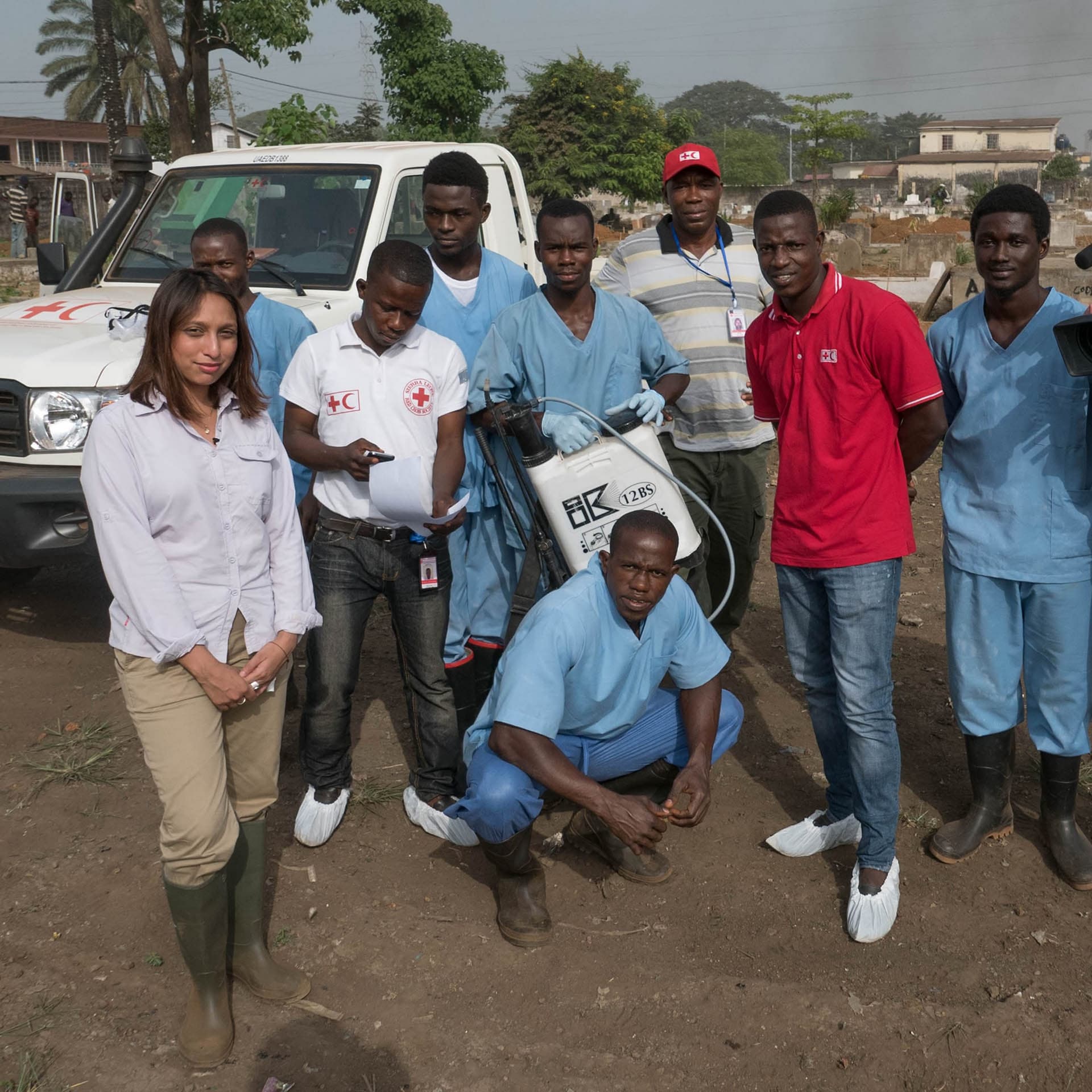
12:30Tulip Mazumdar:Ebola spread not only among the living, but also through the bodies of those it had already killed. Traditional rituals in the region often involved families washing the bodies of loved ones before they were laid to rest. But this final act of love infected huge numbers of people. With schools and colleges closed, students and teachers became the unlikely recruits in the fight against the virus. Pulling on those scary-looking white Ebola suits, they entered the homes of friends and neighbours to collect bodies for safe burial. One of them, who I spent time reporting with, was engineering student Mohamed Kamara.
13:10Very difficult work, but we are trying to do that. We are doing it for the country, so we just have to do it.
13:16Tulip Mazumdar:How long have you been doing this job, Mohamed? Six months. How many bodies do you think you've collected like this? Hundreds of bodies. Over time, seemingly tiny changes to the response made a huge difference. Bodies were placed in white bags instead of black ones, Communities were given more space and time for prayers and rituals as bodies were taken away.
13:43Tulip Mazumdar:In another community on the outskirts of Freetown, local women were given basic training on how to stop Ebola spreading. We explained to her about this virus, then we showed her how to wash arms, how to do the prevention of not getting the virus. This work was crucial because communities were much more likely to listen to healthcare workers they already knew and trusted. Leading these sessions was nurse Joyce Jebambula. She was exhausted when I spoke to her, but determined. Well, it's really painful. It's really painful. At times, I make up my mind, I should not go out to work, but I've been signed for it.
14:30so I'll go.
14:38Tulip Mazumdar:Good morning, Joyce. It's been a long time. Very long time. How is everything? Yeah, why are you? I'm fine, I'm good. Yeah, you sound well done. More than a decade on, Joyce is now in charge of the Hillside Maternal and Children's Health Clinic on the outskirts of Freetown. We are sitting at the under five section, because we are waiting for patients, pregnant women come for vaccine. Some come for check-up and Sinatra clinics. We are having a bright and sunny day here. Yes, I was on the front line at that time. I worked for my conscience to serve my country and humanity. Wow, at that time I felt so bad because I was having no fear.
15:20Everyone was afraid of me. They said if they get contact with me, I will infect them. Since that time to now, the clinic has changed. It has been improved. I've got a lot of nurses and the government supply me a lot of drugs for under five children, especially for malaria.
15:43Tulip Mazumdar:Joyce says her clinic is much better resourced and organised 10 years on, but they still lack some of the basics at times, including protective gear, which she says staff sometimes still have to buy themselves. I could not say I have everything. We need gloves. We need thermometers. We need sanitizers. We have to buy for ourselves at times because they supply us, but it's not enough. So if you don't want to be infected, then you have to buy, you see? Do you think that anything as bad as Ebola, like a similar disease outbreak, Do you think it could ever happen again in Sierra Leone, as bad as it was?
16:26We are praying to God that it will never happen again.
16:31Tulip Mazumdar:Little did Joyce or I know, but as we were speaking at the end of April this year, Ebola was once again quietly killing people. This time 3 ,000 miles away in the DRC, the country then named Zaire, where Ebola was first discovered 50 years ago. This time, it was the lesser-known Bundabugyo strain, with no approved vaccine or treatment. So did healthcare workers have the basics Joyce had just been talking about? Gloves and protective equipment? No, they didn't. No, they didn't. That's Dr. Natalie Roberts from the medical charity Medicine Sans Frontier, one of the first organisations to respond.
17:12For people who haven't been to the DRC, and particularly this part of the DRC, It's an area that's suffered from decades of conflict. People are living in essentially poverty. In Ituri, which is where the outbreak started, those healthcare facilities, they're extremely basic. Most places don't have gloves. Most places don't have running water. Even now, even now. Even now, in the middle of this outbreak. Yeah, even now.
17:34Tulip Mazumdar:At the time of recording, more than 160 healthcare workers have been infected in the DRC. 43 have died. Every loss puts even more strain on an already fragile health system.
18:12You can manage your wealth your way at Schwab. Visit schwab.com to learn more.
18:42million saving billions on hidden fees. Be smart. Get wise. Download the WISE app today. T's and C's apply.
18:53Tulip Mazumdar:This is the documentary from the BBC World Service. Here's Director General of the World Health Organization, Dr Tedros Adhanom Ghebreyesus, speaking at press conferences this summer. The outbreak in DRC is continuing to outpace the response. One thing that's different about this outbreak is the unprecedented speed. It's moving really, really fast. I'm deeply, deeply concerned. Unless we're faster, we cannot catch up. Just three months after the outbreak was declared, it had become the fastest growing Ebola epidemic on record and the second largest ever after West Africa. but fast catching up.
19:36Good morning, good afternoon and good evening. At its current pace, it's on track to eclipse the West African Ebola outbreak of 2014 to 2016.
19:50Tulip Mazumdar:So why has this outbreak escalated so quickly? How has it come to this again in a country that's already had 16 Ebola outbreaks before? Here's Dr Natalie Roberts. What we're up against is decades of conflict, violence, neglect, a distrust in the state, a distrust in international organisations. You can't suddenly equip the DRC with nice, functioning, modern hospitals, with isolation units. You can't suddenly install running water into every home. In the DRC today, people quite rightly sort of say, well, you don't come and help us when armed groups are attacking us, but you only turn up when there's Ebola, and you turn up with these spacesuits and you turn up with these facilities that we're unfamiliar with.
Read the full transcript
20:35Tulip Mazumdar:Listening to Natalie, it's hard not to be struck by how familiar some of this sounds to what I saw in West Africa. But she says there have been many positive changes on the ground which are making a difference. What has changed today is, first of all, this decision to only have individual rooms. you are in a safe environment because if you turn out to not have Ebola you're not going to get infected from somebody else because you're in an individual room. In the old days family members absolutely could not visit inside the treatment centre. Now we allow family members to come into the area to sit next to the window so they can see at least into the room.
21:15They can hopefully talk to the person inside the room.
21:19Tulip Mazumdar:And what difference has that made? A huge difference. A huge difference in trust. People felt these Ebola treatment centres were kind of this black box. You know, people would go in and then they would never see them again. You know, they would just be told later, oh, sorry, they died. So it's really changed that level of trust now that people understand what we're doing, that this is a medical illness and that we are providing medical care. But there have been bigger structural changes too. African institutions are playing a much bigger role, with Africa Centres for Disease Control helping to lead the response in DRC.
21:53Tulip Mazumdar:And the WHO acted much faster this time, declaring a global health emergency within days of the first cases being identified. My name is Chikwe Ihekwazoo. I lead the emergencies programme in the World Health Organisation. There is so much we know about Ebola, and yet here we are. It doesn't feel like we have learned very much. We're back in the same place. Every community is different. The work you need to do to build up community acceptance, trust, confidence is always different. The circumstances are different. Even if we had a vaccine, you still need to access the community and build up that trust.
22:33Tulip Mazumdar:But Dr Chikwe Ehekwazu says that despite this, the world is much better at dealing with outbreaks now. The events of 10 years ago fundamentally changed the World Health Organization, led to the crepement of a new program within the organization focused entirely on health emergencies. It led to the establishment of several new institutions in countries around the world that all lead us to being better prepared, but also in the R &D space, just the innovation around vaccines, new diagnostics. And what have been the tangible benefits that you've seen since then? Every single day around the world, new clusters of infectious diseases are detected, responded to, and no one ever hears about it.
23:22We investigate, we respond, we manage, and it's closed. And so in most of those, they never make the news. And I am confident that Most of the time, we have the capacity to prevent, to detect and respond. Of course, once in a while, there are circumstances that lead to a much bigger outbreak, sometimes a pandemic. We will probably never be fully prepared for whatever comes next. But in terms of where we are today, it's like night and day from where we were 10 years ago.
23:53Tulip Mazumdar:And huge strides in vaccine development are part of that. A vaccine against the Zaire Ebola virus was successfully trialled during the West Africa outbreak and has since been used to help control other outbreaks. CEPI, an international vaccine coalition, now aims to develop vaccines against new threats within just 100 days and several are currently in development for Bundabugyo Ebola too. But one area the world is consistently bad at is coming together to make sure that outbreaks are stopped where they start before they spread further afield. We urgently need the support of the international community.
24:32Tulip Mazumdar:Here, speaking back in July 2026, is Director General of the World Health Organization, Dr Tedros again. He was urging countries to commit cash to end the DRC outbreak. We still face a shortfall of more than$400 million. We urge donors to fill this gap and to help us to control this outbreak as quickly as possible. This is not charity. It's an investment in national security. But with the recent cuts to overseas aid and global health budgets, both Dr. Natalie Roberts from Medicines Sans Frontieres and Dr. Chikwe Ehikwazu from WHO say global health security threats like Ebola will continue to loom large.
25:17I think the world is going maybe backwards in preparedness with the global aid cuts. We're going to see more and more places that have a dysfunctional public health infrastructure because investment in development of the infrastructure of the state services is being cut. So rather than the work being put in place to create a functional health system, instead we're rating almost in crisis response mode. Money will go in once the outbreak starts and by then it's too late. The work we do in between outbreaks is very important, right? You can have all the perfect tools to respond to an outbreak when it happens.
25:55If you're not building trust between a community and the health workforce, it's a fallacy to assume that when there's an outbreak of a pathogen like Ebola that we are interested in because of its potential to spread globally, that suddenly we will have the collaboration of the community. It won't happen.
26:14Tulip Mazumdar:If a new COVID-like virus emerged today, how well do you think the world would be right now to handle it? I think we would be a lot better at finding it. We will be a lot quicker at developing countermeasures like vaccines, diagnostics, therapeutics. Where I'm most worried about is where we need to make collective decisions. How do we collectively agree that if you have a scarce vaccine, for instance, that the best use of that vaccine is not to build a wall around myself, but to deploy that vaccine to where it is needed so you stop the spread at the point where it is needed the most. So yeah, it's a double-sided answer, excited about the progress in the science, deeply, deeply worried about the politics in the world and whether it will truly allow us to come together to find solutions.
27:18After here, I'm going to do my studies. I have classes tomorrow. I have to leave. I have to do some revisions.
27:29Tulip Mazumdar:Back with 2014 Ebola survivor Daniel Touré, who we heard from in Freetown at the start, I caught up with him between classes in neighbouring Guinea, where he's training to become a doctor. Of course, for me personally, the memories are always fresh. It's still difficult losing an entire family, my mother, my brothers, my sisters, my uncle, my aunt. So it left a huge, huge gap. I just have to find a way to cope, to find opportunities so that I can achieve my dream of becoming a doctor, so that I can go back and save lives. And in the end, it's people like Daniel, well-trained, properly supported, and working in stronger local health systems who give us, the rest of the world, the best chance of stopping the next deadly outbreak where it starts.
28:29Yes, Tulip, I've been hopeful, as always. That was the reason why I'm here today. I'm here not only for myself, but for my country, for my people, for my family, to help to improve the health system, make it to become one of the best health systems.
28:50Tulip Mazumdar:you've been listening to the documentary from the bbc world service this documentary was produced by me tulip mazamdar and caris wall it was a bespoken media production
From the publisher
Ten years on from the Ebola outbreak which tore through West Africa, journalist Tulip Mazumdar reconnects with survivors, healthcare workers and volunteers she met when reporting extensively from the frontline. The 2014-2016 Ebola outbreak killed over 11,000. The epidemic exposed how unprepared the world was for fast-moving outbreaks - and how quickly they could spiral out of control. Ordinary people took action and managed to contain the virus. In 2026, Ebola is back in the headlines as the Bundibugyo strain spreads in the DRC. What have we learnt about science communication, pandemic preparedness and grief in the last decade, that can help us today?