Ask ChatGPT
 The Foundr Podcast with Nathan Chan
12 Nov 2026 · 42m · 14 chapters
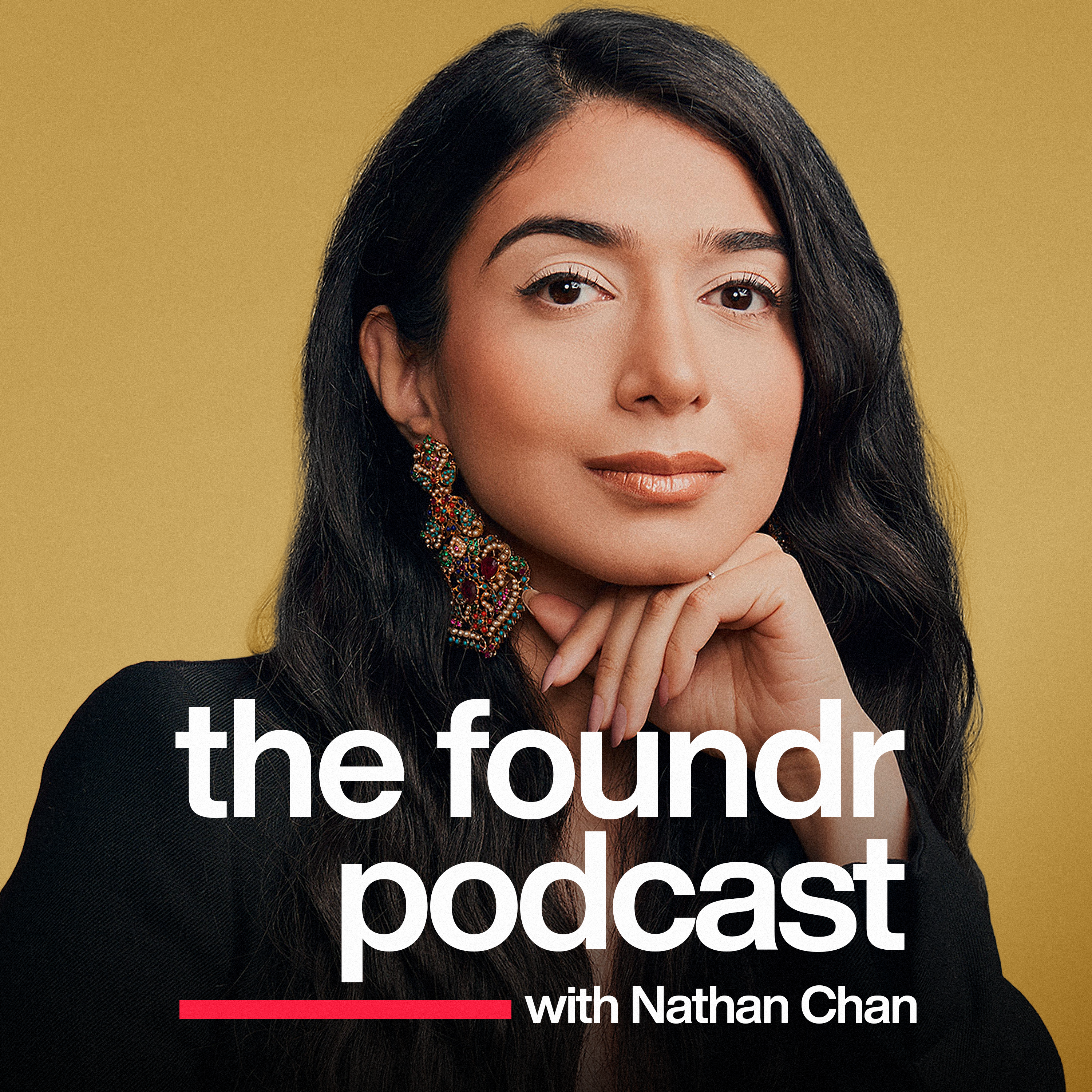
How Shiza Shahid and her husband built Our Place from a single multifunctional “Always Pan” into a $100M+ DTC cookware brand by redesigning the category, avoiding PFAS “forever chemicals,” and using product-led virality plus IP protection.
Shiza Shahid co-founded the Malala Fund (global girls’ education nonprofit). She and her husband bootstrapped Our Place, designing products from scratch with industrial designers, engineers, and factories.
They rejected by ~100 investors; launched in 2019 quietly, then went viral as customers shared photos. They prioritize first-order profitability (not CAC/LTV fantasies) and claim 30–40%+ repeat purchase rates vs 3–4% industry norms. They built 200–250+ patents; biggest defense is staying ahead by innovating.
Always Pan replacing multiple pieces; ceramic/sol-gel nonstick vs PFAS; later titanium cookware (no coating); culture-based collections (e.g., Lunar New Year wok, Persian New Year platter, Diwali set). Celebrity/brand mentions include David Beckham, Oprah, Selena Gomez, Gwyneth Paltrow, and Cameron Diaz.
Written by AI. May contain mistakes.
Discussion about the challenges and initial success in launching a new cookware brand.
“If you ask enough questions, you'll probably figure it out.”
Exploration of the founder's vision and the cultural significance of cooking.
“Hear the stories, learn the proven methods, and accelerate your growth and future through entrepreneurship.”
Details on the product development process and the journey from idea to prototype.
“I wanted to know that the materials I was cooking on were clean and non-toxic without forever chemicals.”
Insights on customer interactions and feedback before launching the product.
“One thing I've learned in my career is nothing is rocket science.”
A recount of the product launch and the viral marketing that followed.
“Cooking is something that everyone does.”
Discover how the company moved away from harmful PFAS chemicals to safer alternatives.
“Really didn't sacrifice the non-stick performance people expect.”
Understand the challenges of protecting intellectual property in a competitive market.
“I conceptualized a time-marked water bottle.”
Learn how the brand attracted investors by demonstrating solid growth and a strong mission.
“And so, yeah, I think that is the takeaway for people.”
Explore the key metrics and financial discipline that helped secure investor confidence.
“And I want to touch on this one because I think this is a common thing that founders come across in the e-com space where they do have product market fit.”
Learn how focusing on first-order profitability and customer retention helped a cookware brand succeed.
“And so while other businesses were out there pitching CAC to LTV promises, we were operating on the hard fats and the truth, which was we have to be first order profitable.”
Discover how storytelling around food culture outperformed traditional marketing tactics.
“And from a high repeat purchase rate, are we talking 30, 40 percent?”
Understand the role of organic celebrity endorsements in driving brand popularity and sales.
“One of the insights that we had early on was food is culture, food is connection.”
Explore how product market fit can determine long-term success and brand recognition.
“And can a brand do anything to earn this rather than just get lucky?”
Learn how to integrate social impact into a business model while maintaining profitability.
“And what advice would you give to founders that are in a space where perhaps their business is a multi-million dollar business, but they're relying more heavily on the marketing than the product to do the heavy lifting?”

Get the gist, explore an idea or ask about something said.
 Claude
On The Foundr Podcast with Nathan Chan, what are the key points of this episode?
Searching your listeningAutomatic transcript. May contain errors.
0:00Hey founder fam, before we jump in, I want to take a quick moment to talk about our sponsor OmniSend, the email marketing and SMS platform built specifically for e-commerce founders. We've been recommending OmniSend to founder students and members of our platform for a while now because it just works. So whether you're launching your first store or you're scaling it to seven figures, it really helps you automate your marketing and get results. And did you know, on average, OmniSend customers make$79 for every$1 they spend, which is an insanely good return on investment. And if you're already on another platform, here's the thing.
0:35In just five days, you could actually be paying 35 % less without doing an absolute thing. OmniSend will move every flow across, list, and template. You just show up when it's done. And finally, because you're part of the founder community, you get 50 % off your first three months with the code FOUNDER50. Just head to OmniSend.com forward slash founder and that's founder without the E to get started. All right, now let's jump in the show.
1:03We got rejected by probably 100 investors. We did 50 million our first year. 50 million. Wow. Nothing is rocket science. If you ask enough questions, you'll probably figure it out. Anyone can grow unprofitably and anyone can be profitable without growing. You just sell one pound for$2 ,000. Guess what? You'll make a profit, you know? Profitable growth, that is the entire game. No room for 16 pieces of cookware. She's a Shahid and her husband bet their savings on one, our place. And it began with one question. What if we took these 16 pieces of cookware and literally where they intersect created this new shape and form factor.
1:41People started to get the product in their hands and experience it and share it on the internet and say, wait a second, this is actually really easy to use. This is really beautiful. And that's really when it started to go viral. It was not an overnight success. We launched and it was very quiet.
1:58They couldn't be with their grandmother, but they could call up their grandmother, Nani, did I make it the right way? Or, I miss you, it doesn't taste as good as yours. I am an immigrant and I cooked to reconnect, to find a sense of place in a new country, to my body, my community, my traditions. Did we know that it was going to go viral and sell out 30 times and, you know, be used in the kitchens of David Beckham? We have a lot of knockoffs. We have a lot of patents. How much have they actually protected you guys against imitators? The biggest defense against dupes is... Hear the stories, learn the proven methods, and accelerate your growth and future through entrepreneurship.
2:41Welcome to the Founder Podcast with Nathan Chan.
2:47Hey, I have a quick ask. If you're loving these episodes, leaving a quick review is honestly the best way to support us. It helps the show grow and means we can keep bringing you the founder stories and insights you tune in for. Please share it with a friend. Thank you so much. Now let's get into it. So Shiza, thank you so much for taking the time. Super excited to speak with you. You went from co-founding the Malala Fund, which is a global girls education, non-for-profit, to launching a direct-to-consumer cookware brand really built around a single pan to begin with. What made you believe that one multifunctional product could disrupt a legacy industry built on selling 16-piece sets?
3:29I was trying to make a brand that represented what food and cooking was for me, which was I am an immigrant and I cooked to reconnect, to reconnect to my body, my community, my traditions, to find a sense of place in a new country. And as I looked around, I didn't see a brand that was really speaking to culture, to connection, to the why behind cooking. The cooking is something that most of us do every single day. We think of our most important memories. They're often around the table, our grandmother, our mother, our father making that recipe that always transports us right back home. And there wasn't a cookware brand, a kitchenware brand that was focused on designing for the modern kitchen.
4:17I remember walking into a kitchenware store and being given 16 pieces of cookware and wondering where I would store all of them. And so the idea was to design products that would fit in my own home. I was living in a studio apartment in New York City. I didn't have room for 16 pieces. I wanted to know that the materials I was cooking on were clean and non-toxic without forever chemicals. And I wanted beautiful design because when you have a beautiful always can or wonder oven out on your countertop versus hidden in the back of your cabinet, you're more likely to cook. You're more likely to host.
4:53So talk me through. So it's 2019, you and your co-founders, like how did you guys meet? How did you guys like build like and launch it? My husband and I are co-founders and it was probably around 2017, two years before we launched, that we started talking about our own experience, building a family, building a community, and what we felt was missing in our own home. And we, you know, sat down at the kitchen table when it was my husband's idea first to say, what if we took these 16 pieces of cookware and literally where they intersect, created this new shape and form factor. And the next two years were designing, designing products from scratch, sketching, prototyping, visiting factories.
5:41We bootstrapped our own savings to get it off the ground. We got rejected by probably a hundred investors. So that made us have to have the discipline to work harder and prove ourselves and get traction. And it was 2019 that we launched. It was not an overnight success. We launched and it was very quiet, but then people started to get the product in their hands and experience it and share it on the internet and say, wait a second, this is actually really easy to use. This is really beautiful. This is a brand that makes me feel seen when I go and check out their imagery or read their stories. And that's really when it started to go viral.
6:20So yeah, I'd love to talk about those couple of years designing the product, visiting factories, being rejected by over a hundred plus investors, How did you work out how to even design a product in the cookware space? A lot of asking questions. One thing I've learned in my career is nothing is rocket science. If you ask enough questions, you'll probably figure it out. My husband had done some product design work in the past. And we had the vision. And then we found people with the skills that we needed, industrial designers and engineers. and production partners. And it was really just getting down and trying to figure out the fundamental details.
7:09Product design is a huge part of what we do at our place. And it's constantly just, even today, figuring it out. We have an amazing team today. But it's always just sitting down and looking at every single angle and making trade-offs. Because when you're designing beautiful products that also need to be functional and high performance, things that look like a work of art but you could also light them in on fire and throw them in the dishwasher and scrub them with metal it's this constant negotiation of every single detail talk me through it took you two years to kind of get your first prototype how many how many rounds of prototyping did you do before you kind of you guys were like yep i think this is the one Oh, my goodness.
7:54Maybe 30. You know, iteration after iteration. Even today, it takes us two years to design a single product, sometimes more, sometimes several years. Because in the industry, what is standard is to go to a factory and say, you know what, I really like this blast. Can you make it for me? Most brands white label. So to actually design from scratch was a radical concept. And what that meant was you were starting from scratch and everything had to be custom made. And so you guys broke mold 30 different times. Not every prototype went into a mold. Sometimes we 3D printed and were able to sort of create an MVP using other methods because, you know, depending on the product itself, a mold can be extremely expensive.
8:41And so in this category, prototyping means figuring out, you know, can you do a handmade sample without creating mold? Can you use a 3D printer to create a plastic mold and then really try and figure out the forming function? And so finding ways to get really scrappy to test and iterate before we have to open those final molds. Can you share with our community, like how much did it cost? Because you said you bootstrapped the business. How much do you think it cost over that two year period prototyping, finding, you know, great contractors or designers to help you really bring your vision to life?
9:17probably over 100 probably in that ballpark yeah between 100 to 200 initially um to get it to a place where we were then able to have proof of concept and go out there and say this is not just a a dream on a piece of paper it's it's a real product it's a real brand it's a real business and then to be able to raise enough capital to um to scale yeah so by the time uh you guys got to a place after two years where you knew that the product was ready. How many customers did you speak to? How many people did you sample the product in front of? I'm curious there. We probably spoke to 150 people, friends, family.
10:07Cooking is something that everyone does. And so it was a natural conversation point to go into any coffee chat or catch up with friends and say, hey, here's something I'm working on. What do you think? What are the pain points you experience? Even before we had product in hand, because again, before you manufacture at scale, having handmade samples can be quite expensive. Just literally pulling up the sketches on your phone and hearing people's experiences and what they felt was missing in their homes and their kitchens. Talk me through, like take me back. It was 2019. You know, you've been speaking to customers, you feel like you're onto something, you're getting good feedback for the product.
10:46You've gone through 30 plus different iterations. Two years, a long time. You must've been itching to get it out. Like talk me through, take me back. Well, when we launched, there wasn't a wait list. It was quiet because we've been so obsessed with the product, but we hadn't invested enough in teeing up the actual marketing and awareness. And so we launched, you know, we had a couple of sales. We were excited, but nervous. And it was really over the next couple of months that we started getting product into customers' hands. These were people who were buying the products. And we were also gifting the product to tastemakers, to chefs, to home cooks, to moms, to dads, to get their feedback.
11:33And as people tried the product, they organically began sharing it on the internet. This was the first time that cookware was beautiful enough that you weren't just cooking with it and then sharing the finished plated meal in a plate. You were actually sharing a photo of your pan. You weren't hiding your pan in the back of your cabinet. You were leaving it out on your stove and it was becoming the centerpiece. And it was this very iconic silhouette, which is now sort of represented across our portfolio of products, the cookware, appliances, and you can look at everything and say, oh, that's the Our Place design approach and it elevates any home, but it's recognizable, like the Pepsi bottle.
12:14And so people were sharing it on the internet and everyone was starting to see it pop up on their feeds. And, oh, everyone I follow that I admire has this in their home. What is this? And that coincided with the COVID-19 pandemic and people being in their homes, unable to leave, and reaching for a sense of comfort for a lot of people that was cooking. They couldn't be with their grandmother, but they could call up their grandmother and get her famous biryani recipe and make it at home and send a photo of it to her and say, you know, Nani, did I make it the right way? Or I miss you. It doesn't taste as good as yours.
12:51And so it was that cultural moment of people realizing they wanted to cook, they needed to cook and having this product that was so different from what had ever existed before. And I think that's the thing that I often take away from interviewing founders that have built massive D2C brands is from a product perspective, you took the time and you created something that was truly differentiated in the marketplace. So I'm curious, so the Always Pan, it was designed to basically replace eight separate pieces of cookware. And then you also made sure that you didn't sacrifice, you know, the non-stick performance, people that expect you removed all the, you know, the toxic chemicals, all that good stuff.
13:41I'm curious from an engineering perspective, how did you, you know, what was the hardest part when it comes to engineering a pan that... Real quick, before we jump in, I want to shout out one of our sponsors, Xero. I've used Xero from day one of Founder, 13 years now, and it's still how we run the business today. It's cloud accounting software built for founders exactly like us, and it automates all the admin that I used to do when I first started Founder. Invoicing, chasing payments, expenses, all the accounting. It really helps me get paid faster and keep an eye on cash flow. So Founder listeners, get a crazy 95 % off for the first six months.
14:26Just sign up through our form at founder.com forward slash zero. Terms and conditions apply. Remember, when you support our sponsors, you are supporting the show. All right, now let's jump back in.
14:40Really didn't sacrifice the non-stick performance people expect. Yes. The engineering of the products is everything. And now we have cookware, we have appliances, which are even more complex. The portfolio is so much bigger than just the one pan. But it all started with the vision that was embodied with a Met First product. And it was really working specifically on the nonstick. It's about working. It was working with chemists on the fundamental chemistry. So in the 1950s and the 1960s, Teflon was invented. And it was the sort of original nonstick coating. And the basis of that coating was what are known as PFAS, the most well-known of which is Teflon, PTFE.
15:28And the early iterations of that chemical were found to have a significant amount of harm on the health, on the environment, on communities, on workers. And it took a very long time for corporations to admit that this chemistry was problematic and to finally pull it from the shelves and then to start to make amends to victims. And there's so much cleanup there that's still pending. Most companies then moved to another kind of PFAS.
16:08and that PFAS is now the basic basis of most nonstick coatings. When we started our place, it was really important to us not to use PFAS chemicals. And we're not in the business of fear mongering. We let people decide what they'd like to bring into their own homes. But we do know, and this is hard to debate, that the production of these chemicals causes harm in the environment. And so we didn't want to be a part of that. And so we chose instead to work with a different chemistry called Solgel or more colloquially ceramic coating. And it essentially uses, instead of PFAS silica, to create what feels like a glass-like coating.
16:52That's why it's colloquially called ceramic, instead of using forever chemicals. And so it doesn't have the same impact that PFAS chemicals have. And a lot of the work that we've done over the last seven years has actually been introduced being alternatives to nonstick. So our best-selling product today is now a titanium cookware collection, which uses no coating at all. And it's interesting because we started out building this brand that's rooted in culture and connection and gathering. And it's now become very much an exercise in innovation. and most of what we're doing is innovating on product design, on engineering, on chemistry, because ultimately if we want to get more people cooking, we have to make it easier and more fun.
17:34Yeah. And that is effectively becoming your moat. So one thing I have to talk to you about, which is very interesting, is you guys invested early and heavily in IP and protecting your IP. So you guys have over 200 patents across the product line. So why did you prioritize patents so early? And how much have they actually protected you guys against imitators? You know, China, products get copied all day, every day. I have a product, you know, it got copied. There was nothing I could do. I conceptualized a time-marked water bottle. Now they're everywhere, right? but I was one of the first to have a water bottle that reminded people when to drink.
18:22Multi-million dollar business but eventually got copied everywhere. So I'd love to hear your take there. Yeah, it's really tough because dupe culture is everywhere and unfortunately it's now even a little bit glamorized. It's sort of become acceptable or even cool to say, oh, look, I got the dupe and I get that when it's a large company. I can understand someone wanting to go out and get the dupe and not pay a huge markup. But when it's a small brand, when it's, you know, a original idea that took years to make and develop, you know, I talked about how we bootstrapped and used our savings. Then I do think dupe poultry can be incredibly harmful.
19:04And so we have a lot of knockoffs. We have a lot of patents. We have over 250 billion of patents, as you referenced. And that does offer some protection because if someone identically copies what we're doing, we have some recourse. That being said, large corporations are masterful and they have teams of lawyers who teach them, hey, if you just change this a little bit, you can skirt. You can skirt this. and you know we're not gonna um we're not gonna take on um oldie right we're not we don't have the or we don't have vm the cash to to fight multi-billion dollar companies even if we're in the right so um the biggest defense against dupes is to stay ahead and to keep innovating and that's that's what we do when we launch our product now we're like all right guys we got a year and a half two years before, you know, all the big players have copied us.
20:00So what are we going to do next? And what are we going to do next? And that's where we're constantly innovating and we're constantly coming out with things that are better. And that's something they can't do. They can't come up with original ideas. And fundamentally, also, I do believe there are consumers who understand that even if another brand has knocked off your product, the quality and the trust they have with you. Yeah, there's other companies that are now making dupes of the always pant. They also use PFAS in their supply chain. So consumers might say, you know what, I want to go with a brand that's been PFAS-brew from day one.
20:32Or I believe even though there's a dupe of this, the quality is better. And so it's on us really, I think, rather than getting angry and thinking it's unfair, to just be better and keep better so that the others are just chasing us. So you still think it is worth protecting your IP even openly knowing that these masterful teams do find their ways around it? I do. And I think the other thing that's made our IP defensible is our products are hard to make. And so there are now other direct-to-consumer brands and they produce generic products. And when we go to trade shows, we see a handful of dupes of our products and we see dupes of their products everywhere because their original product was never original, right?
21:16That's kind of what the industry does at white labels. And so they take something and they popularize it, but they never came with it. And it was never that original in the first book. And so the fact that our product was actually unique and our products are actually unique and designed from scratch, which means, you know, that they're harder to make, but also does, it just slows them down. And I do think that's worth it. Yeah, I agree. And they can't copy brand. They can't copy your marketing. Well, they can, but it's yours ahead. And so, yeah, I think that is the takeaway for people. And they can't copy the community that you're building and the trust and the relationships.
21:59So, no, I appreciate your open and honest candor. So, got proof of concept, product went viral, crazy time to launch just during COVID. Everyone's at home. Everyone's cooking. Everyone's buying. so you eventually raised venture funding. You eventually raised venture funding. So your earliest raise brought in backers like Will Smith from his Dreamers VC, FabFit Funds, Venture Arm. And I'm curious, how did you get investors to really believe in a mission-led cookware brand And what did you refuse to compromise on to keep control of the vision? We were lucky to find a couple of folks who believed in us enough to get early traction.
22:53So that first raise was small, but it allowed us to open moles and order inventory product. Businesses require inventory and inventory requires capital. And so we did sort of meet the bare minimum just to get started before we ever paid ourselves, before we ever hired, we needed to be able to fund in Borey. And we got there. And once we had that and Prada got into Book's hands, we started to then have the numbers that were really quite unexpected. Investors were looking at our growth rates. We were profitable from year one. And they were understanding that a business in this category could really disrupt.
23:41We were used to brands coming out in fashion and beauty, CPG, but kitchenware wasn't really a category that anyone was looking at. And we proved that people did care what they cook their children's meals are, what they had in the center of their dinner table over Christmas. They did care and they did want a brand that made them feel something. and they did want products that were designed for the modern kitchen and were safe and healthy. And so it was really based on that actual success, the revenues, the financial performance of the business that we were then able to raise capital to scale. You know, there are stories of founders in Silicon Valley who walk in with a, you know, one page deck and raise millions on an idea.
24:32That was not us. We had to prove it. We had to prove that the investors were wrong when they believed that we couldn't succeed in this category. And we had to prove that with our performance. Once we had that performance, once we had those numbers, then we were able to get growth capital. And I think being here in Los Angeles, we accepted investors who care about storytelling, and Careback community. And so we did end up working with Jay-Z's fund, Jay Brown, Marcy Ventures, and, you know, lots of other great celebrity investors like Gwyneth Palsh were passionate about health and wellness. And I think that also came from just being in this ecosystem where they were buying the product and trying it in their own homes and believing in it personally.
25:20Yeah. So if you run a brand, you're probably feeling this problem right now. You're relying heavily on Meta and Google to acquire new customers and finding another channel that you can scale profitably is not easy. So that's why I'm super excited to tell you about today's sponsor, Applovin. Now, there's a founder in our community who took the ads already working for them on Meta. They reformatted them for Applovin and within their first 30 days, they'd already scaled to more than$100 ,000 a month in ad spend or seeing really strong returns. Now, I asked them if I could shout them out and share the results, but they said no because they didn't want their competitors finding out about this platform, all the results that they were getting, which is wild, right?
26:04So if you want to diversify your spend beyond Meta and Google, I highly recommend testing out Applovin. Now, founder listeners can get up to$10 ,000 in matched ad credits plus$1 ,000 free in ad credits to test when you sign up through our link. So go to applovin.com forward slash founder.
26:26Thank you for sharing. And I want to touch on this one because I think this is a common thing that founders come across in the e-com space where they do have product market fit. They are generating consistent revenue and sales. They want to scale, but they're caught in this cash flow crunch of stock inventory. and you talked about metrics like that really proved out you had the numbers to really justify the investment appetite to investors. Can you just give a, can you maybe, is it possible to share more detail of what those numbers looked like from a top line revenue, like anything at all, like a CAC to LTV, like anything that you kind of were like, yeah, this is when we knew, this is when investors are like, wow, this is something?
27:22Yeah, I would say early on we weren't even pitching on Cat to LTV because we emerged from this era of businesses, econ businesses that weren't profitable and they were selling the Cat to LTV dream, which was, we know that we're not profitable in the first order purchase, but we will be because this customer will return and they will spend more. But when you just launched a business, you don't know what your LTV is. You're making it up. You need to actually have been around long enough for customers to return. You need to have enough of the catalog to be able to return and have something to purchase.
27:59And we weren't going to have that on day one. And so while other businesses were out there pitching CAC to LTV promises, we were operating on the hard fats and the truth, which was we have to be first order profitable. We're not going to fall into this trap of saying we're going to overspend and lose money on acquiring a customer and then we'll make it up later because, you know, we're immigrants. So we did none of this came easy and we're going to have financial discipline. And so that was really, really important to how we built the business. And it was looking at that profitability, looking at our growth rates, where we were sort of crushing expectations in year one that really gave investors the confidence.
28:45Also, as we started to come out with new products, new colors, we had incredibly high repeat purchase rates for our category. You know, we're making things out of metal, so it would be reasonable if someone would buy something one time and not return, but people were coming back to buy another color, to gift, to collect. And as we started to expand the product catalog, And we were really designing products as ecosystems. So you could buy your always pan and then buy your steamers or your egg poachers, your flipping platter. People were coming back for that ecosystem. And so that first order profitability and that high repeat purchase rate really drove that investor interest.
29:24Yep. Okay, great. And from a high repeat purchase rate, are we talking 30, 40 percent? Exactly. Yeah, 30, 40 percent plus. Exactly. You know, if you're buying lip gloss, of course, you're going to come back for a second. But when it's hard goods, that's really where the challenge comes in is having that high repeat purchase rate. And the industry, it's often three or four percent. So we were 10x. And then when it comes to traction and growth, can you talk or give an indication percentage of growth in first year revenue from zero to X? Well, you know, we were going from zero to X, so the percentage correct would be pretty wild.
30:02But, you know, we did 50 million our first year. 50 million. Wow. Okay. That is wild. And you guys didn't really, like from our research, from a paid performance marketing perspective, you guys didn't lean hard on paid performance, right? You built really the brand around, like you said, storytelling, having food justice leaders, multi-ethnic culinary traditions, and really the way people actually cook at home. So can you talk us through the authentic storytelling, how it outperformed the paid ads playbook for you and what lessons you could share with founders there? Yeah. One of the insights that we had early on was food is culture, food is connection.
30:56and everyone else was all about the performance. And to us, the performance was table stakes. You have to make good products that perform. But why do people choose to buy from you? And everyone else was having these highly complicated competitions on television with chefs making the most complicated dish they possibly could against a clock while someone else screamed at them. And, you know, these elaborate tablescapes. And Peres, it was just about everyone's a chef. Everyone can cook. Just make something with your hands, share it with someone you love. You know, we've got to stop feeling like we can't cook.
31:32We've got to stop ordering takeout because we're overwhelmed. We have to feel empowered and joyful and connected in the kitchen. And that's really what it was about. One of the things that was really surprising was we created collections around culture. So we would work with a Chinese-American chef. We would create a wok for Lunar New Year. We would work with a Persian artist and create a beautiful platter for the Persian New Year. We would work with an Indian nutritionist and content creator and create a gorgeous tableware set for Diwali. And people were seeing these stories come out. And for people within the community, they were saying, wow, I've never seen my culture celebrated and represented by a mainstream kitchenware brand.
32:31And for people who weren't part of the culture, they wanted to participate and understand their neighbors' traditions because we live in these multi-ethnic communities and food is global, right? I had ramen yesterday for dinner and tonight I'm going to have some dim sum for lunch. And so this is how we eat. We connect with different cultures through food. And while other brands just wanted to be as appeal to everyone as possible, we were unafraid to just speak to one community at a time to make them feel sane. Yeah, I think that's really clever and really cool. so one thing that also helped with your guys rapid growth was the always pan took off and got a lot of organic celebrity endorsement oprah selena gomez a lot of other major cultural figures started using your products posting about it organically what can founders learn from this And how did that organically happen, right?
33:41And can a brand do anything to earn this rather than just get lucky? I think product market fit is exactly right. We were lucky to have product market fit from day one. We launched with the Always Pan. We still sell the Always Pan. It's still one of our best sellers. We've since massively expanded the catalog, but it's all rooted in the product truth that we arrived at with that first launch, which is people want products that are multifunctional, non-toxic, beautiful, and designing a bad intersection. For us, I think being based in Los Angeles perhaps had an impact because this is our hometown.
34:25We have now a retail store in Dennis Beach, and we host events. We're part of the community. When good things happen, we celebrate and host celebrations. When bad things happen, like the fires in Los Angeles, we show up and we give back and we help with the rebuilding. And so I think being a part of the community and the fabric of the community that you want to reach is really important. And then creating products that are solving a need that people have. Celebrities are just people. They're people who care about their bodies. They're people who care about their health. um there are often people who care about design and and having a beautiful home um and so we were delivering that we're delivering a non-toxic product for people who were already cooking healthy but we're now thinking wait i just went to the farmer's market to get organic kale but am i cooking a flan right and so so that became something where people were just switching out their products and then if you have a beautiful home and then you have you know scratched up frying pans, you look at that and you say, wait a second, why am I investing in all these beautiful things?
35:35But the thing that I use to serve my daughter breakfast every morning is like an afterthought, right? And so just solving that genuine need, because celebrities are people, and when you solve a product need for yourself, you'll probably reach them too. I'd love to touch just a little more on product market fit, because I've interviewed so many successful founders and I can't double down on this enough they always always when they're you know five six years down the track and they've built a nine-figure brand like you guys they always have spent like at least a year or two on product and I think you know you said that you spoke to 150 people family friends you said you went through 30 different iterations of the product did you know before you launched that you you you had product like you you you had a high level of confidence that you you you had product market fit before you launched we knew that we felt proud of the product we were putting out into the world we knew we wanted it in our own homes for our own families did we know that it was going to go viral and sell out 30 times and you know be used in the kitchens of oprah and guinette paltrow and cameron diaz david beckham No, that was a nice surprise.
36:56And what advice would you give to founders that are in a space where perhaps their business is a multi-million dollar business, but they're relying more heavily on the marketing than the product to do the heavy lifting? Do they need to go back to their next iteration of their hero product? What would you say? Yeah, that's probably a taking time bomb. I think there is, you know, if you're an incredible marketer or an incredible growth hacker, you can get some of the way there, less so than in the past. And 20 years ago, you know, the idea of selling on the Internet was radical. That's not the case anymore.
37:39But if you're particularly good at it, you can get to a certain place. And if that's your goal, then keep going. But you really want to build an enduring brand that lasts. You have to have distinctive products and you have to do it over and over again because one product is not going to carry your business. We reinvented the frying pan and then we reinvented the pot. And then we realized lots of people were using air fryers, us included. And they were plastic and they were ugly and they were bulky and they were also using Teflon and they own one thing. So we reinvented the air fryer. We just launched a rice cooker and a wok.
38:16And, you know, we are very deliberate about what products we make. We don't make it just because it's in the kitchen. We've never made a fork or a spoon because turns out forks and spoons are pretty great. We don't need to make them from scratch. But air fryers, they could use some work. And so when we know we can radically transform a category, we do it. And so you don't just have to do it once. You have to keep doing it over and over again. And otherwise, you can only get so far with great marketing. Yeah, I agree. All right, last question. This has been an incredible interview. Thank you so much for just being so open and honest, Shiza.
38:52You said you want our place to be an enduring 50-year plus consumer-based brand, not a quick flip while staying on its mission. How do you balance profitability and growth against that mission as you scale? and what's the next big bet here with our place? Well, the mission is not something we add on. It's not, hey, we make a bunch of money and then we donate something. It is part of the business. It's embedded into this model. And that to us means we're going to be a brand rooted in culture and connection. We are going to design products made without forever chemicals. We're going to create packaging that is fully recyclable, biodegradable, and designed to minimize waste.
39:38And so when we do all of that work up front, then it scales. And as the business scales, that impact scales. When you do it the other way around, where it's slapped on, then every year it's a negotiation. Can we still afford to give this donation this year? Do we have the margins? But when it's built into your fundamental business model, it scales as the business grows. And that's how we've tried to build our place. to us profitability and growth are not are not in conflict anyone can grow unprofitably and anyone can be profitable without growing you just sell one pound for two thousand dollars guess what you'll make a profit you know um or you spend a bunch of money on growth unprofitably you'll grow so it is it is profitable growth that is the entire game um it's not one or the other and that's how we built our business and i think founders have had it easier than us they got a little bit spoiled because they could grow unprofitably.
40:35And eventually, eventually the cards came falling down. For us, the struggles, the early on difficulties, they forced us to be more disciplined and build a better business. Shiza, thank you so much for taking the time. Congratulations on all of your success thus far with our place. You're welcome back on the show anytime. Thanks so much. This was great. Hey, FounderFam, thank you so much for tuning in today. And if you enjoyed this episode, please take the time to leave us a review and let us know what you think. This podcast is 100 % free. We work so hard to go out and find the most successful founders and entrepreneurs all around the globe.
41:14So your feedback helps us grow, improve, and even bring on more incredible guests and insights. So if you have a second, please take a moment and leave us a review. It really means a lot to me and the founder team. and make so much of a difference. Thank you again for listening and I'll catch you on the next episode.
Shiza Shahid went from co-founding the Malala Fund - a global girls' education nonprofit - to launching a direct-to-consumer cookware brand built around a single pan. The idea was radical: take the 16 pieces of cookware a legacy brand would sell you, find where they intersect, and design one beautiful, nontoxic product that does it all. She and her husband spent two years designing from scratch, went through 30 iterations, bootstrapped $100-200K of their own savings, and got rejected by around 100 investors. When Our Place finally launched the Always Pan in 2019, it was quiet - until it went viral, sold out more than 30 times, and landed in the kitchens of Oprah, Gwyneth Paltrow, Selena Gomez and David Beckham. The company did $50 million in revenue in its first year.
In this interview, Shiza breaks down why obsessing over product beats leaning on marketing, the first-order profitability discipline that won investors over after 100 rejections, and how culture-led storytelling outperformed the paid-ads playbook.
What you'll learn in this interview:
• Why she bet one multifunctional pan could disrupt an industry built on selling 16-piece sets
• The two-year, 30-iteration design process - and why they designed from scratch instead of white-labelling
• How they bootstrapped on $100-200K and turned 100 investor rejections into financial discipline
• Why the Always Pan went viral: the first cookware beautiful enough to leave on the stove, not hide in a cupboard
• How first-order profitability - not cash-to-LTV promises - became their whole investor pitch
• The 30-40% repeat purchase rate in a category where 3-4% is normal - and the product ecosystem behind it
• Why authentic, culture-led storytelling beat the paid performance playbook everyone else was running
• How designing collections around Lunar New Year, Diwali and Persian New Year made communities feel seen
• Why relying on marketing over product is "a ticking time bomb" - and the case for reinventing your hero product again and again
• Why mission built into the business model scales with growth, instead of being an annual line-item debate
If you're building a DTC or physical-product brand, trying to achieve genuine product-market fit, or wrestling with whether product or marketing should carry your growth, this conversation will fundamentally change how you think about differentiation, discipline, and building a brand that lasts.
SAVE 50% ON OMNISEND FOR 3 MONTHS
Get 50% off your first 3 months of email and SMS marketing with Omnisend using the code FOUNDR50.
Start here → https://your.omnisend.com/foundr
SAVE 95% ON XERO FOR 6 MONTHS
Simplify your business finances with 95% off Xero for your first 6
months. Start here → https://foundr.com/xero
GET UP TO $10K IN MATCHED AD CREDITS ON APPLOVIN Scale your DTC brand beyond Meta and Google with up to $10,000 in matched ad credits, plus $1,000 free to test AppLovin. Start here → https://applovin.com/foundr
WANT TO GROW YOUR BRAND WITH META ADS?
Join the Foundr Operators Waitlist → https://foundr.com/operators
HOW WE CAN HELP YOU SCALE YOUR BUSINESS FASTER
Learn directly from 7, 8 & 9-figure founders inside Foundr+
Start your $1 trial → https://www.foundr.com/startdollartrial
PREFER A CUSTOM ROADMAP AND 1-ON-1 COACHING?
→ Starting from scratch? Apply here →
https://foundr.com/pages/coaching-start-application
→ Already have a store? Apply here →
https://foundr.com/pages/coaching-growth-application
CONNECT WITH NATHAN CHAN
Instagram → https://www.instagram.com/nathanchan
LinkedIn → https://www.linkedin.com/in/nathanhchan/
CONNECT WITH SHIZA SHADID
Instagram → https://www.instagram.com/shiza/
LinkedIn → https://www.linkedin.com/in/shizashahid
FOLLOW FOUNDR FOR MORE BUSINESS GROWTH STRATEGIES
YouTube → https://bit.ly/2uyvzdt
Website → https://www.foundr.com
Instagram → https://www.instagram.com/foundr/
Facebook → https://www.facebook.com/foundr
Twitter → https://www.twitter.com/foundr
LinkedIn → https://www.linkedin.com/company/foundr/
Podcast → https://www.foundr.com/podcast