
In short
After a Gaza ceasefire, the episode follows Palestinian freelance journalist Ghada (Rada) Elkord through diary-style messages about daily life, reporting under blockade, displacement, and the ceasefire’s breakdown.
Guest backgrounds
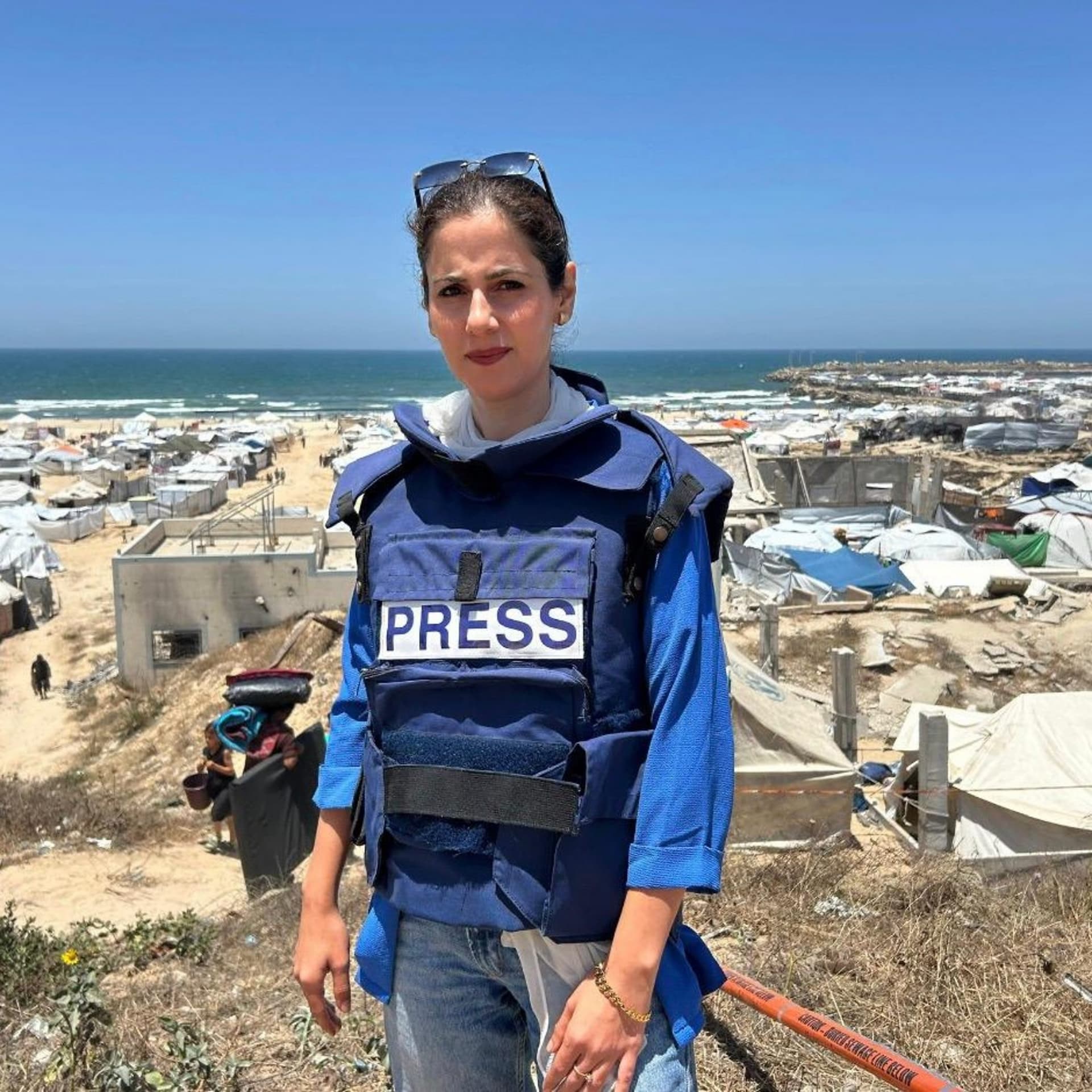
Ghada Elkord is a Gaza City-based freelance journalist who has reported for the BBC and other outlets for about a decade. She studied a master’s in Istanbul (daughters stayed in Gaza with grandparents), then returned to Gaza. She has two daughters (13 and 11) and an ill brother.
Key claims
The conflict is the deadliest for journalists in history (197+ killed, per CPJ). Israel has blocked independent international media entry into Gaza; Israel denies targeting journalists. UN says 92% of Gaza City buildings are destroyed or damaged.
Notable examples
She describes airstrikes, evacuation flyers, losing neighbors, her brother’s inability to travel, tent life at El Nusrat camp, and interviews during hostage releases where some families received dead bodies instead of relatives. She also reports ceasefire “calm” alongside street shootings and alleged Hamas executions (BBC-verified video).
Written by AI. May contain mistakes. Listen to the episode to check what was said.
Chapters
Tap a time to open that second in VOUnderstanding Gaza's Press Challenges
0:30 to 2:04
Exploration of the difficulties faced by journalists in Gaza amidst the war.
“It's been a week now since the ceasefire in Gaza was announced.”
A Day in the Life of Khada
2:04 to 3:00
Khada, a Gaza journalist, shares her experiences and feelings during conflict.
“The first time Khadam messages me is on September the 13th.”
The Human Cost of Reporting
3:00 to 6:46
Khada discusses the dangers of journalism in Gaza and personal losses.
“I love the places where I was born, where I was going to school, where I'm meeting all my friends here.”
The Struggle to Evacuate
6:46 to 8:34
Khada details the challenges of evacuation amidst escalating conflict.
“What will be her future and her baby in these difficult circumstances?”
Life in a Tent
8:34 to 10:46
Khada describes the hardships of living in a makeshift tent after evacuation.
“And yes, I'm still reporting in spite of the the airstrike, the explosions around us.”
Resilience Through Adversity
10:46 to 14:03
Khada reflects on her love for journalism and her home despite adversity.
“On the 27th, Hi Hannah, sorry for not sharing notes, I have limited access to internet.”
Life Under Siege: A Gazan Journalist's Experience
14:03 to 18:31
Learn about the emotional and physical toll of living in Gaza during conflict.
“Hamas attacked Israel in October that year.”
Life Under Siege: A Gazan Journalist's Experience
18:35 to 19:15
Learn about the emotional and physical toll of living in Gaza during conflict.
“We make it easy for you to enhance your outdoor living space with the largest in-stock selection of concrete landscape block ready to take home today.”
Reactions to the Ceasefire: Hopes and Realities
19:15 to 24:24
Hear the mixed emotions of Gazans celebrating a ceasefire amidst ongoing chaos.
“When the news of the ceasefire breaks, people across Gaza are celebrating.”
Challenges of Rebuilding Lives in Gaza
24:24 to 27:41
Explore the difficulties Gazans face in rebuilding their lives post-conflict.
“I mean, you know, a lot of the early messages that you sent me, the sound of drones was just this constant in the background.”
Transcript
Automatic transcript. May contain errors.0:00This BBC podcast is supported by ads outside the UK.
0:30learns how to invest and manage money. Learn more at schwab.com. It's been a week now since the ceasefire in Gaza was announced. The bombs have stopped for now. And so we wanted to find out how people in Gaza are feeling now that the initial elation of the ceasefire has passed. And we specifically wanted to know what life has been like for Palestinian journalists who have been living through this war while also covering it these last two years. And so we are going to do something a little different for today's episode. Over the past month, our colleague Hannah Moore, one of the producers on this show, has been calling up Rada Alkourt.
1:10She's a freelance journalist from Gaza City, and she's reported for the BBC and other news outlets. Normally, the BBC would send our foreign correspondents into war zones. But that hasn't been possible in this conflict because the Israeli government has blocked international media from going into Gaza independently. We talked a little bit about this on Monday's episode with the BBC's chief international correspondent, Lise Doucette. The media watchdog groups, the Association of Journalists, including the Foreign Press Association in this country, they've reiterated their demand for journalists to be let in.
1:46It's nothing less than heroic what the journalists of Gaza have done, and yet a record number, more than any other war the world has known. The journalists have been killed. From the BBC, this is The Global Story. And today on the show, a Gazan journalist's diary.
2:16Ghada Al-Kurd:The first time Khadam messages me is on September the 13th. Hello, this is Khadam, a freelance journalist from Gaza. She's walking through her neighbourhood, Ramal, which is in the west of Gaza City. And I can hear in the background normal everyday life. I can hear people chatting. I can hear car horns beeping. But I can also hear drones flying overhead. And she says that the Israeli Defence Forces, the IDF, has just carried out an airstrike nearby. She wonders what's going to happen to her city. I'm living this situation days and nights and I'm still here in Gaza and I love this city. I love Gaza.
3:01I love the places where I was born, where I was going to school, where I'm meeting all my friends here. It's very hard situation here to live under the explosions around the hour. The sound of these drones is killing us all the time. Whenever you are hearing the drones, it means that you are in an unsafe place.
3:34Ghada Al-Kurd:Khada's job is dangerous. At least 197 journalists and media workers have been killed in this war in the past two years. That makes it the most deadly conflict for journalists in history, according to the Committee to Protect Journalists. The Israeli government has repeatedly denied that its forces target journalists.
4:02Ghada Al-Kurd:By mid-September, the IDF is preparing to invade Gaza City, which it claims is now the main stronghold of Hamas. It flies over the city, dropping thousands of leaflets, telling people to evacuate. I watch the videos of the black and white pieces of paper fluttering in the air, and the children below running to catch them. Today is the 14th of September, 2025. And I'm going now to the office to do my work. Just moving from my house to the office. What I'm seeing around me, people, they are leaving west of Gaza City, taking their tents to move to the south, as the Israeli army just published. evacuation flyers to evacuate immediately.
5:02This is another threat. They are just throwing these flyers every day to oblige the people to leave to the south.
5:17Ghada Al-Kurd:When Hamas attacked Israel on October 7th, killing around 1 ,200 people and taking 251 hostage, is set in motion an Israeli government response that would cause hell for Gazan people. At least 67 ,000 people in Gaza have been killed, according to the Hamas-run health ministry. Most of them civilians, more than 18 ,000 of them children. Reporting on this conflict means Fakhada, interviewing the people she lives beside, In her community, people who were struggling to find food, people who were losing their friends and family. This morning I wanted to see my neighbour. I used to see them every day, but unfortunately they have decided to flee to the south.
6:08I wanted to see Emma. She's 18 and she's married with a young guy who loves her too much, unfortunately. His name is Anan. Anan went to the king crossing to get some food for his pretty wife, but he got shot and killed. I'm thinking too much of Amal every day. She's pregnant now. I keep thinking of her every day. What will be her future and her baby in these difficult circumstances?
7:01Ghada Al-Kurd:Khadas also got her own family on her mind. At the start of the war, one of her brothers and his family was killed in an Israeli airstrike in the north. She thinks they're still buried under the rubble. But it hasn't been safe enough to go and check. Her father died around the same time because they couldn't find him the medication or the food he needed. They buried him, but they don't even know if the grave is still there. Now the IDF is starting its ground offensive. On the TV, I'm seeing videos of apartment blocks being blown up. It's amazing how quickly they fall. And they leave these huge clouds of smoke in the air.
7:54Ghada Al-Kurd:This is how Prime Minister Netanyahu explains what the Israeli government's doing. We're not bringing down those towers to intimidate people. Those towers are serving as Hamas strongholds. We ask you to leave. And what is Hamas doing? they're asking them to stay because they want to use them as human shields as they've done from the beginning of the war. But leaving isn't easy. I'm here with my oldest brother and he's sick and he cannot even walk. We didn't find a transportation, a car or anything to take us to the south and I cannot leave him behind me. And yes, I'm still reporting in spite of the the airstrike, the explosions around us.
8:46Ghada Al-Kurd:Khada also has two daughters to think about. There's Mira, who's 13, and Fatima, who's 11. She sends them out of the city ahead of her to stay with their dad, her ex-husband, while she stays behind with her brother. Good morning. How are you? On the morning of September 15th, she sends me a photo of her office in Gaza City. The windows are smashed in, and there are electricity cables and tiles hanging loose from the ceiling. I have limited access to internet, she writes. Our office is partially destroyed, and there is no connection. The IDF has bombed a building right next door. Targeted, and all the street, the neighbourhood was partially destroyed.
9:31But we're still here, we're still reporting, in spite of all of these circumstances.
9:38Ghada Al-Kurd:Over the next few days, Israel's bombardment will force hundreds of thousands of Palestinians from their homes, scrabbling to take what they can along the coastal road heading south. Khada and her brother, who's ill, have been struggling to find somewhere to stay in the south, but someone in her family offers space for him while she'll go and stay with friends. They pay a driver hundreds of dollars to take them what's normally a 20-minute drive. It's 6pm now and it's been like three hours. I'm waiting in the cloud. And I'm leaving this city and I think this is forever. Maybe this is the last time I will see Gaza.
10:27Destroyed Gaza, my beloved city.
10:32Ghada Al-Kurd:and I don't know what will be the next step of my life. Over the next days, her messages get fewer and shorter. On September the 21st, I just send her a heart emoji. I don't know what to say. September the 22nd. How are you today, Khara? Hi, dear. I'm doing good. The next day, the same message. when we both know that's not true. For the next few days, I hear nothing. On the 27th, Hi Hannah, sorry for not sharing notes, I have limited access to internet. She tells me she's ended up at El Nusrat camp, and that the road to get there was so crowded that it took 12 hours. And now she's got to live in a tent.
11:23Ghada Al-Kurd:I'm worried about her, and I give her a call. Hello, Ghada, can you hear me? Yes, I'm hearing you very well. Where are you just now? I'm inside the cafe, like, waiting for your call. It sounds really quiet in there. I'm surprised. Behind me, it's very noisy. Okay. Like, the windows are broken because there was a target here. Like, they destroyed a building behind me so I can't get the noise of the streets. I'm hearing it all the time. And you know the tent that you're staying in, what kind of structure is that? Is that a sort of just like a camping tent? It's a camping tent. It's like enough for four people.
12:09And I had to evacuate with my friends. And we have limited access to water. And we just built a manual bathroom. It's just made from covers, from blankets. And yeah. So it's very difficult even for me and for the girls. We are in an open land.
12:32Ghada Al-Kurd:So there's just no privacy at all?
12:54Ghada Al-Kurd:Talking to her, I realised that I know quite a lot by now about the daily struggles. that she's living through. But I don't understand fundamentally what has brought her to this point, why she's reporting on this conflict. And what becomes clear as we carry on talking is that she just loves her job and she loves the place she's from. Before the war started, Khada says she was really happy.
13:26Ghada Al-Kurd:She'd been working as a reporter for about a decade and then she went to Istanbul in Turkey to do a master's degree. Studying abroad is quite unusual for Gazan women. While she was there, her daughters stayed behind with their grandparents. And then when she finished her course, instead of moving the family out of Gaza, she went back. I was very happy to come back to Gaza to see my daughters again, see my family. We were happy to be together all the time, going with them to markets, buying for them lots of toys. And I want to teach them and to raise them. I want them to see me as an idol for them.
14:06Ghada Al-Kurd:This was August 2023. Hamas attacked Israel in October that year. So she only had two months of normality with her daughters before everything changed. She says she's been displaced seven or eight times during the war. And every time she moves, she's got to gain people's trust. When you talk to people, who do they feel angry with? Do they feel angry with Hamas? Do they feel angry with the Israeli government? To be honest, like, they feel angry from everyone. Because before that, there were seven girls. It was very beautiful. And we were having, like, cafes, restaurants, buildings, very modern buildings.
14:45And now, like, yeah, they're playing both Hamas and Israel. They are playing with our life, like, moving from north to the south. Retaining from south to north, then resuming the war, then starvation, closing the roads, closing the checkpoints, closing the crossings.
15:03Ghada Al-Kurd:She says everything is destroyed. Kids aren't going to school, they're not getting an education. She says that a lot of them are forgetting how to read. There's no social life and nothing to look forward to. I cannot ride. I'm under pressure, under stress. I don't have the ability to start working, actually. I was crying all the day today. I feel like my brain is full and empty at this time. You know what I'm thinking? I'm all the time. Maybe I need a psychological doctor or something just to talk to him, to express my feelings much better. And I know myself. I will work, but it will need time.
15:50Completely.
15:50Ghada Al-Kurd:Are there memories that keep coming back to you, you know, in terms of just trying to keep your spirit up? I'm just all the time. Sometimes I'm just watching some reels on Instagram about Istanbul, where the places where I was living. I'm telling myself I went to this place. I went to this place. I know this place. and yeah sometimes like I just go back to my childhood where I was living in east of Jabalia with my parents with my brothers we were living inside big yard surrounded by trees like I want to go back to this time where we were very happy and a very happy family living inside one house and even my daughters were with me and even like something like this.
16:45Ghada Al-Kurd:Will you keep me updated if you manage to go and see them? Sure, yes. Yeah, for sure. Thank you. I'm going to let you go because I know you have a lot of things to do and it's a lot to talk about all this stuff. I imagine like emotionally it's really a lot. You can call me and we can discuss more if you want. Okay, we keep in touch. Inshallah, I hope so.
17:34If modern life feels a little loud, you're not alone. At Miraval Resorts, mindfulness has never been about perfection or performance. For more than 30 years, it's been about presence and about slowing down enough to listen. At Miraval Berkshires in Lenox, Massachusetts, each season brings its own rhythm. Rolling green hills, quiet forests, and a sense of stillness that feels like a sanctuary. Here, well-being takes many forms, meditation, yoga, hiking, equine experiences, and time set aside simply to be present. These aren't just experiences for the moment. They're simple, intentional practices, tools you can carry with you long after you leave.
18:22Because wellness doesn't live in one place. It lives in how you show up again and again. Miraval Resorts, wellness for real life. Learn more at miravalresorts.com. Say big on your landscaping project now at Menards. We make it easy for you to enhance your outdoor living space with the largest in-stock selection of concrete landscape block ready to take home today. Build a fire pit or retaining wall with our tumbled Belgian wall blocks. On sale now. Say big on your landscaping project at Menards. Plus check out our weekly flyer on Menards.com for all the great deals happening now. Save big money at Menards.
19:15Ghada Al-Kurd:When the news of the ceasefire breaks, people across Gaza are celebrating. Playing music in the streets, cheering and crying. I call Khada again and she sounds hopeful about what this could mean for Gazans Well I was expecting that President Donald Trump that he will achieve something at the end but it takes time for him you know last time it was in January and it was a ceasefire and the second time now we've been talking here as people as journalists between each other that it should come to the end but it would take time And Gaza needs now, Gaza needs a new government, a new people, a new leader, a new official that will look for a better future for the Palestinians who have been suffering for a long time here in Gaza.
20:06Ghada Al-Kurd:But as the days go by, the fractures in the ceasefire are starting to show. I'm recording this on Wednesday afternoon, and at this point, Hamas hasn't returned most of the bodies of the dead hostages to Israel. And Israel, in return, is withholding aid from Gaza. The hundreds of thousands of people displaced by the war, including Qadr, have also now got to weigh up whether it's safe to go back to the homes that they left behind, if they're still standing.
20:45Hello?
20:46Ghada Al-Kurd:Hi, Khaira. How are you? Hi. I'm good. Yeah? Yes, tired, but good. You've been reporting a lot, right? I've been seeing you on TV. Since the ceasefire, I didn't stop. Where are you now? I'm in Nusairat, leaving maybe after, in two hours to Gaza. OK, you're going back to Gaza City? Again, yes. I'm waiting just for the car and I need my friend to come with me also to carry all the luggage that I have. Then we will move to Gaza. Is your brother going back with you as well? No, he's not. He has some work in Der El Balah. He told me now he will not be able to come back with me. Actually, I don't want anyone to be with me in the apartment.
21:34I want to be alone, just to relax. That's it.
21:41Ghada Al-Kurd:92 % of the buildings in Gaza City have been destroyed or damaged, according to the United Nations. But Khados found out that her home is still standing. She's comparatively fortunate then to have somewhere to return to. How long she'll be able to stay is a different question. Has your job as a journalist become any easier over the last few days since the ceasefire came into place? No, it was like more heavy. It was heavier for me. I had to report many incidents. I had to make so many interviews. And I'm in this place now in central Gaza. And I'm thinking of going back again without electricity, water, without anything.
22:27And being away from my daughters, I could see them twice only during my displacement in one month. I cannot tell you, I cannot describe for you how tired I am now. After yesterday covering the news of releasing the hostages and coming back late at night, I couldn't even change my clothes.
22:48Ghada Al-Kurd:I slipped immediately. She's been interviewing some of the families of the prisoners that Israel has released. The release involved about 250 prisoners who'd been convicted of crimes including murder and deadly attacks against Israelis, and about 1 ,700 detainees from Gaza who had been held by Israel without charge. They just were cheering up and playing summer music and carrying Palestinian flags. Ex-mothers, wives, daughters, they were crying whenever they saw their relatives. It was an emotional day. But amid the celebrations, a lot of confusion, distress and anger. The list of who was going to be released changed several times.
23:37Ghada Al-Kurd:Some families waited for hours to find out their brother, father, sister wasn't coming home after all. And at Nasser Hospital, Khada met people who were expecting to be reunited with their family members and instead were presented with dead bodies. Some of them, they were waiting for their family, but they found like their families completely killed during the war. So they were actually, there was some kind of sad moments in the yard of Nasser Hospital. Not all of them were happy. Some of them lost all the family members and relatives and friends. And they were shocked because they didn't get any information about what was going on in Gaza.
Read the full transcript
24:23Families, they were killed.
24:26Ghada Al-Kurd:How have things changed around you? I mean, you know, a lot of the early messages that you sent me, the sound of drones was just this constant in the background. And you were always fearful about bombings, explosions. You couldn't see. How have things changed around you in the past few days? We can witness some kind of calmness here, quietness. There is no airstrikes, no targeting in the streets or even markets. It was very risky to go out even after evening. Now we can't return home late at night. This is the ceasefire. What does it mean for us? The Israeli bombing has paused, but in its place, a new violence.
25:14Ghada Al-Kurd:Hamas fighters and rival gangs get into deadly shootouts in the streets. We were afraid some of the gangs will meet us in the roads and the streets and will ask us to give them whatever we have because there is no security forces in that area, I mean in the eastern area of the Gaza Strip. The BBC has verified video that shows Hamas executing eight people on Monday night. The it alleges were Israeli collaborators. Israel's previously said that it's supplied weapons to other armed groups in the Strip. Meanwhile, the IDF still controls more than half of Gaza. In the past few days, its soldiers have shot and killed Palestinians who it says crossed the yellow line it has withdrawn to.
26:02Ghada Al-Kurd:Life is still so fragile. So your plan in the next few hours is to get in a car and drive to Gaza City. Do you want to rebuild your life there? Well, my life is for me. I have finished everything. I have my own work. I have my own apartment. The problem for me is just to rebuild my daughter's life. They need to go to school. They need to read and write again. They need education. I will invest all my effort now just to teach them and to find schools for them. And if I have the chance to leave, take them with me, I'll do it. So because the Rafa crossing into Egypt from Gaza might open soon, do you think you might leave Gaza?
27:16All the time look for food or water or electricity or Wi-Fi. The infrastructure is completely destroyed and it will mean months and years just to remove the rubble. I'm rebuilding Gaza, it will take years. I don't want to lose the future of my daughters meanwhile.
27:41Ghada Al-Kurd:Well, lovely to speak to you as ever. and I'm glad it's in a slightly better situation than last time we spoke. You are welcome to any chance. Thank you. All right, safe journey. Okay, thank you. All right, bye. Bye-bye. Bye-bye.
28:07That was Ghada Elkord, a freelance journalist from Gaza City, speaking with our colleague Hannah Moore, who also produced this episode. The executive producer on today's show was James Shield. It was engineered by Travis Evans, and our senior news editor is Chyna Collins. That is it for the Global Story for today. We'll talk to you again tomorrow.
28:42You
From the publisher
Reporting on the war in Gaza has only been possible because of the work of Palestinian journalists, because the Israeli government will not let foreign broadcasters – including the BBC – inside the territory to report freely, even now a ceasefire is in place.
One month ago, freelance journalist Ghada Al-Kurd began sharing voice notes with us, talking about her life, her family, and her days reporting in Gaza City. Her job is dangerous – almost 200 journalists have been killed in Gaza in the past two years – and even with a ceasefire in place, safety is far from reach.
Ghada has continued to report for us through her displacements, sharing her treasured memories of pre-war Gaza, and her fears and hopes for its future.
Producer: Hannah Moore.
Executive producer: James Shield.
Mix: Travis Evans.
Senior news editor: China Collins.
Image: Ghada Al Kurd