In short
The episode examines whether Donald Trump is shifting U.S. foreign policy from post–World War II ideals (democracy/human rights, multilateral institutions) toward a “sphere of influence” approach based on strength, power, and economics. It links recent actions and rhetoric (Venezuela oil leverage, talk of acquiring Greenland, pro-democracy backing in Iran) to historical precedents from Washington and the Monroe Doctrine through McKinley/Roosevelt and Kissinger-era pragmatism.
Guests
Anthony Zerker, BBC North America correspondent and co-presenter of AmeriCast.
Guest background
U.S.-focused BBC correspondent; co-host of AmeriCast (U.S. news/politics).
Key claims
Trump’s team embraces Machiavellian “strength/force/power” and de-emphasizes human-rights idealism; the U.S. sphere of influence is framed as the Western Hemisphere, but ideology (“save the West”) may push involvement beyond it; post–WWII economic/military order is being abandoned.
Notable examples
Monroe Doctrine (John Quincy Adams’ authorship); Roosevelt’s “hemisphere policemen” corollary; Marines in Nicaragua/Haiti; Great White Fleet; Panama Canal; U.S. disentangling from Ukraine; Venezuela oil “purse strings”; Nixon/Kissinger reopening relations with China; potential overreach after successes (Venezuela/Iraq) and risks if confronting major powers.
Written by AI. May contain mistakes. Listen to the episode to check what was said.
Chapters
Tap a time to open that second in VOU.S. Global Influence: Current Context
0:30 to 0:45
Discussion about U.S. actions in Venezuela and Greenland, and Trump's backing of Iran protests.
“Because Schwab knows that when it comes to your finances, choice matters.”
U.S. Global Influence: Current Context
0:48 to 3:00
Discussion about U.S. actions in Venezuela and Greenland, and Trump's backing of Iran protests.
“First, there was the intervention in Venezuela, and then talk of acquiring Greenland.”
Defining Spheres of Influence
3:00 to 5:20
Exploration of the concept of spheres of influence and its implications.
“And if so, is that a break from the way the U.S.”
Shift in U.S. Foreign Policy
5:20 to 7:30
Analysis of how Trump's administration is changing America’s foreign policy focus.
“sphere of influence by what's not in it rather than what's actually in it?”
Historical Perspective: Washington's Views
7:30 to 9:30
Understanding early U.S. foreign policy through George Washington's perspective.
“In the last few days, Anthony, Stephen Miller, one of the president's closest advisors, laid out his philosophy for how the world works in 2026.”
The Monroe Doctrine Explained
9:30 to 12:20
Discussion on the Monroe Doctrine and its significance in U.S. history.
“He saw Europe that was rife with conflict.”
Expansionism: McKinley to Roosevelt
12:20 to 14:00
Examination of U.S. expansionist policies under Presidents McKinley and Roosevelt.
“But I also think it was prescient, right?”
Expansionist Policies of McKinley and Roosevelt
14:00 to 17:28
Learn about the expansionist foreign policies of Presidents McKinley and Roosevelt and their historical significance.
“didn't necessarily have the military power to enforce this vision that it was going to control the Western Hemisphere.”
Trump's Nostalgia for the Late 19th Century
17:28 to 19:35
Explore how Trump's views mirror the expansionist ambitions of McKinley and Roosevelt.
“Is it your sense, Anthony, that whether it's McKinley or Roosevelt, we're talking about both of them, that these are people or an era that the president deeply admires and wants to replicate?”
The Post-WWII Order and Its Reassessment
20:11 to 23:06
Discuss the post-WWII global order and its reevaluation in contemporary politics.
“AT &T Fiber, limited availability in select areas.”
Show all 12 chapters
Kissinger's Pragmatic Approach to Foreign Policy
23:06 to 28:00
Analyze Kissinger's influence on U.S. foreign policy and its implications for today's geopolitical landscape.
“You know, it's going to be hard to envision going back to the United States as kind of this global sponsor of an economic order that many Americans don't feel benefits them anymore.”
The US and Western Civilization
28:00 to 31:28
Explore how the US positions itself as the guardian of Western civilization and its implications.
“from people like Stephen Miller and from Trump himself, is that the United States is also leading a fight for Western civilization and Western culture.”
Transcript
Automatic transcript. May contain errors.0:00This BBC podcast is supported by ads outside the UK.
0:30Schwab offers. Because Schwab knows that when it comes to your finances, choice matters. No matter your goals, investing style, life stage or experience, Schwab has everything you need, all in one place, so you can invest your way. Visit schwab.com to learn more.
1:00couple of weeks. First, there was the intervention in Venezuela, and then talk of acquiring Greenland. It didn't seem much like isolationism. And now, Donald Trump has strongly backed pro-democracy demonstrators in Iran, where hundreds are feared dead, as we record on Sunday afternoon. Donald Trump says the US stands ready to help, and that Iran is, quote, looking at freedom. Freedom is in caps. None of this seems very isolationist either, and it maybe even sounds a bit ideological. Now, normally on this show, we tell individual stories from around the globe. But all this week, we're going to be talking about the world as a whole.
1:38We're looking at power and influence. Who's got it, who hasn't, who's under it, and who's trying to build it. Last week, we were really struck by something that the former head of MI6 told the BBC. He was being asked what advice he'd give the British Prime Minister about how to navigate the world if he was still running the UK's foreign intelligence spy agency. If you don't have a sphere of influence, then you're in a sphere of influence. The truth there is that fundamentally, we are in this new might is right paradigm. And then if you don't possess hard power, you don't get a vote. So all this week, we're teaming up with our sister podcast at the BBC World Service, who are experts in their regions to look at those spheres of influence and tell the story of how we got here.
2:28We'll be looking at China and Russia, why global powers are fighting over Africa, and we'll look at how the former empires of Europe and the players in the Middle East, like Iran, fit into this new world order. But since our show is about where America and the world meet, today we're going to start with the United States. From the BBC, I'm Asma Khalid in Washington, D.C. And I'm Tristan Redmond in London. And today on The Global Story, is Donald Trump building an empire? And if so, is that a break from the way the U.S. historically sees itself?
3:10Tristan, with all the headlines that we have seen about U.S. ambitions in Venezuela and Greenland, over the last several days. I have been wondering what this all means in regard to the United States' place in the world in this moment. Well, Asma, seeing as in our duo, I have been assigned to represent, quote, unquote, the rest of the world. I guess there are a lot of people, certainly in Europe, scratching their heads about what the U.S. place in the world is right now. Because, you know, the United States is just saying, this country is in our sphere of influence. in our immediate geographic neighborhood, and therefore we are taking this action.
3:51And it's not dressing it up in any other terms. Tristan, you mentioned this phrase, sphere of influence. And it is a bit of a wonky term that's thrown around a lot. And so I would love for you to define what you mean by it. I don't know. I have a lot of questions. Is it a geographical area? Is it your immediate neighborhood or your hemisphere? or is it a grouping of linguistically or culturally similar countries? So can it change from week to week, depending on what your foreign policy interests are at any particular moment? So I'm hoping that this week we can answer some of these questions. What would you say it is, Asma?
4:33Tristan, I am fascinated by the focus people seem to have in this moment around the idea of a sphere of influence, because it doesn't feel entirely new to me. I've been wondering, I mean, isn't this the way the world has always been governed? You can look back to the days of empires and colonialism. It feels like for centuries, the world has been governed by spheres of influence. What would you say, Tristan, is the United States' current sphere of influence? Well, we keep being told recently, don't we, that it's the Western hemisphere. But that doesn't entirely wash for me. because U.S. interests span all the way across the globe in all directions.
5:16So I've been wondering, actually, would it be easier to define the U.S. sphere of influence by what's not in it rather than what's actually in it? So we've learned recently that the U.S. doesn't care much about Ukraine, for example, cares much less about Europe than it used to, is maybe much less interested in Taiwan than it used to be. It's certainly less interested in Afghanistan than it has been for the last 20 years. It's kind of forgetting about Africa. And there are places around the world that the United States would be happy to leave to the spheres of influence of other powers. So maybe the U.S.
5:54sphere of influence, Asma, is kind of everything in the world except some clearly defined places that it's not interested. It seems to me that what we are seeing now from the Trump administration is a major shift from the conventional worldview that American presidents took. These ideas of democracy, human rights being at the core of American foreign policy. And now we see President Trump very explicitly changing the conversation, instead focused on economics, not on human rights and democracy. And in the past several days, we have seen multiple U.S. officials make this clear when it comes to the sale of Venezuelan oil.
6:35In fact, the vice president, J.D. Vance, said as much on Fox News just the other day. The way that we control Venezuela is we control the purse strings, we control the energy resources, and we tell the regime, you're allowed to sell the oil so long as you serve America's national interest. You're not allowed to sell it if you can't serve America's national interest. Nonetheless, we want to take a step back, though, from these daily ins and outs and take a wide-angle view of how the Trump administration is repositioning the United States place in the world. And we naturally thought to turn to our good friends over at AmeriCast, which is the BBC's U.S.
7:12News and Politics podcast.
7:14Anthony Zurcher:I'm Anthony Zerker. I'm a North America correspondent here at BBC News. I'm also a co-presenter of the podcast AmeriCast, and it's great to be here on a sister podcast. So good to have you. Thank you so much for joining us, Anthony. Yeah, thank you. I love when people are actually in the studio with me in the flesh. A fellow American, Anthony. It makes a big difference, doesn't it? In the last few days, Anthony, Stephen Miller, one of the president's closest advisors, laid out his philosophy for how the world works in 2026. We'd love to play you the tape of him. We live in a world, in the real world, Jake, that is governed by strength, that is governed by force, that is governed by power.
8:02These are the iron laws of the world. So what do you make of that?
8:07Anthony Zurcher:Well, I mean, it is a pretty kind of Machiavellian look at the world, right? And it stands in sharp contrast to even just 20 years ago where the United States was talking about making the world safe for democracy. And soft power influence the United States had kind of an idealistic view of what the role the United States would have to play. This is a much more pragmatic, cold, clear-eyed view of international relations. It's trying to abandon or move away from idealism and sentimentality and foreign policy. If the United States has the power, it's going to exercise it and has a right to exercise it without making apologies for it.
8:46Anthony Zurcher:And even if it at times ruffles feathers from people who would consider themselves our friends or allies. We really want to understand this viewpoint. So we wanted to go back to the US's early foreign policy and kind of look at a template of what the United States was supposed to be when it was first founded, because we're hoping that that might help us to understand kind of how we got to where we are now. So if we went back all the way to George Washington, the first president of the United States, what was his view on America's role in the world? I think if you listen to George Washington, if you read his speeches, he was afraid or reluctant to commit the United States to permanent international alliances.
9:34Anthony Zurcher:He saw Europe that was rife with conflict. Great powers played out their rivalries in battles across Europe and in seas. He was wary of the United States getting pulled into that. And it was acknowledgment that if he got pulled into these games, it would not benefit the United States. So he, in his farewell address, explicitly said that the United States should not get pulled into permanent alliances. And so I think that that kind of outlook dominated the United States' foreign policy for decades. So that became kind of the dominating view. And it was one that was practical, right? I mean, the United States wasn't a major power and there were very real risks.
10:16And a small country, too.
10:18Anthony Zurcher:a poorer country at the time. You play great power games, there's chances are you're going to end up on the wrong side of it. So let's fast forward a bit to the 1800s. And in 1823, President James Monroe was in the White House and he issued something known as the Monroe Doctrine. In recent months, I think we've all begun to hear a lot more about something that we thought was like a relic of U.S. history class. And we hear President Trump and his team often referring to this idea. So I want to spend a little bit of time here and parse out exactly what the Monroe doctrine was. It's essentially a declaration as written by John Quincy Adams, who was an advisor to James Monroe, would later go on to be become president, but a lengthy kind of a declaration that the entirety of the Western Hemisphere was off limits to European power influence, that not only should the United States stay out of these foreign entanglements, but foreign powers shouldn't entangle themselves in Western Hemisphere affairs.
11:20Anthony Zurcher:And it came at a time when the Spanish Empire was crumbling, that a lot of the South American countries were gaining their independence from Spain. And there was a power vacuum, a European power vacuum in Latin America. And this was an attempt by the American government to keep that vacuum from being filled by other European nations. And I mean, it was it was a declaration. It was a declaration really without teeth. The Americans were not a global power. They couldn't enforce this. Anthony, I've been trying to understand what James Monroe was doing. Was he being extraordinarily bold in making this claim to the whole of the Western Hemisphere?
12:01Or was he showing remarkable foresight about what the United States would later become?
12:06Anthony Zurcher:I mean, I suppose a little bit both, right? I mean, it was it was pretty audacious for an American president that wasn't even controlling all of its territory at the time. It was still trying to expand westward to speak about policy for territories thousands of miles away. But I also think it was prescient, right? I mean, the fact that we're still talking about the Monroe Doctrine 200 years after it was rolled out does show that there was a certain amount of foresight to it. It was something that, you know, a series of principles and ideas that set the stage for America declaring a sphere of influence later on when it could actually enforce it.
12:48I mean, at this point when the United States is quite small, why was there a feeling that it needed to be expansive at all? I mean, it's not as though it didn't have a lot of land, as you mentioned, to move into at its doorstep.
13:02Anthony Zurcher:I mean, I think there's something kind of built into the American character, I suppose. You know, this idea that we're a special place and maybe it has something to do with, you know, all of the kind of various evangelical, religious, proselytizing groups that moved to the United States. that they felt like they weren't just going to keep to themselves. They wanted to tout what a great place they were from, what a great country they were in. This country founded on the idea of democratization and self-rule. And there was this drive. And the term for it at the time was manifest destiny, that the United States had this, you know, by divine providence or the power of its ideals, had this obligation to expand across the continent.
13:45Anthony Zurcher:And then once it was done expanding across the continent from the Atlantic to the Pacific, then, you know, Americans started looking towards the north and the south. I mean, there was a zealotry to it, I think, at times. It sounded like when you were saying the Monroe Doctrine was first issued. The U.S. didn't necessarily have the military power to enforce this vision that it was going to control the Western Hemisphere. That would come some years later. And I think what you were alluding to is kind of the end of the 19th century, right, when you see President William McKinley followed up by President Teddy Roosevelt.
14:21And that, to me, Anthony, is the era that I find so resembles some of what we're seeing today. These were two men who presided over an expansionist era of U.S. foreign policy. How would you characterize their approach to U.S. influence and power?
14:38Anthony Zurcher:Yeah, I think it was a moment in time where the United States was first really starting to flex its muscles. It had become a more powerful country. It had become a continental country. And you saw McKinley and Roosevelt, who was his vice president, wanted to use this new economic power, this new strength that the United States had and craft a military that allowed it to project itself. Alfred Thayer Mahan, who was a naval strategist who was very influential with Roosevelt, talked about the idea that geography is destiny as far as it comes to determining a nation's power. And so Roosevelt, when he ultimately became president, built a dozen, 15 new battleships, the Great White Fleet that began touring around the world.
15:25Anthony Zurcher:And Roosevelt actually created a corollary to the Monroe Doctrine that not only was the Western Hemisphere off limits to the Europeans, but that the United States had an active role as the hemisphere's policemen to ensure stability throughout the entire hemisphere. And now, because of the United States' new military power, it could actually enforce it and do something about it, whereas it was just kind of a pie-in-the-sky idea in the 1820s, this Monroe Doctrine, we're going to stop and tell Europeans to stay out. Now the United States had some of the muscle to be able to enforce that. And constructing the Panama Canal was one of the big key components of making the United States able to project power throughout the hemisphere.
16:08Anthony Zurcher:That was a big thing that Roosevelt adopted as a key project. You saw the United States assert its military power and economic power in Venezuela. Roosevelt sent the Marines to Nicaragua, sent the Marines to Haiti. And then even beyond that, by acquiring the Hawaiian Islands, by defeating Spain in the Spanish-American War and acquiring the Philippines and Guam, the United States was vastly expanding its territory, you know, not just on the continent, which it had over the past hundred years, but around the globe. All of these holdings gave the United States a foothold to become more of a global power.
16:48Anthony Zurcher:And while it would take another 40 years for the United States to really gain global preeminence, this was the inklings that the United States had ambitions beyond just his borders. You know, one thing I noticed when President Trump returned to the White House during that inaugural address he gave, he specifically name checked President McKinley. And we will restore the name of a great president, William McKinley, to Mount McKinley, where it should be and where it belongs.
17:27President McKinley made our country very rich through tariffs and through talent. Is it your sense, Anthony, that whether it's McKinley or Roosevelt, we're talking about both of them, that these are people or an era that the president deeply admires and wants to replicate?
17:44Anthony Zurcher:Absolutely. There is a very real nostalgia for that period in time. And I've I've been with the president listening to him talk about that era as as kind of the golden age. And I've asked him about it. And with Colombia, you use tariffs as a tool to do something. We also talked today of it being a way of raising revenue the way it was in the 19th century. Do you see it both options? Could be. Could be. Not only with Colombia, with everyone else, yeah. But it could raise revenue as well. It was when we were at our best in terms of financial, as you know. From 1870 to 1913, that's when we were really, relatively speaking, at our strongest economically.
18:26He is directly referred to the late 19th century as a time when the United States was at the apex of its power, which is kind of interesting because the United States was the dominant power after World War II.
18:40Anthony Zurcher:But Trump goes back farther than that. He's very nostalgic for the idea of an ascendant United States that had big ambitions and was willing to do big things, you know, take new territory, expand the country, project power in ways that weren't building structures and establishing kind of international norms and coalitions and organizations the way the United States did after World War II. but just kind of the United States as a solo actor doing what it wants to do using the power it had.
19:34group chats that never shut up. Neighbors texting you the score before your TV catches up. Come on! Get a load of this guy. Catch up. On a dog. Yeah, we've got thoughts. Too loud? In Chicago, you're gonna hear it. Because nothing here gets built without conversation. Nothing moves without connection. So, if you think you know AT &T, it might be time to rethink that. Because their network has improved like a lot. So Chicago can keep speaking its mind with AT &T wireless and AT &T Fiber. Chicago won't stop talking. Our improved network backs it up. AT &T, connecting changes everything. AT &T Fiber, limited availability in select areas.
20:17You mentioned World War II there and the institutions that were built after it. And I believe what you're referring to there are institutions like NATO and the United Nations, which the U.S. helped create. What would you define as the United States' sphere of influence around that time period?
20:32Anthony Zurcher:I mean, the United States became a global power. Shortly after World War II, the United States became involved in a war in Korea. The United States became involved in a war in Vietnam. I mean, the United States became involved in deciding the fates of nations in South America and Asia. I don't think there was a corner of the globe at that point that the United States didn't involve itself in. So the U.S. sphere of influence at that point, you would say, would. It was the world, yeah. I think it was the world. And it's interesting now to think of all these structures that the United States built up.
21:03Anthony Zurcher:And the post-World War I era was the American century, I think it's been described, where the United States was the major player in the Western world. We've reached a point now, however, where some of those institutions and structures are being reconsidered. And we've seen the Trump administration withdraw from a number of international organizations. Yeah, yeah. Withdraw from international organizations, just recently withdraw from all of these UN organizations, abandon kind of the economic order that was constructed post-World War II, an emphasis on free trade, on a global economy, global integration, the idea they trade with other nations, you're not going to go to war with other nations.
21:46Anthony Zurcher:You've seen a very dramatic move away from that economic order towards one that's more akin to the late 19th century, where each nation kind of tries to do what it can to gain economic advantage. And I was actually just speaking to someone at the America First Policy Institute earlier today about whether they think that what happened after World War II was a mistake, that this new order that the United States constructed was somehow misguided. And you heard Stephen Miller say, talk about, you know, America and the West apologizing after World War II. This whole period that happened after World War II, where the West began apologizing and groveling and begging and engaging these mass preparation schemes.
22:29Anthony Zurcher:And it sounded like he was going to go off and really kind of condemn the entire order that was set up after that. And this person I was talking to, he said, no, no, but things change. Circumstances change. And this is a clear-eyed reevaluation of the world as it is now. and institutions that no longer function the way they were intended or no longer suited to meet the current situation need to be abandoned. So it is interesting that what you're seeing now is such a sharp break militarily, economically from this post-World War II order. And it might be one that is lasting. You know, it's going to be hard to envision going back to the United States as kind of this global sponsor of an economic order that many Americans don't feel benefits them anymore.
Read the full transcript
23:17So the post-World War II order, Anthony, advocated a kind of idealist view of the world, spreading democracy, anti-communism. But then enter stage right, Richard Nixon and his national security advisor and secretary of state, Henry Kissinger. Kissinger is known for having a pragmatic view of foreign policy. But what was it that he did for you that actually defines that pragmatic view? And what does it mean in terms of this great conversation about spheres of influence?
23:54Anthony Zurcher:He definitely showed a willingness to shift American foreign policy, not based on idealism, not based on the idea that there are good countries and bad countries, that there are ones that are democracies that the United States needs to support, and anything that wasn't a democracy, the United States wouldn't support. So, I mean, you know, the United States was more than willing during the Nixon years to support bad governments and bad people and topple democratically elected governments that, in their view, were not aligned with American interests. Good evening. I have requested this television time tonight to announce a major development in our efforts to build a lasting peace in the world.
24:34Anthony Zurcher:I think probably the biggest thing that happened during the Nixon years and that Kissinger was obviously driving force behind was the United States has moved to reopen relations with China. As I have pointed out on a number of occasions over the past three years, there can be no stable and enduring peace without the participation of the People's Republic of China and its 750 million people. A willingness to reshape the the kind of global political map in a dramatic move that realigned or aligned the United States more closely with China and drove a divide in the communist world between the Chinese and the Russians.
25:13Do you see the United States remit at that time period shift? And if so, what was the United States sphere of influence during the Kissinger foreign policy heydays?
25:24Anthony Zurcher:You know, I still think it was global minded. I mean, it was it was a practical look at the application of American power, a willingness of the United States to follow what is in its kind of pragmatic interests rather than looking after countries that it might have an affinity for. How much do you see that vision influencing what we see today? I think you see in Trump's administration a willingness to make decisions that will be unpopular, even among American allies, a willingness to push back against kind of these traditional friendships that the United States has had. And, you know, in the national security directive that the United States released recently, it talked a lot more about Europe and what Europe was doing wrong than it did about Russia or even China.
26:12Anthony Zurcher:It was a refocus, a realignment of American foreign policy based on different principles than we had seen. Based on believing what's best for the United States. Yeah. Best for the United States, you know, come hell or high water, no matter who it angers, because they have now reevaluated what could be in the United States' interests. I wonder, Anthony, if you could break down for us, as you see it, the Trump administration view of what its sphere of influence is. Perhaps you could give us an example of where the Trump White House might say, nope, we're going to step away from that one. It's nothing to do with us.
26:55and then another where it might say, okay, well, it may not be in the Western Hemisphere, but that one is one for us.
27:03Anthony Zurcher:Yeah, I think you're already seeing that the Trump administration tried to disentangle itself from Ukraine. I mean, that is one that comes up time and time again, that the United States has no real dog in this fight. This is Europe's problem. I mean, it's complicated a bit by Donald Trump's vowed determination to become a global peacemaker. And so you've seen him get involved personally in conflicts where I think America first foreign strategists would say, we don't have any need to be involved. The India-Pakistan conflict, for instance, you know, geographically, clearly, the United States has a focus in the Western hemisphere.
27:39Anthony Zurcher:And the current administration views the Western hemisphere as the United States's sphere of influence from Canada and Greenland all the way down to Patagonia and Argentina. And that we are reorienting our foreign policy and our application of military and economic power to this geographic region. There's a kind of an ideological drive to the Trump administration, though, and you do hear it from people like Stephen Miller and from Trump himself, is that the United States is also leading a fight for Western civilization and Western culture. You have no idea how determined we will be to save this civilization, to save the West, to save this republic.
28:23Anthony Zurcher:Stephen Miller's speech at Charlie Kirk's memorial service drew a direct line from Athens' democracies to Philadelphia and to Monticello, at Jefferson's home in Monticello. Our lineage and our legacy hails back to Athens, to Rome, to Philadelphia, to Monticello. The United States was the heir to and the guardian of Western civilization. And so I think you could see that motivate the United States to get involved beyond just kind of its hemispheric sphere of influence borders. And that'll be something to watch. Anthony, is the flaw in this idea of a US sphere of influence that, you know, it shouldn't have a need to stray beyond?
29:08Is the flaw the fact that mission creep is a bit of a tricky thing to combat against? And you can pretty much define the national interest however you want. The U.S. military is a very big, very shiny and very powerful instrument. And the temptation for any president, not just Donald Trump, is to use it.
29:35Anthony Zurcher:I mean, I think we saw, you know, after this successful military operation, by all accounts, very successful military operation, in Venezuela, you know, kind of an ambition from Trump himself to find new ways of using it. We have the most powerful, most lethal, most sophisticated and most fearsome. It's a fearsome military on planet Earth. And it's not even close. You know, I've been saying it for a long time. Nobody can take us. That kind of you could call it hubris, that kind of optimism. You also saw that after World War too. And it got the United States to overextend itself. You saw that after the successful toppling of Saddam Hussein in the Iraq war, where the United States was able to be successful in one military instance and thought it could do anything essentially and could rebuild Iraq as a kind of a Western democracy.
30:28Anthony Zurcher:And obviously that ran headfirst into reality. So I think there is a very real danger that the United States, with some successes in the Western Hemisphere, starts thinking, well, maybe we can just annex Greenland without worrying about the repercussions of that. Or maybe we should start getting more involved in conflicts or concerns beyond the Western Hemisphere just because, you know, it's a belief in one's infallibility. And it's certainly possible to envision scenarios where China does something in Taiwan and the United States gets involved there. And then, you know, it could be a very rude awakening for the United States as military if it thinks that a success against Venezuela or a success bombing Iran will translate into success against a major global power.
31:20Well, Anthony, it has been a pleasure. Thanks for joining us in studio.
31:25Anthony Zurcher:Thank you so much, Anthony. It's been a total pleasure. I could talk to you all day. Thanks for having me on. It's been a fascinating conversation.
31:35That's it for today's show. Tomorrow, we'll be continuing our series on the new global spheres of influence by looking at China. What does Xi Jinping really want? And will there be enough room on planet Earth for two superpowers as big as the US and China? Today's episode was produced by Sam Chantarassak and Zandra Ellen. It was edited by Bridget Harney and mixed by Travis Evans. Our Sina News Editor is China Collins, and I'm Tristan Redman. And I'm Asma Khaled. And by the way, a quick note before we wrap today's show. If you are looking for the very latest breaking news from around the world, then check out our sister show, The Global News Podcast, wherever you get your podcasts.
32:16That's it. We'll talk to you again tomorrow. Cheerio.
From the publisher
How are Donald Trump’s ambitions in Venezuela and Greenland changing America’s place in the world? President Trump’s key adviser Stephen Miller has said that we are living in a world “that is governed by strength, that is governed by force, that is governed by power” - so where has that philosophy come from?
All this week, we are teaming up with our sister podcasts to explore how power and influence around the world is shifting. We exploring who is in a sphere of influence and who is being controlled by one.
Today, we speak to Anthony Zurcher, co-host of Americast and the BBC’s North America correspondent, about what US history tells us about this moment.
Producers: Sam Chantarasak and Xandra Ellin
Executive producer: Bridget Harney
Sound engineer: Travis Evans
Senior news editor: China Collins
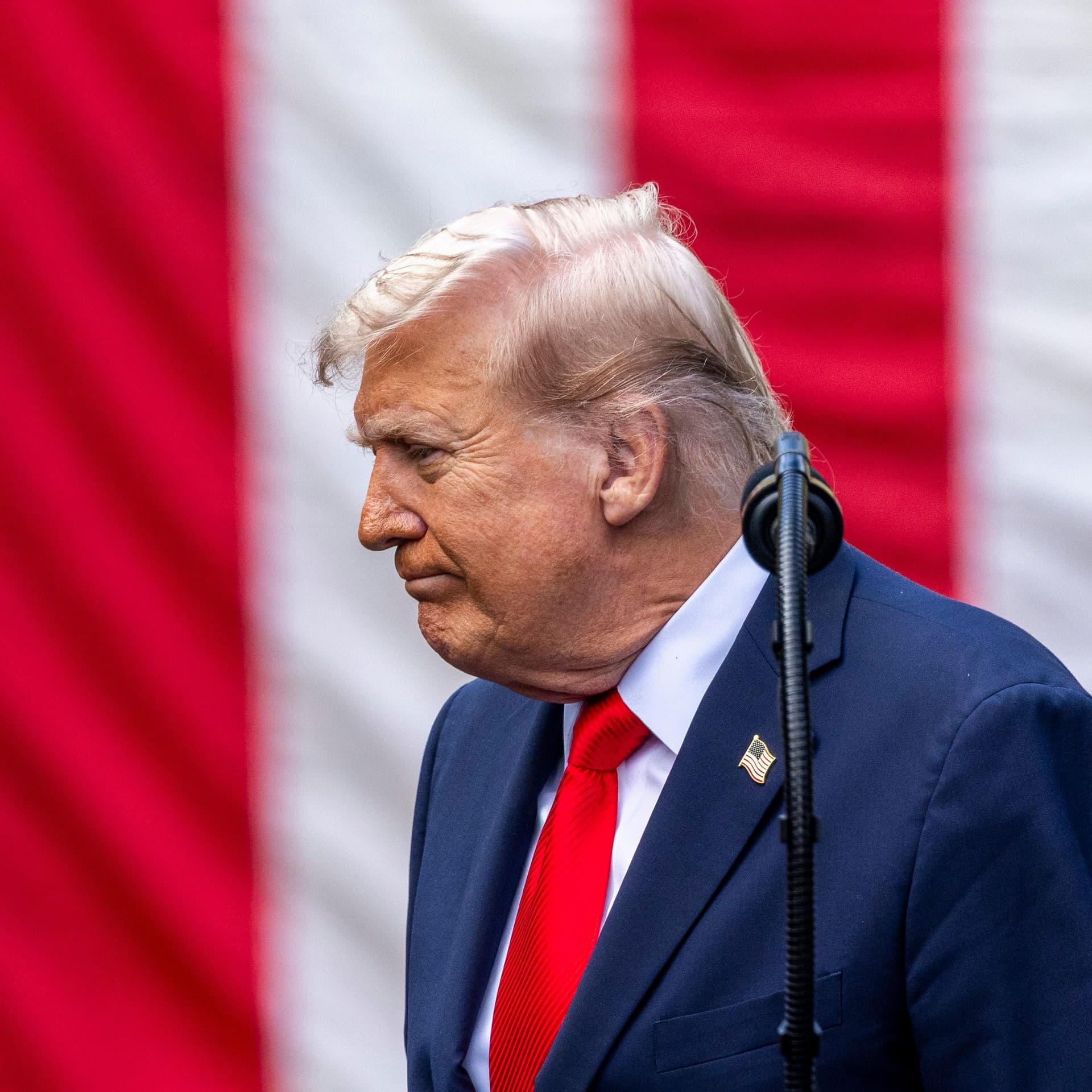
(Photo: President Donald Trump in front of the US flag. Credit: Shawn Thew/EPA/Shutterstock)