In short
How the 2026 World Cup (hosted across the US) sparked “soft power,” community welcome, and growing American soccer fandom—while also raising concerns about FIFA integrity and costs.
Guests (backgrounds)
- Roger Bennett, Liverpool-born American; founder of Men in Blazers; football broadcaster/media network.
- Jonathan Lemire, staff writer at The Atlantic; co-host of Morning Joe (MSNBC).
- Ruth DeWitt, Director of Community Relations, Lawrence Kansas Tourism Bureau.
- Marcus Cranston (“Eagleman”), Las Vegas-based retired US colonel; has attended every World Cup since 1998.
- Dan Rowan, BBC sports editor; covered six World Cups.
Key claims
- Initial US hosting trepidation (visas, entry delays, ticket prices) eased once stadiums filled.
- World Cup warmth helped Americans “fall back in love” with global visitors.
- Lawrence’s welcome for Algeria showed how local preparation can counter restrictive travel realities.
- US soccer interest is accelerating, especially among younger Hispanic fans.
- FIFA faces a trust crisis amid allegations of political interference in disciplinary decisions; Infantino denies influence.
Notable examples
- Algeria’s viral Lawrence, Kansas arrival (drums, chanting, fireworks) and a community session for 2,000+.
- Lawrence Argentina watch party: “sea of green” and Algerian shirts selling out.
- Marcus’s US fan growth: from ~50 US fans in 1998 to 25,000 marching in 2026; singing “Country Road” after Bosnia game.
- Roger’s memory: Argentina vs Egypt in Atlanta—collective emotion after Argentina scored.
- Dan’s coverage highlights: Iran camp move, denied entry for Somali referee Omar Arfan, and the Balogun red-card controversy.
Written by AI. May contain mistakes. Listen to the episode to check what was said.
Chapters
Tap a time to open that second in VOWorld Cup Overview and Significance
1:16 to 2:19
Exploring the significance of the World Cup to American culture and identity.
“Only two teams can still win this World Cup.”
Challenges and Surprises of Hosting
2:22 to 3:39
Discussion on initial concerns and the surprising excitement surrounding the World Cup.
“There was a lot of trepidation around this tournament.”
Soft Power and Cultural Exchange
3:41 to 6:04
The World Cup as a platform for soft power and cultural exchange in the U.S.
“Scotland literally took over the city of Boston and frankly drank all of its beer.”
Lawrence, Kansas: A Welcoming Community
6:10 to 10:37
A community's experience hosting the Algerian football team during the World Cup.
“As Jonathan mentioned there, soft power has been a real thing in this World Cup.”
The American Fan Experience
11:20 to 14:00
Insights into the evolving experience of American fans at the World Cup.
“While Americans were charming all these visitors, there was also some football happening, and some fans were taking it very seriously.”
The Underdog Experience of US Soccer Fans
14:00 to 14:42
Explore the emotional connection and experiences of USMNT fans.
“Marcus, what does being a fan of the USMNT mean to you following them around the world and watching them play?”
Roger Bennett's Journey in American Soccer
14:42 to 17:28
Hear Roger Bennett's reflections on American soccer's evolution since 1994.
“Probably one of the worst things that could have happened for us in this World Cup was to have the idea that we were having an advantage.”
Memorable World Cup Moments
17:28 to 20:26
Discuss unforgettable experiences and emotions from the World Cup.
“The American audience is utterly, madly, truly, deeply in love with football, particularly the Premier League.”
FIFA's Influence on the World Cup
20:26 to 24:46
Analyze FIFA's role and controversies during the World Cup tournament.
“collective understanding, that collective memory making, that to me I'll never forget.”
Reflections on the World Cup's Legacy
24:46 to 27:56
Reflect on the significance and impact of the World Cup in the US.
“And I think it's left itself open to a charge that it can't be trusted and it's going to be very, very interesting to see what the legacy of that is.”
Transcript
Automatic transcript. May contain errors.0:00This BBC podcast is supported by ads outside the UK.
0:30No bouncing between tabs. And best of all, no spreadsheets. Stop managing software and start managing your business with one unified system. Try for free today at odoo.com. That's O-D-O-O dot com. Hi there, I'm Asma Khalid. And I'm Tristan Redmond. And together we're the hosts of the Global Story podcast from the BBC. For those of you who might be new to our show, we here at the Global Story dive deep every weekday on one big story at the intersection of where the world and America meet. And you can now watch the global story on the iHeart app. Catch every brand new episode every weekday. Just tap into iHeart to start watching.
1:10And we hope you enjoy the show.
1:15Spain or Argentina? Only two teams can still win this World Cup. The other 46 have now felt something like the same crushing disappointment that hit France and England this week. Only one team can emerge eternal. But this tournament's not just about winning. For this special episode, we'll hear from Roger Bennett of Men in Blazers. He's a broadcaster and the guru of all things football in the United States. He'll tell us how the World Cup lit up the country. It was amazing to see thousands of fans, whenever they scored across the nation, discover the beauty of football, which is to stand with strangers and throw beers in the air.
1:56But San Jose, California, Birmingham, Alabama, Hartford, Connecticut, everyone just loving it. The story of this World Cup is the story we tell on this show every day about where the world and America meet and about how each shapes the other. We'll be speaking with people across the US to hear about their experiences and what trace the tournament will leave behind. From the BBC, I'm Tristan Redmond in London. Today on The Global Story, what's the World Cup meant to Americans and how has it changed the United States?
2:34There was a lot of trepidation around this tournament. Jonathan Lemire, staff writer at The Atlantic and co-host of Morning Joe on MSNOW, had some anxiety going into the World Cup. There were concerns about whether tourists would want to come, whether they'd be able to require the visas to do so. Long wait times and concerns over entry approvals are creating uncertainty for international travelers. The ticket prices were just so exorbitant, it seemed. The football supporters Europe has said it is astonished by FIFA's extortionate pricing strategy. There was a sense that, like, the World Cup was arriving and no one was all that excited about it.
3:12Is America shaping up to be the worst host ever for the World Cup? That went away as soon as the games began. The stadiums are full. Americans are delighted to welcome international visitors. And what's been so refreshing is at a time when America's relationship to the world has become so strained, people from all over the globe, including Europe, have come here and just been delighted. They're almost falling back in love with the United States. We had these wonderful scenes across the country. Scotland literally took over the city of Boston and frankly drank all of its beer. We have the Norwegians and their Viking Rose celebration in Times Square.
3:54So it has been a welcome reminder at a time of still real geopolitical tensions that there's still far more that unites us than separates us. And what have you seen in terms of the fans themselves on U.S. soil being pleased or delighted or surprised about their experience in the United States? One thing that's striking is how they're just amazed by America as sort of the land of plenty. I've arrived at the World Cup in one of the most insane stadiums I've ever seen in my life. This is mad. The Walmart is just the best tourist attraction you can have in the whole United States. Right now, the United States' most effective bit of soft power might be Applebee's.
4:41It might be like the chain restaurants that dot our nation's landscapes where food is good, the service is friendly, and your visitors from all over the globe appear to be just charmed by it. Pizza, fish, chicken, everything. The Mexican food already also. And yeah, Fatburger and In-N-Out are our favorites. This comes in a moment where the Trump administration has really cut back soft power around the globe, whether that's foreign aid across the globe to smaller things like Voice of America, And I think the World Cup has at least temporarily filled that void. Well, the World Cup has happened in tandem almost with the 250th anniversary since the signing of the Declaration of Independence.
5:23Has there been a kind of complementarity there, Jonathan? America 250, I think, for many Americans, was sort of underwhelming, at least at the national level. President Trump abandoned the bipartisan effort to mark the 250th anniversary and instead gave power and money to the far more partisan organization that put him at the center of the celebration. So I think people were left unsatisfied by that moment. So instead, the World Cup stepped in as sort of an unlikely source of patriotism. And I found sort of replaced almost the 250 or at least complemented the 250 in the national conversation.
6:10As Jonathan mentioned there, soft power has been a real thing in this World Cup. And the most viral example emerged from a place called Lawrence, a college town in Kansas, which hosted the Algerian team. We had been working, honestly, for two years before everything started, trying to prepare our community in many different ways. Ruth DeWitt is Director of Community Relations at Lawrence's Tourism Bureau. When we found out the Algerian team was coming, we worked at the University of Kansas International Relations Department and we started learning all about Algeria. We learned about their history.
6:52We learned how integral the men's team was to the Algerian identity. Our library had French and Arabic lessons leading up to them coming. And we feel like we were ready to embrace them when they came. Tell us what it was like when the team first arrived there in Lawrence. What happened? Oh, it was just a magical night.
7:22They really didn't get here until about one in the morning.
7:31There were probably 200 Algerian fans there. We had drums, rye music, chanting, fireworks, flags waving. And I'm sure the team was surprised to see the outpouring that they got at 1am. Well, pretty soon after they arrived, the world started to see pictures and videos of the incredible time that the Algerian team were having with you guys in Lawrence, Kansas. What was the highlight of the team's visit for you? There are so many. I'm not sure I can pick just one, but I do feel that the community training session was a turning point. Other teams were only allowing like 40 people to visit or something, But the Algerians opened up the venue to over 2 ,000 spectators.
8:25Oh, wow. Yeah. The University of Kansas band played their national anthem.
8:37And they had a clinic with some of our young footballers. They signed jerseys. They did selfies. It was just an incredible night that exceeded all of our expectations. What was it like watching their matches? Nerve-wracking. Another favorite night of mine is the Argentina game. And we had a giant watch party. Massachusetts Street is our main street. And it was just a sea of green. We could not keep Algerian shirts in stock in Lawrence. There were so many places that sold out of Algerian shirts. The images of the incredible welcome that you gave to the Algerian team went viral. People saw them all around the world.
9:19I want to say thank you to Team Algeria for choosing our hometown, Lawrence, Kansas, to come here. And so welcome. And one, two, three, vive l 'Algier. At the same time, there are new restrictions on Algerians entering the United States. that makes it a lot harder for people to visit. What do you make of the contrast between those two things? I think part of why our story was so powerful is because of that very contrast. My husband and I talk about it, that a community welcomes visitors should not be a headline, but it kind of shows where we are in this day and age. And Lawrence is a place in Kansas that was founded by abolitionists who were going to form as a free state.
10:14And we wear that very, very proudly. I think we connected with the Algerian people in that same sort of self-determination from the colonization of the French. And I feel like that Lawrence spirit of injustice and we are going to stand with them. If their country can't come, then we're going to be their home fan base. And I hope that the World Cup has shown Americans to be warm to other cultures, no matter who they are, what they look like. Has this World Cup left an imprint on Lawrence and on the United States more widely? I believe so. I mean, in terms of Lawrence, I think Lawrence has just gotten a summer that it is never, ever going to forget.
11:05Our mayor and our city committees are looking at forming a formal relationship, whether it's sister cities and or an economic development coalition with Algeria. Yeah, it's definitely this whole thing has been transformative.
11:26is. While Americans were charming all these visitors, there was also some football happening, and some fans were taking it very seriously. We went to France in 1998, South Korea in 2002, 2006. We were in Germany 2010. Marcus Cranston is a retired U.S. colonel living in Las Vegas. He's a massive soccer and U.S. men's national team fan. In fact, Marcus and his wife have been every World Cup since 1998. Qatar in 2022. And this year, 2026, we've been following the national team here in the United States. You have a nickname, which is Eagleman. How did you get that nickname? My wife decided that during the Brazil World Cup we were going to wear costumes.
12:13And she was Wonder Woman. I was Aquaman. And I knew I wasn't going to wear an Aquaman costume. So I came up with this costume with an eagle mask, a full eagle costume and uh from there on it's been eagle man ever since brazil can we have a look at it please i would look uh something like that yes very good also i could see how wearing this mask you can still drink a beer whilst wearing it
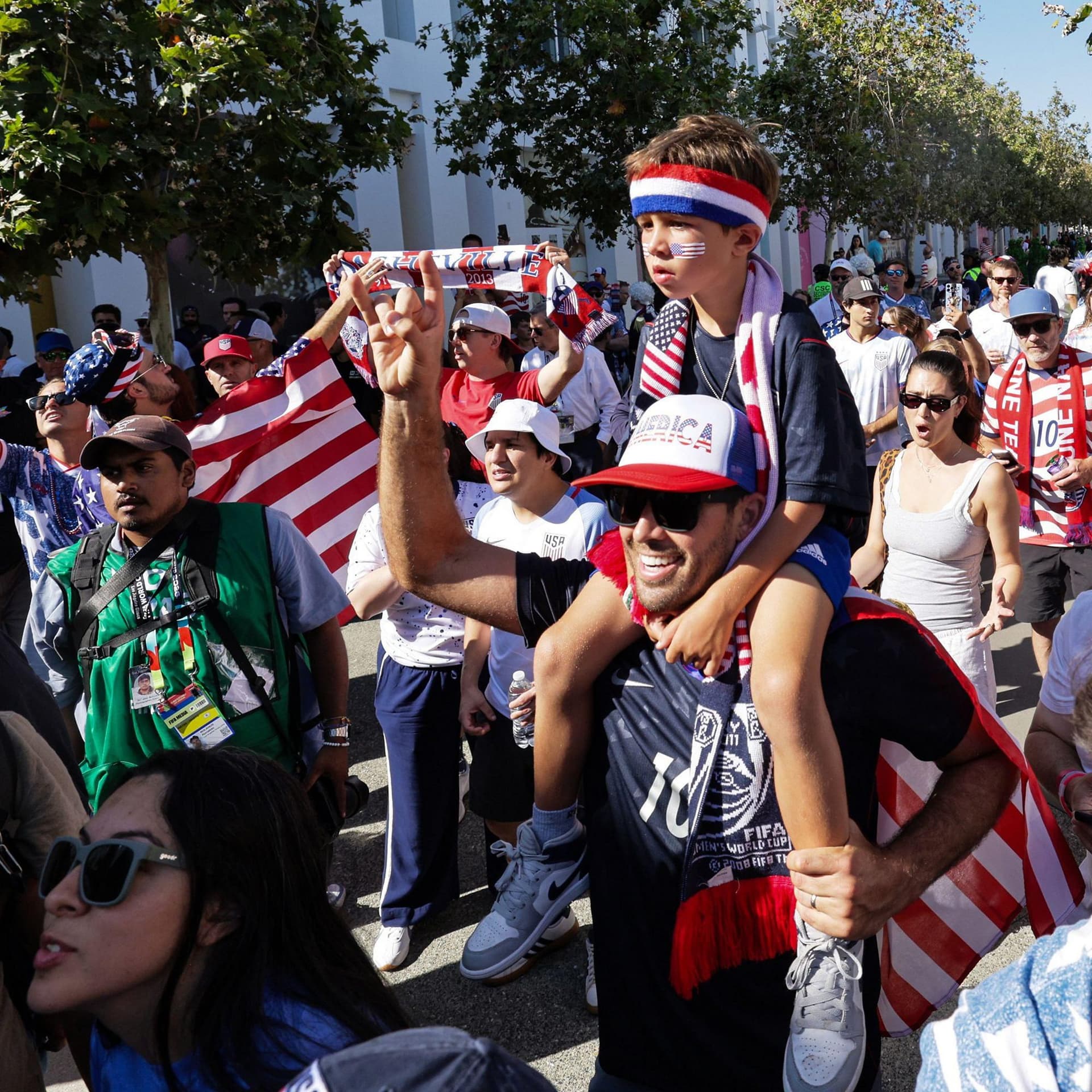
12:40that's right the important things right eagle man superfan your first world cup match what was that match like in terms of being a u.s fan the amount of support compared to all the usa matches you've been to see in this world cup what's changed i think just the number of u.s fans so we sat on a street corner outside of the train station and i think we had maybe 50 u.s fans this is in 98 last week marched in front for about a mile from our meetup spot to the stadium. We had 25 ,000 people in the streets marching there.
13:30This was the first time my, you know, parents were watching every game. They're calling me, asking me what a red card is, what's offside, trying to explain those things. There's so many people, you know, millions of people across the United States that are now moving into that stage of understanding and interest in the game. And probably the most emotional moment was after the games, we started singing John Denver's Country Road, Take Me Home. And, you know, after the Bosnia game to have that many people following, you know, my wife looked over at me and I have to admit I was crying at that point.
14:03Marcus, what does being a fan of the USMNT mean to you following them around the world and watching them play? It's just a connection to the sport. As American fans of international sports, we don't often get to be the underdog. It's just a unique situation where we're not being respected. We think we're more knowledgeable than people think as far as soccer and football fans. There's that little chip on our shoulder, I think, as well, as we go around and look for, you know, just a win at the World Cup, three wins at the World Cup. You know, we're feeling pretty good about ourselves with that. So you actually enjoy specifically the experience of being an underdog?
14:41Oh, definitely. Yeah. Probably one of the worst things that could have happened for us in this World Cup was to have the idea that we were having an advantage. So having the red card pulled back, you know, we wanted that underdog mentality. I think it hurt the team, but certainly it affected the fans too.
15:05Marcus isn't the only one excited about the growing US soccer fan base. I have not slept, I think, in about 39 days. But we'll sleep after the final. And to see this nation come alive in a way I think America really needed in this moment. And to make memories along the way has been really profound. Yeah, but I'm barely standing up right now. Roger Bennett, a Liverpool-born American and founder of the Men in Blazers soccer media network, has spent his adult life preaching the gospel of football in the US. 1994 is when I moved here. The Men's World Cup crashed upon our shores. And back then, America really was like space to Captain Kirk.
15:49It was the final frontier, the one vast territory that was immune to football's charms. I found it quite shocking. coming from Liverpool. I moved to Chicago and I wrote a book about the rise of football, which has been the story of my lifetime in the United States. And just before that 1994 World Cup, there was a study done that felt that football was America's 67th most popular sport and tractor pulling was number 66. But The Economist just did a study before this World Cup and football is now the third most popular fan sport. And that rise from 1994 to 2026 has really been the story of my life to witness.
16:28What was it like watching football as a fan when you first arrived in 1994 compared to now? It's impossible. 1995, Everton, my team, were in the FA Cup semi-final and I had to call my dad to hold the phone to Radio City so that I could follow along. It just was not on the 365 cable channels I had. So there was a long time where football did live in the shadows. We joke on our show that soccer is America's sport of the future, as it has been since 1972. It's perpetually the next big thing. But this World Cup is kind of the symbol of this turning point where it's very much the sport of the now, particularly for this young audience, massive young Hispanic audience.
17:12You know, the internet has connected them to what's going on at Liverpool or Arsenal is close from Alabama or Michigan as if they lived in the same postal code as the stadium. But it has, from an audience perspective, it's been magnificent to witness. The American audience is utterly, madly, truly, deeply in love with football, particularly the Premier League. We're talking of local fan bases, Roger. You're a local now. You're a naturalised American. Am I right in understanding that you were supporting the US men's national team during the World Cup? Yeah, I came here in 94. I was a kid. I watched this American team.
17:48I'd never seen an American kick a football. They walked onto the field with stonewashed denim, jerseys. They looked like they were roadies for Hootie and the Bluefish. They looked like any kind of footballer I'd ever seen before. They all had like mullets and ginger straggly. I was like, oh my God, this is hilarious. And I was just in from that very beginning. And, you know, they love a dream team. The men's team have remained a dream on team. And I'd say it's very much a work in progress, but I do love them. How did you feel about their performance in the World Cup? Were you disappointed when they got knocked out by Belgium?
18:21Yeah, it was an agony. You know, the team's motto was, why not us? You know, by the end of it, it felt like, why never us? We have 330 million Americans. They put a man on the moon. They've invented the cronut. They cannot for the life of them get past the round of 16. It's almost insane. it's like the one place in the world where you know that we know that you know that we know that we're not very good at this and we feel the laughter of the rest of the world there's a real inferiority complex it's very difficult to defang what's the most arresting moment during the world cup the thing that will really stick with you there's there's so many i mean that's the joy of course we'll have Lionel Messi this divine magic the England Azteca i hope we don't forget that Azteca performance.
19:05It was so valiant. But there's also Cape Verde, Vazinha will be remembered. Some of the smaller nations making us know about Curacao, their identity. But for me, the greatest memory was being at Argentina against Egypt in Atlanta and to go to the game and to feel that stadium, the Mercedes-Benz, which is a piece of architecture ripped from the future. And suddenly it felt like you were in Buenos Aires. it was remarkable to be there i was the only one wearing a shirt i think after about 20 minutes but the atmosphere i'm not a religious man but it was deeply evangelical i was with a woman who'd never been to a football game before they were 2-0 down we were watching leonard messi's last game he was done but the second the second argentina scored this is what was amazing number one everyone started crying the woman i was with started crying i said why are you crying you're not Argentinian.
19:59She said, just the overwhelming emotion that is filling this place is so deeply moving. It was stunning. And the thing that blew me away the most was that they were still 2-1 down, they were still going out, but all of them knew they'd won already because they'd seen it before, they knew what had happened. That their team who were hunters now had their prey in their teeth, and they knew exactly how it was ended, and they were right. To see that kind of blind faith and collective understanding, that collective memory making, that to me I'll never forget.
20:56world and America meet. And you can now watch the global story on the iHeart app. Catch every brand new episode every weekday. Just tap into iHeart to start watching. And we hope you enjoy the show.
21:14Like Roger, the BBC's been covering the tournament and all its twists and turns. A bit fortunate enough to cover six World Cups now, the last six in a row. And I think there's no doubt this has been the most physically demanding to cover. He might not be an American, but Dan Rowan is the BBC sports editor and he's been on the road for seven weeks. Because of, A, the length of it, it's the longest ever, but also the sheer scale of it. You know, it is over three countries, an entire continent for the first time. You're sustained by the stories on trips like this. And there's been some really fascinating ones on the field.
21:49Some of the biggest stars performed, the likes of Messi and Mbappe and Kane and Haaland, of course. And off the field, there were so many amazing stories, intriguing issues to cover, as ever it seems, in a World Cup. You know, these tournaments reflect the world around us and tell us a lot about the host countries. The involvement of Iran was particularly newsworthy, of course. Scrutiny over the way that team was treated, of the fact they had to switch their training camp from America to Mexico. The controversy over the Somalian referee, Omar Arfan, who was denied entry to the US. Concern over the record costs that fans faced.
22:24why and how this had become the most lucrative sports event in history. And I think that led to concerns inevitably about whether this marked perhaps the end of football being the people's game. And I think it will raise major questions of FIFA as to whether they got the balance wrong. You know, despite all of that, I leave with good memories, I think, of seeing fans from places like Panama filling Times Square in New York, Croatians marching through Dallas, The way that Boston took the Scottish fans to its heart, I think it's given a good impression of North America overseas. And I think my sense is that a lot of Americans have really enjoyed having the World Cup here.
23:02What are your reflections on the role of FIFA at the end of the tournament, Dan? I mean, they have, it would seem, pulled off a successful tournament bigger than ever before, upgraded to 48 teams. But then, of course, there's the allegations of political interference in the red card decision for the U.S. men's national team. How do you think they've done? When it comes to the expansion of the tournament, there was less jeopardy in the group stage because of the fact that eight of the third place teams went through to the knockouts. But on the other hand, there have been some great stories that may not have happened without that expansion.
23:37The success of countries like Kate Verd, for example, who held Spain to a draw on their debut in the tournament. There was the goalkeeper, 40-year-old Vazenia, who became one of the sort of personalities of the tournament. So that was a fairytale campaign for them. The reality, though, is that a lot of the excitement and the drama that was created on the pitch, to a certain extent, was overshadowed by, in particular, the Balogun case that you reference. And I think for many, there is this sense that there is a bit of a crisis of confidence, a crisis of trust in FIFA, perhaps, as a result. This sense that they may have crossed a line as a result of what many see as political interference because the US President Donald Trump lobbied the FIFA President Gianni Infantino to effectively rescind the ban that Balogun had received for his red card.
24:32and when that then subsequently happened, of course, the perception is that that led to that decision. So there is this perception, whether it's real or not, that FIFA is meddling with the integrity of the game to a certain extent. And I think it's left itself open to a charge that it can't be trusted and it's going to be very, very interesting to see what the legacy of that is. And we should say that the FIFA president, Gianni Infantino, denied having any influence over disciplinary decisions.
Read the full transcript
25:07To round off this episode and the tournament, we asked all our guests the same thing. What did this World Cup mean to them? What did it mean to the United States? And did it change anything? Well, I think I'll remember it as a challenging World Cup to cover, but a fascinating one. There's been plenty of on-field moments that I think I and many others will always remember. but equally I think it's raised serious questions about FIFA's leadership of the game as well and I think that will leave a legacy that the governing body has to address in the years to come. I have been reminded how important it is for people to be embraced and feel welcome.
25:55how little it takes to welcome someone in and how important it is that in spite of how countries act toward one another, that human connection is just vital. The biggest thing was just the number of people that were interested. To have that be the major sporting interest for three, four weeks in this nation, there's more and more hope that the game is going to continue to grow here. I think the defining image is actually going to be thousands of fans from across the globe just marveling at the United States again and the warm embraces they've received from those who live here. Will it lead to concrete change in geopolitical relations?
26:47Possibly not. But certainly, I think right now, it is a moment of good feelings. And there haven't been that many of them in the last decade or so, as the rest of the world looks at the United States and just a little bit askance. And they're just not quite sure they can trust it like they used to.
27:07I just filmed with John Oliver. I thought it was beautiful. I thought it was profound. His point was, why does it take a World Cup for that kind of welcome, for that kind of warmth, for that kind of mutual respect? So we don't know how that will change things. I do believe the Lawrensonians will be talking about this summer for many generations. In Lawrence, Kansas? Yeah, I'm sure they'll remember it for a long time. I do believe there'll be deep connections between the city of Boston and Scotland. I hope for a long, long time in Scotland, you are the greatest. Ultimately, the thing that will last on is the memories.
27:41We've all been bettered by this. We've all been made cross-generational memories. it's been stunning on and off the field and I think ultimately that is the thing that will change us is the awareness, the learning, the experiences we've shared and no one can ever take those away from us.
28:02Thank you to Jonathan Lemire, Ruth DeWitt, Marcus Cranston, Roger Bennett and the BBC's Dan Rowan. Today's show was produced by Lucy Paul and Kat Farnsworth. It was mixed by Travis Evans and edited by Bridget Harney. Our technical producers were Rowan Madison and Mike Regard. Our digital producer is Matt Pintus. Our senior news editor is China Collins. And I'm Tristan Redman. Thanks so much for listening. We'll be back again next week. Have a great weekend and enjoy the World Cup final. Cheerio.
28:40Hi there, I'm Asma Khalid. And I'm Tristan Redmond, and together we're the hosts of the Global Story podcast from the BBC. For those of you who might be new to our show, we here at the Global Story dive deep every weekday on one big story at the intersection of where the world and America meet. And you can now watch the Global Story on the iHeart app. Catch every brand new episode every weekday. Just tap into iHeart to start watching. And we hope you enjoy the show.
29:12Thank you.
From the publisher
Spain or Argentina? These two teams will face each other in the 2026 World Cup final. Only one team can emerge eternal. For the rest, it’s over.
But this tournament’s not just been about victory.
For this special episode, we’ve been speaking with people across the US to hear about their tournament experiences, and asking what trace the World Cup will leave behind.
We hear from: Roger Bennett, founder of the Men in Blazers media company; from the BBC’s sports editor Dan Roan; from the co-host of Morning Joe on MS NOW Jonathan Lemire; from Ruth DeWitt, director of community relations at Lawrence’s tourism bureau in Kansas; and from life long US soccer fan Marcus Cranston.
Producers: Lucy Pawle and Cat Farnsworth
Executive producer: Bridget Harney
Mix: Travis Evans
Senior news editor: China Collins
Photo: USA fans cheer ahead of the FIFA World Cup 2026 group stage match Turkey against USA, in Los Angeles, 25 June 2026. Credit: Christopher Torres/EPA/Shutterstock