In short
How U.S.-origin conspiracy and anti-medicine narratives spread to the UK and can have lethal real-world consequences, using the case of British conspiracy influencer Kate Shemarani and her daughter Paloma.
Guest backgrounds
Mariana Spring, BBC disinformation expert; she investigated social-media disinformation during UK COVID lockdowns and met Shemarani in 2020, also speaking with Shemarani’s son Sebastian.
Key claims
U.S. conspiracy language (e.g., hoaxes, crisis actors) is “exported” globally; pandemic mistrust and political incentives mainstream anti-medicine ideas. Shemarani’s nursing credentials and online cancer story helped radicalize her family. An inquest later found Paloma was adversely influenced by both parents and their influence contributed to her death.
Notable examples
Shemarani’s family absorbed 9/11 inside-job beliefs, Alex Jones content, and David Icke “lizard people.” After Paloma’s non-Hodgkin lymphoma diagnosis (Dec 2023), she declined chemo for Gerson therapy (juices, strict diet, coffee enemas). Paloma collapsed in July 2024; her brothers learned of her death about a week later.
Guests
Mariana Spring.
Written by AI. May contain mistakes. Listen to the episode to check what was said.
Chapters
Tap a time to open that second in VOConspiracy Theories' Global Impact
0:42 to 0:57
Exploration of how American conspiracy theories have affected lives in the UK.
“With the new Schwab Teen Investor Account, teens can gain hands-on investing experience and build positive money habits.”
Conspiracy Theories' Global Impact
1:30 to 3:38
Exploration of how American conspiracy theories have affected lives in the UK.
“Now, Tristan, one of the episodes I was really into is the story of a young British woman who was so influenced by her mother's health conspiracy theories that she died.”
Meeting Kate Shemarani
3:38 to 6:36
Mariana Spring discusses her investigative journey into the life of conspiracy theorist Kate Shemarani.
“You have become the disinformation expert at the BBC.”
The Shemarani Family's Story
6:36 to 13:12
An in-depth look at the Shemarani family's history with conspiracy theories and their impact.
“As the COVID lockdowns were getting underway.”
Paloma's Health Crisis
13:12 to 14:00
Paloma's journey to understanding her health choices amid family beliefs.
“where she begins to distance herself from her parents' views.”
The Power of Conversation in Chicago
14:00 to 15:10
Explore how communication shapes culture and community in Chicago.
“And at that time, she seemed to genuinely be considering them.”
Paloma's Crisis and Her Mother's Influence
15:29 to 16:51
Investigate how a mother's presence affected her daughter's treatment decisions.
“Any mom would want to be there in the hospital with their kid when they're in a moment of crisis, even if they hadn't had the smoothest relationship.”
The Journey into Alternative Medicine
16:57 to 19:43
Delve into Paloma's choice of alternative therapy and its consequences.
“And in the end, she decides, I'm going to go back and live with my mum.”
The Deterioration of Paloma's Health
19:47 to 21:34
Understand the rapid decline of Paloma's health amidst family conflicts.
“From April onwards, she seems to just be becoming more unwell.”
The Aftermath of Paloma's Death
21:39 to 23:27
Examine the family's response and the inquest following Paloma's death.
“And he calls up his mum and says, Paloma's died, why didn't you tell me?”
Show all 14 chapters
The Rise of Conspiracy Theories
23:29 to 26:50
Discuss the growing skepticism towards mainstream media and medicine.
“has had to stop the inquest on multiple occasions and warn everyone about their conduct and the way they're behaving.”
The Global Impact of American Conspiracy Theories
26:51 to 28:00
Explore how American conspiracy theories are influencing the world.
“It is so fascinating to hear you describe the fact that Kate continues to tout what she believes in on an American podcasting platform.”
Exploring Anti-Medicine Conspiracy Theories
28:00 to 28:45
The discussion revolves around the rise of unproven theories and their growing acceptance in society.
“which were triggered by events happening in the US.”
Mariana's Influence and the Inquest Outcome
28:45 to 29:20
Insights about Mariana's viewpoints and the consequences of her influence on her daughter's health.
“Well, folks, that is it for today's show.”
Transcript
Automatic transcript. May contain errors.0:00This BBC podcast is supported by ads outside the UK.
0:30No bouncing between tabs. And best of all, no spreadsheets. Stop managing software and start managing your business with one unified system. Try for free today at odoo.com. That's O-D-O-O dot com. With the new Schwab Teen Investor Account, teens can gain hands-on investing experience and build positive money habits. It's an account co-owned by you and your teen, so you can monitor and engage with the account while your teen learns how to invest and manage money. Learn more at schwab.com. Hey there, it's Asma and Tristan here. Hey guys, as we reach the end of 2025, we wanted to bring you a few of our favourite episodes of the podcast since we relaunched in September.
1:11That's right, and we will be back in the new year with brand new episodes bringing you stories about where the world and America meet. And we love to hear from you about what you thought about the episodes or the other topics we've been looking at. So please message us. Our email address is theglobalstory at bbc.com. Now, Tristan, one of the episodes I was really into is the story of a young British woman who was so influenced by her mother's health conspiracy theories that she died. It is a fascinating story that gives us a glimpse into how conspiracy theories that really originated and had some roots here in the United States traveled halfway across the world, across the Atlantic Ocean, and have found a home in the UK.
2:00Incredibly tragic story, but it's really brought to life by Mariana because she's such a wonderful storyteller. I really enjoy this episode too. These days, it seems like mistrust in science has never been higher. Fewer people are getting vaccines. Vaccination rates for kindergartners continued on a downward trend across the country last year. A known vaccine skeptic is now leading the most powerful health agency in America. I want to thank President Trump for entrusting me to deliver on his promise to make America healthy again. And this year, for the first time in almost a decade, people in the U.S.
2:39died from measles. This is completely preventable. This doesn't have to happen if we can get vaccination rates back to high levels again. The attacks on public health are escalating. In August, a gunman opened fire on the headquarters of the Centers for Disease Control, firing over 500 rounds and killing a police officer. White's deadly attack on the CDC was fueled by his deeply held beliefs in misinformation. They say that he... Increasingly, this misinformation is being exported around the world. And an ocean away, one family is reeling from its real-world impacts. My sister has passed away as a direct consequence of my mom's actions and beliefs.
3:22From the BBC, I'm Asma Khalid. And today on The Global Story, Mariana Spring, on how suspicion of science in America helped radicalize a British mom with devastating consequences. Mariana, hi. It's nice to meet you. Lovely to meet you. You have become the disinformation expert at the BBC. How did you first hear about this particular story about Kate Shemarani?
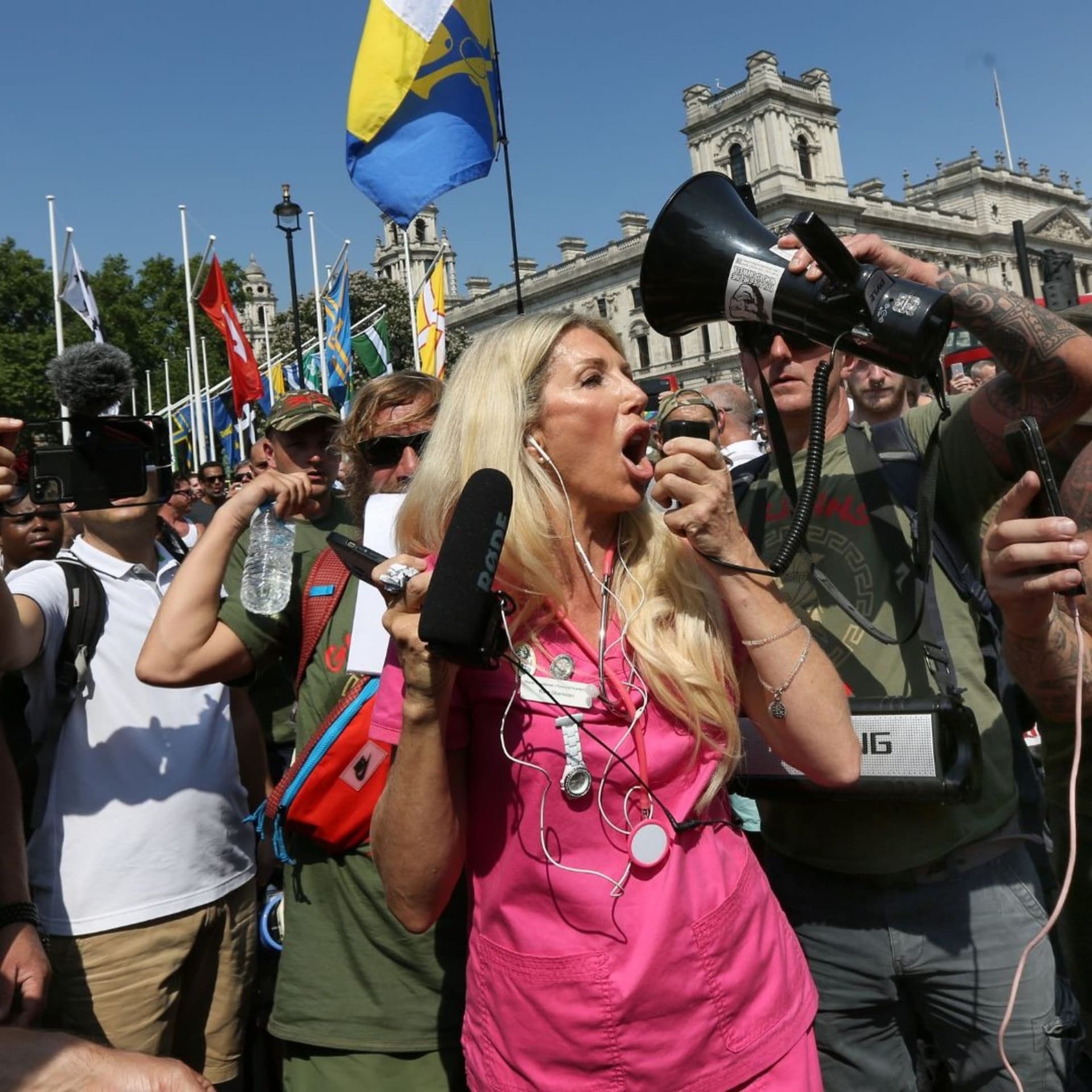
3:51Marianna Spring:Kate Shemarani was someone who came onto my radar very early on in me doing this job. So I started investigating all things, social media, disinformation, around the time that the lockdowns were first imposed during the pandemic here in the UK. And Kate Shemarani was a conspiracy theory influencer who didn't have a huge following at that point. She was posting on social media. She was attending these anti-lockdown rallies. And I remember being at Trafalgar Square in the centre of London and seeing her at one of these protests. And, you know, she was in this quite glamorous dress. She's got long blonde hair.
4:28Marianna Spring:She had a mic. And what was interesting is that she was someone who is, was trained as a nurse. She was there spreading completely untrue claims about the pandemic that went way beyond legitimate questions and concerns people might have about the proportionality of lockdown measures. or vaccines.
4:51Marianna Spring:She builds this platform and she starts to get criticised more and more, particularly when she makes comments suggesting that doctors and nurses involved in administering the vaccination are similar to doctors and nurses in Germany who were hanged for their part in medical experimentation, etc, etc. But perhaps the main way that I came to understand her family was speaking to her children who reached out to me. In the summer of 2020, which was very early on in the pandemic, I heard from her eldest son called Sebastian, who said to me, I'm really worried about the harm that my mum is causing by promoting misinformation about the pandemic, particularly because she's often using her nursing credentials.
5:40And you met her in person during this time period?
5:43Marianna Spring:I did. I met her to speak to her about anti-vaccine videos that she featured in. It was a very intriguing experience. I went round to her house and when I met her, my impression was she really wanted me to like her, which surprised me given that I'd just interviewed her son who was saying, my mum is a danger to society because she's sharing this kind of misinformation.
6:07Marianna Spring:We were at her house, met all her cats and chihuahuas. And there were these photos of the family on the wall. So she has four children. But I knew at that point they weren't in touch with her. So it felt like this veneer of we want to be this happy family and it's all perfect and it's all great. But I knew behind the scenes that at least two of her children had decided they didn't really want to speak to her anymore because she was spreading misinformation. So this is happening 2020, 2021. Yes. As the COVID lockdowns were getting underway. What happens after that time period, after you meet her?
6:47Did you stay in touch over the last few years?
6:49Marianna Spring:Yeah, she stayed in touch over text. She used to text me quite a lot, actually, usually warning me that I was somehow being used or misled by the evil BBC who want me to say and do certain things. Spoiler, that doesn't happen. I'm quite disobedient probably in that regard. But I stayed in touch with her. And I also stayed in touch with Sebastian, her elder son. Okay. Mainly because I was quite interested to see what happened next. Was it possible for their relationship to repair? Would his mum suddenly have this moment where she turned around and said, oh, actually, I don't know why I was posting that stuff and showing that content.
7:26Marianna Spring:I kind of wanted to keep tabs and see what happened. But I don't think I had any idea that it would get as bad as it did, really. Okay, there are a lot of characters in this story. So I want to take a moment and pause just to explain who is who in this family. There's the mom, Kate Shemarani, whom we've already met. She's this well-known British conspiracy theorist. Their eldest son is Sebastian. We met him earlier, too. Then there's a set of twins, Paloma and Gabriel. Paloma is central to this story. She's the daughter who ends up getting sick. Her twin brother is Gabriel. And they all seem to remember a childhood filled with conspiracy theories.
8:15Marianna Spring:It's interesting because when you talk to Sebastian and Gabriel Shemirani about this, they're often filling in the gaps, particularly because a lot of this happened when they were really little. So it was around 2001 when the 9-11 attacks happened in the United States. They say their dad in particular became extra fascinated in conspiracy theories. My dad was radicalised by 2001. He believed and still believes that 9-11 was an inside job. You know, it was staged in some way. It was an inside job. It was a hoax. He would come home from work around maybe 9 or 10pm at night and spend hours until the early hours of the morning watching conspiracy theory documentaries and videos.
9:05So they say that their dad got really into this 9-11 stuff
9:09Marianna Spring:and he was the person that drew their mum into that way of thinking. And she also started to indulge in conspiracy theories. You know, I'd come home from school and she would tell me some new mystical property of a vegetable that she'd found. So there was a lot about lizards. Me and Sebastian believed that the royal family were lizards, shape-shifting lizards that crossed across dimensions. Oh, this I'm not familiar with. This must be like a British conspiracy. Yeah, it kind of is, although actually a lot of US conspiracy theorists share it as well. So there was a lot of talk about lizards, you know, bedtime stories with lizards.
9:47She gave me this book for Christmas by David Icke. It was all about the lizard people that live under the surface of the earth.
9:51Marianna Spring:And then it started to sort of gradually escalate. About how the Rothschilds are plotting to go live on a space station, how there's going to be this mass genocide and stuff like that. It sounds like a bad Hollywood plot. But at the time, you know, I'm 10, 11 years old and I'm bricking it.
10:10Marianna Spring:They would listen to Alex Jones, the US conspiracy theorist, in the car on the way to school. This is when they were... That's Sandy Hook. About Sandy Hook, the shooting that happened in Connecticut in 2012, and all of these false narratives that were being spread at that time, suggesting that it was a hoax or stage that the children had not really died. Really disturbing stuff. It sounds like what you're saying is these kids don't remember a time in their lives when they were not surrounded by conspiracy theories from their parents, that their mom was really predisposed to this. But was there a particular moment in which she becomes sort of deeply, deeply entrenched in these views?
10:52Marianna Spring:so 2012 was this pivotal year where Kate Shemarani was diagnosed with breast cancer and at the time the kids say they were kind of kept in the dark about it they didn't really know what was going on but she had a mastectomy so an operation which appears to be the thing that removed the cancer but she chose not to have subsequent treatment like chemotherapy or radiotherapy, which you can have often to prevent the return of that cancer. And she turned to alternative medicine. What does that even mean, alternative medicines? What would she have done? Alternative medicines can be a whole range of things.
11:30Marianna Spring:So it can include diet, supplements, there's oxygen treatments that you can have. Often they're rooted in lifestyle change. And what's important to say is that some alternative medicine can be and is intended to be complementary. So people might choose to have conventional treatment and then also to basically eat healthily or do things that are good for their well-being but when it comes to Kate Shemarani she credited this alternative medicine on its own as being the cure as being yeah exactly so she usually uses this uses this word cancer-free I'm cancer-free because I pursued this alternative medicine regime I chose to do the Gerson therapy 13 juices a day all organic it was more so around 2015 that she started actually sharing this stuff on social media.
12:15And an organic, fat-free, salt-free, sugar-free, vegan diet. Five coffee enemas a day also.
12:21Marianna Spring:And specifically using her own cancer journey as a key way of connecting with people online. Hi, I'm Kate Shumarone, natural nurse in a toxic world. And building up this brand too. So calling herself the natural nurse because she had those nursing qualifications. Everything I learned in nursing school, I've had to unlearn and re-educate myself in a lot of things. And it's worth saying as well that at this point, the children have absorbed quite a lot of the views that their parents were sharing. I mean, you trust your parents. So, for example, when it came to Paloma, you know, her friends have spoken to me about how she didn't use sun cream because her mum had told her that that could give her cancer.
12:59Marianna Spring:Or she wouldn't use toothpaste that had fluoride in it or she wouldn't eat meat. There were quite a few things that she chose to do taking on her mum's health beliefs. But her process of separating from her mum in particular happens when she's at Cambridge University, where she begins to distance herself from her parents' views. And friends I've spoken to describe how, you know, she starts eating meat. She starts using toothpaste that has fluoride in it. She might take painkillers if she doesn't feel well, which she wouldn't have done. She does continue to try and go back home during the university holidays.
13:30Marianna Spring:But then the kind of unthinkable happens. So Paloma, she's graduated from university. She's living in Kent in a flat share. And then she starts to have some trouble breathing. She's got a pain in her chest. She goes and has a whole range of tests. And then she finds out that December in 2023 that she has non-Hodgkin lymphoma, a blood cancer. The doctors at the time say to her, look, obviously this is scary, but it's a really treatable cancer, especially in younger people like you. They give her around an 80 % chance of the cancer being cured if she has chemotherapy, conventional therapy. And at that time, she seemed to genuinely be considering them.
14:11Marianna Spring:And then her mum turns up out of the hospital.
14:25Chicago talks a lot. Hold on, let me step over here. People are talking too much. We debate about food, deep dish, tavern style, who's got the best beef? We yell across rooms, across blocks, across generations. Yes, nice earrings, Grammy. And now we're doing it on our phones, too. Video calls from the L train, group chats that never shut up. Neighbors texting you the score before your TV catches up. Come on! Get a load of this guy. Catch up on a dog. Yeah, we've got thoughts. Too loud? In Chicago, you're gonna hear it. Because nothing here gets built without conversation. Nothing moves without connection.
15:03So if you think you know AT &T, it might be time to rethink that because their network has improved, like, a lot. So Chicago can keep speaking its mind with AT &T Wireless and AT &T Fiber. Chicago won't stop talking. Our improved network backs it up. AT &T, connecting changes everything. AT &T Fiber, limited availability in select areas.
15:29I think it's totally understandable. Any mom would want to be there in the hospital with their kid when they're in a moment of crisis, even if they hadn't had the smoothest relationship. But when Kate does show up at the hospital, how does she then insert herself and her views into her daughter's treatment plans?
15:50Marianna Spring:So from the accounts of people who were there, Paloma's former boyfriend, for example, and his mum who'd attended the hospital with Paloma, they say that the atmosphere changed very quickly when Kate Shemarani turned up. How so? So she was asking for blood work, histology. She wanted to know exactly what was going on. And some of these things are normal things. If you're a mum and you turn up, you want to know what's going on. But before Kate Shemarani had turned up, Paloma had expressed concern to medics that she was worried what would happen if her mum did end up coming. and I've seen evidence that the medics at the time were discussing safeguarding concerns.
16:29Marianna Spring:They were saying, hang on a second, what's happening here? And then when... Protect her from her own mother. At the time, I've seen text messages where Kate Shemarani was, you know, texting the former boyfriend, for example, saying, don't let her consent to chemo, don't let her consent to anything. And Paloma's kind of saying, okay, everyone, can we just calm down? All of the people I've spoken to who knew her really well have said to me, she was kind of on the fence. She didn't really know what to do. About doing the chemo. About doing the chemo, about whether she should go back and live with her mum, what she should do.
16:57Marianna Spring:And in the end, she decides, I'm going to go back and live with my mum. She didn't make a definitive decision about the chemo. She said, for now, I don't want to have it. And I want to pursue this other therapy, which is called Gerson therapy. What's that? I'm not familiar with that. So Gerson therapy is a type of alternative medicine. People use it for a whole range of different illnesses. and it involves a very strict diet of fruits and vegetables and juices and also coffee enemas. It can actually be harmful in and of itself. And that was something that really, really worried Gabriel and Sebastian.
17:34And how do they react? How do the brothers react to this?
17:38Marianna Spring:So straight away when Paloma has gone home to her mum, so around Christmas of 2023, Gabriel actually turns up at the house with the boyfriend at the time, Ander, and they try to get Paloma to leave. Paloma's really confused. She found the whole thing quite distressing because you end up with Gabriel and her mum arguing with each other. But there's this desperation and when you talk to Gabriel about it, he says, like, this is my twin sister and I just really needed her to leave. I was so worried that the minute she was back home with mum, that was it, that she was going to go down this alternative medicine route and no matter how poorly she got, she wouldn't seek help.
18:13Marianna Spring:And that was actually the last time that Gabriel ever saw his twin sister. that Christmas.
18:22Increasingly, Paloma is difficult to speak to.
18:26Marianna Spring:The relationship with her boyfriend breaks down over a period of time. And Gabriel then tries one last-ditch attempt to say, please, Paloma, can you have chemotherapy? I'm so worried, I don't want you to die. And he ends up getting blocked.
18:45and during the time period i imagine she's getting sicker because if you don't do anything to truth cancer right in terms of chemo how are you going to get better exactly that and
Read the full transcript
18:56Marianna Spring:she's started to fall out with everyone really family friends her boyfriend there is one friend who takes a bit of a different approach because she doesn't want to get blocked and shut out she said she really didn't want her friends getting involved with this stuff. She'd argued with so many people and she was just too tired to argue. And she'd always mention cutting people off. Or I thought, I don't want to be cut off, especially when she's struggling like this. She's called Chantal and she tries to keep speaking to Paloma, having video calls. And on one of those calls, Paloma says to her, look, I've got a new lump under my armpit.
19:32Marianna Spring:And Chantal's really worried. She had a new lump in her armpit. And her mum had told her that the cancer was going out of her body. It was just, you know, like leaving. And I remember thinking, well, that's not the case, you know. And I was like, are you sure? I think you should do scans. I think you should investigate. I don't know if that's true, you know. From April onwards, she seems to just be becoming more unwell. She does do this post on Instagram saying, I want to talk about my alternative health journey and thank my wonderful mum and practitioners. And some of her friends, including Chantal, are a little bit confused because this seems at odds with how unwell she is.
20:12She would tell me that she really lost control of her bodily functions. She was throwing up non-stop. She was very, very thin. It was hard. And the last few months, she was in so much pain, I could tell. Then it gets to July and Paloma collapses at home.
20:33Marianna Spring:her mum's friend comes round and her mum's friend calls the ambulance. I've heard that 999 call, which is really distressing, where her mum says she's dying. And then Paloma ends up being taken to hospital in Brighton. But by that point, she's lost consciousness and she stays in hospital for a few days before the decision is made to turn off her life support because they can't do anything.
21:10Marianna Spring:One of the most distressing things about this story, and a lot of it is very distressing, is that Gabriel and Sebastian didn't find out that Paloma had died until around a week after she died. And Gabriel talks to me about how hard it was that he knows he was walking around for a week and his twin sister wasn't alive anymore, which you can't even really imagine what that must feel like, particularly as a twin. So their mother did not tell them? No. And he calls up his mum and says, Paloma's died, why didn't you tell me? And he says that she responded by saying, who told you that?
21:54Marianna Spring:And he says that he at that time said, right, I'm going to hold you accountable for what's happened here. hangs up the phone, they don't speak again.
22:06You're describing this death that took place in the summer of 2024. What's happened in the interim since?
22:16Marianna Spring:So since Paloma died, I'd say Gabriel and Sebastian have been on quite a mission. I've tried to interview Kate Shemarani multiple times about Paloma. she's remained adamant that her conspiracy theory ideas did not influence her daughter. These were her own decisions. There's also been an inquest, which is something we have here in the UK. What's that mean? I heard you say that. So when there are any question marks over a death when someone's died, so it might be that there's suspected wrongdoing by medical authorities or by the police or anyone else involved. It might just be that it's unclear how someone died or why they died or that there needs to be...
22:55Marianna Spring:The goal of it is to establish the circumstances around someone's death. So it's an investigation. Essentially, but it's not like a criminal investigation. No one's on trial for doing anything. It's just to establish why and how and what someone died of. The most extraordinary thing about the inquest, which I've been attending this summer, has been that at inquest on the whole, families are united and they want answers about the death of their loved one. Whereas obviously this family is not united. and it has got really so hostile. The coroner who's in charge of the proceedings of the inquest has had to stop the inquest on multiple occasions and warn everyone about their conduct and the way they're behaving.
23:34Marianna Spring:Often people will be represented by lawyers, but you don't have to be. So they're all representing themselves, which means they're all asking questions of everyone. So you've seen medics questioned by people who believe conspiracy theories. You've seen these family feuds unfolding right in front of you in this court. It's all been pretty shocking, actually, a very extraordinary inquest. Mariana, this entire family's tragic story feels a bit like a Shakespearean tragedy. And listening to you, it strikes me that, you know, they are not existing in isolation. The backdrop, at least I can speak for the context in the United States, is that, you know, we've seen this growing population of people who are skeptical of mainstream media.
24:21And I think it's just worth pausing on that because it's really fundamentally different than anything I've observed, I would say, in my lifetime. You look at statistics from, say, the Centers for Disease Control, CDC, and you'll see that the number of kids receiving vaccines are down. And, you know, our health secretary, RFK Jr., has a known record of being skeptical of vaccines. And now he's been put on this pedestal of leading the most powerful health institution in the United States. And I guess my question is, how do you see Kate Shemarani fit into this broader trend?
25:02Marianna Spring:Absolutely, she does. This might be an extreme case, but it's by no means isolated in so much as it seems to be symptomatic of this wider mainstreaming of anti-medicine ideas, conspiracy theories. I think that that's something that the pandemic in particular turbocharged because science, medicine didn't always get it quite right. It undermined and eroded trust in medicine. And then also there were people online who were able to seize upon that and to push other ideas contrary to the evidence, which some people have become perhaps more open to because they don't really know who to trust anymore.
25:41Marianna Spring:And I think that there are certain influences and to some extent politicians who have realised that that's quite valuable. They can build a platform based on those ideas. And then we find these ideas entering politics in a way that we hadn't really seen before. So Kate Shemarani, for example, she posts frequently about Robert F. Kennedy Jr. He has this lobby group that focuses on vaccine safety. Yeah, the Children's Health Defence. Yeah, which he was involved with. Kate Shemarani has appeared on several videos for them. Do you think that the people right at the very top are vaccinated? Of course they aren't.
26:14They don't give a damn.
26:16Marianna Spring:She also appears on other fringe podcasts that promote anti-medicine and anti-science ideas. It's just endless. Make them sick, keep them sick, treat them, kill them, dispose of them. There's your National Homicide Service from the cradle to the grave. So Kate Shemarani, even though she's here in the UK, fits into that landscape of anti-medicine ideas more globally. And the kind of outsourcing, I guess, from the United States of these ideas. It's like she's using the same language. She's using the same narrative. She's sharing the same ideas. It is so fascinating to hear you describe the fact that Kate continues to tout what she believes in on an American podcasting platform.
27:01It's very full circle to me. The story of how she, you know, raised her kids listening to Alex Jones. These are American conspiracy theories. And now she's sort of touting her worldview back to an American audience. Is it your sense that one of the great American exports of our time are conspiracy theories?
27:27Marianna Spring:I would definitely say that conspiracy theories, the most persuasive and pervasive ones that I see here in the UK, but all around the world, appear to have begun in the United States. these very specific narratives about hoaxes and crisis actors and stuff being staged and rigged. While they apply to other places and other scenarios, the language derives from the US. And so Kate Shemarani appears to have been brought into conspiracy land, into this world through US ideas, which she could access online, which were triggered by events happening in the US. And then full circle, it's the place where her new ideas, her new unproven theories about her daughter, all of these kinds of other anti-medicine conspiracy theories and misinformation now also have a home, an even more prominent home, an even more acceptable home than perhaps they did 20 years ago because their influence is growing rather than the opposite.
28:26Mariana, thank you so much. Thank you so much.
28:31Where can people find you? I'm still on Twitter. I'm on Substack. I'm on Telegram, Kate Shemarani. And kateshemarani.com, you can join it for$5.99 a month, not because I'm a grifter, but I'm like you. If you want the information, you want to learn how to stay healthy and restore your vitality, come and join us.
28:59We first ran this episode in September. her. Shortly after speaking to Mariana, the inquest into Paloma's death concluded and found that Paloma was, quote, adversely influenced by her mother and that the influence of both her parents more than minimally contributed to her death. Well, folks, that is it for today's show. If you are liking our show, please take a second to rate us wherever you listen. And thanks, as always, for listening. We'll talk to you again tomorrow.
29:53We'll be right back.
30:01Never shut up. Neighbors texting you the score before your TV catches up. Come on! Get a load of this guy. Catch up. On a dog. Yeah, we've got thoughts. Too loud? In Chicago, you're gonna hear it. Because nothing here gets built without conversation. Nothing moves without connection. So, if you think you know AT &T, it might be time to rethink that. Because their network has improved, like, a lot. So Chicago can keep speaking its mind with AT &T Wireless and AT &T Fiber. Chicago won't stop talking. Our improved network backs it up. AT &T, connecting changes everything. AT &T Fiber, limited availability in select areas.
From the publisher
We are away for Christmas, so this is a repeat of a previous episode.
Mistrust in science has never been higher. Fewer people are getting vaccinated, a known vaccine skeptic is leading the most powerful health agency in America and an outbreak of measels in Texas this year led to the first fatalities in almost a decade. Then, in August, a gunman opened fire on the headquarters of the Centre for Disease Control with many speculating he was fuelled by misinformation about health.
Increasingly this misinformation is being exported around the world.
Marianna Spring is the BBC’s Social Media Investigations Correspondent and tells the story of how suspicion of science in America helped radicalise a British mom with devastating consequences.
Producers: Cat Farnsworth and Lucy Pawle
Executive producer: Annie Brown
Mix: Travis Evans
Senior news editor: China Collins
Photo: Kate Shemirani. Martin Pope / Getty