In short
Britain, France, Canada, Australia and others recognize a Palestinian state now, amid the UN General Assembly, and the episode explains why this timing matters and what it could change for Gaza, Israel, and the two-state solution.
Guests
Paul Adams, BBC diplomatic correspondent (Jerusalem/Israel reporting; explains the diplomacy behind recognition and UN votes). Hosts: Asma Khalid (BBC, US) and Tristan Redman (BBC, London).
Key claims
The synchronized move reflects planning and diplomatic “backroom” coordination, driven by the Gaza war and a push to restore momentum for a two-state solution. France and Saudi Arabia led via a July UN conference producing the “New York Declaration,” then Britain followed with conditions on Israel (ceasefire, humanitarian aid, diplomatic process, no West Bank annexation). The US and Israel oppose, warning it rewards Hamas and could lead to annexation.
Notable examples
New York Declaration vote at the UN (142 in favor, 10 against, 12 abstentions); Spain’s arms embargo and settlement product bans; talk of “South Africa moment” pressure and boycotts.
Written by AI. May contain mistakes. Listen to the episode to check what was said.
Chapters
Tap a time to open that second in VORecognition of Palestine by Allies
0:00 to 0:37
Discussion on the significance of countries recognizing Palestine now.
“This BBC podcast is supported by ads outside the UK.”
Recognition of Palestine by Allies
2:27 to 3:38
Discussion on the significance of countries recognizing Palestine now.
“They are then joined by several other countries, Australia, France, Canada, just to name a few.”
Historical Context of Recognition
3:38 to 5:18
Exploration of the historical reasons for delayed recognition of Palestine.
“I mean, for this many countries to make a move like this in sync with each other presumably takes a lot of planning and some serious backroom diplomatic wrangling.”
Israel-Palestine Peace Process Overview
5:18 to 8:10
Analysis of the Oslo Accords and the current state of peace efforts.
“And so this is clearly a move that carries a great deal of diplomatic weight.”
France's Role in Recognition
8:10 to 11:23
Examination of France's motivations and actions towards Palestinian statehood.
“Because essentially the orthodoxy on Palestinian peace and statehood is that things have an order and that you have to have an agreement first and then there is recognition of states.”
Collaboration with Saudi Arabia
11:23 to 14:00
Discussion on France's strategic partnership with Saudi Arabia for Palestinian statehood.
“I'm curious about why he turned to the Saudis and how did they all start working together?”
New York Declaration Overview
14:00 to 15:47
Learn about the New York Declaration and its implications for Gaza.
“And I feel a bit like that with Emmanuel Macron in these kind of Middle Eastern efforts.”
Arab League's Stance on Hamas
15:47 to 17:19
Discover the Arab League's shift in political dynamics regarding Hamas.
“This is something that the Trump administration is opposed to.”
Britain's Role in Palestinian State Recognition
17:19 to 20:47
Explore Britain's conditions for recognizing a Palestinian state.
“So you can see how both France and Saudi Arabia regarded it as a mutually enhancing move for the two of them to be seen to be doing this together.”
UN General Assembly's Vote and Its Significance
20:47 to 22:36
Understand the significance of the UN vote on the Palestinian state recognition.
“General Assembly, which is now underway.”
Show all 12 chapters
International Reactions and Consequences
22:36 to 25:46
Examine international reactions to the Palestinian state recognition and Israeli responses.
“They fear that a lot of countries are doing this to make them feel slightly better about themselves, but not actually to do anything about it.”
The Role of the United States in Middle East Politics
25:46 to 27:58
Analyze the impact of U.S. policies on the recognition of a Palestinian state.
“And there have been times in the past when it seemed as though the US administration was trying to prod and nudge Israel and the Palestinians towards the two-state solution.”
Transcript
Automatic transcript. May contain errors.0:00This BBC podcast is supported by ads outside the UK.
0:30business needs in one place, saving you time, headaches, and serious money. Stop paying for missing pieces. Go to odoo.com. That's O-D-O-O dot com to learn more. Decisions made in Washington can affect your portfolio every day. But what policy changes should investors be watching? Washington Wise is an original podcast from Charles Schwab that unpacks the stories making news in Washington right now and how they may affect your finances and portfolio. Listen at schwab.com slash Washington Wise. That's schwab.com slash Washington Wise. Hey there Tristan, I am heading up to New York this week. On the Amtrak train.
1:16The good old Amtrak indeed. Well I'm heading up to New York because a bunch of world leaders are gathering there for the annual United Nations meetings. And the United Nations as a whole, in theory, just to explain to folks, is a place where world leaders come together to ostensibly solve really complex international problems. And at the General Assembly meetings that take place every September here in New York, lots of presidents and prime ministers get together. There will be lots of speeches, banquets, meetings. But at the same time, a lot of it has felt over the years like just political theater.
1:53Yeah, I agree. I mean, you know, I don't think people always realize what the UNGA is actually supposed to be for. Yeah, that's right. I will say a big focus here this week is the fact that several countries are recognizing Palestine as a state for the first time. I state clearly, as prime minister of this great country, that the United Kingdom formally recognizes the state of Palestine. The United Kingdom did it yesterday on Sunday. That's right. They are then joined by several other countries, Australia, France, Canada, just to name a few. Not on that list is my home country, the United States, who, by the way, just vetoed moves for a ceasefire at the UN in New York for the sixth time just the other day.
2:46Meanwhile, Benjamin Netanyahu, Israel's Prime Minister, says that the UK's decision merely plays into the hands of Hamas. We will have to fight both at the UN and in all other arenas against the false propaganda against us and the calls for the establishment of a Palestinian state that will endanger our existence and constitute an absurd reward for terrorism. The countries that have recognised Palestine have been wrestling with the idea of doing so for some time. They're mostly pretty staunch allies of Israel. So it's a really significant moment. Well, from the BBC, I'm Asma Khalid in the United States.
3:25And I'm Tristan Redman in London. And today on The Global Story, how did some of Israel's staunchest allies come to decide that now is the moment to recognize a Palestinian state? And what could it mean for Palestinians for the war and for the world?
3:47Okay, so the fact that the UK, France, Canada, Australia, and some other countries as well are choosing this moment to announce together that they are recognizing the state of Palestine, that doesn't happen by accident, of course. I mean, for this many countries to make a move like this in sync with each other presumably takes a lot of planning and some serious backroom diplomatic wrangling. And that's the story we wanted to hear. So we called our colleague Paul Adams. My name is Paul Adams. I'm one of the BBC's diplomatic correspondents. And I suppose I've spent quite a lot of time in the last couple of years in and around Jerusalem and Israel.
4:27So at this point, nearly 150 member states have already recognized a country of Palestine. So why is it significant if a few more countries decide to do it now at this particular moment? I think it's significant because of who these countries are. Yes, it is true that the overwhelming majority of countries around the world, particularly in the global south, have long since taken this step, along with Russia and China and others. But here we have countries that are, one, significant because they are members of the UN Security Council in the case of France and Britain, and two, because they are big traditional allies of Israel.
5:12And, you know, you would include Australia and Canada as well as Britain and France in that mix. And so this is clearly a move that carries a great deal of diplomatic weight. Why hasn't this happened already then? Well, that is a long story. you have to really go back to the 1990s. Israeli and Palestinian negotiators are making a new attempt to get their peace agreement back on course. The two sides are meeting in Oslo, where they had secret talks earlier this year. When you had the big breakthrough represented by what was known as the Oslo Accords. The first contact between the Israeli and PLO negotiators began last night at an undisclosed location in Oslo.
5:54It was in this city that the peace accord between the PLO and Israel was worked out in secret. Israel and the PLO reached an agreement on a kind of framework for a settlement. The Israeli PLO peace initiative appears to be developing an irresistible momentum. Both sides say they'll formally recognise each other within days. And so I think that led people to believe that this was the start of a process that would ultimately result in the creation of what is known as a two-state solution. So we've watched today one of the century's most extraordinary events, the PLO and the government of Israel setting out together on the long road to peace.
6:38Israel and a state of Palestine living side by side, roughly along the lines that existed before the 1967 war, which was when Israel captured the West Bank and the Gaza Strip. Now, that process ran aground. It ran aground because Israel continued to build settlements in the occupied territories. It ran aground because of violent actions, including suicide bombs that killed Israeli citizens in cafes and on buses. It ran aground for a host of reasons. And it's been a long time, frankly, since most people believed that a two-state solution was even likely or possible because so much blood has been shed, because so much bad feeling has been aired in the decades since the Oslo Accords.
7:29But that was always the ultimate objective, that we would reach this point, and that the states which had held off recognizing a Palestinian state would, at some point towards the end of that diplomatic process, take this decisive step. And that essentially was the view of many governments. We don't want to go making some kind of symbolic statement of recognition before any of this process has unfolded. We'll do it when there is a process that is clearly working towards the creation of a Palestinian state, somewhere towards the end of that process rather than at the beginning of it. Because essentially the orthodoxy on Palestinian peace and statehood is that things have an order and that you have to have an agreement first and then there is recognition of states.
8:21And that what might be happening this week is actually doing things out of order. Is that right? I think that's broadly speaking how the argument would have been until relatively recently. Yes. Can you remind us which Western country this summer took the first step in this recognition? It all happened quite quickly, but France was the first country to move. I think this was something that has a number of roots. I mean, there is this sense of mounting despair and horror at the war in Gaza. Paul, I remember back in April of this year, Emmanuel Macron visited a refugee camp in Egypt where Palestinians had fled across the border from Gaza.
9:02And it seemed to have an effect on him. And there has been some speculation that this might have been the moment that Macron decided to recognise a Palestinian state. Do you think that his human response to this visit in Egypt could be a part of the story here? Look, I'm not familiar with the details of that visit, but I think you just have to look at the just gut-wrenching scenes that we have all been exposed to over the past two years. Yes, I think it is perfectly fair to suggest that a human response has been part of this. Paul, I've covered French news for many, many years from Paris. And my feeling is that the French involvement in this is interesting because Macron has a kind of domestic agenda that he needs to fulfil, he needs to think about.
9:56What's the domestic agenda, Tristan? Well, the domestic agenda is that the French have a very specific idea of themselves as having a particular role to play diplomatically. There's a thing that you hear in France, which is we are the country of human rights. And they believe that they have a particular duty to defend human rights in the Middle East. Whether you believe that France does that or not is another question, but that's what they believe. I just wonder, how do people view France in the region? Are they seen as a force for good or are people perhaps more sceptical about their motivations?
10:30I think if you're talking about Israel and Palestine, France hasn't really featured very much at all. If you'd asked me even a couple of years ago, do you think France is a significant player here? I'd have said emphatically not. But France did have ties, long historic ties, with Israel. It played a role in the development of Israel's nuclear program, a rather clandestine role, it has to be said, and was also a country that at one point was a very significant supply of military aid to Israel. And so I suppose Emmanuel Macron regards that history as giving him a status that makes him well-placed to intervene now in trying to solve this intractable problem.
11:15So we know why the French president wanted to do this, but he wants to bring, it seems, other nations on board with him in this mission. And my understanding is he then turns to Saudi Arabia for help. I'm curious about why he turned to the Saudis and how did they all start working together? Well, they held a conference with Saudi Arabia at the UN in July. They co-hosted this three-day conference at which the express purpose was to promote the idea of Palestinian statehood. One way of looking at this is just a simple recognition of the enormous diplomatic and political weight that Saudi Arabia wields in the Middle East today.
12:01It is a major player with a dynamic, if controversial, young leader, the Saudi Crown Prince Mohammed bin Salman. And it is also, of course, the country that could unlock Israel's acceptance as a fully integrated member of the Middle East. Just before the war in Gaza began in 2023, it was thought that Saudi Arabia was poised to join the Abraham Accords, the accords brokered by Donald Trump during his first administration, and which had already led to the United Arab Emirates, Bahrain and others, reaching an agreement with Israel. If Saudi Arabia were to join that set of accords, that really would mark a very significant moment for Israel and its ability to regard itself as at home in the Middle East, something that it has never really done.
12:56That all changed after October 2023 and Israel's response to the Hamas actions, the war in Gaza. Saudi officials from the Crown Prince on down have made it clear that they are not going to join the Abraham Accords unless there is a clear path towards a Palestinian state. And that obviously gives Benjamin Netanyahu a choice, either to pursue the war to the bitter end, or this tantalizing prospect of Saudi Arabia joining the Abraham Accords. And so I think that puts Saudi Arabia in a very important position of influence over the course of events in the Middle East. And that, I think, is why Emmanuel Macron, definitely wanting to kind of, you know, burnish his own credentials as a peacemaker, saw Saudi Arabia as one mechanism for helping him to achieve that.
13:49Well, Paul, it's funny you should put it like that, because the way I've seen it from France for a while is that it's a bit like the skinny, weedy kid at school teaming up with the a muscly big kid, in this case, Mohammed bin Salman from Saudi Arabia. And I feel a bit like that with Emmanuel Macron in these kind of Middle Eastern efforts. When France and Saudi Arabia decide to team up for this summit in July, what actually happens and what do they decide? So this three-day conference resulted in something called the New York Declaration. And if you look at that declaration, it really does kind of offer a kind of roadmap for getting from the current sort of state of despair in Gaza to some kind of political horizon.
14:36It said that Hamas must end its rule in Gaza and lay down its weapons, that Gaza should become what it called an integral part of a Palestinian state and must be unified with the West Bank. That is obviously something incredibly important for the Palestinians because these are two halves of a state. And without Gaza, frankly, it would always be an amputated state. It called, obviously, for a ceasefire in Gaza. It called on Hamas to release all the remaining Israeli hostages and also that the Palestinian Authority, which rules in the West Bank but not in Gaza, hasn't ruled in Gaza for 20 years, would be the authority that would take over and rule this unified Palestinian state.
15:23That sounds in some respects like significant progress. It is progress. And this was signed on to, by the way, by all members of the Arab League. So this was the Arab world turning around to Hamas and saying, your day is done. You are no longer going to be part of Palestine's political future. And so that was a big deal. But the Trump administration did its best to try and suggest that this was not an important diplomatic event, that it was rewarding terrorism, that the idea that at the end of this appalling war, the Palestinians should be rewarded by the creation of a state. This is something that the Trump administration is opposed to.
16:10And so as far as Washington was concerned, this was kind of a spanner in the works of their own diplomatic efforts. We've talked to some in this conversation about the president of France, his incentive, Macron's incentive for pursuing this move towards a Palestinian state. Can you help us understand what the motive is for the leader of Saudi Arabia? Why would he be wanting to team up on this initiative? Well, the Arabs have been trying to come up with their own plan for the future of Gaza. In fact, they drew up a plan several months ago now. But I think as long as it just remained an Arab plan, it was always likely that Israel and its principal back of the United States would be able to kind of dismiss it, to push it to one side.
17:04So the idea that the Arab perspective would be kind of married to the perspective of a major European player, that obviously extends the appeal and potentially the diplomatic clout. So you can see how both France and Saudi Arabia regarded it as a mutually enhancing move for the two of them to be seen to be doing this together.
17:34Coming up, France and Saudi Arabia are joining forces. But how did they bring these other countries on board?
18:05so what happens over the summer after macron and mohammed bin salman team up over this who else comes on board well the next country to make this significant step was britain and it didn't take long it was a matter of probably days not more than a week or two after the french and it was a slightly interesting and slightly confusing formulation because it placed conditions not on the Palestinians, but on Israel. Israel had to do four things. Had to make sure that there was a ceasefire in Gaza, had to take significant steps to improve the increasingly dire humanitarian situation in the Gaza Strip.
18:47And obviously, that meant primarily allowing a flood of aid to get back into Gaza, that Israel should commit to a diplomatic process that would result in a Palestinian state, and that no moves should be taken by the Israeli government to annex any part of the West Bank. So those were four conditions placed on Israel. I think there was always a recognition that, frankly, it was nigh impossible that Israel would carry out these steps in the six weeks or so between that declaration and the UN General Assembly. And so recognition became inevitable. Yeah, I mean, it did sound a bit, Paul, like the Palestinians would only get a state in the view of the British government if food was not allowed in.
19:37I mean, it was a bit of a strange logic, I think, to folks around the world. I think a lot of people at the time scratched their heads and said, hang on, why is the UK government demanding steps from Israel before recognizing a Palestinian state? I think the point that the British government was trying to make, and slightly awkwardly at the time, is that it wanted to preserve this notion that recognition would be seen as part of a process, not just in some kind of virtue signaling designed to make everyone feel good about themselves, but actually ultimately leading nowhere. I see. So I think that was the kind of rationale behind the British government's position.
20:18And I think that points to what all of these countries are essentially trying to do, which is to try in their own different ways to create the impression that a process exists and that something can emerge at the end of it. So to sum this all up, after the U.K. joins France and Saudi Arabia, they are then joined by a slew of other countries, Canada, Australia, Belgium, Malta, and Luxembourg as well. And all of these countries plan to recognize the state of Palestine around the time of the U.N. General Assembly, which is now underway. But earlier this summer, there was another concrete outcome of this diplomatic effort by France and Saudi Arabia.
21:01The assembly will now take a decision on draft resolution A-80. You had mentioned earlier this July conference that resulted in something called the New York Declaration, a plan for a Palestinian state. The settlement of the question of Palestine and the implementation of the two-state solution. Well, just a couple of weeks ago, France and Saudi Arabia brought that plan to the UN. The voting has been completed. And there was a big vote on it. In favor, 142. Against 10. Abstentions, 12. 142 states voted in favor of it. And as you perhaps might expect, the United States and Israel voted against it.
21:44One stroke revision, one is adopted. So can you explain to us how are these two things connected? This vote on the New York Declaration that just happened a couple weeks ago and all these countries standing up and recognizing a state of Palestine. And what does this vote actually mean? What does it hold any of these countries to? Well, of course, most of those people signing on to that had already recognized the state of Palestine, some of them many decades ago. But I suppose it was a way of saying to those countries, Britain, France, Canada, Australia, and others, who had signaled their intention to take this step, that this was now a commitment, and that the mere statement of recognition in and of itself would not be enough.
22:29It would now be incumbent on those countries to actually do something to make it happen. And I think this is the key concern that Palestinians have. They fear that a lot of countries are doing this to make them feel slightly better about themselves, but not actually to do anything about it. because merely saying, I recognise the state of Palestine, obviously changes precisely nothing. But the programme outlined in that New York declaration clearly commits the signatories to putting this into practice. And that could obviously involve putting pressure on Israel. And we are seeing that pressure coming from some places.
23:13Spain, for example, has announced an arms embargo. It has said that it will ban products made in settlements in occupied territory, that it will ban aircraft carrying weapons to Israel from entering Spanish airspace. Those are the sorts of steps which would not have been anticipated as little as I would say a year or so ago. And we're also beginning to see the kind of sporting and cultural boycotts that characterized the years before the end of apartheid in South Africa. You know, this begins to feel like the beginning of a South Africa moment. I don't want to exaggerate it. We're not there yet.
23:57But pressure is mounting. Paul, I hear what you're saying. But from my perch here in Washington, I'm looking at the fact that the Israelis and the U.S., the Trump administration, are not changing course at all. They have blasted the move. They have blasted the vote in particular that took place in the U.N. General Assembly. This council has a choice. You can continue with the absence of moral clarity or you can act with purpose. We heard the Israeli ambassador to the U.N. describe it as a one-sided declaration, a hollow gesture. Political maneuvering and empty gestures lead only to irrelevance.
24:36And Marco Rubio, the secretary of state here, just the other day also said that he saw this as an impediment to peace. When these countries start going out there and doing this recognition of a Palestinian state, we told them there's going to be a counter reaction to that by the Israelis, and I think that's what we've seen. that it is hurting the cause and emboldening Hamas. They do not think that any of these moves towards a Palestinian state are helping. And frankly, it has not shifted, I would say, the Israeli government's position to be more supportive of a Palestinian state, nor does it seem to be shifting the Trump administration's opinions.
25:09No, if anything, it seems to be entrenching them. And one of the things that Marco Rubio warned was that Israel's response would be to take drastic action, like formally legally annexing the West Bank, something that would be greeted with horror among many other countries. But you're right, without the United States being a part of this evolution, then it is very hard to see how anything actually changes. The United States is the undisputed main player and obviously Israel's principal backer. And there have been times in the past when it seemed as though the US administration was trying to prod and nudge Israel and the Palestinians towards the two-state solution.
25:59Bill Clinton had a go. Barack Obama had a go. But this administration, the Trump administration, the second Trump administration, seems to have turned its back on all of that. As long as that is the case, it's very hard to see, state of Palestine ever coming into being. The United States has it in its power to prevent that from happening. And so that is the question that I'm still left pondering is, now what happens? What does any of this recognition actually add up to? Well, in one sense, it adds up to very little, except a kind of increasingly overwhelming international view that this is something that should happen.
26:44I mean, it is not insignificant that in the UN Security Council, four of the five permanent members of that council, Russia, China, France, and Britain, have now said that a Palestinian state exists. Only one, the United States, holds out against that recognition. That is an isolating position, not just for Israel to be in, but also for the United States to be in. Those countries that have signed on to this concept of a Palestinian state are now, in theory, obliged to take steps to make it happen.
27:26But as long as the United States stands in their way, it is not going to happen.
27:41Paul, thank you so much. Really appreciate it. Thank you. Great to talk to you. Thanks, Paul.
Read the full transcript
27:49That was the BBC's diplomatic correspondent, Paul Adams. And that's it for today's show. See you tomorrow. Cheerio.
From the publisher
World leaders are currently gathered at the United Nations in New York for the annual General Assembly. This year, the future of the Palestinian territories hangs in the balance: several nations like the UK, France, Canada, and Australia are formally recognising the state of Palestine for the first time. The Trump administration strongly opposes the move, warning that it could embolden Hamas and provoke Israel into annexing the West Bank.
How did some of Israel and America’s staunchest allies decide that the time is right to recognise a Palestinian state? We speak to BBC diplomatic correspondent Paul Adams who has spent years reporting from the Middle East.
Producers: Xandra Ellin and Viv Jones Executive producer: James Shield Mix: Travis Evans Senior news editor: China Collins
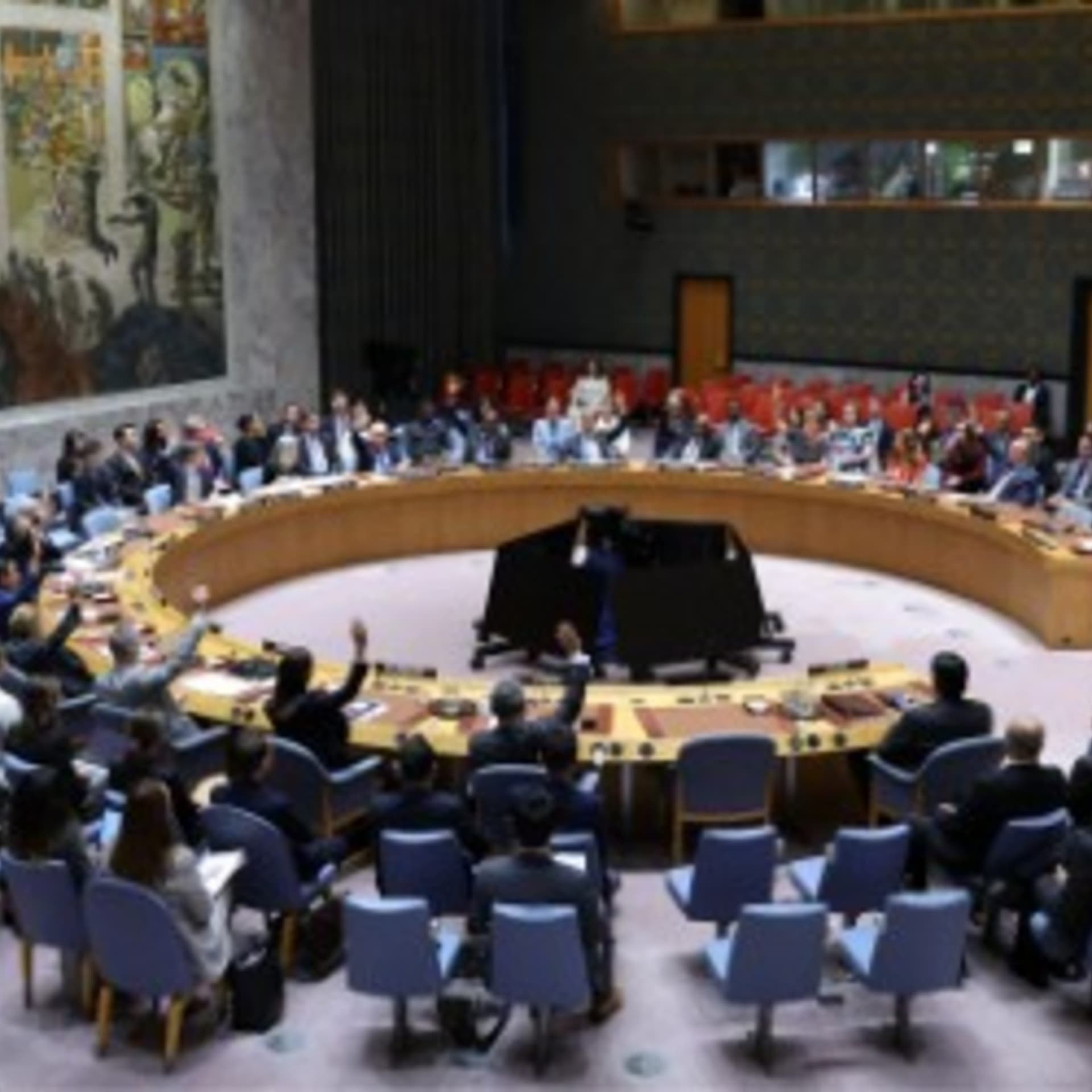
Image: Members of the U.N. Security Council vote on a draft resolution demanding a ceasefire in Gaza, at U.N. headquarters in New York City, U.S., September 18, 2025. Eduardo Munoz/Reuters