
In short
Canada’s Prime Minister Mark Carney’s response to escalating U.S. tariffs, including his “fight back” rhetoric, Canada’s dollar-for-dollar counter-tariffs, and the breakdown of late-stage trade talks.
Guest backgrounds
Jamie Poisson hosts CBC’s daily news podcast FrontBurner; previously joined the show when U.S.-Canada tensions rose. Katie Milkman is a Wharton behavioral scientist (mentioned as the Choiceology host, not the trade guest).
Key claims
Carney’s Davos speech frames Canada as a “middle power” that must build resilience and diversify beyond the U.S. when the “old order” won’t return. The U.S. proposed “uneconomic, unfair” terms; Carney sought lower sectoral tariffs and a broader, fair deal (including steps toward USMCA). Talks collapsed over car/truck tariff differences and Canadian French-language/content rules (e.g., Netflix homepage prioritization). Canada’s public support is high (about 75% in a cited poll).
Notable examples
50% U.S. tariffs on hundreds of Canadian goods; Canada’s counter-tariffs on steel, furniture, honey, fresh tuna, and cotton t-shirts; retaliatory tariffs delayed until Sept. 8; Trump/Carney negotiating around U.S. Trade Representative Jameson Greer; comparison to China’s past U.S. tariff standoff; JD Vance remarks in Maine.
Written by AI. May contain mistakes. Listen to the episode to check what was said.
Chapters
Tap a time to open that second in VOUnderstanding Canada's Position
1:16 to 2:49
Discussion on Canada's trade strategy under Prime Minister Mark Carney amidst US tariffs.
“They negotiate, they flatter, they wait it out and hope for a better deal.”
Mark Carney's Defiant Stance
2:49 to 4:08
Exploration of Carney's speech at Davos and its impact on Canada's trade policies.
“And why do Canadians feel like they might have the upper hand?”
Canada's Global Trade Strategy
4:08 to 5:59
Canada's efforts to diversify trade relationships post-Davos speech.
“So I know that that speech hit hard around the world.”
Escalation of Tariff Issues
5:59 to 7:45
The background on tariffs and how they have escalated in US-Canada relations.
“He has gone across the world trying to secure deals to diversify the Canadian economy.”
Negotiation Breakdown
7:45 to 11:18
Analysis of the failed trade negotiations and the sticking points that caused collapse.
“willing to stand up to the United States, to stand up to the Trump administration, because there is now this looming issue of tariffs.”
Carney's Press Conference and Response
11:18 to 14:00
Mark Carney's response to the trade negotiation collapse and his rhetoric on the US.
“In the last kind of hours and days of the negotiations, the Canadians felt like the Americans were throwing some curveballs into the mix.”
Mark Carney's Defiant Stance on Trade
14:00 to 19:00
Learn about Mark Carney's strong response to U.S. trade demands and the implications for Canada.
“I saw a lot of news coming through about what was going on in Canada.”
Canadian Public Support for Trade Strategy
19:15 to 28:00
Explore the Canadian public's reaction to Mark Carney's trade strategy and the political implications.
“to this decision from the Canadian Prime Minister.”
Transcript
Automatic transcript. May contain errors.0:00Jayme Poisson:This BBC podcast is supported by ads outside the UK.
0:30Join Wharton Professor Katie Milkman, an award-winning behavioral scientist and author of the best-selling book How to Change, as she shares true stories from Nobel laureates, authors, athletes, and everyday people about why we do the things we do and how to make better choices to help avoid costly mistakes. Each episode covers the latest research in behavioral science and dives into themes like the power of self-control, shaping your mindset for success, navigating new beginnings, and why starting over can feel so hard. Listen to choiceology at schwab.com slash podcast or wherever you listen.
1:15Donald Trump's signature go-to move is to threaten tariffs on friends and foes alike. And most allies don't retaliate. They negotiate, they flatter, they wait it out and hope for a better deal. But the Prime Minister of Canada, Mark Carney, is fighting back. I warned that America is trying to break us so they can own us. And I promise that that will never, ever happen. We are keeping that promise. That was the prime minister on Saturday after trade talks between Canada and the U.S. fell apart. Carney was asked by a reporter about his defiant tone. Why does it feel like today Mark Carney is going to war?
1:58Trade war. The tone. Because we were attacked. Like, you're at war when you get attacked. We got attacked. The Trump administration has imposed 50 % tariffs on hundreds of Canadian goods. And now Canada has announced dollar-for-dollar counter-tariffs on a range of American products. Things like steel, furniture, honey, fresh tuna, and cotton t-shirts, just to name a few. Carney is standing up to Trump, even at the risk of economic pain at home. So how did Canada end up here, embroiled in a trade war with its biggest trading partner? And does Canada stand a chance against the world's largest economy?
2:44From the BBC, I'm Asma Khalid in Washington, D.C. And today on The Global Story, Mark Carney's big gamble. What's his calculation? And why do Canadians feel like they might have the upper hand?
3:02Jayme Poisson:My name is Jamie Poisson, and I host FrontBurner, the daily news podcast from the Canadian Broadcasting Corporation, the CBC. Jamie, we had you on the show a little while back because things were getting heated up between the United States and Canada. Welcome back to the show. I think your presence here indicates that things may be even more heated than when we last spoke, but welcome back. They have ratcheted it up for sure. Thanks so much for having me back. It's great to be here. In this episode, we want to zero in on Mark Carney himself, the prime minister of Canada, and look at why he is taking the decisions he has taken to stand up to the United States and say, no, you know, what does he have to gain and what does he have to lose?
3:45And at a speech that he delivered at Davos, this big conference at the end of January, Carney struck a rather defiant tone on the relationship with the United States and the United States' role, I would say broadly, in the world. And I think that that has sort of set the tone of what we have seen from him in the following months. Can you tell us about that speech?
4:10Jayme Poisson:So I know that that speech hit hard around the world. And it hit hard in Canada, too. It got a lot of attention. But it had actually stitched together a lot of things that Carney had been saying for some time, albeit, I think, with more rhetorical flourish. Also, I think the timing of the speech was really important. People might remember that it was around the time that Trump was making these overtures towards Greenland, right? Yes. And the world that he paints in that picture is a harsher one, where you have these big powers vying for power. We know the old order is not coming back. We shouldn't mourn it.
4:52Nostalgia is not a strategy. But we believe that from the fracture, we can build something bigger, better, stronger, more just.
5:01Jayme Poisson:This is the task of the middle powers. And as a middle power, he talks about either needing to be at the table. Because if we're not at the table, we're on the menu. And I don't think that it was a speech advocating for the antagonizing of America, but it was a speech about the importance of pragmatism. Middle powers deal with the U.S. as it is, and then they must go out and build their resilience elsewhere, diversify, work with one another, build strength at home too. The powerful have their power. We have something too. The capacity to stop pretending, to name reality, to build our strength at home, and to act together.
5:48That is Canada's path.
5:54Jayme Poisson:And since that speech, that is what Prime Minister Carney has done. He has gone across the world trying to secure deals to diversify the Canadian economy. We've made deals with India, Saudi Arabia. I think he's heading to Brazil soon, even China. And at the same time, I think he's been trying to get to some kind of deal with the United States that is fair for Canada. And he's been kind of slow rolling it because I don't think what he wanted to do was make some short-term concessions. He's been saying to the administration, let's make a real deal. Let's make a comprehensive deal. And that's what they were trying to do up until recently when everything fell apart.
6:35Well, Jamie, you said a moment ago that that speech at Davos was not necessarily meant to antagonize the United States. And I hear what you're saying, but nonetheless, we saw the president of the United States react in rather strong terms. Canada gets a lot of freebies from us, by the way. They should be grateful also, but they're not. I watched your prime minister yesterday. He wasn't so grateful. They should be grateful to us. Canada. Canada lives because of the United States. Remember that, Mark, the next time you make your statements?
7:09Jayme Poisson:Yeah, I mean, I think since then, the Wall Street Journal has done some pretty incredible reporting that around that time, Mark Carney was also reaching out to European leaders and saying, listen, guys, the United States is not coming back here. We need to move forward. He's like texting them from a British cell phone number because, of course, he used to be the head of the Bank of England. You know, I think it is fair to say that he has kind of positioned himself in a leadership role globally. So Cardi gave that speech back in January. Here we are more than six months on. And we see him being put to the test, you could say, in terms of how much he is actually willing to stand up to the United States, to stand up to the Trump administration, because there is now this looming issue of tariffs.
7:55And, you know, we hear a lot about trade issues between the United States and Canada. And I think people's eyes at times kind of glaze over being like, haven't I, you know, seen this movie before? But this, I think, is really significant. So I want to pause on this, Jamie, and understand how did tariffs specifically bubble up as this huge issue over the last few months?
8:16Jayme Poisson:Okay. So, of course, if we go backwards here, Canada was wrapped up in these initial rounds of tariffs that much of the world was wrapped up in the Liberation Day tariffs. April of like last year, April of 2025. Yes. We've had these industry tariffs that we've been dealing with on aluminum, on auto, on steels. And they have been very destructive to those industries. And so the Canadians have been trying to get relief on those tariffs. And in July of this year, Donald Trump announces. Yes, that's when we last spoke, Jamie, in July. Exactly. When we last spoke in July, he announces these 50 % additional tariffs on all sorts of stuff.
9:00Jayme Poisson:As we talked about last time, cement, hockey sticks, alcohol, some dairy. And a lot of people think that he did that because he wanted to catalyze negotiations. And it did. It brought the Canadians to the table. It brought the Americans to the table. Now they had this deadline and they started to negotiate. And there's no question that they were making some real progress on a comprehensive deal with Jameson Greer, the U.S. trade representative. They were making so much progress that the president announced last week that there was a deal. And I think, you know, the Canadians were much more careful about whether or not there was a deal.
9:41Jayme Poisson:But what we were hearing from their side was a lot of optimism as well. So as they are negotiating this all, and as you say, it appears that the U.S. and Canada are making progress, so much progress that, in fact, we saw President Trump delay the actual implementation of these tariffs because as he went on social media last week and insinuated that they had a deal just, you know, subject to the finalization of documents. What were you hearing from Canada and what do we know about what Mark Carney's position was? So I think Mark Carney's position was, look, what I need here is these sectoral tariffs or these industry tariffs that we've been dealing with for over a year to be at minimum lowered.
10:25Jayme Poisson:They're too high. They're creating too many problems for the auto sector, for the aluminum sector, for steel. Obviously, the other part of the negotiation is that these additional tariffs Trump threatened in July should not go into effect. And then the third part is that Mark Carney wants a real deal, you know, not just a few things. He's trying to get to something kind of larger that would be considered a first step towards a broader negotiation for KUSMA, the North American free trade agreement that Canada, Mexico and the United States are part of. And I have seen reporting in The New York Times and other places kind of giving drips and drops of what the United States was willing to offer.
11:12So help me understand how this all fell apart and when it fell apart.
11:18Jayme Poisson:So here's what it sounds like happens. In the last kind of hours and days of the negotiations, the Canadians felt like the Americans were throwing some curveballs into the mix. As I understand it, the Americans came back with a couple of things that the Canadians felt were unacceptable. Let me give you some examples. What we're hearing is that the Americans came back and said, look, we're going to lower these tariffs on cars, but you're not getting very much reprieve on trucks. So the Ford F350 or the Silverado, which I think is made by GM. These are important automobiles that are made in Ontario.
12:03Jayme Poisson:Obviously, we are a bilingual country, and our culture and heritage and protection of the French language is important. And we're hearing that there were some disagreements around kind of labeling in French, but also importantly around streaming of content. So regulations here in Canada help promote Canadian content, including French language content. And so a company like Netflix would have to prioritize on its homepage that Canadian content, including French language content. And that was something that the Americans were opposed to. And, you know, there was a feeling amongst Canadian negotiators, as I understand it, that this was like not sensitive to our endeavors here to protect the language.
12:54Jayme Poisson:And so that was just yet another sticking point. Right. It's not clear to me that the United States was trying to undermine the French language in Canada. I mean, this might, from their perspective, have just been about, like, efficiency. You know, that companies don't want to print French labels or that tech companies do not want to be overly regulated or have to deal with kind of onerous rules that they don't like. So it sounds like there were these sticking points in the final hours of the negotiations. And, you know, what we're hearing from Washington, at least publicly, was that these talks were progressing.
13:32You're saying behind closed doors, it looked ominous, like things were not headed in the right direction. And then the next thing we know, it appears like these talks completely collapsed. So on Saturday, we then see Mark Carney hold a press conference. Good morning, everyone. Bonjour tout le monde. I'd like to take this opportunity to update Canadians on developments in our trade negotiations with the United States. And I will say it's not every day that news from Canada, you start getting like push alerts and headlines here in the United States from on a Saturday. But I did. I saw a lot of news coming through about what was going on in Canada.
14:10And he struck, again, a rather defiant tone. Tell us what he said, what he was telling the Canadian public in that moment.
14:17Jayme Poisson:He essentially said that the United States had asked for too much and given too little. In recent days, the United States proposed new terms that were uneconomic, unfair, and undermined the net benefits for Canada and called into question the reliability of any deal. You know, he also talked about essentially how this was a war. Like he was asked at the end, it sounds like Mark Carney is going to war. And he said, why does it feel like today Mark Carney is going to war? Trade war. The tone. Because we were attacked. Like you're at war when you get attacked. We got attacked. Those are strong words, Jamie.
15:01Jayme Poisson:Extremely strong words. I mean, he was calm. He's a calm guy. But there was certainly a resolve. And, you know, I would imagine maybe some frustration under there. So he also announced retaliatory tariffs. Canada will match Washington's new tariffs dollar for dollar in order to protect Canadian workers, farmers, families and businesses. So these tariffs, I know I'm so sorry for people listening. We're just talking about so many different tariffs, but the ones that were announced in July by Trump, the ones on hockey sticks and cement that we've been talking about, those went into effect when the talks broke down.
15:37And the tariffs that then went into effect on Canadian goods on Saturday, we're talking about a pretty hefty tariff rate here, 50 % tariffs on, I've heard it reported as 20 billion U.S. dollars worth of goods.
15:53Jayme Poisson:Yeah, about 28 Canadian. And so Mark Carney said, look, like, we are going to do dollar for dollar tariffs. And so there is a sense that what they're going to try to do is tariff businesses in the United States that will create some pain or some problems for the U.S. administration. And I should say this is an important point. These retaliatory tariffs are not supposed to come in until September 8th. That might be because the Canadians felt that they needed time to, like, figure out what to do. It might also be because there was a hope that there could be some kind of off-ramp here, and that maybe it was a bit of time for both sides to get back to the table.
16:35This trade war, if I may use that term, is happening a couple of months before the midterm elections here in the United States. And some of the states that will likely feel this economic pain the most significantly are states along the U.S.-Canada border like Maine, Michigan, states that are also going to play a critical role potentially in which party controls the Senate. But is there a sense within the Canadian government that President Trump, the Republican Party may be more vulnerable right now and less able to withstand the effects of a full-blown trade war?
17:15Jayme Poisson:Yeah. I mean, I think that that's in part why the Canadians have been kind of slow rolling any kind of agreement or really wanting to make sure that we get a good deal, because I don't think they think that Trump is getting stronger. They think that he's getting weaker, right? And so if the Republicans lose the midterms, if they lose the House, even if they lose the Senate, like, I don't know how that would necessarily change the scales here. I mean, it would certainly make the president weaker. I mean, these are presidential proclamations. So I'm not sure if it would necessarily change things on the ground immediately.
17:55Jayme Poisson:But I mean, it could. It could work to Canadians' advantage. You know, you do have to wonder if maybe even there are people who are hoping that the United States might come back to the table before the midterms. Because getting a deal with Canada might actually help. Like, maybe some of these politicians running in some of these states are like, look, this is like a problem for me. People don't like that you have started this trade war with Canada and just like get back to the deal that you were almost at before it all fell apart. And I mean, I suppose that that's a possibility as well. Thank you.
19:01Because at Schwab, you can invest your way. No matter your goals or appetite for investing, Schwab has everything you need all in one place. Visit schwab.com to learn more. I want to ask you about the reaction in Canada to this decision from the Canadian Prime Minister. Our colleagues here at the BBC have been speaking to Canadians to gauge their reaction to Carney's approach on the US and trade. and broadly they seem supportive. A turn to pivot towards Europe and Asia as trading partners reflects the realities of an emerging new world. I think he's doing the best he can do. What Carney is doing, I think any Canadian in his position should do just basically that.
19:47I mean, you don't want to allow a bully to just walk all over you. What's your sense of how this is all being received by the Canadian public?
19:56Jayme Poisson:The latest poll that I have seen places the support for Carney walking away from this deal at around 75 percent of Canadians. So that is a bipartisan consensus. So even Carney's critics, you're saying? People that didn't vote for Carney. So, you know, there is quite an appetite here in Canada for Canadians to fight back. I mean, that poll certainly demonstrates that at this moment, there appears to be a lot of patriotism, willingness to rally around the flag. And so it sounds like you're saying Mark Carney has something beyond just the economic pain, perhaps, of this moment that he's considering from this strategy, that he has something else to gain from this all.
20:46Jayme Poisson:There's an emotionality in this as well. You know, I don't think that it can be discarded. You know, Mark Carney's speech in Davos, Mark Carney's speech on Saturday, I think that's Mark Carney saying what he believes. But it is also Mark Carney tapping into public sentiment. Doug Ford, the premier of Ontario, and now Donald Trump seemed to be going at it. Donald Trump sent this kind of truth social post out on Monday saying that Doug Ford is like the less charismatic, less intelligent brother of the great, late Rob Ford, who people might remember as the former mayor of Toronto, who is embroiled in quite a crack scandal.
21:33Jayme Poisson:Anyways, that's a bit of a sidebar. But Doug Ford is himself, you know, a politician who loves a good line. As I said before, he's the type of guy in school that would take your lunch money one day, take your toque off your head the next day and then steal your running shoes. He's talked about how Donald Trump is a loser. But I'm not going to take any advice off a guy that's the king of bankruptcies. And he's actually tariffing his own people, taxing his own people. Certainly he's using the same kind of approach that Donald Trump does when kind of dealing with other leaders. And just to put this in American terms to be clear, Doug Ford and Mark Carney are not in the same political party.
22:18Jayme Poisson:Yes, Doug Ford is a conservative. Mark Carney is a liberal. And I just think that that also speaks to the point that this is a bipartisan issue here. Despite it being, though, a domestically popular position in this moment to walk away from the United States in the trade talks, it still strikes me as a major political gamble. and I'm curious what you see Mark Carney potentially losing from this all. Yeah, look, this will not come without real hardships for people and I don't know if the winds will change as we move along here. I think this is a big gamble on Mark Carney's part. He has put himself up as this person who is standing up to Donald Trump.
23:11Jayme Poisson:And there's enormous upside in that, right? If it works, and if he is able to extract some kind of real and fair deal, it will be a win, and it will be probably an example for the rest of the world. If it doesn't work, I think the biggest thing that he could lose and that Canadians could lose is that our economy takes an enormous hit. You know, the irony of this whole thing is like, he is trying to go out into the world and get people to invest in Canada in order to gain independence from the United States. But you can't do that unless you're able to kind of calm down the chaos with the United States.
23:56Jayme Poisson:So, I mean, what's on the table here, it's jobs, it's people's lives, it's kind of the economic well-being of the country. There's a lot of risk. You know, at the end of the day, you know, I don't know how much Canadians will blame him or blame Donald Trump. Jamie, part of why Mark Carney's decision to walk away from the trade talks and then announce retaliatory tariffs caught my attention is that I have so rarely seen another country engage with the United States on trade in that way. And in fact, the other country that came to my mind in terms of, you know, that stood up in a similar fashion is China.
Read the full transcript
24:43And last year, there was a moment where a lot of trade between China and the U.S. you know, effectively came to a standstill. And that was the strategy that Xi Jinping took until eventually there was some sort of truce announced. And I mentioned this all because on Monday, we heard the vice president of the United States, J.D. Vance, speaking in Maine. And he specifically drew a comparison between Canada and China.
25:09Jayme Poisson:If you look at the amount of tariffs that have been applied, not just on Maine, but on a lot of our northern states that are doing cross-border trade with Canada, Canada and China have been the two worst countries when it comes to trade policy anywhere in the world. What a shame that is. China, you of course expect. They're our biggest economic competitor. I would expect that from China. I would not expect that from Canada. But to state the obvious here, China is also a much larger economy than Canada. And I understand, you know, Carney saying that middle powers unite. But without the kind of economy that China has, how can Canada withstand the economic pain that an escalating trade war might bring about?
25:51Jayme Poisson:To flip that argument from the Canadian perspective, I think part of it, too, is that we are so integrated, Canada is so integrated with the United States, and that is such an important and central partner that that's actually more of a reason why they feel like they can't take a bad deal. So it's one thing if you're Japan and you cut a bad deal. It's another thing if you're Canada and you cut a bad deal.
26:20Jayme Poisson:Because what you're talking about is like the decimation of some of your industries, for example. You're saying that even though it's not as large of an economy as China's, it's an economy you're saying that is so integrated with the United States. And so that's why it's so important to try and get it right, right? because there could be such tremendous impacts. The other calculation being made here is that this is kind of existential for Canada, but maybe it's not so existential for the United States, right? And so, you know, if you can fight back strategically, if you can kind of show some pain in places
27:06Jayme Poisson:where it's not worth it anymore for the United States. Maybe you don't always have to be the second big guy, right? Maybe that is how you win as a middle power as well. I'm not saying it's going to work. But, you know, I think that's part of the calculus here.
27:30Well, JB, thank you for joining us back on The Global Story. We really appreciate it. Thanks so much for having me. It's great to be with you.
27:42That was Jamie Poisson, host of the CBC's daily news podcast, FrontBurner. And folks, that's it for our show today. A reminder that you can always reach us anytime with questions or story ideas by sending us an email. Our address is theglobalstory at bbc.com. And by the way, you all know I feel really uncomfortable with praise, but I feel like I need to acknowledge this note that we got from our listener, Denise, because it is so unbelievably kind. Loyal listener Denise wrote in, Thanks for such a fascinating discussion on the potential new skin cancer vaccine. I learned so much from this podcast, and it's such a pleasure to listen as often as I can.
28:21She went on to say, My favorite line from the show is, thanks for listening. And we'll talk with you again tomorrow. Well done. Well, Denise, thank you for listening. We really appreciate you taking the time to write in. Our episode today was produced by Aaron Keller and Zandra Ellen. It was mixed by Travis Evans. Our digital producer is Sam Gruet. Our executive producer was Martine Powers. Our senior news editor is Chyna Collins. And I'm Asma Khaled. Thanks as always for listening. And thank you especially, Denise. We will be back again tomorrow.
From the publisher
What are the costs of standing up to your biggest trading partner?
Canada recently walked away from trade talks with the US hours before Trump's deadline to impose major tariffs on Canadian goods. Prime Minister Mark Carney struck a defiant tone, acknowledging that Canada was now locked in a trade war with the US. "You're at war when you're attacked,” Carney told reporters, “we got attacked". He also announced retaliatory tariffs, pledging to match US tariffs, "dollar for dollar". Carney's tough stance is popular at home, but will it come at a price?
We speak to Jayme Poisson, host of the CBC podcast Front Burner, about whether Carney is taking a big political gamble by standing up to Trump’s tariffs – and why many Canadians feel confident they can withstand a trade war with their southern neighbour.
Listen to Frontburner: https://link.mgln.ai/jvyxQW
Producers: Aron Keller and Xandra Ellin
Executive producer: Martine Powers
Digital producer: Sam Gruet
Sound engineer: Travis Evans
Senior news editor: China Collins
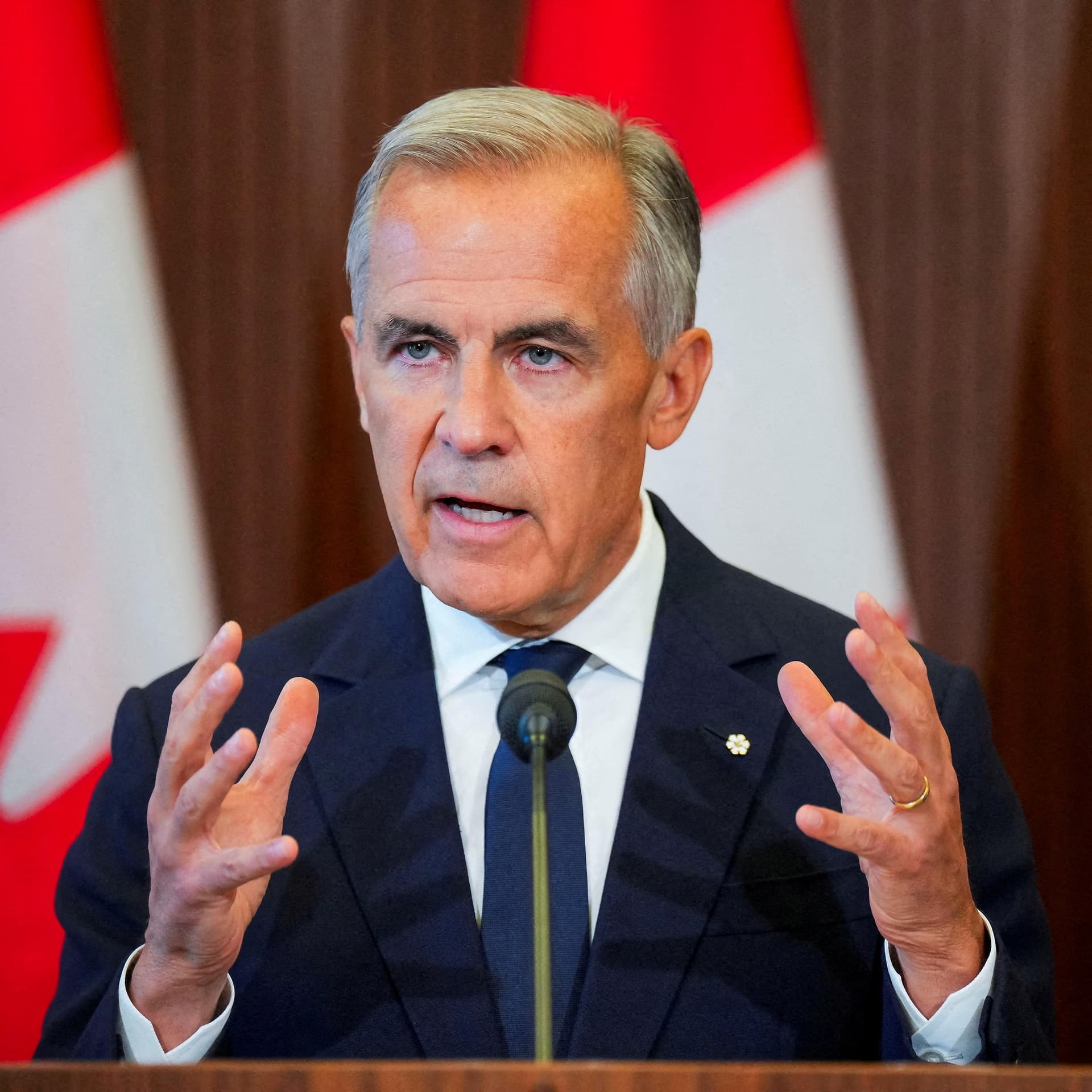
Photo: Canada’s Prime Minister Mark Carney speaks holds press conference after suspending trade negotiations with the US, in Ottawa, Canada August 22, 2026. Credit: Reuters/Chris Tanouye.