
In short
Whether a US-led conflict with Iran could become a “forever war,” and how comparisons to Iraq (2003), Afghanistan, Libya, and Syria illuminate likely outcomes.
Guests
Gordon Carrera, BBC security analyst and former BBC security correspondent; also hosts The Rest is Classified.
Key claims
The Iraq–Iran comparison is “faint” because Iraq had a long, explicit case for regime change (including UN/WMD justification) and major buildup, while the Iran case described here had little buildup and “haphazard” justifications (e.g., claims about nuclear enrichment timelines and missile threats without strong evidence). A central risk is lack of a post-intervention plan, raising the chance of improvisation and “mission creep” toward boots on the ground. Afghanistan is cited as a successful immediate removal of the Taliban but a strategic failure afterward, ending with Taliban return.
Notable examples
Iraq’s WMD/UN process; public support post-9/11; Libya’s air campaign leading to ongoing civil war; Syria’s “red line” vacuum enabling Russia’s intervention.
Written by AI. May contain mistakes. Listen to the episode to check what was said.
Chapters
Tap a time to open that second in VOUS Military Interventions Overview
1:11 to 2:46
Discussion on the U.S. history of military interventions in the Middle East.
“What is happening to the man that I supported?”
Comparing Iraq 2003 to Iran 2026
2:46 to 4:44
Analysis of the similarities and differences between the Iraq war and current Iran situation.
“Let's start with Iraq, which is a comparison that a lot of people are making right now.”
Justifications for War: Iraq vs. Iran
4:44 to 6:54
Exploration of how justifications for military action differ between the two conflicts.
“But that was very different from what we've seen with Iran this time, in which there's been almost no buildup.”
Public Opinion and Political Calculations
6:54 to 12:06
Discussion on how public opinion and political factors shape U.S. foreign policy decisions.
“or made them convincing, because pretty quickly they were disposed of, actually.”
The Afghanistan Context
12:06 to 14:00
Comparison of the U.S. involvement in Afghanistan to the current situation regarding Iran.
“Other points they go, well, maybe we can go for the Venezuela option, which is to have a effectively a leadership change, the Delce Rodriguez option, you know, who was Nicolas Maduro's deputy, who suddenly takes over.”
US Intervention in Afghanistan and Iraq
14:00 to 15:20
Explore the consequences of US military interventions in Afghanistan and Iraq.
“It was done remarkably swiftly, and in that case with just air power and special forces on the ground.”
Lessons from Military Engagements
15:20 to 17:10
Discuss lessons learned by the Trump administration from past military engagements.
“And you could hear Pete Hegseth very explicitly saying this.”
The Trauma of US Withdrawal from Afghanistan
17:10 to 17:40
Understand the traumatic impact of the US withdrawal from Afghanistan.
“Biden's botched exit in Afghanistan is the most astonishing display of gross incompetence by a nation's leader, perhaps at any time that anybody's ever seen.”
Comparison of Libya and Iran
17:40 to 20:40
Analyze the similarities and differences between the situations in Libya and Iran regarding intervention.
“you to decide if they're good, bad, or just another billionaire.”
Consequences of Airstrikes Without Ground Troops
20:40 to 24:10
Evaluate the outcomes of military interventions without ground forces, focusing on Libya.
“and actually Donald Trump had said, you know, help is coming, but it didn't come at that time.”
Show all 13 chapters
The Evolution of US Foreign Intervention
24:10 to 26:10
Trace the changes in US foreign intervention policies from Iraq to the current context with Iran.
“And I think it's different from those other interventions.”
Potential for a New Forever War
26:10 to 28:00
Discuss the risks of the US becoming involved in another prolonged conflict in Iran.
“Could this conflict in Iran be the new forever war?”
Discussion on the Forever War Scenario
28:00 to 28:37
Explore the potential for boots on the ground in a prolonged conflict involving Iran.
“I guess what I'm saying is there is a scenario in which you could end up with boots on the ground of forever war.”
Transcript
Automatic transcript. May contain errors.0:00This BBC podcast is supported by ads outside the UK.
0:30World Service. Listen now or search for Good Bad Billionaire wherever you get your BBC podcasts.
1:00Gordon Correra:Catch every brand new episode every weekday. Just tap into iHeart to start watching. And we hope you enjoy the show.
1:11What is happening to the man that I supported? The man that denounced what happened in Iraq? The man that said no more foreign wars, no more regime change?
1:21Gordon Correra:The former Congresswoman Marjorie Taylor Greene has compared the Iran war to Iraq. He doesn't care about what the American people think, and he may put troops on the ground. After Iraq, Afghanistan and Libya, Donald Trump was supposed to be the anti-forever wars candidate. I am furious about this. How much is this war going to cost us? From the BBC, I'm Tristan Redmond in London. And today on The Global Story, the US has a tumultuous recent history of interventions in the Middle East. What makes Donald Trump think that Iran will go any more smoothly?
2:11Gordon Correra:Gordon, so great to have you with us. Could you introduce yourself, please, for us with your name and title? My name is Gordon Carrera. I am a security analyst for the BBC, a long time previously a security correspondent for the BBC. I also now host a podcast called The Rest is Classified. Fantastic. Well, thank you so much for joining us. We wanted to speak with you today about the possible comparisons between what is happening in Iran now and various different US military interventions in the Middle East, North Africa and surrounding regions over the last few decades to try and understand what lessons, if any, have been learnt.
2:46Gordon Correra:Let's start with Iraq, which is a comparison that a lot of people are making right now. The Iraq war that started in 2003. You've done a lot of in-depth reporting on this period of recent US history, particularly on the case that was made for the Iraq war and the build-up to it. What are the similarities and differences between Iraq 2003 and Iran 2026? The shadow of Iraq is hanging over what the U.S. is doing in Iran now. And you can hear that explicitly referred to and brought up time and time again, including by Pete Hegseth, the Secretary of War, Secretary of Defense, talking about this isn't going to be like Iraq.
3:28This is not Iraq. This is not endless. I was there for both. Our generation knows better and so does this president. So you can see the framing of it is very much about what are supposed to be the differences. There are differences, it's worth saying. I mean, one of the differences is that the Iraq war had an enormous build-up and a very explicit attempt to build a case for what was going to be regime change. Now, that case ended up being settled on weapons of mass destruction. Saddam Hussein has gone to elaborate lengths, spent enormous sums, taken great risks to build and keep weapons of mass destruction.
4:10Nuclear weapons, chemical weapons, biological weapons and missiles. The only possible explanation, the only possible use he could have for those weapons is to dominate, intimidate or attack. And it was a very explicit decision that even though the fundamental drive in Washington was just for regime change, to remove Saddam for all kinds of reasons, they needed a justification for it, they felt, both for public opinion domestically and internationally, including in the UN, in the Security Council. So great effort was placed in the US and also the UK in building that justification for war over months and going through diplomatic international processes, trying to get weapons inspectors in, going through UN resolutions.
4:59But that was very different from what we've seen with Iran this time, in which there's been almost no buildup. There's been almost no attempt to make the case. And when it has been made, just in the last few days, around the time that the war in Iran started, it's been quite chaotic and haphazard. You can see echoes of some of the justification in the way the US has talked about imminent threats, potentially missile programs being reconstituted, which could reach the US, nuclear enrichment. but no one has felt that that was quite made in the same way as Iraq.
5:33Gordon Correra:When you hear some of these justifications which have been laid out by the Trump administration in the last 10 days or so, do you have a feeling of bells being rung and uncanniness to it? Well, what's odd is it's a very faint echo of Iraq. If they're ringing the bell, they're not doing it very hard because you saw them in the period around the start of this war, the Iran War, reaching for some of those justifications which had echoes of Iraq. So you saw, for instance, Steve Wyckoff at one point say, well, Iran is potentially very close to a large amount of nuclear enriched material. The 60 % materials can be brought to 90%.
6:11That's weapon grade, weapons grade in roughly one week, maybe 10 days at the outside. You had to talk about the missile capability and Donald Trump referring to missiles which could potentially reach the United States, intercontinental ballistic missiles. They've already developed missiles that can threaten Europe and our bases overseas, and they're working to build missiles that will soon reach the United States of America. But actually, no real evidence that that was close. And when you go back to Iraq, they'd spent quite a bit of time building up dossiers, intelligence estimates, to justify that kind of language.
6:47This time it felt like they were just quickly reaching round for some of those comparisons without really having built them or thought through or made them convincing, because pretty quickly they were disposed of, actually. You'd see them reach for one justification. We knew that there was going to be an Israeli action. We knew that that would precipitate an attack against American forces. And we knew that if we didn't preemptively go after them before they launched those attacks, we would suffer higher casualties. And then effectively ditch it quite soon for another. I think they were going to attack first, and I didn't want that to happen.
7:21So if anything, I might have forced Israel's hand. And wavering between this talk of whether it's regime change or degrading the Iranian military. This operation is a clear, devastating, decisive mission. Destroy the missile threat, destroy the Navy, no nukes.
7:37Gordon Correra:As the real reason for it happening. What was the actual process that George W. Bush and his administration went through in 2003 to make that case? What were the main things that they had to hit and how did they do it? Well, what's interesting is it wasn't 2003. It started in 2002. You know, this was an extended period from when George W. Bush famously described an axis of evil. States like these and their terrorist allies constitute an axis of evil, arming to threaten the peace of the world. Including, it had to be said, Iran. Iran aggressively pursues these weapons and exports terror. while an unelected few repressed the Iranian people's hope for freedom.
8:22And at the time, the talk in Washington was Iraq first, then Iran. But Iraq went so badly, that never happened. But they started to build that case for a year, effectively. A year of building the case for war and of putting in place the pieces to do it. Putting in place the case of weapons of mass destruction, once they'd fixed on that as the best justification, and a UN process. And all of that concurrent with a large scale military buildup, not just the air and navy that we've seen in this Iran war.
8:53Gordon Correra:So very different in many ways. Well, that preparatory phase in terms of public opinion, where did it get them, the George W. Bush administration? How much public support was there for war when the moment eventually came? I mean, it's interesting because when you talk to people now, everyone was like, I was always against it. But actually, at the time, public opinion in the UK was roughly split down the middle and in the US largely in favour. But it was a different time. It was post 9-11, post the September 11th, 2001 attacks on the United States, which had killed 3 ,000. This was a United States still reeling from that.
9:28And that also had a transformative impact on public opinion. And so public opinion was, if you like, more willing to go along with these national security considerations in those days.
9:38Gordon Correra:Well, I remember vividly in 2003, particularly the kind of the drumbeat of patriotism in some sectors of U.S. society that was built up behind the Iraq war. You remember, you know, the French vetoed the U.N. resolution in New York. And then there was a reaction to that. No French fries were going to be freedom fries. Rename the French fry the freedom fry because of our disappointment with the French. There was the revival of the Simpsons moniker for French people as cheese-eating surrender monkeys. Bonjour, you cheese-eating surrender monkeys. Yes. Who could forget all of that? I mean, what is public opinion showing right now from what you've seen?
10:23A divided US, a US which is more opposed to this conflict with Iran than is supportive of it. and of course, but a polarized US with Republicans, supporters of Donald Trump, far more likely to back this policy. I think politics does play a role in this because you've got the midterms coming up and those calculations that will be going on in Washington and in the White House will be partly about how long can you sustain a war where you don't have large scale public support, where you haven't made the case and where you potentially have economic impact from things like rising oil prices, gas prices at the pump in the US.
11:02That's part of the equation, I think. And again, different from 2003. But I think the other comparison, which is correct, I think, between Iran and Iraq is the question of, is there a plan for what to do? Because the great failure with Iraq was there was no plan. It's extraordinary looking back how they had put all this effort into the build-up to the war, the justification for the war, the execution militarily of the war, but almost nothing about what would happen afterwards. You know, disastrous. I mean, absolutely disastrous. Everyone agrees on that. Some terrible decisions in the aftermath.
11:40Where the parallel opens up now is, is there a plan? Because in the run up to Iraq, they'd actually, you know, the State Department had done lots of planning and it just got junked. This time, I don't think there has been any planning. And you can see that when you hear President Trump and other administration officials talk. Because they will say things at some points like, well, a popular uprising would be great. When we are finished, take over your government. It will be yours to take. Other points they go, well, maybe we can go for the Venezuela option, which is to have a effectively a leadership change, the Delce Rodriguez option, you know, who was Nicolas Maduro's deputy, who suddenly takes over.
12:19But basically the rest of the regime remains in place, but it's more pliant to the Americans. It would seem to me that somebody that's there, that's currently popular, if they're such a person, but we have people like that. We have people that were more moderate. But also you have talk about, well, maybe we don't get regime change. If there's something we can do to help them down the road, we'd obviously be open to it, but that's not the objective. There's clearly not a thought-through plan this time either. They're keeping their options open, But if this does start to disintegrate or go wrong, it's going to require improvising.
12:57And that strikes me as one of the things people are very worried about.
13:07Gordon Correra:It would be impossible for us to have this conversation today, Gordon, about US interventions without discussing Afghanistan. The United States was there for 20 years. How different was that context in shaping the rest of the conflict? And what does that tell us about the moment we're in now? So Afghanistan was very different. Good afternoon. On my orders, the United States military has begun strikes against al-Qaeda terrorist training camps and military installations of the Taliban regime in Afghanistan. Afghanistan came right after 9-11, and it was known that al-Qaeda had carried out the tax and carried it out from Afghanistan, where it was sheltered by the Taliban.
13:49So the decision was to remove the Taliban from power. Our military action is also designed to clear the way for sustained, comprehensive and relentless operations to drive them out and bring them to justice. It was done remarkably swiftly, and in that case with just air power and special forces on the ground. But that was because they had very willing partners in groups like the Northern Alliance who were already engaged in a low-level civil war, quite high-level civil war at times, with the Taliban and who could be used as partners by the US to drive the Taliban out pretty quickly. So a remarkably quick and effective removal of a Taliban regime.
14:32But then what? Lots of things happened, but it's partly because then the US shifted its sights to Iraq very quickly afterward and said, we've done Afghanistan, let's do Iraq. They didn't have a political strategy to integrate the Taliban or the political support of the Taliban amongst a significant part of the population back into the process. and you ended up with a new civil war, which turns into one of these forever wars for the US, which means 20 years later, they basically give the country back to the Taliban after 20 years. Lives lost, huge wealth lost, huge reputational damage. That was a successful intervention in the immediate term,
15:10Gordon Correra:but a failure to think strategically what you were going to do next. Okay, what are the lessons the United States and the Trump administration has drawn from that experience? Well, the lessons that the Trump administration have drawn are interesting because I think from both Afghanistan and Iraq, it's they don't want to be sucked into nation building. And you could hear Pete Hegseth very explicitly saying this. We're not going to do nation building. No nation building quagmire, no democracy building exercise, no politically correct wars. We're not going to get sucked into these forever wars. We fight to win and we don't waste time or lives.
15:45That is the legacy of Iraq and Afghanistan. The problem is, that's fine, but if you're going to intervene and not do nation building, what are you going to leave? And how much ability do you have to shape what happens next? It's not obvious, is it?
16:00Gordon Correra:How traumatic was that US withdrawal from Afghanistan? To Afghanistan now, where with little fanfare, the massive airbase that served as the anchor of America's two-decade-long war is now in Afghan control. The pictures of people flying out of Bagram Air Base. Desperate Afghans trying to get out, US Marines trying to help. People literally clinging to the undercarriage to try and get away before the Taliban took power. A wave of terror across the Afghan capital. A suicide bomb hitting the US troops and the people trying to get on the planes. Today, a suicide car bomber struck a checkpoint outside Kabul airport.
16:39I mean, that was incredibly traumatic and I think seared into American political consciousness. Interestingly enough, that is when President Biden's approval ratings start to dip. You know, it's from that summer onwards is the point at which they start to go down and never quite recover, actually. How far that's due to Afghanistan, who knows? But certainly it's part of it. So the consequences of that disaster were traumatic and led to people thinking, well, what was that for Afghanistan? What was that for? And I think that legacy has been deep. Biden's botched exit in Afghanistan is the most astonishing display of gross incompetence by a nation's leader, perhaps at any time that anybody's ever seen.
17:28The Trump administration is taking a very different approach.
17:58you to decide if they're good, bad, or just another billionaire. Good Bad Billionaire from the BBC World Service. Listen now or search for Good Bad Billionaire wherever you get your BBC podcasts.
18:12Gordon Correra:Hi there, I'm Asma Khalid. And I'm Tristan Redmond. And together we're the hosts of the Global Story podcast from the BBC. For those of you all who might be new to our show, we here at the Global Story dive deep every weekday on one big story at the intersection of where the world and America meet. And you can now watch the global story on the iHeart app. Catch every brand new episode every weekday. Just tap into iHeart to start watching. And we hope you enjoy the show.
18:47Gordon Correra:I want to ask you about Libya. Now, Libya is another example which is being cited as perhaps the most pertinent one in terms of a comparison to what's happening in Iran right now. And I just want to understand from you how similar is it and what can we draw from that? I think people have drawn the parallel, but I again think there are important differences. In Libya, this is the era of the Arab Spring. You had popular uprisings of people against the Gaddafi regime, which was a dictatorial, very unpleasant regime. Gaddafi began to go after them, and particularly in Benghazi. His troops were approaching there, basically expecting to massacre people who were from the opposition forces.
19:26And at that point, it was triggered that the US, UK, France would intervene by air. It has been 10 days since Mr. Obama ordered US forces into combat in Libya. The United States and the world faced a choice. Gaddafi declared he would show no mercy to his own people. And that's the comparison point with Iran, is they intervened by air to hit those forces before they could massacre people and opposition groups against the Qadhafi regime. It was not in our national interest to let that happen. I refused to let that happen. But again, there wasn't necessarily a plan. It was a let's stop a potential massacre.
20:07Let's hit the Gaddafi troops. In the end, what that does is play into a civil war and help undermine the Gaddafi regime and eventually lead to its fall and his death. so that you could say, well, there is some comparison there. I think where the comparison with Iran breaks down is if the US had intervened back in January when there was a popular uprising in Iran, if it had intervened at that point, this might have felt slightly different, I think, because you had hundreds of thousands of people out on the streets and actually Donald Trump had said, you know, help is coming, but it didn't come at that time.
20:46It didn't. I mean, you could say it's come now, but in the meantime, who knows how many people have been killed. And Iran has kind of restored a lot of its repressive capability. And so I think the parallel is interesting because you intervene from the air to change the dynamics on the ground, but you're not willing to go all in and actually enforce regime change with a plan for what kind of regime you want afterwards, which is going to deliver a long-term solution, and you get chaos.
21:13Gordon Correra:Okay, so in Libya then, the lack of American boots on the ground, or French or British, because they were involved as well. What has been the knock-on effect in terms of what Libya actually looks like today? And I mean, it is relatively chaotic. It is chaotic. And you've had different militias and different groups continuing to fight out to this day a civil war. So you have an unresolved situation. I mean, it avoided the boots on the ground. And that was the legacy of Iraq was let's not put boots on the ground, but let's try and do something. But in Libya, was that effective? I mean, if your aim is just to get rid of Gaddafi, well, they got rid of Gaddafi, but the result was chaos and civil war and death.
21:57Gordon Correra:The Libya conflict is interesting because Obama was president at the time. He got involved in a US intervention, but he very markedly and consciously took a back seat. It was a military intervention that was led under the auspices of NATO, led by the French President Nicolas Sarkozy and the British Prime Minister David Cameron. And Obama and the United States were essentially silent partners in the endeavour. My understanding of that was that Obama was reluctant to get involved because of experiences in Iraq and in Afghanistan. And the pendulum had swung so far against foreign interventions that Obama didn't want the United States to be seen to be involved.
Read the full transcript
22:38Gordon Correra:It seems like the pendulum is now moving in another direction. I think that's right. And if you go back to those Obama days, you also had a civil war in Syria in which there was a red line put down by Obama about the use of chemical weapons, which the Assad regime crossed. And Obama basically backed away from enforcing that and getting involved, which again was that posture that came out of Iraq and the Obama worldview. Well, the result is it left a vacuum where Russia intervened. And Russia intervened to support Assad. The civil war continued for a long time and eventually resolved itself with the fall of the Assad regime.
23:11So if you break it down, you've got a whole range of different types of intervention in a sense, because you've got everything from Iraq, which is your full-scale military intervention, ground troops, the works, regime change, but no plan for afterwards. You've got Afghanistan, which is a lighter intervention, air and some special forces. You've got Libya, which is by air, but nothing on the ground. Is that successful? Not really. You've got Syria, where you don't do anything at all, but you leave a vacuum and others get involved. So you can take whatever lessons you want, but none of them particularly look that successful in the long term.
23:45But President Trump, I think the shadow of some of these past interventions does hang over him and how he and others talk about these things. But I think he sees the world in a different way and he tries to act in a different way. And you look at what he did in Venezuela and you look at what he might be trying to do in Iran and it almost doesn't fit any of those categories either. It's almost opportunistic. It's exertion to power. It's, you know, throwing pieces up in the air and seeing where they land. And I think it's different from those other interventions.
24:14Gordon Correra:Gordon, has there ever been a US intervention in the Middle East or surrounding region that has worked out? It's interesting that you say the Middle East and the surrounding region, because I think the birth of some of this was in the late 90s, where you had a period, the growth of what was called liberal interventionism. And Tony Blair in the UK was a particular proponent of this because they believed it had worked in the Balkans, as mentioned in Kosovo, but also Sierra Leone. And that created a sense that maybe this could work. And then you had September 11th, 2001, attacks, a different world, an attempt to use it in different places in different ways.
24:51But the experience in the Middle East has been very different. And I think it's very hard to point to successful interventions there. I mean, you've seen all kinds of attempts, but the complexities of the situation make it incredibly unpredictable.
25:03Gordon Correra:I think in all the cases we've discussed so far, Gordon, the United States has sought some form of international backing, either from the UN or international alliances, UN Security Council resolution, for example. Or in the case of Iraq, they tried and failed. They didn't get one. The French vetoed it. Now, that hasn't happened with this conflict in Iran. Donald Trump hasn't even asked the US Congress for approval. How significant is that? I think we're in a different era now. I think that's the only way of understanding it, is we're in a different era in which, frankly, international law seems to mean less than it used to.
25:44You can complain about that and worry about that, but that's the reality of it. People thought that about Iraq in 2003 because the invasion did happen without the second Security Council resolution that people thought was necessary. but Donald Trump seems even less worried or bothered by that and it just says we're in a different world today from those the times of those other interventions we're in a world a more chaotic more fractured global order one in which power is being exerted more freely and you can see that in other ways Russia's invasion of Ukraine in 2022 an example of that in which states are willing to do things they wouldn't do in the past and to invade and to push for regime change and not even really worry about international law.
26:30So it's different today, I think.
26:33Gordon Correra:Could this conflict in Iran be the new forever war? That's exactly what they say they don't want in Washington. That's what they've been very explicit about not wanting. And they've also tried to say no boots on the ground, but then they've also suggested, well, maybe there might have to be boots on the ground. And you can see there the start of what's often called mission creep, which is that if you do start to commit to the idea that you do want to remove the regime, and there may be other voices around who also say, if you're in, you better finish this, then how do you finish it? You might be able to finish it from the air.
27:13They're looking maybe at arming proxies, militias, you know, Kurdish groups, maybe others to try and help, which takes you back to, if you like, the Afghanistan our model or some of the other models. But if none of those work, what if they feel they have to go further? What if there are significant US casualties, say from a missile attack at a US base? Then you are suddenly into a very different situation. You know, one of the things I remember from Iraq very much was, I remember interviewing an Iraqi general who defected from the Saddam regime. And he said, you know, some people will welcome the Americans when they come and do regime change for a week.
27:50And then after a week, they'll see them as occupiers and want rid of them. And I think that is the reality when people put boots on the ground. Even if some people might welcome that, the dynamics can change very quickly. I guess what I'm saying is there is a scenario in which you could end up with boots on the ground of forever war. I don't think it's what they want. They'd be forced into that by circumstance. Having seen what's happening before and understanding the political implications of that in the US, I think that would be something they will do their best to avoid.
28:27Gordon, thank you so much. It's been a pleasure.
28:36Gordon Correra:That was Gordon Carrera, the BBC's security analyst. A quick note before we go, if you're a frequent listener of our show, you know that the global story is all about where the world and America meet. And the US-Israel war with Iran is a huge story in that zone. So we're going to be sticking with it all this week, looking into different parts of the story. On Friday's episode, we'll be speaking to the BBC's international editor, Jeremy Bowen, a man with many decades of experience covering the Middle East. He's going to be talking to us about where the war could be heading. If you have any questions you'd like answers to or aspects of this conflict you'd like to hear us explore, you can email us.
29:16Gordon Correra:We're at theglobalstoryatbbc.com. For all the very latest news headlines from the BBC, we recommend our sister show, The Global News Podcast. It's available wherever you listen. Our episode today was produced by Viv Jones, Aaron Keller, and Zandra Ellen. It was edited by Sam Bonnan and mixed by Travis Evans. Our studio manager was Ben Andrews and our senior news editor is China Collins. And I'm Tristan Redman. Thanks for listening. We'll be back tomorrow. Cheerio.
30:11you to decide if they're good, bad, or just another billionaire. Good Bad Billionaire from the BBC World Service. Listen now or search for Good Bad Billionaire wherever you get your BBC podcasts.
From the publisher
Following President Donald Trump’s announcement over the weekend that the United States was launching an offensive in Iran alongside the Israeli military, comparisons to past US interventions in the region began to proliferate. Many Americans asked whether this latest military operation would become another ‘forever war’, as the US invasions of Iraq and Afghanistan came to be called.
We talk to Gordon Correra, security analyst for the BBC, about America’s complicated history of intervention in the Middle East and surrounding region, and ask what these past conflicts might tell us about possible outcomes for the war in Iran.
Producer: Viv Jones, Aron Keller and Xandra Ellin
Sound engineer: Travis Evans
Senior news editor: China Collins
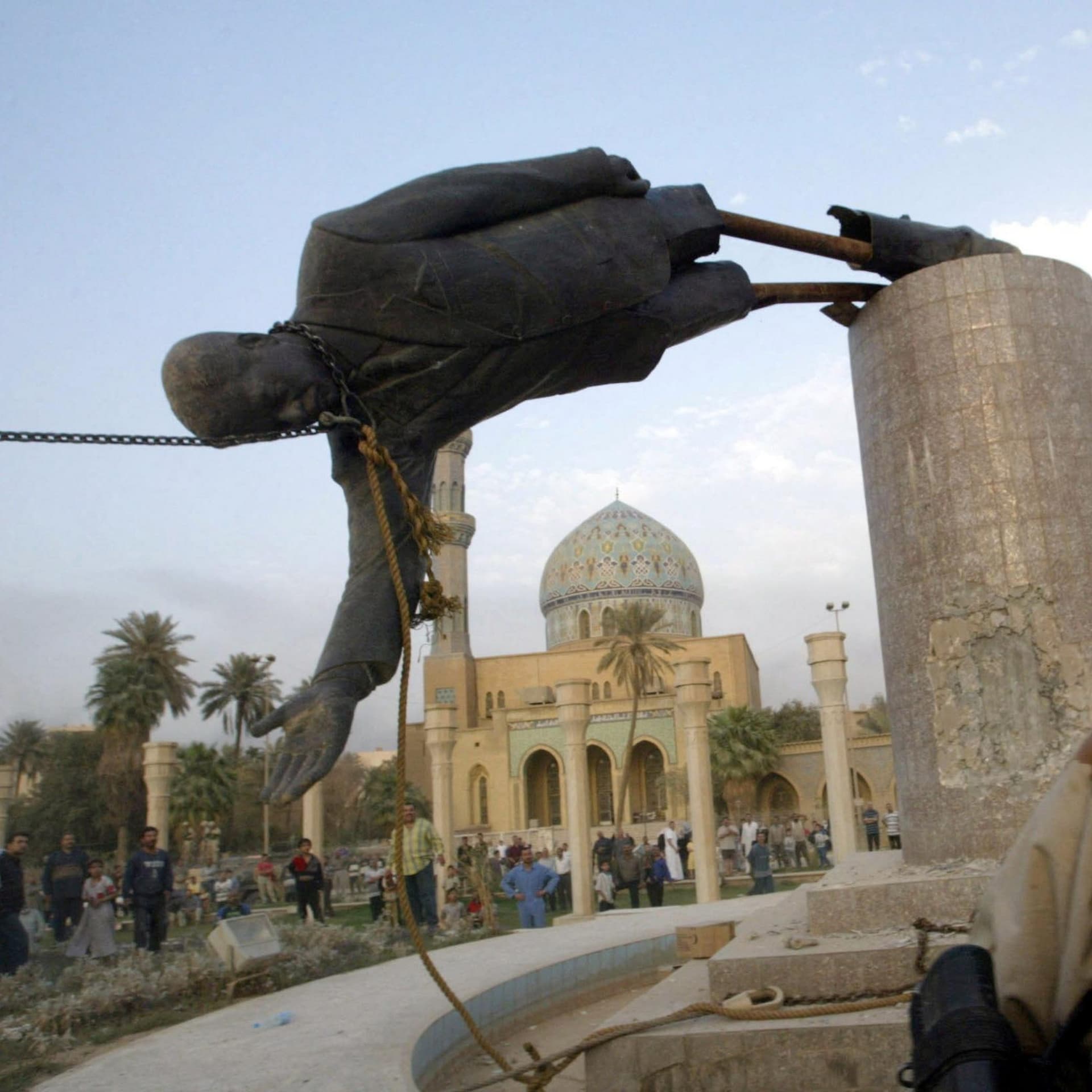
Photo: A US soldier watches as a statue of Iraq's President Saddam Hussein falls in central Baghdad in 2003. Credit: Reuters/Goran Tomasevic