
In short
25 years after 9/11, whether the “war on terror” is over, and what the U.S. response changed—especially Afghanistan, the 2003 Iraq invasion, Iran, and today’s threats.
Guests
Frank Gardner, BBC Middle East correspondent turned Britain’s first security correspondent; he was shot six times by al-Qaeda gunmen in Saudi Arabia in 2004 and uses a wheelchair.
Key claims
Bin Laden planned a long, multi-generational struggle to expel U.S. forces from the Middle East and provoke a wider Muslim–non-Muslim conflict; U.S. intelligence failures (CIA/FBI “stovepiping”) made 9/11 preventable; Afghanistan’s Taliban removal prevented successful international terrorist attacks for 2001–2021, but Iraq was based on false WMD premises and helped embolden Iran and ISIS.
Notable examples
1998 embassy bombings; 2003 Iraq invasion; Iran’s militia/proxy expansion; Iran probing U.S. electricity grid; ISIS’s transnational recruitment.
Written by AI. May contain mistakes. Listen to the episode to check what was said.
Chapters
Tap a time to open that second in VORemembering September 11th
0:45 to 1:05
Personal reflections on the impact of 9/11 and its aftermath.
“Odoo comes fully complete, with all your business apps perfectly integrated and working together seamlessly.”
Remembering September 11th
1:07 to 2:22
Personal reflections on the impact of 9/11 and its aftermath.
“To those of you all who were too young or maybe not alive 25 years ago, I don't know if I can fully explain just how earth-shattering the morning of September 11th, 2001 felt.”
The War on Terror: A Framework
2:22 to 4:05
Discussion of the war on terror as a framework for US foreign policy.
“I was BBC Middle East correspondent, first in the Gulf and then in Egypt.”
Al-Qaeda's Expectations
4:05 to 6:10
Exploring al-Qaeda's expectations and strategies following the 9/11 attacks.
“We are having this conversation 25 years after the attacks on that day.”
Bush's Response to 9/11
6:10 to 7:37
Overview of President Bush's immediate response and declaration of war on terror.
“Salabine, I think it is, people of the cross, from the land that, you know, where Islam sprang up from, of course, all those centuries ago.”
Missteps and Intelligence Failures
7:37 to 9:00
Analyzing intelligence failures and the missteps that led to 9/11.
“And nine days after September 11th, we saw the U.S.”
The Justifications for Afghan and Iraq Wars
9:00 to 12:52
Contrasting justifications for the invasions of Afghanistan and Iraq.
“We're going to lash out at Iraq, possibly with a nuclear weapon, because America was so wounded by this.”
The Consequences of War
12:52 to 14:00
Discussing the consequences of the Iraq invasion and its regional effects.
“And the war ended up lasting nearly nine years and became increasingly controversial and frankly, deeply unpopular here at home as well.”
Consequences of the Iraq Invasion
14:00 to 15:09
Learn about the impact of the Iraq invasion on insurgency and terrorism.
“They considered him an apostate, and he hated Muslim or Islamists.”
Iran's Reaction to the Invasion
15:09 to 17:02
Explore Iran's fears and eventual benefits from the U.S. invasion of Iraq.
“the world to come and join what he called the righteous jihad to reverse that invasion.”
Show all 14 chapters
Emergence of the Islamic State
17:02 to 19:49
Understand how the Iraq War contributed to the rise of ISIS.
“It overthrew the extremely oppressive but Sunni Ba 'athist regime of Saddam Hussein, replacing it with a pro-Iran regime, essentially.”
The Evolving Threat Landscape
19:49 to 21:44
Discuss the current threats faced by the U.S. from Iran and other nations.
“petrol prices and oil prices, everything else, even more.”
Evaluating the War on Terror
21:44 to 24:28
Examine whether the War on Terror has made the U.S. safer since 9/11.
“brought down, cargo planes being brought down by devices put on, smuggled on board planes.”
Reflecting on Military Interventions
24:28 to 26:18
Reflect on the consequences of U.S. military actions in the Middle East.
“And pretty much the whole world was behind it.”
Transcript
Automatic transcript. May contain errors.0:00This BBC podcast is supported by ads outside the UK. Decisions made in Washington can affect your portfolio every day. But what policy changes should investors be watching? Washington Wise is an original podcast from Charles Schwab that unpacks the stories making news in Washington right now and how they may affect your finances and portfolio. Listen at schwab.com slash Washington Wise. That's schwab.com slash Washington Wise. Imagine buying a toy for your kid, but it doesn't come with batteries. That sucks. But honestly, it's even worse when you buy business software. You end up with fragmented, disconnected systems that cost a fortune and don't talk to each other.
0:48Odoo completely changes that. Odoo comes fully complete, with all your business apps perfectly integrated and working together seamlessly. It's everything your business needs in one place, saving you time, headaches, and serious money. Stop paying for missing pieces. Go to odoo.com. That's O-D-O-O.com to learn more. To those of you all who were too young or maybe not alive 25 years ago, I don't know if I can fully explain just how earth-shattering the morning of September 11th, 2001 felt. The horror of watching the second plane hit the World Trade Center live on TV while sitting in high school.
1:30Nearly 3 ,000 victims. The president of the United States in the Oval Office that evening trying to comfort a scared nation. I've directed the full resources of our intelligence and law enforcement communities to find those responsible and to bring them to justice. We will make no distinction between the terrorists who committed these acts and those who harbor them. I was only a teenager, but it was clear to me the world as we knew it was over. The attacks would forever change our American psyche, our sense of safety, how we as a country viewed people like me, its Muslim citizens. But in the years that followed, the way America responded to the attacks also changed the United States' relationship with the world.
2:17From the BBC, I'm Asma Khalid in Washington, D.C. And today on The Global Story, 25 years on, did America win the war on terror?
2:34So I'm Frank Gardner. I was BBC Middle East correspondent, first in the Gulf and then in Egypt. And after 9-11, that then morphed into covering security. They wanted to call me war on terror correspondent. I said, look, that's not going to fit on the television. That's too many words. And I don't like the entire phrase anyhow. So I changed it to security correspondent. I was Britain's first security correspondent. And there's quite a few now. Well, Frank, I should say before we kick things off, you've done this so many times, so I should say welcome back, old friend, to The Global Story. You're very kind.
3:11It's always a pleasure to have you on. Well, thanks very much, Asma. It's nice to be back on the program. I think before I begin, I just, as I want to pay tribute to the victims of 9-11, as somebody myself who is a victim of terrorism, I was shot six times by al-Qaeda gunmen in Saudi Arabia in 2004. I have to use a wheelchair for the rest of my life. And you have my sympathies, all those families, all those who suffered as a result of 9-11. You have my respect and sympathy. And thank you also for sharing that with some of our listeners who may not know your story. I would say for the last 25 years, the guiding framework of U.S.
3:52foreign policy, It has been the war on terror. And the question on my mind as we have this conversation is fundamentally, is the war on terror over? And Frank, I want to begin with September 11th itself. We are having this conversation 25 years after the attacks on that day. And I read this piece recently in the New York Times written by Peter Bergen. He was one of the Western journalists who met Osama bin Laden for an interview in the years prior to 2001. And in that New York Times essay, Peter Bergen wrote that in the lead up to the attacks, bin Laden truly believed that America was a paper tiger.
4:36And his intention was to drive the United States from the region. In other words, in his view, Osama bin Laden did not anticipate a decades-long war that went on to consume Iraq. Frank, you've covered terrorist organizations for a number of years. I'm curious what you make of that conceit, and is that an accurate kind of representation of the starting point? I'm not sure I entirely agree with Peter Bokandera, because bin Laden, he was a long-term planner. He said, look, this is going to go on a long time beyond me. He wanted to set off a multi-generational struggle between what is called Dar al-Islam, the House of Islam, you'll be familiar with this, and Dar al-Harb, the House of War, the Land of War.
5:21You know, going right back to the time of the early Islamic conquests. I mean, I certainly agree that he wanted to drive U.S. forces out of the region, no question about that. But I don't think he ever thought it would be a quick fix. He knew it was going to take quite some time. Did you have a sense of, in that immediate aftermath of the September 11th attacks, that al-Qaeda was anticipating a specific response? What, in your view, did Osama bin Laden, did al-Qaeda expect would happen? Yeah, he wanted to set off a war, I think, between Muslims and non-Muslims. And he wanted the vast majority of Muslims who did not espouse al-Qaeda's cause, he wanted to draw more of them into it with a view to expelling Americans from the Middle East to cleanse the Arabian Peninsula of what he called and what jihadists still call crusaders, Salabine, I think it is, people of the cross, from the land that, you know, where Islam sprang up from, of course, all those centuries ago.
6:24He wanted U.S. military bases out of Saudi Arabia, essentially you're saying. Absolutely, yes. I mean, he was furious with his own Saudi government because bin Laden was a Saudi, although ethnically his family come from Yemen. But his government, the Saudi government, of course, after the 1990 invasion by Iraq of Kuwait, bin Laden had come out of Afghanistan with his so-called Arab Afghans, the Mujahideen, saying, we can do the job. We will expel them for you. And the Saudis said, well, that's very kind of you. Thanks very much. But actually, we're going to get the Americans to do it. The U.S.
7:00Army. What? What? The U.S. Army is going to come in here and do it? Yeah. Well, you know, they've got a pretty big army. Words to that effect. I mean, I'm paraphrasing here, but and he was so appalled about that, that that turned him against the Saudi government. He moved to Sudan and he was stripped of his nationality and moved to Afghanistan. So, Frank, if I'm understanding you correctly, the immediate consequences from your perspective of what al-Qaeda anticipated were twofold. They had an intention to try to get rid of U.S. military bases, U.S. military intervention in the Middle East. And secondly, they did anticipate, Osama bin Laden, in your view, did anticipate a sort of global war.
7:43In fact, you're saying he wanted that. And nine days after September 11th, we saw the U.S. President George W. Bush go to Congress and talk about America's plans to respond. Our grief has turned to anger and anger to resolution. Whether we bring our enemies to justice or bring justice to our enemies, justice will be done. And he's speaking not just to lawmakers in the room. There are family members of those who were killed on September 11th who are in the gallery. I mean, the American public across the nation was watching and tuning in. Our war on terror begins with al-Qaeda, but it does not end there.
8:31It will not end until every terrorist group of global reach has been found, stopped, and defeated. And we hear President Bush use that phrase, which is now known across the world, war on terror. In hindsight, it appears that even from the outset, the American president was indicating that the U.S. response would become extraordinarily wide, vast, that this would be a military campaign unlike something we had seen before. Yeah. In the immediate hours after the 9-11 attacks, I've been told by somebody who was in the heart of UK government that there was a fear that neocons, neoconservatives, hardliners close to President Bush were going to persuade him to lash out at Iraq.
9:31This is two years before the Iraq War. We're going to lash out at Iraq, possibly with a nuclear weapon, because America was so wounded by this. Now, nothing became of that. Within 24 hours, the heads of British security and intelligence agencies flew to Washington, they flew to D.C., sat down with their U.S. counterparts and formulated a strategy for taking down al-Qaeda. It was pretty clear right from the beginning as to where this was. They saw the fingerprints over it right away. Absolutely, because it didn't come out of nowhere. I think it's important to remind ourselves, this was not a surprise attack.
10:06The pieces of the jigsaw were all there, but they were not being joined up by US intelligence. The FBI and the CIA were not sharing intel between them. It was stovepiped, and that was catastrophic. And that's all very clearly laid out in the 9-11 Commission report, where they have said, you know, this was a failure of intelligence, a failure of imagination, a failure to share it. So it was avoidable. And that's the tragedy of it. Because bin Laden had been around for quite some time. You know, he'd, back in the late 80s, he was considered almost a good guy. He used his family's money to fight the Soviets when the CIA was delivering bundles of cash and Pakistani weapons to Afghan Mujahideen to fight the Russians.
10:55When that war ended, when that occupation ended, bin Laden was at a loose end. Came back to Saudi, the Americans were in Somalia doing Operation Restore Hope, and bin Laden's people bombed a hotel in Yemen. Of course, in 1998, al-Qaeda blew up the U.S. embassies in Nairobi and Dar es Salaam in Tanzania. Car bombs exploded minutes apart. Kenyan television is reporting that a van packed with explosives caused that blast. There are unconfirmed reports that an Arab-speaking suspect has now been taken into custody. Glass and debris cut through a long line of people waiting to get into a bank on the same street, turning the sidewalk red with blood.
11:37Killing hundreds of people. And President Clinton, at the time, responded with his missiles, hitting bases in Sudan and Afghanistan. Today, I ordered our armed forces to strike at terrorist-related facilities in Afghanistan and Sudan because of the threat they present to our national security. I have said many times that terrorism is one of the greatest dangers we face in this new global era. So long before 9-11, the CIA knew about bin Laden. They even had a unit called Alex Station whose task it was to hunt him down. Well, initially, the physical manifestation of the war on terror was Afghanistan and the efforts to root out the Taliban.
12:31It then took on, let's say, phase two in March of 2003 when the United States invaded Iraq. And in the United States, we think of the Iraq war as a huge expense of resources, a tremendous amount of life lost. American soldiers, Iraqis as well, of course. And the war ended up lasting nearly nine years and became increasingly controversial and frankly, deeply unpopular here at home as well. It also had this unintended effect on the region and on the neighborhood. Can you explain that? The 2001 CIA, joint CIA-Afghan invasion of Afghanistan to push out the Taliban had plenty of justification. The Taliban had allowed al-Qaeda to use Afghanistan as a base from which to launch the biggest terrorist attack on the United States in its history, the 9-11 attacks.
13:30So the US government demanded the Taliban hand over bin Laden and all those complicit in the attacks. The Taliban refused. But there was some justification for that. There wasn't a justification, history proved, for the 2003 Iraq invasion. It was done under false premises. It's very, very different. There was a false theory during the rounds in Washington in government circles that Saddam Hussein was somehow in league with al-Qaeda, that he had these weapons of mass destruction. No, he didn't. Al-Qaeda hated Saddam Hussein. They considered him an apostate, and he hated Muslim or Islamists. He didn't like them.
14:10And he did in the past have weapons of mass destruction, chemical weapons, a biological research program. He was looking at trying to get hold of nuclear weapons. All of that was destroyed after the 1991 Desert Storm campaign that followed Saddam's and Iraq's invasion of Kuwait the year before. So there were no WMD. It was based on false intelligence. There was a disaster for Western intelligence. It was their biggest setback. Subsequently, catastrophic mistakes were made in the occupation, really stupid, avoidable mistakes, like disbanding the Iraqi army. Most people in the Iraqi army would have been happy to serve under a puppet president appointed by the United States.
14:54But no, they went and took away their uniforms, took away their pride, and so immediately forming the core of an insurgency straight away. In the immediate aftermath of the March 2003 US-led invasion of Iraq, Osama bin Laden issued a kind of call to arms, a dawah, an invitation to Muslims all over the world to come and join what he called the righteous jihad to reverse that invasion. And he said, it doesn't matter if you support, as he called it, the usurper, the apostate in Baghdad, referring to Iraq's President Saddam Hussein. It's not about that. He said, you've got a religious duty to come to Iraq.
15:36And they did. Jihadists came in there thousands from Tunisia, from North Africa, East Africa, from Europe to come and fight. And that ultimately became so-called Islamic State, ISIS, which had a transnational reach. So that was very much as a result, initially, of Osama bin Laden's call to arms. What did the invasion mean for the wider region? And specifically for Iran? I mean, just to geographically place us, Iran and Iraq are neighbors, longtime rivals. What was Iran's reaction to the invasion? When the U.S. launched its invasion of Iraq in 2003, Iran was really worried. They thought, we're next.
16:19And not for no reason. I mean, George W. Bush referred to Iran as part of the axis of evil. Indeed. There were plenty of people close to President Bush in the US centers of power saying, now it's time to clean up the Middle East. And there was a real fear in Iran that they were next. But they ultimately benefited massively in the end from the 2003 US invasion. How so, Frank? It upset the entire chessboard of the Middle East. To the advantage of Iran, to the disadvantage of countries like Saudi Arabia. Because what it did was that it brought in, it ushered in Iranian-backed militias and religious leaders.
17:02It overthrew the extremely oppressive but Sunni Ba 'athist regime of Saddam Hussein, replacing it with a pro-Iran regime, essentially. And it set off a civil war. And within that chaos, Iranian-backed militias and proxies flourished.
17:51Transcription by CastingWords
18:05By the time the Iraq war is officially over, you have a situation now where Iran, Iraq's next-door neighbor, is emboldened, it is strengthened. You also have the group that refers to itself as the Islamic State that emerges as a major threat. We see attacks on Europe. We see the group wreaking havoc in the Middle East. And, Frank, we are having this conversation as the United States marks 25 years since the September 11th attacks. And I don't know that if anyone could have foreseen on that day that 25 years later, regardless of whether you feel that they are all interconnected, that my country, the United States, is still involved in the region broadly.
18:55Is there the risk that America's sustained presence in the Middle East could lead to additional and new threats to the United States? Is there a risk that the Iran war is going to bounce back in the United States? Well, yes. I mean, to some extent, I think that's already happened because there are signs that Iran, which has quite a well-developed cyber espionage, cyber hacking program, along with North Korea, Russia and China, that it's been scoping out part of America's electricity grid. You know, Iran's not going to invade the United States, but it can hurt the US in other ways, as it's already doing by driving up gasoline prices at the pump.
19:37And if they're able to get their Houthi allies in Yemen, for example, to choke off the narrow waterway on the other side of the Arabian Peninsula, the one that separates Arabia from Africa, that's going to drive up petrol prices and oil prices, everything else, even more. So this country, Iran, that has been under huge sanctions for many years, is able to lash out and fight back in unforeseen ways. So you can have the most powerful military in the world, but even a weak country can fight asymmetric warfare against you if you don't plan carefully enough for the consequences. And that is what we're seeing in the conflict of the US versus Iran.
20:18Is the war on terror, in your view, officially over?
20:29I'm hesitating to answer that because we could wake up tomorrow to some hideous terrorist attack on the streets of a European city or, God forbid, anywhere. So, you know, terrorism is never going to go completely away. But the ability, the reach, the power, the extent of both Al-Qaeda and ISIS, so-called Islamic State, they've both been massively reduced. Their ability to plan something on the scale of 9-11 has been not completely eliminated, but made far harder by better intelligence and just better practice. And the mistakes that were made that led up to 9-11, And it's unlikely they would be made again, but not impossible.
21:19Never say never. So is the war on terror over? Nobody talks about it, at least on this side of the Atlantic, anymore. The attention of governments on this side of the Atlantic in Europe has been more on, frankly, the threat from Russia due to the war in Ukraine, which has been raging for four and a half years. And the threats coming out of Moscow are being ramped up in the form of cyber attacks, cyber attacks, sabotage, mysterious arson attacks on warehouses, or worse things like planes being brought down, cargo planes being brought down by devices put on, smuggled on board planes. It's pretty scary stuff.
21:56So frankly, domestic counterterrorism here, although it hasn't gone away, is being overshadowed by the threat of state-sponsored terrorism and activities by Russia and to a lesser extent, China. Let me follow up on that, Frank. What do you see as the consequences of the United States' almost laser focus on the Middle East over the past 25 years? I think one of the unintended consequences of 9-11, which is something that is going to become increasingly important, is that in the 25 years since then, while trillions of dollars have been spent in the Middle East, the wider Middle East, on Afghanistan, Iraq, the Gulf, and so on.
22:42China has become this mega power. They didn't get involved in those wars. They've sat back and they've watched as blood and treasure was spent. But they have become immensely rich and powerful. They are now the world's foremost industrial power. Their navy is huge. It's the largest Navy in the world. And they are looking to take on the United States as the global leader in AI, in quantum, in quantum computing, in pretty much every aspect of the economy. And they've been cornering the market in things like electric vehicles, solar power, green energy. They've been cornering the market in rare earth.
23:29And so it's not just about military power. You've got to look beyond that. It's about what is your ability to project power, to be able to gather in all the resources you need. And China's been very good at that. It's been quietly playing the long game, while the West has been distracted by the war on terror. Final question for you, Frank. Did the war on terror leave the United States safer? And the reason I ask this is, I've heard many Americans point out that in the years since the September 11th attacks, the U.S. has not suffered from an attack akin to that on American soil. I mean, did the United States ultimately win the war?
24:13Bits of it, I think, have been successful and were justified. Bits of it weren't. So let's be clear about this. In the immediate aftermath of September the 11th, there is no way that the United States could leave al-Qaeda immune in its camps in Afghanistan to plot another 9-11. It had to do something. And pretty much the whole world was behind it. Even President Putin, the newly appointed president of Russia, offered his help. It's extraordinary to think of it now, but the world had sympathy, most of it, not all of it. Has it made it safer? the 2003 Iraq war I don't think made it safer it's been a massive waste of blood and treasure and it's emboldened Iran in ways that is now coming back to hurt the United States and the rest of the world but the 20 and I would say this to mothers of of servicemen and women who died in Afghanistan.
25:20From the 20 years, from 2001 to 2021, those 20 years that the Taliban were out of power in Afghanistan, and there was a semblance of democracy. It wasn't peace, but there was not a single successful terrorist attack launched from Afghanistan in those 20 years. So a lot of people are saying, what a waste. Why did we even go there? What was the point of all of that. No, it stopped terrorism, international terrorism for all that time. And it served as a warning, even to the Taliban government of today, extreme as it is. It's a warning to them not to allow al-Qaeda to do that kind of thing again. So it wasn't wasted.
26:07But I can understand how it must feel like that, you know, for people who've lost limbs and nearest and dearest next of kin. Well, on that note, Frank, thank you for joining us on The Global Story. We really appreciate it. Thank you.
26:27You know, as I had that conversation with Frank, it made me think that regardless of whether the war on terror is truly over, to me, one of the lasting legacies is that the United States seems unable to quit the Middle East. It is notable that here we are 25 years later and the U.S. is embroiled in yet another conflict in the region, this time the ongoing war in Iran. And the key difference is that here in the U.S. domestically, in the immediate aftermath of September 11, 2001, there was widespread support for U.S. military action in response to those attacks. But when it comes to Iran, polls indicate that it is amongst the most unpopular military conflicts in recent American history.
27:15And in this moment, I would say that after 25 years of foreign interventions, there is a feeling of exhaustion in the country. And, you know, at times I would say not even just exhaustion, there is real anger and confusion you hear among some American voters about what we as a nation are doing and why we are still involved in the Middle East. And as we look at Iran for now, there is no clear end in sight.
27:49If you're looking for additional coverage of the 25th anniversary, then we recommend taking a listen to our episode from earlier this week. It takes a look at new evidence of a potential Saudi link to 9-11 that was investigated by the BBC. That's it for The Global Story today. Our thanks again to Frank Gardner. And a reminder that here on The Global Story, We go deep every weekday on one big story about where the world and America intersect. If you're also looking for a way to catch up on the latest news headlines, then we recommend checking out our sister show, The Global News Podcast. Our show today was produced by Vari McKenzie and Lucy Paul.
Read the full transcript
28:24It was mixed by Travis Evans. Our digital producer was Charlie Firth. Our studio manager was Mike Regard. Our executive producer was Martine Powers. Our senior news editor is Chyna Collins. And I'm Asma Khalid. Thanks, as always, for spending some time with us. We'll talk to you again on Monday.
29:08podcasts ad-free with an Amazon Music subscription.
From the publisher
Why can’t America quit the Middle East?
September 11 marked a shift in the American psyche, and altered the way the United States saw its place in the world. Shortly after the attacks, President George W Bush announced the ‘war on terror’, a policy that would implicate the United States in multiple wars, on multiple fronts, in the Middle East over the next 25 years.
But was this the US reaction that al-Qaeda had planned for? And as the US entered into more wars, in Iraq, Afghanistan and Iran, are the unintended consequences of the ‘war on terror’ still threatening the US today?
The Global Story’s Asma Khalid speaks to Frank Gardner, the BBC’s security correspondent, about the event that still dominates US foreign policy today.
Producers: Mhairi Mackenzie and Lucy Pawle Digital producer: Charlie Firth Mix: Travis Evans Editor: Martine Powers Senior news editor: China Collins
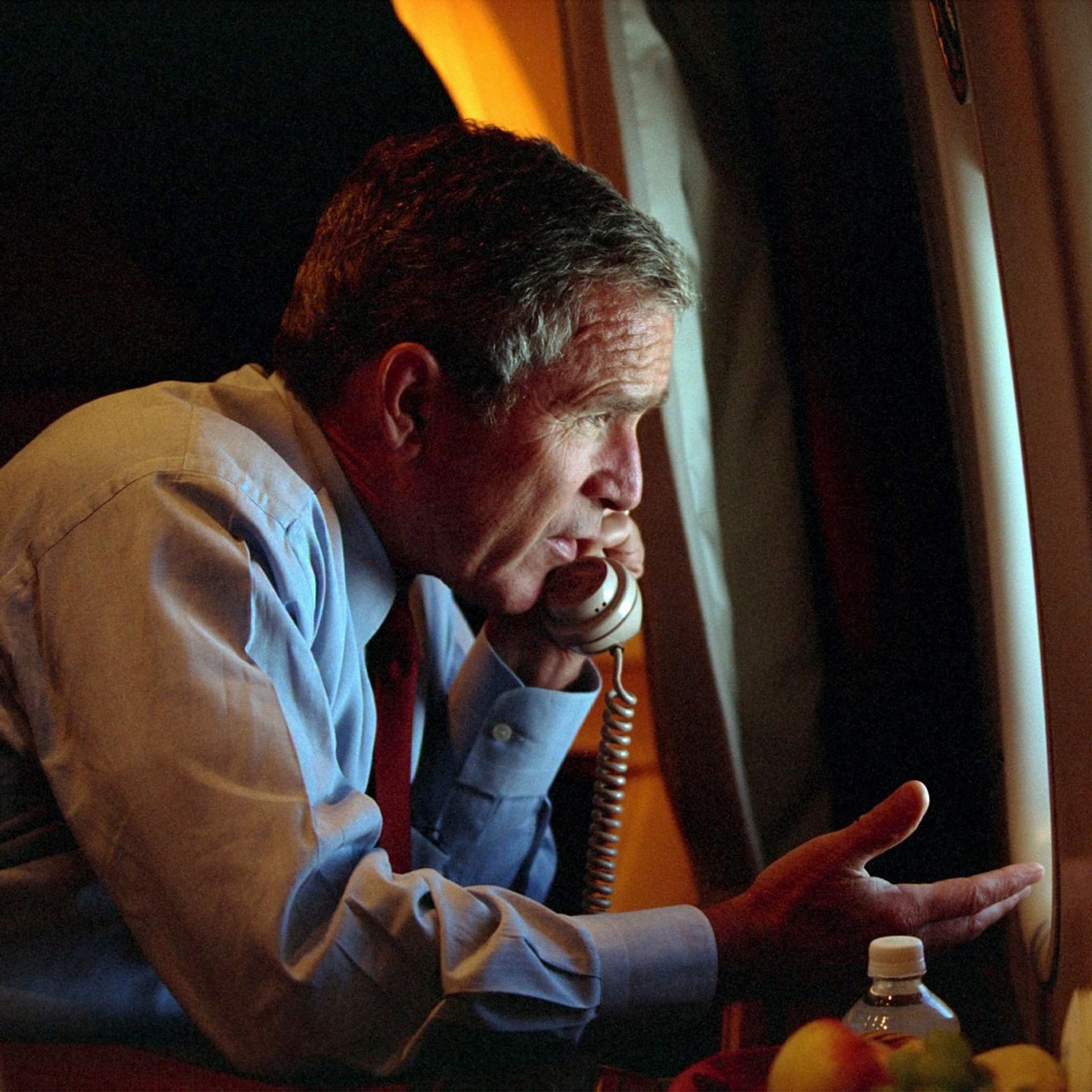
Photo: U.S. President George W. Bush speaks to Vice President Dick Cheney by phone aboard Air Force One after departing Offutt Air Force Base in Nebraska, in this September 11, 2001. Credit: Eric Draper / White House Handout