
In short
Whether Israel’s Prime Minister Benjamin Netanyahu and US President Donald Trump have conflicting end goals on Iran, amid a US-Israel escalation and debate over who drove the decision.
Guest backgrounds
Jeremy Bowen, BBC international editor, long-time Middle East correspondent and analyst of regional politics and conflict.
Key claims
Netanyahu’s decades-long motivation is eliminating Iran as an existential threat to Israel, tied to his “Mr Security” political brand and Israel’s upcoming elections. Trump is portrayed as acting from a mix of gut-driven decision-making and a desire to “smash” Iran, but with unclear “day after” planning and risks of a prolonged “forever war.” Past US presidents avoided escalation due to fears of regional spread (e.g., Hormuz, Gulf involvement) and electoral costs.
Notable examples
Netanyahu’s “1938 and Ahmadinejad is Hitler” framing; references to Iran’s “Axis of Resistance” (Hezbollah, Hamas); Trump’s prior strike on Soleimani; the 12-day 2025 Israel-Iran war where Trump reportedly turned plans around; polling showing US disapproval and lack of clarity on US goals.
Written by AI. May contain mistakes. Listen to the episode to check what was said.
Chapters
Tap a time to open that second in VONetanyahu's Motivations for War
2:58 to 6:04
Explore Netanyahu's motivations for pursuing war against Iran.
“And today on The Global Story, does Benjamin Netanyahu have everything to gain from this war and Donald Trump a lot more to lose?”
The U.S. Perspective on Iran Conflict
6:04 to 11:10
Discuss the U.S. position and past presidents' hesitations on Iran.
“But, I mean, it's not political opportunism, is it?”
Trump's Approach to Iran
11:10 to 14:01
Analyze Trump's decisions and their implications regarding Iran.
“The variable is the personalities involved and one personality in particular, Donald Trump.”
Analyzing Trump's Decision-Making on Iran
14:01 to 16:19
Explore the chaotic decision-making during Trump's administration regarding Iran.
“And this time around, why have they gone further?”
The Dynamics Between Trump and Netanyahu
17:03 to 26:05
Discuss the complexities of the US-Israel relationship and decision-making.
“I want to ask you about who it would have been, Trump or Netanyahu, who made the final decision to go to war, because this has become quite an unclear issue since then.”
Implications of War for Trump and Netanyahu
26:05 to 28:00
Examine the potential outcomes of the conflict on both leaders' futures.
“It's a fair question, and I will try and answer it.”
Concerns Over Iran's Future
28:00 to 28:35
Explore the complexities and uncertainties surrounding Iran's sociopolitical landscape.
“who will have its organs of repression and coercion intact.”
Podcast Recommendations and Sign-off
29:52 to 30:28
Receive recommendations for additional podcasts and a cheerful sign-off.
Transcript
Automatic transcript. May contain errors.0:00Jeremy Bowen:This BBC podcast is supported by ads outside the UK. Any team that's tested AI tools for data has seen the pattern already. AI gives a different number than your BI tool. Metrics don't match across teams and inevitably, users lose trust. It turns out turning on AI is easy, but making it work on data is not. Hex AI was built to solve this. The key is nailing context. Next, HEX is built to unify and curate your data context for agents. Data teams can observe, govern, and continuously improve every AI answer, so answers get smarter the more your team asks. The result? Your entire organization asks data questions in natural language and trusts the answers.
0:48Not because the AI got lucky, because it knows your business and its data. Because that's what an AI analytics platform should do. Join data teams from Cursor, Lovable, Ramp, AWS, and over 2 ,000 more at Hex.ai.
1:27every brand new episode every weekday. Just tap into iHeart to start watching. And we hope you enjoy the show.
1:38For Israel's Prime Minister, Benjamin Netanyahu, the war on Iran is the culmination of a long-standing political dream. Also the peace of the United States, the President of Donald Trump. Standing on the rooftop of the Israeli military headquarters this week, Netanyahu said that he was finally doing what he's, quote, hoped to achieve for 40 years, to crush the regime of terror completely. And polling suggests the war is popular in Israel too. But it's a lot more complicated for Donald Trump. New polling from NBC News shows a majority of Americans surveyed disapprove of the president's handling of this situation in Iran.
2:23The results of our brand new CNN exclusive poll, 59 % of Americans in this poll say they disapprove of the action. Americans do not feel like they have been given a clear explanation of what the U.S. goals are. 60 % say they have not. With elections on the horizon in Israel and the United States, the stakes are high for both leaders. Netanyahu says the war is an opportunity. But does that opportunity complement or collide with Donald Trump's own interests? From the BBC, I'm Tristan Redmond in London. And today on The Global Story, does Benjamin Netanyahu have everything to gain from this war and Donald Trump a lot more to lose?
3:14Jeremy, the BBC's international editor, thank you so much for joining us again. We are at the end of a pretty momentous week in the Middle East, so we're very happy to have you here to help decipher it all. We are talking to you on Thursday morning. It's important to date-stample this because everything's moving so fast. Today with you, we really want to focus on what it might mean for Benjamin Netanyahu and what it might mean for Donald Trump. Let's start by zooming in on Israel and Benjamin Netanyahu. What is his main motivation by pursuing this war against Iran?
3:50Jeremy Bowen:He would say his main motivation is to keep Israel safe, to get rid of its most dangerous enemy. The Israeli army and the state of Israel set out to, with our great friends, the United States of America and President Trump, to thwart existential threats to Israel and great threats to America and the entire world. He has argued for many, many years that the Islamic Republic of Iran poses an existential threat to Israel because of its, you know, they denied it many times, the Iranians, but he was always convinced they were after a nuclear weapon and they wanted to put Israel in the greatest danger.
4:31Jeremy Bowen:When they say death to Israel, he believed very strongly they meant it absolutely literally. Death to Israel, death to Israelis, death to Jews. If they get nuclear weapons and the means to deliver them, ballistic missiles, intercontinental ballistic missiles, they will threaten all of humanity. For many, many years, the Iranians built up this network, the so-called Axis of Resistance, which included particularly Hisbollah in Lebanon. And in more recent times, they have been a backer of the Palestinian group Hamas. And there's another factor working for him as well, an internal political factor.
5:11Jeremy Bowen:Israel has elections this year. They have to have elections by October. He has always run on the basis that he is Mr. Security. He is somebody who will keep Israel and Israelis safe. And after the 7th of October attacks, that reputation took a pummeling. And while he's been steadily rebuilding his approval rating, he was in no sense dominating the polls. If sometime between then and now he can go to the people and say, I have eliminated our worst nightmare, vote for me. I mean, he would say it's all about Israel's safety, of course. But he also, I think, over the years, there's plenty of evidence that he conflates the security of Israel with his continuing presence in the prime minister's office.
5:59Okay, so, I mean, it's potentially an election winner or an election saver for him. But, I mean, it's not political opportunism, is it? Because he has been consistent over many decades in his desire to do something about the Iran threat.
6:16Jeremy Bowen:No, this is a really deeply held conviction. I mean, I remember talking when Ahmadinejad was the president. Ahmadinejad, the former president of Iran. Yeah, which is getting on for 20 years ago now. I remember he came into Netanyahu, came into the BBC office in Jerusalem, and he said, and he's used this phrase a lot. different times, he said, it's 1938 and Ahmadinejad is Hitler. This is deeply, deeply felt for Netanyahu, but the thing which has always been missing from the equation, because there have been lots of flurries over the years when there's been quite deep debates inside Israel about whether or not they should take military action.
6:58Jeremy Bowen:In fact, I remember talking to a Mossad person, 2011, 2012, Well, there was a big flurry of talk about an attack then. And that person said to me, yeah, I think we should do it because we're going to have to do it sooner or later. Do it now on our timetable. Well, it didn't happen. Why didn't it happen? Because the Americans were against it. Joining us now is the Israeli Prime Minister, Benjamin Netanyahu. Netanyahu has also felt very strongly that the only way to do it properly is with the Americans. Is this now the culmination of decades of your work and your belief and your passion that these radicals needed to be defeated?
7:38And what is next for Iran? Well, you're right. I have spoken about it for decades. And I try to persuade successive American administrations to take firm action.
7:51Jeremy Bowen:And now he has a president in the White House who is prepared to go along with that. They'll threaten you and eventually they'll bomb you. This is what President Trump understood. And alone among U.S. presidents that I've worked with, he took action. And we're all very, very lucky that he did. And now for Netanyahu, it's all come together in a really felicitous way. Well, it's very interesting that you raise it like this, Jeremy, because we've had a very specific question from one of our listeners, Maggie, on this point. Maggie wrote to us because she wanted to understand why it is and how it is that past US presidents have avoided this scale of conflict with Iran.
8:39Why has it not happened until now? And have there been any close calls, moments where it almost happened in the past?
8:45Jeremy Bowen:I'll tell you why they didn't do it. It's because they thought it might spread. They thought the Gulf states might get involved. They thought the Straits of Hormuz might get closed. All of which are now happening. Yeah, and the world oil business would take a hell of a hit and pump prices, which is a big deal in America, gas prices, and that would be massive electoral jeopardy, plus the fact that the world's most turbulent region will go into another big spate of upheaval. and and that's something which i don't think any american president wanted to do there have been lots of talks about what to do i mean when american troops were in iraq and american troops were getting killed and a lot of the time they were getting killed with shape charges which the pro-irranean iraqi militias had learned how to construct from iran and of course there was a lot of talk about whether, never mind going after Iran's proxies inside Iraq, go after Iran itself.
9:50It's well documented that we have, for quite a long time now, known where the real problem is in the Middle East. And in fact, the president adequately described it as the axis of evil.
10:03Jeremy Bowen:Remember the late John McCain, you know, he was once overheard on a live mic to the tune of the Beach Boys' Barbara Ann. That old Beach Boys song, Bomb Iran? Singing Bomb Iran. Bomb, bomb, bomb. Anyway. The Americans have seen Iran, a big country, 90 million people, considerable oil resources, a very high level of technical expertise as well, or they wouldn't be able to get involved in enrichment in the way that they did. and they've seen it, of course, as a potential threat. But then there's one thing is to identify the threat. The other thing is how you deal with the threat. You try and contain it or do you try and confront it or do you indeed, as Donald Trump's doing and Benjamin Netanyahu, do you try and smash it?
10:59Jeremy Bowen:They've gone for smash this time around. I mean, it sounds a bit like what you're saying is that the risks and the stakes of going to war with Iran and the context haven't really changed. The variable is the personalities involved and one personality in particular, Donald Trump. Is that fair? I think this wouldn't be happening without Donald Trump, which of course his fans say this as well. Only Donald Trump could do this. Only Donald Trump would have the guts. Only Donald Trump would have the vision. Only Donald Trump would realize that these guys have been jerking us around for 47 years and has got to stop.
11:34Jeremy Bowen:I mean, he says pretty much the same things himself. The question is the degree to which he has thought and his people have thought about the day after, what happens next. Does it matter if a new round of chaos is touched off in the Middle East because of more wars? Donald Trump has been well-documented. In his first term, loads of people wrote books about what it was like to work with him. and I think there's no secrets here. He doesn't really do his homework in terms of reading, you know, extensive policy papers. He goes with his gut. The question is whether going with your gut and with a small team around him, because of course what he's also done is got rid of much of the national security superstructure that had been built up over the years to advise the president in his decision-making.
12:27Jeremy Bowen:Now it's the top team, which of course are hand-picked, And they're handpicked as well to agree with him. So essentially their job is to make the president's will happen and not to challenge it. And he has decided the time has come to do this. Hello. In a dramatic escalation of tensions in the Middle East, a U.S. airstrike has killed Iran's most important military commander. And when in his first term he ordered the assassination of Soleimani. Soleimani was in Iran, arguably the second most powerful man in all of Iran. after the Supreme Leader. The Pentagon said the killing was a defensive act to prevent the deaths of U.S.
13:06personnel.
13:07Jeremy Bowen:A lot of people, supposedly experts, said it's going to be all hell to pay. And there wasn't particularly. There was a response, but it was quite performative. That was Donald Trump's first term. The second term is a slightly different proposition. In 2025, in June last year, the United States and Israel had this so-called 12-day war against Iran. Why wasn't that the moment for all-out war? Well, do you remember that moment when, after that, Israel thought, well, they'd continue, and there were airstrikes planned. I think there were planes in the air, and Trump turned them around. I think he wanted to say, this is one and done.
13:43Jeremy Bowen:I've done it. I've gone in there. One raid, biggest raid ever, the most accurate raid ever, the most destructive raid ever, and now we've got a huge victory. Bingo. Go home, end it, move on. He likes to bank his successes. And this time around, why have they gone further? Now, that is an interesting one, and we don't really know. There are lots of theories going around, and the confusion that seems to be, or rather the chaotic nature of the decision-making, seems to be reflected in the different things that different people in the Trump administration say, not least the president himself. on that first Saturday morning when he was at Mar-a-Lago in his white baseball cap at the podium.
14:29Among the regime's very first acts was to back a violent takeover of the U.S. embassy in Tehran, holding dozens of American hostages for 444 days.
14:42Jeremy Bowen:He went through the whole litany of 47 years of pain that the Americans have had with Iran since the Islamic Revolution. In 1983, Iran's proxies carried out the marine barracks bombing in Beirut that killed 241 American military personnel. He went right back to the beginning. It's been mass terror, and we're not going to put up with it any longer.
15:11Jeremy Bowen:Some of the things he said, like they can be close to getting a nuclear weapon. There's no evidence for that. they have ballistic missiles that very soon will be able to hit the United States. There's no evidence for that. And he also said this will now be a once-in-a-generation opportunity, once-in-several generations opportunity for Iranians to take back their country. When we are finished, take over your government. It will be yours to take. This will be probably your only chance for generations. Well, they've walked that one back a bit now. And I think that's because the regime in Tehran is more resilient than they expected.
16:15needs one last graph for the board. Now your data team has to say no to somebody. Hex changes that. Ask any data question in plain English and get an analyst-grade response, all backed by your actual business context as defined by your data team. Start saying yes to more data questions at hex.ai. Hi there, I'm Asma Khalid. And I'm Tristan Redmond, and together we're the hosts of the Global Story podcast from the BBC. For those of you who might be new to our show, We here at The Global Story dive deep every weekday on one big story at the intersection of where the world and America meet. And you can now watch The Global Story on the iHeart app.
16:57Catch every brand new episode every weekday. Just tap into iHeart to start watching. And we hope you enjoy the show.
17:09I want to ask you about who it would have been, Trump or Netanyahu, who made the final decision to go to war, because this has become quite an unclear issue since then. There's a particular context which I want to run through briefly. So there were comments by the U.S. Secretary of State, Marco Rubio, at the beginning of the week. We knew that there was going to be an Israeli action. We knew that that would precipitate an attack against American forces. And we knew that if we didn't preemptively go after them before they launched those attacks, we would suffer higher casualties and perhaps even higher those.
17:43Netanyahu refuted that. Then Donald Trump refuted it. Based on the way the negotiation was going, I think they were going to attack first. And I didn't want that to happen. So if anything, I might have forced Israel's hand. But Israel was ready and we were ready. Then it became a political question when Mark Warner, who's a prominent Democratic senator, he's the highest ranking Democrat on the Intelligence Committee, and one of the so-called Gang of Eights, who were the U.S. congressional leaders, who were briefed on the strikes before they actually happened. Mark Warner said, This is still a war of choice that has been acknowledged by others, was dictated by Israel's goals and timelines.
18:29Israel is a great ally of America. So how much do we know about who took the final decision, Trump or Netanyahu, to start these strikes? Who made that call?
18:42Jeremy Bowen:I'll be honest, I don't know who actually said, but we can, based on the evidence, we can make an argument. And the argument I would make is that Donald Trump was persuaded, most likely by Benjamin Netanyahu, that this was a great time to deal with a really knotty, long-standing problem that has defeated successive American presidents. They've murdered and maimed thousands of Americans in Iraq, in Afghanistan, where their IEDs, these are roadside bombs. They've bombed your embassies. They tried to assassinate Donald Trump, the president of the United States, twice. They've murdered... And I can imagine a conversation where he would have said something along the lines of, you have a historic opportunity here to do something that Barack Obama couldn't do.
19:37Jeremy Bowen:going way back to Jimmy Carter and the hostage crisis in the late 70s that none of them could do. You can do it. You will go down in history if you do this. And what's more, it's an opportunity because look how weak they are now. In the course of the last few years of the Gaza war, the Iranian strategy of protecting themselves through an outer ring of allies and proxies, the so-called axis of resistance, is effectively smashed. Hezbollah in Lebanon took massive blows in 24. Their leader assassinated. Remember the business with the exploding pages and walkie-talkies. Bashar al-Assad in Syria, he's gone.
20:22Jeremy Bowen:The Houthis are still there in Yemen, but thus far they've been pretty quiet. And plus, of course, internally, massive economic problems in Iran. huge crowds on the streets in January against the regime, and the regime deployed its security forces and killed thousands, possibly tens of thousands of people on the streets. So you can see weaknesses, fractures. This is the time to move. You will kick yourself, Mr. President, if you don't take this opportunity. Well, I mean, as journalists, we spend a certain amount of time wondering about who made the final decision, and people might wonder, well, why is that important?
21:01And I guess maybe the reason why it's important is that if it's perceived down the line not to have been an entirely White House motivated decision, then it puts doubt in people's minds about why the United States might be involved. I mean, this is all hypothetical, but these issues might become important later on. And this is a politically fraught moment for Donald Trump. If Iran, for example, were to turn into, quote unquote, a forever war, that thing that American presidents these days fear, that could be a moment of great peril for him. Now, you've been writing in the last few days about how a war in Iran is a very particular proposition militarily.
21:40Why is that?
21:42Jeremy Bowen:Big country. it's something i think three times the size of iraq four times the size of syria it has more than 90 million people and trying to unseat the regime is difficult i think will be difficult because as well as the supreme leader at the top of it the system was built to deal with a war or assassination or the sudden death of a supreme leader. So beneath that level, there is this dense network of political institutions, and they are backed up by considerable military forces, which are designed essentially for internal use. And there's the IRGC, the Islamic Revolutionary Guard Corps, and their mandate, they were set up after the Islamic Revolution to protect the Islamic Republic from threats at home and abroad.
22:41Jeremy Bowen:So they have, I think the figure that's often quoted is something like 160 ,000 troops, effectively, getting on for half a million or so in a reserve. Backing them up, there's the Basij. The Basij is a volunteer armed militia. and the numbers often quoted for the Basij go up to around a million. These are people who are loyal to the regime. So these are people who are prepared to go out on the streets and kill for the regime. And that makes it very hard to overthrow this sort of authoritarian system which has been designed, built and engineered to withstand an existential threat. and they see this as an existential threat to the survival of the Islamic Republic.
23:30Jeremy Bowen:And they are prepared to do whatever needs to be done to hang on to power. I don't want to ask you to gaze into a crystal ball, but when it comes to Netanyahu and Trump, where do they want to get to? Because it strikes me that they might have very different visions of where that is. So what are their endpoints? I think they do. Starting with Netanyahu, I think that the Israelis want to do as much damage as possible to their enemies. And if that sets off months or even years of internal chaos, crisis inside, for example, Iran, unless it somehow laps up onto their shores, I don't think they're bothered.
Read the full transcript
24:14Jeremy Bowen:In fact, they probably would welcome it because if Iran and its neighbors, its Arab neighbors particularly, are concerned and preoccupied with potential spillover from all of that, they're not going to be in any position to threaten Israel. So there's that. Different, I think, for America because they have a global perspective. They have these close relations with Gulf countries who are really feeling the pain at the moment. because I think quite shrewdly, the Iranians are trying to spread the war. They're hitting what they've hit a dozen countries or more now. They know that they haven't got the firepower to match America and Israel combined or even either one of those on their own.
25:01Jeremy Bowen:Nothing like it. So what they're trying to do is go at them from a more disruptive and oblique angle, increase the pressure, particularly on Trump. Their calculation, I believe, is that keep pushing on that. hit that bruise, hit it again, hit it again, hit it again, wait till it opens and becomes a big cut. And then Trump will say, I'm just going to declare victory now. And I can say, I've destroyed their ballistic missiles. For the second time, we've obliterated their nuclear program. But I don't think it's that simple, because there are consequences. And so that's why I think the Iranians are calculating they can tough this one out longer than he can.
25:40Jeremy Bowen:But we'll see. We don't know. Wars go on for a long time sometimes and their consequences go on for even longer. Well, in 2026, it does feel sometimes like there is a different concept of time and space. It's taken on a different meaning and dimension. The premise of our conversation today that we wanted to put to you is, does Benjamin Netanyahu have everything to win from this war and Donald Trump have everything to lose? Is that a fair question? It's a fair question, and I will try and answer it. I think that so far, Israel and Netanyahu are the big winners, of course, because they're dealing with a country which is definitely their enemy and who they see as a really serious threat.
26:24Jeremy Bowen:Plus, they're dealing with the Americans. What could be better from Netanyahu's point of view? He can sense a victory that he can hold and present to his people. Trump with everything to lose? Yeah, potentially. The risk of some kind of a forever war. It might not be possible to disengage in the way that he's hoping it might, and that's bad for him electorally. He was boasting, I think, only a week or two ago about how gas prices in the States have been lower on his watch than anyone. They're going to go up because of all of this. Not that he's that bothered about it, but his position with his allies, America's allies, is taking another knock.
27:06Jeremy Bowen:More question marks about America's lack of adherence to international law. Again, they're not bothered about that, but these things might have consequences. I mean, I can go on. America is a global power with a global list of preoccupations and interests. And it's not just about one thing, whereas for Israel, it's much simpler, much more fundamental, perhaps they'd argue.
27:36Jeremy Bowen:One thing I would like to end on by saying is what about the people of Iran who have been under the kosh for many years? They could be left with a situation where there is a damaged and bruised and battered regime, but still a regime that wants to reassert itself domestically, that will deal very, very viciously with any internal problems, who will have its organs of repression and coercion intact. That doesn't look good for the people of Iran, who, in my experience, want to have a quiet life like people everywhere. So there are so many imponderables about the future. And that's why so many people who look at the region are really worried about this.
28:35Jeremy, thank you so much. Thanks for asking me.
28:50That was Jeremy Bowen, the BBC's international editor. And that's it for the global story for today. If you have any questions or ideas for us, we always love to hear from listeners. We heard from Maggie today. Thank you for that, Maggie. You can email us at theglobalstory at bbc.com. And thanks also to Mia McDonald, who wrote to ask if we could look at the climate impact of the war in Iran. As it happens, Mia, our colleagues over at the BBC podcast, The Climate Question, are looking at exactly this question in their episode published on Sunday. One quick recommendation before we go. If you're looking for a way to catch up on the latest news from around the world, then check out our sister show, the BBC's Global News Podcast.
29:32You can find it wherever you listen to your favorite shows. Today's episode was produced by Sam Chantarassak and Lucy Paul. It was mixed by Travis Evans. Our studio managers were Hannah Montgomery and Mike Regard. Our senior news editor is China Collins. And I'm Tristan Redman. Thanks for listening. We're back on Monday. Have a great weekend. Cheerio.
30:21Good Bad Billionaire
30:28Belina wherever you get your BBC podcasts.
From the publisher
For Israel’s prime minister, Benjamin Netanyahu, the war on Iran is the culmination of a long-standing political ambition. On Sunday, Netanyahu said he was finally doing what he had “hoped to achieve for 40 years – to crush the regime of terror completely.” Polling suggests the war is popular in Israel too.
But it’s a lot more complicated for Donald Trump. He was elected on a promise to end foreign wars, and current polling suggests the war is not supported by most Americans.
We talk to the BBC’s international editor Jeremy Bowen about whether this war, which Netanyahu says is an opportunity, complements or collides with Donald Trump’s own interests. And ask if Benjamin Netanyahu has everything to gain from this war, and Donald Trump a lot more to lose?
Producers: Lucy Pawle and Sam Chantarasak
Sound engineer: Travis Evans
Senior news editor: China Collins
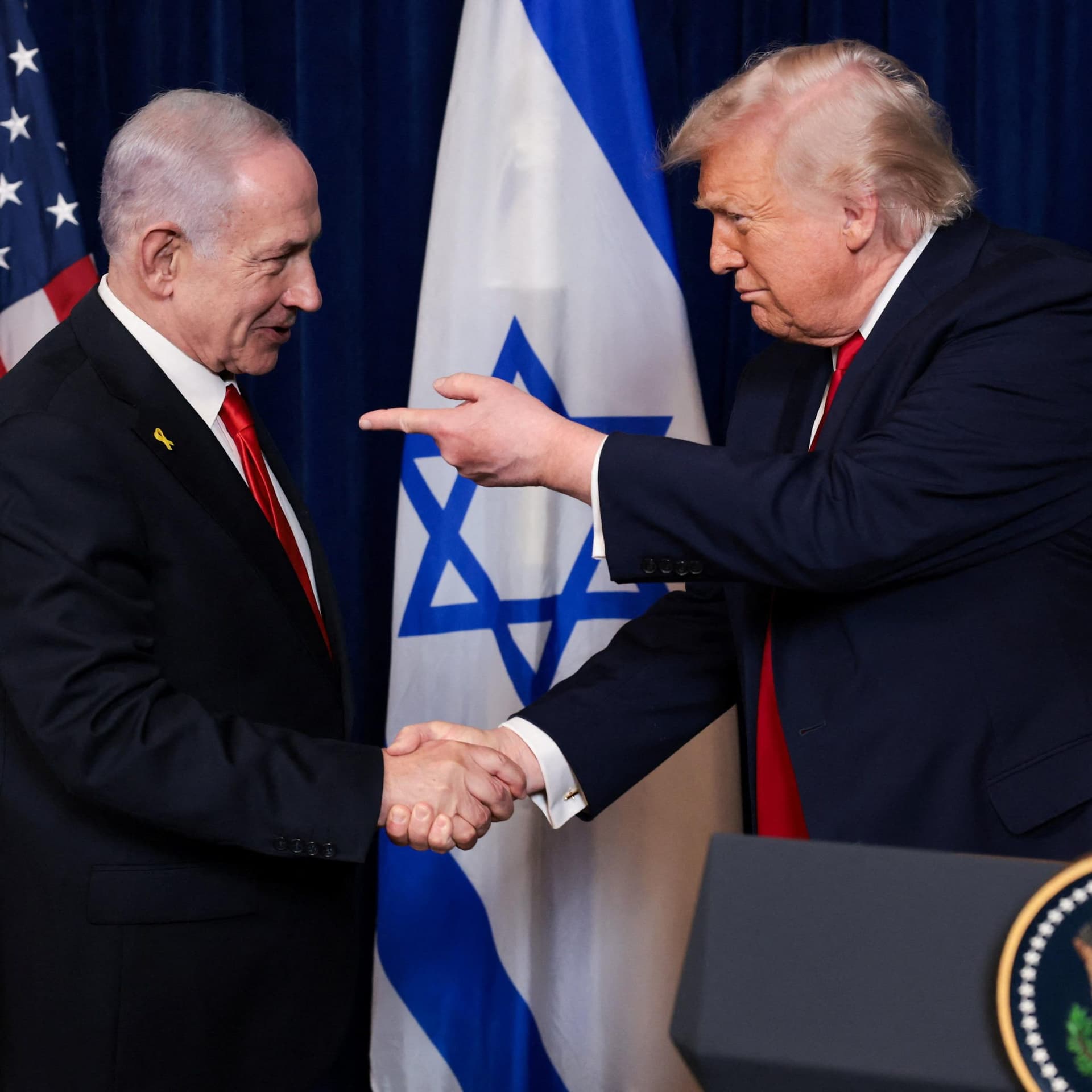
Photo: Jonathan Ernst/Reuters. U.S. President Donald Trump points his finger towards Israeli Prime Minister Benjamin Netanyahu as they shake hands during a press conference after meeting at Trump’s Mar-a-Lago club in Palm Beach, Florida, U.S., December 29, 2025.