In short
A BBC Global Story episode on the 2024/2025 Ebola outbreak in the Democratic Republic of Congo (DRC) and neighboring countries, asking “how worried should the world be?” It explains Ebola transmission, why this outbreak is hard to contain, and what international preparedness means.
Guests
James Gallagher, BBC health and science correspondent and host of BBC Radio 4’s Inside Health.
Guest background
Health/science journalist focused on medical topics; explains WHO emergency declarations and outbreak response.
Key claims
WHO declared a Public Health Emergency of International Concern because the outbreak is crossing borders and needs multi-country containment. The virus is Bundibugyo Ebola (Bundy Bujo), not the Zaire species (which has a vaccine/drugs), and early tests often looked for Zaire, delaying recognition. Ebola spreads via bodily fluids; it becomes most infectious when symptoms peak and transmission risk persists after death during funeral washing. Conflict, displacement, and limited water/communication hinder response. Global risk is low compared with regional risk; U.S. entry restrictions (Title 42) are noted.
Notable examples
April 24 death of a nurse; May 5 WHO alerted to high-mortality outbreak; May 15 Ebola declared after lab tests (8/13 positive for Bundibugyo); May 16 WHO emergency declaration. Comparison to the 2014–2016 West Africa Ebola outbreak (nearly 30,000 infected, 11,000+ deaths; few cases abroad). U.K./Oxford using Oxford-Serum Institute vaccine tech for Bundibugyo, aiming for “a couple of months” to doses.
Written by AI. May contain mistakes. Listen to the episode to check what was said.
Chapters
Tap a time to open that second in VOEbola Outbreak Overview
0:30 to 1:39
An overview of the ongoing Ebola outbreak and its implications.
“There's a rare type of Ebola spreading in Central Africa.”
Understanding Public Health Emergencies
1:39 to 3:37
Explaining what a public health emergency of international concern means.
“And today on The Global Story, how worried should we be about this Ebola crisis?”
The Nature and Spread of Ebola
3:37 to 6:28
Detailing the nature of the Ebola virus and how it spreads.
“It's a disease, a virus that I will say people here are not particularly familiar with.”
Fatality Rates and Care
6:28 to 8:30
Discussing fatality rates of Ebola and the importance of healthcare.
“Where have Ebola outbreaks traditionally occurred?”
Current Strain and Challenges
8:30 to 10:29
Exploring the Bundy Bujo strain and challenges faced by health officials.
“Some of it is down to how good the healthcare system is where the outbreak's happening.”
Tracing the Outbreak's Origin
10:29 to 13:32
Investigating how the Ebola outbreak began and its early spread.
“I mean, there's definitely a lot of cases that have been detected quite quickly once everyone realized the Ebola outbreak was happening.”
Response and Containment Strategies
13:32 to 14:03
Discussing strategies for containing the Ebola outbreak and the response from health organizations.
“I think at that point, it will kick off all of those plans around how do you contain an Ebola outbreak, of which the tools are fairly simple and obvious.”
Challenges of Ebola Care and Contact Tracing
14:03 to 16:05
Learn about the complexities of managing Ebola outbreaks in conflict zones.
“It takes a lot of time and effort to do that degree of what's known as contact tracing, But also on that day, they had 246 suspected cases and already 80 deaths.”
WHO's Response and U.S. Health Policy
16:39 to 18:36
Explore the WHO's response timeline and the impact of U.S. policy changes.
“Secretary of State, Marco Rubio, allege that the World Health Organization was, quote, a little late in identifying the deadly Ebola outbreak.”
Funding Cuts and Their Implications
18:36 to 20:44
Discuss how U.S. funding cuts affect Ebola outbreak responses.
“On top of that, this is a very specific species of Ebola that has clearly been more challenging to deal with the Bundy-Bujo species.”
Show all 12 chapters
Ebola's Geographic Spread and Risk Assessment
20:44 to 24:28
Evaluate the potential for Ebola to spread beyond the DRC and its global implications.
“was in some ways less equipped to handle this all because of cuts to USAID.”
Lessons from COVID and Future Preparedness
24:28 to 26:54
Examine lessons learned from COVID-19 and how they apply to future pandemics.
“You had that pre-symptomatic ability to spread the virus because you don't have that with Ebola.”
Transcript
Automatic transcript. May contain errors.0:00This BBC podcast is supported by ads outside the UK.
0:30Just tap into iHeart to start watching. And we hope you enjoy the show.
0:38There's a rare type of Ebola spreading in Central Africa. And there's no vaccine for it. More than 160 people are suspected to have died from the virus. The numbers of cases and deaths have been rising over the past few days. And the World Health Organization has said it expects them to keep rising.
0:58James Gallagher:I'm deeply concerned about the scale and speed of the epidemic. People in the Democratic Republic of Congo, the epicenter of this deadly outbreak, are living in fear. I'm afraid of bringing the disease home to my family because I spend the whole day transporting people on my motorbike taxi. I'm afraid of dying. This disease is very dangerous. Last time it killed a lot of people. One person infected with Ebola can infect more than five people. were truly afraid of this disease. And here in the United States, the government is restricting entry for people coming not just from the DRC, but also from Uganda and South Sudan.
1:38From the BBC, I'm Asma Khalid in Washington, D.C. And today on The Global Story, how worried should we be about this Ebola crisis? And what does this latest outbreak tell us about how prepared or not we are for a possible global health crisis?
2:04I'm James Gallagher, the BBC's health and science correspondent, and I also present Inside Health, BBC Radio 4's specialist health programme. James, we wanted to have you on the show because for the last several days, we've been hearing a lot about Ebola. It has been making headlines here ever since the World Health Organization declared a public health emergency of international concern. After we saw that news from the WHO, We then saw the WHO chief say that he was deeply concerned about the scale and speed of the Ebola epidemic. And I do want to understand how we got here. But first, before we do that, even, can you just explain what a public health emergency of international concern actually means?
2:46Yeah, I can tell you what it doesn't mean, if that's OK, because sometimes it's easier to explain that. What it doesn't mean is we're not facing a COVID-style pandemic. So a public health emergency of international concern isn't that. But what it is, is a scale of a problem that is beyond the scope of one country to deal with on its own. It's going to require multiple countries to come together to solve the problem. And that's what we're dealing with here. An outbreak of Ebola that is already crossing borders. We're seeing cases not just in the Democratic Republic of Congo, but some neighbouring countries.
3:16I'm sure you'll know there is one American that has symptoms as well. An American doctor, I'd heard. Yeah. Yeah. So we're in this situation now where in order to contain the outbreak, it's going to require resources from the world to go into DRC to contain it. But also every country is going to need to be on high alert for any potential spread of the virus too. What exactly is Ebola? It's a disease, a virus that I will say people here are not particularly familiar with. Ebola virus disease is a disease caused by a series of Ebola viruses. And there are six different species of Ebola virus. And when it gets into the body, it starts off with symptoms basically like being hit really suddenly with the flu.
4:04So you get things like fatigue, a fever, feelings of exhaustion, a headache. But then it progresses over time. So it's quite common to then start vomiting and to have really bad diarrhea. And then you can get to the territory of having internal organ failure, but also your blood vessels don't cope as well. You start bleeding internally and sometimes externally as well. It's through those bodily fluids that is the major route through which Ebola is transmitted from one person to another person. And it happens in outbreaks like we're seeing now because normally Ebola viruses infect animals. That's their natural home, their natural reservoir, as it's called in scientific terms.
4:50What type of animals? Mostly fruit bats. A fruit bat is just a type of bat, a species of bat or a group of species of bats. And they are the natural host or reservoir of these viruses. And how does it spill over from animals to humans? Oh, spillover. You picked up the correct terminology. Yeah. So these spillover events is what they're known as. And that has to happen when people come into contact with infected animals. Now, that could just be handling a dead animal. It could be part of the bush meat trade. So if you are either handling and preparing bush meat, so some people would eat fruit bats, and you could be either eating them or handling those products.
5:27And again, those become moments where there is a potential for that first person to become infected. and once that first person has become infected they develop Ebola virus disease and then they have the potential to spread it on to other people. The thing that's kind of quite important to remember in this as well though is that you become more infectious over time, you don't really spread Ebola virus disease before you have any symptoms and in the early stages the symptoms aren't making it much easier for the virus to spread but by the time you are being sick then that is the moment at which it becomes really infectious.
6:00So that becomes a danger in hospital environments. So if you think about by the time you end up in hospital, you're at the peak of how much you're able to spread Ebola virus. But also the risk remains after you have died. So there are many funeral practices that would include families washing the body of a loved one as part of the funeral. And that is also a major moment at which people can end up contracting Ebola as well. And this latest outbreak is taking place in the Democratic Republic of Congo, the DRC, as well as Uganda. Where have Ebola outbreaks traditionally occurred? If we think that there is an animal reservoir that these viruses naturally infect animals, then the outbreaks are going to be where those animals are.
6:48And that's why we have seen more than a dozen Ebola outbreaks in the Democratic Republic of Congo before. So DRC is a major source of these infections, but they all tend to be in Africa because that's where these fruit bats live and that's where the virus naturally is. Once the symptoms are onset and somebody has Ebola, what is the risk for fatality? I mean, this is a horrific disease. Let's not shy away from it. This is an absolutely horrific disease. The fatality rates, it varies depending on what species of Ebola it is. So there is a wide range, but it's not uncommon to talk about up to half of people dying once they have contracted Ebola.
7:32I mean, it is, for good reason, one of the most feared infections that exist. So there are many things that affect that fatality rate. How good healthcare is in the region will determine what the survival rate is as well. So while you'll have heard a lot in the news about, oh, there's no vaccine for this, there's no specific drug for this, that doesn't mean there's nothing you can do. And if you get that early intervention in really quickly, so if you think of someone who is being sick all the time, is bleeding, then one thing is just getting fluid back into that person, getting adequate nutrition into that person to support their body while they're fighting the virus.
8:12If you can get that, you improve the survival rates against Ebola. So if you look across all of the outbreaks, you can see figures sometimes as though I was talking about 25 % fatality rates. You see figures up to 90 % fatality rates from Ebola. So there is a very broad range. Some of it's down to the virus itself. Some of it is down to how good the healthcare system is where the outbreak's happening. James, you mentioned earlier that there are different strains of the Ebola virus. What's the specific type of virus that we're seeing now in the DRC? And why has it made fighting this all more complicated?
8:51Yes, this one is called Bundy Bujo. And one of the issues is there's only been two outbreaks of this before, one in 2007, one in 2012. So it's not the main form of Ebola that we're used to dealing with. That's something called the Zaire species of Ebola. That's the one that we have the vaccine for. That's the one that we've developed drugs for. Is that the one that in 2014, 2015 time period was particularly deadly? Exactly that. And it's the one that most of the time, if you hear this in Ebola outbreak, most people's first thought would be, well, is it the Zaire version of Ebola? In this time, it's Bundy Bujo.
9:26And so the vaccine for that is just not going to be effective, you're saying? There's some debate and discussion about whether it may have some limited protection. So it's what's known as cross-protection, whether there is enough similarity between the two species of Ebola so that it might provide some limited protection, but nobody's expecting it to provide the level of protection you get from Zaire. And in addition to the fact that there is no vaccine, is there something about this particular type of the virus that makes it more complicated for public health officials, for health workers? One of the things that has really been challenging at the beginning of this is the fact that most of the tests that would be used to identify Ebola aren't looking for Bundy Bujo, they're looking for Zaire.
10:09So what was happening at the very beginning of this outbreak is doctors were suspecting that this patient may have Ebola. They did the blood test, but the standard blood tests that they have, and it was coming back negative. And that is one of the things that seems to have contributed to what appears superficially to be a quite slow response to Ebola. I mean, there's definitely a lot of cases that have been detected quite quickly once everyone realized the Ebola outbreak was happening. But the suspicion is this has been going on for probably a couple of months, and we still don't actually know how many people have been infected because everyone's playing very rapid catch-up here.
10:48What do we know about how this outbreak began? Can you walk us through where it all first began and then how it spread, as we know thus far? One of the challenges here is that we don't know the very beginning. So logic will tell us that at some point, a human being came into contact with an infected animal, and that would have been the very beginning of the outbreak. At the moment, the World Health Organization is estimating, based on the current number of cases, that that probably took place a couple of months ago. But when you start then, exactly, there's been quite a long period in which this virus has been able to spread before we've got to the point where we knew there was an outbreak on our hands.
11:31So we have to fast forward a little bit to the first moment that we really know, which is April the 24th. And that was a nurse who had fever, vomiting, bleeding, intense malaise, and they died. died. And the issue with that is, you know, that's not the first case because it's very unlikely that it's a healthcare worker that has come into direct contact with the infected animal in the first place. Most likely, that is a scenario where somebody has come into the hospital who is ill, and then they have picked up the virus in hospital. So that is the most likely way in which they became infected. The next key date we have is May the 5th.
12:17And that's when the World Health Organization was alerted to a high mortality outbreak. At this point, nobody knows it's Ebola. It's an unknown illness, but there have been enough deaths in DRC to raise alarm bells. We have to accelerate another 10 days, though, because what happened then, that is when the blood samples from suspected patients were sent to Kinshasa and tested in a sophisticated laboratory. And that's when eight out of those 13 samples tested positive for Bundy Bujo Ebola. So that was the moment that this high mortality outbreak could be pinned down to Ebola. That day, 15th of May, outbreak of Ebola was officially declared in the Democratic Republic of Congo.
13:10and Uganda was also saying that there is an outbreak. It was on the 16th that the Director General of the World Health Organization declared this a public health emergency of international concern.
13:25Once they did that, did it expedite resources and attention to figuring out what to do with the virus? What does that mean? I think at that point, it will kick off all of those plans around how do you contain an Ebola outbreak, of which the tools are fairly simple and obvious. You have to find everybody who's infected. You have to find everybody that those infected people have come into contact with. You try to isolate those before they themselves become infectious and spread it onto another person. So that's how you try to squeeze the outbreak. In order to do that, you need a huge amount of facilities.
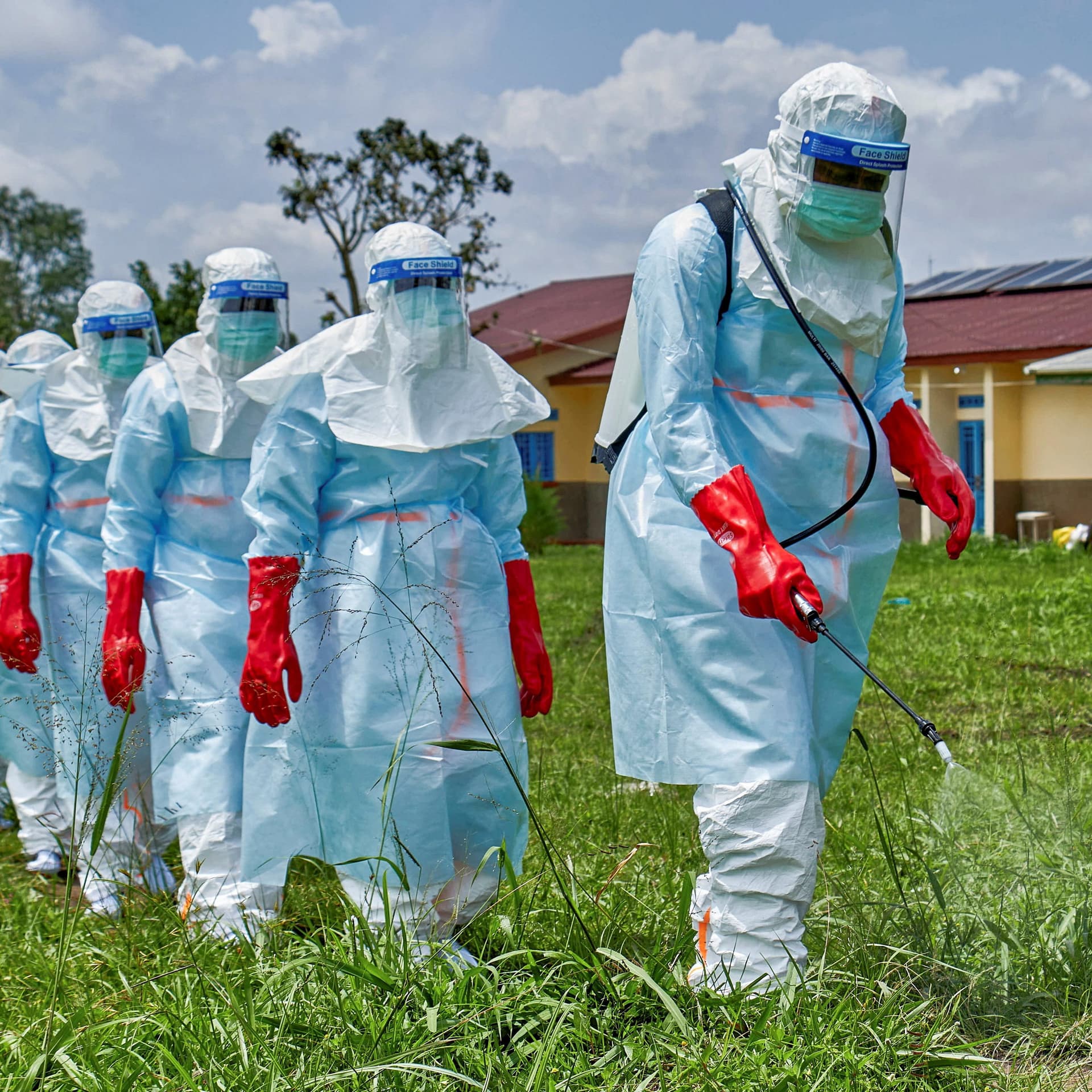
14:03It takes a lot of time and effort to do that degree of what's known as contact tracing, But also on that day, they had 246 suspected cases and already 80 deaths. So that is already a substantial job of contact tracing, but also caring for those infected people. Because if you just care for somebody who has Ebola on a standard hospital ward, that is going to spread to the staff there and to other patients in that hospital. So it often requires specialist facilities and you can build these. They can be like pop-up facilities, but you really need to treat people in isolation. And the doctors and the nurses and the health care workers there need high standard personal protective equipment in order to not get infected themselves.
14:51There is, I know, an ongoing conflict in the DRC. In fact, it's one that we've heard President Trump announce that he had solved as many of the peace deals he says that he has resolved. Nonetheless, it is an ongoing conflict. And how is that factoring into this epidemic? It makes it a really challenging issue for a number of reasons. You're not just dealing with the government of the Democratic Republic of Congo. You're also dealing with the militia groups on the ground that control areas where the Ebola outbreak is currently taking place. I mean, there has been a report of a death from Ebola in areas controlled by the M23 militia group.
15:28So you're dealing with multiple kind of like authority figures.
15:35And also, if you're struggling to find clean water that day, or you are fleeing your home, Ebola is not your number one priority. And that in and of itself makes it challenging in the region to communicate and persuade people of how important it is to stop an outbreak that actually isn't the most important thing in their life that day.
16:05Hi there, I'm Asma Khaled. And I'm Tristan Redmond. And together we're the hosts of the Global Story podcast from the BBC. For those of you all who might be new to our show, we here at the Global Story dive deep every weekday on one big story at the intersection of where the world and America meet. And you can now watch the Global Story on the iHeart app. Catch every brand new episode every weekday. Just tap into iHeart to start watching. And we hope you enjoy the show.
16:38The other day we heard the U.S. Secretary of State, Marco Rubio, allege that the World Health Organization was, quote, a little late in identifying the deadly Ebola outbreak. And so, James, my question to you is, was the WHO late? I think everybody was late is the honest answer to this. I mean, we're talking about an Ebola outbreak that probably happened a couple of months ago. I mean, you can then, the question is who was late and why was anybody late? It's a whole separate chain of events. And the World Health Organization itself would reject the argument that it was late and it acted incredibly quickly once it was made aware because you are reliant on that intelligence on the ground to flag up that something is happening and needs a response.
17:22I mentioned the comments from the American Secretary of State, and it's worth putting this all in the context of some of the changes we've seen. hear from the Trump administration. You know, our show is about where the world and America meet. And I think it's hard to have this conversation without talking about some of those changes. On President Trump's first day back in the White House, he initiated a move to pull the U.S. out of the World Health Organization. We then saw President Trump work to dismantle USAID, the U.S. Agency for International Development. There have also been cuts to the CDC, the Centers for Disease control and prevention.
17:57What does all of this mean in this moment in terms of trying to combat the spread of the Ebola virus? This is a really big question. And can I give some context before we go into it? Because some of the narrative already is, well, this wouldn't have happened if it wasn't for the Trump cuts. And I think that is challenging to substantiate, because if you think this is not yet the biggest Ebola outbreak, there have been bigger Ebola outbreaks in DRC itself. We've mentioned the 2014 to 2016 Ebola outbreak in West Africa. So there have been massive Ebola outbreaks in the past that have happened before these cuts happened.
18:41On top of that, this is a very specific species of Ebola that has clearly been more challenging to deal with the Bundy-Bujo species. Not coming up positive in test results has clearly blinded the response a little bit in the early stages. You're in a corner of the world where there is vying for control. There's government versus militia groups. You have a population that is highly mobile that has been displaced from their homes. Hundreds of thousands of people displaced from their homes because of the conflict in the region. So there is a lot going on. These outbreaks happen, and I don't think that the cuts to USAID would have stopped it happening.
19:26Yeah, James, I wanted to ask you about that, because we've seen some, at least here in the U.S. press, we've seen some prominent voices in the medical sector who have explicitly linked U.S. aid cuts with the response that we're seeing. I saw, you know, for example, just the other day in the Washington Post, they were reporting that aid groups and health officials say that they lack the staff, the surveillance systems, the emergency supplies to quickly detect infections. And critically, the personal protective equipment to actually deal with an outbreak as well. So this is where now organizations like the International Rescue Committee are coming in.
20:00So they would have been recipients of USAID funding in the past. Some of that has come up. They have said funding cuts have left the region dangerously exposed because of those funding cuts. And that is the impact that we're seeing. So I think it is not rocket science to say if there is less money, there is less resource that would make it harder to deal with an outbreak. So I don't think you can necessarily blame the start on cuts. But the trajectory and what happens next, that will be something people will be arguing over, I think. Well, in terms of what happens next, we have seen the Trump administration push back on the criticism from some in the medical community, the health aid community.
20:43We saw a spokesperson for the State Department issue a statement that rejected the idea that the U.S. was in some ways less equipped to handle this all because of cuts to USAID. And the State Department announced that the United States would fund 50 treatment centers in recent days. Also said that the U.S. had mobilized$23 million in assistance to the DRC to help contain the outbreak. Are those numbers kind of sufficient with the scope of the virus that you're seeing right now? I think that's an almost impossible question to answer until you can apply a bit of hindsight to it. We're at a point where we don't really even truly understand how many cases there are.
21:23And so therefore, it's almost impossible to measure, well, is the scale of response appropriate to the scale of the problem? We will know the answer to that in the coming weeks when we see whether things are spiraling out of control or if things are rapidly coming under control. And so there's still this massive effort to really understand where the cases are and how many people are affected. What's the geographic spread of it as well as the sheer total number? Well, I want to ask you about the geographic spread of this virus, because we've been talking about the DRC. And at the point in which we are having this conversation, that's where a lot of this epidemic has centered.
22:02But there is certainly a fear that it could spread to other neighboring countries in Africa, possibly beyond Africa. I mean, is that a possibility? And the reason I ask that is that we've seen here in the U.S. the CDC has restricted entry for people who have been to Uganda, DRC, South Sudan in the last 21 days. They're using this little used rule known as Title 42 that was, to my knowledge, only ever used before during COVID. And so it has made me wonder, what's the potential spread beyond here? I mean, here in the U.S., we're expecting a solid amount of visitors from different countries with the World Cup.
22:41Also, the annual Hajj pilgrimage is underway in Mecca, which I know is always a huge focus of pandemic surveillance and just global health monitoring to ensure that diseases and viruses don't spread. So what is the possibility of geographic spread? Do we have a sense of that? In all honesty, it's probably quite low. You know, there is always the possibility of something happening. But where I draw that conclusion from, and I should say it's not just my conclusion, the World Health Organization say the risk is high in the region, the risk is low globally. Is there official take? So I would learn the lesson of what happened to the biggest Ebola outbreak the world has ever seen, the one that took place in West Africa between 2014 and 2016.
23:26Nearly 30 ,000 people infected, more than 11 ,000 people died. and there were only a handful of cases in Europe, in the Americas and nearly all of those were related to people that had been to the region as healthcare workers. So they were doctors or nurses that had been part of that humanitarian effort to stop the outbreak, often had been repatriated and treated at home. So that is the most likely scenario that we can copy and paste really in terms of understanding what the global risk of it is. And it is really worth stressing that the risk is very different in the United States to the risk in a conflict zone in the Democratic Republic of Congo.
24:11Because there will be multiple specialist facilities throughout the United States that could handle an Ebola case. All doctors would have incredible access to personal protective equipment and the risk of onward transmission of that virus would not be very high. And the reason that is very different to COVID, COVID, you were infectious before you were even symptomatic. Exactly. You had that pre-symptomatic ability to spread the virus because you don't have that with Ebola. If you have the resources, it's incredibly easy, in theory, in a rich Western country to stamp it out before it spreads. So that is why I think the risk is genuinely of a pandemic much, much, much lower than it ever was with COVID.
Read the full transcript
24:57These are very different viruses. And I do think sometimes you just have this knee-jerk reaction, don't we? Like in a post-COVID world, we saw it with Hantavirus. We're seeing it now with Ebola. But we're all asking the question, is it coming here? And I think the answer is no. You just mentioned COVID. And there was a sense that perhaps the world had learned some lessons after the coronavirus pandemic about how to deal with global health emergencies. Is it your sense that we truly have? I realize I'm not trying to even compare these two things, but I'm just talking about the ways in which you deal with global health emergencies.
25:36There have been areas of contraction. So, you know, people would look at cuts to CDC and USAID, but also you would look at all the lessons that have been learned from the COVID pandemic. And I could give you one example that would suggest that we are more prepared. Please do. The University of Oxford team that developed a COVID vaccine, they are using very similar, almost identical technology to develop a specific vaccine against the Bundy-Bujo species of Vibola. And they're working incredibly rapidly. They think this will be the fastest vaccine that's ever been produced in human history. It's a collaboration between Oxford and the Serum Institute in India.
26:16And they reckon we could be a couple of months away from having doses that could be given. At some point, there will be another pandemic. That's pretty much an inevitability. It might not be in our lifetimes. It might not be in our grandchildren's lifetimes. But it is going to happen. At that point, how much do we still remember COVID? How much have we forgotten the lessons that we learned from it? I think it is somewhat human nature that the longer the gap goes, the more you forget the fear of what happened in COVID and the further down pandemic preparedness comes in your list of priorities.
27:07Well, James, thank you so much for joining us on The Global Story. I really appreciate it. Pleasure.
27:18That was James Gallagher, a health and science correspondent with the BBC. And just a reminder that if you appreciated our show today, then I've got a favor to ask. I know it's a bit uncomfortable for me to ask always for praise and ratings and reviews, but could you take a moment to rate us or write a review? Because it really does help other people find our show. And as always, if you'll have any story ideas or questions, you can email us at theglobalstory at bbc.com. We heard recently from Pratam, who writes, Dear Asuma and Tristan, I listen to the Global Story podcast every single day. I hope you guys will continue to do this amazing work for years to come.
27:55Pratam, we hope so too. Today's show was produced by Viv Jones and Zandra Ellen. It was edited by Bridget Harney and mixed by Travis Evans. James Piper was our studio manager. Our senior news editor is China Khalids. And I'm Asma Khalid. Thanks as always for tuning in, and we'll talk to you again tomorrow.
28:37And you can now watch the global story on the iHeart app. Catch every brand new episode every weekday. Just tap into iHeart to start watching. And we hope you enjoy the show.
From the publisher
An Ebola outbreak in the Democratic Republic of Congo and Uganda has been declared a public health emergency of international concern by the World Health Organization.
The latest outbreak involves a rare species of Ebola for which there is no vaccine, and the epicentre is in an area affected by conflict. The WHO says the outbreak may be spreading faster than originally thought.
James Gallagher, the BBC’s health and science correspondent, explains why this outbreak is in some ways more worrying than previous ones, and discusses what it might reveal about global preparedness for international health emergencies.
Producer: Viv Jones, Xandra Ellin, Sam Chantarasak Executive producer: Bridget Harney Sound engineer: Travis Evans Senior news editor: China Collins
(Photo: Red Cross workers in the Democratic Republic of Congo. Credit: Reuters/Gradel Muyisa Mumbere)