In short
European backlash to Donald Trump’s renewed push to take/own Greenland, and whether it could damage NATO and transatlantic trust.
Guests
Joe Inwood, BBC world news correspondent (interviewed by Tristan Redmond).
Guest backgrounds
Inwood is a BBC correspondent covering global/world news; the episode frames him as an analyst of European responses to Trump.
Key claims
Trump says Greenland is essential for US security and for his “Golden Dome” anti-missile system; he argues Denmark can’t protect Greenland from Russia/China. European leaders have shifted from “tiptoeing” to firmer language: Denmark’s Mette Frederiksen calls it blackmail and warns it would be the end of NATO; Macron calls it unacceptable; Keir Starmer says tariffs on allies are wrong and Greenland’s future is for Greenlanders. Trump escalates with proposed 10% then 25% tariffs and a text to Norway’s Jonas Gahr Støre linking his actions to not receiving the Nobel Peace Prize.
Notable examples
Operation Arctic Endurance troop deployments; Trump’s Truth Social “soon” map tweet; the “Washington Group” coordination; Trump’s Norway message; EU “trade bazooka” counter-tariffs.
Written by AI. May contain mistakes. Listen to the episode to check what was said.
Chapters
Tap a time to open that second in VOHeckling and Transatlantic Tensions
0:43 to 1:40
Discussion on the recent incident of heckling related to US actions in Greenland.
“There was an actress and a singer called Vanessa Williams who sang the anthem.”
Cinematic Parallels: Love Actually
1:40 to 3:34
Exploration of how European leaders have responded to Trump, likened to a scene from Love Actually.
“I'm here with the BBC's world news correspondent, Joe Inwood.”
European Leaders' Stronger Stance
3:34 to 5:03
Analysis of the increasingly assertive language from European leaders towards the US.
“There are plenty of Europeans who would like to think that their leaders would speak in such a way to a US president.”
The Resurgence of the Greenland Issue
5:03 to 6:28
Background on how the Greenland issue resurfaced in political discussions.
“So we've certainly seen more diplomatic backbone from European leaders than we have in the past, I think.”
Trump's Geopolitical Argument for Greenland
6:28 to 8:31
Discussion on Trump's claims regarding the strategic importance of Greenland for US security.
“has come rushing back and it's led us to where we are today.”
Tariffs and Diplomatic Reactions
8:31 to 10:00
Examination of Trump's proposed tariffs and the European leaders' responses.
“He says their purpose there is unknown, they're playing a risky game.”
The Washington Group and Divergent Strategies
10:00 to 12:19
Insight into the coordinated approaches of European leaders towards Trump.
“And it then goes on, and this is the crucial bit, it then goes on to announce that there are going to be tariffs, first of 10 % and then ultimately of 25 % put on these countries.”
Conciliatory vs. Stance Approaches
12:19 to 14:00
Discussion on the varying strategies of European leaders in dealing with Trump.
“And it gives you a slight indication of exactly how serious the consequences would be.”
Trump's Controversial Message to Norway
14:00 to 18:04
Explore Donald Trump's provocative communication with the Norwegian PM regarding the Nobel Peace Prize and its implications.
“and so they are not being threatened with these retaliatory tariffs.”
European Leaders' Responses to Provocation
18:04 to 20:59
Discuss the challenges European leaders face in responding to Trump's provocative actions and the evolving transatlantic relationship.
“and together we're the hosts of the Global Story podcast from the BBC.”
Show all 12 chapters
Trade Wars and Military Concerns
20:59 to 24:35
Analyze potential trade wars between the US and Europe and the implications for military security in Greenland.
“If you take two possible responses to Donald Trump and say the harshest response is that being proposed by Emmanuel Macron, this so-called bazooka of trade tariffs and trade restrictions.”
The Future of US-European Relations
24:35 to 27:00
Examine potential long-term consequences of weakening US-EU alliances and the geopolitical landscape amid rising tensions.
“The idea they demand Greenland as a price for that.”
Transcript
Automatic transcript. May contain errors.0:00This BBC podcast is supported by ads outside the UK.
0:30Just tap into iHeart to start watching. And we hope you enjoy the show.
0:42The Memphis Grizzlies and the Orlando Magic just played in the London NBA game. It was the first since 2019. There was an actress and a singer called Vanessa Williams who sang the anthem. And there was a heckler.
1:06Just to be clear, he's shouting, leave Greenland alone. It's just one voice in a crowd of almost 20 ,000 people. But here was the US being heckled in the capital city of its closest ally about an attempt by the US president to annex the territory of another of its closest allies. Even if this Greenland thing goes no further, what happens if trust breaks down between allies? From the BBC, I'm Tristan Redmond in London. And today on The Global Story, have the last few days done irreparable damage to the transatlantic relationship?
1:50I'm here with the BBC's world news correspondent, Joe Inwood. Joe, thank you so much for joining us.
1:56Joe Inwood:Nice to be here with you. Joe, have you ever seen the film Love Actually? Many years ago, yes. I can't say it's a favourite of mine, but I'm aware of it and I think I know the scene you're going to be referring to here. Well, I hope you'll humour me for a second because I'm going to play you a little scene from it. So in this scene, the UK Prime Minister, played by Hugh Grant, is meeting the US President, played by Billy Bob Thornton, and the Billy Bob Thornton character has just made a pass at Hugh Grant's love interest. Natalie, I hope to see much more of you as our two great countries work toward a better future.
2:34Thank you, sir. And Hugh Grant, Prime Minister Hugh Grant, decides that he's not going to stand for that kind of behaviour. And so he makes this kind of impassioned speech in the press room in front of an audience of journalists. And this is what he says. We may be a small country, but we're a great one too. The country of Shakespeare, Churchill, the Beatles, Sean Connery, Harry Potter. David Beckham's right foot. David Beckham's left foot come to that. And a friend who bullies us is no longer a friend. And since bullies only respond to strength, from now onward, I will be prepared to be much stronger.
3:17And the president should be prepared for that.
3:22The reason I took you on that little Love Actually detour is that today we want to delve into European responses to Donald Trump and we particularly want to explore how it's all working out for them in relation to Greenland. There are plenty of Europeans who would like to think that their leaders would speak in such a way to a US president. How has the response of European leaders compared to Hugh Grant's response there?
3:53Joe Inwood:I don't think we've had anything that's quite as dramatic that's got that, you know, that sense of him standing up directly to his face. But I think it is fair to say that after a year of European leaders tiptoeing around Donald Trump, we have actually heard language for the first time, I think, that comes close to that kind of rhetoric. Obviously, there's nothing to do with making a pass at a love interest here. It's potentially making a pass at a piece of territory. But what we've heard from the Danish prime minister, for example, Mette Frederiksen, has accused the US of blackmail, has said that if the US tries to take Greenland, it would be the end of NATO.
4:30Joe Inwood:That is close to as strong as you're going to hear it getting, certainly between allies. The French as well have said that, I mean, French President Emmanuel Macron has said that it's completely unacceptable. And even Keir Starmer, who has always been, his supporters would say, been something of a Trump whisperer, his critics would say has gone too much towards trying to appease the US president, has used stronger language than we've heard him use before, certainly. He said that it was wrong for the US to be putting these tariffs on and has basically said that the future of Greenland is up to the people of Greenland.
5:03Joe Inwood:So we've certainly seen more diplomatic backbone from European leaders than we have in the past, I think. A few weeks ago, I was thinking to myself, the Greenland question's gone a bit quiet. I haven't heard anything about that for a while. And yet it's come roaring back. Can you just remind us how it became such a big issue again? Yeah, so I'm sure people will remember a couple of weeks ago, and it's amazing to think it was actually only just a couple of weeks ago, when on a Saturday morning, the US launched this extraordinary military operation in Venezuela, where they captured the Venezuelan president Maduro.
5:36Joe Inwood:Now, whatever your view of the US president, it was an extraordinary military operation. And the phrase was used afterwards. He was then going on a geopolitical sugar rush. And we then had him talking about taking action against Colombia, taking action against Cuba. And also in that same conversation, he mentioned owning Greenland. Now, this is something he'd spoken about before. And I think people sort of thought he was just getting maybe a bit carried away here and didn't think anything was going to come of this. But then we got a tweet by the wife of Stephen Miller. He's a key Trump advisor, Katie Miller.
6:13Joe Inwood:And it basically was a map of Greenland with the stars and stripes over it. And it said, soon. And this from here seems to have been, I'm not attributing direct cause and effect, but basically from here, the conversation about the US trying to take over Greenland has come rushing back and it's led us to where we are today. What does Donald Trump say he actually wants from Greenland? And the public argument that Donald Trump makes is that Greenland is essential for US security. That in order for the US to be able to protect itself from Russia, from China, from other Arctic threats, they need to have control of Greenland.
6:52Joe Inwood:They're in the process of building something which he calls the Golden Dome. This is a pan-North America anti-missile defence system, like Israel's Iron Dome. and he says that they need to have Greenland to put components here. This is his argument. If we don't go in, Russia's going to go in and China's going to go in and there's not a thing that Denmark can do about it, but we can do everything about it. And that's basically the long and short of it. This isn't the first time, though, that there's been tension between the United States and Europe over Greenland, but it does feel like it's the first time where it's taken on the aspect of a major crisis.
7:34What is it that's actually tipped it into the space where we are now? What's clearly different is just how far this argument has gone.
7:43Joe Inwood:Now, to listen to Donald Trump's reasoning, he attributes it to a deployment of a European security mission. Basically, a number of European troops last week went to Greenland. And we're talking a really tiny number of troops, just a few dozen. military personnel, for example, from the UK, one officer went. Now, this is in preparation for a bigger mission. And what they were trying to do, when you read their press releases, is reassure the United States. One of the criticisms there's been of Europe is they're not in a position to defend Greenland. They can't protect it against the Russians or the Chinese.
8:16Joe Inwood:And so what they've done is they've sent out a small number of forces to prepare for a big mission to say to the US, look, we are, we're taking this seriously, we can defend Greenland. but how it seems to have been interpreted by Donald Trump, he seems to have interpreted this Operation Arctic Endurance as some sort of operation against the United States. He says their purpose there is unknown, they're playing a risky game. What he seems to be implying is that they have sent troops there to deter him rather than to deter Russia and China. And he seems to have used that as his excuse to put these punitive tariffs on or to propose putting them on.
8:54Joe Inwood:Now, I think it's fair to say if the European powers were at the point that they were trying to put forces in place to deter American aggression, they might send more than a couple of troops. And it seems to be only the White House that's interpreted the different way. I mean, it feels a bit like a sort of they're damned if they do and damned if they don't, because if they hadn't sent any troops, it's quite conceivable that the United States would accuse them of not taking Greenlandic security seriously enough. So what is Donald Trump's next move. Yeah, so what we then get is on Saturday, Donald Trump puts out a post on Truth Social, his own social media platform.
9:31Joe Inwood:He basically says, we've subsidised Denmark and all of the countries of the European Union and others for many years by not charging them tariffs or any other forms of remuneration. Now, after centuries, it's time for Denmark to give back. World peace is at stake. China and Russia want Greenland and there is not a thing that Denmark can do about it. They currently have two dog sleds as protection, one added recently. Only the United States of America under President Donald J. Trump all in capitals, can play this game and very successfully at that. And it then goes on, and this is the crucial bit, it then goes on to announce that there are going to be tariffs, first of 10 % and then ultimately of 25 % put on these countries.
10:10Joe Inwood:And this, it is this message on social media that really ramps up the pressure, the war of words, frankly you could say the looming economic war between the US and Europe. Okay, so in response to all of that on Saturday, European leaders dispatched ambassadors to meet with each other in Brussels on Sunday. Now, there was a very interesting piece published by Politico on Monday morning, which talked about how European leaders, including Georgia Maloney of Italy, Alexander Stubber of Finland, Macron in France, Mertz in Germany, Zelensky, and the European Commission President Ursula von der Leyen.
10:49We don't know if it's a WhatsApp group or a Signal group, but they coordinate their response when Donald Trump does something unexpected. And reportedly, they call it the Washington Group. How would you describe the differing approaches that the leaders in that group are taking?
11:07Joe Inwood:Yeah, so just to remind people, they're called the Washington Group because this is the group of leaders that went to Washington with President Zelensky to try and stand behind him as he went for a meeting with Donald Trump, following on from his disastrous one in February, which we all remember. So that's where the name The Washington Group comes from. And I think it's fair to remember and reflect on the fact that this is an astonishingly difficult diplomatic tightrope they are all walking. They've all taken different strategies. So Keir Starmer has taken very much the kind of be a Trump whisperer approach to try and get him on side.
11:42Joe Inwood:We've had the flourishing, the letter from King Charles to invite him for a state banquet. Macron has also seemingly had a good relationship with him in the past. Maloney, who is far more of a kind of ideological bedfellow, they have reportedly a very good relationship. In terms of how they've reacted since this has happened, the Danish have taken, in some ways, the strongest line, understandably, or maybe not surprisingly. Then you've got Macron maybe in the middle. It's reported that he is one of the leaders who's trying to advocate the EU using its very significant economic negotiating muscle to try and put pressure back on the United States.
12:18Joe Inwood:There's something they call it the EU's trade bazooka, is how it's generally referred to. Do we know who coined that name, Joe? No, I don't. I don't. It is an excellent one. And it gives you a slight indication of exactly how serious the consequences would be. It's one of those phrases you hear bandied around a lot. But no, who came up with it? You've got me there. No idea. What exactly is it? It's basically extreme counter-tariffs. There's a whole suite of measures, I won't go into all of them now, that would allow equal economic pressure to be put back onto whoever they're dealing with. They're anti-coercion tactics, basically.
12:52Joe Inwood:They were designed in case China decided it was going to try and coerce the European Union. OK, so that's Macron's proposed approach. But who's advocating a softer, more conciliatory line to Trump? If we're thinking of this as a scale, we've got Denmark on this side, Macron's here. I think you then come along and you'd say Keir Starmer is slightly more conciliatory. He has, as I mentioned before, he's had a very good relationship with Donald Trump. He hasn't accused the US of blackmailing. He hasn't said it's going to be the end of NATO, but he was firm in his speech. The use of tariffs against allies is completely wrong.
13:28It is not the right way to resolve differences within an alliance.
13:34Joe Inwood:He didn't go full Hugh Grant, but he made it very, very clear that President Trump's ultimate aim was not acceptable. And then I think probably on the most conciliatory end, you'd have someone like Giorgio Maloney of Italy. And I think she is going to be one of the people who is going to try and find a diplomatic path through this. It's also worth pointing out, of course, they weren't involved in the Operation Arctic Endurance, and so they are not being threatened with these retaliatory tariffs. Okay, so European leaders are coordinating on their Washington chat group. But as we're talking on Monday, Joe, it doesn't feel like any of these approaches are working, whether conciliatory or much more of a stick approach like Macron's, because things seem to be getting even more tense.
14:25There's a report of a text message that Donald Trump has sent to the Norwegian prime minister. Can you just talk us through that?
14:32Joe Inwood:Yeah, this is an absolutely extraordinary message. Now, he has sent this to Jonas Storre, who is the Norwegian Prime Minister. Now, before we go, we should remind people, Norway is the country where the Nobel Peace Prize is based. It's not awarded by the Norwegian government, but it is a Norwegian thing. Now, he sent a text or a letter or some communication to the Norwegian Prime Minister, and he basically said, your country did not give me the Nobel Peace Prize, therefore I don't feel obliged to try and look for peace anymore, and I'm going to act in the US national interest. First thing he said linked his actions over Greenland and a potential change of sort of geopolitical posture to the fact he didn't get given the Nobel Peace Prize.
15:15Now, everyone has
15:16Joe Inwood:known for a long time he's spoken about the fact he feels he deserves a Nobel Peace Prize. He talks about all of the conflicts he's solved. There are many people who would dispute that, but it's certainly something he's always said. For him to link it so explicitly, basically saying, I did not get this and so I will take these future actions, is jaw-dropping stuff, I thought. I mean, he basically said the quiet part out loud. He then went on to basically say, from now on, since you didn't give it to me, as I said, it's America first. We should say that the Norwegian Prime Minister responded by saying, we don't decide this, and that's accurate.
15:51Joe Inwood:But it does just show the tone that this debate has now taken. Can I just read you some of this text message, Joe? This is from Donald Trump to the Norwegian Prime Minister, and it starts, Dear Jonas, considering your country decided not to give me the Nobel Peace Prize for having stopped eight wars plus, I no longer feel an obligation to think purely of peace. And then he goes on to say, the world is not secure unless we have complete and total control of Greenland. Thank you, President Donald J. Trump. What stands out most for you there, Joe? There's one other point that I thought was quite interesting.
16:34Joe Inwood:If I'm just going to read a little bit here, Denmark cannot protect the land from Russia or China. And why do they have a right of ownership anyway. There are no written documents, although there are literally agreements between the US and Denmark that recognise their right to Greenland. The 1951 agreement that governs their military bases there is based upon accepting of Denmark's legal ownership of it, or right to it. It's only that a boat landed there hundreds of years ago, but we had boats landing there also. So he's essentially questioning historic claims to territory. This is a letter from a head of state to the leader of an allied government.
17:12Joe Inwood:And it really is, the whole tone of it is really quite extraordinary. One of the key things that Donald Trump has said throughout this is that the Americans need to defend this, and the Europeans can't do it. He's also said that the Americans need to own it to defend it. Now, it is explicitly written into the treaty that the Americans can basically do whatever they like. They can build whatever bases they like. They can fly, they can sail their ships around. there's no restriction on what they can do. And I think the suggestion by the American president that he needs to own it to build his Golden Dome is not borne out by the text of that treaty, shall we say.
17:49Joe Inwood:They don't need to own it. Whether that has a bearing on the outcome is a different matter.
18:04Hi there, I'm Asma Khalid. And I'm Tristan Redmond. and together we're the hosts of the Global Story podcast from the BBC. For those of you who might be new to our show, we here at the Global Story dive deep every weekday on one big story at the intersection of where the world and America meet. And you can now watch the Global Story on the iHeart app. Catch every brand new episode every weekday. Just tap into iHeart to start watching. And we hope you enjoy the show.
18:37Joe, this isn't the first time since his return to the White House that Donald Trump has done something to provoke or antagonize European leaders. And their critics might say that European leaders have struggled to respond in a cohesive, coherent and united fashion. Is there a pattern that's starting to develop here of provocative action by Donald Trump and disunited response by European leaders?
19:12Joe Inwood:I mean, I think we should say the response hasn't always been disunited sometimes, but not always. I think what we've seen over the last year is European leaders trying to maybe persuade themselves, maybe just trying to persuade their population that the relationship between the US and Europe, as we've always known it, is still the same. There's superficial differences, there's presentational differences, but fundamentally doing everything they can to keep the transatlantic alliance in place. You know, when J.D. Vance turned up to the Munich Security Conference and basically berated European leaders about how the greatest threat to Europe is not without its within, they were offended.
19:56Joe Inwood:They were fairly stony-faced in the auditorium, but they've tried to talk their way through it. They've maintained that this is still the closest relationship. They made it clear that they thought there was still, you know, business as usual. And I think what we've seen in the last 24, 48 hours is a final acceptance that this is not business as usual. I mean, maybe there are some that are still hoping it can be. Maybe they still think that the relationship can go back to some sort of normality. But I think there's probably an increasing number of people that think this US administration is not the same as the administrations that have previously been at the heart of the transatlantic alliance.
Read the full transcript
20:37Joe Inwood:And maybe when J.D. Vance said he thinks that the threat to Europe comes from within Europe, that's because they have a fundamentally different worldview. And I think we are seeing strains upon this historic relationship greater than anything it's seen before. And the fear is, for people who want to defend it, greater than it can survive. I want to ask you about what happens next, Joe. If you take two possible responses to Donald Trump and say the harshest response is that being proposed by Emmanuel Macron, this so-called bazooka of trade tariffs and trade restrictions. And on the other hand, the most conciliatory approach might be, say, Georgia Maloney's.
21:20What's the worst and best case scenario of how each of those could play out?
21:23Joe Inwood:Yeah, I mean, so if you get a complete breakdown, essentially an escalating trade war, that could be economically disastrous for Europe, but very, very significant for the Americans as well. I think it's important in all these conversations to remind ourselves that EU and Europe is a huge economy. It's not as big as the United States, but it is very, very, very significant. They are significant military powers. They're in nuclear armed states there. It's often presented like the Europeans are helpless in this. And militarily, they are vastly outmatched by the Americans, and there are things Americans have the Europeans don't.
21:58Joe Inwood:But the Europeans do have agency here. And if they decide to use it, well, you could see an escalating trade war. And who knows where that could lead? I mean, it is worth pointing out that the phrase, and I'm sure some people won't like this, but the phrase that was used in America is taco, Trump always chickens out. The suggestion was that Donald Trump basically played hardball and then backed down. And we saw not exactly that, but we certainly saw that the looming trade war with China didn't go as far as it could. So all of this is speculation. But you could imagine a situation where the EU decides to play hardball to escalate a trade war, and then you get some sort of backing down, or you could see a breakdown in the transatlantic relationship.
22:42Joe Inwood:I mean, those are distinct possibilities. What about the Maloney approach, which might be more conciliatory? I mean, for example, does Donald Trump maybe have a point that the European Union and NATO are unable to do enough to protect Greenland from threats? I think even Europe would agree that they basically let their guard down. They relied upon and they got complacent relying upon the American security umbrella. They are trying. By 2030 is their deadline. They are trying to rectify that. There's huge militarisation or military build-up in Germany and Poland. The UK has increased its defence budget.
23:18Joe Inwood:So the Europeans are saying they will step up. I think we need to remind ourselves that at the heart of this discussion around Greenland, there is basically two mutually exclusive positions. The Americans say, we would like it. The Europeans say, you cannot have it. It's quite hard to see how a conciliatory approach finds a middle ground there. I mean, of course, you can have more diplomatic language. But if Donald Trump says we would like this territory and that is our red line and the Europeans say you cannot have this territory, that is our red line. Well, where is the conciliatory position?
23:53The U.S. Treasury Secretary on Sunday spoke out about the Greenland issue and he linked it directly to the question of Ukrainian security. Is there a possibility here that where this all ends up is a kind of grand negotiation where a resolution for Greenland is wrapped up with the question of a resolution for Ukraine? And that's how this is all sorted out.
24:18Joe Inwood:I think that's quite difficult to see because in a way, what we'd be seeing there is the suggestion that the Americans say we will get a deal that's acceptable to the Ukrainians if you give us Greenland. Now, firstly, at the moment, the Americans have proven incapable of finding a deal that's acceptable to the Ukrainians and the Russians. The idea they demand Greenland as a price for that. Well, I don't see that as being acceptable to Europe. I mean, I've actually got the quote from Scott Besant here. He was basically asked if Greenland was more important for American security than NATO. He said that was a false choice.
24:50Is Greenland or NATO more essential to the United States national security? Well, Chris, that's obviously a false choice. Not from the perspective of European leaders.
25:02Joe Inwood:The European leaders will come around. And this is the bit where he goes to link them. He said the European leaders will come around to the idea of America having Greenland, he meant, and they will understand that they need to be under the US security umbrella. Security umbrella. What would happen in Ukraine if the US pulled its support out? The whole thing would collapse. He was basically saying, we've got them over a barrel. But I still don't see, I mean, if the Europeans were faced with that invidious choice between abandoning Ukraine or handing over sovereign territory to the United States, I think that is the point at which they've described as being the end of NATO.
25:41Joe Inwood:And I think it really would be, I mean, I don't know how many times I can use the word unprecedented, but even in the context of unprecedented things, that will be even more unprecedented. Could the United States regret alienating allies in Europe, particularly if the Europeans then start to ally themselves more closely with China? I don't think Europe is going to start allying itself with China, but it could start to become more neutral when it comes to the future great power rivalry between America and China. And that that would have serious consequences. I mean, America is undoubtedly the world's preeminent military superpower.
26:18Joe Inwood:But the reason it's the diplomatic superpower as well is because of its alliances. NATO is the most successful military alliance and the Western alliance has been the most successful diplomatic alliance of the modern world. I think if we pretend that there is not a cost to America of the fracturing and disintegration of this relationship, then that is not accurate. But there would be a huge cost to Europe as well. It's a path of, if not mutual destruction, it's a path of serious mutual damage if the alliance continues to fracture as it is and goes on to break.
27:00Joe, thank you so much. My pleasure. Thanks for having me.
27:09That was the BBC's World News correspondent, Joe Inwood. And you can listen back to our previous episode from the 8th of January, where we explain all the tensions between the United States and Greenland in full. And if you've enjoyed today's episode, please send us your thoughts and ideas on theglobalstory at bbc.com. And if you want to catch up on the latest news from around the world, then look for The Global News Podcast, our sister show, wherever you get your podcasts. And that's it for The Global Story for today. Today's episode was produced by Kat Farnsworth and Lucy Paul. It was edited by James Shield and mixed by Travis Evans.
27:47Our senior news editor is China Collins, and I'm Tristan Redman. See you tomorrow. Cheerio.
28:00Hi there, I'm Asma Khalid. And I'm Tristan Redman, and together we're the hosts of the Global Story podcast from the BBC. For those of you who might be new to our show, we here at The Global Story dive deep every weekday on one big story at the intersection of where the world and America meet. And you can now watch The Global Story on the iHeart app. Catch every brand new episode every weekday. Just tap into iHeart to start watching. And we hope you enjoy the show.
From the publisher
President Trump says he will, "100%" follow through on his threats to impose tariffs if a deal over Greenland is not reached, and responded "no comment" on Monday when asked whether he would use force to seize the island. Even if Trump’s attempt to control Greenland goes no further, has trust between the United States and its Nato allies been damaged beyond repair? We speak to the BBC’s world news correspondent, Joe Inwood. Producers: Cat Farnsworth and Lucy Pawle
Mix: Travis Evans
Executive producer: James Shield
Senior news editor: China Collins
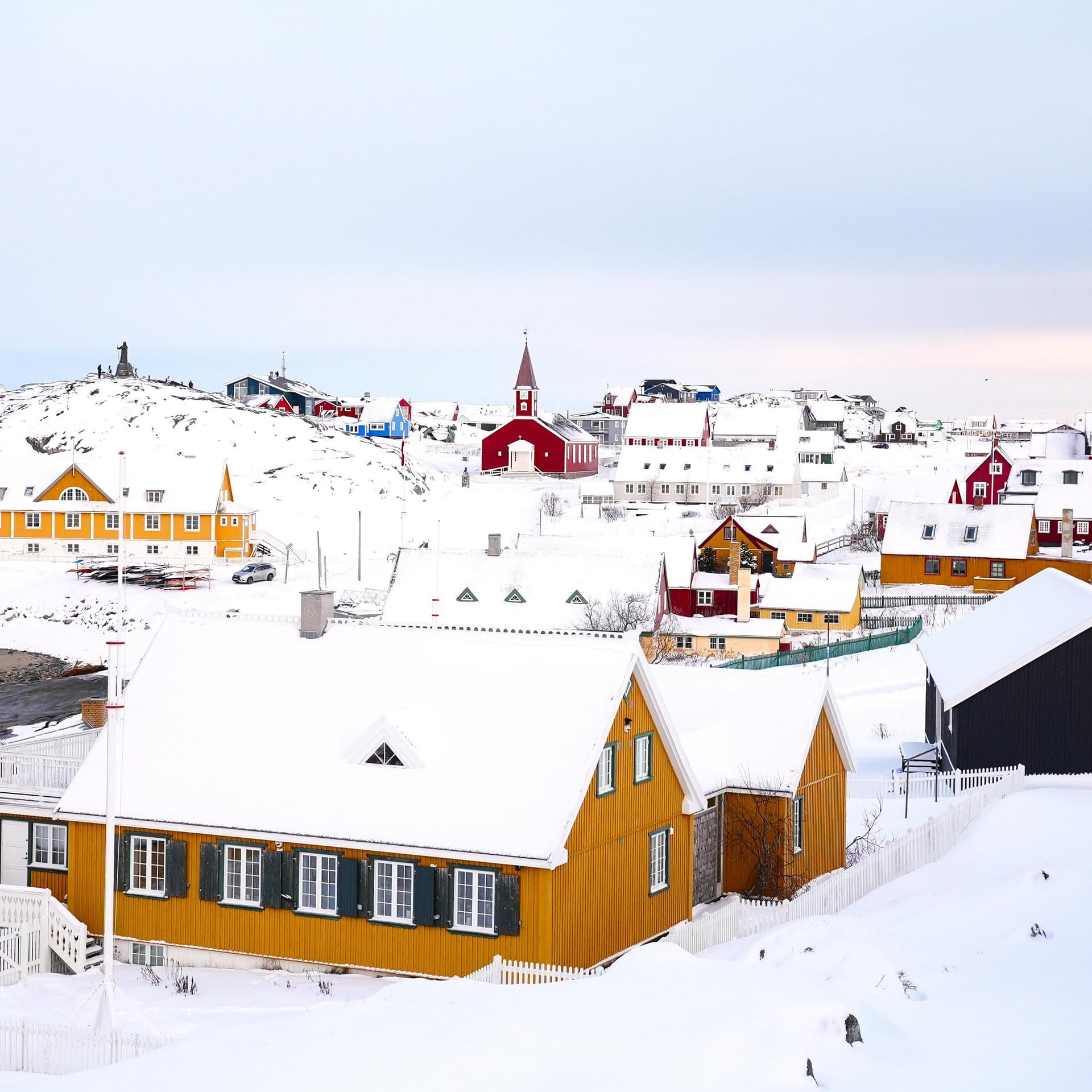
Credits: Love Actually (2003) / Dir: Richard Curtis / Universal Pictures Photo: A town in Greenland. BBC.