In short
The BBC Global Story episode explains El Niño–Southern Oscillation (ENSO) and warns that a predicted “super El Niño” (dubbed “Godzilla El Niño”) could drive extreme global weather. It links El Niño strength to rainfall, drought, heat waves, wildfires, and weakened monsoons, and argues that past El Niños have contributed to major historical crises and political instability. It also discusses preparation: systemic resilience, food supply planning, and how shocks can compound with other problems.
Guest backgrounds
Peter Frankopan is a professor of global history at the University of Oxford and author of Earth Transformed, studying how climate shapes world events.
Key claims
UN expects El Niño soon with 90% certainty; strongest-ever scenario. Human-caused ocean warming may amplify impacts. Effects vary by region and depend on prior conditions.
Notable examples
1780s Australia climate flip; 1780s southern Africa “Mahatulay” famine; India “Dojibara” skull famine; French Revolution via grain/wine price shocks; early 1900s India famine blamed on British “Drain Theory”; 1970s Soviet grain failures and “grain robbery” narrative; Jefferson’s daily climate measurements; Tambora 1815 causing “Frankenstein” era weather.
Written by AI. May contain mistakes. Listen to the episode to check what was said.
Chapters
Tap a time to open that second in VOUnderstanding El Niño
0:30 to 2:20
Exploration of the origins and implications of El Niño.
“Centuries ago, as legend has it, some fishermen off the coast of Peru noticed that every so often, the Pacific Ocean would become unusually warm around Christmas time.”
The Science of El Niño
2:20 to 4:40
Expert Peter Frankopan explains the mechanics of El Niño.
“And today on The Global Story, what do previous El Niños tell us about what might be coming down the pipeline?”
Global Impacts of El Niño
4:40 to 7:20
Discussion on how El Niño affects different regions worldwide.
“We've been hearing and seeing some headline reporting that this El Nino this year could be particularly powerful.”
Historical Events Shaped by El Niño
7:20 to 12:00
How past El Niño events influenced major historical moments.
“And also it doesn't affect those places in the same way.”
Colonial Responses to El Niño
12:00 to 14:00
Examining the relationship between El Niño and colonialism.
“Are there some more recent historical moments that have also been possibly down to an El Nino?”
Historical Impacts of El Niño on Food Supply
14:00 to 16:27
Learn how past El Niño events influenced global food supply and geopolitical dynamics.
“We find ways to be able to move grain to help people at times of famine and shortage.”
Understanding Current Global Challenges
17:00 to 19:23
Explore the interconnected challenges facing the world today, including El Niño.
“Peter, we don't want to give our listeners a constant stream of doom and gloom, but there are quite a lot of bad things happening in the world right now, quite challenging moments all over the place.”
Humanitarian and Economic Crises
19:23 to 21:47
Examine how crises lead to centralization of power and impact democracy.
“Well, it's hard, because Tristan told me to be positive and optimistic and give people opportunities.”
Historical Awareness of Climate Events
21:47 to 24:49
Understand how historical figures and societies responded to climate events like El Niño.
“If you don't want to learn from the El Nino events of the 1890s and 1900s, then learn from what we've had in recent experience.”
Crisis and Creativity in Human History
24:49 to 26:46
Discuss the relationship between crises and cultural creativity throughout history.
“But the eruption of Tempora creates the first recession in US economic history too, because of the effects it has on harvests and on grains and so on.”
Transcript
Automatic transcript. May contain errors.0:00This BBC podcast is supported by ads outside the UK.
0:30project started today.
1:00Just tap into iHeart to start watching. And we hope you enjoy the show.
1:08Centuries ago, as legend has it, some fishermen off the coast of Peru noticed that every so often, the Pacific Ocean would become unusually warm around Christmas time. There weren't as many fish for them to catch, and their livelihoods were hit. And so, as the story goes, they dubbed the changing Christmas temperatures El Nino, referring to Baby Jesus. El Ninos are a naturally occurring phenomena that go back, as you can see, years and years. A climate pattern known to drive extreme weather around the world. Heavy rainfall, severe droughts, intense heat waves. And now, this week, the UN issued a fresh, dire warning.
1:51Peter Frankopan:The science is clear. El Nino is arriving on our doorstep in the coming months with 90 % certainty. This coming El Nino is predicted to be one of the strongest ever recorded, a so-called super El Nino. Through the centuries, El Ninos have done more than just shape our weather. They've been linked to major world events from famines to revolution. From the BBC, I'm Asma Khalid in Washington, D.C. And today on The Global Story, what do previous El Niños tell us about what might be coming down the pipeline? And how we can prepare for this one?
2:36When we first saw the news of this so-called Super El Niño, something that, in fact, one news report we saw had dubbed a Godzilla El Niño, My co-host Tristan Redman and I figured we ought to put this into historical context. And so we called up Peter Frankapan. I'm a professor of global history at the University of Oxford. And amongst the things I've looked at for the last 30 years are not just regions, but new themes and the new materials. And as a historian, climate archives are a crucial part of understanding the past. I've done lots on climate histories and environmental bits that are important in the world of tomorrow and today as well as in the past.
3:14Well, Peter, for those of us, myself included, who have a kind of rough idea what El Nino is, but not understand the full concept, can you explain it for us, please? What is El Nino? Well, the world's global climate systems are extremely complicated and they interlock. But in short, El Nino is part of a configuration together with the La Nina, it means the boy and the girl, or the son and the daughter, that opposite phases of the same climate system that's known as the El Nino Southern Oscillation, or ENSO for short. And it's a natural climate phenomenon that usually occurs when you've got very warm water, or unusually warm water, that spreads eastwards across the central and the eastern Pacific Ocean.
3:58And that has an interactive role that triggers reactions in other parts of the global climate system. So normally in the Pacific, trade winds push the warm water towards Asia and towards Australia. but during an El Nino cycle or event, the winds weaken and that allows warm water to move eastward towards the Americas. And that changes lots of things in lots of parts of the world. It changes rainfall patterns, it changes storm tracks, and it changes global temperatures too. And so as a result, it can throw up anomalies, things we're not used to seeing, so floods, droughts, unusually strong or unusually weak monsoons.
4:33And it doesn't affect each part of the world the same way. And it It doesn't affect it each time there's a strong El Nino event. It doesn't always happen the same way. We've been hearing and seeing some headline reporting that this El Nino this year could be particularly powerful. What would make it so powerful? And how different is it expected to be from what we've seen in the past? Well, there are three different scenarios. All probably play part of it. One is that the opposite of the El Nino is the La Nina system. And so some of my colleagues think that La Nina charges the battery to unleash a whiplash.
5:07So the way conditions suddenly flip, there's an accumulation of heat that suddenly creates an extra strong La Nina. So the storage of heat is one part of it. A second part of it is that because of the fact that we've been burning lots of carbon dioxide, putting up the atmosphere, the oceans have got a lot warmer than normal. The human impacts play a role. And because there are more of us on this planet than ever been before, and we're burning more energy level before, that creates the conditions for things to be unusually strong. And then the third bit is that there is a natural cycle where these things, they come around time and time again.
5:41But in this particular case, we're seeing readings that I've never seen before in my career as a historian. We have imperfect records looking backwards in the past, but some of the buoys and the floats that gather the temperature readings in the Pacific are not a degree or half a degree above average, which would be statistically important. They're five or six degrees above average. I should just emphasize that we're talking about Celsius here rather than Fahrenheit. Celsius, yes. So, for example, in the United Kingdom in early May, we were sitting about 10 degrees centigrade Celsius below average.
6:13And over the course of about 48 hours, temperatures in the British Isles went up by about 20 degrees, up to the mid-30 degrees centigrade. And then over the course... Gosh, that's like 90s Fahrenheit, right? Huge. That's very hot. And it's the speed of change that you suddenly have this anomaly that you will rise by a significant degree other than normal. So it's not just about El Nino, it's about disturbances in the climate package around the world. What is the actual frequency with which we expect to have an El Nino or a La Nina year? Because it's not every year, is it? It's every two to seven years.
6:46The problem is not that they occur. I mean, it's a bit like whether it rains, it's how much it rains. It's not if it's sunny, it's how hot is it. So it's about the strength of these cycles. That's the key. You say that this is a weather pattern that specifically affects the Pacific Ocean. So does that mean that parts of Asia, say parts of the west coast of the United States, will be particularly affected? Do we know what geographic area might be hard hit by this El Mino? It's sort of where this is part of a climate pattern, and a bit like a jigsaw puzzle. When you move one piece, other pieces move two.
7:19So it doesn't affect everywhere at the same time. And also it doesn't affect those places in the same way. depends on all the different marginals. But typically, strong El Nino will make hot, dry weather in parts of South America, and in Southeast Asia, and in Australia, and would create conditions for extensive wildfires and droughts. But how much there is to get burnt depends on how much, ironically, it's rained in months and years before. So for example, a couple of years ago, we had the terrible fires in Los Angeles. One of the reasons why those were so bad was that there had been years of drought followed by lots and lots of rain that had made lush conditions that meant there was a lot of flammable material that could then catch fire.
7:57So it does have a sort of system where it's typically hotter in Southeast Asia, South America and Australia, and it weakens the Indian monsoon. And it also has an impact on rainfall in the Horn of Africa. But it doesn't always work exactly the same way. Well, Peter, you've written a book called The Earth Transformed, which is about how climate isn't just kind of a background noise to world events. it actually kind of shapes them at certain key moments in history. What are the big ticket moments in the last few hundred years that we think might have been shaped by an El Nino weather event? It's such a great question.
8:37And I wish I could stay on the podcast for three or four hours. You know, I think when we go back to the things that we all learn as kids, you know, about the flood of Noah, I guess people who, if you're Jewish, if you're Christian, if you're Muslim, which has a big chunk of the world's population. You know, that story about how human stupidity and disobedience gets punished with a massive flood. You know, that's all to do with problems in the past where unusual weather patterns have produced biblical, in this case, epic amounts of rainfall and flooding. So you have these warnings back the whole way through history about if humans aren't respectful, there will be punishment that's environmental and climatic.
9:14And I think that that's a really important sort of starting point. all global religions, including other great faiths too, have as part of their framing, plenty comes to those who live good moral lives. And if you live in a way that is stupid or selfish, then you get punished. But there've been lots of really important El Nino, super Ninos. One of the most famous ones is in the 1780s. It's just an exact moment when British colonizers arriving in Australia. And to start with, they think Australia is uninhabitable because there's so much rain. That then flips over the course of about 12 months to become so hot, as one source says, that it's like living in an open oven, that it's too hot to be able to survive.
9:55But where you have big problems with any climate anomaly is that it affects not just humans, it affects other forms of life too, in particular plants and crops and animals.
10:09In the 1780s, you have a devastating drought in southern Africa, for example, that kills millions. It gets known as the Mahatulay famine, which means literally the time we were forced to eat grass. Or in India, you have something called the Dojibara, or the skull famine, because so many bones of unburied victims are found lying by the sides of the road, and their skin eventually rots, and you're just left with the bones and the skulls. And you've got death rates measured in the millions, maybe even the many millions, because you can't find enough to eat. And when you start to add what's happening in other parts of the world, so in France, probably in European history, it's one of the most famous periods where you have a French Revolution, largely driven by the fact that grain prices go too high.
10:54You get hailstones the size of stones, proper big stones that makes the price of wine go up. And that makes people lose confidence in their government and how they do it in France when they're complaining about food and wages and not enough to eat, is they blame the king. And the king does what any stupid leader does, which is he says, send me your complaints on a postcard, which makes people think that he'll be able to solve the problems. And of course, he doesn't. So eventually, in the spring of 1789, people pick up, take on the pitchforks, and they march on Paris. And eventually, next thing you know, you have the French Revolution.
11:29These things, they produce recognizable problems, but it's to do with food shortages, water shortages, civil disobedience, and of course, disease. When people can't eat, their immune systems are compromised, and people die from hunger, of course. And so you've got a kind of catalogue of things that flow from stress and states can find it very difficult to react to shocks.
11:55Peter, that was the most fantastically elegant encapsulation of the French Revolution I've heard in some time. Thank you, I really enjoyed that. Are there some more recent historical moments that have also been possibly down to an El Nino? the difficulty with history is it's it's it's a it's a beautiful art so you can find you can find causes everywhere but it's about what the reactions are to problems so the problem is not el nino in itself it's it's how the reactions uh come towards it so for example there's a significant el nino event around the start of the 1900s where you have the same patterns that i mentioned before unusual weather patterns, crop failures, people suffer because of food shortages.
12:38In the late 1800s, early 1900s, in India, where you have large-scale death, you start to get a response of local people in India, critics saying the reason why people are starving is because the British are getting this wrong, the colonising power at the time. And one, for example, is a guy called Dhammad-Narodji. And he writes something called The Drain Theory. He says that wealth all gets extracted from India through taxation, through remittances, through debt payments, through trade, and it makes the country poor and therefore vulnerable to shocks. So famines, he says, are not just natural disasters.
13:15They are a symptom of a colonial economic system. So you can find in these kinds of crises, people try to provide explanations. So a few thousand years ago, it was God punishing. In the case of India, you get critics who say that the reason why Indian people are dying is because their wealth and their systems are being set up for other people's benefits rather than their own. So you can find... Peter, are you suggesting that there's a causation then or a link between an El Nino and the threats to colonialism, to British imperialism? I think causation is a tricky word for historians, but links, I think, is probably right.
13:51Right. So it's how much you want to put the emphasis on it. And, you know, for example, the British, as a response to this, kept telling everybody in India, well, we built railways. We find ways to be able to move grain to help people at times of famine and shortage. And then, of course, critics say it's the opposite way around. Actually, those trains are exported. They're built to help people to get food out and profits out too. So I think it's more complicated that you could prove things. But it's about understanding that these connections are there. But, you know, sometimes you get reasonably modest elderly news, like in the 1970s, that helped bring down ideas about the Soviet Union's ability to react as well.
14:29How so? I write about it in The Earth Transformed. I mean, the agricultural and consumerist comparisons between the United States and the Soviet Union after the Second World War are fascinating. You've got Soviet delegations who are taken around US supermarkets in the 1960s, whose their eyes pop out of their head that there are hundreds of different kinds of apples. and they're all perfectly shaped, they're all perfectly ripe. And they have to bite their hair to pretend that they have the same thing back at home. And then they go back home and go, we need to have agriculture that could compete, that looks about the same.
15:00In the 1970s, where there's an El Nino event, not particularly a substantial one, but Soviet production of grain falls by about 25 million tons. And as a result, they are forced to go and buy grain from the United States. And the United States think that the Soviets are buying it to feed their animals. And they give the Soviet Union a$750 million credit line, because that'll be great for American farmers. And the Soviets spend that in less than 30 days, because they're so desperate for food. In the way that history works in these sort of odd things, there's a satellite that's put into space a few months later called Landsat-1.
15:36If the US had had access to that data, they'd have seen that the Soviets had had terrible frosts, terrible droughts, followed by terrible droughts, and massive production failures. but a time of day it became known as one of the great sort of moments in history where the Soviet model gets exposed and it gets known as the great grain robbery sort of a play on the British great train robbery where the Soviets was pulling the wool over the USIs but it created a kind of a set piece where we learned not to trust Soviet figures we learned that there was will-run vulnerability and that they needed us at times of crisis where we didn't need them.
16:14And that was quite important in the 1970s for things like arms limitations talks that followed.
16:27Hi there, I'm Asma Khalid. And I'm Tristan Redmond. And together we're the hosts of the Global Story podcast from the BBC. For those of you who might be new to our show, We here at The Global Story dive deep every weekday on one big story at the intersection of where the world and America meet. And you can now watch The Global Story on the iHeart app. Catch every brand new episode every weekday. Just tap into iHeart to start watching. And we hope you enjoy the show.
17:00Peter, we don't want to give our listeners a constant stream of doom and gloom, but there are quite a lot of bad things happening in the world right now, quite challenging moments all over the place. You know, we don't even know what the full effects of the Iran war are yet on the global economy. and then you throw in a possible El Nino, a Godzilla El Nino into the bargain, like what are people supposed to make of all this? Well, they should understand it. That's the first thing. I mean, I'm a historian. I'm not a prophet. So I can't tell you what they should do, but I can tell you how things have worked in the past.
17:35So, you know, if you were thinking about this at a government level, if you're thinking about this at a household level, you might be thinking, how should I change and modify my personal behavior and spending patterns to prepare for what looks like it's coming towards us? And again, when I used to get taken to Sunday school when I was a boy, one of the stories I got told, and then as I got older and I could buy my own tickets, I went to go and see Joseph and the Technicolor Dreamcoat, the great Andrew Lloyd Webber musical. That whole story was about in the seven years aplenty, and seven is the kind of biblical word for just a lot, is make sure that you've got stuff set aside for the seven years or a lot of sorrow that comes later.
18:11So I think it's about how do you prepare for it? And that's not just about food. It's about thinking systemically about when you've got challenges, how do you respond? It's about thinking about if we've got these shocks coming towards us of high prices, inflation, it's obviously not great, but probably we should be thinking systemically about what that all means for us. And again, there's an obvious question, I think, about what's happening at the moment is that when you get a multiplicity of problems all at the same time, they magnify each other. And so it's a bit like how Shakespeare writes it in Hamlet, that sorrows don't come in single arrows, they come in quivers.
18:48And you can cope with one shock, that the problem is if you've had the great financial crisis, if you've had costs through COVID, if you've got fertilizer problems at the moment, if you've got fuel shortages, then suddenly things that can be quite modest can knock you over. And so suddenly a mega Nino or a Godzilla Nino suddenly means that those resiliences become very difficult and stressful. And again, a historian like me will try to flag what are the kind of worry points that you might also be thinking about that's not just about food prices. So what are the worry points, Peter? I mean, what can you do?
19:23Well, it's hard, because Tristan told me to be positive and optimistic and give people opportunities. And I suppose, again, speaking as a historian, the cynic will tell me that humanitarian crises, environmental crises, price shocks, economic shocks are great for those in positions of power because they are very closely correlated towards high levels of centralization. In emergencies, you see that states and rulers behave autonomously and autocratically because they believe, and sometimes they do need to deliver decisions quickly. And so there's a direct link between failing stances of democracy and pressure on democratic states and institutions and small groups that take power.
20:05And that's great. If you happen to be one of those people, then Bob's your uncle. You know, there are lots of things happen out of crisis empires being built. And again, in today's world, we think of empires as being bad things, but businesses, corporations, they don't all behave aggressively and behave badly. Peter, if back in biblical times, people might have blamed extreme weather events on gods, and in the 18th, 19th century, people might have blamed them on their colonial occupiers, who do you think might be on the receiving end of a major El Nino this year? Look, I think people in the past weren't stupid.
20:41You know, people understood the sciences. I mean, people, I can promise you, Mesopotamia, were able to calculate the circumference of the earth much more accurately than I can. So I don't think that people just looked at the skies and thought, oh, we're just being punished and it's not really our fault. It's to do with the gods being angry. I think that religion can give you a narrative that explains it, but it's very closely linked to saying you deserve what you get, right? And if you get things that are awful, of food shortages, of death, of mass mortality, it's your own fault. So politicians always get blamed.
21:09I mean, that's how it works, whether you're the king, whether you're the ruler, whether you're an elected ruler or otherwise. It's how well you can respond in a crisis. And again, one of the lessons we should have learned about COVID was it's awful when these things happen. But if you can see them coming and you can react quicker or quickly, then probably you come out of it less badly damaged than other people. So it's recognising that shock. It's not a surprise that, for example, countries like China have thought quite aggressively about food supply. So every city with more than a million inhabitants in China carries two weeks of spare food supplies.
21:39And in the United Kingdom or United States or Europe, no major city carries any supplies. History is always a dress rehearsal for what comes next. If you don't want to learn from the El Nino events of the 1890s and 1900s, then learn from what we've had in recent experience. Peter, you're a historian. And so I wanted to understand some of these examples you've given us. The El Nino, say, at the turn of the 19th century, the El Nino that you see took place in the late 1700s. Did people know what was happening in that moment? I guess I want to understand from a historian's perspective, presumably we look at the past.
22:14It helps us make better decisions, in theory, for how to deal with this in this moment. When those moments happened, did people know what was going on or were they only identified later? I think in today's world, we're all used to having a handset in our pocket where we could take out our phone and say, hey, look, it's one or two degrees lower. Typically, it's quite hard to feel the change unless you're measuring accurately. But, you know, Thomas Jefferson, one of the great, one of the founding fathers, one of the presidents of the United States, you know, we're coming up to 250th anniversary of US independence.
Read the full transcript
22:45Thomas Jefferson was obsessed about climate change and about weather shocks. And he took three temperature and wind readings every single day for about 50 years. So the morning that he signed the Declaration of Independence, which he drafted, he went to go pick up a new barometer from a shop because he was so he was as worried about getting free from the tyranny of Britain as he was about working on what atmospheric pressures were like so people were very concerned that things were changing in fact Jefferson was one who thought that by people European descent cutting down forests in northern America that they were making climate change and he got attacked by a colleague of his at Harvard who said you know you're relying on you know old people telling you that it used to be warmer or cooler you need to measure this stuff properly he got very stung by that.
23:28So that's why he kept these detailed records every single day, three times, which, you know. Though Jefferson was, I mean, a really highly educated person, as you say, a president of our nation here in the United States. I guess, did lay people know? I think I'm wondering in comparison, you know, I saw a story on the BBC website the other day telling me that this is going to be a super El Nino. I think as Tristan said, a Godzilla El Nino, which I don't know what exactly that means. Sounds very terrifying. But we are being told that this is likely to happen. Did people know that this was happening?
24:00Yes, they did. And there'd be plenty of times when you've had strong El Ninos where there were no shocks that come with it. But people do recognise when there's unusual weather.
24:11For example, there was a big volcanic eruption in 1815. Tambora, one of the largest eruptions in history. And that ruined the holiday for Lord Byron and Mary Shelley and Percy Shelley, who'd gone to Lake Geneva for a nice boating holiday. and they had to spend the whole time indoors because it kept raining and having thunderstorms with big dark clouds. So they thought, well, to hell with this for a summer break. Let's tell each other ghost stories. That's why Mary Shelley came up with the idea of writing Frankenstein. So that was a direct result about the fact that this massive volcanic eruption, which by the way, she might've written that story anyway.
24:47It might've still been raining. The storms, they still might've been bored. But the eruption of Tempora creates the first recession in US economic history too, because of the effects it has on harvests and on grains and so on. So we live in this hyper-connected world. It's not just about human history. It's trying to understand things as a whole. That's my job as a historian anyway.
25:11And we got a classic novel out of it. Frankenstein. We got a great novel out of it. And in fact, not only that, we got a great primer for fears about what a nuclear war might look like. So in the 1980s, members of the Soviet delegation meeting, but talk about arms limitations talks in the United States, would bring up the Frankenstein story. And to say, this is what will happen if we put a lot of, if we inject a lot of material into the atmosphere because of nuclear tests or worse, nuclear warfare, where, you know, massive radioactive clouds could change the global climate patterns. we're going to live in a world where food is going to be scarce and global temperatures as was modeled in a very famous paper printed in science in 1983 that global temperatures might fall by seven eight nine degrees and when that happens there are consequences so you know there are some amazingly there are some important lessons you can learn from history but i'd be reluctant to try to say that they're deterministic to say that this is what is going to happen but you can you can see the warning signs and a bit like go to the doctor once you once you once you think you're going to fall ill, you know, start taking the medicine.
26:14Peter, I was trying to bring us to a warm and fuzzy conclusion about a novel and you took us back to nuclear war. Look, I think we live in a beautiful, hyper-connected world where we can listen to podcasts, we can meet each other virtually, where we can create music, we can write novels. Wonderful things happen in times of crisis because it can also show humanity at the most creative.
26:39but you know history tells you that you know mother earth and mother nature aren't here to prolongate our species and our success nature doesn't care if humans are here or around it's about not just survival of the fittest in fact what darwin writes about it's about the ability to adapt that's key and adaptation at times of challenge and change is it's not easy but if you can get it right then you know then there's great news.
27:11Thank you so much, Peter. It was great to talk to you. Thank you, Peter. Absolute pleasure. Thank you.
27:26That was Peter Freikopan, Professor of Global History at Oxford University and author of a book about how climate has shaped history called Earth Transformed. And friends, as you all might know, the World Cup is kicking off next week here in North America. And I think it is fair to say that it is a tense time around the world. We are cooking up a special episode based off of your listener questions. And we'd love to hear from you. So we want to know what you all want to know about the World Cup. Three countries, 48 teams, and I think it's fair to say lots to talk about beyond just the sport of it all.
28:01You can send us your questions via email at theglobalstory at bbc.com. And a reminder, as you all loyal listeners know, that we here at The Global Story dive deep every weekday on one big story about where the world and America meet. If you're also looking for a way to catch up on the very latest news headlines, you should check out our sister show, The Global News Podcast. You can find it wherever you listen. Today's show was produced by Valerio Esposito and Aaron Keller. It was mixed by Travis Evans. Our studio manager is Mike Regard. Our senior news editor is Chyna Collins. And I'm Asma Khalid with Tristan Redmond.
28:37That's it for today. Thanks as always for tuning in. And we'll talk to you again on Monday.
28:52Hi there, I'm Asma Khalid. And I'm Tristan Redmond. And together we're the hosts of the Global Story podcast from the BBC. For those of you who might be new to our show, we here at The Global Story dive deep every weekday on one big story at the intersection of where the world and America meet. And you can now watch The Global Story on the iHeart app. Catch every brand new episode every weekday. Just tap into iHeart to start watching. And we hope you enjoy the show.
From the publisher
Scientists warn that a “super” El Niño could be on its way which, combined with the effects of human-caused climate change, could result in 2027 being the warmest year on record. Yet El Niño is not just a climate story - throughout history, this recurring weather pattern has helped shape global events, triggering everything from famines and revolutions to impacting the Cold War. In this episode, we speak to historian Peter Frankopan, Professor of Global History at Oxford, to discuss what historical El Niños tell us about what cou be coming our way, and how we can collectively prepare.
Producers: Valerio Esposito and Aron Keller
Executive producer: James Shield and China Collins
Mix: Travis Evans
Senior news editor: China Collins
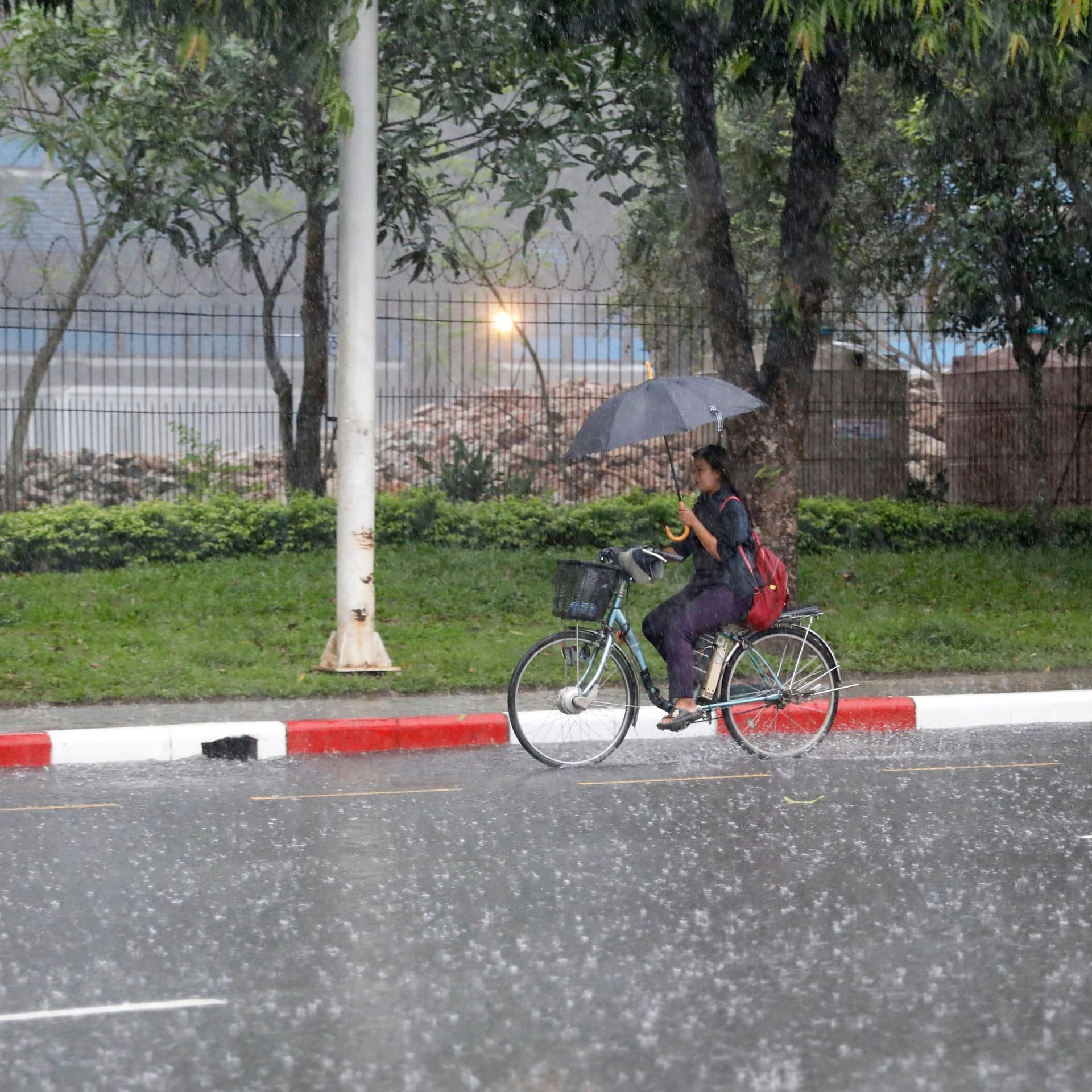
Photo: A woman rides a bicycle in the rain in Yangon, Myanmar, 22 May 2026. Credit: Nyein Chan Naing/EPA/Shutterstock