
In short
How the Nov 26 Washington, D.C. National Guard shooting (suspect Rahmanullah Lackenwald, Afghan) rapidly accelerated Trump’s immigration crackdown, including asylum pauses and broader travel-ban expansion, and how Afghan refugees—especially those who worked for U.S. forces—may now face renewed risk.
Guest backgrounds
Asma Khalid (BBC Washington correspondent). Tristan Redman (BBC London). Mahfouz Zoubaidi (BBC journalist; Afghan-born, Kabul; covered Afghanistan for 15+ years; fled after Taliban return; now in London).
Key claims
Trump linked the shooting to “lack of vetting” under Biden; administration reviewed asylum cases and halted asylum decisions; barred Afghans from entry; paused pending immigration applications from 19 “high-risk” countries; critics call it collective punishment.
Notable examples
Lackenwald entered via Operation Allies Welcome; obtained asylum in April; Afghan Evac founder says he worked with a CIA-backed unit. Mahfouz’s interviewee fears family reunification promises will collapse. UN/Human Rights Watch warnings about deportation safety; TPS termination for Afghanistan. Somalia cited alongside Minnesota fraud/ICE actions involving Somali immigrants.
Written by AI. May contain mistakes. Listen to the episode to check what was said.
Chapters
Tap a time to open that second in VOContext of the Shooting
0:44 to 0:57
Overview of the National Guard shooting incident and its implications on immigration policy.
“teens can gain hands-on investing experience and build positive money habits.”
Context of the Shooting
1:14 to 2:00
Overview of the National Guard shooting incident and its implications on immigration policy.
“Since then, there's been an immigration crackdown that has turned up the White House's anti-immigration policies to a new level.”
Explaining the Immigration Crackdown
2:00 to 2:42
Discussion on how the shooting connected to Trump's immigration policies and the response from his administration.
“immigration policy happened so fast, and why Afghans who helped the United States might now be at risk.”
Afghan Migration Numbers and Policies
2:42 to 3:58
Insight into the numbers of Afghan migrants in the U.S. and the vetting process after the shooting.
“Okay, Asma, it feels like a lot of things have happened in a very short space of time.”
Immediate Policy Changes Post-Shooting
3:58 to 6:00
Exploration of the immediate immigration policy changes following the National Guard shooting.
“Donald Trump campaigned on being tough on immigration.”
Social Media and Political Responses
6:00 to 7:54
Analysis of political responses to the shooting and subsequent immigration policy changes.
“Why don't we start with what we saw on the 27th, which was Thanksgiving Day.”
Impact on Afghan Refugees
7:54 to 9:20
Discussion on how the Afghan refugees are affected by the new immigration measures.
“OK, and how quickly do we see these measures actually being applied?”
Discussion on Somalia's Role in Policy Changes
9:20 to 10:52
Examining the unexpected focus on Somalia in the context of immigration policy.
“And what the founder of that organization, Afghan Evac, says is that Rahmanullah Lackenwald, the suspect, worked with this CIA backed unit in Afghanistan.”
Trump's Rhetoric and Policy Implications
10:52 to 14:00
Evaluating Trump's statements about immigrants and how they impact policy.
“Strong words there from the woman who is the head of the Department of Homeland Security.”
Trump's Controversial Comments on Somali Immigrants
14:00 to 14:48
Discussion on Trump's derogatory remarks about Somali immigrants and Congresswoman Ilhan Omar.
“When President Trump was asked a question about the Democratic governor of Minnesota, and he went on a rant about Somali immigrants, he cited specifically a sitting congresswoman by the name of Ilhan Omar, who is a U.S.”
Show all 16 chapters
Criminal Investigation Impacting Somali Community
14:48 to 15:38
Overview of a criminal investigation involving Somali immigrants in Minnesota and its implications.
“The words he has used, the derogatory language he has used to refer to Somali immigrants caught a lot of people's attention.”
Mahfuz's Journey: From Shoeshiner to Journalist
17:07 to 21:44
Interview with Afghan journalist Mahfuz Zabeda about his journey to BBC and experiences in Afghanistan.
“AT &T Fiber, limited availability in select areas.”
The Plight of Afghan Immigrants
21:44 to 24:24
Mahfuz shares the stories of Afghan immigrants in the U.S. struggling with immigration issues.
“You've been speaking to Afghan immigrants in the United States whose immigration cases are now on hold.”
Potential Deportation of Afghan Nationals
24:24 to 27:02
Discussion on the implications of terminating Temporary Protected Status for Afghan nationals in the U.S.
“But what he is hearing from the news is that's worrying him and his family.”
Human Rights Concerns in Afghanistan
27:02 to 28:00
Highlighting the dire human rights situation in Afghanistan and the risks for returning nationals.
“I wanted to try and understand a little bit about what it could actually mean to be deported back to Afghanistan.”
Continuing the Important Story
28:00 to 28:26
Discussion on the importance and ongoing nature of the story.
“I think we should keep on this story because it feels like it's not going anywhere and it's a really important one.”
Transcript
Automatic transcript. May contain errors.0:00This BBC podcast is supported by ads outside the UK.
0:30No bouncing between tabs. And best of all, no spreadsheets. Stop managing software and start managing your business with one unified system. Try for free today at odoo.com. That's O-D-O-O dot com. With the new Schwab Teen Investor Account, teens can gain hands-on investing experience and build positive money habits. It's an account co-owned by you and your teen, so you can monitor and engage with the account while your teen learns how to invest and manage money. Learn more at schwab.com. Just before Thanksgiving, two U.S. National Guard members were shot in Washington, D.C. After the attack, President Donald Trump promised to, quote, permanently pause migration from all third world countries.
1:15Asma:Since then, there's been an immigration crackdown that has turned up the White House's anti-immigration policies to a new level. Afghan refugees in the United States are at the center of all of this because the suspect in the Washington shooting is an Afghan. And some Afghan refugees are in a particularly precarious position. Those who arrived in the U.S. after working for the U.S. military during the 20-year war in their home country. Many were promised safety in America when U.S. troops withdrew, and that promise is now in doubt. I'm Asma Khalid in Washington, D.C. And I'm Tristan Redman in London.
1:56Today on The Global Story, how huge changes to U.S. immigration policy happened so fast, and why Afghans who helped the United States might now be at risk.
2:14Asma:Coming up later in the show, we're going to hear from our colleague Mahfouz Zoubaidi. He's a journalist with the BBC in London, originally from Afghanistan. He's bringing us his own reporting on the stories of some Afghans in America who are caught up in these sudden sweeping immigration changes. But before we get to Mahfouz's reporting, Tristan and I wanted to sit down and talk through everything that has happened here in Washington around immigration policy since that National Guard shooting. Okay, Asma, it feels like a lot of things have happened in a very short space of time. Can you run us through them, please?
2:49Yeah.
2:50Asma:I mean, Tristan, I would say a monumental number of changes happened to the U.S. immigration system, I will say, in a very, very quick order. Since this Afghan national by the name of Rahmanullah Lock and Wall was accused of shooting two members of the National Guard here in Washington, D.C., just blocks from the White House. One of those National Guard members has died as a result of that attack. And what we've seen from the Trump administration is an effort to draw a direct line between that attack here in Washington and the prior administration, the Biden administration's vetting or what they would say lack of vetting of Afghan migrants.
3:30The suspect in custody is a foreigner who entered our country from Afghanistan, a hellhole on earth. He was flown in by the Biden administration in September 2021.
3:42Asma:They argue that over the last couple of years, there's been this free flow of dangerous migrants coming into the country. The last administration let in 20 million unknown and unvetted foreigners from all over the world, from places that you don't want to even know about. Donald Trump campaigned on being tough on immigration. That is something that his supporters very much endorsed. He said he was going to crack down on the southern border, that he was going to carry out the largest deportation force in modern history. He was elected on a wave of anti-immigrant sentiment. I will also say, though, that to Donald Trump's critics, these changes we've seen over the last several days are being viewed as collective punishment for the crime of one individual.
4:27Asma:And some of Trump's critics see this as an opportunistic move to enact the president's broad immigration agenda in ways that they feel does not actually reflect the reality of this one individual crime. Just for context, do we know how many people of Afghan origin there are in the United States? The total number, Tristan, I would have to look that up. But what I can say is that in 2021, after that chaotic withdrawal that we saw of the United States from Afghanistan, there was this program that the Department of Homeland Security under the Biden administration created. It was called Operation Allies Welcome.
5:04Asma:There was that program, then a subsequent initiative that brought in many, many Afghans to the United States. The numbers I've seen through a State Department report said that more than 190 ,000 Afghans have moved to the U.S. since 2021. OK, I mean, that's a huge amount. It is a large number. And the Biden folks at the time, certainly allies of this program, say that the Afghans were well vetted. I recall the Department of Homeland Security at the time spoke of a process that involved biometric and biographic screenings. But some Republicans have questioned the speed with which this vetting process was carried out.
5:40Asma:And they point to an inspector general report that found some flaws in the process. Well, since the shooting on November 26th and the revelation that the chief suspect is a person of Afghan origin who used to work with American forces in Afghanistan, what's happened exactly? Oh, gosh, a lot has happened. Why don't we start with what we saw on the 27th, which was Thanksgiving Day. This was the day after the shooting. President Trump posted a Thanksgiving greeting in which he also said that he intends to, quote, permanently pause migration from all third world countries. And he spoke of deporting immigrants that he saw as, quote, noncompatible with Western civilization.
6:29Asma:He also closed his message by saying, Happy Thanksgiving to all except those that hate, steal, murder, and destroy everything that America stands for. I mean, it seems like a very rapid expansion of an issue. There's a shooting one day and very quickly afterwards, the ban is extended to an immigration crackdown on people from lots of different countries, not just from Afghanistan. And one of the things, Tristan, I will say, is that over the last few days, we've had to parse what the president has said on social media, perhaps what some of his supporters have also said, and what we've actually seen change in policy.
7:07Asma:And we have seen a number of policy changes. So what we saw from the president was this pause in migration from third world countries threat. We saw those words. And then what we saw was the director of USCIS, which is the main government agency responsible for lawful immigration. It is under the Department of Homeland Security. And the director of USCIS wrote on social media that the protection of this country, the protection of American people is paramount. And the American people will not bear the cost of the prior administration's reckless resettlement policies. And so the administration said very quickly after that shooting that it is going to begin reviewing all asylum cases approved under the prior Biden administration.
7:54OK, and how quickly do we see these measures actually being applied?
7:58Asma:Well, on Friday, day after Thanksgiving, we get word that the Trump administration has halted asylum decisions for all migrants in the United States. This new change presumably affects people who are already in the process of claiming asylum here in the U.S. And that process can can take a long time. And then the other major move we saw from the Trump administration was the State Department saying that would bar Afghans from entering the country. And I think some listeners might be confused thinking, well, hey, isn't Afghanistan already on this travel ban list that the Trump administration issued back in June?
8:38Asma:You might remember this. There was this list of countries for whom the Trump administration issued a travel ban over the summer. Afghanistan was on that list, but there had been an exception for SIVs, special immigrant visas. These are Afghans who helped the U.S. military. They were given a carve out because, frankly, there's been bipartisan support amongst lawmakers for a long time to say, hey, these people helped the United States over its war effort in Afghanistan and that the U.S. government owes them something in return. OK, well, just so I so I fully understand the suspect in the shooting in D.C., Mr.
9:15Lackenwald, did he enter the United States on this special visa program?
9:19Asma:Tristan, I've been in touch with this NGO called Afghan Evac that has assisted a number of Afghans to resettle here in the United States. And what the founder of that organization, Afghan Evac, says is that Rahmanullah Lackenwald, the suspect, worked with this CIA backed unit in Afghanistan. on. He came to the United States in 2021 through that program I mentioned, through the Operation Allies Welcome Program. He then went on to obtain asylum in April of this year under the Trump administration. And, you know, later on Sunday on Air Force One, the president was also pressed on how long the administration intends to pause asylum.
9:58Asma:The president did not give a time frame. He just said a long time and that the U.S., he said, doesn't want those people in the country. All of this stuff has been happening during the Thanksgiving weekend. What happens when America goes back to work on Monday? Well, on Monday, we see the Secretary of Homeland Security, Kristi Noem, issue this rather scathing statement on social media, calling on President Trump to enact a, quote, full travel ban on every damn country that's been flooding our nation with killers, leeches, and entitlement junkies. She goes on to say, Our forefathers built this nation on blood, sweat and the unyielding love of freedom, not for foreign invaders to slaughter our heroes, suck dry our hard earned tax dollars or snatch the benefits owed to, all caps, Americans.
10:49Asma:We don't want them. Not one. Strong words there from the woman who is the head of the Department of Homeland Security. I mean, that is quite a social media post. What is a response when she posts this? Well, I will say that one response we saw, Tristan, is that President Trump shared that message on his own social media platform. And, you know, I will say, regardless of what people may say, I think retweets are generally considered endorsements. And building on that social media post, the Secretary of Homeland Security then went on Fox News and gave some more details on what this expanded travel ban might include.
11:31I won't be specific on the number, but it's over 30. And the president is continuing to evaluate countries. Listen, if they don't have a stable government there, if they don't have a country that can sustain itself and tell us who those individuals are and help us vet them, why should we allow people from that country to come here to the United States? So are these measures backed by legal mandates? Or at this stage, are they just kind of living in the social media world or in declarations on Air Force One?
11:57Asma:It's not just rhetoric. On Tuesday, we saw the Department of Homeland Security issue a policy memo to take effect immediately with some major changes to legal immigration. One key change we saw is a pause and review of all pending asylum applications. And in this memo, they point to Rahmanullah Lakinwal, the suspect in that National Guard attack in Washington, D.C. But what you hear from the Trump administration Their justification is that this is not one isolated incident. They also point to another Afghan national who they say was planning an attack in the U.S. on Election Day in 2024. They say pled guilty in federal court to conspiring and attempting to provide material support and resources to ISIS.
12:47Asma:And also in this memo that was issued, another major change is a pause on all immigration applications from people from 19 countries that the Trump administration has deemed high risk. Those countries don't just include Afghanistan. Also on the list are countries like Somalia, Iran, Haiti, just to name a few. And it seems that could affect people who have green card applications, who are on a legal pathway to citizenship. I wanted to ask you about Somalia because I saw on Tuesday that Somalia had been kind of cited by Trump as a place of particular interest. Why Somalia all of a sudden? Can you explain that to me?
13:29Asma:It's an excellent question and one that a lot of journalists here have been wondering, because since that National Guard attack, we have seen multiple instances in which the president has cited Somalia. Sometimes he's spoken about Afghanistan and then sort of in the next breath, the next paragraph, talked about Somalia. You know, the moment that really, really caught a lot of people's attention was a cabinet meeting here at the White House last week. Nice to be with you. Welcome to the final cabinet meeting of 2025. a year that will go down as the most consequential and successful first year of any administration.
14:05They're saying that, not me.
14:07Asma:When President Trump was asked a question about the Democratic governor of Minnesota, and he went on a rant about Somali immigrants, he cited specifically a sitting congresswoman by the name of Ilhan Omar, who is a U.S. citizen of Somali heritage. Ilhan Omar is garbage. She's garbage. Her friends are garbage. These aren't people that work. These aren't people that say, let's go. Come on, let's make this place great. You referred to her as garbage, her friends being garbage. We don't want them in our country. Let them go back to where they came from and fix it. Thank you very much, everybody. The words he has used, the derogatory language he has used to refer to Somali immigrants caught a lot of people's attention.
14:56Asma:And look, Somalia is on that travel ban list that the president has issued. But the context for this also is this large-scale criminal investigation in Minnesota.
15:12Asma:According to the reporting of our colleagues here at the BBC, dozens of people have been charged over a scheme that federal prosecutors say involved a charity that was fraudulently billing the Minnesota government for meals during the COVID-19 pandemic. A number of Somali immigrants were implicated in that alleged scheme, which ultimately cost the state tens of millions of dollars, according to a former investigator in Minnesota's attorney general's office. We've also heard news from our reporting partner, CBS News, that ICE is going after Somali immigrants in the Twin Cities, in the Minneapolis-St.
15:48Asma:Paul area of Minnesota. Mm-hmm. And so the criticism of the president's comments is that he is using at times the act of an individual or the act of a few to enact some sort of collective punishment.
16:13Chicago talks a lot. Hold on, let me step over here. People are talking too much. We debate about food, deep dish, tavern style, who's got the best beef. We yell across rooms, across blocks, across generations. Yes, nice earrings, Grammy. And now we're doing it on our phones, too. Video calls from the L train, group chats that never shut up. Neighbors texting you the score before your TV catches up. Come on! Get a load of this guy. Catch up. On a dog. Yeah, we've got thoughts. Too loud? In Chicago, you're gonna hear it. Because nothing here gets built without conversation. Nothing moves without connection.
16:51So if you think you know AT &T, it might be time to rethink that because their network has improved, like, a lot. So Chicago can keep speaking its mind with AT &T Wireless and AT &T Fiber.
17:03Asma:Chicago won't stop talking. Our improved network backs it up. AT &T, connecting changes everything. AT &T Fiber, limited availability in select areas.
17:17Well, Asma, I mean, it seems like it really did escalate fast. And Asma, while you've been looking into all of this for us in DC, I've been speaking to an Afghan journalist who's been covering this story. And as you know, the BBC has journalists from all over the world. And for this episode, I've spoken to Mahfuz Zabeda, who's our colleague who comes from Kabul and Afghanistan and he's been doing some important reporting on this story. He's based in London and he's been talking to Afghan migrants in the United States who are caught up in all of this. And when I sat down with him, I asked him how it was that he came to be working for the BBC in London when he's originally from Kabul.
18:01Well, I have a long story about how did I join the BBC. I was a shoeshiner. A shoeshiner? shoeshine. Wow, where? In Kabul. So I was on the street where the BBC office was. Wow. When was this? Well, I started working when I was six, seven years old. So my father got paralyzed and my mother was a housewife. So I decided to go out and work for the family. Okay. So at this point you are working on the street where the BBC has its office. And then when the Taliban's government collapsed in 2001, I was still continuing doing shoe shining and going to school. And one night, Elise Doucette was my customer.
18:53Elise Doucette, the BBC's chief international correspondent and friend of the Global Story podcast. Yeah. Yeah, and so I used to polish her. There's one thing special about her that even if she's busy, she kind of observing the areas and people around her. So one night she came out of the car and I was sitting there and I was doing my homework on the street. You know, for the next day I was going to school and it was about 11 o 'clock in the evening or something and she came to me and she said, Mahfouz, it's late night. What are you doing here? She took me inside the BBC because it was November, it was cold a little bit So I polished her shoes and she gave me money which was enough for two, three months of food for my family Wow, how old are you at this point?
19:44I was in high school Okay, so 13, 14, something like that? Yeah
19:53so Lisa arranges for Mafuz to work an admin job in the BBC cardboard bureau you know doing small jobs like buying the newspapers and booking tickets for the team and Mafuz is really good at it and one day he's called in for a conversation with the bureau chief I said what is it said from now on, you're a BBC employee. I have been doing this job for, I don't know, God knows, for two years or three years. I said, no, no, no. Up to now, it was Liz used to pay your salary. What Liz had kept from Mafuz was that he wasn't technically employed by the BBC at all. She was paying his wages and he'd had no idea.
20:35From her own pocket. For how long? It was for two years or more than two years. Wow. Yeah.
20:44And so then you became the BBC office manager in Kabul and then a BBC producer in Kabul. Yeah, I was covering stories in Afghanistan for the BBC. So at this point, Mafuz is a journalist and he covers Afghanistan for more than 15 years until the moment in August 2021 when the government collapses and the Taliban returns to power. and that of course is the moment when lots of afghans leave the country and mafuz was covering all of this and he was living it at the same time i was covering the story for bbc for seven days after the labs and then i moved to pakistan with my four years old daughter and two months old son we had a really tough journey but you know we went to pakistan and I was there for 18 months and then came to London in March 2023.
Read the full transcript
21:39Incredible story, Mahfuz. And now you work with us here at the BBC in London and you've been doing some reporting recently. You've been speaking to Afghan immigrants in the United States whose immigration cases are now on hold. Can you tell us the stories that you've been collecting? Well, I'll start with one person that is now in the United States, but his family is still in Afghanistan. He said he used to work for Americans in Afghanistan in Kandahar province where the American base was there. And also in Kabul. He was interpreter. He was translator for the Americans. So he said when the Americans left and there was a lot of people went to the airport, the American soldiers put him in a plane and took him to Qatar and from Qatar to the United States.
22:31He said the reason he didn't take his families on that day because it was so many people and he had a newborn baby. So he was scared that if they go through those crowded people so he might lose his family. He said, let me go first, settle there. And because I've worked with them, I will pile a case for you guys and then you guys can come. when I spoke with him he said you know that all the procedure of them to come to the United States was finalized and he was waiting for the Americans to tell his family to go and collect the visa and come and join me and he said he keep promising his little daughter she is now four years or four plus that she will reunite with him and in the United States and somewhere better than Afghanistan and he fears that after this incident, that might not happen.
23:27Okay, so it's been more than four years then that he's seen his daughter, is that right? Yeah, face to face. I mean, they talk on the phone, on WhatsApp, but also now he says, if she asks me a question that when she will join me, he said, I don't have the answer for her. He said, that's the very sad moment for her. What did he tell you about his reaction to the killing, the shootings when they happened in Washington? Well, he said that, you know, it's one person do something wrong. Don't blame all the nation. They condemn this attack. It's unforgivable. But he said, please don't judge all Afghans with one person when he committed a crime.
24:13And is he worried that it may be more complex than his family not being able to come to the United States? Is he worried that he might actually have to leave the United States as well? Well, he said he doesn't know what will happen. But what he is hearing from the news is that's worrying him and his family. How is he coping? I mean, it's an incredibly sad story. How does he feel about it all? I mean, he said he's very sad because he lost the hope now. God knows what will the American government decide. He said it's not just my case. It's all those Afghan friends that I have. Their brothers are in Afghanistan.
24:50and their parents are in a bond son, their wife or children are in a bond son. So we are just saying what will happen and we just pray.
25:01A certain number of promises and commitments seem to have been made to many Afghans, Afghans who worked alongside American forces in Afghanistan, sometimes for years and years. Has the backlash from the U.S. government after the shootings in Washington come as a shock to Afghans? A lot of them are saying this, you know, that we work alongside of the Americans shoulder by shoulder for 20 years. But now for one person, a mistake, they forgot about us.
25:41Thank you so much, Mahfuz. My pleasure. It's good to be in your program.
25:51Well, that is quite a story, Tristan. Well, something we haven't covered yet, Asma, is what would ultimately happen to Afghan nationals like the ones Mahfuz has spoken to if they're deported back to Afghanistan. What are you hearing on that?
26:06Asma:Now, back in May, we saw the Trump administration terminate a program known as TPS, Temporary Protected Status, for Afghanistan. The Department of Homeland Security Secretary argued that Afghanistan is now a safe country to go back to. And we heard Kristi Noem, who heads that department, say that Afghanistan has had an improved security situation and its stabilizing economy, in her words, no longer prevents them from returning to their home country. With the end of that TPS program, it certainly opens up the door for deportation for Afghan nationals here in the United States. And so, you know, the end of these programs in some cases has been challenged in the courts here in the United States.
26:53Asma:But essentially what this means is it certainly raises the stakes for Afghan nationals living in the United States to be deported. Yeah, I mean, it must be a concerning moment for them. I wanted to try and understand a little bit about what it could actually mean to be deported back to Afghanistan. The United Nations has said that nobody should be returned to Afghanistan because, quote, Afghanistan is not a safe country. Now, Human Rights Watch has said that the situation in Afghanistan is catastrophic. They say, quote, extrajudicial executions, enforced disappearances and torture are happening in Afghanistan.
27:33No one is safe there.
27:38Asma:You know, in working on this episode, I tried to reach out to someone who is an Afghan national here in the United States with an asylum pending case. And the response I got back was, quote, if I talk to the reporters and then also get deported, it's a certain death for me and family. Oh, boy. I'm sorry to hear that, Asma. I think we should keep on this story because it feels like it's not going anywhere and it's a really important one. Yes, it's such an important story and we are going to keep following it.
28:25Asma:That's it for today's episode of The Global Story. Our show was produced by Zandra Allen and Viv Jones. It was edited by Bridget Harney, and it was engineered by Marty Peralta. Our senior news editor is Chyna Collins. If you've got any ideas or suggestions or questions for a future episode, please send us a note. Our email address is theglobalstory at bbc.com. We really appreciate hearing from you all. And thank you, as always, for listening.
From the publisher
After an Afghan national was charged with shooting two National Guard members in Washington DC, President Donald Trump called for sweeping changes in immigration policy and pledged to "permanently pause migration" from all "third world countries".
Afghan nationals, especially those who worked with the US mission in Afghanistan, may now find themselves in a particularly precarious position. Asma and Tristan discuss these rapid recent policy changes, and the BBC’s Mahfouz Zubaide shares recent reporting on how Afghans in America are getting caught up in the crackdown.
Producers: Viv Jones, Xandra Ellin
Executive Producer: Bridget Harney
Senior News Editor: China Collins
Mix: Marty Peralta
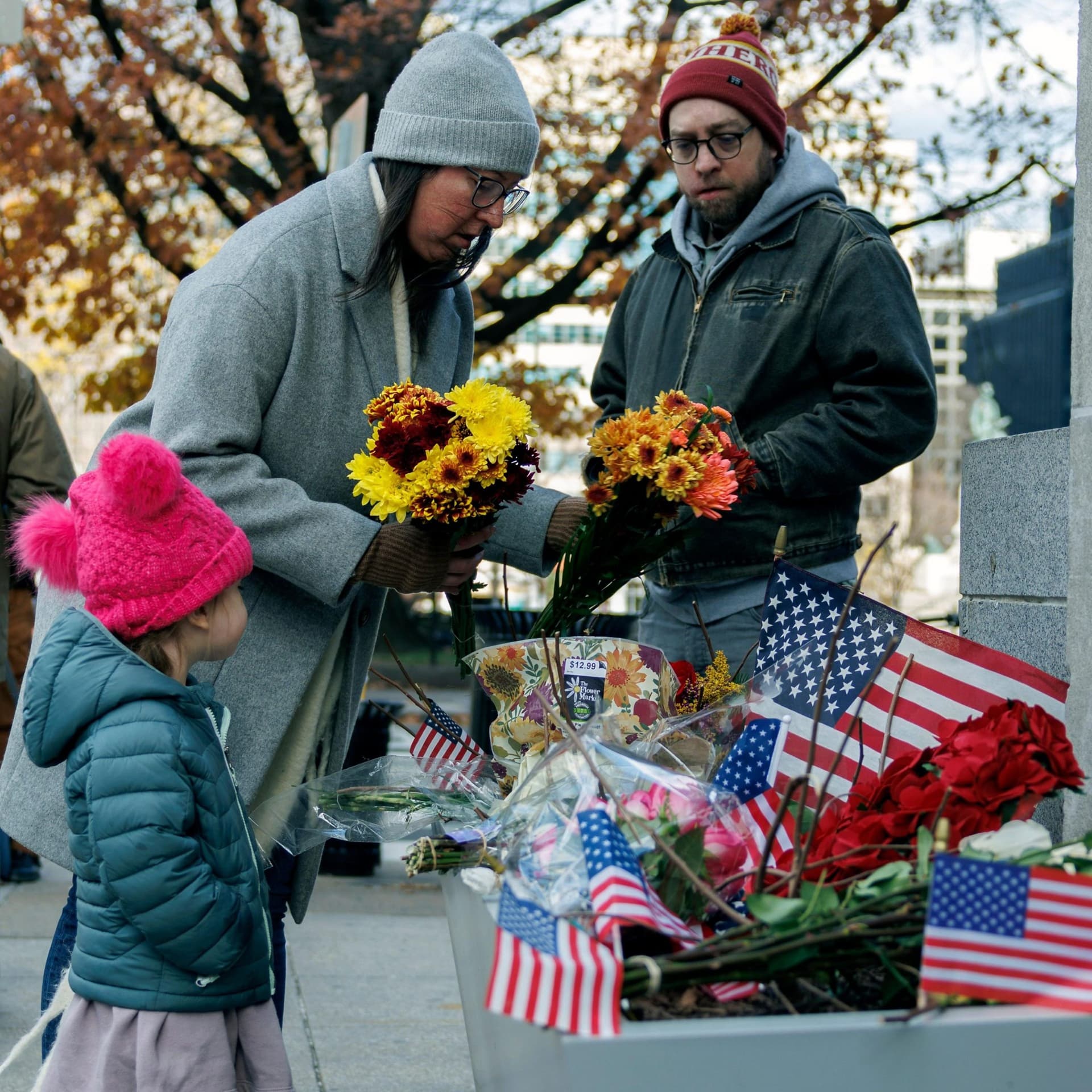
Photo: People leave flowers at the scene where two National Guard members were shot in Washington DC. Credit: Will Oliver/EPA/Shutterstock