In short
How the US, China, and Russia compete for influence in Central Africa, framed as “deal maker” (US), “loan shark” (China), and “gun for hire” (Russia), and what this means for Africans.
Guests
Charles Gittonga, Nairobi-based host of BBC Focus on Africa.
Key claims
The three powers are deeply present via security, trade, and humanitarian/investment ties; competition centers on access to critical minerals and security leverage.
Notable examples
- DRC: US-backed “peace deal” between President Félix Tshisekedi and Rwanda’s Paul Kagame; conflict linked to ethnic tensions and rebel control of cobalt/lithium/coltan for smartphones and batteries. US estimates minerals worth $25 trillion; China dominates cobalt exports (24 of 33 companies).
- Zambia: Chinese investment (about $6B in two decades) in copper, power, rail, and culture (Shaolin Temple opened 2021); benefits include infrastructure, downsides include debt (about $12B owed in 2020; $4B to China) and allegations of unclear loan use; 2020 default.
- Central African Republic: Russia-linked influence via Wagner mercenaries after the 2013 Battle of Bongi; reports of abuses and links to diamond/timber/gold networks; Wagner described as a pseudo-state controlling much of the country.
Written by AI. May contain mistakes. Listen to the episode to check what was said.
Chapters
Tap a time to open that second in VOMeet Charles Gittonga
0:00 to 0:37
Introduction of guest Charles Gittonga and discussion on spheres of influence.
“This BBC podcast is supported by ads outside the UK.”
Meet Charles Gittonga
1:59 to 2:45
Introduction of guest Charles Gittonga and discussion on spheres of influence.
“We're joined today by Charles Gittonga, one of the hosts of the BBC's Focus on Africa podcast.”
The Democratic Republic of Congo Overview
2:45 to 3:49
An overview of DRC's geography and current conflicts.
“So the thing is, those three countries that you've mentioned are very present in Africa today.”
Conflict and Mineral Wealth in DRC
3:49 to 4:54
Discussion on ongoing conflicts and the rich mineral resources of the DRC.
“This is a massive country in Central Africa, has about 112 million people.”
US Intervention and Peace Deals
4:54 to 6:27
Exploration of US involvement in DRC and peace deals with Rwanda.
“In fact, there are even statistics from organizations like the Global Conflict Tracker that says about 6 million people have been killed since 1996.”
Historical Context of DRC Conflict
6:27 to 8:01
Insight into the ethnic tensions and historical conflicts in the region.
“What was happening here is the president of Rwanda, Paul Kagame, and the president of the Democratic Republic of Congo, Felix Shisekedi, Zakedi.”
Impact of the M23 Rebels
8:01 to 10:00
Discussion on the M23 rebels and their control in Eastern DRC post-deal.
“And you've got rebel groups such as the M23 group, which is one of the groups involved in this conflict in Eastern DRC.”
Mineral Reserves and Economic Stakes
10:00 to 11:11
Details on the vast mineral wealth in DRC and its economic implications.
“In fact, what they've done is installed what they are calling a civilian administration to run the affairs of this city that they've seized.”
China's Role in DRC's Minerals
11:11 to 12:27
Examination of China's mining influence in DRC and competition with the US.
“Can you help us understand the scale and scope of minerals or mineral reserves that are expected to be there?”
China's Investment in Zambia
12:27 to 14:02
Overview of China's billion-dollar investments and cultural influence in Zambia.
“And then there is China, which has also been mining for decades.”
Show all 14 chapters
China's Cultural Investments in Zambia
14:02 to 19:30
Explore China's cultural and economic influence in Zambia through investments and key projects.
“But also there is the culture as well, the cultural investments as well in the country.”
Russia's Involvement in the Central African Republic
20:41 to 28:00
Understand Russia's unique military and economic strategies in the Central African Republic.
“are all vying for influence in Central Africa and what it tells us about how they operate.”
The Future of Africa's Economy: Insights from Charles Gittonga
28:00 to 28:36
Learn how Africa could become an economic powerhouse influenced by major economies.
“And so you need someone to come in with the money, with the expertise, hopefully transfer some of that technology and help the young people be able to take up these jobs and build these infrastructures and technology.”
Episode Wrap-Up and Recommendations
28:36 to 29:33
Discover additional podcasts and insights on the evolving global landscape.
“Thank you so much, Charles, for just bringing your knowledge and expertise and joining us on the show.”
Transcript
Automatic transcript. May contain errors.0:00This BBC podcast is supported by ads outside the UK.
0:30business needs in one place, saving you time, headaches, and serious money. Stop paying for missing pieces. Go to odoo.com. That's O-D-O-O dot com to learn more. With the new Schwab Teen Investor Account, teens can gain hands-on investing experience and build positive money habits. It's an account co-owned by you and your teen, so you can monitor and engage with the account while your teen learns how to invest and manage money. Learn more at schwab.com. You've probably noticed that we're doing something a little different on the show this week. It's a special series about how global power is shifting.
1:07We're collaborating with a host of BBC podcasts around the world to hear from their perspective. Who's really in charge in this moment? We've been looking at how the United States, China and Russia are vying for control and access around the world. And today we're going to talk about how all three of those countries are trying to gain a foothold in Africa. a continent of over 1.5 billion people with a median age of just 19 years old. It's a place where so much of the world's wealth is held and where the world's future could be decided. Specifically, we'll be looking at what those three powers have been up to in three countries in Africa and telling you tales of the dealmaker, the loan shark and the gun for hire.
1:53From the BBC, I'm Asma Khalid in Washington, D.C. And I'm Tristan Redman in London. And today on The Global Story, how the US, China and Russia are competing for influence in Africa and what it means for Africans.
2:11We're joined today by Charles Gittonga, one of the hosts of the BBC's Focus on Africa podcast. And Charles is joining us from Nairobi, the capital of Kenya. It's such a pleasure to have you with us, Charles. Thank you for joining us. It is a pleasure. It's amazing to join you guys, yeah. Charles, we've been speaking all this week about spheres of influence on our show. I'm looking at the United States, China, Russia. Today, we wanted to speak with you about how you see these spheres of influence operating and influencing Africa. Yeah. So the thing is, those three countries that you've mentioned are very present in Africa today.
2:52You hear them in conversations, even if you sit in a cafe or in politics or you're reading a newspaper, you'll find a U.S. headline, a Russia headline, a China headline, especially a China headline because of the kind of investments that the country has been making in various African countries in infrastructure. which for China, it's seen as an alternative. And so in terms of interests, you are looking at security investments, you're looking at trade, and you're looking at humanitarian presence or investment in the humanitarian sector. So that's sort of where they are present, and they have been present for quite a long time.
3:29Well, Charles, today we really want to understand the involvement of these three countries on the African continent via the stories of three particular examples, three countries in Central Africa that you're going to talk us through. Where should we kick it off? Let's start with the Democratic Republic of Congo, or DRC, as many people call it. This is a massive country in Central Africa, has about 112 million people. And it has a number of neighbours, if you're looking at their map, such as Angola, Zambia, those are to the south of the country, then the Central African Republic and South Sudan to the north of the country.
4:06and then you've got Uganda, Burundi and Rwanda to the east. And that's why we've been having a lot of these headlines about a conflict and war and minerals coming from recently. To the Democratic Republic of Congo now where there has been intense new fighting between the army and M23 rebels. M23 rebels appear to have captured almost all of its largest city, Goma. Rwanda's ambassador has said the armed group will continue beyond the city. After years of fighting, Congo's government vowing to restore order in the area, but there was no sign of soldiers. Many were seen fleeing on Saturday and Sunday alongside thousands of civilians.
4:48For over 30 years, there's been a lot of fighting there. So many people have been displaced and killed. In fact, there are even statistics from organizations like the Global Conflict Tracker that says about 6 million people have been killed since 1996.
5:06It also happens to be a region that is rich in minerals such as cobalt, lithium, coltan. And the reason why these minerals are important is because they are very important in making smartphones. They are very important in making batteries, electric cars. And all these are technologies that people look at as technologies of the future. And between the U.S. and other countries such as China, there's a bit of a race to try and dominate that space. And DRC is sitting on some of the largest reserves of these minerals in the world, right? You mentioned this conflict, and that is something that we've heard President Trump talk about.
5:47He has taken credit for brokering a peace deal, he says, between the Democratic Republic of Congo and Rwanda. I solved eight wars. Go to Rwanda and the Congo, talk about India and Pakistan. Look at Thailand. Look at look at all of the wars that we solved. He had this celebration at the U.S. Institute of Peace here in Washington, D.C. in December, which he is now newly named, by the way, after himself. President Chisekite of the Democratic Republic of the Congo and President Kagame of Rwanda. They are amazing people and they had stories to tell me that were incredible. What was happening here is the president of Rwanda, Paul Kagame, and the president of the Democratic Republic of Congo, Felix Shisekedi, Zakedi.
6:43They had been invited to Washington to sign this deal that would end a conflict in Eastern DRC, which borders Rwanda. They've spent a lot of time killing each other. And now they're going to spend a lot of time hugging, holding hands and taking advantage of the United States of America economically, like every other country does. Can you explain to us, Charles, what the reasons for the conflict are? And have they actually been solved by this US intervention? So the reasons for the conflict, it goes back to ethnic tensions, beginning with the genocide in Rwanda against the Tutsits. That's one of the communities in Rwanda.
7:26And, you know, some of the people affected by that conflict and the Hutus specifically, which was the other party to the genocide, they ran across the border to the Eastern DR Congo. And so when the genocide ended in 1994, Rwanda has had an interest in Eastern DRC because they in part believe that, you know, some of the people involved in the genocide in Rwanda ran across the border and they are living there. And they may be enjoying the protection of the DRC governments that have come to power since then. But then there is the issue of Minros inside now the DRC territory, Eastern DRC specifically.
8:06And you've got rebel groups such as the M23 group, which is one of the groups involved in this conflict in Eastern DRC. For context, I should say that Rwanda has always denied any involvement in this conflict. They are accused of supporting the M23 rebel group, but they've always denied that. So there's a contestation for this wealth. You've got a government that's trying to maintain law and order, but you've got rebel groups that are controlling a huge part of the economic fortune that can be found in digging out these minerals and selling them somehow to the rest of the world. Look at them, look at the way they love each other.
8:44Interestingly, in that meeting in December, when you hear President Trump say that he thinks President Kagame and Shisekedi, they love one another and they will be hugging. So I have a lot of confidence in both leaders. At that meeting, there was no laughing and hugging that was visible. And they're heroes within their countries because of today. A lot of this is a big story. There wasn't even a handshake, right? They're just signing paper. They are barely interacting. And that's the image that the world took notice of. And so it was quite interesting and funny to some people. What has Donald Trump promised Rwanda and DRC in exchange for striking this deal?
9:25Rwanda and DRC are, first of all, expecting peace. And so the U.S. promises, you know, stability, protection, security. Have we seen that over the last several weeks since that deal was signed? No, we've seen the opposite because the M23, interestingly, a few days after the deal was signed in Washington, this rebel group walks into a town called Uvira and takes over the town. And everybody is surprised. I've been to it just not heard of a deal signed to prevent this kind of a thing from happening. But to date, they haven't left. In fact, what they've done is installed what they are calling a civilian administration to run the affairs of this city that they've seized.
10:09President Trump referred to it at the time as a miracle deal. What did you think when you heard those words? It's hard to know what President Trump means by a miracle deal. However, it is a historic deal in itself because the conflict in eastern dear Congo has been going on for so long. And so perhaps it could have meant a miracle in that way that it was meant to end this conflict, but also maybe an economic miracle. Today, the United States is also signing our own bilateral agreements with the Congo and Rwanda that will unlock new opportunities for the United States to access critical minerals.
10:49If the United States was to get a hold of those minerals, that's going to be a very big deal. And we'll be involved. We're sending some of our biggest and greatest companies over to the two countries. And we're going to take out some of the rare earth and take out some of the assets and pay. And everybody's going to make a lot of money. Can you help us understand the scale and scope of minerals or mineral reserves that are expected to be there? I mean, what are we talking about? It sounds like these are lucrative, you're saying, for building technologies of the future. But how much is really at stake?
11:28It's a lot, actually. And the U.S. government in 2023 estimated$25 trillion as the worth of the Minrose in the DRC. Again, we are talking about coltan, cobalt, copper, lithium. I mean, that's nearly 10 times the size of the African economy today. So if all of that can be found in one country, and if another country is able to invest there through companies and government influence, then you can imagine what that would mean for America, for example, if they are even able to get a fraction of that. It strikes me that President Trump thinks he has made a somewhat simple deal here to help the U.S.
12:11potentially extract more minerals in exchange for AP steel. Is it really that simple? It's not simple. There are already players that are mining these minerals. There are rebel groups that are controlling some of the mines in parts of eastern DRC. And then there is China, which has also been mining for decades. It's actually a major player for minerals like cobalt, where you've got 33 companies that export cobalt out of the DRC. 24 of those are from China. And they have legitimate deals that have been signed over the years between Chinese authorities and authorities in the DRC. And many of those contracts are still in place.
12:59it sounds from what you're saying like china is a lot more implanted particularly in a place like drc than the united states is the new kid on the block as you call it um so i wonder if you can help us to understand china's mo how it functions in africa and i know you wanted to talk to us a bit about zambia which is a country to the south of drc as an example of how china operates absolutely so for zambia specifically the investments from china run into billions of dollars you know some estimates say around six billion dollars has been invested in the last two decades they are involved in everything from mining copper metals like copper infrastructure they have been involved in building electricity generating plants and a railway as well that links Zambia to one of its neighboring countries, Tanzania.
13:54So that's sort of the spread of how China is involved from an investment perspective in Zambia. But also there is the culture as well, the cultural investments as well in the country. Can you talk to us a little bit more about the cultural investment in Zambia. How do you notice that? If you are to take a walk in the streets of Lusaka, for example, which is the capital of Zambia, you might see a number of China malls. These are big business shopping malls, big business establishments. They are stocked with a lot of Chinese made goods, which tend to be quite cheaper compared to goods imported from elsewhere, even produced in Zambia.
14:36And so they are very popular among Zambians, right? And then perhaps the most vivid representation of Chinese cultural investment into Zambia is this Shaolin Temple that's outside of the capital, Lusaka. It was opened in 2021. And it's a striking expanse of, you know, yellow-walled, red-roofed Chinese-style kind of buildings. And in there, you'll find Zambians learning martial arts, Mandarin. They learn the Chinese culture in general. So you can see a deliberate effort here by China to help the people of Zambia understand China even better, because this is actually said to be the first Shaolin temple in Africa.
15:20Why is China so interested in Zambia in particular, so interested that they've built a Shaolin temple? I think it's more to do with acceptance. So you want to operate in an environment where you are seen as an ally the same way other countries like maybe the UK or the US are seen. What are the downsides to these investments? You say culturally, economically, China has been investing significantly in Zambia. Are there downsides to this? I think many people living in Zambia might look at these investments by China as both a blessing and a curse at the same time, in the sense that they have helped, you know, life get easier.
16:02You know, the roads, the railway, the electricity and all of that. But a curse because it left the country in a lot of debt. How much debt? As of 2020, Zambia was owing foreign countries that have lent its money about 12 billion US dollars. And 4 billion US dollars was owed specifically to China. And these are high interest loans. They had been criticized as loans whose use wasn't exactly clear. There were allegations of corruption involved and that all the money wasn't invested in the right way. So what happened is in 2020, Zambia is in so much debt that they are unable to pay the accreditors and they became the first African country to default on their foreign debt.
16:52And the country was heading to an election in 2021. So the economy and the debt was a big part of that election. And you had this new candidate, Hakainde Hichlema. He's a businessman. He's a farmer. He's a politician. Let's come together to retrieve our country from total collapse. Let's fight for our freedoms. You know, he is nicknamed Bali, and Bali means father. They were looking for someone that was going to come and fix it, all right? So, father will fix it.
17:27So, it was Bali will fix it. Father is going to fix this economy that we're struggling with. And that became the main aim of the campaign and the main hope for many Zambians that will elect somebody new. And hopefully they are going to be able to pull us out of this. Has he fulfilled that promise? In part, he has. And in a big way, actually, because in terms of China, the debt was renegotiated. So they're better, more friendly terms now. But also because there's a lot of investments by Chinese multinationals and mining companies in Zambia. There is this deal now where they can pay their taxes in yuan, which is a Chinese currency.
18:11So they do not have to convert it to the USD to be able to pay China. Because that process, there's a lot of loss of value for a currency when you have to convert it to the US dollar. And that's a big relief. Is the Chinese approach to gaining a foothold in African countries like Zambia working? I think it depends who you ask that question.
18:37For China, they might feel that the approach is working. African countries are a big part of China's global investment model called Belt and Road Initiative, you know, helping them trade with the rest of the world. However, for many African countries, you end up in a lot of debt that you have to pay.
19:29We'll be right back. Online at merinochevrolet.com or call 773-465-2000. Together, let's drive. Chicago talks a lot. Hold on, let me step over here. People are talking too much. We debate about food, deep dish, tavern style, who's got the best beef. We yell across rooms, across blocks, across generations. Yes, nice earrings, Grammy. And now we're doing it on our phones too. Video calls from the L train, group chats that never shut up. Neighbors texting you the score before your TV catches up. Come on! Get a load of this guy. Ketchup. On a dog. Yeah, we've got thoughts. Too loud? In Chicago, you're gonna hear it.
20:10Because nothing here gets built without conversation. Nothing moves without connection. So, if you think you know AT &T, it might be time to rethink that. Because their network has improved, like, a lot. So Chicago can keep speaking its mind with AT &T Wireless and AT &T Fiber. Chicago won't stop talking. Our improved network backs it up. AT &T, connecting changes everything. AT &T Fiber, limited availability in select areas.
20:40So we are looking at how these three powers, the United States, China, and Russia, are all vying for influence in Central Africa and what it tells us about how they operate. Thus far, we have talked about the United States trying to act as a sort of dealmaker and its deal with the Democratic Republic of Congo trying to negotiate peace in exchange for access to natural resources. We've talked about China investing in Zambia. And now we want to talk about Russia. Which part of Africa is Russia getting involved with and how is it going about doing that? So the third example that I would like us to talk about is the Central African Republic or CAR.
21:22It's a landlocked country in Central Africa. It's bordered by Chad, Sudan, South Sudan, and also the Democratic Republic of Congo, which is one of the other countries that we talked about. But when it comes to the involvement of Russia in this country, it's very, very different from what we've been talking about. And Tristan, you've been there. You've covered stories from there. What can you tell us? I have. I spent three years covering the civil war there between 2013 and 2016. I mean, I know what you mean. I mean, Russia became involved in a very different way from China and Zambia, as you described, and the US and DRC, really because of muscle and money.
22:02Now, the story of Russian involvement in CAR kind of starts in 2013 with something called the Battle of Bongi. Bongi is the capital of CAR. And the Battle of Bongi was a moment when around 13 South African soldiers who were essentially operating as bodyguards for the president at the time of Central African Republic were killed in a gun battle by rebels. and the president at the time fled the country. There was a civil war that played out for a few years in Central African Republic. Things eventually settled down and the current president came into power, a man called President Tuadera. And Tuadera looked at what had happened to his predecessor and he said, I'm not going to let that happen to me.
22:48But he didn't want to rely on South African bodyguards because it didn't turn out too well for his predecessor. So he thought, who's got the most weapons and the most muscle right now? And at the time, a Russian private mercenary company was operating quite successfully in Syria called Wagner. Now, Wagner is a mercenary group somewhat similar to the American group Blackwater, which operated in places like Iraq back in the early 2000s. Now, the president of Central African Republic phoned up Wagner and said, I want to cut a deal. Will you come to CAR and protect me? And in return, I'll pay you money.
23:33And that is how Wagner ended up in Central African Republic, because they were the strong guys. And Wagner over the years became almost like a kind of pseudo state within CAR. And they control much of the country, which is fascinating and very much in contrast to what you've described in DRC with the U.S. involvement and in Zambia with the Chinese involvement. And how are they viewed in the country? Are they viewed as sort of a guns for hire? They pretty much are, you know, and the image and the involvement is not exactly clean. There are reports of killings, reports of abuse of human rights, reports that Wagner Group could also be linked to a network of opaque companies that are involved in mining of diamonds and production of timber and gold.
24:23So that's how the story goes. And that's how people view the story and Russia and by extension Wagner Group in the Central African Republic. So the thing that I am confused about here is that the Wagner Group is not an explicit arm of the Russian government. And so how, if at all, do you see this model being the work of the Russian government? Is it the work at all of the Russian government? Do you see them trying to impact and create this sphere of influence in the region? If you look at the time when Wagner became involved in the Central African Republic, as Tristan just described, the country was going through a very difficult times.
25:01trying to contain violence and rebel groups and a civil war. And you've had other powers withdrawing their military presence in the country at the time, such as France. I think there was disappointment at the inability of the UN peacekeepers to quell the violence that was being witnessed in the country. So if in that setting, the president of the CIR turns to Russia for military support, part of it being weapons. But then you hear of a Russian private military contractor bringing fighters. What would you think? The thing is, you'd think that there is a connection between this private military contractor and the Russian government.
25:43And that's how most people tend to see it. And that's despite the fact that, you know, Moscow has denied that, you know, they have ties to Wagner. So aside from the military investment between Russia and the CAR, there are also Orthodox churches there and a language center in Bongi, which is the capital of CAR. And actually a few years ago, the BBC visited this church.
26:24You know, they were not allowed to enter the language centre, but there has been reporting before that said that that centre is actually run by a member of the Wagner Group. OK, so 50 years from now, Charles, Africa could be the economic powerhouse of the world. It has this huge young population, abundant resources. the idea in, for example, 2076, that the actions of China, Russia or the United States would have a central role to play in Africa's future might appear totally absurd. Is that the most likely outcome for you? Firstly, God bless us if we are alive then, but to see it all come together.
Read the full transcript
27:10But I think if you ask many young people on the continent, they actually think that the continent should be working towards making themselves better by relying on themselves and not dealing with Russia or with the US or with China. There is a big drive to build this capacity within the African continent and many young people think if our taxes for example was utilized better by governments and built this infrastructure then we wouldn't have to borrow as much right.
27:47There's always a question to African leaders nowadays. Are you facing West or are you facing East? You know, if you're talking about young people, there's a feeling that the African continent is not able to make best of those resources in itself or by itself. And so you need someone to come in with the money, with the expertise, hopefully transfer some of that technology and help the young people be able to take up these jobs and build these infrastructures and technology. So it could be that Africa has become an economic powerhouse by 2076. But behind that, you'll see a lot of pulling of strings by these three economies, which would still be quite significant at the time.
28:36Thank you so much, Charles, for just bringing your knowledge and expertise and joining us on the show. Thank you very much for having me.
28:47That was Charles Gittonga, host of the BBC's Focus on Africa podcast, which I strongly recommend. Episodes are out every weekday, wherever you listen to your podcasts, as well as a visual episode each Saturday on YouTube. By the way, if you want to catch up on the latest news from around the world, then we also recommend checking out the Global News podcast, wherever you listen to your favourite shows. That's it from us today. Listen in tomorrow, when we'll be rounding off our week of special episodes about a possibly new world order. It's with the BBC's international editor, Jeremy Bowen. This episode was produced by Hannah Moore, Aaron Keller, and Lucy Paul.
29:24It was edited by James Shield and mixed by Travis Evans. Our senior news editor is China Collins. Thanks for listening. We'll talk to you again tomorrow. Cheerio.
29:40Chicago talks a lot. Hold on, let me step over here People are talking too much We debate about food, deep dish, tavern style Who's got the best beef We yell across rooms, across blocks Across generations Yes, nice earrings, Grammy And now we're doing it on our phones, too Video calls from the L train Group chats that never shut up Neighbors texting you the score before your TV catches up Come on Get a load of this guy, ketchup On a dog Yeah, we've got thoughts Too loud? In Chicago? You're gonna hear it. Because nothing here gets built without conversation. Nothing moves without connection. So if you think you know AT &T, it might be time to rethink that.
30:22Because their network has improved, like, a lot. So Chicago can keep speaking its mind with AT &T Wireless and AT &T Fiber. Chicago won't stop talking. Our improved network backs it up. AT &T. Connecting changes everything. AT &T Fiber. Limited availability in select areas.
30:42Thank you.
From the publisher
When the leaders of the US, China and Russia look at Africa today, they see huge opportunity – an abundance of natural resources and a skilled, young population. But what does it mean for the continent when African presidents allow these superpowers the influence and investment they want?
All this week, we’re teaming up with our BBC sister podcasts to explore how power and influence around the world is shifting. We’re talking about which countries have a sphere of influence, and which countries are in someone else’s.
In today’s episode, we speak to Charles Gitonga from the BBC’s Focus on Africa podcast about three countries in Central Africa which have found themselves at the at the centre of a geopolitical tug of war.
Producers: Hannah Moore, Aron Keller and Lucy Pawle
Executive producer: James Shield
Mix: Travis Evans
Senior news editor: China Collins
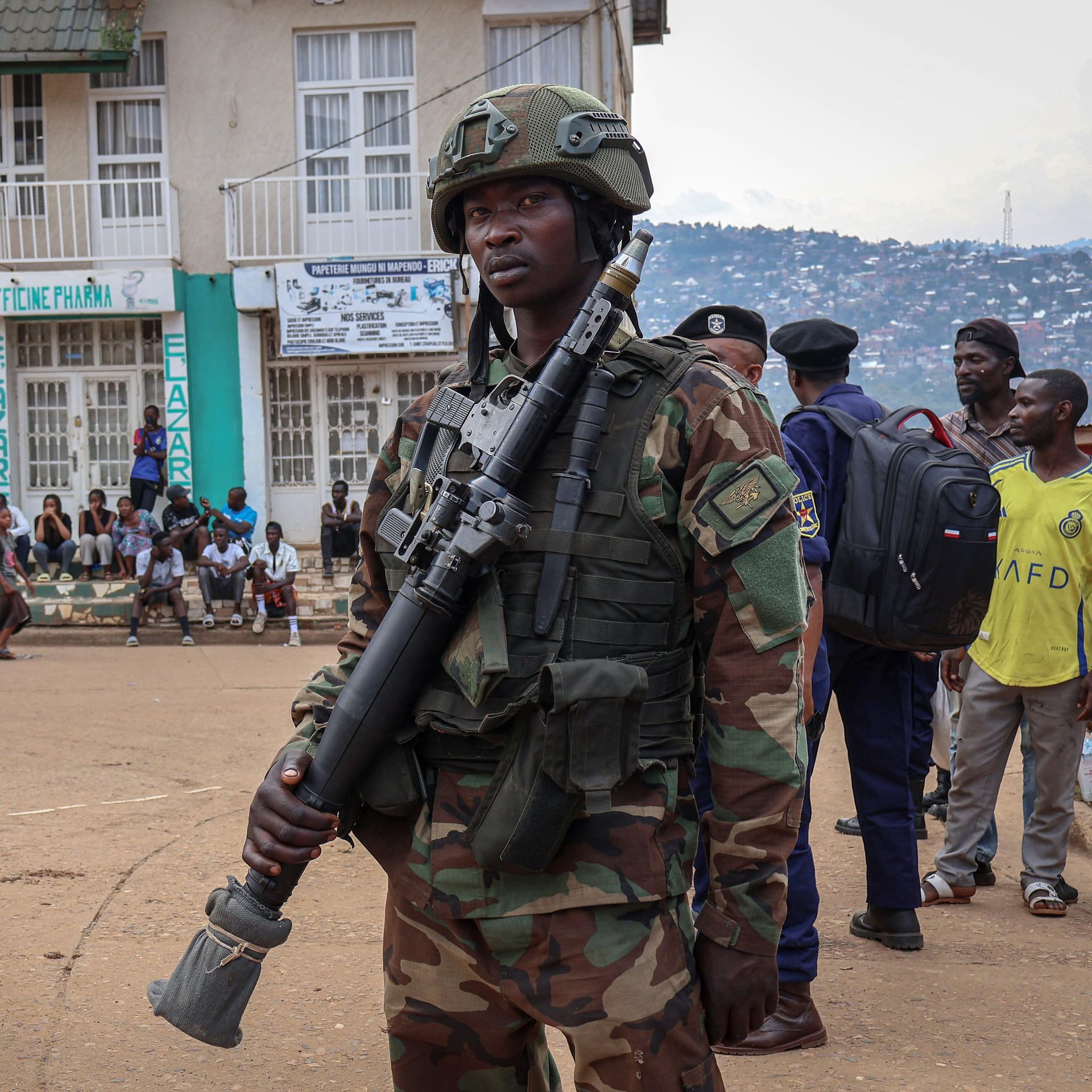
Photo: A soldier with the M23 armed group stands guard in Bukavu, South Kivu, Democratic Republic of the Congo. Credit: Marie Jeanne Munyerenkana/EPA-EFE/REX/Shutterstock.