
In short
The BBC Global Story episode discusses the Trump administration’s 14-point Iran memorandum of understanding aimed at ending the Iran conflict and preventing Iran from obtaining a nuclear weapon, focusing on verification challenges, inspection access, and what “freeze” and downblending would practically mean during a 60-day window before final talks.
Guest backgrounds
David Albright is president of the Washington, D.C.-based Institute for Science and International Security and a former UN weapons inspector. He worked on Iraq inspections in the 1990s, verifying Iraq’s nuclear declarations and probing for hidden activities.
Key claims
The deal is political and vague; verification is the core problem. Iran’s declared program is inspected, but access disputes arise over undeclared or sensitive sites. The language should explicitly ban production/testing and clarify downblending targets.
Notable examples
Iraq’s 1995 disclosure and inspector methods (interviews, inconsistencies, site visits). A 2004 Tehran facility teardown that prevented environmental sampling. Trump’s “nuclear dust” description tied to highly enriched uranium in destroyed Ford plant infrastructure.
Written by AI. May contain mistakes. Listen to the episode to check what was said.
Chapters
Tap a time to open that second in VOThe Significance of the Agreement with Iran
0:44 to 0:57
Discussing the implications of the recent agreement with Iran.
“teens can gain hands-on investing experience and build positive money habits.”
The Significance of the Agreement with Iran
2:36 to 4:00
Discussing the implications of the recent agreement with Iran.
“And today on The Global Story, we speak with a former weapons inspector about how this all might work.”
Understanding the Role of Nuclear Inspectors
4:00 to 6:32
Insight into the duties and challenges faced by nuclear inspectors.
“And I think that it does open up a possibility that the Middle East can change fundamentally.”
Challenges of Inspecting Iran's Nuclear Program
6:32 to 8:26
Exploration of the difficulties faced in inspecting Iran's nuclear program.
“In 95, Iraq decided to come clean and revealed that it did have a nuclear weapons program.”
Comparative Challenges in Iraq vs. Iran
8:26 to 10:00
Contrast between the inspector experiences in Iraq and Iran.
“And he kept lying for a half hour, 45 minutes.”
Assessing Iran's Nuclear Activities Post-JCPOA
10:00 to 13:06
Analysis of Iran's nuclear activities before and after the JCPOA.
“David, we've been speaking to you about Iraq and your experiences working on that particular country, but let's switch to Iran.”
Impact of U.S. Withdrawal from the JCPOA
13:06 to 14:00
Discussion on consequences following the U.S. exit from the nuclear deal.
“David, I want to understand what your assessment is of visibility into Iran's program before and after the JCPOA.”
Overview of the Iran Nuclear Deal
14:00 to 14:54
Learn about the background and context of the Iran nuclear deal and its implications.
“Was there limited visibility into what Iran was doing?”
The Immediate Aftermath of the Deal's Collapse
14:54 to 16:00
Explore the quick transition after Trump's departure and the resulting lack of planning.
“And I remember going to briefings after that.”
Inspections and Agreements Post-War
16:00 to 17:38
Discuss the future of inspections and the vagueness of agreements made with Iran.
“So for the last year, essentially, there have been very few inspections, you're saying?”
Show all 14 chapters
Understanding Downblending and Its Importance
17:38 to 19:51
Learn about the process of downblending enriched uranium and its implications.
“If you say procure and develop, Trump has said he's worried about Iran buying a nuclear weapon.”
The Concept of 'Nuclear Dust'
19:51 to 22:06
Discover what 'nuclear dust' is and its significance in discussions around nuclear materials.
“I've heard him say this again and again.”
Future Negotiations and Strategic Considerations
22:06 to 24:32
Explore the challenges and potential pathways for future negotiations with Iran.
“Did they burst and turn into what he calls nuclear dust?”
The Case Against Iran's Enrichment
24:32 to 26:45
Understand the arguments for why Iran should abandon its enrichment program.
“Well, I think Iran should give up enrichment.”
Transcript
Automatic transcript. May contain errors.0:00This BBC podcast is supported by ads outside the UK.
0:30No bouncing between tabs. And best of all, no spreadsheets. Stop managing software and start managing your business with one unified system. Try for free today at odoo.com. That's O-D-O-O dot com. With the new Schwab Teen Investor Account, teens can gain hands-on investing experience and build positive money habits. It's an account co-owned by you and your teen, so you can monitor and engage with the account while your teen learns how to invest and manage money. Learn more at schwab.com. Mr. President, please, just one question for French TV and the RM deal. Just one question. Is it signed the deal?
1:11Did you sign the MOU? It's signed. We signed it. We signed it. On Wednesday at the Palace of Versailles near Paris, President Trump signed a 14-point memorandum of understanding to end the war with Iran. Now, this deal is just a first start. There's now a 60-day clock to reach a final agreement. And officials from the U.S. and Iran are planning to meet soon in Switzerland for initial talks. But at a press conference on Wednesday, President Trump sounded triumphant. We reached an agreement with Iran that achieves everything we set out to accomplish, everything and much more. ending the current conflict, reopening the Strait of Hormuz, and preventing Iran from ever obtaining a nuclear weapon.
2:00That's what it was all about. That was about 99 percent. Iran cannot have a nuclear weapon. And while the deal, according to the U.S., lays out that Iran will not procure or develop a nuclear weapon, there are still a lot of unanswered questions about the nuclear issue. And that's before you even consider the deep skepticism from all sides as to whether a deal is realistic. How do you even go about checking that everyone's actually playing by the rules they've signed up to? From the BBC, I'm Asma Khalid in Washington, D.C. And today on The Global Story, we speak with a former weapons inspector about how this all might work.
2:46My name is David Albright. I'm president. of the Institute for Science and International Security, and I guess in D.C. terms, a think tank, and as a result of world events, have spent a lot of the last 20 years looking at the Iran nuclear program. I just want to say, David, welcome to The Global Story. Thank you for joining us. Good to be here. Prior to this world you've had in the think tank world, as you say, here in Washington, D.C., you were also a U.N. inspector, is that correct, in the 1990s? Yes, I was involved in the inspections in Iraq, and I think I was the only one picked from a non-governmental organization.
3:24David, before we dive into any of that, actually, I just want to start with we heard President Trump this week say, again, that the United States would never let Iran have a nuclear weapon. He says that they have agreed to that. That is what the Trump administration is saying. You're a former weapons inspector. When you hear that, what's your reaction? Well, my initial reaction is that I'm very happy they have a deal. Okay. It's a working document. It's more of a political agreement than a technical agreement. And I think that it does open up a possibility that the Middle East can change fundamentally.
4:05But a verification of that is going to be a principal point. And that can be a rough road. I want to talk about what's going on right now in Iran and what we might expect in terms of an effort to monitor Iran's nuclear program moving forward. But first, David, you were somebody who monitored this all with the United Nations. Can you just explain to me what nuclear inspectors are for? I imagine a lot of listeners are unfamiliar with this as a job. Do nuclear inspectors inspect all countries? Most of the inspection effort is centered on the Nuclear Non-Proliferation Treaty, ratified in 1970, that commits countries not to build nuclear weapons.
4:47And it offers these countries a great deal. Your neighbors won't have nuclear weapons. You can live in a safer environment because they don't have them. And when did Iran sign the Nuclear Non-Proliferation Treaty? Yeah, I don't remember the actual date, but it was back in the 70s. It was one of the earlier signers of the Non-Proliferation Treaty. Okay. Now, five countries had nuclear weapons there, plus Israel, the United States, Russia, Britain, France, and China. And then later, Israel obtained nuclear weapons, and then India and Pakistan also obtained nuclear weapons and have not joined the Non-Poliferation Treaty.
5:25So they're called acknowledged nuclear weapon states. So it's evolved into a pretty elaborate system where countries allow these inspectors to come in and look at their nuclear facilities. More importantly, look at their what we call nuclear material. And more importantly, these countries provide a declaration. This is our complete and accurate description of our nuclear program. I see. And one of the jobs of the inspectors is, well, is it really complete or is something left out? David, I want to ask you about your work as a weapons inspector. What did your role actually look like? Well, I'm an analyst.
6:04Okay. And we're looking to find secret activities. Iraq was vehemently denying it had a nuclear weapons program until about 1995. They denied they had a nuclear weapons program. And so you had a situation where the evidence was mounting that they had a nuclear weapons program. They're denying it. Saddam invaded Kuwait. Yes, that was during the first Bush administration. And so in 91, there was a ceasefire agreement that imposed on Iraq a commitment to get rid of all its nuclear programs. In 95, Iraq decided to come clean and revealed that it did have a nuclear weapons program. It had a very robust gas centrifuge program, much of which we didn't understand.
6:48And so they provided a new declaration describing all their work prior to 91. And this was 1 ,500 pages long, littered with technical detail, procurement, names of companies. And so I was involved in verifying that. And so I went to meet the heads of these programs and also the people in the programs. I would meet the head of the whole program, a man named Jafar Jafar. And I went with Rizzo Zifarero, the head of the inspection effort. and then met with the head of the centrifuge program and his leading technical deputies. You'd meet face-to-face? For hours, all day, for many days. Where? In a hotel room, or are you meeting in a government?
7:30They had a center. They had a center where we would meet, sort of a place where they set up to meet the UN. I see. Different groups would come in, and then we would ask them questions. And so the idea was to draw out more information, get more documents, and to settle inconsistencies. And, you know, there's also inspections. For example, I did go out to the secret centrifuge site in Baghdad and looked at things and saw how they hid things. It became a kind of a joke among inspectors. You could tell where something secret was because they would pile up like 15, 20 desks and chairs in a big pile over whatever they were trying to hide.
8:11And part of the job as an inspector is take the declaration, read it, and then start probing, looking for inconsistencies. Do they answer with something that's contradictory? What's their body language like? How are they acting? And so, for example, when the head of the inspection effort, Zif Ferreiro, had information that the Iraqis were lying about a procurement for the centrifuge program, he was interviewing the head of the centrifuge program. And he kept lying for a half hour, 45 minutes. He was sweating. He was nervous. I mean, one of the things that also was irritating is he had four or five of his technical deputies lined up behind him sitting in chairs.
8:54And some of them were rolling their eyes, shaking their heads. And then he just said, oh, OK, you're right. I was not telling the truth. And so but that was a kind of an anomaly in this. Mostly the Iraqis were opening up. So at a certain point, David, you went back to the U.S. government and informed the government that Iraq, in fact, did not have nuclear weapons. Am I correct in that? Yes. No, and in the declaration, I remember telling Jafar Jafar. I mean, he was the head of the whole program. And at the end of sort of a multi-day sets of interviews, I told him I was very encouraged that, you know, from their point of view, if they fully revealed things, then sanctions would come off.
9:37And how did you, David, come to that conclusion? I mean, that's a rather profound thing. I mean, you're proving a negative. That's right. You keep working at it to build confidence in the absence of undeclared nuclear activities or materials. So it's a complicated process, and that's why it can take long periods of time, particularly if the country's not cooperating. David, we've been speaking to you about Iraq and your experiences working on that particular country, but let's switch to Iran. Over the last couple of decades, what would you say has been the biggest challenge for inspectors in dealing with Iran?
10:15It's the lack of cooperation. I mean, inspectors will say we need to speak to this person or that person. We need to go to a military site. And Iran would say no. So there were cases, particularly in the, let's say around 2004, where we had seen in Iran that a facility was being torn down, a large facility in Tehran was being torn down. And the inspectors knew about it. We wrote a study. They took our study at the IAEA and went to Iran and said, look, we'd like to go in here. Here's this satellite imagery study by my institute. And in this case, Iran said, OK, come in. But they'd already taken down the buildings.
10:57They'd scraped off multi-centimeters of dirt. And so nothing was there anymore. And the IAEA said, well, can we see the rubble? Because they wanted to do environmental sampling, look for enriched uranium. Iran said no. My understanding is that Iran does not entirely trust these IAEA inspections. We saw the Iranian government say in 2025 that they view the IAEA as acting politically and that they want to protect their territorial integrity and safety of their scientists. Well, then they shouldn't have signed the nonproliferation treaty because under the nonproliferation treaty, the IAEA actually has the right to go anywhere in the country to pursue its mandate.
11:40There's modalities, there's rules. But if Iran refuses, and in some cases the IE pursued it, they can push it up to the Security Council for action. David, over, say, the last two decades, how often would you say inspections took place in Iran? Oh, they take place all the time because, again— On an ongoing basis, you're saying? Yeah, because they look at the declared material. Iran declares a lot of its nuclear program. The civilian nuclear program, yes. Well, they've always said it's for civilian purposes, my understanding is. But then they don't let you go to certain places. But the declared program is inspected all the time.
12:20Now, there's rules. There's a comprehensive safeguard agreement negotiated between Iran and the IAEA that sets up the kind of the modalities, the procedures of the inspection process. And then this Joint Comprehensive Plan of Action added things to that to give the inspectors more access to declared programs. Iran reported more. They started to allow, for example, camera surveillance of certain manufacturing processes related to gas centrifuge production. And so they're very active in that. And it's all seen as very good. And so that's not where the problem lies, unfortunately. and the conflicts come out over, is the declaration complete?
13:00Is there secret nuclear activities that haven't been declared? David, I want to understand what your assessment is of visibility into Iran's program before and after the JCPOA. Just to clarify for listeners, that is the shorthand name for the nuclear deal that was agreed upon during the Obama administration. And I'm going to start by saying that, you know, the assessments I have read show that a number of official reports and statements from the UN, from the European Union, from the IAEA, indicate that, in their view, Iran fulfilled its JCPOA requirements up until July of 2019. Beginning in July of 2019, it seems that the IAEA verified that some of Iran's nuclear activities were exceeding those limits that were specified in the JCPOA.
13:55Can you describe to me this sort of before and after moment? And to be clear, 2019 is a year after the Trump administration pulled the United States out of that Iran nuclear deal. So what did that mean? Did inspection stop? Was there limited visibility into what Iran was doing? President Trump, under the first administration, there was a group, and I was part of it, that was creating a fix for the nuclear deal. So the idea was, OK, we will stay in the deal for the first 10 years. And there was going to be a congressional law, unsure if we could ever get it passed, but a congressional law that would say, OK, at the 10 year mark, the president goes to Iran and says, OK, we will snap back sanctions on Iran if you refuse to negotiate an amended deal.
14:40And so the idea was to empower the president to negotiate. And what was done was to get the Europeans were drawn in and had more or less agreed to this approach. And so when Trump left just with very short notice, everyone was shocked. And I remember going to briefings after that. And again, I emphasize it was not in the government. This is an outsider. But I went to a briefing after and I basically was told they had no plan. Who had no plan? You're saying the Trump administration had no plan? Yeah, because this happened so quickly. And they said, I was told they will not build up their nuclear program.
15:16And so I mentioned these centrifuge people in Iraq were kind of rolling their eyes. And when their head was lying to the chief inspector, many of us in the room rolled our eyes. That somehow they, that Iran was not going to build up its nuclear program again.
15:42David, at some point, did Iran stop inspections altogether from the IAEA? When the war started in June 2025. And just to be clear, when you say June of 2025, you're referring to the 12-day war last year when the U.S. bombed nuclear facilities in Iran. That's right. And so at the end of the war in June, the IA didn't want to go back in, and Iran refused to let them go back in. So for the last year, essentially, there have been very few inspections, you're saying? That's right. I see. We're having this conversation on Thursday, June 18th. And at this moment, what we know of the Memorandum of Understanding is that there is only one paragraph that deals directly with the nuclear issue.
16:26My understanding is it says, the Islamic Republic of Iran reaffirms that it shall not procure or develop nuclear weapons. I want to know how you interpret what has actually been agreed upon. And I realize what we know largely comes from briefings from administration officials. As of this recording, we have not seen the text of the document. Well, again, as someone who has to have an interest in verifying and ensuring that there aren't loopholes, the language is too vague. I mean, the U.S. side, it should at least be banning production, testing. There's standard language it's put in, and it's not academic.
17:07I mean, if you're going to inspect, you have to clearly state what has to be declared and what is prohibited and what is not. And so you want precise language. And so I would combine the two statements from Iran and the United States and make sure it includes a ban on production. I would add manufacturing and testing and procuring. Normally, the way you'd say it is otherwise acquire a nuclear weapon and try to just be as broad as possible. And then there's – and I'll give you an example. If you say procure and develop, Trump has said he's worried about Iran buying a nuclear weapon. He's probably thinking of North Korea.
17:48And then developing is different than producing. I mean, you develop a nuclear weapon. That's a set of steps. We think Iran has mostly finished that. And then you go to produce a nuclear weapon, which is manufacturing the device itself. And so you ban development. You don't demand production. then they can say, well, you told us we can't develop it, but we know how to develop it. We now want to produce it. And when it's an adversarial relationship between inspectors and the inspected, these kind of things actually matter. And so you really want a deal that's clear. There's another paragraph that deals with this.
18:26It's very important. The freeze. Okay. Iran has frozen its program, but there's two parts to this, verifying the freeze and then and verifying whatever is agreed to be done with the nuclear material. Yeah, I was going to ask you, I mean, is the freeze referring, David, our understanding is that the deal also refers to downblending on-site under the supervision of the IAEA. What does that mean, downblending? The fate of the enriched uranium is very central to this. And what you would do in downblending is you would mix it with uranium that's much less enriched. So it's like diluting it, essentially.
19:03So essentially, and so you mix, you turn both into gas, mix them together, and then the result will be at a much lower enrichment than what you started with. And so what's unclear is what do you downblend to? Are we downblending to 20 % with the 60 % or down to natural uranium at 0.7 %? So, I mean, none of these details are clear. And that's going to be kind of at the core of the negotiations is, OK, if it is going to be downblended to what? Iran may say, no, it's to 5%. We want to maintain a stock of 5 % enriched uranium. The U.S. may say, no, we can't live with that. We've also heard President Trump repeatedly refer to something that he describes as, quote, nuclear dust.
19:47So the official name is highly enriched uranium. And I call it nuclear dust because it seemed to be nice and everyone understands it better and it's sort of cute and people picked it up. I've heard him say this again and again. We're getting the nuclear dust. The nuclear dust came up with a terrible season. They were enriching material, as they say. I call it nuclear dust, nuclear dust, sort of dusty. What exactly is nuclear dust? And why does this administration, and the president in particular, feel that this is so important? Yeah, and yesterday in his press conference, he used nuclear dust when he was referring to what had happened to the Ford plant, which the U.S.
20:30military had pretty thoroughly destroyed using these bunker busters. What happened is we then terminated that, and they call it the nuclear dust, and that was the end of that. and they went down ventilation shafts so there was much higher assurance they would reach the enrichment plant that's deeply buried and so those things go off in that enrichment plant in this closed space the enriched uranium which was theirs it's it's in canisters but very likely the canisters burst under the explosive forces and it's in it's in a chemical form of uranium hexafluoride and fluorine is very reactive water touches it and you're going to have a violent reaction and that's going to create a nuclear dust.
21:15It's a dangerous dust. It's very dangerous. Dangerous to inhale, dangerous to the body, the skin. It'll burn your lungs. If you're in there when it happens, if you inhale it, it'll just burn your lungs because one of the chemical byproducts is an acid, a very reactive acid. And so you don't want to be around it without wearing hazmat suits. And I've actually, in my younger days, mishandled a gas centrifuge rotor that had uranium hexafluoride dust on the inner surface. And I touched it and I had to go immediately run my hand under water for several minutes to make sure it didn't burn. And it's just a minute amount that was on the inside of the centrifuge rotor.
22:00So I think it confuses the situation and I wish he wouldn't use these terms and And that it also fundamentally, we don't know the form, the state of the enriched uranium. Did the containers hold up? Did they burst and turn into what he calls nuclear dust? Or are the containers very easy to retrieve? So that's one of the issues that needs to be settled. I want to understand, David, what the next steps here might look like. The other month, April 29th, here on our show on The Global Story, we ran an interview that I did with Wendy Sherman, who was, of course, the lead negotiator for the United States on the JCPOA, that Iran nuclear deal under President Obama.
22:47And she told us about how long and excruciating it was to make that deal. You know, it took some 18 months of talks. This ceasefire is only for 60 days. I have a lot of questions about how it's possible to, you know, hash out a nuclear deal so quickly. If you were part of the negotiations team, what model would you want the Iranians to agree to? Well, I think it's what Wendy was dealing with and what's being dealt with now is very different. How so? Yeah. Well, one is Iran had this large centrifuge program. It was reactors that were under negotiations, lots of enriched uranium. And the negotiation was about what could stay and what would be reduced in operation or dismantled, stored.
23:35Here, what you have is a destroyed enrichment program. And the question is, is Iran going to rebuild it? And is it going to get rid of its enriched uranium? And so what you're negotiating is much simpler. I mean, you may not get an outcome that favors the United States, but still. You think it can be done in 60 days? I think, yes, it can be. But if Iran cooperates and they can find a compromise, the United States is confronted with two things now. They have to verify the freeze, which means they're going to look very carefully that tunnel entrances aren't opened, that activities don't happen that reflect an enrichment program in any way or enriching uranium.
24:17And then of the negotiations will be on these critical issues of the stocks and how long would an enrichment halt last? Is it, you know, two years, 10 years, 20 years forever? So I think the freeze part is actually very important to consider because that'll be where the United States is going to want to get the IA back in and want to know that Iran isn't digging out these tunnels, for example. So what would you like to see? What would your advice be? Well, I think Iran should give up enrichment. I don't see any purpose for it at all. It's not economic. It's tied to their nuclear weapons effort at the hip.
24:59And they can just give it up and buy enriched uranium like most countries do. In fact, what they do too. And then the other part is that they provide assurance they don't have a nuclear weapons program. And that, to me, is the more important part. I mean, if we had assurance Iran does not have a nuclear weapons program and there's confidence in that, then if they enrich, it's much less stressful. I mean, Netherlands enriches, Brazil enriches, Germany enriches. I mean, I imagine Iran would see it as the right, like many countries, to enrich uranium. No? Sure. But it's, I mean, I have a lot of rights that are better not to exercise.
25:42that it makes more sense to look at it economically and politically and diplomatically and not get hung up on a right. And also, Iran is a violator of the Non-Proliferation Treaty. I mean, that's what the IA has been certifying, and that's what was the situation before the JCPOA. The current U.N. Security Council resolution says Iran cannot enrich uranium. the long term we can talk about. But right now, you don't have this right to enrich. So Iran tries to confuse things with these kinds of statements. And I think one is they're not right legally. But more importantly, their enrichment program is just a huge burden on their country's future.
26:30And it has been a burden. And it has no economic justification. And so I think it's better if they give it up.
26:44On that note, David, thank you for joining us. Thank you.
Read the full transcript
26:56That was David Albright, president of the Washington, D.C.-based Institute for Science in International Security and a former UN weapons inspector. And one quick note before you all go, we have a special series that we're working on ahead of the United States' 250th anniversary. And this series is going to dive into all of the unexpected ways America has shaped the world. And as part of that series, we want to hear from you all, our Global Story listeners. How has your life been impacted or personally changed by the United States, its people, its policies? Please do get in touch. As always, our email address is theglobalstory at bbc.com.
27:35And that's it for our show today. It was produced by Kat Farnsworth and Zandra Ellen. It was edited by Bridget Harney and mixed by Travis Evans. Our video producer is Matt Pintis. Our senior news editor is Shaina Collins. And I'm Asma Khalid. Thanks as always for tuning in, and we'll talk to you again soon.
From the publisher
On Wednesday, President Trump met with Iranian leaders to sign an initial memorandum of understanding towards ending the months-long war. In a press conference after the signing, Trump was triumphant. Specifically, he touted the deal’s firmness on one of the US’s key priorities: ensuring that Iran can never develop a nuclear weapon.
Whilst Iran has agreed to “not procure or develop nuclear weapons," there are many questions left unanswered. What does it actually look like to police the weapons programmes
Today, we speak to someone intimately familiar with the weapons inspection process: President of the Institute for Science and International Security, David Albright. In the 1990s, Albright worked in Iraq with the UN, investigating the nation’s weapons programme under Sadaam Hussein.
Producers: Xandra Ellin and Cat Farnsworth Executive producers: Bridget Harney and China Collins Mix: Travis Evans Video producer: Matt Pintus Senior news editor: China Collins
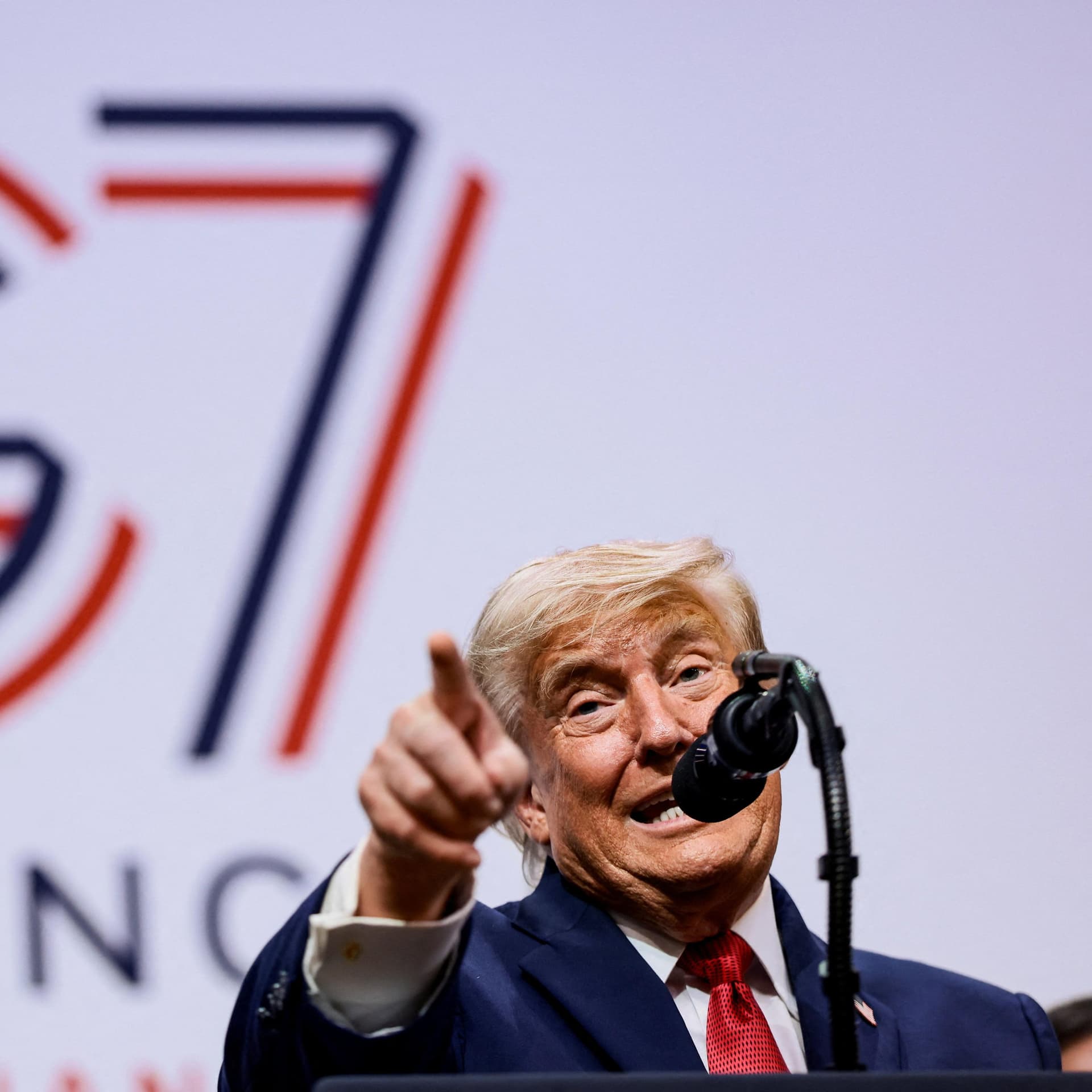
Photo: U.S. President Donald Trump holds a press conference during the G7 Summit in Evian-les-Bains, France, June 17, 2026. Credit: Reuters/Evelyn Hockstein