
In short
Ukraine’s robot/drone-driven tactics and how they changed modern warfare, including a claimed first where a ground robot captured Russian troops without soldiers at risk; the episode also argues this innovation helped Ukraine become a tech provider to other countries, while both sides’ “transparent battlefield” dynamics drive stalemate.
Guests
Mark Urban, BBC columnist at The Sunday Times; long-time reporter covering diplomacy and conflict, with ~40 years’ experience including being embedded with the Soviet army in Afghanistan; author of Tank.
Key claims
Ukraine’s tech collective (EiroRozvidka) existed before 2022 and accelerated drone use (recon, artillery spotting, grenade drops, FPV “one-way” attacks, and later uncrewed ground vehicles for casualty evacuation). Russia often “plays catch-up,” including adopting FPVs and using fiber-optic guided FPV drones to resist jamming. Drone/AI visibility creates a “transparent battlefield,” making concealment and local superiority difficult, producing stalemate.
Notable examples
Zelensky’s April 13 video of a tracked UGV with a machine gun forcing robot-only surrender; hobbyist quadcopters adapted for artillery spotting; FPV drones crashing into trenches/buildings; Magura explosive jet-ski sea drones hitting Black Sea targets; claims of a maritime drone downing a Russian Su-30 using adapted Sidewinder missiles; Gulf/NATO interest in Ukrainian drone defense know-how (Saudi/UAE/Qatar agreements).
Written by AI. May contain mistakes. Listen to the episode to check what was said.
Chapters
Tap a time to open that second in VOUkraine's Robot Surrender
1:12 to 2:14
Discussion of a unique incident where a robot captured enemy soldiers.
“up fear on their faces, and they walk towards a camera and surrender on the snowy ground.”
Ukraine's Technological Shift
2:14 to 3:08
Examination of how Ukraine became a leader in drone and tech warfare.
“And today on The Global Story, inside the robot war revolution that turned Ukraine from needy to needed.”
Mark Urban's Insights
3:08 to 3:36
Mark Urban shares insights on the evolution of warfare in Ukraine.
“That's the president of Finland, Alexander Stebb, speaking earlier this month.”
Zelensky's Battlefield Robots
3:36 to 4:21
Analysis of a specific battle where Ukrainian robots forced a surrender.
“And for my sins, I've been covering diplomacy, conflict, war, all the rest of it for a very long time.”
Evolution of Drone Warfare
4:21 to 7:49
Chronological development of drone use in the Ukraine conflict.
“And this appears to be a first in modern warfare.”
Russian Innovations in Warfare
7:49 to 12:04
Discussion on how Russia adapted to Ukrainian drone tactics.
“and it contributed to the stalling of that Russian offensive.”
The Role of Fiber Optic Drones
12:04 to 13:26
Insight into the strategic advantages of fiber optic connected drones for Russia.
“between the Ukrainian operator and the drone that's flying over Russian lines.”
Uncrewed Naval Innovations
13:26 to 14:01
Exploration of Ukraine's use of uncrewed systems in maritime warfare.
“By 2024, say, those types of FPV drone are so prevalent in the Russian system that it's causing the Ukrainians significant problems.”
Innovations in Warfare: Ukrainian Drones and the Black Sea
14:01 to 16:06
Learn about Ukraine's use of drones and uncrewed systems in naval warfare against Russia.
“And, you know, you hear tales told they're seeing the Russians on Tuesday and selling to them, and then seeing the Ukrainians on Wednesday, But it's not just drones in the sky, is it?”
The Transparent Battlefield: Impact on Strategy
16:07 to 17:58
Explore how drones and surveillance technology affect modern military tactics and lead to stalemates.
“I mean, unless one is innovating and the other is just matching its innovation, maybe that's leading to the stalemate that we see.”
Show all 14 chapters
Challenges and Innovations in Casualty Evacuation
17:59 to 20:25
Understand the development of uncrewed vehicles for casualty evacuation and resupply in combat zones.
“What's the significance if that distance gets bigger and bigger?”
Casualty Estimates: The Human Cost of War
20:26 to 21:38
Gain insights into the current casualty figures for both Ukrainian and Russian forces during the conflict.
“And yeah, that has spurred the development of uncrewed ground vehicles.”
Ukraine's Technological Innovations: A Shift in Defense
21:39 to 24:15
Examine how Ukraine's technological advancements are influencing the global defense landscape.
“I want to understand from you how Ukraine has turned this technological innovation into an asset now.”
The Evolution of Warfare: Robots on the Battlefield
24:16 to 26:38
Discuss the potential transformation of warfare with increasing reliance on robotic systems.
“Well, I always say someone has to charge the batteries on those robots.”
Transcript
Automatic transcript. May contain errors.0:00This BBC podcast is supported by ads outside the UK.
0:30business needs in one place, saving you time, headaches, and serious money. Stop paying for missing pieces. Go to odoo.com. That's O-D-O-O.com to learn more. Self-directed investing, trading, full-service wealth management, automated investing, financial planning, thematic investing, retirement planning. Phew. And to think, that's just a small taste of what Schwab offers. because Schwab knows that when it comes to your finances, choice matters. No matter your goals, investing style, life stage or experience, Schwab has everything you need, all in one place, so you can invest your way. Visit schwab.com to learn more.
1:24up fear on their faces, and they walk towards a camera and surrender on the snowy ground. But they're not surrendering to a Ukrainian soldier, or in fact, to a soldier of any sort. They're surrendering to a robot. It was, according to the Ukrainians, the first time in history that an enemy position was captured solely by a battlefield robot, without putting a single soldier at risk. And a sign of how Ukraine has become a leader in the robot wars. For the last few years, Ukraine has been pleading with the world, asking for help in its fight against Russia. Now, Ukraine finds other countries asking it for drone and tech help.
2:11From the BBC, I'm Asma Khalid. And today on The Global Story, inside the robot war revolution that turned Ukraine from needy to needed.
2:28I'm going to be straight up here at the outset. The war and the technology of war is not something that I am an expert on. But having seen that video, I was struck when I heard the U.S. Army Secretary, Dan Driscoll, recently speak in glowing terms about the Ukrainian army. They have fundamentally altered how humans engage in conflict. They have done an absolutely amazing job of innovating. And what struck me more was that he seemed to imply that the U.S. armed forces were actually learning from Ukraine. We are learning a lot from them and we are changing to a lot of the lessons that they have taught us.
3:03It turns out the U.S. is not the only country being taught a thing or two by Ukraine. I think we're coming to a point where Europe, the West, the United States, the Gulf states, they need Ukraine more than Ukraine needs us. That's the president of Finland, Alexander Stebb, speaking earlier this month. So to help us track Ukraine's robot war revolution and how the country has transformed modern warfare, my co-host Tristan Redman and I spoke with a defense expert who also happens to be a former BBC colleague. I'm Mark Urban. I'm a columnist at the Sunday Times. And for my sins, I've been covering diplomacy, conflict, war, all the rest of it for a very long time.
3:46I mean, the best part of 40 years, which means that I'm old enough to have been embedded with the Soviet army in Afghanistan. Impressive. Well, yes, certainly interesting. Mark, on April 13th, we saw Ukraine's leader, Volodymyr Zelensky, post on social media.
4:08that Ukraine won a battle.
4:14Essentially, just with a battlefield robot. The robots cornered some Russian troops, and they were forced to surrender. And this appears to be a first in modern warfare. I'm sure you've seen the video. I saw it, in fact, for the first time, just as we were preparing for this conversation. And it was surreal. Yeah, President Zelensky wanted to herald that this innovation had happened. We've seen Russians surrendering to drones before and being sort of given directions in order to reach Ukrainian lines, in order to surrender. But the key thing about this latest video is that it was ground vehicles and the Ukrainians have been big innovators and they wanted us to see that.
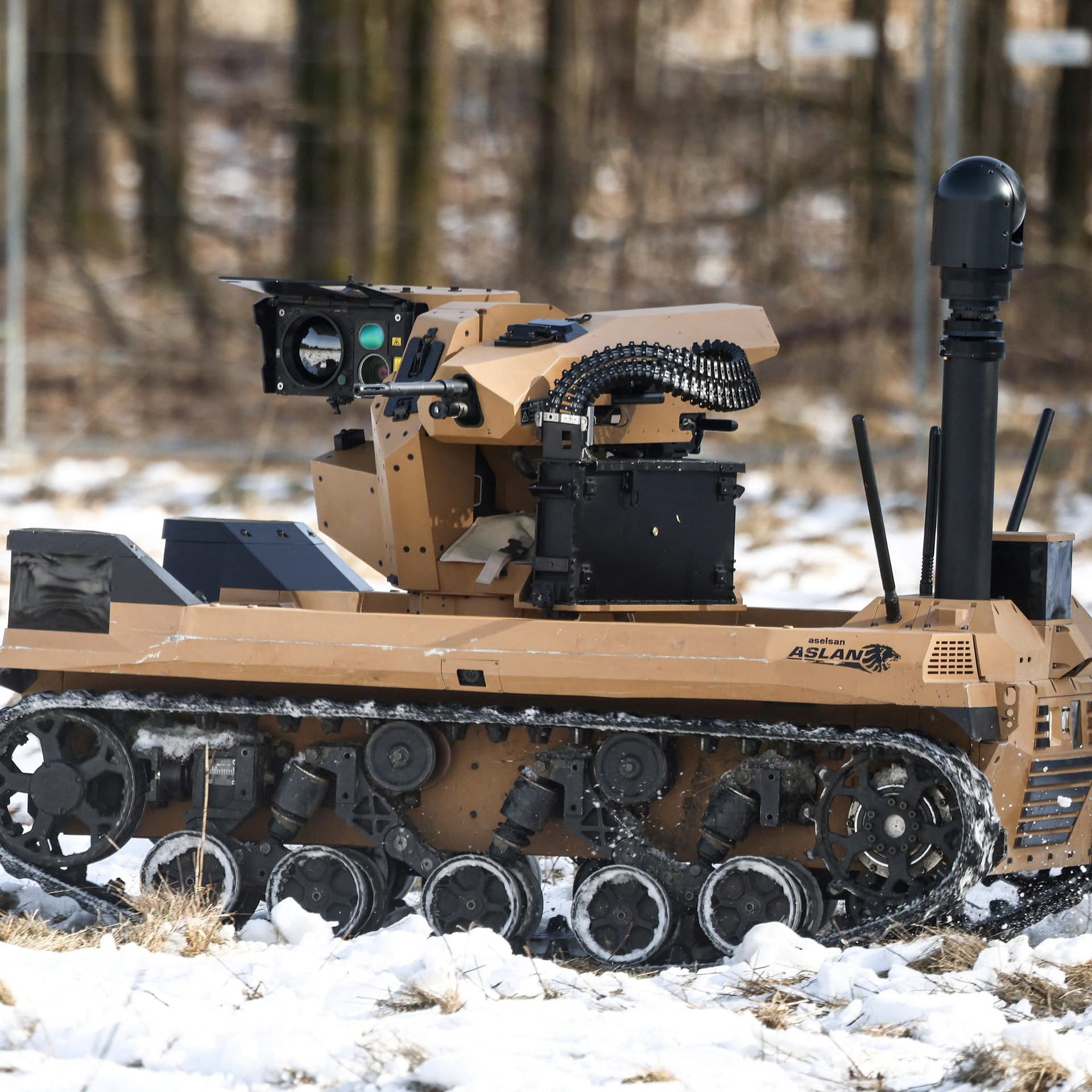
4:59Can I explain the picture of the robot I have in front of me? So we think it looks like a cross between a Wally in the Disney film. It's kind of a tracked vehicle with a machine gun on top. It's a UGV. It's a UGV. That's what we call them. Okay. Yes, uncrewed ground vehicle. Yeah. Presumably it's being controlled remotely, just like a remote control car toy. Correct. Yeah. Mark, as you and I were discussing just before we started recording, we were, both of us, in Ukraine in February 2022 when the war started. I remember at the time there was a 60 mile long convoy of armored vehicles descending on Kyiv.
5:41You know, it was a very kind of conventional old school style conflict at the beginning. We're a long way from that now. What's the story of how the war has actually evolved? How have you got from mass tanks to this where you have robots actually making people surrender? Yes. Well, that moment you mentioned where the Russians invaded in February 22 followed several years in which the Ukrainian military had been facing off against the Russians in Donbass. Donbass being eastern Ukraine. Eastern Ukraine, yeah, during the previous eight years. And so had tested themselves in the real world against the Russian army before the full scale invasion.
6:25I see, I see. and knew how it fought and knew what they needed to do in order to gain advantage tactically. And one of the things they had was an organisation called EiroRozvidka, a sort of collective of Ukrainian tech bros who basically gave their expertise to the business of drone design and operation. And so when the Russians invaded in February 2022, it already existed. and there was already a drone capability in the Ukrainian army. It was aerial reconnaissance. It was the ability to observe by the use of drones, including quite basic ones that, you know, hobbyists might have used to put a camera on to go and take pictures of their house from up above or whatever.
7:14The kind of off-the-shelf Chinese-made four-rotor drone. That you could buy in the duty-free store in Dubai Airport or whatever. And so at first, this Ukrainian collective adapted those. So essentially, during the failure of the Russian advance on Kyiv, what we saw was the drones being used to spot for artillery. And we saw, in a sense, that artillery, which was the biggest killer in World War I and World War II, was the biggest killer, but it was just being aimed much more effectively and more quickly because you had all these eyes in the sky. and it contributed to the stalling of that Russian offensive.
7:55They also had people who developed very effective ways of sharing data so that all the drone operators could input the data and they had a system which everyone could get onto so that they would know that the Russians were occupying that junction north of Kiev or whatever. So all of that started in the first days of the war. So initially, eyes in the sky, but I remember how things began to evolve And very quickly, people realised that you could attach grenades to drones, and then you would get these videos where a drone would sort of try and line up with the top of a tank and then drop a grenade through an open hatch.
8:32Sometimes they would miss, sometimes it would go in, and it was like watching a kind of particularly macabre video game. How did things evolve from there? Well, really, if you look at the war as it evolved during the remainder of the first year, 2022, it was just the introduction on a wider and wider scale of that type of hobbyist drones. And it can be used to observe and it can be used to drop ordnance on people. I see. Then there were bigger quadcopters that they started to buy that could carry heavier mortar bombs and things that make a bigger bang, crudely. But they were still working on the same principle that you were trying to line them up.
9:11And, of course, the Russians, while it was hovering, would be trying to shoot it down and jam it and, in every other way, stop it from doing what the operator was trying to do. Towards the end of 22, beginning of 23, you start to get the first appearance of so-called first-person view drones. Now, first-person is a reference to the pilot using virtual reality goggles or a smartphone to fly it, and that becomes a very different kind of proposition because instead of having a little grapple on the bottom that drops the grenade off the drone, you attach something like the warhead off a rocket-propelled grenade and you fly the drone into the target.
9:57It's a one-way ticket for that device. And your aim is to use your point of view, maybe to even explore inside a building or to go down into a trench line along the trench and find out, aha, the guys are hiding in this bunker and then go in through the entrance of the bunker. So that suddenly creates a huge leap in lethality because the first-person view drone begins to allow the operator to literally find his or her way into structures to crash the device into the target. And that builds through 2023. So the FPVs become dominant numerically. At this point in the story, are the Russians innovating at the same pace as the Ukrainians?
10:50If we recall what happened, the Russians at the beginning of the war, they've got a terrible drubbing. And at that point, I think there was quite a big reassessment done in the Russian military. Now, the Russian military is a very curious and paradoxical organization in the sense that at the level of the soldier blundering forward to near certain death, it seems like a sort of unreformed version of something Tolstoy would recognize. You know, heavy drinking, bullying, coercion by commanders to force the soldiers forward when they knew they stood very little chance of coming out. All of that we see in Ukraine.
11:27But what we also see in Ukraine is that at the higher level, at the officer level and at the industrial level, the Russians start to innovate quite successfully. So the Russians adopt the hobbyist solution as well. And then as the Ukrainians started to develop first-person view drones, the Russians also adopted those. So they were largely playing catch-up to the Ukrainians. It's a constant cat and mouse. At times, the pendulum has swung. So, for example, by the latter months of the first year of the war, the Russians have acquired quite an edge in electronic warfare. And the aim there being to interrupt the connection between the Ukrainian operator and the drone that's flying over Russian lines.
12:09So if you can successfully jam out those signals, then he'll lose control of the drone. So that's one point where they're in the lead. Then the FPVs start to come in, And the Russians apply their thinking to this question of jamming. And they literally do something which seems crazy in a way and started connecting their first-person view drones to fibre optic cable. Within a few months, they were ordering spools of cable from China that were 25 kilometres long. 15 miles. Yeah. So what does it mean when you have this connected, you're saying, through a fibre optic cable? It just means... You can't jam it.
12:48You can't jam the signal. So in the end, the fibre optic guided FPV drone becomes absolutely a weapon of choice, particularly for the Russians. And you start to get these bizarre images emerging of the contested, shattered towns or forests in eastern Ukraine with a sort of spider's web, because hundreds of drones had overflown them, each one leaving its own trail of fibre optic across the landscape. And these trails become so dense that you can see them sort of glistening in the sunlight. Utterly bizarre. But it starts to cause huge problems. By 2024, say, those types of FPV drone are so prevalent in the Russian system that it's causing the Ukrainians significant problems.
13:40because they were not quite as quick to get onto the innovation. But one of the really strange things that's happened in this, as the two sides have tried to match each other's innovations, is they've often been going to the same factories in China. Oh, wow. Whether that's for the motors for the drones, whether it's for the fibre optic spools. And, you know, you hear tales told they're seeing the Russians on Tuesday and selling to them, and then seeing the Ukrainians on Wednesday, But it's not just drones in the sky, is it? I mean, I remember big stories of drones in the Black Sea, for example.
14:19How significant has that been? Bit by bit, the Ukrainians start to think, well, why don't we use uncrewed systems at sea as well? And so they developed a kind of explosive jet ski called the Magura. And they started ordering these from American people who often were just making jet skis and small boats. Is that right? And adapting these designs, making them a bit bigger so you could put like 800 kilos of high explosive into one. Russian officials say a Ukrainian sea drone has hit a tanker near the Black Sea. And they started using these Magura uncrewed surface vessels against Russian ships. It is the second such attack in 24 hours after a similar drone attack on a warship near a Russian naval base.
15:07Ukraine, it seems, is really stepping up on strikes on Russian territory and against Russian vessels and ports in the Black Sea using these unmanned air and sea drones. And they also started to think really out of the box. So they put some old Soviet-era air-to-air missiles on a couple of them. And lo and behold... Over the Black Sea, a Ukrainian missile locks on and downs a Russian Su-30 flanker in what's claimed to be a moment of military history. They managed to shoot down a Russian fighter jet that's coming in to land in Crimea. The first time ever that maritime drones have been used to kill a fighter jet using adapted Sidewinder air-to-air missiles.
15:49So they started to use it as a platform for other weapons. In developmental terms, it's quite a key moment. But that's the thing, Mark. You've described all this technological innovation with all these drones, all these robots. It is still perplexing as to why neither side seems to ultimately be able to win the war. I mean, unless one is innovating and the other is just matching its innovation, maybe that's leading to the stalemate that we see. Well, when I was a young chap going through my training of a sort of basic training at the British Army officer school, the thing that was drummed into you again and again was that on the modern battlefield, if you could be seen, you could be killed.
16:29And therefore, all of the tactics we were taught were about using the landscape to mask ourselves and our movements. Now, that approach is nullified when you have a drone overhead that sees, reveals those forces moving up. And this comes down to a concept that the military call the transparent battlefield. And what they mean by that is through a combination of all of those thousands of drones and indeed overhead reconnaissance from satellites, it just becomes incredibly hard to hide things. it becomes impossible to bring together the forces you need to achieve local superiority and you have a stalemate.
17:09So effectively what's happened with a combination of the transparent battlefield being able to see in so much more detail so much further into the enemy space and then all these weapons that can be used to attack targets from the old school artillery through to more modern drones, that produces stalemate, just like it did in the First World War. You know, there are many differences, but the idea of two sets of people facing off across a quite narrow piece of territory, sometimes so close that they can call out to one another, you know, is there in 1916 and it's there in 2023 in the Donbass. If you have a transparent battlefield, Mark, and you've talked about drones being able to operate some sort of 15 to 20 miles beyond the operator.
18:02What's the significance if that distance gets bigger and bigger? So one of the problems that the increasing range of these systems causes is that it allows each side to go deeper into enemy territory in search of targets. So whereas at the start of the war, you might be saying to yourself, we've got to change over our soldiers in this frontline position because these poor guys have been up there for weeks. But you might have reckoned that the last four or five kilometers or whatever could be really dangerous. Now, some of the Russian reconnaissance drones, they're not used to drop bombs, going up to 40 kilometers into Ukrainian battle space, it's created a huge problem because to cover that sort of distance faster than the Russians can organise a response, it becomes really problematic.
18:54And so in the last year, we've seen extraordinary footage from some of the Ukrainian units of, you know, guys relieved from a position who've been in there for six months and they come out looking like sort of Robinson Crusoe, you know, with beards and grimy faces. One can only imagine how kind of shell-shocked they are at having been under fire for months and months and months without any kind of relief. Because they just can't move because it's too dangerous. Yes. And say they've lost guys trying to go in, trying to relieve them. They then face this challenge of how on earth are we going to get them out?
19:27If someone gets wounded, what are you going to do? So the Ukrainian army was facing quite a morale problem in that people were watching their comrades bleed out and die in front of them because for hours, nobody could get through or people were even afraid to try and get through. So over the past year, we've seen the development of uncrewed ground vehicles for the purpose of casualty evacuation. And that has been quite a successful use of those devices because they've been designed so that they can take, you know, a stretcher case. So Ukrainians have started in recent months to use those for casualty evacuation.
20:05And of course, they've also been resupplying those forward positions, both by air and ground uncrewed vehicles. So either a drone drops in some more rations or bullets. But I mean, the life of those poor guys in those positions, it's horrifying. So it's really become a sort of sterile zone, 20, 30 kilometers on each side of the so-called zero line or the notional front line. And yeah, that has spurred the development of uncrewed ground vehicles. How many deaths are we currently seeing every month in Ukraine right now on both sides? It's really hard to know, but it's reasonable to suppose that, say, between 10 ,000 and 15 ,000 Russians a month have become casualties.
20:49The Ukrainian figure is considerably less, partly because they really scarcely now put troops in those forward positions. But if you look at the total dead, it's pretty numbing, really. I would say anything between 250 ,000 and 300 ,000 Russians killed. Oh, wow. And something in the order of 100 ,000 to 120 ,000 Ukrainians. It's a huge number of people. Yeah. Shocking.
21:19Mark, from my vantage point where I normally sit in Washington, D.C., I think there is an assumption that Ukraine is very needy in this war, that Ukraine needs American weaponry, American money. And so it is really fascinating to hear you tell the story of Ukraine's technological innovation and advantages, because I think for many Americans, I would say myself included, the assumption is that America has led the world in defense manufacturing. I want to understand from you how Ukraine has turned this technological innovation into an asset now. Yeah, well, of course, what we've seen since the start of the Iran war is that some of the Gulf states coming under bombardment from Iranian long range strike drones, the so-called Shahid family of drones, they've literally got in touch with the Ukrainians and said, help us out here.
22:12because as we know, you know, in the last year or two, the Ukrainians have sometimes been facing barrages of 600 or 700 of those types of drones a night. And so, of course, they've developed all kinds of systems to find them, to track them, and then to jam them or to shoot them down. Volodymyr Zelensky inked defence deals with Saudi Arabia, Qatar and the United Arab Emirates last week. And though the contents of the agreements haven't been made public, The Ukrainian president said they included drone know-how. And of course, the Saudis and the Emiratis, they wanted all of that. Yeah, show us how to do this.
22:51We've agreed on strategic cooperation in the military technology field and other areas. We are talking about 10-year agreements. The Ukrainians have sent experts to the Emirates to help them and to deploy active defences against drones. These are the defence systems. Yeah, the Ukrainians have brought in for them. And are US military bases in the region using those as well? This has emerged quite recently. I mean, I think there's been a news agency report that suggests that the Americans are now adopting that technology. They had very costly setbacks at the Prince Sultan Air Base in Saudi Arabia in March.
23:29They were attacked by a combination of drones and missiles. So definitely that's piqued US interest in this. And it is also the case, I mean, the Ukrainians have been gloating somewhat about some exercises to train NATO forces in the realities of what it's like to be up against an enemy with drones. So in some sectors, at least, the tables have turned that the NATO countries actually need Ukraine and its know-how technology advice. Is that right? Yes, I think that's right. Yeah. Mark, are we seeing at this point warfare transforming in front of our eyes? Are we going to move to a point soon where battles are being fought solely between robots, essentially?
24:19Well, I always say someone has to charge the batteries on those robots. Somebody has to create a launch site for them. Somebody has to control them in their current... Does somebody have to control them? In their current incarnation, yes. So you can say, well, yes, we're seeing a situation where there are fewer and fewer people in the front line, but then your drone operators are still going to be there somewhere 20, 30 kilometres back from the front line, just as your artillery is. Could we move to a point where the very, very front line is solely populated by robots? Yeah, I think you could.
24:57I mean, there are already systems, sort of uncrewed guard turrets turrets with machine guns. But the actual person who operates the machine gun is many kilometers away. Mark, that raises all sorts of ethical questions. If you're not so intimately connected with the actual war you're fighting, it changes the whole scope of how long you're willing to engage in the fight. But also, I mean, that isn't true autonomy. Of course, you can create a system like that with a remote control machine gun, which just operates autonomously based on a sort of image library of what the enemy looks like. That is terrifying.
25:35Yeah. These things are happening now on the battlefield in the Ukraine war, that type of processing of imagery with AI tools. You know, throughout our conversation, you've described a situation in which the war in Ukraine has in some ways revolutionized modern warfare. And that leaves us wondering, I mean, if Vladimir Putin has perhaps accidentally created this innovative fighting machine in Ukraine through his invasion. Well, he has, yeah. And I suppose it's a little bit like a sort of immune response to a contagion or a virus, isn't it? He's ended up breeding a stronger Ukraine in that sense.
26:21this extraordinary power, you know, these extraordinary cycles of innovation. And yes, they show us the way. But don't underestimate the degree to which the Russians as well have learnt a lot from this. And that's the big challenge for Western Europe now, is to, in a sense, to employ that precious know-how that the Ukrainians can give them to prepare their own forces in case things become much more serious. with Russia in the future.
Read the full transcript
26:54On that note, thank you so much, Mark. It's been a pleasure. Thank you so much, Mark. That was great. Thank you both.
27:08That was Mark Urban, journalist, military expert, and author of the book, Tank. And as always, we love hearing from you all. So if you have any story ideas or questions for us, you can email us at theglobalstory at bbc.com. And a quick reminder that we here at The Global Story bring you one story every day where we go in-depth about where the world and America meet. If you're looking for a way to catch up on the latest news headlines, then we recommend checking out our sister show, The Global News Podcast. You can find it wherever you listen. Today's episode was produced by Lucy Paul and Viv Jones.
27:45It was edited by Richard Fenton Smith and mixed by Travis Evans. Our digital producer is Matt Pintis. Our studio manager was Mike Regard. And our senior news editor is Chyna Collins. Thanks as always for tuning in and we'll talk to you again tomorrow.
From the publisher
For the first time in history a country has apparently won a battle using only robots, without a soldier on the ground put at risk. Ukraine claims to have recently taken over a Russian position – forcing Russian soldiers to surrender – using robotic systems alone.
President Zelensky has been asking the world for help to fight Russia since the full-scale invasion began in 2022. But in the years since, Ukraine has revolutionised the technology of warfare with battlefield robots and drones, and now other countries are turning to it for its technology and expertise.
We speak to the journalist and defence expert Mark Urban about how Ukraine went from needy to needed.
Producers: Lucy Pawle and Viv Jones Executive producer: Richard Fenton-Smith Mixed by: Travis Evans Senior news editor: China Collins
Photo: The "ASLAN" unmanned ground vehicle (UGV) is tested during a NATO exercise in Germany, February 20, 2026. Photo by: Liesa Johannssen/Reuters