
In short
What would happen if China attacked Taiwan, and what would Donald Trump do? The episode argues an invasion could be catastrophic for the global economy and US credibility.
Guests
James Crabtree, writer/author/geopolitical analyst; spent much of his career living in Asia; Asia-Pacific expert.
Key claims
Taiwan’s status stems from the Chinese civil war (Kuomintang retreat to Taiwan after 1948) and remains disputed by the PRC. The US uses “strategic ambiguity” (dissuade both China and Taiwan) and Taiwan is not a formal US ally with automatic security guarantees. After Nancy Pelosi’s 2022 Taiwan visit, China increased pressure via exercises and an “anaconda” approach (encircling, cutting Taiwan off). Taiwan’s 2024 president William Lai is seen as more serious about self-defense; Taiwan funded a drama (“Zero Day”) to build public resilience. Trump’s administration is portrayed as split between Elbridge Colby’s “Strategy of Denial” (deterring invasion) and Michael Anton/J.D. Vance’s more China-skeptical, possibly less Taiwan-focused approach. Xi wants the US to oppose Taiwanese independence (a concession).
Notable examples
Pelosi’s 2022 visit; “Zero Day” quarantine-to-invasion plot; missile/ship exercises after Pelosi; US tariff-linked economic crisis mentioned; invasion readiness target “start of 2027.”
Written by AI. May contain mistakes. Listen to the episode to check what was said.
Chapters
Tap a time to open that second in VOTrump's Risky Trip to Asia
1:03 to 3:06
Discussion about Trump's trip to Asia and its implications for Taiwan.
“Tristan, President Trump is not in Washington this week.”
Taiwan's Historical Context
3:06 to 5:57
James Crabtree explains Taiwan's complex history and current status.
“I'm a writer, author, geopolitical analyst, and I've spent a good chunk of my career living in Asia.”
US-Taiwan Relations and Strategic Ambiguity
5:57 to 8:34
Exploration of the US's policy of strategic ambiguity regarding Taiwan.
“So it doesn't, for instance, have membership of the United Nations.”
Nancy Pelosi's Visit and Its Aftermath
8:34 to 11:16
Impact of Nancy Pelosi's visit to Taiwan and China's response.
“But it would also dissuade Taiwan from doing anything that would provoke the Chinese into military action.”
Taiwan's Political Landscape Post-Pelosi
11:16 to 14:00
Discussion on the election of Taiwan's new president and his stance towards China.
“I have to take this opportunity to reiterate the Taiwanese people's welcome to Speaker Pelosi.”
Taiwan's Changing Leadership and Defense Strategy
14:00 to 16:15
Learn about Taiwan's political shift and its implications for defense against China.
“And then it feels like the next big phase in this story is that in 2024, Taiwan elects a new president, and he is pretty gung-ho in his stance towards mainland China.”
Government Support for Taiwan's Military Preparedness
16:15 to 16:48
Explore how Taiwan's government uses media to raise awareness of the Chinese threat.
“And together we're the hosts of the Global Story podcast from the BBC.”
The Impact of Donald Trump's Presidency on Taiwan Policy
16:48 to 19:29
Discover the internal debates within the Trump administration regarding Taiwan's defense.
“He uses government money to back a TV drama series about a hypothetical invasion of Taiwan by mainland China.”
Divided Views on Taiwan within the Trump Administration
19:29 to 22:54
Understand the contrasting opinions on Taiwan's strategy among Trump advisors.
“On the one hand, you've got this guy called Elbridge Colby, who's the Undersecretary of Defense.”
Potential Consequences of a Chinese Invasion of Taiwan
22:54 to 27:30
Analyze the geopolitical ramifications of a hypothetical Chinese invasion of Taiwan.
“But there is this tension within the Trump camp, which is, are you going to continue to back the Taiwanese or are you not?”
Transcript
Automatic transcript. May contain errors.0:00This BBC podcast is supported by ads outside the UK.
0:30All the great deals happening now.
0:35Hi there, I'm Asma Khaled. And I'm Tristan Redmond. And together we're the hosts of the Global Story podcast from the BBC. For those of you who might be new to our show, we here at the Global Story dive deep every weekday on one big story at the intersection of where the world and America meet. And you can now watch the Global Story on the iHeart app. Catch every brand new episode every weekday. Just tap into iHeart to start watching. And we hope you enjoy the show.
1:08Tristan, President Trump is not in Washington this week. He is, in fact, in Asia on one of the riskiest trips any president has ever taken. That's according to what his former advisor, Steve Bannon, told Politico the other day. He's in Asia for the first trip of this second term, meeting with a whole bunch of world leaders. Critically, he's expected to meet with China's president this week. He's there to try to strike a deal to deal with an economic crisis, one that many folks would say was arguably created by him and his tariff policy. Well, Asma, I would argue that the economic crisis isn't even the half of it, because the greatest danger, it seems to me, could be coming from somewhere else altogether, and that is Taiwan.
1:57I don't see that at all with presidency. I think we're going to get along very well as it pertains to Taiwan. And that doesn't mean it's not the apple of his eye, because probably it is. Taiwan is one of the United States' biggest friends in Asia. But I sometimes wonder if actually U.S. presidents wished it didn't exist at all. And that's because China hasn't made any secret of the fact that it wants to re-annex Taiwan. He wants to bring Taiwan back into mainland China. And if that happens, we could have a situation in Asia Pacific that goes from extremely tense to explosive. So what have you been working on for today, Tristan?
2:41Well, I've been talking to a man called James Crabtree, and he is an expert on the region. And he's been telling me why if China tried to invade Taiwan, which is a thing that really could happen, It could have catastrophic consequences for the region, but also for the United States' place in the world. So from the BBC, I'm Tristan Redmond in London. And today on The Global Story, if China attacked Taiwan, what would Donald Trump do about it?
3:17My name is James Crabtree. I'm a writer, author, geopolitical analyst, and I've spent a good chunk of my career living in Asia. Could you explain a kind of short history of the island of Taiwan to us, please, and how we got to where we are now? So at the beginning of this, you've got to go all the way back to the Second World War. Americans made some attempt to bring the communists into a coalition Chinese government. But it all came to nothing. Civil war followed. There was a civil war in China in which you had a nationalist army and a communist army led by Chairman Mao. By the summer of 1948, the Kuomintang army was losing ground.
4:01The communists won. And the Kuomintang was in full retreat. The remnant took refuge on the island of Taiwan. And the nationalists, instead of being entirely defeated, got on boats in large numbers and moved to Taiwan. just after the end of the Second World War. And in a sense, that's the situation that we have been in ever since. You have two groups who claim to be the rightful government of China, the People's Republic of China, led by the Communist Party to this day, and then the government of Taiwan, which is the inheritor of the Nationalist Party, originally led by a dictator called Chiang Kai-shek.
4:40And so that's the roots of the problem. The Communist Party of China thinks that Taiwan is, in a sense, the end of its victory in the civil war and the process of national reunification. Over time, Taiwan has moved from being a dictatorship to being a vibrant democracy. And although it isn't viewed as an independent nation, it has most of the attributes of that and doesn't want to become part of the People's Republic of China.
5:12Okay, so the People's Republic of China, mainland China, views it as a sort of renegade province. Is that right? That is a kind of language that people use to describe it, yes. So they view Taiwan as rightly a province of China that has, in a sense, not been brought into the fold. Taiwan itself recognizes that were it to declare itself an independent nation, then that would most likely prompt China to launch a military invasion or to take very dramatic measures. And therefore, it exists in this kind of neither one nor the other state where it has most of the attributes of an independent nation, but doesn't get to call itself one.
5:59So it doesn't, for instance, have membership of the United Nations. And what is Taiwan's status on the world stage? To what extent is it recognized and accepted by its neighbors and other world powers? So again, if you go back to the beginning after the Second World War, then most countries recognize the nationalist government as the rightful government of all of China, even though it only had the island of Taiwan. Over time, that position became increasingly untenable, So over the decades, more and more countries recognized China as the proper China, as it were. And the number of countries that now recognize Taiwan, which is known as the Republic of China, is now down to about a dozen.
6:44It's a small number of island states in the Pacific and Latin American countries. So most countries recognize the People's Republic of China. Okay. If Taiwan calls itself the Republic of China, is it a Taiwanese policy that one hypothetical day it might return to its rightful state as the ruler of all of China, including mainland China? Yes, in a formal sense, although obviously there's absolutely no chance of that happening under any conceivable scenario that we could think of at the moment. But in its history, Taiwan thought that this might be possible. It was a sort of a dream to take back the motherland.
7:25Now that's not really plausible, but formally, yes, if you look on maps in the Taiwanese foreign ministry, then you will see that the Republic of China claims not just all of China, but actually bits of Mongolia and other bits of territory as well. Well, historically speaking, how has the United States approached Taiwan diplomatically since its founding in 1949? So the United States has always supported Taiwan in one form or another. Originally, it recognized the government of Taiwan as the rightful government of China. Over time, as with everybody else, that became untenable. And so in the 1970s, there was a formal process in which the US recognized Beijing, the Communist Party government, as the entity that it would deal with as the government of China.
8:15And then it created a range of diplomatic understandings with China about the status of Taiwan. The US would continue to support Taiwan. It would give it weapons. It would dissuade China from trying to take the island by force. But it would also dissuade Taiwan from doing anything that would provoke the Chinese into military action. So it, in a sense, tried to manage the situation using a series of complicated understandings that have remained a source of tension between China and the United States to this day. Okay, so it sounds like a sort of compromise where the United States wants to support an ally, but not to the extent of antagonizing mainland China too much.
9:02That's about right. Although it is important to say that Taiwan is not a US ally in the sense that it doesn't have any security guarantees in the way that it would be with Japan. or Australia or the Philippines. So it has always left the question of, were the People's Republic of China, the Communist Party government, were they to invade? What would the US do? Would it automatically back Taiwan or would it not? And this policy of ambiguity that the US has generally had was to stop the Taiwanese doing anything stupid, as in in the era in which Taiwan was run by military dictators who did dream of taking back the motherland, the US was very concerned that the Taiwanese shouldn't bounce the US into military support against the mainland Chinese government.
9:50Well, you mentioned this word ambiguity. I mean, that's the thing that I keep seeing when I've been reading about Taiwan. I've seen it phrased as strategic ambiguity. Could you explain what exactly strategic ambiguity is? The idea of strategic ambiguity is not to give any side a clear sense of what the United States would do. So if you are China, you want China to think, well, if we invade, there is at least the possibility that the US will come running to the rescue. And therefore, that would be a big problem. Because for almost all of Taiwan's independent history up until the present moment, the US has been much stronger militarily than China.
10:31That is no longer true, but it's always been true up until a few years ago. But you also want to leave a degree of ambiguity to the government in Taipei, which is, you know, don't go and poke the dragon, as it were, unnecessarily, because if you do that and you get into trouble, we might not come and rescue you. So in a sense, the US is trying to use this policy of strategic ambiguity to ensure that both sides don't do anything rash. Okay, so it sounds like a sort of codified version of Donald Trump saying, we'll see what happens, which he says very often. That I think is exactly right. OK, I feel like Taiwan is not a place that necessarily looms large on people's radars.
11:11But I do remember not very long ago it flaring up as a big news story. I have to take this opportunity to reiterate the Taiwanese people's welcome to Speaker Pelosi. In 2022, Nancy Pelosi, the U.S. Speaker of the House, made this surprise visit to Taiwan. We come in friendship. We thank you for your leadership. We want the world to recognize that. Why was that something of a turning point in Taiwan's recent history? Yes, in the autumn of 2022, Nancy Pelosi landed in Taipei and it created a huge diplomatic storm. The Chinese viewed this as an unnecessary provocation in which such a senior U.S. figure was going to Taiwan and they thought that her arrival would strengthen pro-independence forces.
12:03They also thought that this was a deliberate policy of the U.S. In actual fact, that wasn't really what happened. I mean, I think President Biden's administration would rather that she didn't go, but ultimately she decided that she was going to do this anyway. The result was a short-term crisis. Well, overnight, that historic moment on this trip that has sparked a lot of controversy and fierce pushback from the Chinese. The torrent of Chinese aircraft, missiles and ships moved towards Taiwan as soon as House Speaker Nancy Pelosi left the island. China conducted a whole range of military exercises to show its displeasure.
12:45China showed its strength and hinted at its strategy. Firing missiles, encircling the island with military ships, that kind of thing. Taiwan this month suggested Chinese forces would surround the island in the event of a conflict. Really, it's China practicing cutting off Taiwan from the rest of the world. It was at that moment that China really seemed to step up its efforts. And what China is trying to do is convince the people of Taiwan that basically their reliance on the U.S. as their savior is hopeless in the end. that China's military is now so strong that their ability to encircle the island and cut off Taiwan's internet cables, that there's no way they can remain independent and they might as well, you know, get on with the business of ultimate unification.
13:31That is Beijing's strategy, what they sometimes call the anaconda approach.
13:39Okay, so the anaconda strategy is a direct result of the Pelosi visit, Is that right? The anaconda strategy began to be seen in earnest after the Pelosi visit. So yes, I mean, I think you could say that it resulted from it. All right. So after this visit by Nancy Pelosi in 2022, China ramps up its posturing. And then it feels like the next big phase in this story is that in 2024, Taiwan elects a new president, and he is pretty gung-ho in his stance towards mainland China. What does he actually do when he reaches office? So previously you had President Tsai Ing-wen, who was a sort of level-headed, calming figure.
14:27The current president, who's called William Lai, has a very different background and historically is seen to have been more supportive of formal Taiwanese independence. Certainly, that's what China views him as. They see him as a kind of agitator and a renegade. And so when he won the election in 2024, this was very disquieting for Beijing because they thought that he would try and shift Taiwan in a direction that was further away from Beijing. In actual fact, he hasn't been that provocative, maybe a little bit more than his predecessor. or he's not said very nice things about Beijing. I think the biggest thing that has changed is that under William Lai, Taiwan has taken its own self-defense much more seriously.
15:10So partly under pressure from the Trump administration, they started spending more on defense and also spending more on the kind of things that you need to stop a potential Chinese invasion. The Americans have been badgering the Taiwanese to spend much more money on these kinds of things for years. And under William Lai, they've actually begun to do that much more seriously. Well, a conflict scenario like this might happen by the end of 2027. Is that right? What the Americans believe is that Xi Jinping has given his military a target to say, you should be ready by the start of 2027, so not that long away from now, to launch an invasion if I say that I need you to do it.
15:52Now, that doesn't necessarily mean that they're going to invade then. And so the assumption is that they're not because the cost of doing that would be enormous and it would be incredibly risky. But to have the capability to do that is what the Chinese have been aiming for.
16:15Hi there, I'm Asma Khalid. And I'm Tristan Redman. And together we're the hosts of the Global Story podcast from the BBC. For those of you all who might be new to our show, We here at The Global Story dive deep every weekday on one big story at the intersection of where the world and America meet. And you can now watch The Global Story on the iHeart app. Catch every brand new episode every weekday. Just tap into iHeart to start watching. And we hope you enjoy the show.
16:48This is one thing that I read about that I really have to ask you about, which is that when the new Taiwanese president came into power, he's the guy who takes the Chinese threat very seriously and he wants to make sure that Taiwanese people do too. So he does something quite unusual. He uses government money to back a TV drama series about a hypothetical invasion of Taiwan by mainland China. Could you tell us about how that actually came about, please? Yeah, so there has been this television drama called Zero Day.
17:27It came on Taiwanese television about a couple of months ago. It tells the story of a Chinese quarantine of the island that then turns into an invasion. And I think part of the reason why the government wanted to do this is you have the question of does Taiwan have the military kit that it needs to survive? But there are other questions as well, one of which is, do the people of Taiwan have the will to fight? Are they ready? Are they thinking about the reality that they may have to do this? And there has been some concern that maybe civil resilience in Taiwan hasn't been strong enough. And so having a television program like this in which the whole of the country has to contemplate what this might look like has been quite an important development.
18:22Have you watched this show? And should I add it to my watch list? Yeah, it was very good. And I suppose in the end, a plausible scenario, as in it doesn't just start with a massed invasion of the sort that you might think of from, I don't know, Saving Private Brian or films about the Second World War. It starts with China introducing a quarantine on a sort of slender pretext. So it's, you know, I think it was to do with the accidental sinking of a ship. And so China said, well, because of this, we're going to stop shipping, going into Taiwan, you know, the anaconda strategy. And then eventually that leads to an invasion.
19:04So that, in a sense, I think is a kind of quite realistic scenario for how this might transpire. OK, well, none of this is happening in a vacuum. You know, the anaconda strategy, the election of this new president who's boosting Taiwan's defense, because in 2025, Donald Trump obviously comes into office. And one of the big issues on his desk is what is Taiwan policy going to be? There's a tug of war, it seems, inside the Trump administration over what to do about this. On the one hand, you've got this guy called Elbridge Colby, who's the Undersecretary of Defense. Could you tell us what his position is, please, on Taiwan?
19:44So Elbridge Colby worked in the first Trump administration in the Pentagon in a kind of mid-level position and now has gone back in in a more senior position. He's a prominent China hawk. I'm interested in Taiwan because of China. The reason Taiwan is important is that it's very important for China to subordinate Taiwan in order to establish a hegemonic position over Asia, which is going to be the world's largest market area. Right. And from that position, it would have a dominant position over the global economy, including our own. And he wrote a book called Strategy of Denial. If you want the political status quo, you have to do what I'm talking about, because you have to you have to present them with a military denial.
20:24And what he meant by that was that the U.S. had been spending a lot of time in wars in the Middle East and supporting Europeans. And the danger was that the main threat to the U.S.'s position in the world was now China. And the U.S. wasn't doing enough about stopping the most threatening scenario, which is an invasion of Taiwan, which would have all sorts of long-term consequences for U.S. prosperity, for the global semiconductor industry, for all sorts of things. And so he proposed this strategy of denial, which was basically to focus the US military on one core task, which was stopping a Chinese invasion or deterring a Chinese invasion, putting in place the kind of capabilities that you would need to mean that Xi Jinping wakes up every morning and thinks, well, I might quite like to invade Taiwan, but I'm not going to do it today.
21:11Okay. So on the other side of the argument, as I understand it, you have a guy called Michael Anton. We are told constantly that crisis is brewing in the Taiwan Straits. China's been patient. Patience may be running out. Maybe they'll try to do something. I just want to raise some questions. Can you tell us who Michael Anton is, please? You have a strain within the Trump administration which is more isolationist and which is sceptical of the idea of standing up to the Chinese over Taiwan. So Michael Anton was until recently the head of a thing in the State Department called the Policy Planning Unit.
21:53It's like an internal think tank in the State Department. Right now there seems to be a massive amount of groupthink. We're only allowed to think about this one way. Nobody is allowed to bring up any of the counterfactuals. When policy is made on that basis, horrible blunders and catastrophes result. He recently quit, but until he left, he was in charge of drafting what's called the National Security Strategy. And so the rumors are that the national security strategy that he was drafting will downplay the importance of Taiwan and focus instead on issues in the U.S.'s backyard in the Western Hemisphere.
22:28And so, although Anton is a relatively minor figure, the most important figure in this group is J.D. Vance. And to some degree, the president's son, Don Jr., they are seen to be people who are more skeptical of a kind of tough line against China, that what they want to see happen is a trade deal with China. They certainly think that it would not be in the US's interest to go to war with China over Taiwan. But there is this tension within the Trump camp, which is, are you going to continue to back the Taiwanese or are you not? OK, well, Trump is meeting with Xi later this week and they're expected to discuss Taiwan.
23:08What does Xi want from the meeting? So, putting to one side the economic deal, what we think the Chinese would like the Americans to do is to shift their position on Taiwanese independence. So, currently, the U.S. says, we do not support Taiwanese independence. What the Chinese would like is for the U.S. to say that we oppose Taiwanese independence. And that might seem like a fine distinction, but in the delicate diplomacy over Taiwan's status, it's the kind of thing that Beijing would be delighted to get, and it would be seen to be a major concession. So there has been some public reporting that China has asked for this, and those in the U.S.
23:55system who are supportive of Taiwan are a little bit worried that Trump, in exchange for a better economic deal, might be tempted to water down the U.S.'s commitment to Taiwan. I suspect that won't happen simply because it would be such a major concession to the Chinese that they would have to offer something very substantial in return. But you can't really tell with Trump. It's the sort of thing that if you were sitting in Taipei, you would be very worried about. Okay, well, I just want to try to understand from you. Imagine, hypothetically speaking, that China does invade Taiwan by the end of 2027, as you've suggested that it might.
24:36and the United States does not step in to prevent China from taking over Taiwan. What is the worst case scenario? What does that actually mean for the region, for the world, the United States? Well, I suppose the first thing that you have to say is that this, you know, a war over Taiwan would be vastly more damaging to the global economy than Ukraine, many orders of magnitude. I mean, particularly if it ended up in a war between the United States and China. I suppose if the scenario that you're talking about is one in which China is able to invade, the US says, well, we're not going to get involved, and Taiwan folds or fights briefly, but is overwhelmed, that would have an economic effect, but probably not a catastrophe.
25:25Then this is a massive boost for the Chinese government, because this is their primary international aim. It would secure President Xi's place as the most important Chinese leader in the modern era, surpassing Mao. And it would be an enormous blow to the credibility and prestige of the United States. Because if you are the dominant power, or previously the dominant power globally and in the Indo-Pacific, and you have all these alliances, and the allies then look at you and say, well, you know, you had this quasi alliance with Taiwan, not a formal one, but the Taiwanese always expected that you'd have their back and you just decided not to do that, then we have to look very seriously at whether or not you would support us, you know, if we're Japan or Australia, you know, the other countries that are in this anti-Chinese coalition.
26:17So it would be a real breaking point in global geopolitics, probably the most significant that we have had since the end of the Second World War, certainly since the end of the Cold War. And what would that say about the US ability to project power and influence around the globe? Well, it would say that that is massively diminished, as in it will say that the US, in a sense, was given the choice as to whether to support one of its closest democratic partners, and it decided not to do that.
Read the full transcript
26:54and the effect on US prestige would be very dramatic. I mean, in a sense, the US has already signaled that it wants to do less in Europe and is drawing back from European security and this would be a signal that the US no longer wanted to be the leading power or the co-equal leading power in the Pacific. So in a sense, it would be, I think, the moment that people viewed China as the world's leading power as opposed to the United States.
27:29James, thank you so much. Thank you.
27:38That was writer and Asia-Pacific expert James Crabtree. If you're enjoying the show, please rate us. It helps others find us. Today's episode was made by Viv Jones, Zandra Ellen, and James Shield. It was engineered by Travis Evans. Our senior news editor is China Collins. And I'm Tristan Redman. That's it for the global story for today. Thanks for listening. Cheerio.
28:13Hi there, I'm Asma Khaled. And I'm Tristan Redmond. And together we're the hosts of the Global Story podcast from the BBC. For those of you who might be new to our show, we here at the Global Story dive deep every weekday on one big story at the intersection of where the world and America meet. And you can now watch the Global Story on the iHeart app. Catch every brand new episode every weekday. Just tap into iHeart to start watching. And we hope you enjoy the show. Thank you.
From the publisher
President Trump is in Asia this week to strike deals with several countries, including with China. One of the big questions overshadowing the trip is Taiwan’s future. China has long vowed to "reunify" with self-governing Taiwan and has not ruled out the use of force. On Sunday, Secretary of State Marco Rubio said the US wouldn’t abandon the island in exchange for a favourable deal with China. But a tug of war has been playing out inside the Trump administration over whether a military battle for Taiwan – if China did try to seize it – would be in America’s best interests. We speak to writer and analyst James Crabtree about what to expect from Trump’s visit to Asia and where Taiwan goes from here. Producers: Viv Jones and Xandra Ellin
Executive producer: James Shield
Mix: Travis Evans
Senior news editor: China Collins
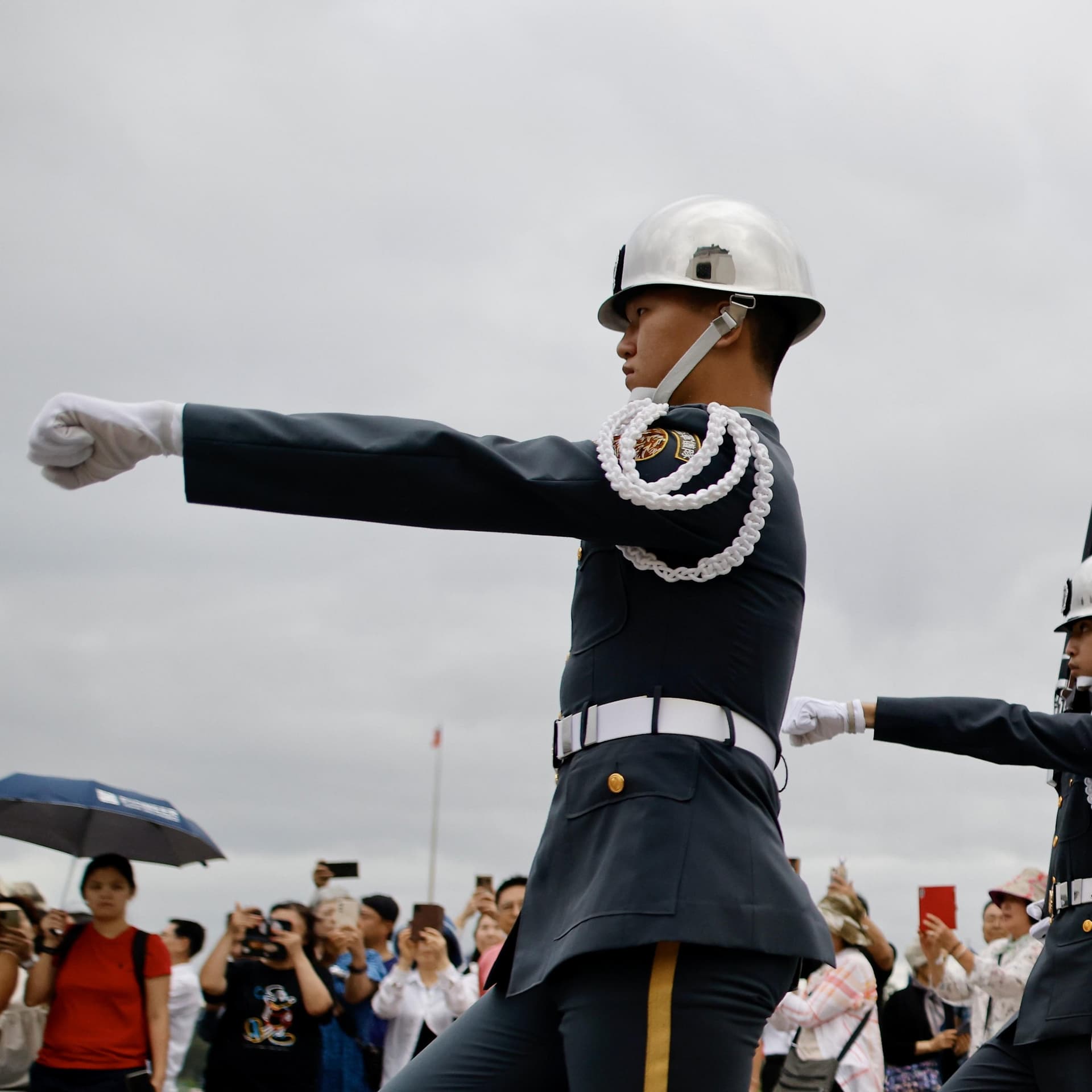
Image: Taiwanese people observe the changing of honor guards in Liberty Square in Taipei. Ritchie B Tongo/EPA-EFE/REX/Shutterstock.