
In short
Five years after the U.S. withdrawal from Kabul, the episode examines Taliban rule over Afghan girls’ education and women’s rights, focusing on “secret schools” and the Taliban’s public claims versus reported reality.
Guest backgrounds
Lise Doucette, BBC chief international correspondent, has reported on Afghanistan for about 40 years; she returned to Afghanistan to speak with Taliban officials and ordinary Afghans.
Key claims
Taliban have systematically dismantled women and girls’ rights (UN: “systematically dismantled”); girls are barred from studying past primary and women from university; over 100 Taliban edicts target women; UN/human rights groups call it gender apartheid and possible war crime.
Notable examples
a hidden “secret school” with escape routes from morality police (two visits in one case); a 13-year-old studying online and teaching English; women entrepreneurs (jam factory) after university closures; Taliban officials claim education/work are allowed “within Islam,” but admit problems when pressed.
Written by AI. May contain mistakes. Listen to the episode to check what was said.
Chapters
Tap a time to open that second in VOThe Beginning of a Story
0:30 to 1:05
A reflection on a powerful moment from October 2001 regarding women's rights.
“Stop managing software and start managing your business with one unified system.”
The Taliban's Return
1:05 to 2:58
Description of the Taliban's return to power and its impact on women in Afghanistan.
“both because it was so strange and because it was so emblematic of the political rhetoric we heard in those days of why, in part, the United States was going to war in Afghanistan.”
Life Under Taliban Rule
2:58 to 4:25
Lise Doucette shares her experiences and observations from reporting in Afghanistan.
“Lise Doucette is the BBC's chief international correspondent.”
Secret Schools for Girls
4:25 to 6:00
Exploration of clandestine educational settings for girls in Afghanistan.
“So one of the visits that I will always remember is going to what Afghans call a secret school.”
The Risks of Education
6:00 to 7:55
Discussion of the risks and fears young girls face while pursuing education.
“and we are so happy to have a school like this.”
Voices of Hope
7:55 to 9:10
Insights from students about their hopes and fears regarding education.
“So let's speak to one of the teachers here.”
A Broader Perspective on Education
9:10 to 11:28
Exploration of how some Taliban members view girls' education and the existence of alternative schools.
“And of course, when they see someone who's a foreigner, they think, oh, I can go and practice my English.”
Women in the Workforce
11:28 to 13:50
Examining women's roles in the workforce under the Taliban, including entrepreneurship.
“Which, Liz, you know, we've talked here on the show in the past about some of the shutdown of USAID clinics and the fact that many Afghan women, they can no longer become midwives, they cannot become nurses, doctors.”
The Reality of Promised Rights
13:50 to 14:00
Discussion on the discrepancy between Taliban promises on women's rights and the current situation.
“And I said, well, what if your life was that you were a jewelry maker instead of a doctor?”
Afghan Girls' Education Under the Taliban
14:00 to 18:32
Learn about the struggles Afghan girls face in pursuing education under Taliban rule.
“No, I wouldn't be happy because they are all not my main goal, which is becoming a doctor.”
Show all 11 chapters
The Evolving Landscape of Taliban Governance
18:54 to 26:33
Explore the changes in Taliban governance since their return to power and its impact on women's rights.
“Do you have a sense that the Taliban you are interacting with now is different than the Taliban that was there in the late 1990s?”
Transcript
Automatic transcript. May contain errors.0:00This BBC podcast is supported by ads outside the UK.
0:30No bouncing between tabs. And best of all, no spreadsheets. Stop managing software and start managing your business with one unified system. Try for free today at odoo.com. That's O-D-O-O dot com. Get more with BBC Podcasts, wherever you listen. Be the first to listen to your favourite shows like Evil Genius, Good Bad Billionaire and You're Dead to Me with a subscription to BBC Podcasts Premium on Apple Podcasts. You can also enjoy a range of our podcasts ad-free with an Amazon Music subscription.
1:04There is this moment from October 2001 that is seared into my memory, both because it was so strange and because it was so emblematic of the political rhetoric we heard in those days of why, in part, the United States was going to war in Afghanistan. A Democratic congresswoman from New York by the name of Carolyn Maloney spoke on the floor of the House inside the U.S. Capitol. But you couldn't actually see her. You couldn't see her face or her blonde hair. She was completely covered from head to toe, dressed in a light blue burqa to protest the Taliban's treatment of women. In the face of the most repressive regime in the world, women are risking their lives to gain rights so basic that we in the United States don't even think about them.
1:54Her message was that America would not forget these women. And the women in Afghanistan who are fighting for freedom should know that they are not fighting in vain. The women in Congress, the women across this country are standing with them. But almost 20 years after that speech, on August 30th, 2021, the final U.S. military aircraft flew out of Kabul. the Taliban had returned to power. In the five years since the U.S. left, so much has changed. The Taliban claim that women are an important part of society. At times, they've suggested that women would be able to get an education and work. But the reality, in the words of the U.N., is that they have systematically dismantled the rights of half of the country's population, making Afghanistan a global outlier with no parallel in the modern world.
2:54From the BBC, I'm Asma Khalid in Washington, D.C. And today on The Global Story, we hear from the girls and women of Afghanistan.
3:08Lise Doucette is the BBC's chief international correspondent. She's been reporting on Afghanistan for roughly four decades. Lise recently returned to Afghanistan to speak to government ministers and the ordinary Afghans living under the Taliban's rule. And we here at The Global Story caught up with her to get a sense of what life has specifically been like for women and girls. It was really good to be back in Afghanistan. I hadn't been back for three years. It's more difficult now to get visas in Taliban-ruled Afghanistan. And, you know, that way in which we like to cover anniversaries, it was a five-year mark.
3:44Astonishing that it has been five years since Taliban fighters swept into Afghanistan. And of course, it's a time seared in memory and still five years on, it's a very traumatic time. But for the Taliban and its supporters, one of the reasons why they were letting media in is they now feel very confident. They're still in control. They haven't collapsed. They control all of the country aside from there have been intermittent, in some ways, increasing attacks by some of the armed groups based in exile. But they're still very much in control. And so they put on a celebration. I know you spent a lot of time reporting on women and girls.
4:22Where did you go and who did you speak with? If there's any one image or story that symbolizes five years of Taliban rule, it is this cruel reality that girls are no longer allowed to study past primary school and that women can't go to university. So one of the visits that I will always remember is going to what Afghans call a secret school. Now we're going down a dark hallway into a far corner. And this is how young girls in Afghanistan, beyond grade 6, are being educated now. A school which is beyond the gaze of the authorities, although some of the authorities do know they exist. Afghan girls studying in the dark, in danger.
5:21hidden from Taliban eyes. I can't reveal because by its nature it is secret and no one wants to reveal the location of the schools, the identity of the students or teachers, but suffice it to say that where we went, it was sufficiently, it was hidden. And you can imagine these are very young, these are teenage girls who just desperately want to learn. We're just going up the stairs now. some other classrooms of the oldest girls studying here.
5:55It's so good. I love the way that they teach. And we're having great teachers, and we are so happy to have a school like this. The extraordinary thing was, not only were the girls managing to reach the school undetected, although they talked to us about how they walked in fear to get there in the possibility that the morality police could pounce. They explained to us that when they hear sounds, there's a knock on the door, that the morality police are there. They have all these escape routes that the girls will go in one direction, the teachers will go in another. Did that happen one day? They said to you, teachers told you, go home now?
6:34It's too dangerous? They're coming? Two times. Two times the Taliban, the morality police came? Yeah. And the teacher said, quick, go home. Yeah. One of the students that we spoke to, you know, they have this fear. What happens if we get caught? What will happen to us? But sometimes you feel scared. Yeah, fear is coming. Fear. Yeah. What do you fear? What could happen? It's a secret school. If they find us, maybe something happens for us and also for our school. But even with this fear, we're coming to study and learn something. But for them, and this is the most powerful thing, is that the fear of not going to school is much more powerful than the fear of going to school.
7:18Sometimes you get sad. Yeah. I'm thinking that what will happen in the future. And sometimes this feeling is coming. And what do you do when you get sad? Telling it to my mom, sitting with him. She's telling, it's going, OK, continue. Yeah, it will be better in the future. Do you think it will be better? I don't think so. But you don't lose hope. No. You're a very brave girl. Thank you. Thank you also.
8:01So let's speak to one of the teachers here. Hello. Salam alaykum.
8:10And the teachers, you have to so admire their lightheartedness, the songs, the way they teach in the classroom. Why do you take this risk?
8:26This is a risk for us also. I accept. And he also said, we also want to prepare for the day when things change. And I said, well, how will they change? He goes, well, someday they will change. And the students said that to us as well. I said, how will change come? And they said, well, someday it will come. And we want to be ready. We want to be, we want to have studied. And they are studying, Lise. I know that one of the young women, a teenager you interviewed, what, 13 years old, she did an interview in English, which I would say is just, it's really remarkably impressive. You're always blown away by these young, talented, full of personality, young girls.
9:15And so often they'll come up to you. And of course, when they see someone who's a foreigner, they think, oh, I can go and practice my English. So they come up to you and they talk to you and you meet them in places where you don't expect. And that 13-year-old girl that you mentioned was not going to what's called a secret school. She was studying online. I'm studying my school and my English. And what kind of subjects are you learning? I like the same English subject, and it's my favourite subject I can totally say to you. And about the school, I don't like mathematic subjects. Officially, the world has largely forgotten Afghanistan.
9:53It's not on their radar anymore. There are so many good people and organisations inside Afghanistan and outside in many countries who have set up these online schools. And you were sitting in a classroom with your fellow schoolgirls for six years. Now you're by yourself online. How does it feel? It doesn't feel very good. It feels very bad, I think, because we were classmates, we were friends, and we all studied together, but right now we can't do that. But it's good to study. But there is a sense, Asma, in which there are these senior Talibs who don't accept this rule, who do, they want their daughters and their sisters to be educated.
10:36And in some ways, there's a turning of a blind eye, that they know the secret schools exist. Some of them have been visited and warned, but they've also been allowing Islamic madrasas, madrasas, Islamic school for girls and some for boys. Traditionally, there's about 70 % of religious subjects, but more and more of them, especially ones which are private schools, are teaching other subjects like maths, like science, like English. It's not enough. and it will never be a replacement for a proper school system. And I found this in rural areas, some of the most conservative rural areas of Afghanistan.
11:12We met a tribal chief who said, yes, we want our girls to be educated, not just high school. We want them to go to university. They understand that Islam gives them this right to be educated. And women understand Islam gives them this right to go to university and to work. It's not a Western idea, as the emir sometimes likes to say. Mm-hmm. Which, Liz, you know, we've talked here on the show in the past about some of the shutdown of USAID clinics and the fact that many Afghan women, they can no longer become midwives, they cannot become nurses, doctors. But I guess it sounds like much of the professional career world is limited.
11:49Some areas, because, for example, if you were with me, Asma, when we arrived at the Kabul International Airport, there were women working in the airport. They're working on security. They're working on passport control. and the private sector, curiously, is one area where the Taliban are allowing women to work. The Women's Chamber of Commerce in Kabul says they've never issued so many licenses to women to do small to medium-sized factories. Some of the women are quite big entrepreneurs. Some of them are quite small to make jams, to make traditional crafts like embroidery, like carpet weaving. We heard about women actually, you know, tarmacking roads, being delivery bike drivers.
12:30this sort of thing. And so we went to visit this jam factory just outside of Kabul, about an hour away. This whitewashed basement, and you go downstairs in this beautiful leafy village, and it's full of women wearing white coats, and the big cauldrons are bubbling with cherries and plums, and some of the women are putting labels on the glass jam jars. But then you speak to them. One of the women we spoke with, she'd been studying at Kabul University. So I was a university student of political science. So I finished my six masters. So only two of them left and then they have closed the universities.
13:14Only two semesters left? Yes, yeah. She would either go into law or she would go into politics. And here she was learning how to make jams. So after the closure of the university, I lost hope. And I said to myself that I can't sit at home to go backward, so I have to go forward. So in one way, it's a sign of hope, but in another way, you realize, I mean, can you imagine, Asp, if you were told, sorry, you can't be on the BBC anymore, but here, why don't you go and make jams or jewelry? And the young girl of 13, who was not only just studying online, she was actually teaching English, but she was also making jewelry.
13:58And I said, well, what if your life was that you were a jewelry maker instead of a doctor? Would that be OK? No, I wouldn't be happy because they are all not my main goal, which is becoming a doctor. So becoming a doctor, I think, is much better than becoming a jeweler. Do you sometimes feel the world has forgotten Afghanistan and Afghan girls? Yes, I think the same day forgot it. But I can totally tell them that we are unstoppable and we will never give up. When the Taliban did return to power five years ago, I recall they claimed that they would respect women's rights. Our God, our Quran says that women is a very important part of our society.
14:43They can work. They can get education. They were needed in our society. And they will be actively involved. That is, it seems very much not what we have seen happen, but what has happened in reality? When I sat down with Zabiyo Lomajahed, who is the Taliban chief spokesperson in Kandahar in southern Afghanistan, where the Taliban emir, the supreme leader, Hibatullah Akunzada is based, I said, what happened? And just after the Taliban came to power, you publicly said, we are going to allow women to work and study within the framework of Islam. What happened? Yes, we had said that it would be under the guidance of Islam and Islamic laws.
15:32At present, women work in places where there is a need for them and where Islam permits it. And then, of course, they fall back on Islam and say it has to be within Sharia law. and then you point out to them, well, what about all the Islamic leaders who've come knocking on your door and said Islam gives women and girls the right to study, the right to work, and why aren't you being honest and just say it's never going to happen? When you hear reports of young girls committing suicide because they don't see they have any future, how does that make you feel? We will do everything within our ability to find a solution to this problem.
16:11That is one of the biggest issues of disagreement among even senior Talibs. I went to see someone I've known for many years, a very senior member of the Taliban, and he said to me that they don't agree with this edict, but the emir doesn't want to hear it. And they say, well, we've all signed an oath of loyalty to the emir, and his edicts are absolute. But when I sat down with the foreign minister, Amir Khan Motaki, I said, well, how do you feel about representing a country that if this continues, Afghanistan will no longer be training women doctors, women teachers, other professionals? And he admitted this will be a problem.
16:49It seems like there has been a systematic erosion of women's rights. It's not just that they can't go to, say, higher schooling or work in certain professions. They can't leave a marriage, right? And it sort of preserves men's unilateral right to divorce and limits, it appears, the rights for women to do the same. There have been so many edicts, more than 100 edicts issued by the Supreme Leader, all focused on the lives of women and girls, so much so the United Nations calls it systematic discrimination. Human rights groups say that this is gender apartheid. There's a move underway to make this a war crime, that the Taliban are systematically excluding women and girls from public life.
17:39As you say, it's not just the education. Women can't go to parks. They can't go to women-only gym. They cannot travel abroad without what's called a maram, a male relative. Many of the laws about governing marriage in terms of women's right to a divorce, there are some of the ones where the Taliban looked at it and said, well, they have rights to inheritance. They have certain rights within marriage. But by and large, their interpretation of Islamic Sharia law has been highly discriminatory towards women. They have basically made child marriage possible by removing the minimum age so that now any girl past puberty, even before she becomes a teenager, can be married.
18:32Get more with BBC Podcasts, wherever you listen. Be the first to listen to your favorite shows like Evil Genius, Good Bad Billionaire and You're Dead to Me with a subscription to BBC Podcasts Premium on Apple Podcasts. You can also enjoy a range of our podcasts ad-free with an Amazon Music subscription.
18:54Do you have a sense that the Taliban you are interacting with now is different than the Taliban that was there in the late 1990s? Is it more entrenched? Is it more pragmatic?
19:11Afghanistan, Kabul, most of all, was in ruins when the Taliban took over the first time. No electricity, not a single working telephone. When they came to power in 2021, they got, as they like to say, well, now they're hiding it because it infuriates President Trump so much, so much American military hardware, all of the computers, all of the software, all of the infrastructure around a functioning government. Members of the old government, the republic, are still there in the foreign ministry and some of the ministries. The Taliban now are doing lots of road building. The airport has never been cleaner, more organized, and I've seen it in all of the years I've been going.
19:48But the Taliban are now able to govern. They say, and they said it to us, particularly the foreign minister and the chief spokesperson, why don't you recognize what we have done? We have almost eliminated opium production. It's true, 95 % of opium production has stopped. I mean, it's a more complicated issue of what aspect of the chain, if you like, of production. But they have stopped the farming of it. They say that Afghanistan is much more safe. And that is true. It's much easier now for aid agencies working there. They can now cross from north to southeast and west of the country because it's now safe in a way it wasn't before.
20:25But let's be honest, that was because the Taliban were attacking. There was suicide bombings, there was explosive devices. And yes, there were NATO armies there as well, with the U.S. Army carrying out raids in rural areas. But it is much safer now. So in some ways it's better, but in some ways it's a lot worse. Because as we've been discussing, they are now used and they're all promulgating all these edicts, which are, to use the words of the U.N., is erasing girls and women from public life. And they are girls and women who are more educated, have a better sense of the world. So it's much more painful now.
20:58And who knew a different era. Yes, yes, yes. The most connected, most educated generation in Afghan history was able to emerge during those two decades of international engagement. So it's very difficult. The world is different and Afghanistan is different and Afghans are different. And in some ways, the Taliban are ruling even more harshly than they did the first time around, although it's not quite as black and white as it was in the 1990s, where literally Kabul was in darkness, literally. You know, one of the things I noticed when you talk about interviewing Taliban officials, is it's so interesting that the Taliban would do all of this and yet want to open itself up to the world's media and the world's scrutiny.
21:41What image are they trying to portray of themselves to the world? They want to say, we're not going away. They want to say, you have to deal with us. They want to be part of the international community. They want their seat in New York. At the UN. Yes. They believe that they righted a wrong, that they were toppled. They were ousted by U.S.-led forces in 2001. They returned to power. They see that as, in their minds, justice. And they believe they have earned their right to be part of the world community. Amir Khan Motaki, who is the foreign minister of Afghanistan, and were able to talk to him about the fact that five years on, only Russia has formally recognized the Taliban rule, although there are many countries, China and Russia and India and other countries, Central Asian, Islamic countries are going, signing deals.
22:32There's been a lot of investment in gold and minerals and rare earth elements. Well, he said, you know, the world divides into East and West and regional countries, countries like China and India, they're signing a lot of deals. They've accredited their diplomats, whereas there's only been limited contacts between Afghanistan and the West. Afghanistan remains under international sanctions. So when I said to him, well, what's your message? He goes, those who are dealing with us are benefiting politically and economically. They're having their embassies here and we're exchanging visits and those who aren't, aren't getting anything.
23:04So what have you gained by not talking to us? Nothing, he says. So they're saying basically you have to deal with us. You know, you have a real divide. There are human rights groups and women activists in exile who say, what have you to show for five years of the UN and governments talking bilateral to the Taliban? Nothing. Therefore, you should not talk to the Taliban aside from humanitarian aid, because bear in mind that Afghanistan is mired in one of the deepest humanitarian crises in the world with some three million children facing the prospect of severe malnutrition. So talk to them about aid issues, but don't talk to them about anything else.
23:42And then there are others who are saying, well, listen, we have to keep talking to the Taliban, because if we don't, they'll become isolated. Many countries say, Britain and America and other countries, what should we do to make the situation better for women? Should we talk to the Taliban or we should put pressure on the Taliban? What do you think?
24:05I think it's better to talk with them and to tell them to allow the girls to continue their education. So talking to them nicely, if they don't allow the girls to go to school, our country will go backward, not forward in terms of the education. If we will be shortage of doctors and the economy will get weaker and weaker, I think talking is the solution. But of course, the real concern should be, you know, it's basically the underlying thought of our discussion, Asma, is that Afghanistan's story is our story too. We, the international community, were there for two decades and we left. We abandoned them again.
24:47And by any measure, I mean, how can any of us accept that we live in a world where girls are not being educated? In prepping for this interview, I am humbled to say that I just didn't compute this. We are now looking at five years of the Taliban in power. The Taliban was in power the first go around for roughly the same amount of time. They came into power in 1996. And I just want to understand how similar or different this moment feels, because when the U.S. went in in 2001, it sort of felt like it was taking on this power that seemed entrenched in Afghanistan. And, you know, here we are marking five years of this moment.
Read the full transcript
25:29And broadly, the international community has moved on to other storylines. Well, partly that is, of course, because there are so many other major world crises where countries like Britain and the United States feel there are much more interests at stake for them, whether it's, you know, President Putin's threats to Europe, whether what's happening in the Persian Gulf and the rise in oil prices and food prices. So Afghanistan feels a long, long way away. But if you go back and look at Afghan history, and I think this is what you're alluding to in your question, is that somehow things in Afghanistan never stay the same for long.
26:09They've had so many chapters of war. They've had a major invasion by the then Soviet Union. Then they had a major invasion by U.S.-led forces. I don't think, I mean, we live in unpredictable times. there'll be another major international invasion of Afghanistan. I think this time when change comes, it will have to come from within Afghanistan. But Afghans do take heart from saying that at some point it will change. So Afghanistan does have this propensity to surprise, to shock, to anger. And for the millions of Afghans, including the many, many Afghans scattered the world over who basically want to go home and have a country they recognize as their own, that there is a country called Afghanistan for all Afghans.
26:59Well, on that note, I just want to say thank you, Lise, for joining us on the show. It's always a pleasure to speak with you, Asma.
27:09That was the BBC's chief international correspondent, Lise Doucette. Now, we asked the U.S. State Department about its stance toward the Taliban's treatment of women and girls. And a spokesperson pointed to the pressure that the Trump administration is putting on the Taliban. They said the U.S. has suspended foreign aid that, quote, could possibly reach the hands of the Taliban. We were also told that the State Department supports Afghan women and girls education virtually and in third countries. As always, if you all have any thoughts about this episode, we'd love to hear from you. You can also email us with suggestions for future episodes.
27:44We really love hearing from listeners. Our email address is theglobalstory at bbc.com. Our producers today were Sam Chacharacic and Hannah Moore. Our episode was mixed by Travis Evans. Our studio manager was Ben Andrews. Our executive producer was Martine Powers. Our senior news editor is Shaina Collins. And I'm Asma Khalid. Thanks as always for spending some time with us. And we'll be back again tomorrow.
From the publisher
Five years after the withdrawal of US troops from Afghanistan, the Taliban’s near-total crackdown on the rights of women and girls has made the country ‘a global outlier with no parallel in the modern world’, according to the United Nations.
The Taliban governed for five years in the late 1990s before the US invasion. Now, as Afghanistan reaches the same milestone with the Taliban’s second stint in power, how is the international community engaging with them this time around?
We speak to the BBC’s chief international correspondent, Lyse Doucet, who has reported on the country for decades. She recounts her recent trip to Afghanistan and her conversations with senior Taliban ministers, as well as women and girls trying to challenge their repression.
Producers: Hannah Moore and Sam Chantarasak
Executive producer: Martine Powers
Mix: Travis Evans
Senior news editor: China Collins
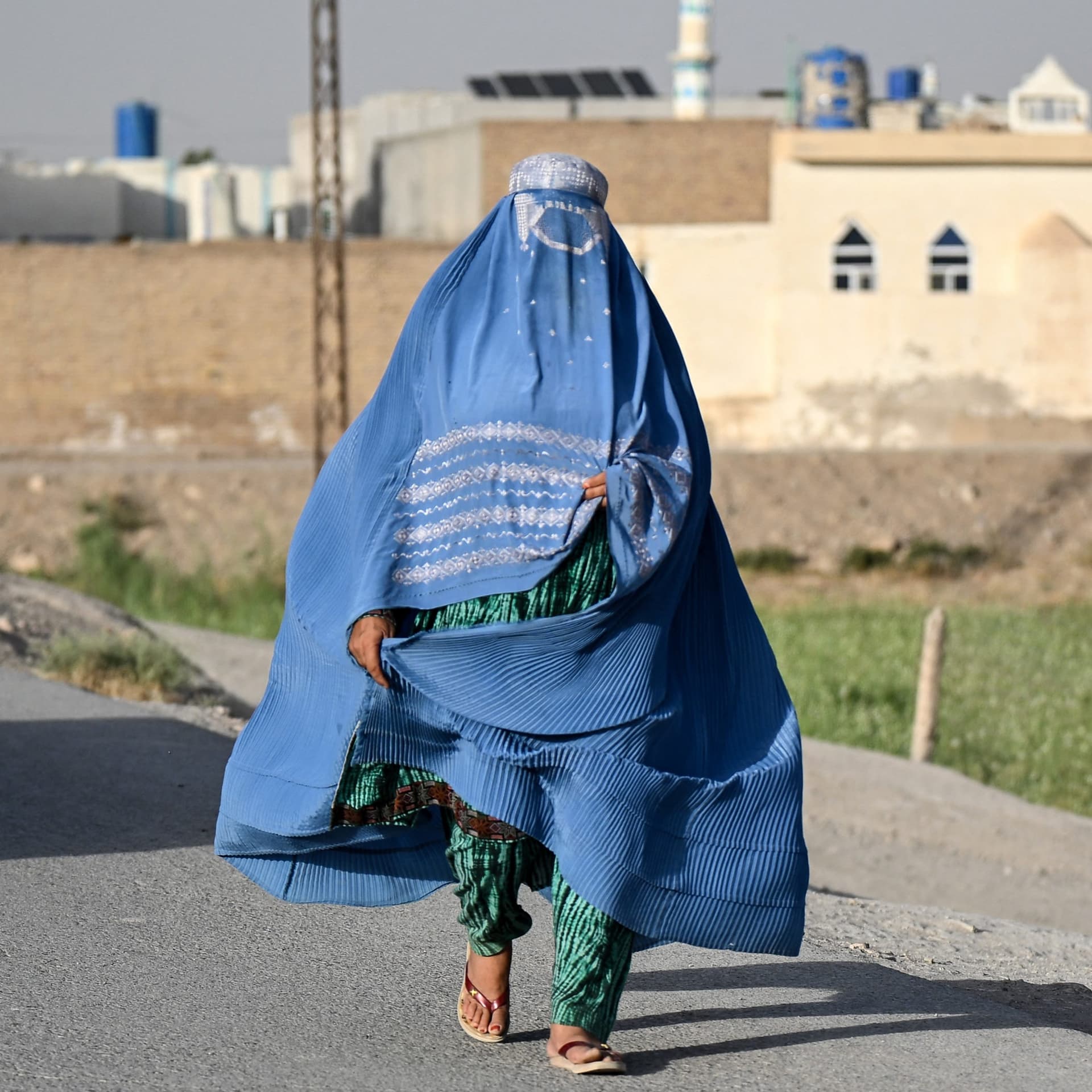
Photo: An Afghan burqa-clad woman walks along a road at Kolcha Abad village in the Dand district of Kandahar on June 16, 2026. Credit: Sanaullah Seiam/AFP via Getty Images.