
In short
The BBC Global Story episode examines whether the Trump administration is putting U.S. free press at serious risk by tightening White House access, including banning CNN, MSNBC (MSN/“MS Now”), and Politico from White House grounds; it also discusses how such curbs echo globally.
Guests and backgrounds
Jason Rezaian, former Washington Post bureau chief in Tehran (Iran affairs), jailed 544 days; now Washington Post Director of Press Freedom Initiatives and host of Freedom Desk. Asma Khalid, former White House correspondent and part of the White House press pool.
Key claims
Limiting press access threatens democracy and the First Amendment; access is a right of the public to information, not a privilege. The White House took over the press pool rotation (starting last February), and the bans fit a broader pattern (including an AP restriction over “Gulf of America” naming).
Notable examples
Rezaian’s avocado Kickstarter leading to imprisonment; accreditation suspensions in Iran; Rubio’s “not closing CNN” framing; Asma’s “Trump TV” still missing journalists’ questions.
Written by AI. May contain mistakes. Listen to the episode to check what was said.
Chapters
Tap a time to open that second in VOTensions Between Trump and the Press
0:49 to 2:06
Discussion on Trump's interactions with journalists and press freedom.
“I'm surprised that CNN is here covering me.”
Introducing Jason Rezaian
2:06 to 2:39
Introduction of journalist Jason Rezaian and his background.
“spent years reporting from the White House and serving as part of the so-called press pool.”
The Avocado Kickstarter Project
2:39 to 3:47
Jason shares his unique experience with a Kickstarter project in Iran.
“And he believes that any attempt at limiting the freedom of the press, however big or small, is dangerous for democracy.”
Imprisonment in Iran
3:47 to 6:05
Jason recounts his imprisonment and the surreal experiences he faced.
“You can get avocado toast in London, right?”
Accreditation in Journalism
6:05 to 8:31
Discussion on the importance of press accreditation and its implications.
“I spent seven weeks in solitary confinement.”
Press Freedom Under Obama
8:31 to 11:43
Exploring press freedom issues during the Obama administration.
“So this was the tail end, wasn't it, of the Obama presidency.”
Current Press Restrictions
11:43 to 14:00
Discussion on recent restrictions on press access under Trump's administration.
“Where were you when you found out that this had happened?”
Access to the White House: Right or Privilege?
14:00 to 21:41
The discussion centers on whether access to the White House is a privilege or a right, highlighting its implications for democracy and information access.
“They're just not allowed to work from the workspace at the White House.”
Impact of Press Restrictions on Democracy
21:41 to 22:20
Asma Khaled discusses the implications of recent press restrictions during the Trump administration and their effect on journalist access and public knowledge.
“It's been great talking this through with you.”
Podcast Recommendations and Closing Remarks
22:20 to 28:00
The hosts wrap up the episode, providing information about their sister show and credits for the production team.
“After that fascinating discussion with Jason, I'm pleased to say we have somebody else who knows this situation very well that we're going to be able to call on.”
Transcript
Automatic transcript. May contain errors.0:00This BBC podcast is supported by ads outside the UK.
0:30Listen to Choiceology at schwab.com slash podcast or wherever you listen. Odoo, providing tools for businesses across industries into one fully integrated platform. Whatever your business needs, Odoo is committed to providing it. Learn more at odoo.com.
0:57So it's an honor to be here. I'm surprised that CNN is here covering me. You shouldn't be here. You should not be here covering me. That's President Trump speaking at the UN General Assembly in New York on Tuesday. He's talking to Caitlin Collins, who's a reporter from CNN. You said you weren't going to cover me. You shouldn't be covering me. But I will tell you, it is an honor to be at the Internet. Now, this kind of tension between President Trump and journalists isn't new. But it's ratcheted up since last week when the White House banned CNN, along with Politico and the MS Now network from the White House grounds.
1:34The ban's been challenged in court, but the episode is being seen by some as a threat to press freedom with consequences that could be felt not just in the United States. From the BBC, I'm Tristan Redmond in London. And today on The Global Story, how did press relations in the White House get so tense? And why curbs on journalistic freedom in Washington could be felt around the world?
2:05Now, as you may know, our very own Asma Khalid spent years reporting from the White House and serving as part of the so-called press pool. And she has a fascinating insight from behind the scenes on all of this. I think it's enormously significant and we all ought to be paying attention to it. We're going to be speaking with Asma a little bit later. But first, we'll hear from Jason Rezaian of The Washington Post, who spent more than 500 days in jail for his journalism. Jason is now director of press freedom initiatives at The Post and host of the new podcast Freedom Desk. And he believes that any attempt at limiting the freedom of the press, however big or small, is dangerous for democracy.
2:47So we're talking with you, Jason, because you come at this story of what's happening in Washington right now with a very specific perspective. And that all goes back to your time working for The Washington Post in Tehran. You were the Washington Post bureau chief there covering Iranian affairs. And when you were there, you encountered something of an extreme version of what the curtailing of journalistic freedom can look like. And we want to get into that with you today. So where does it all start for you? Look, it starts with a dream to help illuminate the land of my father and my ancestors through a tale about what it might take to bring the sacred avocado to Iran.
3:33Why did you want to bring avocados to Tehran? Look, I was born and raised in California. I had the opportunity to benefit from this wonderful and delicious superfood all throughout my life. And one of the most shocking things about living in the Islamic Republic was that this magical fruit that had become omnipresent. You can get avocado toast in London, right? You can get it in Sri Lanka. You can get it in South Africa. At the time, you couldn't get it in Tehran. And it seemed like I needed to uncover why that was. And, you know, people laugh at that. But the idea was really to show the ways that blanket sanctions on an economy affect life in a country that's living with it.
4:26But how did you go from trying to get avocados into Iran to then sitting in a cell at the pleasure of the Islamic Revolutionary Guard Corps? I put up a Kickstarter project in 2009 as a way to just make a point. And that Kickstarter project failed to get funded. And I forgot about it. And it became sort of a talking point that made folks laugh or think about Iran in a different kind of way. And then five years later, my wife and I were preparing to leave our apartment to go to a surprise birthday party from a mother-in-law. And agents of the Revolutionary Guard Corps' intelligence service were waiting in our building's garage to ambush us and take us to prison.
5:19One of the first questions that I was asked in my initial interrogation, minutes into being taken to Evin Prison, was about this Kickstarter project. They thought that the avocado Kickstarter that I had started was some sort of secret CIA plot to overthrow their government. And if you think that that sounds ridiculous as a story, it sounded even more ridiculous as an accusation. And behind a blindfold, being threatened with life in prison or execution, it made me laugh because it was ridiculous. And the ridiculousness lasted for another 544 days. I spent seven weeks in solitary confinement. My wife spent about 10 weeks in solitary confinement until she was ultimately released on house arrest.
6:22My wife is also a journalist. I was interrogated relentlessly, deprived of sleep and medical attention and basic sustenance. And so it was a treacherous, horrific situation to kind of live through.
6:44Okay, so, I mean, there is a spectrum of curtailments of journalistic freedom. Your experience there is at one end of it. By comparison, a question of accreditation or not accreditation, essentially a badge with your face on it that gives you permission to get into a building, seems fairly petty by comparison. But did you ever have experiences in Tehran where accreditation was used as a stick to beat you with? Yeah, many times. To work in Iran as a journalist, you have to have accreditation from the state. They don't give that out easily. Once you do have it, you're always subject to losing it, having it suspended, canceled.
7:30I can remember many situations before we were arrested where my accreditation was suspended for weeks at a time, months at a time. I remember very vividly visiting the foreign press office in Tehran once when my accreditation was suspended and the director of the office welcomed me into his office and said, you're here to ask about your accreditation and why we suspended it. And it was either because you crossed over one of our ever-changing red lines in your coverage, or you did something to threaten our national security. And at this moment, I can't remember which one it was. It's a very arbitrary situation, confusing by design, right?
8:23And I think with the intention of making journalists question the kind of coverage they want to do. Well, you were released in 2016 and you traveled back to the United States. So this was the tail end, wasn't it, of the Obama presidency. His administration was involved in the negotiations which led to your release. I'd imagine from your perspective, you're probably quite grateful for that. But by the time you arrived back in the United States, the Obama administration had been facing some accusations that it had acted to curtail press freedom itself. There were accusations, for example, that Fox News had been temporarily prevented from participating in a pool interview at the White House.
9:13The administration rolled back on that. There were accusations, particularly aimed at the Department of Justice, that it was pursuing journalists both from the New York Times and from Fox News in leak cases with questions over who their sources were. What happened during the Obama administration? And how did that look to you as somebody who spent more than 500 days in prison in Tehran thinking about the question of press freedom? You have to go back to America before and after September 11, 2001, right? How the US government across multiple administrations, Democratic and Republican, started to view not just the press, but also sources of potentially sensitive information or uncovering sensitive information.
10:06You know, whistleblowers, people like Edward Snowden and others. The rolling back of press freedom has been going on for a long time, right? But I don't think that, you know, the Obama administration, the Biden administration, W. Bush administration are particularly shrouded in glory in any of this. I mean, how serious, from your perspective, were the allegations against the Obama White House? I mean, in retrospect, compared to what we're looking at right now, not that serious, right? Go on. Well, I mean, you know, we're in a situation now where the President of the United States actively on a daily basis calls journalists or the work that we do, fake news.
10:47And you never heard Barack Obama say something like that. Donald Trump supporters might say that Donald Trump's calling journalists fake news, those are words, and that the Department of Justice under Obama actually pursued an investigated journalist in some cases. Isn't that a more serious issue as far as press freedom is concerned? I think that they're both serious issues. I mean, I think that that set a bad precedent. Any moves to investigate, especially around sources, is setting a bad precedent. And I don't think that I want to get into a position where I'm comparing and contrasting who's better, who's worse.
11:27I mean, we should be allowed to do our jobs without fear or favor, regardless of the administration. And this decline in access has been going on for a quarter century. And I think it's just going to continue. Well, let's talk about the moment of those denial of accreditation to these three networks, CNN, MSNOW and Politico, who had their accreditations withdrawn. Where were you when you found out that this had happened? And what was your response? I've been asking people a similar question the last couple of days here at the United Nations General Assembly. Did you ever think that this was going to happen?
12:08And I asked a Nobel Prize winner, Maria Ressa, who is from the Philippines and is one of our staunchest press freedom advocates in the world. and you know the response in most cases was any other president it would be a big surprise with this president you sort of expect it in maria's case she told me you know what we told you this was going to happen we who have been you know living in places that use this anti-press playbook have been telling you for years that that these sorts of things will happen is this a part as an issue or is this above politics? I mean, some people might say, oh, well, you know, they might make assumptions about what your own political beliefs are and say, of course, you criticize the government for doing things like this.
12:53This is the United States of America, right? If you believe in the Constitution, then you believe in the First Amendment. The First Amendment guarantees the freedom of expression and belief and the freedom of people like you and me to have a conversation like this without having to be concerned about whether or not we're going to get locked up in prison. And that is what is at issue right now. It's absolutely not a partisan issue. This is literally the founders of this country that got to work 250 something years ago, decided 13 years later that the first thing that they needed to memorialize forever was our ability to freely express ourselves.
13:36Well, the White House and Donald Trump's administration have responded in various different ways over the last few days. And I'd be very interested to hear your response to their response, Jason. So let's listen to what they had to say. So Marco Rubio said to NBC on Wednesday, we're not closing CNN. There aren't a bunch of police officers or soldiers kicking down the doors of MSNBC or MSNOW, whatever it's called, and arresting people and unplugging it from the grid. They're just not allowed to work from the workspace at the White House. And then on Tuesday, court filings obtained by the New York Times showed that the White House position on this said, access to the White House is a privilege, not a right.
14:22I'd like to ask you about that one particularly. Is access to the White House a privilege, not a right? Look, I don't think that anybody, and I'll tell you this from experience, You can't just walk into the White House anytime you want. But those organizations that are in the pool pay for that right. I do think it is a right. And it's a right of the American people to have that sort of access to information to what goes on in our halls of power. And without it, we are being denied our rights. And I think some folks want to frame this as an issue of people not being able to do their job. That job is designed to inform the public so it can understand what's happening, not just with decisions made by elected officials, what happens with our tax dollars, and so much else.
15:17And to the statement that Secretary of State Rubio made, I can tell you, when I was sitting in a prison cell in Iran, Marco Rubio was one of many, many people who wore a hashtag Free Jason pin on his lapel. He has been a vocal advocate for political prisoners and freedom of expression around the world. He has stood up for the rights of the Cuban people in ways that I think are very personal to him. He's stood up to the political repression in places like Iran and has sort of staked his reputation on that. If you stand for those things in the most repressive societies in the world, you have to stand for them in the United States of America where you're one of the top officials.
16:11And so I think it would be beneficial to the future of our democracy for people like Secretary of State Marco Rubio to really uphold the basic tenets of America and not bend because it's potentially to their political boundary. What he's saying there, Jason, is kind of interesting because without naming you, and he's probably not doing this consciously. He's not talking about me. I mean, there's a thousand of us. But he's referring to a situation that happened to you, isn't he? He's saying there aren't a bunch of police officers or soldiers kicking down the doors, arresting people, which is what happened to you.
16:51But are you saying that there is a continuum from withdrawing someone's accreditation to what happened to you? Yeah, in the same way that there's a continuum between 544 days that I spent in prison and the many years that someone else spent in the same prison. And if your argument is, well, it's just not that big a deal because there's worse happening out there to other people in your line of work, it doesn't bode well for your upholding of democracy. Well, okay, let's move on to a couple of other ones. The vice president, J.D. Vance, said... We have to remember those three outlets account. About 92 % of the stories that they have on the president of the United States, on the administration, are negative.
17:37That's not representative of the American people. It's not representative of public opinion. So if you're going to engage in what is effectively far-left propaganda, why would a Republican White House give you special access? He said the move was about basic fairness. MSN, CNN, Politico are as mainstream as it gets. You say that, but MS now actually employs a former White House spokesperson who worked for President Biden, who was an opponent of Donald Trump. So is it arguably unhelpful in the current climate where there is this adversarial nature to politics that a journalistic outfit, which is supposed to be considered impartial, is hiring a former political operative in that way?
18:28I don't think so. I mean, I think if you look at your newspapers in the UK and your television stations in the United States, Jen Psaki is not the only former high-level official that has media outlets and platforms available to her. There's many of them, right? But, you know, once you're out of government, if you want to take a job and be employed by a media organization or a think tank or a law firm or a hospital or whatever, you know, a major league baseball team, it's your right to do that. OK, the Global Press Freedom Index is published every year by Reporters Without Borders. The United States right now is not very high on that list, Jason.
19:13It's its 64th position. Just under Botswana and just above Panama. It's below Liberia. It's below Moldova. Whoa. Now, Moldova, the BBC did some reporting within the last couple of years in which it uncovered evidence of money changing hands in exchange for votes in Moldova. The United States is below Moldova on that list. What do you make of that? How surprised are you that those countries are above it? I think I'm less surprised than most listeners will be because I've been tracking this for several years. That index in particular takes many things into account. Some of the things that we're talking about today, access to government, to the halls of power, but also things like local news representation in regional spaces.
20:07America is a vast country, right? And more and more local newspapers, television stations, radio outlets have closed in recent years and are closing. You know, in some smaller countries and newer democracies, they've done a much better job of not just protecting the notion of absolute press freedom, but have come up with models of local news that are more economically sustainable. And I think if you look at the top of the list, obviously the Scandinavian countries are right up there every year and have very strong commitments to press freedom. But also, several countries, there are former satellite states, Soviet Union, right?
20:51Estonia, former Republic of the Soviet Union is number three. And I had the opportunity to interview a previous prime minister of Estonia a few years ago, and I asked him about that. And he told me that we were a very free country before we became part of the Soviet Union. And we are on the front lines of this. We're on the border with Russia. We've been dealing with their misinformation and disinformation for decades. And we're a very small country that's interconnected and everybody sort of knows each other. And this is a value that matters to us. and I think I'd like to see the United States of America get back to that.
21:40Jason, thank you so much. It's been great talking this through with you. My pleasure. Thanks, Tristan.
21:52John Deere is putting in work and putting up highlights. Oh man, look at those passes. Tillage, planting, harvesting. Three years in and these pre-owned machines are still at the top of their game. We're talking reliability, performance and long-term potential. And get this, these veteran machines can pick up the latest precision tech with ease. You know it and fans ready to add John Deere certified pre-owned equipment and more options to their lineup can shop at machinefinder.com. Booyah!
22:23After that fascinating discussion with Jason, I'm pleased to say we have somebody else who knows this situation very well that we're going to be able to call on. And she's somebody that you also know very well. She's our very own Asma Khaled. Hello, Asma. Hey there, Tristan. Asma used to be, as many of you know, a White House correspondent and has seen this whole setup and situation from the inside. So Asma, I really wanted to ask you, do you think that the current situation is a storm in a teacup, journalists worrying about journalists and journalism? Or do you think this is something that we need to pay attention to?
23:06I think it's enormously significant and we all ought to be paying attention to it as Americans and those who live beyond the borders of the United States. And to me, it builds upon this escalation we've seen from the Trump administration. since Donald Trump returned to the White House in this second term. You might hear people sometimes refer to something known as the White House press pool. And I think it's helpful to just explain what that is. The pool is an organization that was set up by a number of journalists to help us cover the White House. You can't have every journalist come in with all their camera equipment, all their audio gear.
23:42And so over the years, we as journalists, members of what's known as the White House Correspondents Association, we have decided over the years that we collectively as journalists are going to decide how it is best to cover the White House. There's a rotation amongst us. We share notes with each other. But what changed, Tristan, last February is that the White House decided it was going to take over this duty, that the Trump administration would determine which news outlets would be in this rotation. That made a lot of us journalists really nervous, Tristan, because that was the government determining which news outlets ought to be present for a given moment.
24:19And that's just not the way that things have normally been covered. And the reason I think this is so significant and really troubled a number of journalists is it came on the heels of a really controversial move this White House took, which is that they banned journalists from the Associated Press in 2025 from entering meetings in the Oval Office, other events that the president was having, because the Trump administration was upset that the AP refused to change its styling conventions and name the Gulf of Mexico the Gulf of America. So it's in the context of those two major events, blocking the Associated Press from covering the president of the United States, you know, limiting their access to covering the news, and then also subsequently taking over the pool that I think makes a lot of journalists really nervous.
25:08And then this third event, which we, you know, you all were talking about with barring CNN, MS Now and Politico, it comes in a continuation of this pattern. And these are all new things. And I would argue, Tristan, I've never seen them in my years of covering the White House, in my years of covering politics. Okay, so you've seen a kind of deterioration of the way it all works within the pool. Where does it go from here, Asma? I don't really know where it goes, Tristan. Look, in this specific case of the three news outlets that have been banned from the White House grounds, there is a lawsuit.
25:43And there was a hearing just yesterday. And so you can imagine this is going to get tied up in legal litigation, much like we've seen with the case of the Associated Press. OK, Asma then. But if you are a voter, an American sitting at home thinking about, OK, how does this actually affect me? Like, how is this going to stop me from knowing what Donald Trump is doing on a given day, seeing the pictures of him, the photos, hearing his voice? What does this actually change for them? Well, look, the Trump administration has created this Trump TV. So you'll be able to continue to see the images and perhaps the speeches that the president delivers.
26:25But what I think you miss are the questions that the press is able to ask. I mean, Tristan and I have been able to, on countless times in a cabinet meeting under the wing of the airplane, shout a question at the president of the United States. Ask them about rising cost of groceries. Ask them about the situation at the border. You know, ask President Biden, for example, what happened to his commitment to be a bridge candidate and only run for one term. Those are, in my view, really important questions to ask. And so, yes, you can have the images, you can have the voice, the words of the President of the United States issued out on a streaming service.
27:07But it is important to have journalists asking those questions.
27:17Thanks so much, Asma. It's really great to hear your view from the inside. I'm glad we're covering this story. I think it's really important.
Read the full transcript
27:28And that was our very own Asma Khaled. And earlier on, we heard from Jason Rezaian, Director of Press Freedom Initiatives at The Washington Post and host of the new podcast, Freedom Desk. We'd love to hear your thoughts on the episode. As always, our email is theglobalstory at bbc.com. And before we head off, I just want to give you a reminder about our sister show, The Global News Podcast. here at The Global Story. We do one deep dive story every day where the world and America meet. But The Global News Podcast brings you the very latest news headlines from around the world. It's a great listen.
28:04I listen every morning to catch up and you can find them wherever you get your podcasts. And that's it from us for today. The episode was produced by Zandra Ellen and Kat Farnsworth. It was edited by Martine Powers and mixed by Travis Evans. The digital producer was Sam Gruet. Our studio manager is David Evans. Our senior news editor is China Collins. And I'm Tristan Redman. See you tomorrow. Thanks for tuning in. Cheerio.
28:41Welcome to the Haunted Library. Have you come in search of a tale? This podcast invites you to browse the shelves and find stories that will linger long after you've left this place From gothic masterpieces to pulpy penny dreadfuls Join me, Colin Morgan, with new episodes twice a week Find The Haunted Library wherever you get your podcasts
From the publisher
Last week, President Donald Trump barred CNN, Politico and MS NOW from the White House, accusing them of spreading "fake news". After their reporters had their press passes revoked and were denied access to the building, the three outlets launched a joint legal challenge, arguing that the move was unconstitutional.
How unprecedented is this decision? And how does it compare with the treatment of journalists in other countries around the world?
Jason Rezaian, host of the Washington Post podcast Freedom Desk and the paper's former Tehran bureau chief, has a unique perspective on these questions. While reporting from Iran, he experienced restrictions on press freedom and was ultimately imprisoned by the regime. Since his release, he has become a prominent advocate for press freedom around the world.
He joins The Global Story’s Tristan Redman to discuss where President Trump's decision fits into a broader pattern in the relationship between political leaders and the media over recent decades.
Producers: Xandra Ellin and Cat Farnsworth.
Executive producer: Martine Powers
Mix: Travis Evans
Digital producer: Sam Gruet
Senior news editor: China Collins.
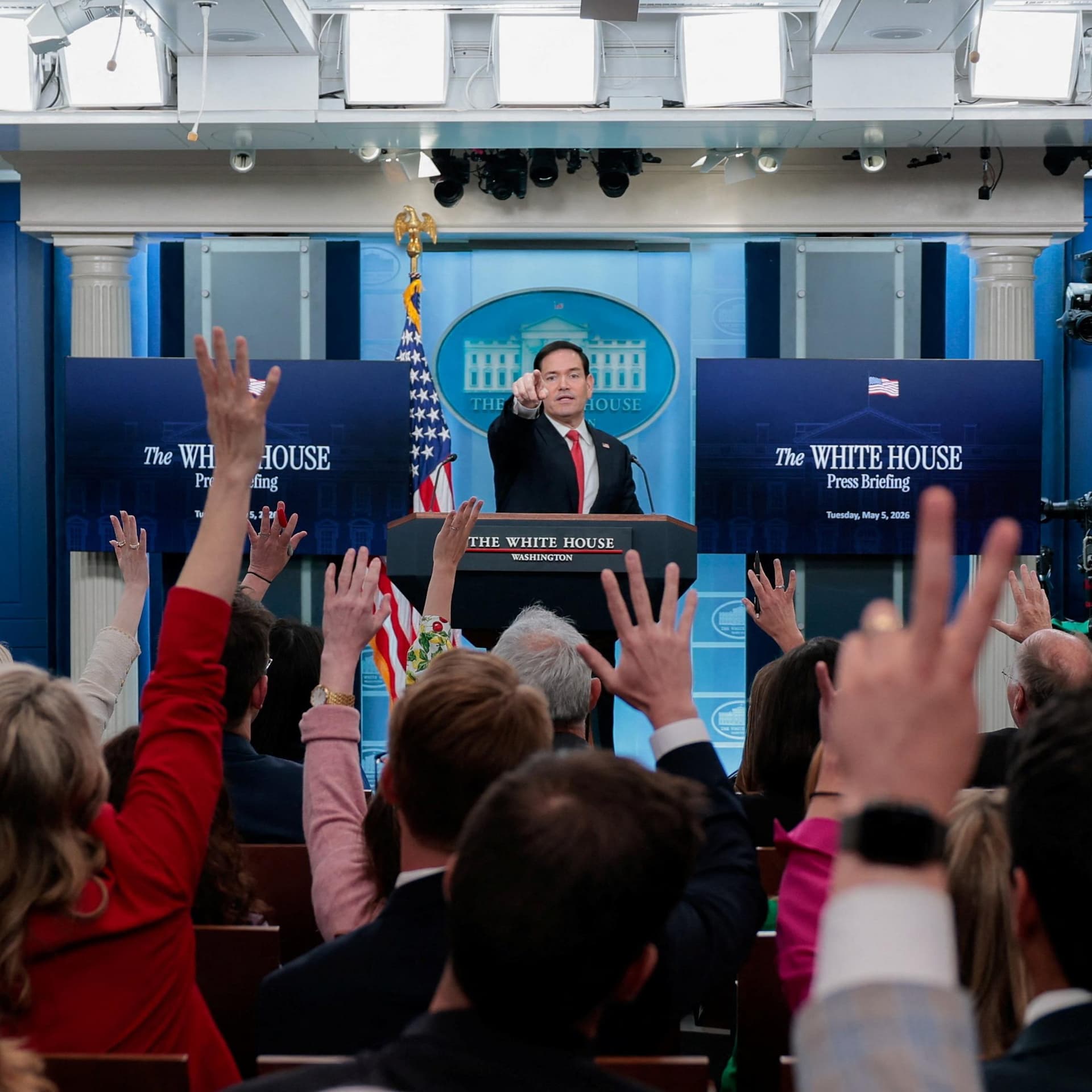
Photo: US Secretary of State Marco Rubio points as members of the media raise their hands during a press briefing at the White House in Washington DC, May 5, 2026. Credit: Kylie Cooper/Reuters.