In short
Whether Cuba is “next” for U.S.-driven pressure after Venezuela’s Maduro was removed, focusing on Trump’s warning to cut off Venezuelan oil to Cuba and the Cuba–Venezuela alliance.
Guests
Will Grant, BBC Central America correspondent; spent years reporting in Cuba and on U.S. attempts to undermine Castro.
Key claims
Trump (with Marco Rubio as key architect) aims for regime change in Cuba by end of year; Cuba has relied on Venezuelan oil (about 100,000 barrels/day under Chávez–Castro, later ~35–40,000) plus other suppliers; Cuba’s security/intelligence support to Venezuela included bodyguards and interrogation of dissidents; Cuban soldiers were killed in the U.S. operation against Maduro (32 of ~100 dead were Cubans).
Notable examples
Cuban state funeral in Havana for returned soldiers (Raúl Castro and Díaz-Canel present); protest outside the U.S. embassy; Obama’s 2016 Cuba thaw and its rollback under Trump; Cuba’s blackouts, dengue/chikungunya, and falling tourism.
Written by AI. May contain mistakes. Listen to the episode to check what was said.
Chapters
Tap a time to open that second in VOUS Warnings to Cuba
0:38 to 1:40
Discussion on President Trump's warning to Cuba regarding oil shipments.
“Before the dust had even settled on Venezuela and the United States' surprise capture of Maduro, President Trump began setting his sights on another target.”
Historical US-Cuba Relations
1:40 to 3:45
Exploration of the long-standing contentious US relationship with Cuba.
“According to insiders who've spoken to The Wall Street Journal, Trump wants to force regime change by the end of the year.”
Cuba-Venezuela Connection
3:45 to 5:50
Insight into the military and economic ties between Cuba and Venezuela.
“and about Cuba's connections to Venezuela.”
Aftermath of Maduro's Fall
5:50 to 7:22
Discussion on the implications of Maduro's removal and Cuban involvement.
“There was a third dimension to that, though, of course, which was intelligence officers' support, particularly in the wake of an attempted coup on Hugo Chavez in 2002.”
Cuba's Reaction to US Actions
7:22 to 10:00
Description of Cuba's public mourning and official responses to the fallen soldiers.
“Well, considering that 32 of the 100 or so people who were killed in the U.S.”
Obama's Historical Visit to Cuba
10:00 to 13:20
Reflecting on President Obama's visit to Cuba and the hope it generated.
“It was a moment of pride, a moment of honour.”
Cuba's Hopeful Moments Post Obama
14:00 to 15:51
Explore the hopeful sentiments in Cuba after changes initiated by Obama.
“And the tears down the cheeks of people watching, you know, that will never leave me.”
Marco Rubio's Political Influence
15:51 to 19:36
Discuss the role of Marco Rubio and the implications for Cuba's future.
“He is a Florida man to all intents and purposes, and he's listening very closely to Marco Rubio.”
Cuba's Current Crisis
19:36 to 24:47
Analyze Cuba's dire economic conditions and societal challenges.
“I think that when it comes to Marco Rubio's personal goals, it is equally about Havana as it is about Venezuela, if not more so.”
Potential for Change in Cuba
24:47 to 26:58
Examine the potential outcomes for Cuba's government and society.
“But if it can't fulfill its side of it and not even keep the lights on, then people are beginning to lose faith in huge numbers.”
Transcript
Automatic transcript. May contain errors.0:00This BBC podcast is supported by ads outside the UK.
0:30Just tap into iHeart to start watching. And we hope you enjoy the show.
0:38Before the dust had even settled on Venezuela and the United States' surprise capture of Maduro, President Trump began setting his sights on another target. President Trump issued a warning to Cuba, a close ally of Venezuela, that it is now cut off from Venezuelan oil shipments. Writing in a post on Truth Social, the U.S. president says, Cuba lived for many years on large amounts of oil and money from Venezuela. There will be no more oil or money going to Cuba, zero. I strongly suggest they make a deal before it is too late. Cuba, one of the U.S.'s closest neighbors and one of Venezuela's closest allies.
1:16American presidents have long criticized the Cuban government, imposing sanctions and travel restrictions on Havana that have dented the economy and deterred tourists. But now, with Maduro gone, some say the Trump administration is emboldened to go further than before and bring about the end of the Cuban regime. And Cuba literally is ready to fall. And you have a lot of great Cuban-Americans that are going to be very happy about this. Are you considering U.S. action in Cuba? We're not going to. I think it's just going to fall. According to insiders who've spoken to The Wall Street Journal, Trump wants to force regime change by the end of the year.
1:54From the BBC, I'm Asma Khalid in Washington, D.C. And today on The Global Story, is Cuba really on the brink, ready to fall?
2:13At the heart of the Trump administration's issue with Cuba is really the heart of Washington's ongoing issue with Cuba. Will Grant is the BBC's Central America correspondent. He's spent years reporting in Cuba, and he's seen how successive U.S. governments have affected life there. Basically, they don't like a communist-run government 90 miles off the coast of Florida. They've never liked a communist-run government 90 miles off the coast of Florida. They've tried to remove a communist-run government 90 miles off the coast of Florida many, many times in different guises through CIA-planned attempts on Fidel Castro's life, the late leader of the Cuban Revolution.
2:52Hundreds of those were planned and several were attempted to squeezing the island through the US economic embargo for six and a half decades, putting punitive measures on everything from companies that might want to send food and medicines to Cuba, to even British and European tourists who visit Cuba. So there's a whole series of things that Washington has done since 1959, essentially to force regime change in Cuba. Of course, Donald Trump in his second administration with Marco Rubio as his secretary of state, it looks like they really do intend to see some form of regime change, some kind of permanent shift in Cuba off the back of what's happened in Venezuela.
3:38Will Grant:As you say, the U.S. relationship with Cuba has been contentious for a long time. But it does seem, at least here in Washington, that we are hearing a lot more about Cuba and about Cuba's connections to Venezuela. We've heard President Trump refer to Cubans as being the protectors behind the Venezuelan government. And one thing that caught my eye when the United States captured Venezuela's leader, Nicolás Maduro was that there were a number of Cuban soldiers who were killed in that operation. They were protecting Maduro. And we'll have a lot of questions here, but why would there have been Cubans protecting Maduro?
4:17That idea was cooked up between Hugo Chávez, the late Venezuelan leader, and Fidel Castro, the late Cuban revolutionary leader. Part of the relationship, the bilateral relationship between Cuba and Venezuela is built on intelligence officers and soldiers, military support. Now, the Cubans had denied that. They said that basically the arrangement was that crude oil would come to Cuba and prop up the Cuban revolution and doctors would go back in the other direction.
4:50Will Grant:So crude oil would go from Venezuela to Cuba. How much oil has Cuba been getting from Venezuela? Well, it was much higher when Hugo Chavez and Fidel Castro struck up their relationship. It was in the region of 100 ,000 barrels of oil a day. Gradually over time, and with the fall of the global oil price, Venezuela hasn't been able to provide those kind of numbers. And it's reduced to more like 35, maybe 40 ,000 barrels of oil a day, much, much less, but when combined with what Cuba gets from Mexico and from Russia, enough traditionally to be able to keep the lights on, but not recently. And in return, they would pay for that with human capital in the form of doctors and medics and healthcare workers who would work in the poorest parts of the country.
5:40The two of them came up with that idea, and it was basically the mainstay of the economic relationship between the two socialist allies until this point. There was a third dimension to that, though, of course, which was intelligence officers' support, particularly in the wake of an attempted coup on Hugo Chavez in 2002. I think from there on, there was more of a role for Cuba, because basically Cuba's know-how, in terms of what Venezuela wanted to achieve, or the Venezuelan government wanted achieve how to stay in power, how to remain in power for six and a half decades without allowing elections that will get in the way.
6:24You can have elections, but ultimately, you know, you're the only kind of choice on the table that you will not be forced out either through democratic elections or somebody in the military turning on you. That basically you can ideologically shift the entire nation to deal with you being in the presidency, you know, for good.
6:43Will Grant:And so part of that intelligence sharing involved actual physical bodyguards. On the ground, protecting Nicolas Maduro. So he, as a disciple of Fidel Castro's, the Castro brothers, was very much part of the same equation that Fidel Castro and Hugo Chavez created. It was rumoured that he actually trusted Cubans more than his own countrymen, and that he bought into the Cuban vision of a socialist nation completely. The other things they did was advise on rushing dissent, quite frankly. There's reports from people who were held in detention, dissidents and journalists, that when they were held in a very notorious detention center in the center of Caracas called Dele Licoide, that they were interrogated by people with Cuban accents.
7:37Throughout this entire period, against those sorts of allegations and against the allegations that Cuban soldiers were infiltrated in the military at absolutely every level, the Cuban government denied them, said that they weren't there, that it was an invention by Washington, that it simply wasn't true. Well, considering that 32 of the 100 or so people who were killed in the U.S. operation in Venezuela were Cubans. They simply had to acknowledge that they were there. And it's sort of exposed that it was true that they had people on the ground in Venezuela and had done for years.
8:11Will Grant:So, Will, you were in Havana, the capital of Cuba, recently, as those soldiers' remains were brought back and put on display, essentially lying in state, right? They were honored by the Cuban government. What was the scene like there in Cuba as you were there reporting? It was truly extraordinary. I mean, Raul Castro, who makes very few public appearances now, was there to receive them at the airport, aged 94. Standing next to him, President Miguel Díaz-Querne, to full military honors, as you say. The boxes were taken from the plane, and loaded into a funeral procession that then drove into Havana.
9:02To the Ministry of the Armed Forces, the streets were completely lined with a combination of those who were obliged to be there, soldiers, cadets, state workers, and those who wanted to pay their respects. The vast majority of the route from the airport to this ministry will have had people along the way. an extraordinary moment because Cuba hasn't lost this number of combatants in a one-on-one battle with the US military, as far as I can see, since the start of the Cuban Revolution. The only point that we can compare it to is the Bay of Pigs in 1961. But that was Cuban exiles who were trained by the CIA and brought to the coast of Cuba to basically try and take back the island.
9:46That failed. But in a direct fight like this, with 32 combatants killed and none on the other side, it was a very sobering moment, a very almost humiliating moment in a sense for the Cuban Revolution, except they certainly didn't paint it like that, as you'd expect. It was a moment of pride, a moment of honour. The words next to each of these boxes with the photo of the respective soldier were the words honour and glory, as they basically tried to give the impression of that that these men were fighting to the last and that their operation in Venezuela was an honorable one, that of defending a brother nation from U.S.
10:23aggression.
10:24Will Grant:So will you say prior to Maduro's ouster, the Cuban government had not in an official capacity really recognized that they were providing this intelligence protection service? Now, at this moment, what's happened to the rest of the Cuban security intelligence operation in Venezuela? Are they still there now that Maduro has been ousted? We don't know exactly in terms of numbers, but here's an anecdote that tells us quite a lot about where we are now. The next day, after these remains have returned, the boxes have cremated ashes. There is a protest outside the U.S. embassy led by President Miguel Díaz-Canel.
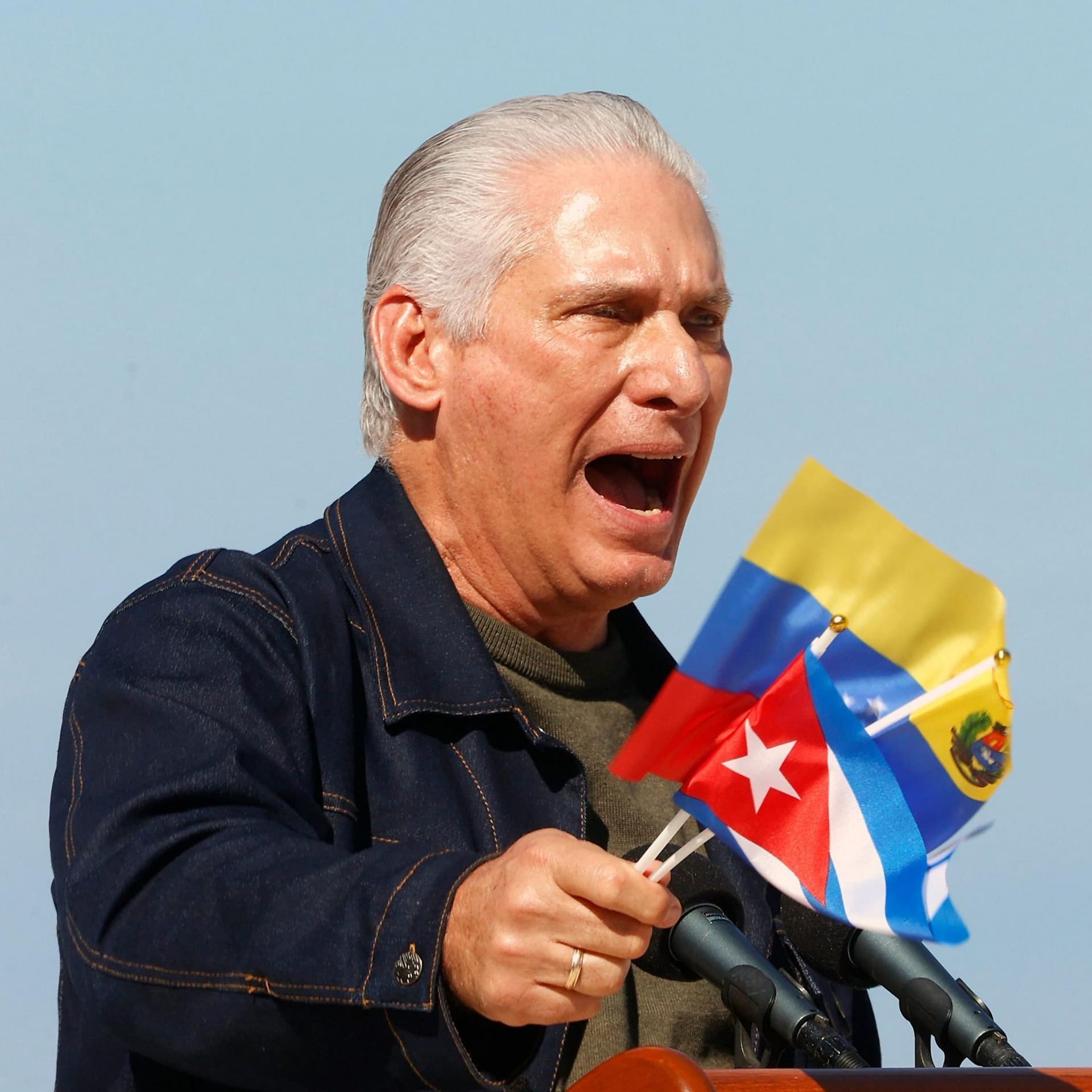
11:08He makes a fiery speech and then a whole slew of people walk past the US embassy, waving Venezuelan and Cuban flags and chanting about solidarity and cooperation to the death and so on. Now, as that was happening, we received on our phones confirmation that Delcy Rodriguez, the interim president in Venezuela, had met with John Ratcliffe, the director of the CIA in Caracas. A U.S. official tells us that Ratcliffe spoke to Delce Rodriguez about improving the country's working relationship and potential opportunities for, quote, economic collaboration. That, Asma, is extraordinary. She didn't meet with a distant diplomat.
11:54She didn't meet with the emissary from the White House, or she met with the director of the CIA less than two weeks after her boss has been removed by US troops. And I showed the information to a Cuban government official. And to say he went white is an understatement. Why? Because it indicates the suggestion that this is the direction of traffic from Caracas now, away from Havana and towards Washington.
12:24Will Grant:Well, Will, the United States relationship has been testy with Cuba for a long time, as we've said. But there was this period of rapprochement, you could sort of say, right, under the former Democratic President Barack Obama. When he came to office, he tried to ease the United States relationship with Cuba. In fact, I recall that moment when he visited Cuba with his family. This was 2016, I believe.
12:54It is history in the making. President Obama is about to land in Cuba. He and the first family took off for Havana aboard Air Force One around 1.30 p.m. Eastern time. Mr. Obama is the first sitting U.S. president to visit Cuba in nearly 90 years. We moved to Cuba just before the announcement, and I think we all thought that it really was the turning of a page. Thank you very much. To President Castro, the people of Cuba, thank you so much for the warm welcome that I have received, that my family have received, and that our delegation has received. It is an extraordinary honour to be here today.
13:42I mean, the words Obama used himself is that I come to bury the remnants of the Cold War in the Americas. Havana is only 90 miles from Florida. But to get here, we had to travel a great distance over barriers of history and ideology, barriers of pain and separation. And the tears down the cheeks of people watching, you know, that will never leave me. Watching that speech, watching the reaction of people, friends, family. So people in Cuba felt really hopeful at that moment. Extremely hopeful. Today, as the president of the United States of America, I offer the Cuban people El saludo de paz Young people felt that there might be a future for them on the island That they might be able to open businesses They might be able to come and go more freely That there would be university exchange programs That there would just be a modern, grown-up relationship Between these two old enemies So there was a lot of hope on the island The Rolling Stones played.
14:50There was dance music, concerts and things like that. Major laser playing on the Malecon. So many events. The NBA came. Hollywood were there, filmings, Fast and Furious. But of course, what was any of that meaning for the actual Cuban people? Were their daily lives getting better? Was the US economic embargo going to be lifted? And of course, we never got a chance to find out what else might have come because Donald Trump won the 2016 election and the whole thing fell like a house of cards because he was so thankful to the Cuban Americans, I think, for handing him Florida that I think it was his quid pro quo was to undo everything they didn't like in Cuba.
15:31Everything that Obama had achieved in Cuba in terms of building towards them, he unpicked, which might have been a personal thing, that he wanted to undo everything that Obama held up as achievements. But also, there was a sort of debt there to the Cuban-American vote in Florida. And only more so now. He is a Florida man to all intents and purposes, and he's listening very closely to Marco Rubio.
15:57Will Grant:You mentioned Marco Rubio, and I want to follow up on that, because here in Washington, there's been a lot of interest and curiosity in the Secretary of State and how perhaps his personal identity, his politics might be factoring into this all. Marco Rubio, who we all know, his family moved to the U.S. from Cuba, and his political identity as the son of Cuban immigrants has been central to his politics over the years. How much of an impact do you see Rubio having on what happens next in Cuba? I think he's absolutely key. I think he's essentially the architect of it. And it's clear that, as you say, this ties in to an existing political DNA for Marco Rubio as an ex-Florida senator, as a son of Cuban immigrants, Cuban exiles.
16:52It's deeply personal to him. Ultimately, the reality, the moment of truth is arriving. Cuba is literally collapsing, both generationally in terms of all the young people leaving, but it's also collapsing economically. They are now living on 20 and 21 hour rolling blackouts and some days longer because Marxism doesn't work, because they're corrupt and because they're inept. And I think that he sees himself as being able to affect change and end of the Cuban revolution and to create the conditions of, as it were, inverted commas, a free Cuba, the one that they always talk about in Miami. that vision of a free Cuba, i.e.
17:26one without a Castro in power, one without state-run socialism. I hope that they will choose the path of empowering the individual Cuban so that the individual Cuban has the ability to do with virtually every, the peoples of virtually every other country in the hemisphere have been able to do at least once in the last 60 years and some more than once, and that is elect their leaders, vote for their leaders. He has seen the roadmap to making the change in Havana possible through the removal of Nicolas Maduro, because that is how you turn off the tap of crude to Havana and then create the conditions by which the Cuban Revolution topples on its own.
18:08That is a big gamble, in a sense, because, as we've said, the one thing that the Cuban Revolution knows how to do is dig in its heels. I wouldn't expect to hear any public declarations of anything other than double down, hold fast, push back, hasta la victoria siempre, you know. But it will be extremely difficult to stay the course without being propped up by Venezuela and oil. This isn't happening in the context of a Cuba that was otherwise healthy and doing well and had the tourist numbers that you saw under Obama. The tourism has dropped off a cliff since that high point of the Obama era thaw, when it was around 5 million people.
18:47Now it's barely knocking on the door of two million and change. Cuba's lost so many of its young people over the last decade. There's been this exodus outwards. The population has dropped by two million people at least over the past five years. So the conditions getting worse, the young people leaving, the exhaustion of those who are still there. There's rolling blackouts, the length and breadth of the island. There are parts of Havana when I was there just now that were more often without power than with. That's food rotting in fridges. That's no fans or air conditioning to keep the mosquitoes at bay.
19:24There's an outbreak of chikungunya and dengue fever that is affecting people. So the island's in a really difficult place. Take away the Venezuelan oil on top of that. And then that's what Donald Trump is referring to, I suppose, when he says it's ready to fall. I think that when it comes to Marco Rubio's personal goals, it is equally about Havana as it is about Venezuela, if not more so. I mean, Donald Trump's joked about him being the next president of Cuba. We need to factor in the Cuban governments. You know, they're not just silent as all this is going on, but their options are narrowing.
20:04Because the basic lifeblood of the Cuban Revolution since 1999 has been Venezuelan oil. And if Washington is successful in turning off that supply of Venezuelan oil to Cuba, then the island is in deep, deep trouble.
20:51www.globalstory.com on the iHeart app. Catch every brand new episode every weekday. Just tap into iHeart to start watching.
21:00Will Grant:And we hope you enjoy the show.
21:08Will Grant:Well, let's talk more about this attempt to cut off oil and what that would mean. Because as you've said, Venezuela has been Cuba's main oil supplier for years. And the United States has been seizing oil tankers that are en route to Cuba. Could the current Cuban government survive without Venezuelan oil? They would argue very quickly, yes. They've been able to survive very, very dark periods in their past after the fall of the Soviet bloc and Cuba basically being isolated. But there was still some support in terms of energy coming from Russia at that point. Today looks bleaker because Russia isn't stepping into the breach, whether or not that's because of geopolitical forces between Putin, Trump and China, where the world is somehow being divvied up into spheres of influence.
21:57And I know you've talked about that on the program in the past. Putting that aside, who could step up? There's Mexico, I think. Claudia Sheinbaum, it's her inclination coming from the sort of intellectual Latin American left to support Cuba. She's sympathetic to its ideals, but she has her own headaches with Donald Trump in two obvious ways. The first is the renegotiation of the North American Free Trade Agreement, USMCA. That is up quite soon for renegotiation and is already being made clear that any support in terms of Mexican oil coming to Cuba has to be cut off or reduced to a minimum expression if the USMCA is to be signed.
22:41So she has that. Trump is also suggesting there could be unilateral military action in Mexico on Mexican cartels, which would be a huge problem in terms of diplomacy if he went on to do that. So she sort of needs to keep Donald Trump sweep herself. And if stepping into the breach of Venezuelan oil, you know, it's going to complicate matters, I suspect she wouldn't end up doing it. Will, I do want to hear from you because you have been on the ground reporting in Cuba about what people are feeling. I mean, it strikes me that Cuba occupies such a unique place in U.S.
23:20Will Grant:foreign policy mythology, right? You refer to it as being 90 miles off the coast of Florida. I too have been to Key West where there's that little sign marker pointing you in the direction of Cuba. It is so close and yet in the minds of so many of us, it is so, so distant and so far away. And so I really want to hear what you heard from people. First and foremost, it's the only topic of conversation. They're obsessed by it. And how could they not be? I mean, you know, politics is thrust down your throat from a very young age in Cuba. And so you grow up as a sort of politically conscious being all the way through your life, even if you later on go on to reject it.
23:57But even if they don't want the Cuban revolution anymore, even if they felt Maduro was an autocrat and, you know, riding roughshod on people's human rights, even if they want change, they are frightened about what that change might be. It's like a toxic relationship. It's like the kind of boyfriend that somebody should leave, but they don't know what life would look like without it, or that kind of a thing. It's this paternalistic thing that Cubans have had their whole lives. Even if things are bad, then it still has this slight safety net of free healthcare, of schooling, of a ration book that supplies some very basic supplies every month, subsidised food, of security that the crime isn't so bad.
Read the full transcript
24:43This is the sort of social contract with the state. But if it can't fulfill its side of it and not even keep the lights on, then people are beginning to lose faith in huge numbers. Would you be surprised in a year's time if the Cuban government has fallen? Anything is possible at this stage. And I think it would be a kind of fool's errand to say X is definitely not going to happen in the current climate. I think it's one of the possibilities that by the anniversary of the Cuban Revolution on the 1st of January, if it's still there, that it's in a different form somehow. Raul Castro's 94. When he is no longer in any way part of the equation of what happens in Cuba, perhaps there'll be an opportunity for change there.
25:37But then that throws it back to what will be acceptable to Washington. As far as I can see, Marco Rubio's red line is nothing less than complete regime change. It's not like they would work with a watered-down version of the revolution. They want no revolution in Cuba. So the next year, exactly what the Cuban government will look like at the end of it, I don't know. What I do know is that they are uncompromising and they have no intention of changing the only route that has worked for them for the past six and a half decades. But as I say, expect the unexpected with the Trump administration in Latin America this year.
26:21Will Grant:Well, on that note, Will, I just want to say thank you for bringing your reporting, your expertise to the show. We always appreciate it. Real pleasure. I love speaking to you guys.
26:36That was Will Grant, the BBC's Central America and Cuba correspondent. And that's it for the global story today. By the way, a quick note before we go. If you want to keep up with the very latest news from around the world, then we recommend checking out our sister show, The Global News Podcast. You can find it wherever you listen. This episode was produced by Hannah Moore and Zandra Ellen. It was edited by James Shield and mixed by Travis Evans. Our senior news editor is China Collins. Thanks, as always, for tuning in, and we'll talk to you again tomorrow.
27:15Hi there, I'm Asma Khalid. And I'm Tristan Redmond, and together we're the hosts of the Global Story podcast from the BBC. For those of you who might be new to our show, we here at The Global Story dive deep every weekday on one big story at the intersection of where the world and America meet. And you can now watch The Global Story on the iHeart app. Catch every brand new episode every weekday. Just tap into iHeart to start watching. And we hope you enjoy the show.
From the publisher
The US and Cuba have for decades had a troubled relationship, with the former imposing sanctions and travel restrictions on its close Caribbean neighbour. Now, in its attack on Venezuela, and the capture of president Nicolas Maduro, the US has dealt Cuba a blow so significant that President Trump has warned the socialist state is, “ready to fall”.
Today, BBC Central America and Cuba correspondent Will Grant explains the deeply intertwined relationship between Venezuela and Cuba, and how Havana’s government plans to stand up to Trump.
Producers: Hannah Moore and Xandra Ellin
Executive producer: James Shield
Mix: Travis Evans
Senior news editor: China Collins
Photo: Cuban President Miguel Diaz-Canel speaks during an event in support of Venezuela in Havana. Credit: Ernesto Mastrascusa/EPA/Shutterstock.