In short
The episode examines a new U.S. State Department report, “Cuba, the capital of 21st century communism,” arguing Cuba runs a long-running “campaign of subversion” against the United States via intelligence operations and ideological influence, and asks why the Trump administration released it now.
Guest backgrounds
Michael Bustamante, associate professor of history and chair for Cuban and Cuban-American studies at the University of Miami; previously covered the White House and American politics.
Key claims
The report links Cuba’s 1960s revolutionary role (including the 1966 Tricontinental Conference) to later U.S. left-wing activism and alleged infiltration of grassroots groups; it alleges a sophisticated Cuban spy network reaching high levels of the U.S. government and cites cases like Ana Belémontes and Victor Manuel Rocha. Cuba’s government dismisses the report as propaganda.
Notable examples
Robert Williams and Radio Free Dixie; Hassan Piker and an aid convoy to Cuba; the report’s claim that U.S. unrest (e.g., George Floyd riots, Antifa, campus pro-terror activism) can be linked to Cuban influence.
Written by AI. May contain mistakes. Listen to the episode to check what was said.
Chapters
Tap a time to open that second in VOCuba as a Threat to US National Security
0:20 to 1:28
Discussion on the Trump administration's claims regarding Cuba's intelligence and subversion efforts.
“For the last several decades, American officials have claimed that Iran, ISIS, or even to some degree China are some of the biggest threats to U.S.”
The Historical Context of Cuba's Subversion
2:41 to 4:30
Exploring the historical arguments in the U.S. State Department report about Cuba's influence.
“But the other part of the argument is that Cuba continues to be a base from which subversive activities are still happening.”
The Tri-Continental Conference and Third Worldism
4:35 to 6:39
Understanding the significance of the Tri-Continental Conference and the concept of Third Worldism.
“Havana, often the mecca for gamblers, sees the jackpot payoff of a political long shot.”
Differentiating Cuban and Soviet Communism
7:27 to 8:06
Discussion on the differences between Cuba's and the Soviet Union's approaches to communism.
“This report makes a distinction between the communism of the Soviet Union in the 1960s and the communism of Cubit that we have seen during that time period and over the years.”
Cuba as a Hub for Left-Wing Movements
8:37 to 10:40
Analyzing Cuba's role as a nexus for various left-wing movements and its implications.
“as a kind of a hub and a convener of this sort of network, was a novelty.”
Cuba's International Spy Network
11:00 to 13:15
Examining the extent of Cuba's intelligence operations and their implications in the U.S.
“And it names specific people, including the former U.S.”
Cuba's Influence on Grassroots Movements
13:32 to 14:00
Discussion on the report's claims about Cuba's influence in American grassroots movements.
“So this report is not just a historical treatise.”
Cuba's Campaign of Subversion
14:00 to 15:49
Exploring the Cuban government's alleged campaign to influence American politics.
“It alleges that the Cuban government's campaign is, quote, designed to turn America against itself.”
Humanitarian Aid and Political Theater
15:50 to 18:00
Discussion on the humanitarian aid efforts to Cuba and their political implications.
“There were some things about the optics of this effort that really bothered me.”
Assessing Cuba's Current Threat Level
18:01 to 19:36
Analyzing the perceived threat Cuba poses to the United States amidst its struggles.
“I'm glad you're asking this question because this is the big question mark for me, too.”
Show all 13 chapters
Ideology vs. Material Strength
19:37 to 21:26
Debating the ideological power of Cuba compared to its economic hardships.
“but has punched above its weight in terms of being a symbol for the world.”
Political Context and Future Implications
21:27 to 23:16
Examining the political motivations behind U.S. reports on Cuba and their potential outcomes.
“And I guess I'd lay that all out here, Michael, to say, what exactly is the U.S.”
Cuba's Evolving Economic Model
23:17 to 25:16
Discussion on Cuba's shifting economic model and its global perception.
“It comes on the heels of a report, unconfirmed.”
Transcript
Automatic transcript. May contain errors.0:00This BBC podcast is supported by ads outside the UK. How many streaming subscriptions do you have? Is it the same for your business? Avoid it by having all your business on one platform. Try Odoo for free at odoo.com. That's O-D-O-O dot com. For the last several decades, American officials have claimed that Iran, ISIS, or even to some degree China are some of the biggest threats to U.S. national security. But the other day, the Trump administration released a 100-page report about the dangers of Cuban intelligence and its communist ideology. And the State Department released a video to promote their case.
0:42Virtually every left-wing, radical, violent terrorist group in the Western Hemisphere has at some point relied on support from Cuba. And we have 90 miles from our shores a failed state. That also happens to be friendly territory for some of our adversaries. The report paints a picture of this isolated island off the coast of Florida is one of the biggest threats to U.S. national security over the last half century. It depicts a through line from the Cuban Revolution to the left-wing politics we see in the U.S. today. It alleges that Cuba has run a sustained campaign of subversion against the U.S.
1:15through a sophisticated spy ring that's reached the highest levels of the U.S. government. And it says Cuba has cultivated generations of American activists, from nonprofits to anti-ICE collectives, and backed a wave of left-wing terrorism on American soil. For its part, the Cuban government has dismissed this all as a mediocre propaganda pamphlet. From the BBC, I'm Asma Khalid in Washington, D.C. And today on The Global Story, what story is the Trump administration telling about Cuba? And why now?
1:56I'm Michael Bustamante. I'm an associate professor of history and the chair for Cuban and Cuban-American studies at the University of Miami. Well, Michael, thank you for taking the time to speak with us. We wanted to have you on the show today to help us make sense of this new U.S. State Department report that was recently released. It's a hundred page document for those who may not be familiar with it titled Cuba, the capital of 21st century communism. I have been giving it a read. I would say it is an unusual government document in some ways, and it is a narrative I have not really heard emphasized by the U.S.
2:31government in recent years. And I say this as someone who covered the White House and covered American politics for several years. With that being said, Michael, what's the central argument of this report? I mean, on the one hand, there's a historical argument, which is that Cuba, dating back to the 1960s, was sort of a base for what the report calls subversion of Western civilization through its support for various third world revolutionary and socialist movements. And there's some truth to that. But the other part of the argument is that Cuba continues to be a base from which subversive activities are still happening.
3:07And that sort of slippery linkage between past and present is, I think, where the report finds itself on shakiest argumentative ground. It strikes me that the central thesis almost seems to be that in some ways Cuba is, in the eyes of the writers, the seat of left-wing revolutionary activism and surveillance across several of the last recent decades. Yes. And this is one of the very bizarre things reading this report, because I felt like I was reading a sort of a mashed up version of the work of many scholars I know who have written quite thoughtfully and in detailed fashion about the very long history of Cuba's place in the global left.
3:45And so Cuba was a sympathizer of anti-colonial and radical movements around the world. All of that is true, but the degree to which that somehow represented an existential threat to U.S. power and politics then or now is something certainly that historians would dispute quite aggressively with the authors of this report. So let's talk about that long history that this report articulates. It goes back to the 1960s and talks about, in particular, this moment, Cuba's Tri-Continental Conference in 1966. It mentions this a couple of different times, and I just want us to understand why the authors of this report believe that moment was so significant and what transpired there.
4:28I would agree with the authors of that report that that was a significant moment. It was a significant moment in global history and the history of third world politics. I mean, the basic context here is the following. The Cuban Revolution triumphs in 1959. Havana, often the mecca for gamblers, sees the jackpot payoff of a political long shot. Bearing 26th of July banners, joyous followers of Fidel Castro sweep triumphantly through the Cuban capital hours after their rebellion had toppled the regime of Fulgencio Batista. It has domestic ambitions first and foremost, but as the revolution radicalizes to a socialist project in the throes of conflict with the United States, Bay of Pigs, Cuban Missile Crisis, all that stuff that we like to read about.
5:09History class, yes. Right. The Cuban government also positions itself as an ally for anti-dictatorial, but also increasingly radical and socialist sort of insurgent movements in places around the world, mostly Latin America and the African continent. Remember, this is a moment of decolonization. Latin America, it was decolonized in the early 19th century. So Latin American nations are independent. But a number of Latin American countries are run by right-wing military dictators, the kind of military dictator that the Cuban Revolution itself overthrew inside Cuba. But the Tricontinental Conference was an event in 1966 that brought together an amalgamation of radical movements, some armed insurgent movements, others not armed per se, from around the Third World.
5:54This is where the tricontinental part, right? Asia, Africa. So who, for example, yeah, was in attendance? Representatives of African liberation movements fighting against colonial rule in places like Angola. insurgent organizations that were not necessarily massive or enormous, but trying to sort of create a space in places in Latin America to fight against right-wing military governments there. Representatives of also a more radical U.S. left, people associated with Black nationalism, for example, right? So this sort of notion that the third world needs to unite in pursuit of common objectives, common development objectives, common objectives of throwing off the colonial mantle.
6:35The authors of the report use this term third worldism. And you kind of alluded to it a moment ago with this tricontinental conference, but what exactly does it mean? What are we talking about there? Countries that are either not the global capitalist West, democratic West, or the Soviet Union and the affiliate of Eastern Bloc. And so third worldism is a way in a sense to try to appropriate that kind of Cold War label of a first world, a second world, and a third world as if it's less important and to say, you know, we are on the front lines of important confluence of political and economic challenges that our societies face.
7:09Thinking about how underdeveloped economies in the global South can actually develop, what's the best model for that? What are the political paths to taking power in name of a more radical vision in which, you know, people from the third world are empowered to shape their destiny? That I think, you know, sort of at the surface level is kind of the basic idea. This report makes a distinction between the communism of the Soviet Union in the 1960s and the communism of Cubit that we have seen during that time period and over the years. Can you help me understand that? Yeah, it's an interesting distinction and that has some base in fact.
7:41You know, the Soviet Union in the 1960s was an established superpower. It kind of cohered and congealed into a very bureaucratic state. The Cuban government at that time was brand new and was sort of the mentality in a way of kind of tear it all down to build something new. Che Guevara, his famous idea of the new man and his own very famous sort of confrontations with the Soviet Union. They saw the Soviet Union as too conservative, as not willing to support also other radical movements around the world because of geopolitical concerns of not wanting to rock the boat too much in the United States' backyard.
8:17And Che Guevara is coming along and saying, you know, we want to forge one, two, three, many, you know, Vietnams around the world so that, you know, imperialism in the United States is always caught off balance and can't defeat the kinds of movements that we're supporting. So the differences with the Soviet Union were multiple. And I think where the report is right is that Cuba's role there was something that was kind of, as a kind of a hub and a convener of this sort of network, was a novelty. So at the same time that the report talks about this tricontinental conference that was happening in Cuba in 1966, it also talks about this era in the 1960s in which Cuba is framed as kind of a nexus point for all sorts of left-wing activism, connecting things like the Black Panther movement with Pan-Africanism and movements for independence across Africa, guerrilla movements in Latin America, that it was all kind of, in their view, united against one common enemy, the United States.
9:15What do you make of that? So Cuba absolutely was a nexus and a hub for all of those kinds of things. Cuba both trained guerrilla fighters. It provided exile to people who were fleeing persecution for their ideas. Where the sort of truth quality of the report, I think, can be called into question is how all of that is framed, right? And the way in which the report seems to insinuate a lack of agency on the part of some of those constituent groups who might have looked to Havana or gone to Havana or seen the Cuban revolution positively. I mean, I think particularly flagrant in this regard is the notion that the sort of Black nationalism was somehow born or fundamentally influenced from Havana.
9:54The report is actually quite vague on the wording it uses for things like causality. It talks, just to use the case of Black nationalism, about the role of a man named Robert Williams, who's one of the founders of the notion of Black nationalism, right, who goes into exile in Cuba, and the Cuban government helps him broadcast an illicit radio broadcast called Radio Free Dixie into the Jim Crow South. Now, that might seem like subversion, and it certainly seemed like subversion to people like J. Edgar Hoover at the time. But if you're in the Jim Crow South fighting for civil rights, maybe you see that a little bit differently, right?
10:25And so, and it's also not to say that, you know, Robert Williams' ideas weren't born in Havana. He might have turned to Havana. Havana might offer support. But again, the degree to which Havana is sort of tagged in this report is kind of almost like the mastermind. Again, simplifies a much more complex story. A complex story of collaboration, but also conflict. Robert Williams is a great example. He leaves Cuba eventually because he's frustrated that the Cuban government is not doing enough to address Cuba's own racial disparities. And he leaves. He's fed up with the Cuban Revolutionary Project.
10:56So again, these are parts of the more complex story that are left out of this report. Michael, beyond just the influence operations, this report spells out that Cuba over the decades was building an international spy network. And it names specific people, including the former U.S. ambassador to Bolivia. Can you help us make sense of that and how vast this spy network has been? There is absolutely history of the Cuban government having a very sophisticated intelligence capacity. And over the years, there have been a number of, you know, very high-profile kind of outings of Cuban agents who have worked their way up into the highest levels of the U.S.
11:36government. They were U.S. officials that grew to have criticisms of U.S. foreign policy, whether toward Cuba or other parts of the world, and that the Cuban government was able to leverage that to get them to send information. So Victor Manuel Rocha is the one that you mentioned. Ana Belémontes is an even more, I think, sort of nefarious case. She rose to be the head of Latin America for the National Intelligence Directorate in the U.S. government. I mean, she was a career official, born in Puerto Rico, and worked as a Cuban agent for years. So it's absolutely true that the Cuban government has kind of punched above its weight or what you might expect from a relatively small country in terms of intelligence capacity.
12:16Before we move on, I just want to understand why somebody who is in sort of the higher echelons, if you say, of the State Department or the Pentagon, National Security Council, might be enticed to be a spy for Cuba. I mean, yes, we know many nations try to recruit spies, presumably they're offering money, access. The perception is that Cuba is a fairly poor country and doesn't have the resources to be able to offer people if they were to spy for Cuba. It's not about monetary reward. That certainly wasn't ever the motivation of someone like Annabelle Montes. And that's the case that I think has been most deeply reported and written about at this point.
12:53I mean, she's someone from Puerto Rico. there are obviously long questions about the status of Puerto Rico vis-a-vis the United States. Having a certain concern about that in her case, I think, made her sympathetic to the arguments of the Cuban government that they were, you know, also victims of sort of U.S. power and sort of imperial influence through its sanctions policies and things of that nature. So I think that the Cuban government has often been able to garner sympathy around the world, including for people and high-placed government positions that would lead them to do the kinds of things that they did.
13:32So this report is not just a historical treatise. It doesn't just argue that the Cuban government had spies in the United States in the past. It doesn't just argue that the Cuban government was trying to create some sort of ideological movement of nations, as we see amongst the third world, as they said. It is arguing that Cuba's revolutionary left-wing zeal has infiltrated grassroots movements. It alleges that the Cuban government's campaign is, quote, designed to turn America against itself. And it, in fact, singles out specific people, such as, for example, the left-wing pundit and commentator Hassan Piker, someone like Isra Hirsi, the daughter of the Democratic Congresswoman Ilhan Omar, and describes them as front groups and fellow travelers for Cuba.
14:25Can you explain what the report is arguing there? So Hassan Piker was involved in this humanitarian convoy that went to Cuba earlier in the spring, and that's where he was singled out. We are basically the last leg of this international convoy that's coming from all around the world. We're now officially on the third month of Cuba being without oil, and the energy grid collapsed in its entirety a couple days ago for approximately 29 hours until they were able to bring it back up. They're basically operating on one HP right now. The entire country is, and it's a total man-made disaster. It should not happen.
14:58There was an effort on the part of a number of left-leaning organizations to gather aid, humanitarian aid, so over-the-counter medicines, non-perishable foods, syringes to sort of deliver it to Cuba to help and objectively a very, very dire humanitarian situation that did not just start in January. I want to be clear, but it's gotten way worse since the cutoff of oil after the removal of Nicolas Maduro from power. And so the backdrop here is this U.S. pressure campaign on Cuba, biosanctions and other coercive tools. And so these folks wanted to gather aid to deliver to the Cuban people to make an argument that the United States It's policy is a policy of collective punishment on the Cuban people, and that's not fair.
15:42In many ways, I agree with that assessment. Aid is absolutely necessary, but this became also a big sort of moment of political theater for the Cuban government itself. This aid group was let in with sort of a literal red carpet, but their efforts were welcomed by the Cuban government at the highest levels in a way that Cuban-American efforts to also channel aid into the country tend to not be, because those efforts also come with criticism of the Cuban government on human rights and other matters. There were some things about the optics of this effort that really bothered me. I think it gave the Cuban government too much of a pass for its own internal failings.
16:15While I share all the humanitarian concern and I share the criticisms of the humanitarian impact of U.S. sanctions. And so, again, you can make an argument that this effort was, that they allowed themselves to be used for propaganda purposes or what have you, but like that is a very different thing than espionage. And I think the conflation of these two things in this report, or the treatment of them under a similar frame, is what I find particularly dangerous. There's a line in the conclusion of the report that says the following. Many of the most significant upheavals in recent American political history, from the George Floyd riots to the rise of Antifa to the explosion of pro-terrorist activism on American college campuses, this is the report's words, can be linked, quote, in some way, shape, or form to Cuban influence.
16:59This is a government that has spent, a regime that has spent the better part of 30, 40, 50 years destabilizing the region and the movements that they've supported. and they've lost, I don't know, 10 to 15 percent of their population since 2021 because of how mismanaged the country is. We want it to have a better future and we're prepared to do things that help them get there. But they have to decide they want to do that. The people that are in charge of it right now just don't want to do it. How much of a threat in real practical terms at this moment is Cuba to the United States right now? Because that's the other thing about this report.
17:30It articulates a worldview of Cuba as an extremely dangerous country to the United States. And yet I'm also aware that in this particular moment, Cuba does not seem to be in a particularly strong position. As you say, the U.S. has had a blockade on oil coming into the island. There have been rolling blackouts here on our show. We have spoken to our correspondent from Cuba. I mean, he has spoken to us about these blackouts, food shortages. So what does the report say about this in terms of how much of a threat Cuba is to the U.S. in this moment? I'm glad you're asking this question because this is the big question mark for me, too.
18:05You know, President Trump himself has said on a number of occasions in the last six, seven months that, you know, Cuba's a failed state. Cuba's about to fall. But it's difficult, I think, for the lay person to read this report and the kind of picture that it paints to understand, to match that up against the rhetoric that Cuba's system is about to collapse under its own weight of economic failure and immiseration. I mean, there was a video a few months back of the Cuban government put out on state media of military preparations for American action in which soldiers were shown pulling an anti-aircraft gun on a cart that was being pulled by a donkey.
18:40It doesn't exactly project strength or force, right? Which is not to say that, you know, U.S. intelligence shouldn't take the work of Cuban intelligence agents seriously. And I think they do. It seems like the argument from the authors of this report is that Cuba's strength comes not maybe from its military prowess, its economic wealth or anything. It comes from its ideology. And I say that, Michael, if I can read just a sentence to you from the report. This is on page 99, so near the end. It says, to mistake Cuba's poverty for harmlessness is to misunderstand the threat entirely. Its material weakness was never the measure of its danger.
19:24Its power was always ideological, subversive, and parasitic. It goes on to say more. But it's a striking argument, I think. It's true that Cuba, I hate to keep using the metaphor, but has punched above its weight in terms of being a symbol for the world. But part of the reason it's been a symbol for the world, either of abject evil, of a one party communist state that represses its people, or liberation that sticks it to the man in the United States, part of that is about the long history of conflict between the United States and Cuba, the sort of David versus Goliath narrative. And so Cuba generates a lot of sympathy around the world because of the way it's perceived, or one can argue that it has been sort of beaten up on by the big guy.
20:09you know, when the U.S. government seems to have no problem getting along perfectly well with authoritarian one-party states in a number of places around the world, Vietnam, China, never mind sort of the Saudis or others, right, that U.S. objections about democracy in Cuba seem to be fundamentally inconsistent with a more pragmatic foreign policy elsewhere. And sort of the sanctions are treating the Cuban people as collective punishment. That has long generated sympathy on the American left, going back to the 60s. And then it kind of withered once Cuba actually became a communist state. So, you know, if that threat of Cuba as an ideological example is insidious, I guess I would throw back at the report's authors, you know, to what extent is that also a product of the way that U.S.
20:50policy has treated Cuba over the years? And given Cuba the ability to say, you know, we're the victims and we're trying to create an alternate reality, I don't think we can excuse members of the American left that have given a pass over the years to Cuba's, the Cuban government's own human rights violations. But again, these are all arguments that we can have on the terrain of political debate and not as an argument about threats to U.S. national security. We've been having this conversation with the full knowledge that, you know, this report is not happening in isolation. Earlier this month, we saw the Secretary of State Marco Rubio announce additional sanctions on the Cuban government.
21:25This is all also happening in the context of repeated threats from the Trump administration for some sort of possible takeover of Cuba. And I guess I'd lay that all out here, Michael, to say, what exactly is the U.S. government trying to achieve, in your view, by releasing this report? Hard to say for sure. So on the one hand, there's the domestic political piece, right? This report is kind of ammunition and domestic political arguments, and the midterms are not too far away. It's hard to escape that, particularly with the frequency with which Democratic Party elected officials or aligned folks are mentioned explicitly.
22:01But on the foreign policy front, You know, the administration has been building a case in fits and starts over the last few months about Cuba's national security threat in a way that would perhaps tee up some kind of military operation, right? So in the same way that we saw the United States in the Venezuela case, you know, leverage an old indictment of Nicolás Maduro in court for drug trafficking, but then you sort of pivot to this notion of Venezuela as this drug trafficking hub and that, you know, getting Maduro as a law enforcement operation. There was like an attempt to build a narrative that sort of set the table for what they did, even if when they did it, it was still a surprise.
22:37I think we'd be naive to not wonder if the U.S. is doing that, right? So this report follows on a number of things. It follows on significant reporting, and I would also say speculation about the extent to which China and Russia have listening posts, that is their own intelligence facilities inside Cuba, which one could say, yeah, that might be a concern for the United States. It comes on the heels also of the indictment of Raul Castro in a federal court a few weeks back for his alleged involvement in the shootdown and killing of U.S. civilians in civilian aircraft over the Florida Straits in 1996.
23:17It comes on the heels of a report, unconfirmed. Again, it seems very speculative that Cuba may have acquired a certain defensive drone capacity from the Iranians. Right. So all of these elements. And then now this report that says, you know, there's this this ideological nemesis sort of off off shores that's sowing discontent. 90 miles away from Florida. Right. And so is the ideological concerns they have, is there any veracity for the idea that that the ideological influence of Cuba has grown over the last decade? I don't know how one would measure that kind of thing. But what I can say is that I find the allegation kind of startling in light of the ideological shifts that are happening in Cuba itself.
23:59And what do I mean by that? You know, back 15 years ago, Raul Castro, then the Cuban head of state, started articulating a need for economic liberalization, framed as we're improving socialism, right? But it was creating more space for the private sector, right? So the Cuban government over the last 10, 15 years has been gradually unwinding the economic model of state socialism. There is a private sector in Cuba today that is doing a majority of retail business. Still in its infancy by the comparisons about just any other place in the world you go to, maybe save North Korea. But nonetheless, it's a shift.
24:36And so I don't think Cuba represents for the global left the kind of model of an economic system. Fidel Castro himself, in a late interview before he died to the American journalist Jeffrey Goldberg, sort of confessed and joked, the Cuban model doesn't even work for us anymore. And that made a headline at the moment. And I think some parts of a kind of a very doctrinaire, some may say campus left, hang on to some notion of Cuba offering an alternative model of development. Anyone who spends a shred of time in Cuba, I think, would have real questions about that. Cuba's best economists argue that we are not a model for anybody and we need to change things from root to stem.
25:16So I do question the notion of the sort of ideological influence, right? I think also that the real economic issues, cost of living issues in our society are driving folks to look for other models. I think there are some folks out there who have a very simplistic view of what Cuba is or the kind of model that it exists. But again, my experience is that folks who actually spend a significant time there, who don't just parachute in for a week, come to start hearing these tales of Cuban people who may like a certain thing about the Cuban system or the principle of free health care, but are also watching as more than a million Cubans have left in the last five or six years.
Read the full transcript
25:49And it's not just because of American sanctions. Joel, on that note, I just want to say thank you so much, Michael, for spending some time with us and trying to help us make sense of it all. Thanks for having me. Hope it was helpful.
26:05That was Professor Michael Bustamante, director of Cuban studies at the University of Miami. We also contacted the State Department for comment on why they released the report in this moment. And we were told that Cuba's intimate links to far-left extremism in the United States is one of the great untold stories of the past 60 years. This report's aim is to tell it in full for the first time, we were told. And that's it from us here at The Global Story today. By the way, if you all have story ideas or questions, you know you can always reach us by emailing us at theglobalstory at bbc.com. And a reminder that as uncomfortable as it is for me to ask for praise, if you did appreciate our show today, we'd really appreciate if you all could take a moment to write a review or rate us wherever you listen, because it really does help other people find The Global Story.
26:54Our show today was produced by Hannah Moore and Valerio Esposito. It was edited by James Shield and mixed by Travis Evans. Our digital producer is Matt Pintus. Our senior news editor is Chyna Collins. And I'm Asma Khalid. Thanks for spending some time with us, and we'll be back again tomorrow.
From the publisher
“Cuba’s assault on the United States was never, at root, a quarrel over economic policy or sovereignty or even ownership of a particular territory,” reads the US Department of State’s new report on the communist state 90 miles from the Florida coast. “It was a revolution against Western civilization itself”.
Over the course of 100 pages, Cuba: The Capital of 21st Century Communism draws lines between Cuba and the Black Panthers, the Pan-African movement, radical feminism, Antifa and more, concluding that international sympathy for the island’s dire humanitarian crisis overlooks a sinister reality; that, “its power was always ideological, subversive, and parasitic.” The Cuban government has dismissed the report as, “a mediocre propaganda pamphlet.”
How much validity is there to its arguments, and why release it now? Michael Bustamante, a professor of history at the University of Miami, joins Asma to discuss.
Producers: Hannah Moore and Valerio Esposito
Executive producer: James Shield
Mix: Travis Evans
Senior news editor: China Collins
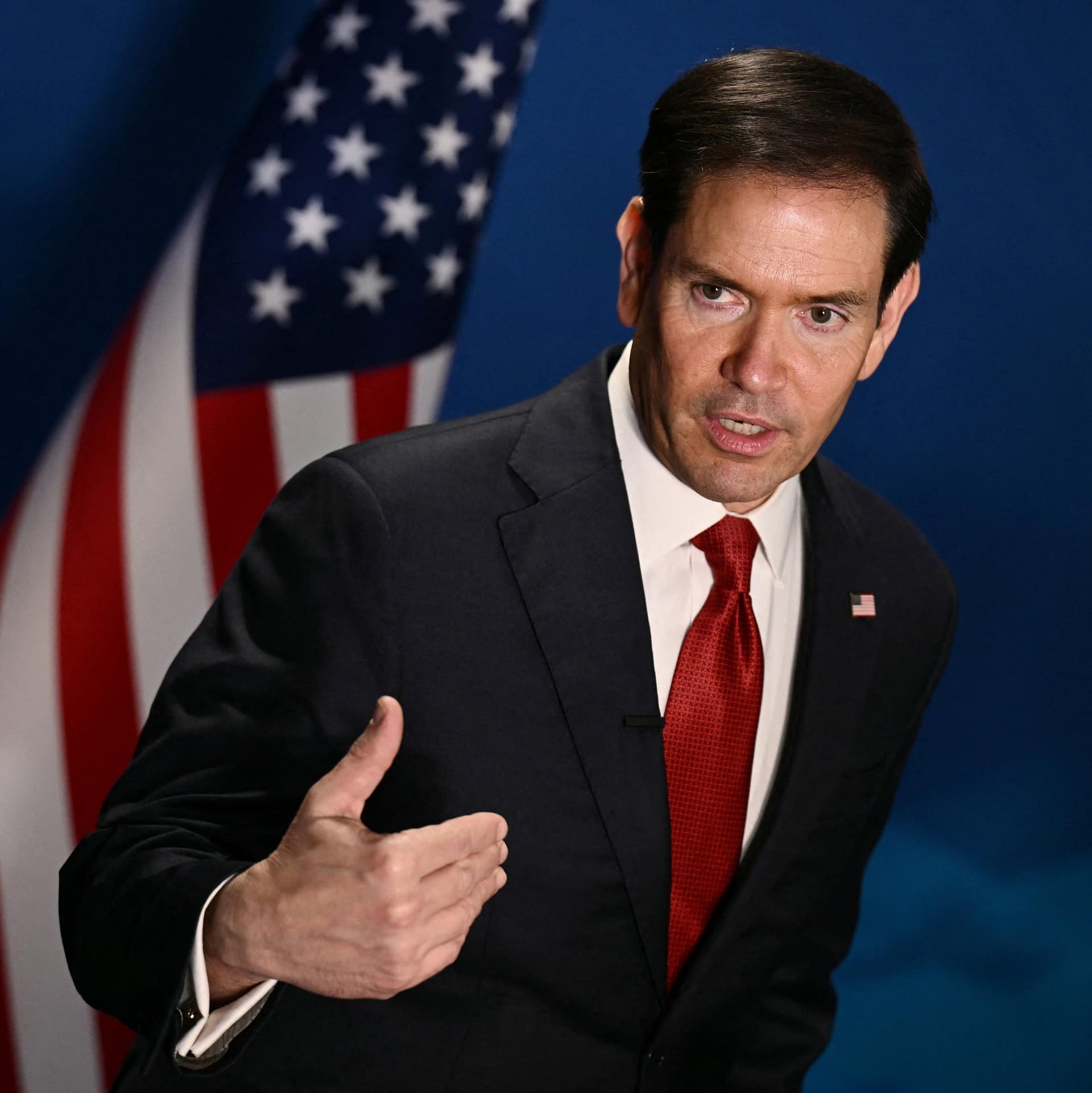
Photo: U.S. Secretary of State Marco Rubio, July 23, 2026. Credit: Brendan Smialowski/ Pool via Reuters.