
In short
Whether U.S. support for Israel is weakening, why, and how it’s affecting Israeli politics and upcoming elections.
Guests (backgrounds)
- Asma Khaled, BBC Washington-based political correspondent and former NPR reporter covering U.S. politics and public opinion.
- John Donison, BBC correspondent based in Jerusalem, covering Israel and U.S.-Israel relations since the Gaza war.
Key claims
- U.S. support has long been bipartisan, but the “center of gravity” is shifting, especially among Democrats.
- Evidence includes Democratic talk of conditioning aid and a record April vote by 40 Democratic senators to ban arms sales to Israel.
- Public opinion has turned: a Pew poll (March) finds 6 in 10 Americans view Israel unfavorably, up since 2022.
- In Israel, officials and media closely track U.S. polling; Channel 12 reports 71% of Israelis don’t trust Trump on the Iran deal.
Notable examples
- Rahm Emanuel, Gavin Newsom, Pete Buttigieg, Bernie Sanders comments on conditioning aid.
- 2015 Netanyahu speech to Congress and Democratic boycotts.
- Israeli election dynamics: Netanyahu’s campaign reportedly shifting away from Trump posters; tightrope over Lebanon ceasefire while trying to preserve U.S. relations.
Written by AI. May contain mistakes. Listen to the episode to check what was said.
Chapters
Tap a time to open that second in VOU.S.-Israel Relationship Overview
0:34 to 2:28
Discussion of the historically strong support of the U.S. for Israel and possible shifts in this dynamic.
“The idea that the United States is a staunch supporter and ally of Israel has been a political truth for decades, whether you're a Republican or a Democrat.”
Introducing Expert Analysis
2:28 to 3:24
Introduction of Asma Chaled, the political correspondent, to discuss U.S.-Israel relations.
“And today on The Global Story, are there cracks in the historically rock-solid U.S.”
Shifts in Political Support
3:24 to 4:52
Analysis of changing attitudes among Democratic politicians regarding support for Israel.
“It's a storyline, actually, that I've been following over a number of years as a political correspondent.”
Historical Context of Support
4:52 to 7:24
Exploration of bipartisan support for Israel throughout U.S. history and its evolution.
“You will be able to purchase weapons just like any other ally with any other restrictions.”
Impact of Recent Events
7:24 to 10:12
Discussion on the recent Gaza conflict and how it has affected American public opinion towards Israel.
“You know, I mentioned conditioning aid to Israel.”
Polling Insights on Attitudes
10:12 to 14:00
Detailed look at recent polling data reflecting changing views on Israel among Americans.
“So then let's fast forward to the days of the Obama administration.”
Shifts in American Support for Israel
14:00 to 15:20
Explore the recent decline in American support for Israel and partisan divides in opinions.
“in a place like, say, the Chicago Council on Global Affairs or Gallup or the Pew Research Center.”
Impact of Recent Wars on Republican Views
15:20 to 17:50
Discuss how recent conflicts have led to wavering support for Israel among Republicans.
“But there are a lot of prominent Republicans as well, like Tucker Carlson, who are also expressing some wavering support on Israel.”
Israeli Perspectives on U.S.-Israel Relations
17:50 to 21:40
Insights from a correspondent in Jerusalem about how Israelis view shifting American attitudes.
“I'm a correspondent based in Jerusalem at the moment.”
Netanyahu's Political Tightrope
21:40 to 24:19
Examine Netanyahu's challenges amidst U.S.-Iran negotiations and his political standing.
“and Iran to try to end the war has complicated that electoral dynamic for Netanyahu?”
Show all 11 chapters
The Polarizing Figure of Trump in Israel
24:19 to 26:50
Understand Trump's polarizing impact on Israeli public opinion and Netanyahu's political dilemma.
“And obviously, we've got 60 days to negotiate the rest of this Iran deal.”
Transcript
Automatic transcript. May contain errors.0:00Tristan:This BBC podcast is supported by ads outside the UK.
0:30Jon Donnison:learns how to invest and manage money. Learn more at schwab.com. The idea that the United States is a staunch supporter and ally of Israel has been a political truth for decades, whether you're a Republican or a Democrat. America has never flinched from its commitment to the state of Israel.
0:51Asma:America's proud to be Israel's closest ally and best friend in the world.
0:57Jon Donnison:One thing I can say definitely will never change is the unique bond that unites the United States and Israel. Even Barack Obama, who sometimes had a tense personal relationship with Benjamin Netanyahu, was steadfast in his support for Israel, the country. While we may at times disagree, as friends sometimes will,
1:18Asma:the bonds between the United States and Israel are unbreakable.
1:23Jon Donnison:But could that all be changing? If I was in the cabinet of the Israeli government, I might not be attacking the only powerful ally that I have anywhere left in the entire world. This is Vice President J.D. Vance just a few days ago questioning Israeli attacks on Lebanon, which in his view could have imperiled the Middle East peace deal.
1:47Asma:Anybody in Israel who thinks their biggest problem is the president of the United States needs to wake up and smell the reality of the situation that country is in.
1:57Jon Donnison:And in the New York City Democratic primary elections on Tuesday, U.S. support for Israel was on the ballot and lost. There's no question Israel has been a big issue in this race. We cannot keep paying for Netanyahu's wars with our tax dollars. Democratic voters across the country are saying this loud and clear. From the BBC, I'm Tristan Redmond in London. And today on The Global Story, are there cracks in the historically rock-solid U.S. support for Israel? And how is this affecting Israelis and their upcoming elections?
2:46Jon Donnison:here on the show guys we really wanted to dig into what might be behind this this changing relationship between the united states and israel and so to do that we're calling on our very own expert gumshoe reporter in washington dc asma chaled uh who knows her way around the city Later on, we're going to cross to John Donison, the BBC's John Donison in Jerusalem. But I'm pleased to say we're going to spend a bit of time with Asma first, who's been doing some reporting on this, and Asma's going to explain to us what's behind all of this. Asma, great to have you on the show.
3:21Asma:Well, thank you. Thank you for inviting me onto the global story to talk about this all. It's a storyline, actually, that I've been following over a number of years as a political correspondent. As you know, I used to be here in Washington.
3:33Jon Donnison:So, Asma, if you'll permit me, I mean, it's kind of political orthodoxy that the United States supports Israel. How have we arrived at a point where that might be changing?
3:44Asma:Well, you're correct in saying that it's certainly been conventional wisdom, that U.S. foreign policy supports Israel. That has been the case. You can go back to the 1960s, 1970s. This was bipartisan approval across Republicans and Democrats and lawmakers. lawmakers. And Tristan, recently, it's become clear to me that the center of gravity appears to be shifting, particularly among Democrats. And I will say, look, this has been a slow evolution in some regards, and we'll get to that in a moment. But the moment this really became clear to me was when I began to see comment after comment from what I would describe as 2028 Democratic presidential hopefuls that haven't all announced officially that they're running.
4:25Asma:But take someone like Rahm Emanuel, former mayor of Chicago. He was the chief of staff under President Barack Obama. And, you know, during the Obama administration, they directed money toward Israel's Iron Dome defense system. And recently I heard him singing a very different tune when it came to taxpayer financial assistance for Israel.
4:46Jon Donnison:Israel's in a different place today. And what I said was, and I believe, taxpayer support for purchasing weapons is over. You will be able to purchase weapons just like any other ally with any other restrictions. That's what Germany, Japan, UK, you'll have it just like that.
5:00Asma:And Rahm Emanuel is not the only one. We've seen Gavin Newsom, the governor of California, be asked about this issue. The former transportation secretary, Pete Buttigieg.
5:11Jon Donnison:It's one thing to want to make sure that Israel can shoot down missiles that are being rained down on them by the Iranians. And it's another thing to be sponsoring Netanyahu going in to annex the West Bank or, you know, going in to invade Gaza. Right.
5:26Asma:Increasingly, as Democrats are eyeing the White House in 2028, it appears that support for Israel is a sort of litmus test. And I cannot overstate how fundamentally different this is in Democratic Party politics. You know, I remember being in these cavernous halls covering the Democratic debates in 2020, and you heard someone like Bernie Sanders, who was running at the time, and many folks in the chattering political class thought of Bernie as a fringe lefty candidate, someone who wasn't, in their view, going to become the nominee. Bernie Sanders spoke about conditioning aid to Israel. $3.8 billion is a lot of money, and we cannot give it carte blanche to the Israeli government,
6:08Jon Donnison:or for that matter to any government at all. We have a right to demand respect for human rights and democracy.
6:14Asma:I remember there was this debate in Atlanta in 2019 where he spoke about Israel.
6:20Jon Donnison:I am pro-Israel, but we must treat the Palestinian people as well with the respect and dignity that they deserve.
6:27Asma:He said the U.S. ought to rethink its allies, rethink its alliances.
6:32Jon Donnison:So we need to be rethinking who our allies are around the world.
6:35Asma:I mean, these comments were very novel to be hearing in public amongst Democrats running to be president of the United States.
6:44Jon Donnison:Was that controversial at the time when he said that, Asma?
6:47Asma:When he spoke about conditioning aid to Israel, I recall that later Joe Biden, who was also running and obviously became then the president of the United States, was asked about those comments and said it would be absolutely outrageous to withdraw aid from Israel on the condition that they change a specific policy. So, no, this was not the conventional attitude in the Democratic Party. If we fast forward to where we are today, when we look at candidates possibly eyeing the presidency in 2020, at least on the Democratic side, I am hearing things in public that I have never heard in previous election cycles.
7:20Asma:But I would say, Tristan, it's not just politics, even when it comes to policy. You know, I mentioned conditioning aid to Israel. It was thought to be an out-of-the-box idea, let's say, on the Democratic side. you know, four years ago. In April of this year, you saw a record 40 Democratic senators vote to ban arms sales to Israel. And that caught my attention. And frankly, it caught a lot of reporters' attention because you had not seen a vote like that take place on Capitol Hill before.
7:48Jon Donnison:Okay, so things are shifting now. But back in the day, Democrats and Republicans generally didn't agree on very much, but they did agree on support for Israel. But why was that an exception that there was this bipartisan support?
8:03Asma:I mean, I think it goes back many, many decades. If you go back to the 1960s and 70s, in the minds of many Americans, Israel was seen as this tiny nation fighting for its survival. And this was a sentiment that I heard covering someone like Joe Biden or Kamala Harris. Let me give you an example. I remember covering Kamala Harris and she's recounted this story over the years of being a little girl and going around with a box collecting funds to plant trees in Israel. I fondly remember those Jewish National Fund boxes that we would use to collect donations to plant trees for Israel. And it's a story she shared to show her deep-rooted support for Israel.
8:47Asma:And that was commonplace in Democratic Party politics. Years later, when I visited Israel for the first time, I saw the fruits of that effort and the Israeli ingenuity that has truly made a desert bloom. And so that was the norm for decades. There was bipartisan consensus for this unwavering support of Israel over the years, particularly from lawmakers.
9:10Jon Donnison:When did you start to see cracks in that support for Israel? Is it as simple as when the Gaza war got underway or is it more complex than that?
9:21Asma:You know, Tristan, I actually did a story looking at this very issue back in 2021 when I was at NPR. So it has been an evolution over the years. But in reporting out this story for our podcast, I called up a couple of pollsters because I wanted to actually understand when did they begin to see the shifts in American public opinion. The first major pivot point that one pollster pointed me toward was George W. Bush's administration in the years after September 11th, in which more Republicans appeared to support Israel in part because white evangelical support for the Republican Party grew. And many evangelicals tend to have a strong support of Israel through a theological lens.
10:05Asma:And so you began to see support for Israel along more partisan lines.
10:10Jon Donnison:Yes. OK, so what happens next then?
10:12Asma:So then let's fast forward to the days of the Obama administration. President Barack Obama, quite bluntly, did not have a smooth relationship with the Israeli prime minister, who was at the time also Benjamin Netanyahu. Netanyahu was vocally opposed to what I would describe as Obama's signature foreign policy idea. That was the Iran nuclear deal. And isn't it so strange how everything in the past seems to be now recurring in our current moment of politics? But the reason this is particularly significant, pollsters told me, is that there was a moment in 2015 when Netanyahu came at the invitation of some Republicans in Congress and addressed a joint session of Congress, which is a big deal for a foreign leader to come and address lawmakers.
10:55Jon Donnison:My friends, I've come here today because as prime minister of Israel, I feel a profound obligation to speak to you about an issue that could well threaten the survival of my country.
11:09Asma:The Obama administration was really miffed by this. They saw it as a move to undercut his authority. And in particular, because Netanyahu blasted the Iran nuclear deal. Now we're being told that the only alternative to this bad deal is war.
11:25Jon Donnison:That's just not true. The alternative to this bad deal is a much better deal.
11:32Asma:He did not want this to go through. And that really annoyed a number of Democrats. I think over 50 Democrats boycotted the speech altogether and didn't show up. And what I heard was that that was a major point of division, because what you began to see was some people viewing Netanyahu's decision as a particularly partisan issue. It was an involvement in U.S. domestic politics. And so you saw some Republicans really, really supporting Netanyahu. In fact, one pollster told me that he did a poll at the time in which he found that Netanyahu was as popular among Republicans as Ronald Reagan, which is for some context, Ronald Reagan has always been an enormously popular Republican president.
12:17Asma:Democrats, their views towards Israel began to decline.
12:21Jon Donnison:Yeah, essentially the sequence of events was Obama and Netanyahu had a tense relationship. That led to Netanyahu coming to Washington, addressing Congress without the say-so of the White House. And that essentially being seen as a thumbing of the nose to the Democratic side of Congress and therefore creating the beginnings of a kind of a rift in a party political sense. Is that right?
Read the full transcript
12:47Asma:Yeah, and it deteriorated and it has been deteriorating since then. You know, I mentioned that I did a story about the relationship and attitudes towards Israel in U.S. public opinion in 2021, looking at how the violence in Gaza, because there was also violence in Gaza around that time point, was marking a shift in the American political debate around Israel.
13:07Jon Donnison:So it's in that context then that October 7th happens and then the Gaza intervention. In some ways, though, it's counterintuitive, isn't it? Because October 7th was a hugely traumatic moment for Israel and people in the United States who had been longtime supporters of Israel rallied around Israel in support, didn't they? But did that sentiment not last?
13:32Asma:What I can say, Tristan, is that as the war continued in Gaza and as the death toll in Gaza grew, we saw public opinion amongst Americans move away, it appears, from Israel. And this is not just one poll. You can look at survey after survey from reputable polling outfits that have been tracking this attitude over time. So they have some metric of comparison. in a place like, say, the Chicago Council on Global Affairs or Gallup or the Pew Research Center. And to give you a sense of the scope of what we've begun to see, a Pew poll from March of this year found that six in 10 Americans have a very or somewhat unfavorable view of Israel that was up seven percentage points since last year and nearly 20 points since 2022.
14:28Asma:to. So a real dramatic difference over the last couple of years, it appears.
14:32Jon Donnison:And do we have any sense from those numbers, the division between Republicans and Democrats in that level of support, in that decline of support for Israel?
14:42Asma:There's definitely a partisan divide. If you look at, you know, this Pew poll that I cite or other polls as well that have looked at Democratic and Republican attitudes, you'll see that more voters who identify as Democrat or Democratic-leaning do seem to have an unfavorable view of Israel. When you look at Republicans, a majority of Republicans do continue to have a more favorable view of Israel, though I will say some of the polling suggests that unfavorable attitudes in the last year have ticked up amongst Republicans, particularly among younger Republicans. All right.
15:20Jon Donnison:So it would seem that the wavering on Israel is primarily happening on the Democratic side. But there are a lot of prominent Republicans as well, like Tucker Carlson, who are also expressing some wavering support on Israel. So what's going on in the Republican camp?
15:36Asma:The most recent war that the United States conducted with Israel and Iran, but also you could argue even last year's 12-day war, have exposed some cracks in the traditional unquestioning support for Israel that we had amongst Republicans. Particularly, it appears, amongst some younger Republicans. But you also, you mentioned popular podcasting personalities like Tucker Carlson or Megyn Kelly. I do think that even I, as I look back, I'm like, I'm pro-Israel. I say I'm pro-Israel. And I've been asking myself lately, like, how, like, why exactly am I pro-Israel? We've seen also a couple of Republican lawmakers be outspoken about this as well.
16:15Asma:I think this, Tristan, seems to tie back more to their hesitancy about U.S. intervention in foreign wars. We know that there is a part of the Republican base that is extremely skeptical of U.S. intervention abroad. and they feel the United States, in their view, was dragged into this recent war with Iran and that they don't think that that was to the benefit of the United States. You know, I will say, I think the cracks right now that we're seeing in the Republican Party, while maybe small, and yes, there is still substantial evangelical support amongst Republicans for Israel and amongst other Republicans as well, these cracks do appear to be real.
16:58Asma:because, look, politicians, they are political operatives, and this is all happening in the context of an upcoming midterm election cycle here in the United States. And so they've made the calculation that it's OK to be critical of Israel in public to some degree, as we've heard from President Trump and J.D. Vance recently. But still, the majority opinion, as we've seen in public opinion surveys, but also the majority opinion amongst Republicans on Capitol Hill is to continue the traditional support we have seen from the United States towards Israel.
17:36Jon Donnison:Okay, well, I mean, that's the view from D.C. But as you all know, friends, we do America and the world. We do indeed. We have called up the BBC's John Donison, correspondent in Jerusalem, to find out how all of this looks from Israel.
17:54Tristan:So my name is John Donison. I'm a correspondent based in Jerusalem at the moment. I used to be based here permanently for four years, and I've been coming back to Jerusalem periodically since the war in Gaza started.
18:09Asma:So John, presumably you've seen how public opinion may or may not have shifted in Israel over the years. And the question on my mind is whether Israelis are aware that attitudes about Israel in the United States, presumably their closest ally, have soured so much in the last couple of years?
18:27Tristan:I think they are aware because I think the Israeli media scrutinizes the relationship with the United States, which, as you say, is their most important ally very, very closely. So the polls that you would have seen in the U.S. have also been reported here. So they're aware of that. And certainly in recent weeks, there's been a lot of coverage about how Israel's relationship with America is under strain.
18:55Asma:John, what do attitudes look like in Israel towards the United States at this moment? I mean, I used to cover the White House, and the only time I've been to Israel has been on one of these presidential junkets. And so there's lots of signage up that shows how close the U.S. and Israel are as allies. I don't know that that signage is regularly shown around town, but there was a sense of warmth. What are you seeing now?
19:17Tristan:Well, look, I don't want to overplay this because I do think Israel remains America's most important ally in the Middle East. A huge amount of money, a huge amount of weapons goes from the United States to Israel. But when you look at some of the polling just in the last few weeks, and I know we shouldn't rely too much on an individual poll, but there was one on Channel 12 television here this week saying 71 % of Israelis don't trust President Trump to look out for them in the Iran deal. and just 11 % believe that Israel won that war. And those figures, that 71 % figure, was down 10 % apparently on the same question when it was asked just a week before.
20:02Tristan:So the Iran conflict has really put a lot of political pressure on Prime Minister Netanyahu. He has elections coming up in a few months' time. He's doing badly in the polls. and people are saying, look, you got us into this war and the war aims that you set out to achieve haven't been achieved. And at the same time, you've put a strain on this relationship with the United States, which is so important for Israel.
20:30Jon Donnison:John, we have to be careful about a poll taken in isolation, but there is a little bit more urgency around polling numbers in an election year. It's an election year in the United States with the midterms, but also in Israel, there's a general election later this year. how might the evolving sentiment around Israel and the United States influence that election in Israel?
20:51Tristan:It's interesting because in the past, Prime Minister Netanyahu has used his close relationship with President Trump as an electoral asset, saying, you know, only he has this strong relationship with the most powerful man in the world. This time, though, I think there's going to be a bit of a shift. hearing it reported here that his campaign team are stepping back from that approach. And they're going to say, look, Prime Minister Netanyahu is the only potential prime minister strong enough to stand up to President Trump. So that's a subtle but quite important shift. So in the past, when we've had elections, we've seen big posters of Prime Minister Netanyahu and President Trump up on billboards around Israel.
21:37Tristan:I'm not sure we're going to see that this time.
21:39Asma:Can you extrapolate a little bit on how the deal we've seen announced here by the United States and Iran to try to end the war has complicated that electoral dynamic for Netanyahu?
21:51Tristan:Well, it's complicated it because there's no doubt Israel was told about this deal. They were not consulted. President Trump clearly really wanted this deal to go ahead. Prime Minister Netanyahu and plenty of Israelis don't think there should have been a ceasefire yet with Iran, and they certainly don't think there should have been a ceasefire in Lebanon. Now, of course, the Iranians have insisted that Lebanon, where Israel has been clashing with Hezbollah, an Iranian-backed group, Israel has occupied a large chunk of southern Lebanon. The Iranians have insisted that has to be part of any ceasefire deal.
22:31Tristan:And there was a risk right up until the weekend, really, and frankly, the risk is still there, that the fighting in southern Lebanon could derail the whole Iran deal. So essentially, the Americans over the past week have been saying to the Israelis, look, you need to rein it in in southern Lebanon because they didn't want that to derail the deal. So Prime Minister Netanyahu is in a difficult spot because he doesn't want to upset President Trump any more than he already has. But at the same time, pulling out those forces from southern Lebanon would be perceived by many here as a sign of weakness.
23:03Asma:Would it be politically unpopular, you're saying, John, at this point?
23:05Tristan:It would be politically unpopular to do that. Yeah.
23:07Jon Donnison:Yeah. So there's a political tightrope he's walking. But at the same time, it looks like there's also a security tightrope that he's walking, because on the one hand, he has one security imperative, which is, he says, to protect Israel from a security threat from Lebanon, from Hezbollah. But then there is also another security imperative, which is to maintain good relations with the United States, which is a strong military backer. That's a difficult choice to have to make, isn't it, for Benjamin Netanyahu? What's the main priority there?
23:38Tristan:Well, I think the main priority is to walk that tightrope and certainly to keep relations good with America. At the same time, I just do not think the Israelis are going to pull out of southern Lebanon at the moment, not just months before an election. So I think we're going to get to a sort of those forces will remain there and they will be under pressure not to see the situation there escalate. But at the same time, while you have Israeli troops occupying Lebanese territory, it's very easy to see flare-ups. They could quickly escalate. And obviously, we've got 60 days to negotiate the rest of this Iran deal.
24:23Tristan:That's not a lot of time. I still think there's plenty that could go wrong.
24:27Asma:John, beyond the halls of power in Israel, beyond, say, the Netanyahu government, I'm curious how the United States and how President Trump are viewed broadly. You know, we've heard Trump and his team consistently say that they have done more for Israel than anybody else would have. You've heard them allude to the fact that, in their view, Israel would have been destroyed without their support. And as you said yourself, John, I mean, there's a lot that Trump has done over the years in terms of his relationship with Netanyahu, but also I would say towards the nation of Israel. In his first term, he moved the U.S.
25:00Asma:embassy to Jerusalem. He recognized the Golan Heights is Israeli territory. He's lifted sanctions on West Bank settlers. And so I am curious, is Donald Trump himself still popular? Do you have a sense of how he's viewed beyond just, let's say, the leadership in Israel?
25:15Tristan:Yeah. And it's important to say that those polls I mentioned earlier, that 71%, that was, didn't trust President Trump to look out for them in the Iran deal. So it's not talking about the broader views of President Trump. And I do think generally, the majority of Israelis regard President Trump as good for Israel. Certainly, they think he's better for Israel than his predecessor, Joe Biden, or before that, Barack Obama. President Trump is also a polarizing figure in Israel, like he is everywhere around the world. So I think it's quite difficult to kind of generalize too much about, you know, how Israel
25:53Jon Donnison:feels about President Trump, I guess. Is this a particularly perilous moment for Benjamin Netanyahu, John?
25:59Tristan:Yeah, it is. It is because the majority view in Israel is that the war in Iran has not worked out as planned. And that is going to be used in the upcoming elections against him. He's facing criticism, not just from the opposition, but from members of his own cabinet about how this has been handled. And at the moment, the polls show he's losing support. He would lose an election, I think, if one was held tomorrow. And then at the same time, you know, he's also facing corruption charges in Israel. He's on trial for that at the moment, charges that he denies. So there's a lot at stake for him at the moment.
26:42Asma:Well, John, thank you for joining us.
26:44Jon Donnison:John, thanks so much. It's a pleasure.
26:50Jon Donnison:That was the BBC's John Donison speaking to us from Jerusalem. And before that, you heard our own Asma Khaled. And that's it from us for today. As you know, on The Global Story, we bring you one story in depth where the world and America meet. For the very latest news headlines, check out our sister pod, the Ronaldinho to our Ronaldo, the barbecue sauce to our brisket, the Global News Pod, wherever you listen. Our email, as always, theglobalstory at bbc.com. Don't be strangers. Today's episode was produced by Viv Jones. It was edited by Bridget Harney. Our studio manager was Ricardo McCarthy. Our digital producers are Charlie Firth and Matt Pintus.
27:35Jon Donnison:Our senior news editor is China Collins, and I'm Tristan Redman. Thanks so much for listening. We'll be back again tomorrow. Cheerio.
From the publisher
The United States has been a staunch ally of Israel for decades, and Americans used to be steadfast in their support for the country. But in recent years - and recent weeks - the special relationship between the two counties has come under fire.
Several polls indicate that Americans have increasingly negative views of Israel and its prime minister, Benjamin Netanyahu. And as the midterms approach, support for Israel is on the ballot in some races.
Asma briefs Tristan on shifting US public and political opinion on Israel. And Jon Donnison discusses how fluctuating US sentiment on Israel is affecting domestic Israeli politics.
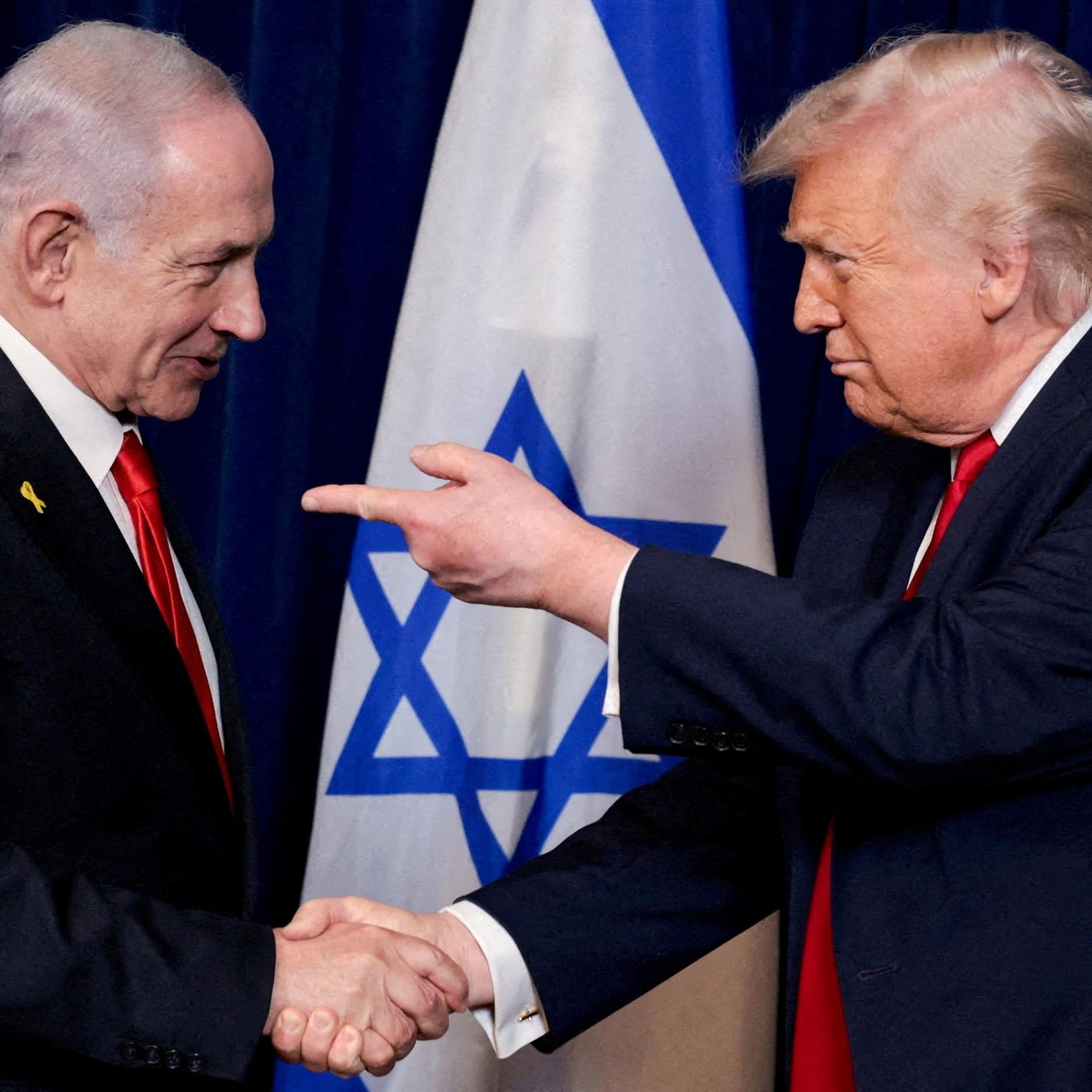
(Photo: President Donald Trump (R) gestures with an extended index finger at Prime Minister Benjamin Netanyahu (L) as they stand face to face in front of an Israeli flag. Credit: Jonathan Ernst/Reuters)