
In short
Whether the US is losing the EV race to China, focusing on BYD’s rise, US barriers (tariffs and national-security concerns), and China’s advantages in scale, cost, and charging tech.
Guests
Suranjana Tiwari, BBC Asia business correspondent (based in Singapore; covers business, economics, technology across Asia-Pacific). Interviewee: Stella Lee, BYD global spokesperson and executive vice president.
Key claims
BYD surpassed Tesla as the world’s top EV seller despite being effectively barred from the US (about 100% EV tariffs). China’s government support since early 2000s helped companies innovate and scale; Chinese firms also market via influencers and offer lower prices. US automakers face a dilemma: China is both competitor and major market. BYD says it can grow without the US, selling strongly in Southeast Asia, Latin America, Europe, and Canada.
Notable examples
BYD dealerships in Morocco; BYD cabs in Singapore; Beijing Auto Show (largest auto show; nearly 1,000 exhibitors); BYD “flash charging” (70% in 5 minutes; ~400 km); automated EV factory visit (robots assembling vehicles).
Written by AI. May contain mistakes. Listen to the episode to check what was said.
Chapters
Tap a time to open that second in VOTesla vs. BYD: A Global Perspective
0:38 to 2:26
Discussion about Tesla's current market position compared to BYD.
“When you picture an electric car here in the U.S., you probably think of a Tesla.”
BYD's Market Strategy in Southeast Asia
2:26 to 4:19
Insights on BYD's presence and pricing strategy in international markets.
“BYD, like all Chinese EVs, are effectively barred from the United States.”
Technological Innovations and Cost Efficiency
4:19 to 6:06
Exploration of how BYD maintains low manufacturing costs and innovations.
“but in other Chinese EVs, how are they different from Tesla, which is the electric vehicle car company that so many of us know here in the U.S.?”
US vs. China: The EV Race Dynamics
6:06 to 8:27
Analysis of the geopolitical aspects affecting the EV market in the US and China.
“And long story short, I covered American politics for a while.”
BYD's Growth and Global Strategy
8:27 to 11:15
Overview of BYD's journey from battery manufacturing to global EV leader.
“And that's really interesting because there is this kind of dilemma for those U.S.”
Future Prospects and Scaling Production
11:15 to 14:03
Discussion on BYD's future production capacity and market adaptability.
“And I think the state backing that we've already talked about really contributed to that.”
China's EV Demand and Production Capacity
14:03 to 18:07
Discussion on the high demand for electric vehicles in China and the capacity challenges companies face.
“Also, especially after we introduced flash charging, it's a really big game changer.”
US Barriers to Chinese EVs
18:07 to 20:53
Exploration of the US tariffs and national security measures affecting Chinese electric vehicle companies.
“And presumably they're also on quite a roll selling cars in Europe as well.”
The Shift in Global EV Market Dynamics
20:53 to 24:15
Analysis of how Chinese EV companies are adapting and thriving in the global market despite US restrictions.
“And I will say, Sorinjana, ahead of his trip to China, you had Republican and Democratic lawmakers really nervous that maybe he would open the door, possibly just a wee bit to Chinese car makers.”
Emerging Technologies in Chinese EVs
24:15 to 26:59
Insights into the innovative technologies being developed by Chinese EV makers, including autonomous vehicles and fast charging.
“has these concerns around manufacturing, around national security, it's actually losing out because China is very much at the center of the global auto industry, not just the global EV industry today.”
Show all 11 chapters
Understanding U.S. Military Decision-Making
28:01 to 29:46
Learn about the political mechanisms that govern U.S. military action.
“Thank you for your amazing show and the insights it helps me gain on many important topics.”
Transcript
Automatic transcript. May contain errors.0:00This BBC podcast is supported by ads outside the UK.
0:30Just tap into iHeart to start watching. And we hope you enjoy the show.
0:38When you picture an electric car here in the U.S., you probably think of a Tesla. It has dominated the EV market in the States for years. But Elon Musk's car company is now lagging behind a Chinese rival that many Americans may have never heard of. It's called BYD, and it surpassed Tesla to become the largest seller of EV cars in the world. You can find their factory in Brazil, their buses on the streets of London, their dealerships in Morocco or Mexico. Despite being effectively shut out of the American market, China has quietly become the global powerhouse of EV production, leading the industry in technology, innovation, and scale.
1:22From the BBC, I'm Asma Khalid, and today on The Global Story, has America lost the EV race?
1:40My name is Suran Janathawari. I'm the BBC's Asia business correspondent. So I travel all around the Asia Pacific covering business, economics and technology news. And I also provide analysis for all of our BBC platforms on what's going on in the world of business and economics. Wonderful. I'm excited to have you on our show today. And I will say our program, The Global Story, is about where the world and America meet. And I really wanted to have you on because I've been so intrigued with the success of BYD. especially in comparison to Tesla. I will say that I was recently in Morocco and I saw a BYD dealership in an upscale neighborhood.
2:24And it caught me off guard because here in the US, you don't see BYD. BYD, like all Chinese EVs, are effectively barred from the United States. So let me just start by asking, have you been in one? What's a BYD car actually look like? Actually, I have because I'm based in Singapore. And actually, a lot of the cabs that we book on our ride hailing apps nowadays are BYDs. And I must tell you that it's a really smooth journey. I mean, EVs in general are a smoother ride than traditional combustion engines. But in this part of the world, Southeast Asia has a huge market for BYD. And in case you didn't know what BYD stands for, it's actually build your dreams.
3:02So it's an interesting spin on the so-called American dream and how the US used to be the center of the global auto industry. and that's really shifted to China now. How much does a BYD vehicle cost? You can actually get a BYD in London for anything from about 25 ,000 US dollars to 60 ,000 US dollars. But they are targeting, you know, a more affordable sort of price range as well. And that's one of the really interesting things with the development of electric vehicles. Initially, it was very expensive to develop, But China seems to have really gamed that. And companies, aside from BYD, but as well as BYD, are producing very, very affordable cars.
3:52But having said that, it's about market access as well. For example, you can't buy a BYD in the US, probably, unless you're very rich and you're not telling us, because there are tariffs. and tariffs on electric vehicles in the U.S. are about 100%. So you're paying a huge amount of money for an EV. And that's one of the reasons you don't see BYDs on the roads in America as much as other parts of the world. So, Ranjana, how is a Chinese EV, say if we're talking about BYD, but in other Chinese EVs, how are they different from Tesla, which is the electric vehicle car company that so many of us know here in the U.S.?
4:31Well, they're the same technology. They're fully electric vehicles as opposed to hybrids. But what BYD has managed to do ever since it's been producing cars globally is that it's really honed in on that electric vehicle technology plus the software that drives it. And that's something that Tesla is also very good at. But because of the way that China's industrial policy is set up, BYD manages to keep manufacturing costs very, very low. And that's why its cars are so affordable. The Chinese government has for many years now, since the early 2000s, has said that electric vehicles are going to be the future.
5:14Of course, China had a lot of issues with pollution and things like that. They really focused on cleaning up their vehicles and the air as a result of that. And so they provided a lot of subsidies and a lot of government support incentives for these companies to develop this, what they call new energy vehicle technology. And that's why you see so many Chinese companies making electric vehicles, because it's very easy there. And then there's the innovation factor as well. When you give that much support to these companies, they continue to innovate. And that's why you see, you know, some of these Chinese car makers making the fastest car in the world, which is now a BYD, by the way, or the most energy efficient rather, and the best battery chargers as well, which has long been a big challenge for EV adoption around the world.
6:06I mean, it's so striking to hear you talk about the groundswell of support at a government level there in China because I don't know how much you followed this, but during the Biden administration, there was something known as the Inflation Reduction Act, whose mission it was was to sort of boost electric vehicle purchases, electric vehicle manufacturing here in the United States. And long story short, I covered American politics for a while. It was an extraordinarily controversial move. And there was not sort of unanimous consensus amongst Republicans and Democrats for this push. Absolutely. And this is one of the areas that electric vehicles have not just become sort of a business issue, but they've become a trade issue.
6:44They've become a geopolitical issue as well. Now, one of the reasons for the Inflation Reduction Act was because China had taken so much manufacturing away from America. So there wasn't much production. There wasn't much export-led growth from America as a result. But having said that, you know, for these US automakers that were trying to develop this electrical vehicle technology, China is also a huge market. I mean, I was there just a few weeks ago. I actually was there to cover an auto show, which has now become the largest auto show in the world. The Beijing Auto Show. I saw some of your reports.
7:23Yes, that's right.
7:28We're at Auto China, now the largest car show in the world. Nearly 1 ,000 companies are exhibiting here in a space that's the equivalent of more than 50 football fields. And when you're here, the message is loud and clear. China is now at the centre of the global auto industry. And, you know, there you could see, you know, it was a huge expanse of area where this was being held. Like, I was clocking up 17 ,000 steps a day just going from booth to booth. But all the Chinese and foreign car makers were exhibiting their latest models. May I have your attention please? Right now we're going to send Group B onto the track.
8:17And there was so much buzz around the Chinese car makers, whereas the foreign car makers, both the US, the Japanese, the Europeans, there wasn't as much buzz. And that's really interesting because there is this kind of dilemma for those U.S. automakers. They want to be able to develop this technology and compete with Chinese car makers. But also China is a huge market for them. It's the second largest consumer economy after the U.S. And frankly, what I saw was that they've really fallen behind in this electric vehicle race, especially. People are opting for Chinese cars as opposed to U.S. cars that have this EV technology.
9:00And they're recognizing this as well.
9:05What was really striking there was the number of ordinary families who were coming to an industry event. You know, in the past, it was a very business-to-business kind of auto show. But I saw, you know, parents bringing their children to show them the cars, to show them the latest technology and the latest models. And the children were really excited by it. It was an event. And that just told me that this electric vehicle drive and this innovation in terms of autos is a lifestyle. So it sounds like the Chinese EV companies were really getting a lot of attention at this auto show. And we've said that BYD has kind of become the hit EV brand globally.
9:50So I want to understand where this company got its start from. Where, when did this happen? BYD actually started by making batteries back in the early 2000s. And then they kind of realized that with the government push towards electric vehicles and new technologies and future technologies, that there might be something in making electric vehicles. They started off by making regular vehicles. But funnily enough, those traditional combustion engine, they were not very well received. And that's when they got an expert who had worked in companies like Volkswagen to come on board. And he actually helped develop the first electric vehicles.
10:32And even then, you know, they weren't innovating at the same pace as other companies. At that stage, it wasn't. And what time period was this? This was around the 2010s. 2010s, OK. Yeah. But it wasn't until sort of 2020 that BYD went global and started selling electric vehicles that were received very well. And as I mentioned, they've now overtaken Tesla. They're selling. They're the top vehicles EV seller in the world. And even though it's not available in the US, the BYDs, other markets are doing extremely well. Latin America, Middle East, Europe, and it can survive without the US market. And I think the state backing that we've already talked about really contributed to that.
11:20It meant that these companies were able to grow. It meant that they were able to innovate very fast. And actually, I visited an EV factory, not BYD's, NIO, which is another top car seller within China. It's a very big company. It targets the luxury market a little bit more.
11:43I could see with my own eyes why these companies were able to roll out models so fast. The factory was fully, fully automated. I can't tell you how few workers were inside there. And so the innovation is not just in the products that these Chinese companies are making, it's also in how they make those products as well. What I saw here in China was literally different models floating around on these robots. They were just moving from station to station, getting doors attached and getting windshields attached and all sorts of different things, but completely autonomously. It's all programmed and that allows them to churn out a lot of products very fast and in a very, very controlled way.
13:03Transcription by CastingWords And you can now watch the global story on the iHeart app. Catch every brand new episode every weekday. Just tap into iHeart to start watching. And we hope you enjoy the show.
13:24You spoke with this BYD executive at the Beijing Auto Show, who essentially told you that it sounds like they don't think they need the U.S. market to survive. Am I understanding that correctly? That's right. Stella Lee is essentially BYD's global spokesperson. She is an executive vice president, but she's the one that talks to media around the world. And yes, she was at the auto show and I managed to speak to her. And I started by asking her how BYD hopes to meet the rising demand for electric vehicles in light of the Iran war and those rising oil prices.
14:02Suranjana Tewari:Our demand is much higher than what we can supply. Also, especially after we introduced flash charging, it's a really big game changer. Now, she did say that they are having to relook at their production capacity because the demand has gone up so much. Since the Iran war, she said. Since the Iran war, that's right. When the oil price increases, then the electricity car, EV car can help them save money every day. But she said they're working on building up that capacity. And she's very confident that they will be able to do that because they're so used to scaling up. And don't forget as well that, you know, every second car sold in China already is an electric vehicle.
14:47So these companies have got a history of being able to scale up for a very big market. But the real nuance here, Asma, is actually that perceptions have changed around Chinese companies as well, partly because Chinese companies are just making better vehicles. They've learned a lot from the foreign car makers or the foreign retailers who have been manufacturing in the country already. They have those ecosystems that we've already talked about that are very ingrained in the industrial sort of set up there.
15:18Suranjana Tewari:BYD is very confident because we will deliver all the technology solving consumer speeds. Is it less about the cars now and more about the charging infrastructure? Yeah, less about the car, it's more about the ecosystem, it's more about the total solution. This also makes BYD different. That's always, in my speech, I say BYD is not a car, it's a BYD. people are recognizing that these are really quite good products as well. They're some of the best electric vehicles in the car, in the world rather, and that the technology, which is the sort of the bread and butter of these types of vehicles is really excellent as well.
15:58So you've been saying that electric vehicle car companies in China are doing really well. I recall that President Biden effectively barred these sorts of vehicles from China from coming into the U.S., both with a combination of national security measures and then 100 % tariff. What did those measures mean for a company like BYD, the idea that the United States has tried to build a kind of protective wall around itself? Yeah, I mean, it means that BYD cannot access the world's largest consumer market because the U.S. not only does not want electric vehicles in the US because, you know, Donald Trump especially thinks that that will take jobs, that is taking jobs away from the US.
16:44But there are these national security concerns because essentially these cars are smartphones on wheels. And there is a great deal of concern that if these Chinese companies are able to deploy these cars in the US, that they're also able to control people's devices. And it's an ecosystem, right? It's something that at the end of the day is connected to your phone, it's connected to your home, and it's connected to your car. And there's a great deal of concern that that's a national security risk. Having said that, US automakers, again, are also very sceptical of these EV giants from China being able to access the US market because they're really worried for their US sales as a result of that.
17:30They're seeing in the UK that EV sales are going up as well. They're seeing in Europe that it's going up. They're seeing in Latin America and Canada are lighting in these Chinese EVs as well. And they're very concerned about the US market. One of our producers in prepping for this story pointed out a sort of remarkable stat, which is that Chinese owned brands now make up one in seven new UK cars, which I just thought was a really, really astounding statistic that five years ago, he said it was about 1.3%. I mean, that's a rather dramatic amount of growth that these companies are making in the United Kingdom.
18:07And presumably they're also on quite a roll selling cars in Europe as well. Yeah, and I will say that these companies are also marketing themselves in a very different way. One of the things I saw at the auto show was hundreds and hundreds of influencers promoting models and sort of talking about, you know, giving reviews of models, these Chinese companies are also leveraging that, that social media sort of reach and saying, here's a great car. This is, you know, this is what it can do. They often give their cars for test driving to these influencers and they're garnering huge amounts of views as a result of that.
18:48So I think these Chinese companies, where they've been quite traditional in the past in terms of how they market themselves, they've also changed. They're also picking up on trends. And that's really worked in places like the UK alongside those higher fuel costs, people becoming more concerned about the environment and looking to electric vehicles. And again, the price point is very important in the UK, especially with rising inflation. All of these foreign competitors have realised that China has pulled ahead in the EV race. And even though they've been developing the technology, they want to make good EVs.
19:29Again, they haven't had the perhaps government backing or they haven't had access to markets that they've needed to be as successful as the Chinese competitors. For decades, it was known that the Japanese make the best cars in the world. But what it's seeming like is that they bet on the wrong technology because they really focused on hybrid technology. But what we're seeing is, especially with those high oil prices, that people want to go fully electric. And actually, an executive from Honda was touring a Chinese factory recently, and he said, we can't compete. China has won their race. We can't compete with this kind of thing.
20:09Because the technology seemed just so superior or because what, the scale of it? The Chinese bet on the right technology at the right time and they have innovated. Now, I will say as well that Donald Trump, in a recent trip to Detroit, has said that he would like Chinese EVs to be available in the US. You know, those tariffs are keeping the foreign autoworkers now. If they want to come in and build the plant and hire you and hire your friends and your neighbors, that's great. I love that. Let China come in. Let Japan come in. They are and they'll be building plants, but they're using our labor.
20:43Yeah, that was a real alarm bell sign, though, I will say to some lawmakers here, right, especially because he made those comments in the the auto manufacturing capital of the U.S. And I will say, Sorinjana, ahead of his trip to China, you had Republican and Democratic lawmakers really nervous that maybe he would open the door, possibly just a wee bit to Chinese car makers. Absolutely. And I would be very surprised if electric vehicles aren't part of the discussions in those trade negotiations. We might never know what's. The problem is that these Chinese manufacturers, again, their ecosystem is so set up in China, they're able to work very fast, they're able to push out a large volume of products very fast.
21:29It doesn't always translate over to the US. Now, in the run up to that historic meeting between President Xi and Donald Trump, we did hear that there could be some promise of investment in the US. And we thought that it could be around Chinese electric vehicles or perhaps battery technology, because that's the other area that China is really speeding ahead. You know, some of these companies like BYD were battery makers initially. And BYD actually launched at the auto show this very fast charging technology. That's one of the problems with electric vehicles is that for big distances, you need to continue charging your car.
22:09Now, this fast charging technology, it's called flash charging that BYD launched at the auto show. That takes your battery to about 70 percent within five minutes. They say that you're able to drive about 400 kilometers on that amount of charge. So that's a real game changer. You mentioned President Trump's recent trip to Beijing and his comments earlier this year, where he seemed to suggest that maybe under certain conditions and within certain parameters, he might be open to some Chinese car companies possibly working in the United States. But nonetheless, it's a somewhat politically toxic thing to say out loud in our politics.
22:56I mean, I think back to Trump himself when he was running for president in 2024. He went to Detroit and was singing a very different tune. In other words, I kept China cars, Chinese cars out of America. And we had to do it because when they come in, they take over everything. and you would have had no car manufacturing at all. And he's not alone. You know, we've recently seen bipartisan legislation, Democrats and Republicans team up to essentially put forth laws that would completely ban Chinese EVs from the U.S. market. Ahead of our interview, I came across a report in Politico that was quoting a Democratic congressman, Don Beyer from Virginia, saying, and I'm going to quote him here, he says, the only thing that terrifies me is BYD.
23:45The fact that it's so inexpensive would destroy every other car company's investment in electric vehicles. And so I guess I just wonder how realistic it is to enter the U.S. market. Are you seeing cracks around the walls that the U.S. has built to keep Chinese EVs out? It's kind of a double-edged sword because what was very clear at the Beijing Auto Show is that China is winning the EV race. It's very clear. So even though the U.S. has these concerns around manufacturing, around national security, it's actually losing out because China is very much at the center of the global auto industry, not just the global EV industry today.
24:29BYD's Stella Lee, she said that she can manage without the U.S. market. And that's because the demand is rising in other big markets like Southeast Asia, Latin America, Canada, as well as Europe. So these Chinese companies are going full steam ahead. They're moving on to the next frontier of technology. So all of them are developing humanoid robots, autonomous driving, whether it's for personal cars or for robo taxis. And Xpeng, which is a huge Chinese EV maker, is actually developing a flying taxi. A flying taxi. It's like the jet race. It's finally here. A flying car. I saw it with my own eyes.
25:11The founder told me that he's looking at manufacturing these flying taxis sometime next year. Do they really fly, though? I just want to understand this. They literally come out another vehicle and they take off vertically. Yes, it looks like a helicopter, but it's a car. And I asked the founder of Xpeng why he's developing this technology, because surely electric vehicles, there's still more market share to gain. And he said within China, within three years, these technologies are going to be completely applied in the real world. And that's why we need to move in that direction.
Read the full transcript
25:53It sounds like you're saying that the rules, the tariffs that the U.S. has put in place have not ultimately prevented Chinese EVs from taking off, that they really are taking off regardless of what the U.S. is doing. Are you suggesting the U.S. market is not relevant to them? It's not that it's not relevant. It's still a huge consumer market. But in the face of these types of controls over access to the US market, China is recalibrating its approach. And it's saying, hey, we've got lots of other markets. We heard it from Stella Lee herself, the BYD global spokesperson. We've got all these other markets where we can sell to.
26:34We're doing very well there. We're expanding our capacity in order to meet the demand. And on top of that, we are developing these new technologies, the battery charging infrastructure, the robots, the autonomous vehicles, in order to survive and to continue doing well in the future.
26:58On that note, Surinjana, thank you so much for joining us. I really appreciate it. Thanks a lot.
27:15That was Sorinjana Tiwari, the Asia business correspondent for the BBC. And a reminder that we here at The Global Story, as you loyal listeners know, we go deep every weekday on one big story that dives into where the world and America meet. If you're also looking for a way to catch the latest news headlines, you should check out our sister show, The Global News Podcast. Today's episode was produced by Valerio Esposito and Aaron Keller. It was edited by Bridget Harney and mixed by Travis Evans. Our digital producer is Matt Pintus. Our senior news editor is Chyna Collins. And I'm Asma Khaled. And as always, our email address is theglobalstoryatbbc.com.
27:55Give us a shout if you all have any ideas or questions. In fact, we got a message the other day from Maddie, who writes, Thank you for your amazing show and the insights it helps me gain on many important topics. Thank you, Maddie. Maddie also asked, in the context of Iran, what the political mechanisms are that allow the U.S. military to attack another country. Is it possible that one man, Donald Trump, has the right to make these monumental choices? Is that really what happens? Well, Maddie, in a former life, I was a reporter covering American politics. So I'm going to try to briefly answer this.
28:29The president of the United States is the commander in chief. That being said, the U.S. Constitution divides war powers between the president and the U.S. Congress, which provides oversight and funding. And there is a law on the books here known as the War Powers Resolution of 1973, which specifies that the president is supposed to seek approval from Congress within 60 days to declare war or authorize the use of military force. Now, in the context of Iran, President Trump has not sought congressional approval for those strikes. The Trump administration says that that rule doesn't apply because of the ceasefire in Iran.
29:07Democrats, though, in Congress have been trying to limit the president of the United States. And late last week, there was a vote on these war powers that looked actually like it was on the verge of passing. But Republicans pulled the vote on that in Congress. So as you can see, there is disagreement between the branches of government over who really is in control. It's been a bit of a pendulum, but it is also worth noting that although Congress has authorized military force over the years, the last time Congress officially declared war was in the 1940s during World War II. Well, that's it for today.
29:44I hope that helps, Maddie. And listeners, please keep those questions coming. We love to hear from you all. Thanks, as always, for tuning in, and we'll talk to you again tomorrow.
30:19you can now watch the global story on the iHeart app. Catch every brand new episode every weekday. Just tap into iHeart to start watching. And we hope you enjoy the show.
From the publisher
In 2025, the Chinese electric vehicle giant BYD overtook Tesla as the world’s biggest seller of electric vehicles. As conflict in the Middle East pushes up fuel prices and boosts demand for EVs, Chinese carmakers are seizing the opportunity.
Driven by years of state-backed investment and industrial policy, China has quietly become the global powerhouse of EV production, leading the industry in technology, innovation and affordability, while the US struggles to keep up.
In today’s episode, we speak to Suranjana Tewari, Asia Business Correspondent for BBC News. She explains what BYD cars are really like, and how China won the EV race.
Producers: Valerio Esposito and Aron Keller
Executive Producer: Bridget Harney
Mix: Travis Evans
Senior News Editor: China Collins
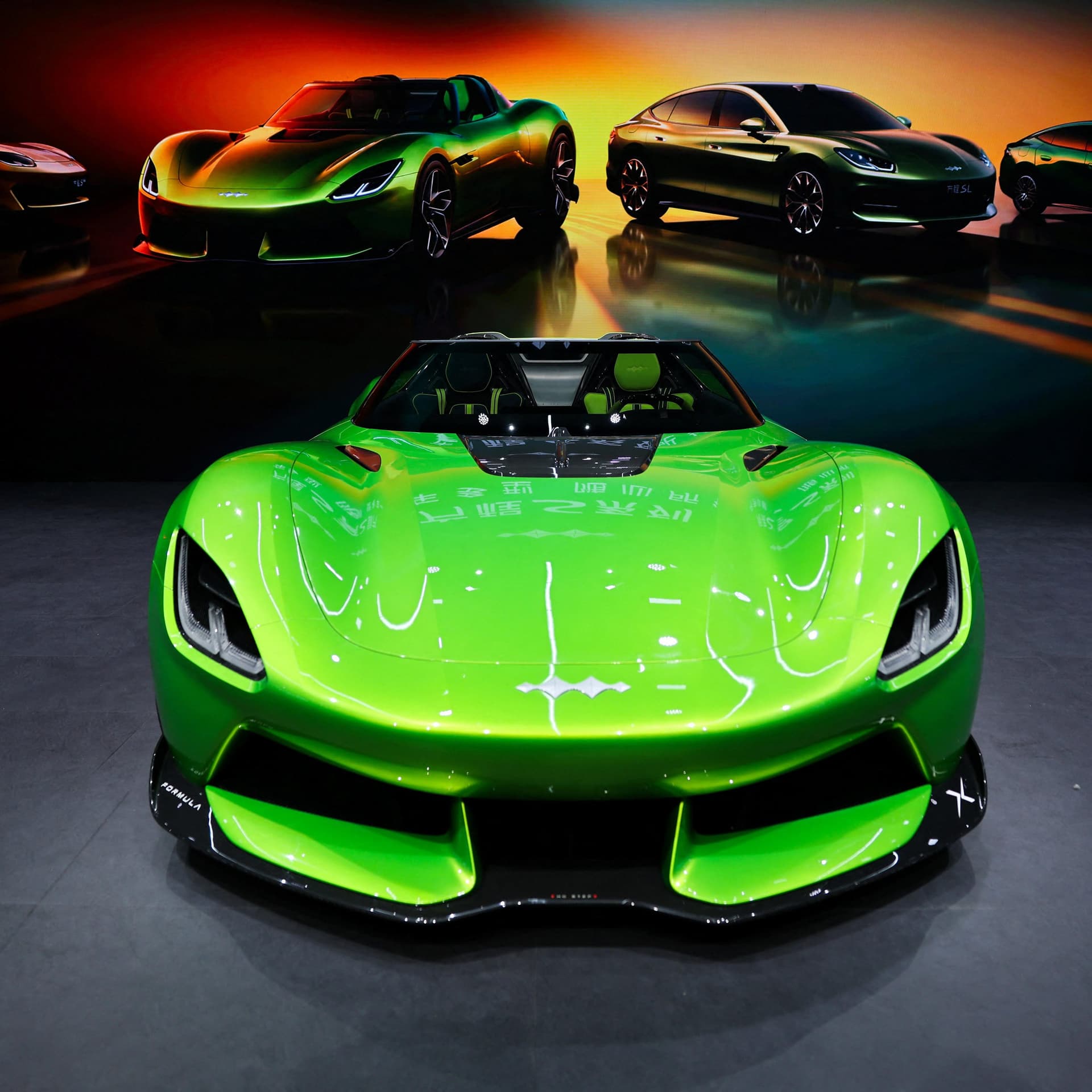
Photo: A newly presented electric roadster Formula X of BYD's brand Fang Cheng Bao appears at the company’s booth at the Beijing International Automotive Exhibition (Auto China), in Beijing, China April 24, 2026. Credit: Reuters/Maxim Shemetov.