
In short
The BBC Global Story episode examines how Jason Arday’s death became a flashpoint over DEI and the treatment of Black academics, focusing on his Cambridge appointment, allegations about his scholarship and life story, and broader U.S./UK debates about tokenization and scrutiny.
Guest backgrounds
Branwyn Jeffries is the BBC education editor. Tyler Austin Harper is a staff writer at The Atlantic and a former environmental studies professor at Bates College (left a tenure-track role).
Key claims
Cambridge’s promotion of Arday (youngest Black professor; autistic; high-profile media presence) collided with allegations of plagiarism and implausible personal claims; Cambridge says it supported him and faced racist attacks. Harper argues DEI can become “theater,” with minority faculty used for optics, and that Black academics face both lowered and heightened standards.
Notable examples
Harper describes being assigned Bates’ MLK Day committee due to race and a hiring decision favoring DEI expertise over outdated/unqualified research.
Written by AI. May contain mistakes. Listen to the episode to check what was said.
Chapters
Tap a time to open that second in VOJason Arday Vigil and Impact
1:16 to 2:26
Discussion of the vigil for Jason Arday and his significance in academia.
“Although it was organized quite last minute, there's at least a couple of thousand people here at this Jason Arde vigil at Trafalgar Square.”
Understanding Jason Arday's Legacy
2:26 to 3:39
Exploration of Jason Arday's life, his achievements, and controversies.
“And today on The Global Story, how Jason Arde came to embody the fault lines around DEI and higher education.”
The Significance of Arday's Appointment
3:39 to 4:45
Analysis of the significance of Jason Arday's hiring at Cambridge University.
“So when Jason Arday was appointed to this leading role, it became a huge worldwide story.”
Media Attention and Controversies
4:45 to 5:54
Discussion on the media's role and controversies surrounding Jason Arday.
“So I was 18 when I just turned 18 when I learned to read and write.”
Allegations and Academic Integrity
5:54 to 7:20
Details of plagiarism allegations and their implications for Arday's career.
“The first in the United States was his forthcoming biography, which was beginning to be promoted.”
Public Perception and Racism
7:20 to 9:29
Exploration of public perceptions of Arday amidst allegations and racism.
“Liverpool John Moores University said that they had carried out a review of the PhD once they were contacted and that they had found no reason to find that there had been plagiarism.”
Cultural and Political Implications
9:29 to 11:58
Discussion on the cultural and political ramifications of Arday's story.
“At what point did this story expand beyond Jason Arde's academic work to encompass questions about his broader life and his life story?”
Aftermath of Arday's Death
11:58 to 14:00
Discussion of the aftermath following Jason Arday's death and responses.
“that he became the lightning rod for a highly political, cultural debate that's happening here as well as in the US.”
Reactions to Jason Arday's Death
14:00 to 15:50
Discusses the anger directed towards media and Cambridge after Arday's death.
“which they say the public cruelty Jason was subjected to was too much for any man to bear.”
The Experience of Black Academics
16:06 to 19:19
Tyler Austin Harper shares his experiences and frustrations as a Black academic.
“Jason Arde's story is also sparking conversation here in the U.S.”
Show all 12 chapters
Affirmative Action and Its Consequences
19:19 to 22:46
Discussion on the implications and criticisms of affirmative action policies.
“of representation of various minority groups.”
Standards for Black Academics
22:46 to 27:21
Explores the dual standards faced by Black individuals in academia.
“But the extremes are really undesirable.”
Transcript
Automatic transcript. May contain errors.0:00This BBC podcast is supported by ads outside the UK.
0:30business needs in one place, saving you time, headaches, and serious money. Stop paying for missing pieces. Go to odoo.com. That's O-D-O-O dot com to learn more. Choiceology, an original podcast from Charles Schwab, is a show about the psychology and economics behind our decisions. Join host Katie Milkman, an award-winning behavioral scientist and author of the best-selling book, How to Change, as she shares true stories from Nobel laureates, authors, athletes, and everyday people about why we make the choices we do and how to make better ones to help avoid costly mistakes. Listen to choiceology at schwab.com slash podcast or wherever you listen.
1:16Although it was organized quite last minute, there's at least a couple of thousand people here at this Jason Arde vigil at Trafalgar Square.
1:24Jason Arday:That was Monday in London where people were gathering to mourn a man who had been celebrated as the youngest Black professor to ever be hired by the University of Cambridge. In the last several days, social media has been filled with people sharing their condolences and even their anger about the circumstances leading up to Jason Arde's death last week. The UK police have said Arde's death was unexpected, but not believed to be suspicious. Many people here in the US hadn't heard of Arde before last month, but questions about his academic work and his life story became the focus of intense media coverage.
2:01Jason Arday:On August 5th, Arday resigned from Cambridge after denying allegations of plagiarism. But by that point, for some, he had already turned into a symbol more than a person. On one side, a symbol of the failures of diversity and inclusion policies, and on the other, a symbol of the undue scrutiny Black academics often receive. From the BBC, I'm Asma Khalid in Washington, D.C. And today on The Global Story, how Jason Arde came to embody the fault lines around DEI and higher education.
2:39Jason Arday:Coming up later in the show, I speak with a former professor here in the U.S. who talks about his complicated feelings around being Black in academia. But first, I wanted to understand who Jason Arday was and what we know and what we don't know about his story. So I turned to my colleague, Branwyn Jeffries, the BBC's education editor. This is such an important story, and we know that there is worldwide interest in this. So it's good to have the time to talk about it in a more considered way. I appreciate that. And I do want us to also acknowledge here at the outset that this is an incredibly sad story, particularly given that Jason Arde has died.
3:20Jason Arday:The details of his life story are also quite complicated, and there are still many more questions than answers at this stage. But, Branwen, I want you to take us back to 2023, when Jason Arde was first hired by Cambridge University as a professor. The university made a big announcement. Why was this so significant? Jason Arday's appointment as professor of sociology of education at Cambridge came at a very particular moment, both in the university's history and also in a global debate about what an inclusive society should look about, both in the UK and the US following the Black Lives Matter protests and the murder of George Floyd.
4:05So when Jason Arday was appointed to this leading role, it became a huge worldwide story. He was their youngest black professor, part of a tiny and very visible minority in the UK. If you look across all of the UK's universities, barely 1 % of professors are black. So he was very high profile for that reason alone. What is interesting when you look back at how they promoted and celebrated his appointment at the time is his remarkable life story. I didn't learn to read until I was an adult. So I was 18 when I just turned 18 when I learned to read and write. The university wanted to celebrate his background, the fact that he had overcome remarkable challenges as an autistic man to get to this position of prominence.
5:00As part of raising the profile of this star academic appointment, Jason Arday did an extraordinary range of media appearances, really going far beyond where you might expect an academic of the sociology of education to appear. Professor Jason Arday was diagnosed with autism spectrum disorder at the age of three. He couldn't speak until he was 11. But that did not stop him from following his dream of becoming a professor. And now the 37-year-old has achieved what was once seemingly impossible. We are so lucky to have you. You are the best in the world in terms of the research that you do.
5:41Jason Arday:Redwyn, I want to be candid here. Even though I myself am a Cambridge alum, I had really never heard of Jason Arde prior to about a month ago. It seemed like starting in late July, his name was everywhere. We started hearing about him quite a bit here in the American press. What brought him into the news? Two things brought him into the news. The first in the United States was his forthcoming biography, which was beginning to be promoted. But what was significant and really propelled it into the public domain in the UK was a blog that was published by an academic who had been sacked from Cambridge for his views on race.
6:21Nathan Kofnus describes himself as a race realist. He is on record as saying that if diversity and inclusion policies weren't in place, there would be no prominent black figures outside of the worlds of sport and entertainment. The controversy around those remarks had led to him leaving Cambridge. He published a blog. In it were allegations which had previously been made privately by academics to the University of Cambridge. that the first major piece of research that Jason Arday had carried out, his PhD at Liverpool John Moores University, was in parts plagiarised, an allegation that Jason Arday denied.
7:04He said that simply wasn't true, that if he'd made mistakes in attribution, that was down to his autism, his neurodivergence. The University of Cambridge said that it was a matter for the university which had awarded his PhD, Liverpool John Moores. Liverpool John Moores University said that they had carried out a review of the PhD once they were contacted and that they had found no reason to find that there had been plagiarism. As the debate escalated, what emerged was that last autumn 2025, the Times Higher Education magazine, which documents universities in this country, in the UK, having investigated and looked through his PhD, they were privately raising questions.
7:53What happened in response to that was the Times higher education reporter who was involved in the investigation found himself reported to the police and also the most high profile and famous defamation lawyers in the UK, they also wrote to the journalist. And as a result, the Times Higher had not published the story. It was then later picked up by Nathan Kofnas and published in a blog. And it just didn't stop there. It went on gathering momentum. Jason Arday, who has been all over the news this week. Much of his life story seems to have unraveled. I'm wondering whether this whole house of cards is really now in freefall.
8:44How did Jason Arday call his way into university? Of course he did. Legacy media, print media, blogosphere, social channels. People started crawling over Jason Arday's life story and his academic record. What did Cambridge University say about the allegations? At the time when this was beginning to really spiral in the public debate, what Cambridge was saying publicly was that they were defending Jason Arde and they were happy with his credentials as an academic. Privately, they were also saying that they felt that he had been the subject of racist attacks since he had been appointed, that they had been having to offer him support, that this was a campaign to vilify an academic that was unjustified.
9:36Jason Arday:At what point did this story expand beyond Jason Arde's academic work to encompass questions about his broader life and his life story? Once the allegations of plagiarism were in the public domain, people started looking at his life story and saying, frankly, some of these things just do not add up. One was a claim that Jason Arday had made to have raised single-handedly five million UK pounds, British sterling, through running an extraordinary distance in a short number of days, hundreds of miles in six days. People started pointing out that if he had done this, he would have been in a tiny handful of elite ultramarathoners in the world.
10:24And no one had ever heard of him in that field. No one was aware of this. So Jason Arde then clarified that actually it had taken twice as long and that the charity fundraising had been over a longer period of time and involved many people. There was a book that was listed on some of his online profiles as having been authored by Jason Arde, which it turned out had never actually been published. There were questions raised about the sequencing of his narrative around some of his health conditions. So Jason Arde said that before he did his exam for his PhD, he had had a benign brain tumour, an operation for that just a couple of weeks before, and a stroke.
11:09People were questioning, why had this not come out at the time? So bit by bit, aspects of his life story began to be questioned. It became apparent that some were, at the very least, exaggerated.
11:23Jason Arday:It strikes me that Jason's story also garnered attention globally because it ran across cultural fault lines that have become so prominent in our politics. I mean, his story became in some ways a referendum on these DEI, diversity, equity and inclusion programs, whether that is fair or not. There are certainly many voices in the UK now who suggest that Jason Arde's story was weaponised by people who strongly object to diversity and inclusion policies, including in universities, that he became the lightning rod for a highly political, cultural debate that's happening here as well as in the US. There have been voices here in the UK, including some from within Cambridge, questioning whether Cambridge University appointed Jason Arday because it suited their purposes at the time to signal that they were a more inclusive institution without really fully thinking through what it meant for the individual.
12:28and there are certainly many academics of colour in the UK, some who've said this publicly but also others who've said it to us privately, that they are concerned that in doing so, in promoting someone so rapidly through the university system, it has had a ripple effect that other Black and Asian academics in the UK now fear that their work may be discredited despite their established research reputations. And I'm sitting here with the thought that this is a story where many, many things are true at the same time. I have spoken to many academics and students who met Jason Arday in one capacity or another.
13:14There are many people who've described him to me as gentle, charismatic, extremely likable. There are also people who contrast that with the hiring of high-profile libel lawyers, of reporting people to the police, of apparently exaggerating or even potentially fabricating aspects of his life story. I think we can say without a doubt that this story,
13:40Jason Arday:it is tense, it is complicated, it is polarizing. And I think no matter what your feelings are about the allegations themselves, learning last Friday about Arde's sudden death was shocking. We still, my understanding is, don't have a cause of death, though Arde's family have issued a statement in which they say the public cruelty Jason was subjected to was too much for any man to bear. There is a tremendous amount of anger after Jason Arde's death, directed both at media institutions for how the press has covered him, but also questions about Cambridge and its handling of the situation. What has Cambridge said in the last number of days?
14:25The University of Cambridge has stressed that throughout his time at the university, they were trying to support him and protect him, that that continued after Jason Arday resigned from his post, which came on the day that Cambridge finally said, we will launch an investigation into his appointment and into his time at Cambridge. And Asma, I see two systems in this. There's a questionnaire for the media system about whether it thought sufficiently about the individual at the centre of this in every way. And there are system questions for Cambridge and beyond that, the wider university system in the UK.
15:11Why, when concerns were raised privately, did they not look into it? Did they hurry to appoint Jason Arde because there are so few black male academics without thinking what scrutiny that would open him up to? What his vulnerabilities might be as a neurodivergent man and how that would play out over the coming years if they promoted him because of his life story.
15:49With the new Schwab Teen Investor account, teens can gain hands-on investing experience and build positive money habits. It's an account co-owned by you and your teen, so you can monitor and engage with the account while your teen learns how to invest and manage money. Learn more at schwab.com.
16:09Jason Arday:Jason Arde's story is also sparking conversation here in the U.S. about how Black academics are treated and how liberal institutions cultivate diversity. Tyler Austin Harper is a staff writer at The Atlantic who's written about these issues. Tyler himself was an assistant professor of environmental studies at Bates College in Maine. He left a tenure-track position in part because of what he saw as superficial celebrations of DEI. He's written a piece called Confessions of a Token Black Professor, in which he talks about some of the experiences that frustrated him at Bates. So when I arrived at Bates, after my first year, I was asked to chair the Martin Luther King Jr.
16:48Day Committee, which is a committee devoted to putting on a day of workshops and events and speakers on Martin Luther King Day. and it was clear to me pretty quickly that I was put on this committee solely on the basis of my race. I did not really buy the line that they wanted an ecological perspective to the Martin Luther King Day celebration. It was obvious to me that they were asking me because I was a black guy, which is on the one hand, something I was vaguely sympathetic with in that you can say, okay, this is obviously a form of tokenization. On the other hand, you can say, well, if they didn't put a black guy in this position, people would be upset that you had a white person leading the Martin Luther King Jr.
17:24Day celebration, right? So it was a bit of a no-win situation, which I sympathize with, but being on the receiving end of it, being placed in this role that you're being delegated solely on the basis of your race, was one of the first moments where I began to feel like minority professors were on that campus to be scholars and teachers second and visibly black and brown first, and to be a kind of PR arm of the college's efforts to paint itself as this bastion of diversity and progress, etc. But the MLK thing was something that I could overlook, right? The grand scheme of things, it's not the biggest deal.
18:00But when I saw how diversity, equity and inclusion policies were being applied and hiring was one of the moments when I became much more skeptical of how these policies were actually being instantiated. There was one committee I was on in particular where we were hiring a scientist and we attempted to hire a woman who was her research made her sort of flatly unqualified for the job. We consulted another expert in her field who basically described her work as being 50 years out of date. But she was a minority and she did have expertise in working in diversity, equity and inclusion. and there was an effort made to hire her despite what were glaring shortcomings with her academic work.
18:44And what that says to me is that minority faculty were being brought on campus to be scholars second, if at all, right? If they're academic rock stars, awesome. And if the research is 50 years out of date, that's fine. Because what matters is that students see someone who looks like them and that they have experience doing DEI work, right? And as, you know, a black person, I found that idea pretty insulting, right? Tyler, you wrote in your piece, and you've also said to me here in our conversation, that it became obvious that you'd been a DEI hire and that you stopped believing in affirmative action because of your experiences.
19:19There are certainly people in the United States, there are certainly likely listeners hearing our conversation, who believe that affirmative action and DEI practices are essential to helping rewrite historic and present-day wrongs, including a lack of representation of various minority groups. And I realize we are also having this conversation not in isolation, right? There is a political context in which this is all happening. And this is coming at a moment in time in which we've seen the Trump administration crack down on DEI across the board, including an executive order that mandated an end to DEI programs at universities that receive federal funding.
19:57And so my question to you is, do you have concerns that your words feed into a narrative that might be used to block people of color from jobs for which they are immensely qualified? I would say that this kind of counterargument has been used, at least in the American context, for at least 10 years since the rise of Donald Trump in 2016. That now is not the time to have these conversations. That sure, maybe there are some good faith criticisms of these policies, But we're in a moment of right-wing authoritarianism and attacks on universities. And so now is not the time for this kind of self-criticism.
20:29That attitude has allowed these problems to fester for years and years and years and has resulted in a profound lack of public trust in these liberal institutions. If you look at polling on higher education for the last 10 years since 2015, we went from a world in which the majority of Americans had a lot of faith in colleges to one, according to polling where a minority of Americans have a lot of faith in colleges, right? That's a profound shift in 10 years. It's not just among conservatives. It is also among Democrats. I think you have to take seriously that actually maybe some of these policies, these very, very progressive policies on American campuses have done a lot to damage the institutional reputation of these places and not just among conservatives, right?
21:11I also would just add there are professors of color around this country, both of the institution I taught at and other institutions who feel the same way I do, who have the same sets of frustrations, and many of whom are not in positions of power or privilege where they are not on the tenure track, where they don't feel like they can speak up. And yet they feel like at their own institutions, there is a whole lot of theater and performance around progress without any actual substance behind it. I said in the piece I wrote about my experiences at Bates College that I have always supported affirmative action in theory, and I continue to support it in theory because I think the rationale that affirmative action grows out of remains sound, that you cannot just erase a century plus, multiple centuries, in fact, of violent institutionalized racism and wish that away with a magic wand and now everyone is on an equal playing field.
22:05Now, the problem with affirmative action is that it relies on human judgment. We accept that we want to have slightly different standards for minority candidates because they may not come from backgrounds of privilege? And when is accepting slightly different standards dipping into eroding the standards at all? Right. And I think we need to figure out how to negotiate some middle ground between a lot of the more extreme iterations of affirmative action I think we have seen in the last 10 years, at least in America, and the alternative that many on the right want, which is nothing, which is a return to these places being overwhelmingly white.
22:43And we need to do the hard work of finding what that middle ground is. But the extremes are really undesirable. Let's move back to the reason that we wanted to have this conversation today, and that is Jason Arde and his story. You've written that Arde was fetishized by people with different agendas. What do you see as those different agendas? And what, in your view, did they both get wrong? Yeah, absolutely. I think Arde was only able to ascend to the position he ascended to because a lot of very smart people in liberal institutions shut off their critical thinking capacities when a minority is in front of them.
23:22This was a guy who claimed to have run 600 miles in six days. He claimed to run multiple marathons on a broken leg, that he would have been mute until age 11, illiterate until age 18, then got a PhD by age 30. It would be obvious to anyone on the street if you told them that story, right? Any person off the street would say, that guy's obviously a con artist. That's not possible. But somehow some of the smartest people in these elite institutions, in Cambridge in particular, overlooked what would have been obvious to regular people. And they overlooked it because they were so keen to try to address a very legitimate problem of an absence of faculty diversity at Cambridge that they shut off their brains.
24:00You know, claims of untruths about Arde's life and work outside of academia are at this stage just allegations. And I do want to indicate that. Sure, absolutely. Right. But there are allegations that shade into implausibilities. Right now, I think the flip side of this is you have a media establishment, especially in Britain, that is has latched on to what is ultimately a minor academic scandal. Jason Arde is not a household name. Right. He is not. He is not George Clooney. Right. He is not a Nobel Prize winner. And yet his downfall generated a multi-week international saga in the British press and in the international press.
24:39Right. And I think only a black academic con artist could generate this amount of feverish attention. Right. What do you mean by that? I mean that he had been put on this pedestal and many people, for reasons of, I think, racism, subconscious or conscious, were all too eager to see him taken off that pedestal. Right. He had been pushed up the mountain, up the mountain, up the mountain on a castle, sandcastle of what appeared to be, again, alleged untruths. And then I think when that sandcastle started to crumble, a lot of sharks smelled blood in the water and began to feast. Right. And I think it's hard to make a argument that it is reasonable for every outlet seemingly in England to have run, in many cases, dozens of articles about this guy who, again, is not a household name, hurt nobody, who was a plagiarist, it seems, but is not a criminal.
25:37And it's wild. And just to be clear, we should say that Arde denied the claims of plagiarism before his death. He did, yes. And suggested that mistakes in attribution were due to his autism. I mean, at this point, the BBC has not independently vetted those claims of plagiarism. Right. And I do want to note that as well. You were beginning to kind of touch on this a moment ago, and it's something that you wrote in your piece that caught my eye. And that is about the standards of being black in institutions of higher learning. You write that to be black is to, quote, have the standards simultaneously set too low and too high.
26:15What were you trying to say about race and academia? Yeah, like I said, I think the standards for black folks in American institutions, elite institutions in particular, are too low and too high. Too low in the sense that often there is a lowering of standards, as I saw firsthand at the college I taught at, in service of getting minorities in the door. Right. And a lowering of standards that goes beyond what might be considered reasonable as a way of redressing historic inequalities. Now, the flip side of that is that. Black Americans in elite institutions, when they are academic rock stars, they are just treated as specific examples.
Read the full transcript
26:57Right. They don't they're not an avatar for their race. They're just a black person who happens to be an excellent economist. But when they fail, right, when they are exposed to, say, a potential plagiarist, then they come to stand in for all Black people. If you misstep at all, right, suddenly you become an avatar for, well, this is what happens when you have these DEI policies, and this is what happens when you have affirmative action. And so it is a no-win situation.
27:28Jason Arday:That was Tyler Austin Harper, a staff writer for The Atlantic and a former professor at Bates College in Lewiston, Maine. Earlier, I spoke with Branwyn Jeffries, the BBC's education editor. We contacted Bates for a comment, and the college told us it strongly disagrees that Tyler was a token and that it does not have, quote, DEI hires. Bates also said the role of chair of the MLK Day Committee has been handled by people of all races, it is not, quote, black eye work. Our show today was produced by Lucy Paul and Hannah Moore. It was mixed by Travis Evans. Our executive producer was Martine Powers.
28:06Jason Arday:Our digital producer was Matt Pintus. Our senior news editor is Chyna Collins. And I'm Asma Khaled. Thanks, as always, for spending some time with us, and we'll be back again tomorrow.
From the publisher
How did a prominent Cambridge professor come to embody the fault lines around DEI in higher education?
Three years ago, Jason Arday was celebrated as the youngest black professor ever appointed at the University of Cambridge. But recent questions about his academic work and his life story became the subject of fierce media scrutiny — scrutiny that only intensified after Arday was found dead at his South London home last week. Police have said his death was unexpected, but not believed to be suspicious.
Now, Arday’s personal narrative is raising broader questions about the responsibility of universities to vet high-profile hires, the media’s role in amplifying a firestorm of controversy, and the deepening cultural divide over diversity and inclusion in liberal institutions.
Asma Khalid of The Global Story speaks with BBC Education Editor Branwen Jeffreys and Tyler Austin Harper of The Atlantic about Arday’s story — and what it reveals about the limits of inclusion in higher education.
Producers: Lucy Pawle and Hannah Moore
Digital producer: Matt Pintus
Mix: Travis Evans
Editor: Martine Powers
Senior News Editor: China Collins
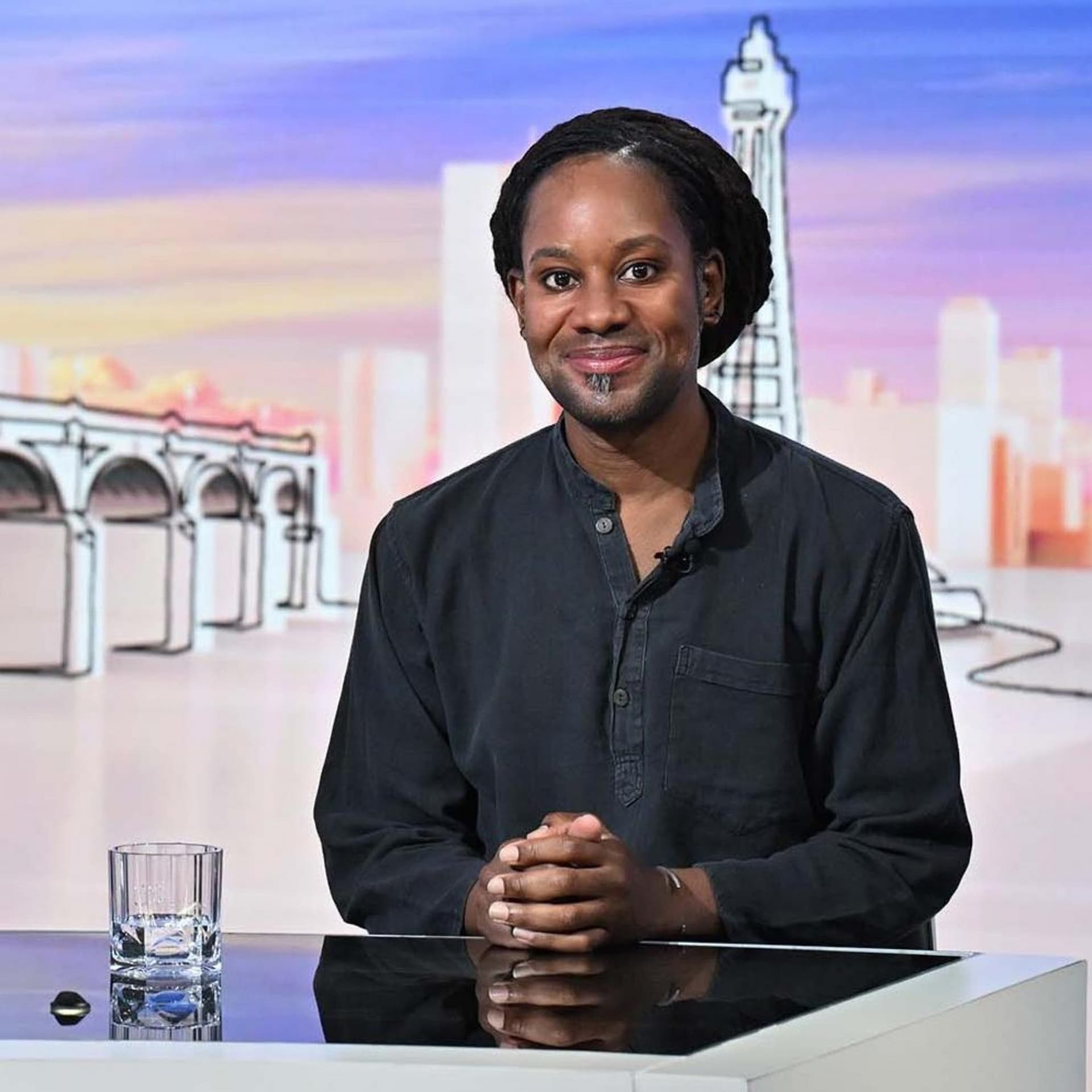
Photo: Jason Arday - a guest on the panel of BBC show Sunday with Laura Kuenssberg in 2025. Credit: Jeff Overs/BBC