
In short
How Prince Andrew’s downfall reflects Jeffrey Epstein’s operating methods, using key photos, allegations, and a pivotal 2019 BBC interview, plus new contradictions from leaked emails and Virginia Giuffre’s posthumous memoir.
Guests
Emily Maitlis, former BBC journalist and host of News Agents podcast; she conducted Andrew’s 2019 BBC interview. No other guest is interviewed.
Guest background
Maitlis is a senior interviewer who faced Andrew at Buckingham Palace; she describes arriving “terrifying,” focusing on interview tenor, and later seeing his language become meme-like.
Key claims
Andrew met Epstein via Ghislaine Maxwell (officially 1999). Photos in 2011 linked Andrew to Epstein after Epstein’s conviction and to 17-year-old Giuffre. Andrew denied sex and denied breaking ties in Dec 2010, but Maitlis says recent emails contradict him. Andrew’s 2019 interview hurt him publicly; he later settled civilly with Giuffre without admitting liability.
Notable examples
Central Park photo (winter 2010/2011 publication), arm-around-photo with Giuffre (17), Andrew’s “shooting weekend” and “Pizza Express in Woking” alibis, and Giuffre’s memoir claims of abuse before Epstein and Maxwell as a “pivotal” enabler.
Written by AI. May contain mistakes. Listen to the episode to check what was said.
Chapters
Tap a time to open that second in VOThe Epstein-Andrew Connection
0:32 to 2:02
Exploration of Jeffrey Epstein's impact on Prince Andrew's royal status.
“Questions about the convicted sex offender Jeffrey Epstein and his alleged associates have dominated the news cycle for months.”
Timeline of Key Events
2:02 to 4:24
The hosts discuss the timeline of Prince Andrew's association with Epstein.
“Well, Tristan, here in the United States, you probably have heard that there's been this bipartisan push in Congress to release the Epstein files.”
The Infamous BBC Interview
4:24 to 7:24
A detailed look at Prince Andrew's controversial interview after Epstein's death.
“and would know that a photo like this would be extremely damaging.”
Emily Maitlis on the Interview Experience
7:24 to 9:16
Emily Maitlis shares insights about her experience interviewing Prince Andrew.
“And then he gives this alibi where he couldn't have been where he was on the night of the alleged sexual relations with Virginia Dufresne because he was, quote, a pizza express in Woking.”
Contradictions and Revelations
9:16 to 14:00
Discussion of inconsistencies in Prince Andrew's statements during the interview.
“Emily, could you tell us a little bit about what it was like behind the scenes in Buckingham Palace that day?”
Prince Andrew's Relationship with Epstein
14:00 to 14:44
Exploration of Prince Andrew's controversial friendship with Epstein and its implications.
“The chicken's way of doing things would have been the phone call.”
Consequences of the 2019 Interview
14:44 to 17:04
Discussion on the fallout from Prince Andrew's interview and subsequent actions taken against him.
“contradicting his claims that he'd severed all links with Epstein after December 2010.”
Virginia Roberts' Memoir Insights
17:04 to 19:05
Insights from Virginia Roberts' memoir detailing her experiences and the role of Ghislaine Maxwell.
“have reached an out-of-court settlement in a civil case filed in New York.”
Complex Relationships with Epstein and Maxwell
19:05 to 23:01
Understanding the complicated dynamics between Virginia, Epstein, and Maxwell as described in her memoir.
“and I don't know if I need to sort of put a verbal trigger warning on some of the stuff that's in it, but she describes a life of abuse that started actually even before Epstein.”
Accountability and Missed Opportunities
23:01 to 25:24
Discussion on the lack of accountability in Epstein's case and the missed opportunities for justice.
“Well, I mean, it feels like there's been very little accountability in the Epstein case.”
Show all 11 chapters
Public Demand for Transparency
25:24 to 26:54
Examination of public calls for accountability and the release of files related to Epstein's case.
“It was absolutely fascinating to talk with Emily about this, and particularly to hear her feelings that there was a lot more still to come out about Epstein.”
Transcript
Automatic transcript. May contain errors.0:00This BBC podcast is supported by ads outside the UK. Hi there, I'm Asma Khalid. And I'm Tristan Redmond. And together we're the hosts of the Global Story podcast from the BBC. For those of you who might be new to our show, we here at the Global Story dive deep every weekday on one big story at the intersection of where the world and America meet. And you can now watch the Global Story on the iHeart app. Catch every brand new episode every weekday. Just tap into iHeart to start watching. And we hope you enjoy the show.
0:37Questions about the convicted sex offender Jeffrey Epstein and his alleged associates have dominated the news cycle for months. Here in the UK, whenever Jeffrey Epstein is mentioned, there's often another name that also comes up. Prince Andrew.
0:57On Friday, Epstein-related pressure had built up to the point that Andrew gave up his royal titles. It was a big, symbolic moment. A way for the royal family to distance itself from him. And on Tuesday, the memoir of one of Jeffrey Epstein's accusers was published posthumously. Virginia Giffray tells a harrowing account of her abuse. She repeats her allegations not just against Epstein, but also against Prince Andrew. Jufres says she was forced to have sex with the British royal on three separate occasions. Prince Andrew has always vigorously denied these accusations. From the BBC, I'm Tristan Redman in London.
1:39And I'm Asma Khalid in Washington, D.C. And today on The Global Story, what the downfall of Prince Andrew tells us about how Jeffrey Epstein operated.
2:02Well, Tristan, here in the United States, you probably have heard that there's been this bipartisan push in Congress to release the Epstein files. There's been this committee and Congress investigating this all. And I will say I have heard Prince Andrew's name mentioned in the context of all this Jeffrey Epstein news, but I don't really know his alleged role in any of this. When and how exactly did Prince Andrew meet Jeffrey Epstein? How did the two of them get to know one another? Well, officially they meet in 1999 and they meet through Ghislaine Maxwell, who's now known as Jeffrey Epstein's co-conspirator in some of his sex crimes as she's currently in jail.
2:43So he was supposedly friends with Ghislaine first. Ghislaine introduces him to Jeffrey Epstein. But their friendship isn't really on anyone's radar until much, much later, until around 2011. And now this is a kind of a key moment in the whole story. Because in that year, two photographs emerge that link Prince Andrew to Jeffrey Epstein. The first one is actually taken in late 2010, but it's published in 2011. And it's a photograph of Epstein and Prince Andrew walking together in Central Park in New York in the winter. They're out taking a stroll. And the reason that this is controversial is that at this moment in time, Epstein is already a convicted sex offender.
3:29Yeah. Yeah. So he served time in jail at this point. And yet, here is Prince Andrew being seen, photographed with him in public. Now, that is quite controversial. Very shortly after that, a second photo is published in the British press. And it's a photograph that you may have seen. It's a photograph of Andrew with his arm around a young woman, Virginia Dufresne. At the moment the photograph was taken, Dufresne was only 17 years old. Andrew has questioned the veracity of this photograph. He says it may not be genuine. But nonetheless, when these photographs come to light, people start to ask themselves, what is the nature of Andrew's relationship with Epstein?
4:14And what is he even doing as a British prince having a relationship with Epstein, who's already a convicted sex offender? I mean, I imagine a lot of people would have questions about that, Tristan. I would imagine that the royal family would be attuned to the court of public opinion and optics and would know that a photo like this would be extremely damaging. Yes, and the publication of these two photographs in 2011 is really the beginning of the kind of unraveling for Andrew. Over the next few years after that, the story sort of dips in and out of the public conversation. But then in 2015, Virginia Giffray takes the allegations further.
4:54So she says that she had sex with Andrew. and that she was trafficked to Andrew by Jeffrey Epstein when she was just 17 years old. She goes on later to say that she and Andrew had sex on three separate occasions. Andrew denies this. And then, of course, the next big stage is in 2019, when Jeffrey Epstein, having been arrested on further allegations of sexual crimes, is then found dead in his cell. At this point, the headlines are nonstop. I remember. And Prince Andrew makes the fateful decision to grant the BBC an interview very shortly after Epstein's suicide. And the interview is a total and utter car crash.
5:43OK, tell me how big of a moment this was. Well, first of all, I would say that this is one of the kind of totemic TV interviews in the history of TV journalism, in my humble opinion. It's kind of right up there with sort of Frost Nixon in the 70s. It's very rare for a member of the royal family to be called to account in a TV interview like this, but also it was just a kind of extraordinarily theatrical TV moment. Now, the things that really stand out about the interview, first of all, that Andrew shows apparently no remorse for his relationship with Epstein. Do you regret the whole friendship with Epstein?
6:20Now, still not. He gives this answer to the allegation from Dufresne that they'd been to a nightclub together and that at the nightclub, Prince Andrew had sweated profusely. And his answer to this is that at the time, he was medically unable to sweat. I didn't sweat at the time because I had suffered what I would describe as an overdose of adrenaline in the Falklands War when I was shot at. and I simply, it was almost impossible for me to sweat. He uses this kind of now legendary, kind of meme-worthy phrase about a straightforward shooting weekend when he's asked whether or not he's thrown a party for Epstein and Ghislaine Maxwell.
7:06Am I right in thinking you threw a birthday party for Epstein's girlfriend Ghislaine Maxwell at Sandringham? No, it was a shooting weekend. A shooting weekend? It was just a straightforward shooting weekend. It was just a, quote-unquote, straightforward shooting weekend, as though all of us have straightforward shooting weekends all the time. And then he gives this alibi where he couldn't have been where he was on the night of the alleged sexual relations with Virginia Dufresne because he was, quote, a pizza express in Woking. I'd taken Beatrice to a pizza express in Woking for a party. So specifically, why would you remember a pizza express birthday and being at home.
7:46Because going to Pizza Express in Woking is an unusual thing for me to do. A very unusual thing for me to do.
8:01That's also such a strange alibi for a prince to give because I will say we, Tristan, had our launch party for a podcast at Pizza Express. I would describe Pizza Express to Americans as kind of like an Olive Garden, Maybe a little higher class than an Olive Garden. A cross between an Olive Garden and a Cheesecake Factory. But all it serves is generally pizza. I would defend the honor of Pizza Express to the day I die. Nonetheless, it is an odd place for Prince Andrew to go with his daughters and to remember having been there more than a decade later. So none of it really stands up. And the interview goes very badly for Prince Andrew.
8:38But the person who interviewed Andrew for this landmark interview is Emily Maitlis. who is a former BBC journalist, now host of the News Agents podcast. And she is our guest today on The Global Story. And we really wanted to speak to Emily today because she's, you know, journalists don't like to become the story, but she is, in spite of herself, a central personage in this whole story because she did that interview. One of the things I really wanted to ask her about was new evidence that's emerged in the last few weeks that contradicts what Prince Andrew told her in that interview about his dealings with Jeffrey Epstein.
9:15And I do want to warn listeners that this interview includes themes of sexual abuse and grooming. 1, 2, 3, 4, 5, 6, 7, 8, 9, 10, 11, 12. Does that sound all right? Sort of thing like this. Everyone happy? Okay. Emily, could you tell us a little bit about what it was like behind the scenes in Buckingham Palace that day? What did it feel like to be in that interview? Terrifying. I arrived at the palace and just felt sick. And I remember thinking, I've got to hide myself away before I meet anyone. And just, I sort of ran off to the bathroom. It's a wonderful chintzy palace bathroom with, you know, beautiful old-fashioned taps and wonderful sort of doilies and towels and all the rest of it.
10:02And I remember just locking the door and sitting with my back to the door thinking, thinking, deep breaths, I have to calm this down. And actually, the most important thing to do before any interview is to just pause and take a beat and hold on to that silence and think, what is this about? What is the tenor of what I'm trying to do here? And so those sort of five minutes just locked in the loo were really important to me as a way of grounding myself. And then I went out and it was in this huge ballroom. And I'm sure that wasn't coincidental, Go on, why would you mean? Well, because it was a much larger room than two people need.
10:43And it was intimidating and it was grand and it was his home. As soon as I was in the chair, the muscle memory of an interview kicks in. Yeah. It's fine. I knew what I was asking and I knew when he said something that I didn't understand that I would go back and say, I'm sorry, because that's what I do. You know, that's what I've been doing for 30 years. But in those first few moments, you're slightly dazzled by the whole thing. What were the key moments for you? I think just the fact that he had come to the interview was key. I went into it just thinking it was astonishing that he'd said yes.
11:21And that actually there were no prejudgments. And from his side, there were no required questionnaires or forbidden questionnaires, which was really important to us as a team. we just thought it was astonishing to be going to talk to a senior member of the royal family about a subject that nobody, nobody had asked about before. And for us, in one way, it made it very simple because anything he said was going to be fascinating. You know, anything he told us about his friendship with Jeffrey Epstein, about his friendship with Ghislaine Maxwell, about what had or hadn't happened, was going to be incendiary immediately because people had never heard it from his mouth.
12:09But I think what we hadn't anticipated was the sort of the phrasing and the language and the explanations would take on a whole secondary life of their own. The whole idea of whether he'd sweated or he was unable to sweat. I mean, people were sort of sending me all sorts of medical definitions afterwards, you know, about the fact that this had never existed and it couldn't possibly be true. And I think there was so much sort of theatre around it that in a way, I think we were in danger of missing the story itself. Him trying to deny in the face of one accuser's full testimony anything that he might or might not have done and him trying to explain his friendship with Jeffrey Epstein.
13:03For you, was there a particular moment where he seemed to damn himself or dig himself into a particular hole, one particular thing that stood out for you? It was the inconsistencies, actually. He described his stay with Jeffrey Epstein in 2010, December. So this was shortly after Jeffrey Epstein had come out of jail. It's about five months after he'd come out of jail. He signed this plea bargain that put him behind bars in a very kind of relaxed, open prison for 18 months. And in December of 2010, Prince Andrew went to stay with him at his townhouse in Manhattan. And he told me it was to break off the friendship.
13:48And I said, well, I don't understand why you'd have to stay with somebody to break off the friendship. And he said, well, I didn't want to take the chicken's way out. The chicken's way of doing things would have been the phone call. But I wanted to do the honorable thing. So he framed it as a moment of honor, of principle, that he would go and stay in the house of a convicted pedophile, that he would then take him for a walk in Central Park. That famous snap of the two of them together was on that occasion. And he stayed for four, possibly five days, he says, before actually breaking off the friendship.
14:29Now, he described to me the moment when he says he had that conversation with Epstein to break off the friendship. And we now know that the friendship was never broken off. In recent weeks, emails from Prince Andrew have emerged contradicting his claims that he'd severed all links with Epstein after December 2010. Or at least there is a very intimate email that was sent by Prince Andrew to Epstein just two months later. A series of emails published in today's Mail on Sunday between the prince and his friend Jeffrey Epstein sent in February 2011. In February 2011, Andrew emails Epstein saying, keep in close touch and we'll play some more soon.
15:08So I've had to revisit that whole conversation. When I asked him, why did you stay with a convicted paedophile? Why did you have to spend nearly a week with him? He said, well, I suppose it was my tendency to being too honourable. You know, it's this unforgettably pompous phrase. And it was because he was too honourable that he wanted to do it in person. And you put that side by side with the email that we've now all seen, which says, we're in this together. Let's play some more soon. Whatever that means, it is a stomach churning phrase to use about a convicted paedophile. And it comes two months after he had sworn, not to me.
15:51I mean, I'm delivering the interview because I'm the journalist, but he told the British public that his friendship ended in December of 2010. It clearly happened. There was huge fallout from the interview that you did in 2019. Could you talk us through what happened afterwards? In the weeks after the interview, which was November of 2019, Prince Andrew was basically removed from public life. He lost a lot of his patronages, both charitable and military. He lost some of his titles then. And he was sort of disappeared from palace life, public life, told to stay away from family engagements. What was complicated was that we were coming up to a significant jubilee year, Queen's Platinum Jubilee, and there would have been pressure on the palace to make their mind up.
16:48You know, is he part of this celebration? Is he not? Is he in the royal family? Is he not? And I think there was a bit of a drip-drift effect, which was what do we do with him? What do we do now? And we know that that led to a settlement. Prince Andrew and Virginia Dufresne, the woman who'd accused him of sexual assault, have reached an out-of-court settlement in a civil case filed in New York. It was a settlement without any implication of guilt for Prince Andrew, but it was a settlement with his accuser, Virginia Dufresne. It was always thought that he would have to settle out of court, and that's exactly what Andrew has now done, without any admission of liability, but with the promise of a substantial donation to Virginia Dufresne's charity in support of victims' rights.
17:35And the ballpark figure, many of us have been told, is around£12 million, paid for by his mother, the late queen. And after that settlement, there was, we now know from the memoir, a gagging order basically put in place that Virginia Giffray was not allowed to speak about anything, not allowed to speak about her abuse for 12 months.
18:03Hi there, I'm Asma Khalid. And I'm Tristan Redmond, and together we're the hosts of the Global Story podcast from the BBC. For those of you who might be new to our show, we here at the Global Story dive deep every weekday on one big story at the intersection of where the world and America meet. And you can now watch the Global Story on the iHeart app. Catch every brand new episode every weekday. Just tap into iHeart to start watching. And we hope you enjoy the show.
18:37So Prince Andrew has kind of melded away slightly into the background, but he's very much back in the foreground now, and that's mostly, it would seem to do with the publication of Virginia Roberts' memoir, a copy of which is on your knee. You've read it. Yeah. Could you just share with us, please, some of the bits that really stood out to you when you read it? It is devastating. I mean, it's really harrowing, and I don't know if I need to sort of put a verbal trigger warning on some of the stuff that's in it, but she describes a life of abuse that started actually even before Epstein. She met Jeffrey Epstein when she was 17 years old, but in her memoir she claimed she was abused before the age of 10 and that she ran away from home.
19:27She was picked up by another predator, another paedophile, who kept her as a sex slave for about six months when she was 15. And that having then left him, she went home and started work at Mar-a-Lago. At first, she thinks it's going to be the making of her. She's told that she's going to become a masseuse and she's going to be trained up. And one day, this car pulls up alongside her and out gets Ghislaine Maxwell. and she describes Ghislaine Maxwell as the apex predator. And why I think that is so important is that many people look at the Epstein story, what they know of it, and say, oh, you know, all these men behave terribly.
20:10And in Virginia, Robert's framing of this, she says that Maxwell was key to what happened in that ring of paedophilia because she normalized it for the girls. In other words, she looked at this smart woman with her posh voice and her British accent and her lovely clothes and Ghislaine made everything seem okay. You know, nothing could really be bad if there was a woman in the room when she was giving the massage to Epstein. And so I think Ghislaine Maxwell's role through Virginia's eyes is absolutely pivotal. Well, how did she come across? Well, she says they were less girlfriend than boyfriend and more two halves of one wicked whole.
20:56It is Maxwell that takes Virginia into massage Epstein at his home the first night that they meet. And she tells her how to massage, what he likes to have done. And every time Virginia Dufay is pulling back saying, oh, this feels a bit weird. This feels a bit weird. She looks across at Maxwell and Maxwell's like, don't be silly. nonsense just take your clothes off just you know he's going to turn over and he's naked and in her memoir she goes on to describe how she was made to feel complicit in this arrangement and I think many people have asked the question why does she stay for two years you know there were no bars on the windows there were no locks on the doors she was getting paid she had an apartment why couldn't she leave and it's a really hard thing obviously for me to be able to answer without Virginia as Euphrae, but the understanding she gives in the memoir is that Epstein had a photograph of her younger brother on his desk, said, well, we know where your brother goes to school and I own the Palm Beach police.
22:00And not only did they control her, but they also made her procure other girls for them. And she says, this is the real low point. This is the worst thing she's ever done in her life. She talked to young girls and said, you have to know what you're getting yourselves into, but here's the pocket money, here's the deal. And she brought other girls forward, something that she deeply regrets. And it's a very complicated relationship she has with Epstein and Maxwell. Sometimes they're like her family, you know, so she thinks of Ghislaine as her mother and she thinks of Epstein as her dad. And after the sex, he sort of tries to educate her and she says he was my mentor, not my predator.
22:41And he wants to tell her about ancient Greece. He wants to tell her about Roman mythology. He wants to tell her how the markets work. They go off to art galleries. They visit the Louvre together. You know, they are sort of this weird, dysfunctional family. And I don't think anyone can understand that if they haven't come from a place of childhood abuse. Well, I mean, it feels like there's been very little accountability in the Epstein case. Epstein himself died by suicide. your interview with Andrew is kind of held up as a very strong example of holding someone powerful in this case to account.
23:20I just wonder how you feel about your role in all of this and whether we might expect that more people might be held accountable for their actions in the Epstein case. There's more to be done. That's how I feel. There's a lot more to be done. If you go back to the police investigation of 2006, 2007, the Palm Beach Police brought together, I think it was around 40 victims, young girls, women, who were all prepared to tell their story, who were all prepared to sit down in gruesome detail, recount what Epstein had done to them. and they hoped to see a trial take place. And Epstein was arrested and was initially charged.
24:07And then suddenly that all disappeared. It turned into a plea bargain. He ended up with a ridiculously light sentence. It was 18 months in an open prison, pretty much, where he came and went by day, slept in the prison by night. We do not know what happened. We know that something happened in the Department of Justice which led to a change. Why was Epstein let off with incredibly light plea deal? It was one count of soliciting a minor and one count of prostitution. How did so much work? How did so much testimony? How did so many victims' accounts come down to that? He wasn't really incarcerated.
24:50He wasn't punished. He definitely wasn't reformed. From what we understand, from the accounts I've read, he was still able to procure young women, even during that 18 months. So I guess that's what I feel. I just think the opportunities missed, the opportunities missed to put him behind bars when they could have done are extraordinary. And somebody knows so much more about what went on than we do.
25:23Emily, thank you so much.
25:28It was absolutely fascinating to talk with Emily about this, and particularly to hear her feelings that there was a lot more still to come out about Epstein. Yeah, I mean, it was fascinating to hear Emily and to hear you guys' conversation. And I do think that this Epstein saga is one that spans the globe in an unusual way. You know, hearing about Prince Andrew and his ties to Jeffrey Epstein, it made me think of this interview that we saw just this week that Congresswoman Marjorie Taylor Greene from the state of Georgia gave to the BBC. You know, she is the rabble-rousing Republican congresswoman.
26:06And she said that Prince Andrew ought to step forward. Prince Andrew should step forward. I would say anyone that was a witness to what was going on, the best thing they can do is to come forward and tell what they saw. And the congresswoman isn't alone. Recent polling has shown that most Americans, about three quarters of Americans, want to see the release of all files related to the Jeffrey Epstein case. In fact, Donald Trump himself, when he was running for president, called for the release of these files. But now, you know, he seems to have changed his mind. I will say that listening to this whole story, it makes me think of how much of this Jeffrey Epstein saga is still unknown.
Read the full transcript
26:53And there is a hunger for accountability.
27:02And that's it for The Global Story today. This episode was produced by Sam Chantarac, Lucy Paul, and Zandra Ellen. The executive producer and senior news editor was China Collins, and it was engineered by Travis Evans. And folks, if you liked today's episode, please take a moment to rate us wherever you listen to podcasts. It helps other people find our show. You can also get in touch with us by emailing theglobalstory at bbc.com. You can send us your thoughts, your questions, your ideas for a future episode. Again, that's theglobalstoryatbbc.com. And thanks, as always, for listening. Cheerio.
27:59Hi there, I'm Asma Khalid. And I'm Tristan Redmond, and together we're the hosts of the Global Story podcast from the BBC. For those of you who might be new to our show, we here at the Global Story dive deep every weekday on one big story at the intersection of where the world and America meet. And you can now watch the Global Story on the iHeart app. Catch every brand new episode every weekday. Just tap into iHeart to start watching. And we hope you enjoy the show.
28:31Thank you.
From the publisher
***This episode contains themes of sexual abuse and grooming*** The memoir of Virginia Giuffre, one of Jeffrey Epstein's most well-known accusers, was published posthumously this week, repeating allegations against Epstein as well as Prince Andrew. The revelations come as Prince Andrew gave up his royal titles, amongst renewed and increasing scrutiny over his relationship with the convicted sex offender Epstein. Prince Andrew continues to vigorously deny all the allegations, but the loss of his titles is a big symbolic moment that allows the rest of the Royal Family to distance themselves from him.
His downfall was accelerated by a disastrous 2019 interview with the BBC. We speak to the interviewer Emily Maitlis, now host of the News Agents podcast, about that day, and how Prince Andrew’s story gives us an insight into the ways in which Jeffrey Epstein functioned.
Producers: Sam Chantarasak, Lucy Pawle and Xandra Ellin
Executive producer: China Collins
Sound engineer: Travis Evans
Senior news editor: China Collins
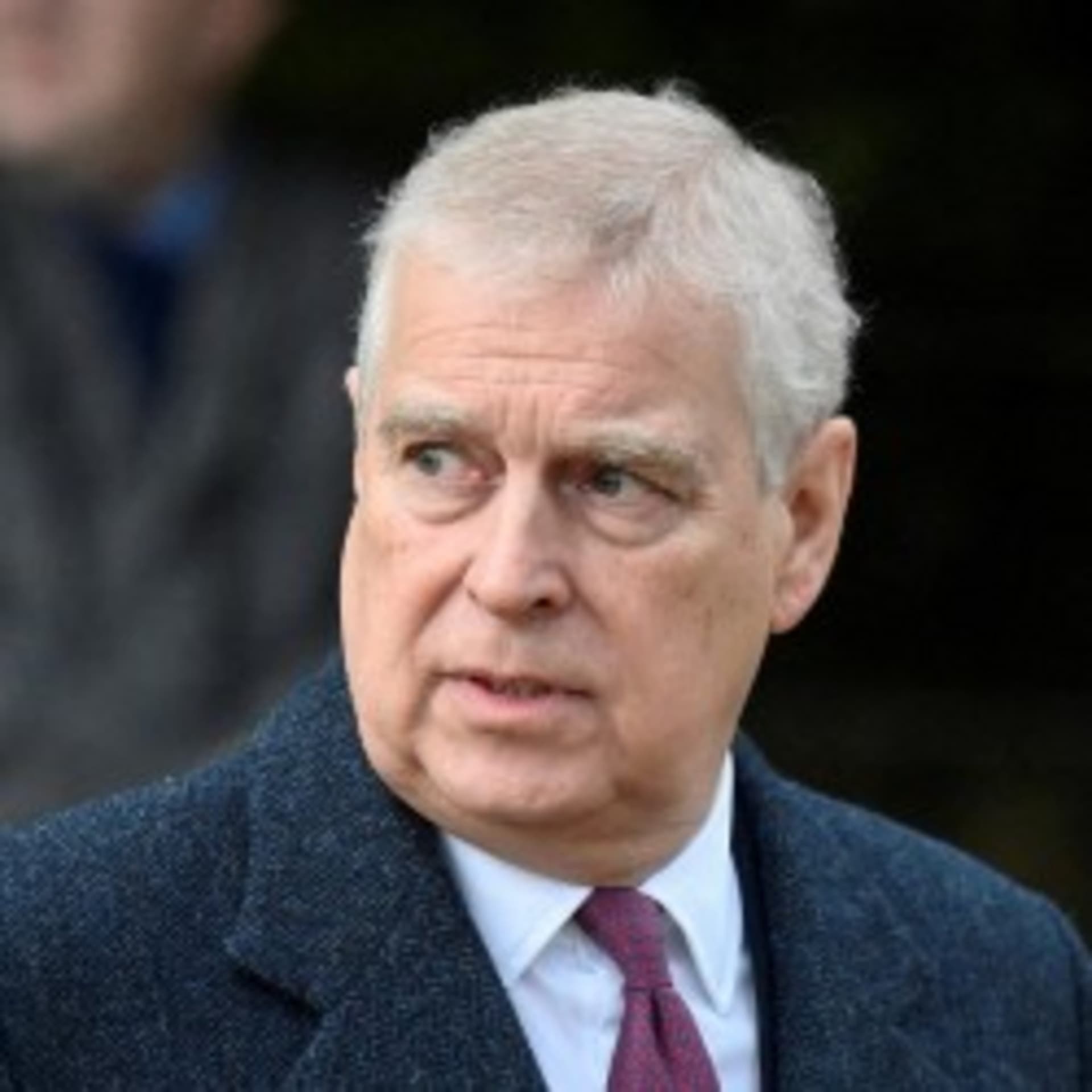
(Photo: Prince Andrew. Credit: Toby Melville/Reuters)