
In short
Listener Q&A on the U.S.-Israel war against Iran, regional spillover, and possible outcomes (Lebanon, Gulf states, ISIS/regime change, and international law).
Guests
John Simpson, BBC World Affairs Editor (worked at BBC since 1966; covered Iran’s 1978–79 revolution; expelled from Iran in 2009 after protests over Ahmadinejad’s disputed election). Hosts: Tristan Redman (London) and Asma Khalid (Washington, D.C.).
Key claims
Israel/US aims haven’t been achieved; killing senior leaders (e.g., Ali Larijani) may not destroy the system. Iran’s attacks on places like the UAE are framed as retaliation and signaling control. Iran’s anti-U.S./U.K. sentiment is rooted in 1953 oil-industry coup (Mossadegh overthrown with CIA/UK help) and subsequent hostility, not personal hatred of individuals. The U.S. isn’t bound by the ICC because it withdrew/was never a signatory, so Netanyahu’s ICC warrant doesn’t compel arrest in the U.S. Lebanon’s weakness is limited capacity plus sectarian divisions; Hezbollah is both political and military, weakened by Israeli strikes but not eliminated. Gulf states likely won’t fight on the ground in Iran.
Notable examples
1953 Mossadegh overthrow; 1978–79 revolution; U.S./Israel nuclear strikes on Iran (referenced as “last June”); Ali Larijani assassination; Iran attacks on UAE (Dubai); Israel strikes displacing hundreds of thousands in southern Lebanon; ICC warrant for Netanyahu tied to alleged war crimes/crimes against humanity in Israel–Hamas war; ISIS said to have no foothold in Iran due to Iran’s Shia majority.
Written by AI. May contain mistakes. Listen to the episode to check what was said.
Chapters
Tap a time to open that second in VOListener Questions and Introduction of John Simpson
0:54 to 2:41
Hosts discuss listener questions about the U.S.-Israel war in Iran and introduce expert John Simpson.
“The US President Donald Trump says the US is not ready to make a deal to end the consequences of Operation Epic Fury continue to be felt around the world.”
Current Status of the Iran Conflict
2:48 to 4:42
John Simpson describes the current state of the conflict and its complexities.
“So I've got a certain background in Iran.”
Consequences of Attacks in the Region
4:47 to 8:31
Discussion on the implications of recent attacks on leadership in Iran and the region's stability.
“Decapitating quite a large number of the leaders of the system has not been enough to destroy the system.”
Historical Context of U.S.-Iran Relations
8:32 to 11:15
Exploration of the historical reasons behind Iran's sentiments towards the U.S. and Britain.
“But this episode is really about the questions that listeners have sent us.”
Perceptions of Americans and British in Iran
11:16 to 14:00
John Simpson shares anecdotes illustrating Iranian attitudes towards Western individuals versus governments.
“That was something which blackened the relationship between the two of them.”
Personal Experience in Iran
14:00 to 14:39
Hear a compelling personal anecdote about respect and welcome in Iran.
“And I thought, yeah, I've got to because the camera's on me.”
Question from Harry on Netanyahu and International Law
14:39 to 15:30
A listener raises concerns about Netanyahu's legal standing amidst international law.
“And I should say, for the absence of doubt, that's Birmingham in the UK rather than Birmingham, Alabama.”
Understanding the ICC and Netanyahu's Situation
15:30 to 17:45
Discussion on why the U.S. isn't obligated to arrest Netanyahu under the ICC.
“Bush, first of all, refused to ratify the agreement.”
Question from Lodi on Lebanon's Future
17:45 to 19:18
A listener inquires about the complexities of Lebanon's political landscape.
“It is open to a country to say it won't do what it's supposed to do.”
John's Insights on Lebanon's Challenges
19:18 to 21:40
Exploration of Lebanon's vulnerabilities and Hezbollah's power dynamics.
“One, it's small and not poor, but nevertheless not wealthy enough to be able to defend itself in the way that it ought to be able to defend itself.”
Show all 13 chapters
Question from Jack on Gulf States and Iran
22:02 to 23:50
Inquiry into the potential role of Gulf states in the Iran conflict.
“Let's move on to the next one, which is from Jack from Sheffield in the UK.”
Exploring Military Involvement in Iran
23:50 to 26:59
Discussion on military capabilities and political will of Gulf states regarding Iran.
“You cannot tell from my accent, but Michigan is my birth state.”
Question from Tracy on ISIS and Power Vacuums
26:59 to 28:00
Listener questions the potential rise of ISIS if Iran's regime falls.
“But they themselves, the Kurds themselves, said they didn't really want to do it And that seems to have fallen away Who are the troops going to be?”
Transcript
Automatic transcript. May contain errors.0:00This BBC podcast is supported by ads outside the UK.
0:30to music moguls and celebrity CEOs. We'll be taking a closer look at the lives and fortunes of some of the world's richest people. And asking you to decide if they're good, bad, or just another billionaire. Good Bad Billionaire from the BBC World Service. Listen now or search for Good Bad Billionaire wherever you get your BBC podcasts.
0:53The headlines coming out of the Middle East every day can feel dizzying. A war now into its third week. The US President Donald Trump says the US is not ready to make a deal to end the consequences of Operation Epic Fury continue to be felt around the world. It's hard to make sense of it all sometimes, and you've been sending us your questions. Hi there. Hi Tristan and Asma. Hi Global Story team. Today on the show, we answer them with a little help from the expertise of a BBC legend. From the BBC, I'm Tristan Redman in London. And I'm Asma Khalid in Washington, D.C. And you're listening to The Global Story.
1:39Today's episode is really special because it is based off of all the brilliant and in-depth listener questions that you all have sent us. We really appreciate it. You guys have sent so many, many smart questions about the U.S.-Israel war in Iran and the impacts that that war is having across the region and, frankly, across the world. So thank you all for getting in touch. And we have picked a few choice questions that you've sent in to us. And we've also picked a very special person to help us answer these questions, a man who knows his way around the Middle East, a BBC legend, Mr. John Simpson.
2:15John, if you could just introduce yourself, please, for us, for our listeners, that would be fantastic. Sure. My name is John Simpson. My extremely grand and undeserved title is World Affairs Editor of the BBC. I've worked for the BBC since 1966, which is a rather long time, and I'm 81 years old. In my lifetime, I covered almost the full extent of the revolution in Iran in 1978 to 9. And I flew back to Tehran with the Ayatollah Khomeini on his flight from Paris. Oh, wow. To kick the whole thing off. So I've got a certain background in Iran. You've got the long view. Yes. I haven't been allowed back.
3:07I was thrown out of Iran in 2009 during the rioting which followed the stolen election of President Ahmadinejad, the second election. And I've never been allowed back since, but it's a country I know or have known well and love very, very dearly. Well, I think we really have got the right man for the job. We're very pleased to have you here, John. Thank you so much for joining us. John, it's a pleasure to have you on the show. Today is really about answering the brilliant listener questions that we have. But I hope you don't mind, I hope listeners don't mind, that before we dig into their questions, we've got a couple of our own first, a bit of host privilege here.
3:47You know, so much has happened since the United States and Israel first struck Iran more than two weeks ago. And there is so much news coming out of the region every day that, I mean, frankly, it can feel quite dizzying. And so we want to begin by just asking you where you would say the war stands at this moment. I think it stands almost equidistant between the aims that Israel in particular, but also the US, set out and the failure of those aims. And it's too soon to know what's happening. But it is clear that the kind of spirit with which Israel and the persuasive power of Prime Minister Netanyahu, where President Trump was concerned, has not been achieved.
4:43It hasn't been a quick or an easy campaign. Decapitating quite a large number of the leaders of the system has not been enough to destroy the system. We've now got the killing of Ali Larajani. Let's begin now with breaking news. The Secretary of Iran's National Security Council, Ali Larajani, was assassinated in overnight strikes on Iran. The head of the Supreme National Security Council, is that right? Yes. He was probably the dominant force in the leadership that remained. He's now gone. I mean, I've met him, I think, four or five times. A rational, not what you might call a headbanger, a man you can have a discussion with, even though he clearly doesn't like you or agree with what you say.
5:36The kind of person that President Trump himself actually seemed to indicate they needed to have as somebody to discuss with. And that is, I think, going to be a problem because it seems pretty clear that the supreme leader, the younger Khamenei, is not a man of great intellect or understanding. And if he's the interlocutor, then I think that there are greater problems than if Laragiani had been. But, of course, there's no indication that there would be a deal negotiated. But, you know, I mean, one of the principles always in fighting a war is to work out how you get out of it. And one of the possible ways is by negotiating a peace deal with a senior figure.
6:28and simply to destroy entire layers of leadership, it can be more of a nuisance and a difficulty than it can be a success. How concerned are you about the fact that the war is spreading outside of Iran through the region? Well, of course, that's Iran's way of saying you may hit us and you may hit us hard, but we can hurt you back. We can hurt your pride. We can hurt your reputation. And we can show that we're still in full control of ourselves and our weaponry. I mean, in terms of the actual attacks that Iran carried out on the UAE, for instance, in Dubai, they were, of course, headline news right across the world.
7:23But in terms of death and destruction, they weren't perhaps that significant. I mean, nothing that compared with what Israel, for instance, has done in Gaza. And yes, there were 20 or 30 people who died in the UAE, a tragic number, but it's a relatively small number for this kind of war. Yes, there were some absolutely significant attacks on buildings, on quite famous buildings, but not the kind of destruction that we've seen in other places. It's just that supposedly it doesn't happen in the UAE. The UAE is not that kind of country. It's a country which welcomes people from all over the globe to come in there and spend and invest their money.
8:17And the shock was not the scale of the damage or the number of deaths. The shock was that it would happen at all in a country which was simply there really to encourage the making of money. So, John, thank you for answering the questions that we had on our mind. But this episode is really about the questions that listeners have sent us. And so why don't we begin with our Our first question, which comes to us from Greg in Arizona. Hello.
8:49John Simpson:I'm interested in learning the underlying reasons for Iran's dislike of the United States government. I'm especially curious regarding how the United States and Israel may have contributed to or fomented that dislike. Specifically, is there an arguably valid basis for the belief that this dislike is a result of our government's own doing? Take it away, John. Well, I want to make a point right at the start. When we say Iran's dislike of America, of Britain, actually, which figures very largely in the minds and imaginations of Iranians, it doesn't extend to a dislike of the country and it doesn't extend to a dislike of individuals.
9:35This is not true of Israel, which is disliked on a much deeper and more visceral level. And it goes back, as everything does, to history. 1953, the prime minister of Iran, Musadegh, had taken a nationalistic approach to Iran's oil supplies, wanted more for them than the British in particular, who pretty much ran the Iranian oil industry at that stage, were prepared to pay. There were demonstrations and Britain, with the strong help of the CIA, the American CIA, overthrew Mossadegh and ensured that the government of the young Shah would stay in power for, what, 30 years afterwards. And there was a lot of dislike of Britain and the US as a result of that.
10:36And the feeling always is that in Iran is that everything is kind of manipulated by, well, it used to be Britain, less so now, but by America. America's behind everything. So it's not a personal thing in any sense, but there is definitely a feeling that the Khomeini revolution in 1978 to 9 wouldn't have happened if the British and Americans had not overthrown Mossadegh all those years earlier in 1953. Does that sentiment continue on to the present with the U.S. government's actions in more recent years? Well, Iran and the US have had nothing except bad relations ever since the revolution, the kidnapping or the capture of the American hostages.
11:28That was something which blackened the relationship between the two of them. And ever since, Israel's attacks on Iran of different kinds have always been, I think, supported by the United States or almost always. And the United States is seen as the big international enemy of Iran by Iranians themselves. You know, you've only got to go back to last June to the attacks which the US with Israel carried out on the nuclear facilities in various parts of Iran. But, I mean, there are examples after examples after examples. Trade pressures on Iran. Sanctions. All sorts of different ways in which the United States has tried to isolate Iran, just as Iran, of course, has carried out extraordinary numbers of attacks, most of which go completely unreported on Western interests.
12:33And so nobody is entirely able to say, well, you know, we're the innocent party in this. John, you mentioned that it's nothing personal, that there's a distinction made between dislike of, say, the American government and the British government and American or British people. What have you seen in terms of actual affection in Iran for American or British people? Well, if I can tell you one of my rambling stories, there was a big demonstration in Tehran in, it must have been about 1985 when I was there, and thousands and thousands of people chanting death to Britain, death to Thatcher, Margaret Thatcher.
13:12And I said to my cameraman, stand up on this low wall and film me walking through the crowd. And the cameraman was a very gentle, rather paternal figure. And he said, John, I really don't think you should do this. It's too dangerous. And I said, I think I know what I'm doing. And I walked through the crowd and people beating their chests and saying, Mar, bar, Anglia, death to England. And as I'd come up to them, I would say, I work for the BBC, I'm English. And they would shake my hand. And finally, there was a man who was going absolutely berserk. He actually was, I think, the sort of organizer of the demonstration.
13:55And there was spit everywhere and he was shouting, he was going crazy. And I thought, shall I go up to him? And I thought, yeah, I've got to because the camera's on me. And I went up. I promise you this is true. He went down on his knees and kissed my hand and said I was welcome in Iran. So, you know, I think it's, you know, clever people who are heavily controlled, and this applies across the world really, do always tend to think everybody else is kind of as weak as they are and it's only their governments that are evil and brutal They make a distinction which we often in the West, for instance, don't make between individuals and the government.
14:39John, we're going to trot on to our second question, which is from Harry in Birmingham. And I should say, for the absence of doubt, that's Birmingham in the UK rather than Birmingham, Alabama. So, Harry, take it away. Hi, Tristan and Asma. I have a question which came from listening to your excellent interview with Jeremy Bowen on March the 6th. How is Benjamin Netanyahu able to have a face-to-face conversation with Trump at Mar-a-Lago when there is an international warrant out for his arrest from the International Criminal Court? And more broadly on Iran, does international law have any power or meaning anymore if no one is prepared to stand up and enforce it?
15:29Thank you. I hope you're both well. This is a brilliant show. I listen to it every day. Thank you for that nice bit of praise. That's very nice. Well, I'm afraid, Harry, the answer is very, very simple, that although under President Clinton in the year 2000, the United States signed the agreement setting up the International Criminal Court, just a couple of years later in 2002, his successor, George W. Bush, first of all, refused to ratify the agreement. and then formally withdrew from it. So the United States isn't required to arrest Mr Netanyahu or anybody else who's charged with international crimes of any kind.
16:20It's not a signatory. There are 123, I think, signatories to the agreement, but the United States isn't one of them. And, you know, if Mr Netanyahu flies from Israel to the United States, probably crosses, I don't know, dozens of countries, but no country is obliged to kind of order down the plane or anything if it knows that somebody wanted by the international criminal courts on board. So everything that he did in going to the US was entirely above board. And just to remind listeners what the actual arrest warrant for Benjamin Netanyahu from the ICC is for, the judges of the ICC said there was, quote, reasonable grounds for criminal responsibility for alleged war crimes and crimes against humanity during the war between Israel and Hamas.
17:15and that the warrant applied to three people, including Benjamin Netanyahu and one Hamas leader and one other Israeli leader. And Israel and Hamas have both rejected the allegations. Just to be really clear before we move on, if Benjamin Netanyahu were to visit one of these countries that has signed on to the International Criminal Court, say like the United Kingdom, would that country be obliged to arrest him? And has he visited any of those countries? He hasn't visited any other country that's been reported, which is a signatory, no. What has sometimes happened with other people is that countries unilaterally say, and I think certainly South Africa did this with Vladimir Putin, that if he went to South Africa, it would not uphold its duties to the ICC and it wouldn't arrest him.
18:13It is open to a country to say it won't do what it's supposed to do. All right, on to the next question. This comes from Lodi from Ottawa in Canada.
18:25John Simpson:I've become a loyal listener of the Global Story and Global News podcast, Actually Addicted, because I appreciate the breakdown of stories and facts reported in the manner that you do. So I'm very curious to hear a segment about Lebanon and the current situation with the war, meaning what is the stand of Hezbollah, Israel and beyond? And what is the future of Lebanon as it stands currently? Thank you. Well, Lodi, thank you very much for your question. And before we go to John for an answer, I just want to say that we are actually working on an episode on that very topic, which will be specially dedicated to you.
19:10But in the meantime, you're going to get John's answer too. So please, John. Well, Lebanon is a lovely country, but it has two weaknesses. One, it's small and not poor, but nevertheless not wealthy enough to be able to defend itself in the way that it ought to be able to defend itself. And secondly, it's riven with divisions that are ethnic and religious. And that has been a huge weakness. Hezbollah grew up in the aftermath of the revolution in Iran, which galvanized Shia Muslims right across the world, in fact, but particularly in Lebanon. And Hezbollah is not only a militia group, but it's also a political organization then in Lebanon.
20:07It is, yes. But it started off as a political party with a military wing to it. And now the military wing is the greater influence and greater power. Nevertheless, over the last three years, Israel has been hitting southern Lebanon so hard that Hezbollah has been very seriously damaged. And now Israel is moving in in force. Hundreds of thousands of people displaced in southern Lebanon, forced to go northwards. Israel's trying clearly to wipe out the last remnants of Hezbollah's military prowess. Whether it'll succeed, it hasn't succeeded in the past. It's weakened Hezbollah very greatly, but it hasn't so far destroyed it as a military grouping.
21:04In principle, you don't really stamp these things out ever. you can weaken an organisation like Hezbollah, but it's very, very difficult to destroy it.
21:40Celebrity CEOs. We'll be taking a closer look at the lives and fortunes of some of the world's richest people. And asking you to decide if they're good, bad or just another billionaire. Good, bad billionaire from the BBC World Service. Listen now or search for Good, Bad, Billionaire wherever you get your BBC podcasts.
22:02Let's move on to the next one, which is from Jack from Sheffield in the UK.
22:08John Simpson:Hi, Global Story team. What I'm wondering is whether the Arab Gulf states might get drawn into the Iran conflict as the boots on the ground for stabilisation and peacekeeping, if not for a more active regime change role. Would they have the military capability or political will if they were put under enough pressure? And were the US and Israel likely ambivalents to reaching a stable conclusion to the conflict? Very good question. Yeah, it's an excellent question. I don't think there's any desire, no will, no, hasn't been any need because outside countries like Britain and the US in particular have helped them, armed them, protected them and so forth.
22:49So there's been no need. There wouldn't be, I mean, it's impossible, I think, to think of a Gulf army that could move into Iran and do anything. They wouldn't want it. They're trading nations. They don't want to be military powers. Can I just ask you then in that case, both the UAE and Saudi Arabia waged a campaign in Yemen against the Houthis on the ground. Is the idea of them participating militarily in an effort against Iran just a different order of magnitude that would make it impossible for them? I think that's one part of it. But also, you know, I mean, it was the Saudis that were the backbone of that and the Gulf states came in and helped.
23:34But it was, I mean, the Saudis have got an army, quite an effective and well-trained and well-armed army. But they show no signs of wanting to get involved on the ground in Iran. Let's go to our next question then, John, which is from Tracy in Michigan, which I'm very pleased to hear from you, Tracy, because I'm also from Michigan. You cannot tell from my accent, but Michigan is my birth state. Were you really born in Michigan? I was born in Michigan. I was born in Detroit. British parents? British parents who were living and working in the United States. So great to hear from you, Tracy. Thank you.
24:13Take it away.
24:15John Simpson:I've been listening to your terrific coverage of the ongoing war in Iran and across the Middle East. One of the scenarios that this conflict could end in is the Iranian regime falls and leaves a power vacuum. We've been hearing that Hezbollah and Hamas have been weakened, but I am wondering about the strength of groups like ISIS. If the regime falls, or even if it doesn't fall, but is severely weakened, could a group like ISIS try to take advantage, as they did during Iraq's power issues and the Syrian civil war? Well, I think we ought to kind of make one or two things clear here. ISIS doesn't seem to have even the slightest foothold in Iran, not even in the relatively small areas where Sunni Muslims are living.
25:07Iran is a very largely Shia Muslim country, and it's regarded as an enemy by ISIS. Iraq, on the other hand, has in fact probably got a Shia majority, but it's also got a very strong Sunni minority. And that's why ISIS was operating so heavily in Iraq and as it does in other places where it's got at least a foothold because of a Sunni population. So I don't think there's any question of ISIS getting involved in the long term story in Iran. The question of whether the regime in Iran is going to be overthrown is a very, I mean, we can't tell at this stage. I mean, it must be a possibility, as Israel in particular is pushing for, that the regime will be so weakened and the Islamic Revolutionary Guards will be so depleted that eventually the strength of the remaining figures in the regime will be destroyed and they'll be able to crush what's left of the regime.
26:30That must be a possibility. But at the moment, we're not seeing any great signs of that. And people seem to be stepping up to take the places of leaders who are killed and so forth. So that's a possibility, but it's not very likely. And it's now become a cliche of this whole operation. But you can't really get regime change without having boots on the ground. The United States seemed to have an idea of bringing in the Kurdish groups from the northwestern edges of Iran But they themselves, the Kurds themselves, said they didn't really want to do it And that seems to have fallen away Who are the troops going to be?
27:17Well, unless they're American, unless they're Israeli, it's very, very hard to see who else is going to step in Thank you very much, Sean. Thank you, John. Well, thank you, both of you, very much.
27:37That's it for The Global Story today. Thanks again to the BBC World Affairs editor, John Simpson, for helping us answer your questions. And if you enjoyed our show today, then please take a moment to rate us. It really helps other people to find the show. And by the way, a quick recommendation before we wrap. If you're looking for a way to catch up on the latest news headlines from around the world, then we recommend checking out our sister show, The Global News Podcast, and you can find it wherever you listen. Today's episode was produced by Hannah Moore and Zandra Ellen. It was edited by Bridget Harney and mixed by Travis Evans.
28:10Our studio manager was Johnny Hall. Our senior news editor is Chyna Collins. And I'm Asma Khaled. And I'm Tristan Redman. And thanks, as always, for listening. We'll talk to you again tomorrow. Cheerio.
From the publisher
Since the start of the US-Israel war on Iran, The Global Story listeners have been contacting us with questions: about the causes of the war, the legality of it, and how other countries are responding. As Gulf states get drawn further into the conflict, might they send military reinforcement? And if the Iranian regime were to fall, could islamist groups such as Isis seize an opportunity to claim more power?
In today’s episode, we answer all of these and more, with BBC world affairs editor, John Simpson. Producers: Hannah Moore and Xandra Ellin Sound engineer: Travis Evans Senior news editor: China Collins
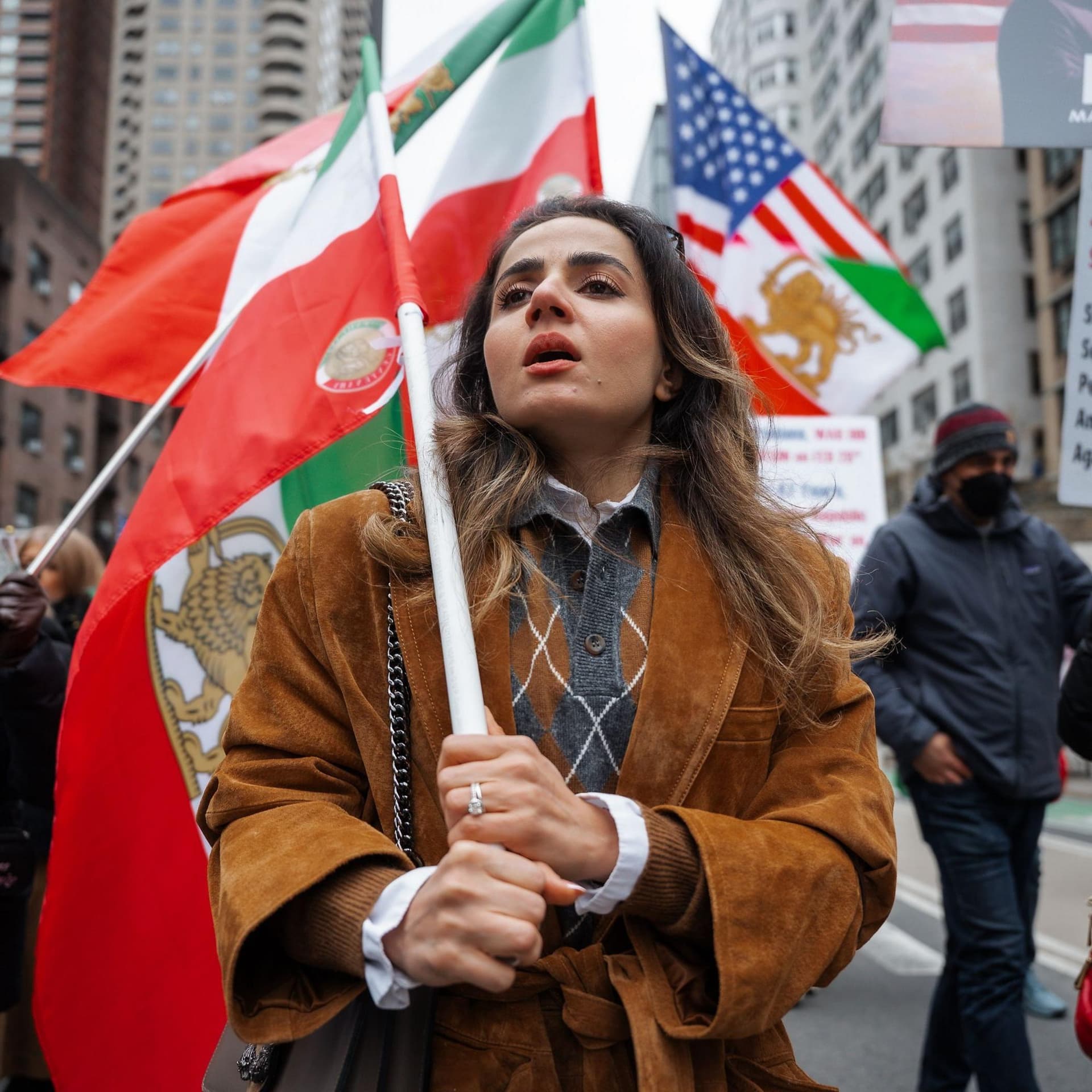
Photo: A woman marches with an Iranian monarchy flag during a 'Freedom for Iran' protest in New York, New York, USA, 15 March 2026. Credit: Olga Fedorova/Shutterstock