
In short
A live Global Story BBC episode (taped at Syracuse University) looking ahead to 2026 amid “ruptures” in the world order, focusing on US foreign policy, alliances, and flashpoints (Minneapolis domestic unrest; Europe; China; Iran; Gaza; and Trump’s “Board of Peace”).
Guests
Tom Bateman, BBC State Department correspondent; previously spent many years in the Middle East. Emma Ashford, senior fellow at the Stimson Center; author of First Among Equals: US Foreign Policy in a Multipolar World.
Key claims
Minneapolis showed opposition to Trump “finding its voice” after federal immigration actions; Europe is increasingly anxious about US unpredictability and costs of dependence; Trump’s China approach is more personal (G2 language) and tariff-driven leverage may not change outcomes; Gaza’s ceasefire is fragile because Gaza is effectively split and permanent measures risk entrenchment; the Board of Peace functions as a rival, personalistic governance mechanism that may outlast Trump.
Notable examples
Minneapolis killings (Renee Goode; Alex Pretti), Davos/Munich remarks by J.D. Vance and potential Rubio attendance, Venezuela raid, AfD meeting, record China trade surplus, Gaza “yellow line”/Rafah crossing limits, and the Board of Peace clause keeping Trump as chair.
Written by AI. May contain mistakes. Listen to the episode to check what was said.
Chapters
Tap a time to open that second in VOSetting the Stage for Discussion
0:38 to 1:51
Hosts discuss the whirlwind start of 2026 and introduce the day's theme.
“I mean, it's been a whirlwind start to 2026.”
Introducing Guests and Context
1:51 to 3:05
Hosts introduce special guests and establish the focus on international stories.
“From the BBC, I'm Asma Khalid in Washington, D.C.”
Minneapolis Reporting Insights
3:05 to 4:19
Tom shares his experiences and insights from reporting in Minneapolis.
“But of course, one of the biggest stories that we have already seen in Trump's second year thus far, second year of his second term, is Minneapolis.”
Analyzing the New Normal in Minneapolis
4:19 to 7:11
Discussion on the changing atmosphere in Minneapolis and reactions to events.
“And that report was actually about a week, I think, after Renee Goode was killed, but before Alex Pretti was killed.”
Transitioning to Foreign Policy Themes
7:11 to 8:34
Focus shifts to foreign policy as Emma discusses her book and its relevance.
“We had to ask Tom about Minneapolis because he's just come back.”
Trump's Impact on European Relations
8:34 to 10:00
Discussion on Trump's influence on U.S.-Europe relations and upcoming events.
“Organizers of this very conference have banned lawmakers representing populist parties on both the left and the right from participating in these conversations.”
Reactions of Europe and Canada to U.S. Policies
10:00 to 12:20
Emma discusses the shifting dynamics in Europe and Canada regarding U.S. policy.
“And Tom, you cover Rubio quite in depth.”
Implications of U.S.-China Relations
12:20 to 14:01
Exploration of the upcoming diplomatic engagements between Trump and China.
“Whether or not that's the reason he's not there, I think is a different matter.”
European Security Concerns
14:01 to 14:32
Discussion on Europe’s response to security threats and capabilities.
“And some of that actually is a realization that it's going to take time, right?”
US-China Relations Under Trump
14:32 to 15:30
Analyzing Trump's approach to China and trade tariffs.
“Well, I mean, we really want to talk to you today a little bit about China because President Trump has said he will travel to China in April and that he has invited President Xi Jinping to the United States in August.”
Show all 18 chapters
China's Position in Global Politics
15:30 to 17:58
Exploring China’s perception of Trump's leadership and influence.
“And so I think I think the reality is that what you're seeing in, you know, in the tariffs issue is an attempt by Donald Trump to sort of prove this point that, to put it bluntly, said, you know, the U.S.”
Middle East Dynamics and Trump's Policy
17:58 to 20:04
The impact of Trump's actions on the Middle East, specifically Gaza.
“And yet we have seen the year start with an absolute intervention in Venezuela.”
Challenges in Gaza Post-Ceasefire
20:04 to 21:54
Discussing the ongoing situation in Gaza and implications of peace efforts.
“But I mean, as we're using this episode to look ahead to this year, I think there's two really important things to think about.”
The Board of Peace and its Future
21:54 to 25:47
Examining the newly announced Board of Peace and its implications for Gaza.
“Is it some kind of exile amnesty agreement for those still in Gaza?”
Israel's Future Amid Political Unrest
25:47 to 28:00
Discussing the future of Israel's governance and US relations.
“unless there's a unanimous decision by the rest of the board to get rid of him, but he gets to choose the successor.”
US-Israel Relations and Elections
28:00 to 28:34
Analyzing the impact of upcoming elections on US-Israel relations.
“But I think that, you know, the polling has been pretty turbulent for Likud and Benjamin Netanyahu.”
Trump's Approach to Canada
28:34 to 29:59
Discussing Donald Trump's motives behind his stance on Canada.
“So, Emma, Trump, Donald Trump has revealed the motives for Venezuela, Greenland and India.”
Macron's Sunglasses and Political Image
30:04 to 31:39
Exploring the significance of Emmanuel Macron's sunglasses and popularity.
“I have one final question, and it's the big one.”
Transcript
Automatic transcript. May contain errors.0:00This BBC podcast is supported by ads outside the UK.
0:30Just tap into iHeart to start watching. And we hope you enjoy the show.
0:37Can you believe it is already the second week of February? I mean, it's been a whirlwind start to 2026. We have already covered so many huge stories. Venezuela, Greenland, Iran, the Board of Peace, the Epstein files, just a few. And by the way, if you still have questions about the Epstein story, we'd love to hear them for a future episode. So you can email us at theglobalstory at bbc.com. Anyways, it has been a head-spinning start to the new year. And today we want to take a step back and look at the big picture. Where is the rest of this year going? There's obviously a lot that is unknown, but one thing that's for sure, there's been a lot of talk about alliances broken and new alliances formed.
1:22A rupture in the world order, as Canada's Prime Minister called it at Davos a few weeks ago. So we wanted to sit down and get our heads around this and also look ahead to the rest of 2026. At the start of last week, we taped a conversation about all of this with two guests in front of a live audience at Syracuse University's Institute for Democracy, Journalism and Citizenship. We loved it so much, we wanted to bring it to all of you who couldn't be there in person. Hope you enjoy. From the BBC, I'm Asma Khalid in Washington, D.C. And I'm Tristan Redman, also in a very cold and snowy Washington, D.C., with some of the tough cookies in this city who brave the cold to join us here in person.
2:15We are joined by two special guests. First off here, Tom Bateman, the BBC's State Department correspondent. Hey there, Tom. Hi, guys.
2:27And we're also joined by Emma Ashford. Emma is a senior fellow at the Stimson Center here in Washington and someone who's written a whole book about everything we're going to be talking about this evening, which we will come to a little bit later. Hello, Emma. Thanks so much for having me. So Tom, for folks who might not know, has spent many years in the Middle East prior to coming here to Washington, D.C. And our show, for listeners who might not know, our show is about where the world and America meet. And so as we were thinking about, you know, sort of how to discuss some of these storylines, we thought, well, Tom, Tom is really the perfect guest.
3:03So thank you for joining us, Tom. And tonight we're going to discuss a few of the biggest international stories that are coming down the road in 2026 in Trump's second year in office. But of course, one of the biggest stories that we have already seen in Trump's second year thus far, second year of his second term, is Minneapolis. And Tom, you were just in Minneapolis reporting on the scene there. And watching your reporting, I will say we couldn't help but notice you wearing some of the same equipment that reporters traditionally wear in combat zones, things like a gas mask, etc. And we actually want to play a wee bit of your reporting.
3:43The police are moving forward now towards the protesters here. They've warned them to get off here. They'll come forward. These streets are now the clash of wills between a Republican president pushing the boundaries of his power and a Democratic city pushing back. Tom, you're now here back in Washington, D.C., and you've had time to think about what you saw in Minneapolis. And so I am so curious to know what your reflections are. Well, it's interesting. So I've been twice with two different teams in the last sort of three weeks. And that report was actually about a week, I think, after Renee Goode was killed, but before Alex Pretti was killed.
4:28So it was this period in between. And it's interesting watching that because I was struck on that first visit about how much more anger I felt really in the crowds and in the protests. was actually this time and I just got back on Thursday and we we flew out um we just missed the snowstorm coming into DC after the day Alex Brett was killed on the Saturday and we we flew that afternoon and so we got there on the Saturday night and immediately went to the spot where he'd been killed where a makeshift vigil had been established and to be honest I was expecting similar scenes and a lot of anger but I didn't feel it actually this time the second time you know, the way it was written was this was now a trend.
5:09You know, Americans were being killed by a federal immigration agency. And so I kind of think that, and I put it in that report there, you know, Minneapolis was pushing back. And it was, I think, the first time that the opposition to the Trump administration in this term had really found its voice. And I think it had become kind of crystal clear by that Saturday that we got there. And so there was much more actually of a sense of kind of remembrance and mourning for Alex Preti on that Saturday night. And I didn't feel the anger so much, although it was there and it was around the protests. And certainly you did see it, you know, at times on the consecutive nights.
5:47Are you saying, Tom, that this is, it feels like it's sort of a new normal in a way? Well, I think it was more about the response in the city. And I think there had been this epic struggle, basically. You had, you know, clearly a Democrat city with all of the, you know, if the Trump administration was sort of choosing locations to really target, it had these elements that the administration felt were very symbolic. It had Tim Walts as a state governor. It had the whole issue of the administration's belief that widespread fraud, which it has generalized to the Somali community there falsely. Although, of course, there was a small number of Somali people involved in cases of convictions and prosecutions.
6:28But the wider generalization of that by the administration gave it this edge that got into issues of race and nationality and immigration. So it was a very, very charged atmosphere. And if the administration sort of deliberately decided to use that city to try and push its mass deportation agenda, you really felt that the city was pushing back. And I think by the time of the second killing, it was clear, you know, that the Trump administration, particularly because the way it characterized his killing, which everyone could see was not what had actually taken place from the videos, I think it was clear probably by the time we got there that you were going to start to see the administration probably in retreats on this, which is basically what has happened.
7:12Emma, I'd like to bring you in. We had to ask Tom about Minneapolis because he's just come back. But the main thrust of what we're going to be talking about today is foreign policy and what we can expect in 2026. Now, last year, you published a book called First Among Equals US Foreign Policy in a Multipolar World. Now, we're guessing you started running that book a while back. And then conveniently, everyone started talking about the multipolar world. And since we're talking today about ruptures and not transitions, I think the moment that it maybe occurred to me for the first time that Donald Trump 2.0 was going to be a rupture of that magnitude was when J.D.
7:54Vance popped up for the first time at the Munich Security Conference almost exactly one year ago. And we're going to play you a little bit of J.D. Vance now. The threat that I worry the most about vis-a-vis Europe is not Russia, it's not China, it's not any other external actor. And what I worry about is the threat from within, the retreat of Europe from some of its most fundamental values, values shared with the United States of America. Well, Emma, we are coming back round again to Munich now. It starts on February the 13th. It seems like whenever Trump officials go to Europe these days, things happen.
8:33What was the thing that he said that really, really stood out to you? I mean, to me, I think the most obvious point was not just about sort of freeloading allies, but also about some of these cultural issues that the administration is really privileging In its foreign policy, he talked about the exclusion of certain political elements from the European political process. Organizers of this very conference have banned lawmakers representing populist parties on both the left and the right from participating in these conversations. Now, again, we don't have to agree with everything or anything that people say.
9:09But when people represent, when political leaders represent an important constituency, it is incumbent upon us to at least participate in dialogue with them. But it was then the fact that he went on the next day to actually meet with members of the AfD in Germany. And that was the kind of party. Exactly. Yeah. So that that is kind of shocking. And that is who he was talking about in his speech. He was basically saying the sort of, again, European consensus among the mainstream parties that has kept out some of these more right wing parties that the Trump administration did not approve. And this was quite a profound shift for me in how an American administration might approach this.
9:47So Vice President Vance put Europe on notice last year and made it clear that the United States intends to take a different posture moving forward. It has been reported that he is not planning to attend the Munich Security Conference now this year. Nonetheless, it's possible and very likely it seems that the Secretary of State Marco Rubio might go. And Tom, you cover Rubio quite in depth. Is it your sense that Munich will feel different this year? I mean, are the Europeans breathing a sigh of relief that, oh, this guy who sort of publicly humiliated us isn't going to be here? Can they expect more fireworks nonetheless this year?
10:19I mean, I think the fact that J.D. Vance isn't going means we're not going to get a repeat, obviously, of that particular moment. I think the fact that it's highly likely Marco Rubio will go means we'll get a far more traditionally diplomatic kind of connection between the Trump administration and the European leadership. I think they will be pleased about that. Frankly, I think they find Marco Rubio easier to deal with because a lot of the positions he actually holds or has held before joining this administration align more closely personally with the Europeans. He's a hawk on Russia, traditionally has been a hawk on China, for example.
11:00But of course, the Europeans are deeply worried about what this administration is saying and doing about Europe. And this year has started an incredibly assertive way with the raid on Venezuela. And so I think, you know, after that raid, everything shifts because there is now, in terms of the potential for what the Trump administration might do, there is always the potential that that becomes real. So whether you're talking about Iran at the moment, whether you're talking about policy towards China, particularly the Europeans' concern over Greenland, I think that has been reshaped by what we've seen in the last two to three weeks of this year.
11:36But the Venezuelan action was very much a Rubio moment. It's almost like his kind of moment to shine. Is his appearance in Munich an extension of that? I mean, yeah, I mean, he, you're absolutely right to point out, of course, he's very hawkish when it comes to Latin America. But, you know, I still think when it comes to the Europeans, in terms of the way they interact with the administration, there's something they can, I think they feel they can, when Rubio's in the room, I think they feel like they're with part of the administration that understands where they're coming from a bit more fundamentally.
12:14fundamentally, whereas I think there is this sense of hostility that they feel with the vice president, for example. Whether or not that's the reason he's not there, I think is a different matter. But I don't think we're going to see fireworks at Munich. Famous last words, pretty well. All right. Emma, how has Europe and to some degree Canada also reacted to the United States perhaps not being such a predictable partner, particularly predictable NATO partner anymore? And maybe this is a somewhat loaded question, but I mean, I am curious if you see Europe and Canada getting closer to China. I mean, look, I think the relationship between the United States and particularly Europe, right, through NATO, Canada, we can put in there as well.
12:56But because Canada is so close to the U.S., it's a little different. But I think the Europeans, we've always sort of portrayed this and Donald Trump has portrayed this as America is providing defense for Europe and is costing America and we don't want to do that anymore. That's kind of the narrative. I feel like in some ways in the last year that has become flipped a little bit. And now Europeans are themselves not seeing this as necessarily something that they are benefiting from, but something that is actually creating significant costs for them. To be so financially dependent on the U.S. To be so security dependent on the United States.
13:33And what we've seen is, you know, so the trade war, for example, Donald Trump declares a bunch of tariffs on the European Union. The European Commission under Ursula von der Leyen has a bunch of sort of reciprocal measures ready to go. And then European capitals basically say, no, don't do it. We don't want to torpedo the security relationship over this trade fight. And so Europe has still got at least 15 percent tariffs because they sort of caved on that. And we've seen other cases where the Europeans have sort of appeased the Trump administration or gone very lightly, even though their own interests are on the line because they're fearful of losing this security relationship.
14:14And some of that actually is a realization that it's going to take time, right? It is going to take time for Europeans to move in the direction of more capabilities where they could actually potentially defend themselves. It's this sense of vulnerability that I think has really come through in the last year that we didn't even see in Trump one. Well, I mean, we really want to talk to you today a little bit about China because President Trump has said he will travel to China in April and that he has invited President Xi Jinping to the United States in August. I mean, I can't remember the last time a Chinese leader came to the United States.
14:51Who's the boss in the relationship between Xi and Donald Trump? Tom? I think the answer depends on which part of the policy you're looking at. And I think what we've seen since the start of the Trump administration is when it comes to the economy and tariffs, Donald Trump has tried to boss that situation clearly by imposing up to our, you know, what escalated towards... But is he the boss? Because I was struck by the fact that he's tried to slap a bunch of tariffs on China. But ultimately, you just saw in the last year, China's reported that it has a record trade surplus. And so like, yeah, and their exports are just as healthy as they have been.
15:30And so I think I think the reality is that what you're seeing in, you know, in the tariffs issue is an attempt by Donald Trump to sort of prove this point that, to put it bluntly, said, you know, the U.S. has been ripped off. and here we're going to sort of create a situation where you try and drive the industrial waste back into the United States. But that is such a long-term process. It may be in part effective, but the measure for the Chinese is that they've been able to ride this out. And actually, as you say, you know, their exports have maintained the level they were at. What do you think, Emma?
16:03Who's in charge there? I mean, look, I think one of the more interesting shifts in Donald Trump's second term has been the fact that he has rejected the consensus that emerged from his first term that America is engaged in this open great power competition with China that we must prevail on it. And now, to be frank, I think he sees Xi as a peer. He actually used the phrase G2 a couple of weeks ago in one of his posts on Truth Social. Now, that is something that gives many people in Washington just absolute fits, the notion that an American president might acknowledge that. But I think Trump himself, for whatever reason, is perfectly happy to go and meet Xi Jinping or others on their turf because, you know, he believes that he's in charge and he can make a deal.
16:52And so there's a lot more sort of just personal diplomacy at play. So it sounds like this idea of spheres of influence, which we recently did a whole week of episodes on, And it sounds like you're sort of suggesting maybe he's operating in this world that the United States sphere of influence is the Western hemisphere. And it sounds like you're saying President Trump is OK with China being in charge in parts of the Indo-Pacific and Asia. I'm not sure I would go quite that far. I think the Trump administration has been very clear that they believe in spheres of influence for the United States. Right.
17:24All of Latin America's hours. They're very clear about it. And they have indicated, I think, with their overtures to the Russians and China, that it is not a paramount interest of the United States to see that it gets everything it wants when it comes to Taiwan or Ukraine. I don't think that's the same as saying that Russia or China gets their own unique sphere of influence where they get to influence everything. everything. I think it's also, you know, what we've seen this year is the contradiction in the Trump administration foreign policy in the sense that fundamentally pretty much a non-interventionist foreign policy was written into elements of the national security strategy.
18:03And yet we have seen the year start with an absolute intervention in Venezuela. But I think the Chinese are looking at in one sense, of course, with a lot of concern because this affects oil that is purchased by China and some of its allies. China has interest in Latin America, which this is meant to push away. But on the other hand, I think, and I've been trying to understand a bit about the Chinese diplomatic position in the run up to this summit in April. I think it also concerns them because of the possibility of instability, which they don't want, because they're still very reliant on the US as a consumer market, of course.
18:39But what this represents for the potential for Iran, I think is much, much bigger worry for the Chinese, because there are two things that are going on there. You see the possibility of a threat, a military threat by the Americans against the Iranians that has potentially a very significant impact on a Chinese ally whose oil it buys a lot of. But there is also embedded in at the risk of this idea of regime change being catching. And that sort of plays into this idea, again, about the dislike, the fear of something that destabilizes the current status quo when it comes to what are now rival powers.
19:14So I think they're very worried about that for a lot of reasons. Well, the Iran question's in a state of flux at the moment with this armada in the Persian Gulf. But we did want to ask you about the Middle East. I mean, in terms of moments of rupture, a major one has been Gaza. And it's arguably been a success story of the Trump administration. I mean, we spoke to you a lot, Tom, around the time of the ceasefire. And I think we did one or two episodes talking about, is this ceasefire going to last? And there were a lot of question marks. Here we are a couple of months down the road. And there are exceptions, but it does seem for the most part to have worked.
19:53What have the Trump administration done right in this case? Well, I think they've been able to exert leverage over the Israeli leadership because I think the Israeli leadership has nowhere else to go. So I think that's one reason. But I mean, as we're using this episode to look ahead to this year, I think there's two really important things to think about. One is what's happened on the ground in Gaza at the moment is the Gaza Strip has been split in half. And the vast majority of the population is on the coastal side of this so-called yellow line, which is becoming or has become basically fortified.
20:28And the sad reality in that part of the Middle East is that things that are meant to be temporary have a horrible habit of becoming permanent. So I think... What do that mean? What could that mean in practice? I mean, you know, the region is made up of what have been ceasefire lines that have never been translated into full peace agreements. And the risk is this happens again. And so you have the population of Gaza basically hemmed into a space that is half what it was before if they can't continue with the breakthrough. Now, the administration is saying it's trying to push that. But I think you have to remember that Donald Trump's 20-point plan was never itself signed up to by the sides, by Hamas and the Israelis.
21:08It was agreed to sort of in principle, and Hamas said yes to bits and no to bits. But what was actually signed was a hostage and prisoner exchange and a ceasefire, and that's still where we're at. My sense from officials in the administration is they're trying to sort of push some realities to get momentum. So we saw a partial opening of the Rafah crossing, very, very limited numbers of people going either way. those things in themselves are not going to be enough to get the momentum. What they need is Hamas to agree to disarm most of its heavy weaponry and the tunnels, and for the Israelis to withdraw back to pretty much what was the perimeter line of the Gaza Strip.
21:47So if that's going to happen this year, what is the offer on the table to Hamas fundamentally to get it to agree to do that? Is it some kind of exile amnesty agreement for those still in Gaza? And also, remember, there's going to be an election in Israel this year. So that's a big moment. I covered five Israeli elections in the seven years I lived and worked in Jerusalem, which tells you something about the turbulence. The Israeli right wing has fractured around Benjamin Netanyahu. He is the most divisive factor within the right of Israeli politics. So if he doesn't win that election, you're going to see a fundamental realignment within the leadership of Israel.
22:25That will have a difference too, because then the relationship with the Trump administration shifts slightly. It changes the sort of pressure points of leverage. So there's a lot going on, you know, in the next kind of six to eight months that will shape all of this. Can I ask you both one final question as it relates to Gaza? And that is around this newly announced Board of Peace that President Trump has created. What we are seeing in Gaza and what we will probably likely to continue to see over the next several months is this effort to rebuild, they say, Gaza. This is a fundamentally different way of rebuilding, of nation building.
23:00it is happening at the same time that the United Nations has said it's in danger of a financial collapse, that we see this board of peace that some would say, in fact, Tom, I think you've said this to me, that it is sort of a counter institution being created in some ways to counter the United Nations. And so I want to understand from both of you where you see this board of peace going in 2026. Yeah, I mean, there is in some ways, I think, a real inherent contradiction in the fact that the Trump administration has probably been the most open to peace of any of the last three or four administrations, right?
23:33They have initiated these wide sweeping peace processes, not just on Gaza, but on Ukraine and elsewhere. But they have done so by largely eschewing the traditional forms of diplomacy, the traditional international forums that would manage these negotiations. And instead, It's been done very much through these these personalistic networks, right? People to people exchange. If we're talking about, you know, so, I mean, it's many of the same actors in both cases. But in Gaza, right, Jared Kushner and Steve Witkoff have been very instrumental. But, you know, even if we're looking at sort of this armada is approaching Iran and the president is pushing for negotiations.
24:12Right. This is not going to be some U.N. sponsored process. this is going to be a personal envoy of President Trump going out and trying to sort of make these negotiations happen. And I think this is what they seem to be trying to formalize through this board of peace. But if it is fundamentally just this personal negotiation, I'm not sure how anything it actually does really sticks. And when the people involved go, then what is the body, what's left? Exactly, right. If this is about legitimising Steve Whitcoff and his, I mean, frankly, very good progress on a number of peace deals, right? But if this is mostly about legitimising that, then I'm not sure it survives past the Trump administration.
Read the full transcript
24:53Tom, what do you think? If we were sitting here this time next year, would we still be talking about the Board of Peace or would it be in the past? Well, I think we'll still be talking about it because you have to remember, fundamentally, it was devised as a mechanism to govern the Gaza Strip by an administration that won't accept the role of the Palestinian Authority yet, at least. So it came up with this sort of technocratic committee that is supposed to govern Gaza. But they have got the Israeli leadership to do some things they did not want to do by setting up this committee. so it has become a bit of a vehicle for consensus in terms of just getting to the next stage but the reality is i mean this thing has now taken on a whole new existence that no one even ever knew so now you know the foundational document of the border peace doesn't even mention the word gaza it sets up an effectively a sort of rival to the united nations with president trump in perpetuity and it even has this extraordinary clause in it that says that president trump remains the chair unless there's a unanimous decision by the rest of the board to get rid of him, but he gets to choose the successor.
25:56And, you know, obviously the question's been asked to officials, once he is no longer president, is he still chair of the Board of Peace? And as far as I can understand it, the answer to that is yes. Hi there, I'm Asma Khalid. And I'm Tristan Redmond. And together we're the hosts of the Global Story podcast from the BBC. For those of you who might be new to our show, we here at the Global Story dive deep every weekday on one big story at the intersection of where the world and America meet. And you can now watch the global story on the iHeart app. Catch every brand new episode every weekday. Just tap into iHeart to start watching.
26:33And we hope you enjoy the show.
26:40We're going to turn to questions now. And before we started this event, we put a box outside for your questions. So we're going to go through a few of those. So this first one came via email from someone named Meryl Brown. Is there a Meryl Brown? What is the future of Israel, especially in light of some in government there talking about greater Israel exerting more control over the Middle East? Tom, you want to take that one since you've spent so much time in the region? Yeah, I mean, before October 7th, most of the year in the run up to that, I spent covering the protests, the anti-government protests, basically, which had sort of quite deep roots and causes, but were fundamentally about the attempt by the Netanyahu government to disempower the judiciary and the legal system.
27:29and was seen by its opponents as really an attempt to sort of turn a Jewish democracy and a liberal Jewish democracy into a theocratic state. And of course, after the ruptures of October 7th and the war in Gaza, a lot of that has not got forgotten, but what has happened in the two years since has obviously dominated the headlines. But that fracture hasn't gone away. And so I think we're seeing in the Israeli government, the far right had become very empowered. And those kind of voices that are talking about the sort of things you say, you know, a greater Israel. But I think that, you know, the polling has been pretty turbulent for Likud and Benjamin Netanyahu.
28:08And so I come back to this point, I think a lot will rest on what happens in this election now. So I think this is going to be a really sort of fundamental year. And in terms of the US-Israel relationship, it has the potential to make a difference there as well, because, you know, Benjamin Netanyahu has become extremely competent at handling relations with Washington through successive presidencies. So you're going to see a very different dynamic. Thank you, Tom. We have a good question for you, Emma. It's a I don't have a name on it. It's a Canada question. So, Emma, Trump, Donald Trump has revealed the motives for Venezuela, Greenland and India.
28:47But what is the motive for going so hard at Canada? Is there a long game here? Two things. I would say the first, as with everything with Donald Trump, is there's very much personality at play here. He disliked Justin Trudeau. He dislikes Mark Carney far more, I would say. And Mark Carney has made very clear that he is no fan of Donald Trump. The second justification, and the one that I think may make more sense in the long term, is about this Western Hemisphere policy, right? It's easy to forget much of the time, but we're sort of being reminded now that both Greenland and Canada are part of the Western Hemisphere, right?
29:29It's not just Latin America. And I think Donald Trump, you know, he may be mostly trolling, but he can nest it within this notion that America should be dominant inside the Western Hemisphere. And if, for example, you know, Mark Carney's out in China signing deals on Chinese electric vehicles. Donald Trump can talk about how that is a national security concern, that Canadians are going to drive them across the border. Now, I don't necessarily agree with that, but I think there is a logic to that, and it's adding to this sort of personality-driven approach. Thank you. I have one final question, and it's the big one.
30:08It's an anonymous question, but I'm going to read it myself because I wish I'd written it myself. And this is for both of you. So, Emma, I'm going to start with you. Do you expect other world leaders will follow Emmanuel Macron's example and rock indoor shades in 2026? And who do you think will rock them best, Emma? Oh, my goodness. You should provide a bit of context. Well, I mean, take a look at the shades, Emma. So Emmanuel Macron, I believe, had some eye condition. No one's very clear on exactly what it was. But in his appearances, particularly at Davos, he's seen sporting these incredibly fashionable aviator sunglasses, you know, solving a problem in a very French way.
30:54You know, I would say that it is not out of the realm of possibility that we see other European leaders sometime in the next year sporting these as a sign of solidarity. because we have seen following his remarks at Davos, we've seen a bunch of the social media for different countries, the Germans and others, tweeting out pieces from his remarks and about how cool his shades were. So perhaps we will see the Germans next. Tom, what do you reckon? Well, I suppose as I'm from the UK, I have to say Sir Keir Starmer wearing sunglasses, but I don't think we're going to see that moment somehow. OK, well, I have to say, as somebody who has lived and worked in France for a very long time, the sunglasses and the foreshore catchphrase is one of the most remarkable political turnarounds because I'm not surprising anyone to say that Emmanuel Macron has had a problem with popularity for a few years and it seems to have turned it around to just one cheap prop and one catchphrase and that may have been...
31:51I mean, he's right back in the game. Guys, thank you so much. It's been wonderful talking with you.
32:02And that is officially all we've got time for this evening. All that is left to do is to officially thank Emma Ashford, senior fellow at the Stimson Center and author of the book First Among Equals, U.S. Foreign Policy in a Multipolar World. And Tom Bateman, the BBC State Department correspondent. Thank you so much. Thank you. And most of all, thank you to our audience here in Washington, D.C. Our first live audience. Thank you so much.
32:36Today's show was made by Chris Bendrev, Zandra Ellen, James Shield and Chyna Collins. It was engineered by Daniel Shukin and mixed by Travis Evans. Thanks as always for tuning in and we'll talk to you again tomorrow. Cheerio.
32:57Hi there, I'm Asma Khalid. And I'm Tristan Redmond. and together we're the hosts of the Global Story podcast from the BBC. For those of you who might be new to our show, we here at the Global Story dive deep every weekday on one big story at the intersection of where the world and America meet. And you can now watch the Global Story on the iHeart app. Catch every brand new episode every weekday. Just tap into iHeart to start watching. And we hope you enjoy the show.
From the publisher
2026 has already been a huge year for international news, from Venezuela to Greenland to Iran.
We wanted to get our heads around what other seismic changes we can expect in the rest of 2026: from Europe’s new dynamic with Washington, to President Trump’s meeting with President Xi of China, to the rebuilding of Gaza.
So we sat down with two foreign policy experts: Tom Bateman, the BBC’s State Department Correspondent, and Emma Ashford, a Senior Fellow at the Stimson Center and author of First Among Equals: US Foreign Policy in a Multipolar World.
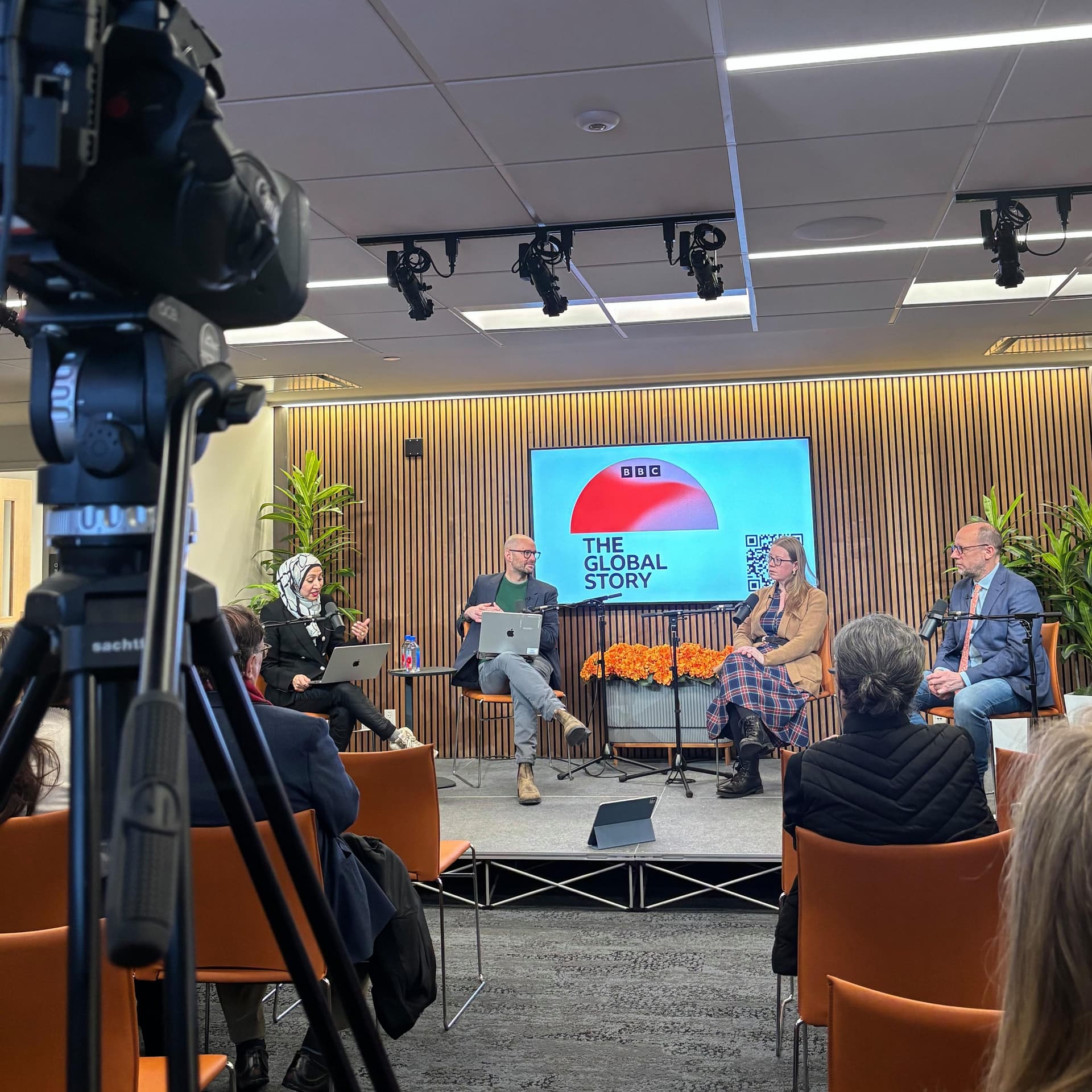
We were joined in the heart of Washington DC by a live audience at Syracuse University’s Institute for Democracy, Journalism and Citizenship.
Recorded Monday 2 February.
Producers: Chris Benderev and Xandra Ellin
Executive producer: James Shield
Mix: Travis Evans
Senior news editor: China Collins
Photo: A live taping of The Global Story in Washington DC on 2 February 2026. Credit:Emma Carroll Hudson/Syracuse University