
In short
The BBC Global Story episode examines the killing of Mexico’s cartel boss El Mencho (Jalisco New Generation Cartel) and whether it satisfies Donald Trump’s demands for Mexico to crack down on drug trafficking, amid fears of renewed violence and possible U.S. troop involvement.
Guests/backgrounds
Will Grant, BBC reporter based in Mexico City, covering Mexico’s security situation; hosts Asma Khaled (Washington, D.C.) and Tristan Redmond (co-host, not speaking in this excerpt).
Key claims
Mexican authorities executed the operation with U.S. intelligence support (no U.S. boots/hardware). El Mencho was tracked via his romantic partner. Violence after his death spread across about 20 states, including arson and attacks on businesses/vehicles. Cartels function as an alternative power in Mexico, including influence over local officials and law enforcement. Sheinbaum’s crackdown is described as more aggressive than her predecessor’s “hugs, not bullets,” partly due to Trump pressure (tariffs/troops/strikes threats).
Notable examples
Tapalpa safe house near Jalisco; firefight and helicopter attempt; El Mencho’s death en route to Mexico City; mention of Rafael Caro Quintero being sent to the U.S.; attack on Mexico City’s police chief attributed to CJNG.
Written by AI. May contain mistakes. Listen to the episode to check what was said.
Chapters
Tap a time to open that second in VOTrump's Military Pressure on Mexico
1:12 to 2:55
Discussion on Trump's pressure on Mexico regarding drug cartels.
“that the Trump administration was preparing to possibly send U.S.”
El Mencho: The Notorious Drug Lord
2:55 to 3:21
Overview of El Mencho's capture and its implications.
“And today on The Global Story, is Mexico caught between Donald Trump and the cartels?”
The Capture Operation
3:21 to 4:22
Details on the operation that led to El Mencho's capture and death.
“about how exactly Mexican authorities managed to catch this notorious drug lord.”
Repercussions of El Mencho's Death
4:22 to 6:39
Discussion on the violence following El Mencho's death and its impact.
“they were trying to take him to Mexico City for medical attention and he died en route.”
The Power of Cartels in Mexico
6:39 to 11:17
Analysis of the influence and operations of cartels in Mexico.
“You know, this is now a big, big international drug cartel.”
Public Reaction to El Mencho's Death
11:17 to 13:04
Insights into how locals view the removal of El Mencho and its implications.
“I've got to ask, Will, you have spoken to people in Guadalajara near where Al Mencho was killed.”
El Mencho and Trump's Policy Pressure
14:19 to 16:45
Discussion about El Mencho's cartel activities and Trump's demands on Mexico.
“Okay, so Will, El Mencho ran this criminal organization that was responsible for trafficking huge quantities of cocaine, meth, and fentanyl into the United States.”
Claudia Sheinbaum’s Strategy Against Cartels
16:45 to 18:49
Analysis of Sheinbaum's approach to handling cartel violence and cooperation with Trump.
“But I think, you know, the broader strategy of being seen to work alongside Donald Trump has sort of worked reasonably well for Claudia Sheinbaum, but it never seems to be enough for Donald Trump.”
Kingpin Strategy vs. Ground Level Tactics
18:49 to 21:16
Exploration of the effectiveness of the kingpin strategy in combating cartels.
“when gunmen wielding high-caliber weapons attacked Mexico City's police chief.”
Pressure from Trump and Domestic Policies
21:16 to 24:16
Examination of the impact of Trump's pressure on Sheinbaum's domestic policies regarding cartels.
“police chiefs and politicians and so on.”
Show all 12 chapters
Trump's Influence in Latin America
24:16 to 28:00
Discussion of Trump's broader influence and strategy in Latin America including recent actions.
“And I think she's been under pressure since she came in to do more.”
Reflections on Trump's Influence in Latin America
28:00 to 28:18
Discussion on the implications of Trump's stance on Latin America.
“But ultimately, Donald Trump's just like, yeah, I want more.”
Transcript
Automatic transcript. May contain errors.0:00This BBC podcast is supported by ads outside the UK.
0:30World Service. Listen now or search for Good Bad Billionaire wherever you get your BBC podcasts.
1:00Catch every brand new episode every weekday. Just tap into iHeart to start watching. And we hope you enjoy the show.
1:11We noticed towards the end of last year that there was a news report on NBC that the Trump administration was preparing to possibly send U.S. troops into Mexico. The target would be the drug cartels. And shortly after that story, Trump was asked about it. Also potentially launching strikes. In Mexico, or putting American troops or American personnel into Mexico to deal with the cartels? What are the drugs in Mexico? To stop drugs? It's okay with me. Whatever we have to do to stop drugs, Mexico... So this past Sunday, when Mexico's most powerful drug lord was taken out, a guy who went by the name El Mencho, it was notable that it was Mexican authorities who carried out the operation, with the help of a little bit of intel from their neighbors to the north.
1:58Mexico's president, Claudia Sheinbaum, told journalists she got a phone call from the American president just to check in.
2:07And it wasn't particularly surprising, because after all, for the last year, President Trump has been on a pressure campaign demanding that Mexico crack down on cartels. For years, cartels have been a powerful, pervasive force in Mexico. And in response to the death of El Mencho, his cartel set fire to businesses and vehicles, unleashing chaos on the streets.
2:42Shane Baum now finds herself trying to reassure her people and the world that Mexico is still safe ahead of the World Cup this summer. From the BBC, I'm Asma Khaled in Washington, D.C. And today on The Global Story, is Mexico caught between Donald Trump and the cartels?
3:07Will Grant covers the region for the BBC. He's normally based in Mexico City. But we caught up with him as he was reporting in the west of the country following the death of El Mencho. And he began by telling us what we've learned in the days since Sunday's operation, about how exactly Mexican authorities managed to catch this notorious drug lord. There was an opportunity for them to get him, and they were going for an arrest. I think that much is very, very clear. This wasn't an attempt to kill him. But they scrambled to a place called Tapalpa, which is outside the state capital of Jalisco. about 80 kilometers or so.
3:49And there, there was a safe house. And it's quite a luxuriant sort of country house on the edge of a forest. And obviously, the arrival of large numbers of troops alerted El Mencho's men. They started trying to bring down the helicopter in which they were traveling, but were unsuccessful in doing that. He fled into the forest. There was obviously a firefight, but eventually they did catch up with Elementor. They injured him and they were trying to take him to Mexico City for medical attention and he died en route. Now, how they located this safe house is pretty interesting. I have a lot of questions.
4:33I've heard about this romantic partner. They were able to trace him down through that. That does seem to be what's happened, that they have basically been following his partner, that they were able to track her to this house. Clearly, there has been intelligence involved. We understand that U.S. intelligence was involved in that whole part of the operation. Mexico portraying the operation very much as a Mexican operation, but with U.S. support. And U.S. intelligence support, not U.S. military, to be clear? Exactly, yeah. That is a distinction worth making, that it wasn't involving U.S. hardware or U.S.
5:08boots on the ground in any way, shape or form. We've been referring to this cartel leader as El Mencho. Can you just explain who he was? It seems like he eluded Mexican authorities for a number of years. He did. I mean, his backstory is pretty interesting. He was from poverty in the state of Michoacan, a western state, which brought him into contact with criminality through the marijuana fields. He gradually started to rise in the sort of criminal underworld. And apart from brief appearance in his life as a police officer, he started really rising as a cartel boss. He joined the Millennial Cartel and started getting more and more responsibility.
5:50And once the Millennial Cartel broke up, the Jalisco New Generation Cartel, what we call the CJNG in Mexico, their Spanish initials, that emerged from the remnants of the Millennial Cartel. And that's the organisation he has been heading. Correct. And what I think El Mincho has done as the head of the Jalisco cartel is position it now to be really the foremost cartel in Mexico. I mean, it's challenging and often stronger than a Sinaloa cartel, which suffered the breakup after El Chapo Guzman was arrested and then extradited to the United States. There's never really a vacuum for too long in Mexican drug cartel culture.
6:36And so it was, I think, with the Jalisco New Generation cartel under El Mencho. You know, this is now a big, big international drug cartel. And so with him as its head, of course, the authorities have wanted him for some time. I remember thinking, it's one of those things that when you cover this part of the world, you'd always think, when will they get El Mencho? And then, of course, it happens on a quiet Sunday. And then the way in which that Sunday turned on its axis was absolutely extraordinary. Well, I do want to ask you about some of the repercussions, because that is what has caught my eye, Will, is just the sheer scale of the repercussions to El Mencho's death.
7:19We saw reports of violence in the aftermath in some 20 different states across Mexico. You live in Mexico. I vacationed there just last year. It is a place that many Americans go to. I don't think that there is an assumption of this scale of the violence we saw this week. Yeah, I think this clearly was out of the ordinary. You know, this isn't a normal occurrence. Yes, there is violence. And yes, there can be very, very powerful and frightening parts of the drug war that unfold in front of the ordinary population in Mexico. But what made this stand out was just the way it just took off. And why did it happen?
7:58I think basically there may have been an initial outpouring of violence because of some misinformation that he was still alive and they were trying to get him back. But even once it was clear that he was dead, I think they continued to spread fear, spread the violence, because the message is just so potent. It says, OK, you might have taken our leader, but we can do this in the centre of your cities. We aren't turning our guns on the civilian population, but we're burning their cars. We're attacking the stores. We're blowing up. We're setting fire to convenience stores. And we can do this at the drop of a hat.
8:34We can do this in the middle of the World Cup this summer. We can do this this afternoon. And it would take nothing for us to turn this on the civilian population and the tourists. And it could have been far, far worse in that regard. Just to talk about the spread, the geographical spread, I think it is worth mentioning just how important the fact that there were those 20 states that had violence in them. To me, it says something about the map of Mexican cartel presence, that they are in the majority of the country. And those places where there wasn't any, it doesn't mean that there can't be any.
9:08Now, of course, the government would like us to think that everything's returning to normal and it is on some level. But I think the big thing that this revealed to me is that they can appear in a different guises pretty much anywhere you like. If they choose not to, it's because it's not great for them for business. There's no strategic reason to be there. But, you know, if there's no, say, Cancun cartel, could there be? Sure. I mean, if it was good for business. Well, I want to understand the scale, the power of cartels broadly in Mexico. You know, we've been speaking about Almencho, the organization that he headed.
9:46We often hear of cartels in the abstract. Can you give us a sense, Will, of the lay of the land with cartels in Mexico? What is the situation? There's been a lot of very good drug war analysts talking on the airwaves this week. The kind of core message I take away is the extent to which the cartels represent a sort of alternative power in Mexico. So this idea that Mexicans know that their government isn't the one that's just in sole control of the institutions of the state. It's not just the police that run the police. Such is the power and plout of the cartels that a local police force could very much be policemen by day, narcos by night sort of idea.
10:31Oh, wow. And absolutely in the payroll of the drug cartel. Now, that can be true of local mayors and local parliamentary deputies, and it goes up and up and up the chain. And in its very, very worst expression, it's a narco state where the very president of the republic is sort of up to his or her ears in it too. And I don't think it is in any way, shape or form a legitimate accusation to level at Claudia Sheinbaum. But a government is made up of many moving parts. There are lots of cogs and some of those cogs are very, very broken in Mexico. So given the control that the cartels have had on certain geographic regions there in Mexico, and given the scope of the violence that we've seen this week, I've got to ask, Will, you have spoken to people in Guadalajara near where Al Mencho was killed.
11:22Are people glad that this cartel leader was brought down? Yeah, so after Al Mencho was killed, I pretty much straight away came to Jalisco and started with the state capital, Guadalajara, Mexico's second city. Very strange experience driving in with, you know, the evidence of the burnt out cars still on the road. massive security presence and a city on edge still with businesses shuttered and spoke to a variety of people a couple of folks who'd opened their businesses i spoke to a local member of parliament a local parliamentary deputy people do welcome the idea that somebody like el menchor isn't in the equation anymore.
12:07But most were very, very cognizant of what it could bring. Again, as we've seen with the removal of El Chapo to the Sinaloa cartel, could the removal of El Menchon to the Jalisco cartel bring that same infighting? And what I thought was very eloquently put by the parliamentary deputy was what people want are not these big, this kingpin strategy of taking out the head of the beast only to have it replaced with another because they're multi-headed monsters, but rather to engage with the issues that underpin violent crime and drug trafficking in Mexico. That is poverty that makes the idea of joining these groups particularly attractive to young men and tackling the inflow of guns into these societies from the United States and all these sorts of things without simply just wiping out one guy, which could actually destabilise the cartel and make things even worse for the people in the middle.
13:19Hi, I'm Simon Jack. I'm Zing Zing. And together we host Good Bad Billionaire, The podcast exploring how some of the wealthiest people on the planet made their money. And we are back with a new season. From sporting superstars to music moguls and celebrity CEOs. We'll be taking a closer look at the lives and fortunes of some of the world's richest people. And asking you to decide if they're good, bad or just another billionaire. Good, bad billionaire from the BBC World Service. Listen now or search for Good, Bad, Billionaire wherever you get your BBC podcasts.
13:51Hi there, I'm Asma Khaled. And I'm Tristan Redmond. And together we're the hosts of the Global Story podcast from the BBC. For those of you all who might be new to our show, we here at the Global Story dive deep every weekday on one big story at the intersection of where the world and America meet. And you can now watch the Global Story on the iHeart app. Catch every brand new episode every weekday. Just tap into iHeart to start watching. And we hope you enjoy the show.
14:24Okay, so Will, El Mencho ran this criminal organization that was responsible for trafficking huge quantities of cocaine, meth, and fentanyl into the United States. And President Trump has consistently said Mexico ought to do more to crack down on cartels. And in February of last year, President Trump threatened Mexico with a 25 percent tariff. And I recall that Mexico agreed to put troops at the border to help intercept fentanyl. And I want to ask you about that because it was surprising to me to see Claudio Sheinbaum, who has a reputation as a left wing leader, seem to be willing to sort of play ball with the Trump administration on this issue.
15:06Can you help me understand that? Yeah, I think particularly in those early days of President Trump's second term, he He came in like, you know, a kind of tsunami of big policy decisions and we're closing the border and we're going to send out ICE and all these things that were happening. And she was faced with very, very little option except to show willing to work together in a cooperative way. Did she agree with those national security concerns that we've heard from the Trump administration? She always says that Mexico security is an issue for the Mexican government, but in conjunction on cross-border issues with the US one.
15:44So she, I think, was prepared to do it. It didn't cost her very much politically at home to send 10 ,000 troops to the border, show willing to the Trump administration. But then she also started doing other things like sending high level cartel members to the U.S. to serve out their sentences there because they were facing charges in the U.S. And why did she do that? I mean, the way it often got painted here was a sort of peace offering to Donald Trump. They involved one man called Rafael Caro Quintero, who was one of the founders of the Guadalajara cartel from which the Sinaloa cartel was born.
16:21Now, he had been arrested, went to prison back in the 80s when eventually he came out on a judge's order. The United States was very angry that he wasn't immediately stopped from leaving prison and sent to the US to serve charges there. He was re-arrested a couple of years later, an old man now, and still now by Claudia Sheinbaum, was one of those hundred or so cartel figures that had been sent north. So she did things like that. But I think, you know, the broader strategy of being seen to work alongside Donald Trump has sort of worked reasonably well for Claudia Sheinbaum, but it never seems to be enough for Donald Trump.
17:00That's what I was going to ask, because despite some of those overtures you describe in January of this year, after the Venezuela operation to take out Nicolas Maduro, we heard President Trump on Fox News pretty explicitly call out Claudia Sheinbaum. So was this operation a message that you're sending to Mexico to Claudia Sheinbaum, the president there? Well, it wasn't meant to be. And we're very friendly with her. She's a good woman. But the cartels are running Mexico. She's not running Mexico. The cartels are running Mexico. He said that she was frightened of the cartels. He said that she's not running the country.
17:36I've asked her numerous times, would you like us to take out the cartels? No, no, no, Mr. President. No, no, no, please. He also said, you know, something's got to be done with Mexico. And despite that strong rhetoric from President Trump, I've also seen some reporting suggesting that Claudia Sheinbaum's policies with the cartels have been the most aggressive crackdown that Mexico has seen in more than a decade. So help me make sense of that. What's accurate? When he made those comments, she responded to them with, well, it's simply not true. We don't recognize that and gives this sort of very calm demeanor, tries to sort of counterbalance the bombastic statements coming from Washington.
18:18In general, he insists on the U.S. military being involved, and we always tell him that is not necessary. We are very clear about defending our territory, plus our collaboration is currently working. I think the truth of the matter is that she has shown this new strategy. She has a man she considers very competent as her security secretary in Omar Harfouch, who was the security secretary for Mexico City when she was mayor. She trusts him implicitly, I think. He himself was attacked by El Menchor's men. The sound of gunfire and explosions rocked the Mexican capital in the early hours of Friday morning, when gunmen wielding high-caliber weapons attacked Mexico City's police chief.
18:58And his personal bodyguards were killed when he was attacked in an upscale neighborhood of Mexico City. In a tweet following the attack, the city's police chief placed the blame on the Jalisco New Generation cartel. They are leading a strategy that traditionally she has never been a fan of the kingpin strategy, saying that it doesn't really make great changes. And explain that, the kingpin strategy being take out the guy at the top. Exactly right, yeah. And the difficulty with doing that, you know, is that it assumes that if you take out enough of the sort of, you know, the cards, the house of cards at the top, then the whole thing will fall.
19:34But I think the feeling is actually if you knock the house at the bottom, then the whole thing will come down. So Claudia Sheinbaum was not a fan of taking out the kingpin. She's not. Traditionally. Traditionally, exactly. Traditionally, she's never shown herself to be a fan of that. She's been critical of it in other governments. And now she just took one out. And now she just took one out. So that, I think, maybe shows some pressure from Washington. It maybe shows that when the reality of being in power in Mexico and that opportunity presents itself, you simply can't say no. If they say, Madam President, you know, we know where he is.
20:08And if you give the green light, we go right now and we do this, then you just simply can't say, well, let's let it slide. I imagine some of the calculations are of that nature. On this accusation that President Trump has made that she's not running Mexico, the cartels are running Mexico. You report from there in Mexico. Is that in any way accurate? Is that in any way true? On one level, it's a bit of a cheap shot because, you know, she is the president of Mexico. The Mexican state runs Mexico officially. but it is very very true um and and the trump administration donald trump is right about the pervasive nature of cartels in mexican politics in mexican power in mexican law enforcement and so on now if that was what he was referring to obviously reading between the lines it's hard to know if that's exactly what he's saying but if that was what he was referring to then he would have a point that, yes, the cartels are powerful.
21:13They do have control of judges in places and police chiefs and politicians and so on. But to suggest that Claudia Sheinbaum isn't in charge and, you know, that El Mencho is, is a very politicized take on what's happening in this country. As with many things that are said, there's a grain of truth, but it depends on how you approach the question. And what about the reports that she is actually undertaking a more aggressive crackdown on cartels, more so than we've seen in the last decade in Mexico. I mean, she is. I mean, I think that that's clear, certainly to her predecessor, Andres Manuel López Obrador, her political mentor.
21:52The feeling was that he was just leaving it to the cartels in whole swathes of the country, just letting them be. Yeah, that strategy, right, of hugs, not bullets. Is that right? That's exactly the way it was phrased. The president calls his approach hugs, not bullets. How is that working out for Mexico? Very well. So it's a quote. The Hugs Not Bullets was a quote from Andres Manuel López Obrador. Her predecessor. Her predecessor. Brasos no balasos. Meaning that he wanted to deal with the cartels by creating opportunities for young people and giving them social development means to not join the cartels.
22:33There are still 30 ,000 homicides in Mexico and very few of those are prosecuted. So there's an idea that there's still lawlessness in Mexico. Is that fair? Of course we prosecute them. There's no impunity in Mexico. They all get prosecuted. The difficulty with that is that people saw it as unrealistic. And then, of course, it gets simplified. You know, that's sort of a bit taken out of context because, of course, it remained a military-led strategy. There were major confrontations, moments of confrontation between the military and the cartels. But I think what it sort of said to a lot of Mexicans and a lot of analysts was like a sort of laissez-faire, hands-off approach.
23:17And it never really had the impact. So it is also accurate that she has taken a more aggressive approach to combating the cartels? I would say so, yes. And I think, you know, to what extent that was obliged by the fact that she's overlapped with Donald Trump, who's saying, look, if you don't do more, visibly more, you'll be hit with tariffs. And has also threatened unilateral strikes, right? Exactly. That's the other thing I was going to say. Has threatened to use U.S. military power on Mexican soil over the head of Claudia Sheinbaum. And that is something she's obviously keen to avoid. It's very, very, very much one of her red lines.
23:54That cannot happen. We will not countenance that and it would be a big, big problem. She's made that clear to Donald Trump. That much, I think, is obvious. So the question that has been on my mind is, is she doing this because of pressure from President Trump? Or is this something that she wants to do regardless? I think to an extent, she does want to do it regardless because there was a lot of pushback against Andres Manuel Lopez Obrador's hugs, not bullets strategy. And I think she's been under pressure since she came in to do more. And yeah, the strategy, I think, was going to strengthen anyway.
24:31Has it had a shot in the arm from the demands coming being put upon it from the Trump administration, I would say undoubtedly, because I think after Donald Trump took office, there was a sort of noticeable uptick in some of the things that she's now heralding as success. Fentanyl seizures, you know, drug traffickers being sent north to serve sentences where they can't flex their muscle from within Mexican prisons, the murder rate going down, which is questioned by some experts because it doesn't necessarily reflect the fact there are so many disappeared people in the country. But, you know, I think she did want to improve the security situation.
25:11And I think that Donald Trump being the partner that she has to work with in Washington has meant that she has been forced to react quite fast, quite directly, and that there has been kind of almost a marriage of his needs with what she wanted to do. So it's given her only more reason to sort of push her security strategy. I'm not saying it's coming from him necessarily. It's not his choice. But I think there is an overlap there. Will, what does this week tell us about President Trump's influence, his grip on the Western Hemisphere? He has made it very clear that he sees the Western Hemisphere as his sphere of influence.
Read the full transcript
25:51Yeah, I think it's smart to go back to the start of 2026. Three days in, he removes Nicholas Madhulov from power under the guise that he was a narco terrorist, a narco president. That was, I think, shocking. It was such a powerful, extraordinary moment to see Washington remove a head of state by bombing another nation in the Americas. That hasn't happened since 1989 in the attack on Panama. So it was an extraordinary moment. The squeezing of Cuba by the turning off of Venezuelan oil, its oil supply, and also pressuring Mexico. So Mexico can't step in except sending a bit of humanitarian aid to Cuba, but no crude oil.
26:32That will hopefully, from the Trump administration's point of view, create a changed government. So that's taking place. We've just seen El Menchil removed. Now, is that from US pressure? Is that from Donald Trump arguing that, you know, that he wants to see more action? So he says, I want more done. They get him El Menchil. He says, I want more done. They put troops on the border. He says, I want more done. They're picking up huge amounts of fentanyl. And so his numbers and his things look better on his side of the border too, even if in some cases it might be more cosmetic than real. You know, we'll see.
27:05It takes longer than just the first year of the Sheinbaum administration and the second Trump administration to find out what is actually at play. But we'll get a proper idea over the full four years of the Trump presidency and the six years of the Sheinbaum presidency. So there is this great kind of narrative at the moment of this Trumpian sort of push to shape the region in his image, to have his influence the length and breadth. And so that he only has partners he knows he can work with. Claudia Sheinbaum is one of them. I think there's respect there. There's a mutual respect that she's found a way that she can work with him.
27:42But also he continues to apply this pressure. You must do more. They're not doing enough. You've just got an admission. You're still not doing enough. Yes, even after that. Even after that, you know, it didn't it wasn't a flicker. It didn't really register. I mean, there was positive comments from his spokesperson and from, you know, from the deputy secretary of state and so on saying it was a good thing for America. It was a good thing for Latin America. It's a good thing for the world. But ultimately, Donald Trump's just like, yeah, I want more. And I think that's sort of part of the relationship between Washington and Latin America today.
28:17Well, Will, it's a pleasure to have you back on the show. And I'm so glad we had an opportunity to speak to you about your home base in Mexico today. Thank you. It's a real pleasure. It always is.
28:35That was Will Grant. He covers Mexico for the BBC. And we here at The Global Story, we love to hear from listeners. So if you all have any story ideas or questions for us, you can email us at theglobalstory at bbc.com. And a quick recommendation before we go. If you're looking for a way to catch up on the latest news from around the world, then check out our sister show. It's called The Global News Podcast, and you can find it wherever you listen. This episode was produced by Chris Banderev and Aron Keller. It was edited by James Shield and mixed by Travis Evans. Our senior news editor is Chyna Collins.
29:11I'm Asma Khaled, and I know you all loyal listeners out there are probably wondering, what's happened to Tristan Redman? Well, don't worry, he's just been on vacation. He'll be back in your feeds next week. Till then, we hope you all have a wonderful weekend, and we'll talk to you again on Monday.
29:36Hi, I'm Simon Jack. I'm Zing Zing. And together we host Good Bad Billionaire. The podcast exploring how some of the wealthiest people on the planet made their money. And we are back with a new season. From sporting superstars to music moguls and celebrity CEOs. We'll be taking a closer look at the lives and fortunes of some of the world's richest people. And asking you to decide if they're good, bad or just another billionaire. Good Bad Billionaire from the BBC World Service. Listen now or search for Good Bad Billionaire wherever you get your BBC podcasts. all right
From the publisher
Mexico’s most wanted man – Nemesio Oseguera Cervantes, better known as “El Mencho” – was killed during a security operation to arrest the cartel leader on Sunday.
In the days that followed, the operation was celebrated by President Trump in his State of the Union address. But it came at a cost, as cartel members carried out retaliatory rampages across Mexico and turned many towns and cities into war zones.
El Mencho’s death came after months of pressure from the Trump administration on Mexico to do more to fight the drug cartels. According to one NBC News report, the US even considered sending troops into Mexico.
Our correspondent, Will Grant, examines the dilemma Mexican President Claudia Sheinbaum now faces – and we ask if she is now caught between Trump and the cartels.
Producers: Chris Benderev and Aron Keller
Executive producer: James Shield
Mix: Travis Evans
Senior News Editor: China Collins
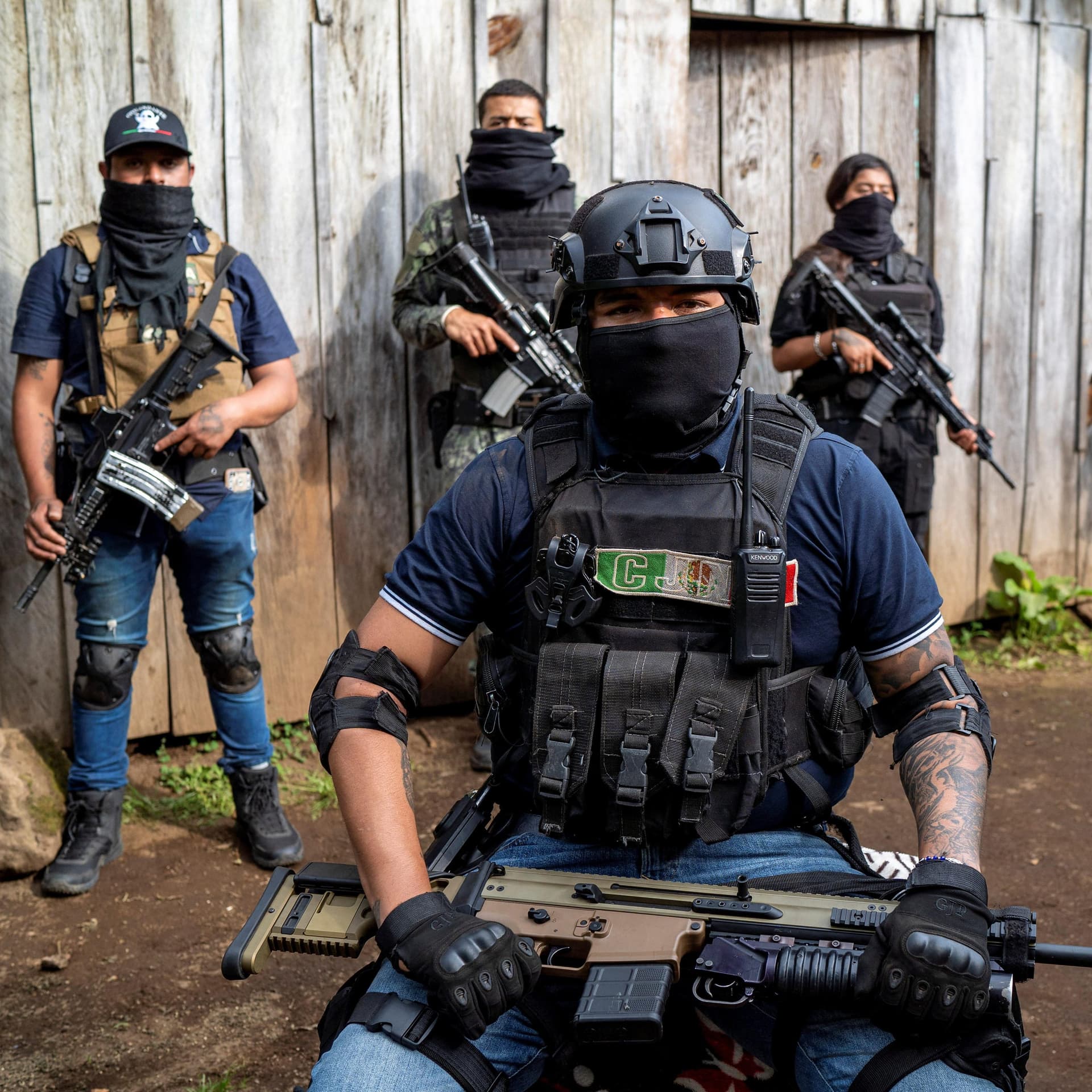
Image Credits: FILE PHOTO: Members of the Jalisco New Generation Cartel (CJNG), led by Nemesio Oseguera, known as “El Mencho,” poses for a photo at an undisclosed location in Michoacan state, Mexico, October 15, 2022. REUTERS/Stringer