
In short
How AI-generated “proof” and deepfake-style rumors during the Israel-Iran war spread uncertainty, using Netanyahu’s alleged death as a case study, and what incentives and strategies drive the “AI slop” ecosystem.
Guests and backgrounds
Thomas Copeland, BBC Verify (debunks AI-generated and fake social-media footage). Peter Pomerantsev, author of Nothing Is True and Everything Is Possible, specializing in propaganda and disinformation.
Key claims
Netanyahu rumors were fueled by AI images/videos (including a “six fingers” claim) that were debunked by HD footage and later “proof-of-life” videos. The broader problem is monetized, scalable AI content that spreads via engagement-driven platforms; X announced demonetization for AI war-video posters for 90 days.
Notable examples
“Where’s Bibi?” six-finger TikTok; AI images of Netanyahu injured/killed after an airstrike; false claims of Tel Aviv and US-base attacks; Trump fooled by an Abraham Lincoln “on fire” video; World War I atrocity rumors as historical parallel; Iran “Lego” meme-style propaganda.
Written by AI. May contain mistakes. Listen to the episode to check what was said.
Chapters
Tap a time to open that second in VONetanyahu's Alive Rumors
0:30 to 0:48
Discussion of the rumors about Netanyahu's death and their origins.
“And to think, that's just a small taste of what Schwab offers.”
Netanyahu's Alive Rumors
0:52 to 1:45
Discussion of the rumors about Netanyahu's death and their origins.
“In the last week, the Israeli Prime Minister has posted multiple videos on social media reiterating that he is indeed alive.”
AI and Propaganda
1:45 to 2:35
Exploring the role of AI in creating misleading content during conflicts.
“Now, to make sense of this wave of fake AI content we're seeing in this war, we have two guests on today's show.”
Thomas Copeland's Insights
2:35 to 4:25
Insights from Thomas Copeland on debunking AI-generated rumors.
“My name's Thomas Copeland, and I work for BBC Verify, and I spend my days trying to debunk AI-generated and fake footage that's on your social media feed, trying to tell you what's real and what's not real.”
The Six Fingers Claim
4:25 to 6:14
Investigation into the bizarre claim about Netanyahu having six fingers.
“one frame within this quite long press conference.”
The Cycle of Misinformation
6:14 to 8:43
Understanding how rumors and AI-generated content spread online.
“Well, you, in fact, Thomas, at Verify, you all did a video to correct the story here.”
Monetization of AI Content
8:43 to 10:36
Discussing the economics of AI-generated content on social media.
“to the extent that it's reaching your timeline who might be interested in neither of those two things.”
Platform Responses to AI Content
10:36 to 12:16
Exploring how platforms like X are addressing AI-generated content.
“Well, there's a lot of interest in what's happening in the Middle East.”
AI Slop in Current Conflicts
12:16 to 14:03
Examining the pervasive issue of misleading AI content in ongoing wars.
“that in his view, 99 % of the AI-generated war videos on X were being made and created and posted by folks that, in his words, were trying to game monetization.”
The Rise of AI Misinformation
14:03 to 16:51
Explore how AI-generated content complicates the verification of reality.
“It was a false claim of an airstrike on a US base in Qatar.”
Show all 13 chapters
Historical Context of Misinformation
16:51 to 18:44
Learn about the historical role of deception in warfare and propaganda.
“And clearly that is something that is occasionally and in some cases we see is being done for a very specific political purpose.”
The Impact of AI on Propaganda Strategies
18:44 to 21:41
Understand how AI enhances traditional propaganda tactics in modern conflicts.
“Peter, has there ever been a case of fake information changing the course of a war?”
The Future of Misinformation and War
21:41 to 25:12
Examine how the proliferation of AI-generated misinformation might change future conflicts.
“The idea that you would use the enemy's idioms and language and memes to kind of almost crawl inside their language and unsettle it from inside is not particularly new.”
Transcript
Automatic transcript. May contain errors.0:00This BBC podcast is supported by ads outside the UK.
0:30And to think, that's just a small taste of what Schwab offers. Because Schwab knows that when it comes to your finances, choice matters. No matter your goals, investing style, life stage or experience, Schwab has everything you need, all in one place, so you can invest your way. Visit schwab.com to learn more. In the last week, the Israeli Prime Minister has posted multiple videos on social media reiterating that he is indeed alive. But I have to tell you, I'm alive. Just to be absolutely clear, he's definitely not dead. But the reason Benjamin Netanyahu is sharing all these I'm alive messages is because there have been rumors circulating online, in fact, you might have seen them on your feeds, that he was dead.
1:22Photos depicting Netanyahu in the aftermath of an airstrike have been viewed millions of times. The thing is, these photos were generated by AI. And all of this got us wondering, are we now in the first AI slot war? From the BBC, I'm Tristan Redman in London. And I'm Asma Khalid in Washington, D.C. And today on The Global Story, is the AI genie so far out of the bottle that we can no longer trust our own eyes?
1:59Now, to make sense of this wave of fake AI content we're seeing in this war, we have two guests on today's show. Coming up later, we'll be hearing from Peter Pomerantsev, who's written extensively about propaganda and disinformation. And he's also written a book which has the rather brilliant title of Nothing is True and Everything is Possible. With a lot of AI, I mean, it's really just an augmentation of what we've seen in social media, what we've seen historically. Before we had AI, people were doing that with rumours. That really is war propaganda 101. But first, we're going to hear from one of our colleagues who's specifically been looking into the Netanyahu rumours.
2:35Thomas Copeland:My name's Thomas Copeland, and I work for BBC Verify, and I spend my days trying to debunk AI-generated and fake footage that's on your social media feed, trying to tell you what's real and what's not real. And that's a job that's becoming harder and harder to do. Well, just the man we wanted to talk to today. Yeah, Thomas, we are here to do something which we don't often do on The Global Story, which is to talk about a rumour. And we would like your help, please, to pick it apart. Where did we all first hear this rumour that Benjamin Netanyahu was dead? I can tell you exactly where I was sitting on my bed at home, taking a look at a TikTok that we had put out from BBC Verify earlier on in the day about another AI story.
3:16Thomas Copeland:And as sometimes you will do when you're in a TikTok, you'll take a look at the comments. And the comments were all saying, you need to look into the six fingers. What about the six fingers? Look up the six fingers. And I thought to myself, oh gosh, maybe I've been on the tube. I've missed some of the fast moving developments in the online world. And so on my TikTok, I went up to the top corner and searched up Six Fingers. Let's play Where's Bibi? Last week, his office released a video of him where he apparently has six fingers. It's just very weird. What do y 'all think of us in the comments, guys?
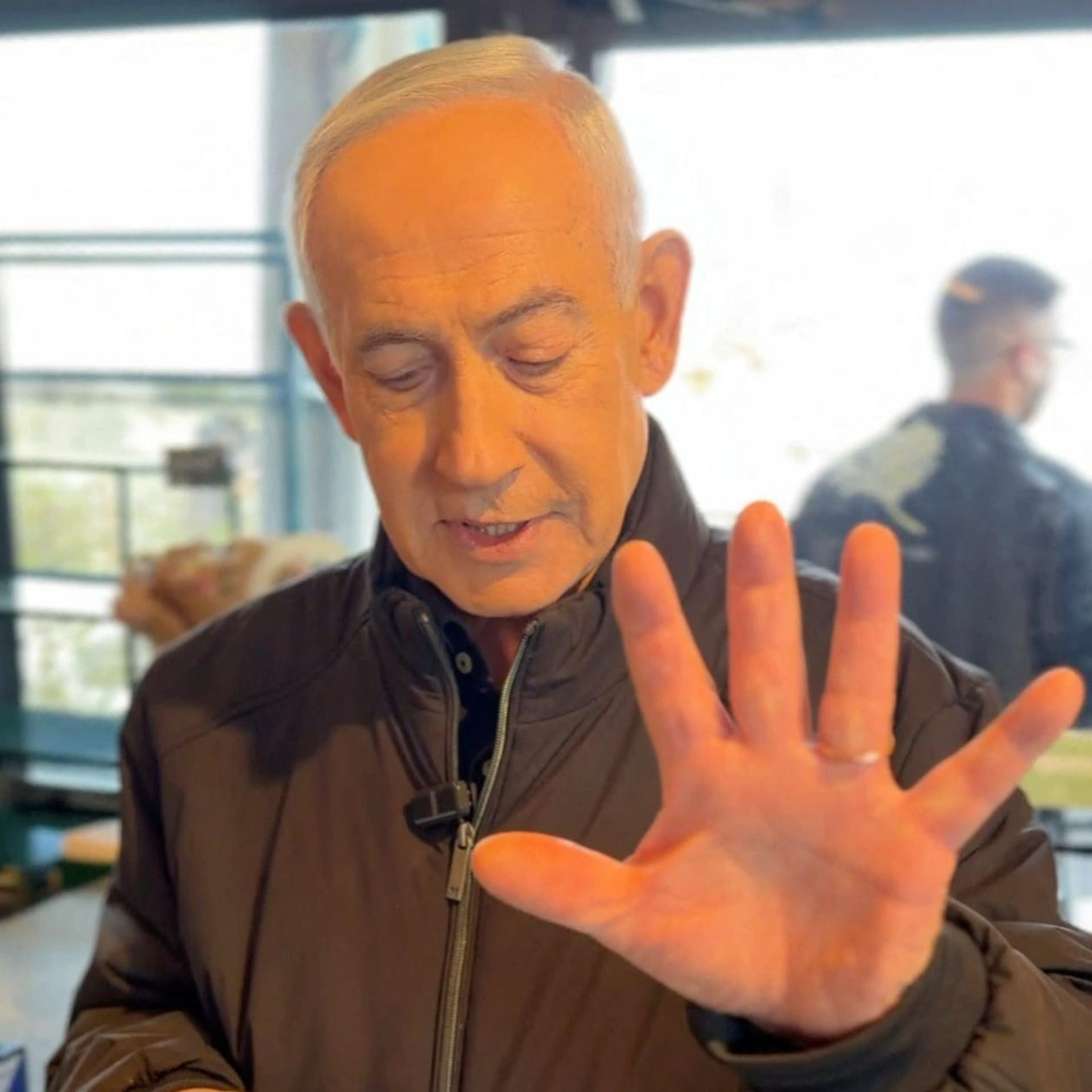
3:50Thomas Copeland:Do y 'all think something weird's going on? And I saw reams of videos that were making claims that a press conference that Israeli Prime Minister Benjamin Netanyahu had done on the Thursday, these claims said, this is AI. This is an AI version of Netanyahu. How do we know? They said, well, he's got six fingers, was the claim in some of the videos. It's not something that is caused by light. It's not something that is caused by a glitch in the frame. He literally appears to have a sixth finger. I quickly looked into it. In reality, of course, he didn't have six fingers. The HD version of this press conference showed there was an ever so slight shadow on his fifth finger at one moment, one frame within this quite long press conference.
4:34Thomas Copeland:But this fell into a long run of false and AI-generated pictures that we had seen since the beginning of the war, claiming to show Benjamin Netanyahu injured or killed, apparently in an Iranian airstrike. And such was the volume of these claims that on Sunday, that day, so just a couple of days ago, the Israeli PM decided that he needed to say something for himself. He went to a coffee shop in Jerusalem and filmed a kind of proof-of-life video. which he said, I am alive, I'm here in this coffee shop, look at my fingers, and he held up his fingers. I only have five of them. But then what happens, obviously, after that, you look through the comments on that video, we did a TikTok on that video, and people are saying, this video is AI generated.
5:20He gonna show you all five of them fingers and say it ain't six? Something about this right here don't feel right to me.
5:26Thomas Copeland:And on and on it goes. And since then, Netanyahu has published more proof of life videos on Tuesday of this week. Mr. Prime Minister, I wanted you to know the president asked me to come and make sure you were okay. Another proof of life video showing him standing next to U.S. Ambassador Mike Huckabee walking down a corridor. Yes, Mike. Yes, I'm alive. I checked that and I'm happy to see that, but he wanted to make sure because, you know, you guys get along too well. I know and we shake hands with five singers in each hand. So none of that quieted the naysayers. None of that quieted the naysayers.
6:01Thomas Copeland:And the reason for that is because we have seen this AI-generated wave of content since the beginning of this conflict in particular. And that has left a lot of people, even in the two or three weeks that this conflict has been going on for, unsure of what they can believe when they look at the pictures and images on their screens in front of them. Well, you, in fact, Thomas, at Verify, you all did a video to correct the story here. What feedback did you all get? Well, what we did was we debunked the various AI generated pictures and images. We debunked this six finger claim by showing the HD footage that clearly showed that he didn't have a sick finger.
6:36Thomas Copeland:We show the proof of life video in the coffee shop. We had multiple angles that were shared on social media by that coffee shop. But of course, the comments then are filled again with folks saying that this is sort of AI generated content. And you're left as a reporter in this slightly difficult position because you're saying to yourself, on one hand, you don't want to chase online conspiracy theories down the rabbit hole, and we want to do a service to our audience. But equally, it's the case that more and more people are believing this content, and it's our job to put in front of people as the next video may be on their TikTok timeline.
7:07Thomas Copeland:They might see a couple of AI conspiracy theory videos. We want to be the next video that's saying, no, stop for a second. It's not real. And here's how we know it's not real. Do we know who started the rumor that Netanyahu was killed? Where that idea originated from? Since the beginning of this conflict, images have circulated online, AI-generated images appearing to show Netanyahu injured after Iranian airstrikes. And they form part of a much wider tapestry of fake content that's focused particularly around Tel Aviv, claiming to show airstrikes in Tel Aviv that never happened. Now, what happens is a lot of that content is created for the monetization purposes.
7:46Thomas Copeland:Then what happens is these false claims are repeated by hardline Iranian news agencies, in the example of Netanyahu's false claims about him being killed or injured. And then the cycle goes round again. And that encourages more folks to make AI-generated footage claiming to show that he has been killed or injured. And so the cycle goes round and round and round. And so if we try to track down exactly where this content first comes from, one of the things that BBC Verify that we spend a huge amount of time doing is this thing called reverse image searching. We take individual pictures or frames from videos asking search engines, where did this first come from?
8:20Thomas Copeland:Sometimes we can have a degree in success of tracking down the account that first posted them. In the case of these videos, it's very, very difficult to do because they have emerged often from multiple and sort of anonymous accounts all at the same time. And so this claim begins to bubble up, bouncing back and forward from those who are trying to make money from it and those who are trying to push a political message from it until it raises to the extent that it's reaching your timeline who might be interested in neither of those two things. I am curious to understand what's the environment, the ecosystem that led some people to believe this story that, you know, is not true?
8:58Thomas Copeland:I think that over the last two weeks in particular, but it's a little bit longer than that, there has been a fundamental change in the kind of pipeline of content on social media. We have seen over the last six months, a little bit longer than that, huge leaps and bounds in the quality of AI generated picture generators and video generators. And that has allowed for an ecosystem online where folks who are gaming monetization, making money from your clicks, from your likes, from your shares, from your comments. When a war is kicking off in the Middle East, that's clearly a time and has always been a time when people are looking to their news sources.
9:34Thomas Copeland:They're looking for information. They're going to social media. They're trying to find this information. So you've got a kind of ripe attention economy right there. And you've got folks who are willing to exploit that. And they're using the incentive of monetization programs on many of these social media platforms. X is clearly a really big and important place for this. But also some of Meta's platforms, TikTok and others. And this process allows them to make money. Yeah. Could you break down the economics of how it actually works? If you're an AI content creator and you have an idea, how do you get it out there and how do you monetize it exactly?
10:12Thomas Copeland:Very simply, if you're eligible for monetization programs on one of these different platforms, it might be Facebook, it might be X, you need to maintain consistent levels of engagement in your content in order to remain within that monetization program. And then at home, you have access to AI tools that are increasingly more accessible. They're cheaper. you will sit at home and say to yourself, right, what is going to get lots of engagement online? What else is doing well online? Well, there's a lot of interest in what's happening in the Middle East. There's a lot of interest in airstrike. There's a lot of interest in damage to US bases.
10:46Thomas Copeland:I can create some content that is going to build on that interest and take advantage of the fact that people want this information. You can increasingly, and with fewer prompts on these AI generators, request it to create certain content. If you're making lots and lots of it, you might spend less and less time on every individual video when you're just designing to churn out as much stuff as possible, or you might spend a little bit more time to make a higher quality product, then you can take that and upload it straight onto social media. And you can earn, it's very difficult and there's not a lot of transparency about the monetization programs on all of these different platforms, but what an expert has told us is that you can earn between$8 to$12 on X for every verified million views or so.
11:29Thomas Copeland:and that there are lots of different variables in place there depending on where you are in the world, etc. But it is the case that$8 to$12 is clearly going to go a lot further in some parts of the world than others. And there have been well-documented reporting at the BBC and others that there are parts of the world where a lot of this content does come from. Some of it's Southeast Asia, some of it's Pakistan and other places like that. Now, we can't tie direct accounts to direct parts of the world in quite as explicit a manner, but that reporting exists as to where lots of this content does come from and where that money will go a long way.
12:00Thomas Copeland:Ground for a lot of this content. Thomas, can I pause you? Because hasn't Elon Musk just in the last few days come out and made it clear that they are not going to allow AI slop to be monetized? And this is one of the reasons that we know that this is an unprecedented wave. So this was last week, X's head of product said that in his view, 99 % of the AI-generated war videos on X were being made and created and posted by folks that, in his words, were trying to game monetization. And the new policy that X has introduced and said that they would introduce is that anybody that posted this video would be removed from their monetization program for 90 days.
12:38Thomas Copeland:And that's a very significant move from X. Yeah, because they've had a pretty permissive strategy to date, I would say. Yeah, amongst the other social media platforms, I think critics would definitely come to a conclusion that they are much more permissive in their moderation policies. And so that's a really massive and meaningful step. We also approached TikTok and Meta, the parent company of Instagram and Facebook, asking them if they had plans to do the same. They didn't get back to us. But what we do know is that all of these platforms are currently researching and engaged in ways to work out if they can detect AI and figure out how they're going to moderate it on their platforms.
13:12To be clear, the rumor, the false storyline that Netanyahu was killed, that's not the only image, video, storyline we have seen that has gone viral as a result of AI since this war began. Is that right? I mean, can you give us a sense of just the sheer scope of AI slop that we've seen out there?
13:31Thomas Copeland:It's been a massive problem for us over the last number of weeks. Every time over the last number of years a conflict has come up, we've said to ourselves and the team, gosh, you know, this is the AI slop war. This is the AI-generated war. And then the next conflict comes along and we say, whoa, there's so much more and on and on it goes. And we've reached the point now where for a period of time, certainly, you know, I'm a fairly sophisticated consumer on social media. I would be scrolling through my social media feed and it felt like every other video was AI slop. Every other video was a false claim of an airstrike in Tel Aviv.
14:03Thomas Copeland:It was a false claim of an airstrike on a US base in Qatar. Even Donald Trump said in the last number of days that he had been fooled by a video. They showed all sorts of things happening in the last two weeks that never happened. Between their kamikaze boats that don't exist, between blowing up the aircraft carrier, one of the great ships in the world, the Abraham Lincoln, on fire. They showed it on fire. He said that he called up a general to ask what's going on with the ship. I said, General, what's with the Abraham Lincoln? It looks like it's burning down. No, it's not burning down. Not a bullet was ever fired at it, sir.
14:39They know better. They said, this is my first glimpse of AI and what they've done with it. And are you seeing this on all sides of the conflict?
14:49Thomas Copeland:All sides of the conflict, yeah. So these videos about Netanyahu are 100 % within a wider ecosystem of a total wave of content that sometimes feels a little bit like those who are trying to make money from this, just kind of throwing anything at the wall, seeing what works. Part of your job, you say at Verify, is to verify images, verify videos, figure out what's real, what's being generated by AI. And do you find that more difficult now in this moment? And the reason I'm asking this is there was a photograph published in the New York Times that showed a massive crowd of Iranians out after the new supreme leader was announced.
15:30That image was criticized by some as being generated by AI. And I actually saw the New York Times publicly respond and say, no, no, this was a genuine image taken by a real journalist in Iran and that they do not use AI for photographs to generate, you know, and to manipulate images. But that made me wonder, gosh, even real things are now being questioned or criticized as being AI. And it feels like there's a lot of just information and disinformation warfare around what's real and what's not.
16:04Thomas Copeland:A hundred percent. And this links back to the sort of Netanyahu proof of life videos, right? It's a real video that's put out there and people start to look at it and say, well, hold on, is it real or is it not? I've seen so much stuff that I couldn't work out if it's real or not. So I think you have two things here. One, folks who are really sincere and have massively been, I guess, confused, misled, taken advantage of, exploited by those who are trying to make money from this content over the last number of weeks, for example, who just don't know the answer and are questioning everything now, no longer know if they can trust what they see.
16:33Thomas Copeland:But then you also get the folks that are trying to exploit that fact. And they probably know deep down that that was a real picture that the New York Times published. But it's in their interests to spread uncertainty and to say, oh, that could be AI. And that's how you sort of denigrate and collapse trust in the stuff that you're seeing in front of you. And clearly that is something that is occasionally and in some cases we see is being done for a very specific political purpose. What are the solutions to stop this deluge of AI content? A massive question. And if I could answer it, I might not be sitting right here.
17:07Thomas Copeland:I am really interested to see what the result of X's demonetization approach is going to be and whether that has a measurable impact in the amount of content on there. Lots of different social media companies are investing more or certainly talking more about AI detection and moderation. There is kind of a fundamental tension, and this is what experts have told us, between prioritizing on platforms content that will get lots of engagement that is relatively cheap to produce and that will normally come through a sort of AI pipeline and information that is always accurate on authentic and that's a difficult tension to resolve and social media companies over this year in particular are going to be looking really hard at that.
17:45Thomas Copeland:I think there are other and people in the space would talk about other things like content credentialing trying to put metadata and labels and watermarks on content so you can prove when they're real and where they're fake. I think ultimately, though, all of this comes down to individuals. And we're just trying at Verify, we do this all the time. And you can go online and find our transparency videos trying to tell people, here's the different approaches, here's the different tools that you can use to try to spot the real and the fake at home. And the end result of that will be moving away from a space and a mindset where we say, you know, we trust what we believe until we're disproven, to maybe saying, well, we're going to be slightly more suspicious until we have good proof that something is real.
18:30Thanks so much, Thomas. It was great to talk with you. Thanks so much for having me. Thanks for joining us.
18:44Peter, has there ever been a case of fake information changing the course of a war? Well, many. I mean, war is often won by deception. That's Peter Pomerantsev. He's written a lot about propaganda and misinformation. And we're turning to him to understand if what we're seeing now is just a new version of old tactics. So the Trojan War was one with an act of deception. Taking us all the way back. Taking that history, yeah. So I think, I mean, but, you know, Sun Tzu and others insist on deception being an absolute prerequisite of winning a war, or maybe sometimes weirdly the decisive factor. so deception is part and parcel of war if we're talking about kind of atrocity propaganda historically we have many many examples of that but i think most spectacularly is world war one where rumors of german atrocity propaganda were a major motivator of britain and then especially america joining the war there's all these stories about germans bayonetting nuns and pregnant mothers that emerge, partly spread by the British, which motivates Britain and America to join the war and cause much resentment afterwards.
20:00So that's really when we have the real sort of panic around the impact of disinformation, fake news, propaganda, and war. Well, Peter, what do you make of the misinformation that we're seeing circulating around the Iran war now? So a lot of it is just, to be honest, like with a lot of AI, I mean, it's really just a augmentation of what we've seen in social media and what we've seen historically. We have all this AI generated imagery of, you know, shock and horror in Dubai, which isn't always true, which is a way to augment Iran's aura of strength and to spread panic in the Gulf. That's pretty common.
20:42Before we had AI, people were doing that with rumors. You know, the British in World War II spread rumors that they had a weapon that could set the channel on fire, which was spread among German troops so that they would be alarmed around the invasion of Britain. So that's pretty classic stuff, you know. That really is war propaganda 101. on. What's fascinating now is the way it kind of borders on kind of cultural references and sort of Iran making Lego videos about American war crimes. You know, and it's one of the cartoons that Iran made. There was a Lego video of the Americans hitting the girls' school in Tehran.
21:23That clearly wasn't for an Iranian audience. That was almost telegraphing into an American audience that Iran can play the meme games.
21:38Which I thought fascinating, but again, not that unusual. The idea that you would use the enemy's idioms and language and memes to kind of almost crawl inside their language and unsettle it from inside is not particularly new. AI lets you do it faster. AI lets you do it at very low cost. AI lets you do it at scale. AI lets you test it iteratively in a way that was impossible before. So in that sense, AI is a game changer. I'm not saying it's not, but it's a game changer in terms of production. But in terms of strategies, it's just a technological upscale of very, very, very common strategies. Can we throw down a little deeper on the strategy and incentive?
22:22because prior to speaking with you, we were speaking with our colleague Thomas, who works with BBC Verify. And he mentioned that many of the AI videos we're seeing now appear to be privately created. And Thomas was explaining to us that people appear to be creating this content for financial incentives. In some cases, they don't all necessarily have a political dog in this fight. And I'm curious how significant that is and how that compares to I know you've done a lot of work on state-backed misinformation and propaganda. And to be clear, you know, there are certainly nation states and countries that benefit from these AI videos.
22:59But what I thought was fascinating is he was saying some of the people creating this appear to be people who are just trying to make a buck. So but this is exactly the same thing we saw in 2016. Remember the Montenegrin troll farms? This was the first kind of wave of awareness and sort of panic around the possibilities of digital propaganda. These are all these kind of like online stories in support of Trump. And it turned out they were being produced by content farms in Montenegro. Journalists went down to Montenegro thinking they would find kind of Russian troll farms or MAGA troll farms. And there was a bit of that, but actually it was just a bunch of Montenegro kids who worked out that they could make some money on this.
Read the full transcript
23:41And they were creating these kind of spam sites, these sort of slop sites, with a mix of kind of like pills that make you strong, Trump is big and sexy, and advertising. There's zero interest in American politics. They just saw this wave building, and they latched onto it. Peter, I mean, from what you're saying, this is nothing new. Disinformation has been a part of conflict and war since, you know, all the way back to the Trojan War days. but nonetheless the quantity of this stuff with AI just becomes that much greater and the quality of those AI videos in future will become that much more convincing too.
24:17A lot of us can see through them now but maybe that won't be the case in the future. Do you think that that aspect of it could actually change the shape of conflicts in future? I don't know about shaping the change of conflicts. Conflict is changing in so many ways. I mean there's been an overall sense that conflicts has become even more about perception because we're such an information-saturated society. I mean, taking the war in Ukraine, even when very little happens on the ground, the perception games around it can influence whether people think Russia is winning or Ukraine is winning when really it's just slow attrition.
24:53And that can influence how negotiations go. So the amount you can do in shifting perceptions because the information environment is so saturated is probably dramatic. But in terms of what does the quantity do, I think what the quantity does is it doesn't necessarily change the propaganda or it changes what we do about it. Because our way to battle propaganda was censorship, frankly. It was always one of the ways. But that's not something democratic societies do, but not something you really can do to any great effects in this information environment. And two, it's like pluralism and you have real truth to balance the lies and somehow it all kind of works out in some glorious and now seemingly utterly mythical marketplace of ideas and the people are looking for the truth and they'll get to it if you just provide it to them and the bbc will balance out all the all the slop and lies we like to believe that of course we will but but the problem is that when you can make the slop at lies at scale at so little cost that marketplace idea completely falls apart
25:59and the ways we have to fight propaganda a belief that you can hold the powerful account of all the truth kind of a checks and balances of information that has completely collapsed and I don't think that's anything that we've really started to deal with we have all these romantic ideas and I don't think they're true anymore for this environment
26:26Peter, thank you so much. It's been great to hear your thoughts. Thank you very much for taking the time. All right. Ciao, ciao. Bye-bye.
26:41That was the writer Peter Pomerantsev. And earlier, we heard from our colleague Thomas Copeland with BBC Verify. And that's it for today's episode. A quick record before we go. Here at The Global Story, we bring you one story every day where the world and America meet. But for the very latest headlines, listen to our sister show, The Global News Podcast, and you can find it wherever you listen. Today's show was produced by Valerio Esposito, Viv Jones, and Zandra Ellen. It was edited by James Shield. It was mixed by Travis Evans. Our digital producer is Matt Pintus. And our senior news editor is China Collins.
27:19I'm Asma Khaled. I'm Tristan Redman. Thanks for listening. Have a great weekend and we'll see you on Monday. Cheerio.
From the publisher
Social media platforms this week have been flooded with a wild rumour: that Benjamin Netanyahu was dead (which he is not). Fake photos and videos of his body, coated with dust and debris, seemed to show that the Israeli prime minister had been killed in an Iranian air strike.
The rumour was false – Netanyahu had not died, nor been involved in a strike. The photos and videos were AI-generated. But when Netanyahu posted several videos of himself, debunking and mocking the rumour, some people on social media still refused to believe these were really him.
Today on the show, Thomas Copeland from BBC Verify explains how the economics of social media drive the creation of AI-generated fake videos – sometimes by people with no strong feelings about the war itself. And we speak to Peter Pomerantsev, author of Nothing Is True and Everything is Possible, who says the essential strategy behind wartime disinformation remains unchanged since ancient times.
Producers: Viv Jones, Valerio Esposito and Xandra Ellin Executive producer: James Shield Sound engineer: Travis Evans Senior news editor: China Collins
(Photo: Israeli Prime Minister Benjamin Netanyahu shows his hand as he speaks at a cafe Credit: Benjamin Netanyahu/Reuters)