
In short
The episode investigates how many Russian soldiers Russia has lost in the Ukraine war, challenging Western casualty estimates and explaining how those numbers are compiled and disputed.
Guest backgrounds
Olga Ivshina, a BBC Russian service journalist, has spent years verifying Russian battlefield deaths using open-source research and field experience from WWII grave recovery near St. Petersburg. She works with independent volunteers and partners with MediaZone.
Key claims
Russia’s losses are likely lower than some Western “millions” claims because those figures often mix dead, wounded, missing, and repeat counts of the same person. Ivshina’s database contains about 246,000 confirmed dead names (mid-September 2026; nearing 250,000). She argues many reported “30,000–40,000 per month” figures rely on Ukrainian sources and may be overestimates.
Notable examples
She describes early regional officials publishing names, later pressure and deleted articles; prisoners recruited for Ukraine duty; and cases of soldiers appearing multiple times in lists due to being wounded, returned, captured/exchanged, and killed again. She also notes losses disproportionately come from small, economically disadvantaged towns (e.g., Buryatia vs Moscow).
Written by AI. May contain mistakes. Listen to the episode to check what was said.
Chapters
Tap a time to open that second in VOContext of Russian Military Losses
0:30 to 2:29
Discussion on the staggering losses of Russian soldiers in the Ukraine war.
“and more options to their lineup, can shop at machinefinder.com.”
Olga Ivshina's Mission
2:29 to 4:48
Introduction to Olga Ivshina and her work verifying Russian military casualties.
“how many soldiers has Russia really lost?”
Families Seeking Closure
4:48 to 7:24
Exploration of families looking for missing soldiers and the emotional toll it takes.
“Me and my colleagues quickly discussed the situation, and we concluded that if we don't try to establish the number of Russian losses in this war, we might not know the real figure, at least in our lifetime.”
Establishing Casualty Figures
7:24 to 10:00
Insight into the methods used to establish verified casualty figures in the war.
“I think now we know that at that moment in time, more than 9 ,000 Soviet soldiers were killed as opposed to almost 6 ,000.”
Socioeconomic Factors of Losses
10:00 to 12:14
Analysis of how socioeconomic factors influence military recruitment and losses.
“and its names, where they're from, date of birth, date of death, etc.”
The Human Cost of War
12:14 to 14:02
Personal stories that illustrate the decisions behind joining the military for financial reasons.
“And life expectancy in some regions are much lower, especially male life expectancy.”
Social Ties and Awareness of Loss
14:02 to 14:55
Exploration of how Russian society perceives soldier casualties.
“And people in Russian towns and cities, they haven't seen those guys anyway.”
Casualty Numbers and Reporting Challenges
15:58 to 17:47
Discussion on the difficulty of accurately reporting Russian soldier casualties.
“What date did you establish that number on?”
Skepticism Towards Western Estimates
17:47 to 19:42
Critique of Western intelligence estimates regarding Russian losses.
“and he was sent back, sent back to fight.”
Ukrainian Casualty Reporting
19:42 to 21:10
Examination of Ukraine's reporting on its own military casualties.
“but what are the Ukrainians saying about their own casualties and what have you been able to find out about how many soldiers they're losing?”
Show all 15 chapters
Putin's Perception of War
21:10 to 23:19
Insights into what Vladimir Putin may understand about the war's progress.
“And as we know, because of the development of the drone strikes, drone warfare, and both sides are struggling with that, the evacuation process has become very, very prolonged.”
Discrepancies in War Reporting
23:19 to 25:18
Analysis of discrepancies in the information reported to Russian leaders.
“But what we do know is that, first of all, he was getting unrealistic assessments of situation in Ukraine before the invasion.”
Impact of Casualties on Russian Society
25:18 to 27:39
Discussion on how Russian society perceives and responds to war casualties.
“So, like, you know, some senior officials already delivered the maps, showing that this territory is taken.”
Closing Remarks and Production Credits
28:00 to 28:59
Learn about the production team behind today's episode and the show's mission.
“That was Olga Ivshina, a senior journalist for the BBC's Russian service.”
Closing Remarks and Production Credits
29:00 to 29:31
Learn about the production team behind today's episode and the show's mission.
“With a subscription to the BBC website and app, you can now get early access to your favorite BBC podcasts.”
Transcript
Automatic transcript. May contain errors.0:00This BBC podcast is supported by ads outside the UK.
0:30and more options to their lineup, can shop at machinefinder.com. Booyah!
1:05I saw this clip of the political scientist Francis Fukuyama talking to the BBC, and he said this thing about Russia, which really surprised me. They're estimating that the Russians have been losing like 30 ,000 to 40 ,000 soldiers per month in the year 2026. 30 ,000 to 40 ,000 soldiers a month. That's huge, if true. For perspective, the United States lost 52 ,000 soldiers in 10 years of the Vietnam War and is still arguably processing the effects of that conflict to this day. To be clear, we don't really know how many soldiers Ukraine is losing either. They don't often say. And when they do, it's probably a lowball.
1:51But 40 ,000 Russians a month? Could this massive number be correct? And if so, how much longer could Vladimir Putin keep the war going? As it turns out, we have a BBC colleague who's better placed than almost anyone to answer these questions. She's called Olga Ivshina, she's Russian, and she's devoted years of her life to verifying how many Russian soldiers have been killed in battle. Not just recording their names, but building a picture of what their lives were like too. From the BBC, I'm Tristan Redman, and today on The Global Story, how many soldiers has Russia really lost? And could the Ukraine war be Vladimir Putin's Vietnam?
2:41In the early 2010s, Olga Ifshina volunteered to join a team traipsing through a swamp close to St. Petersburg in Russia. Olga's on what was once a battlefield. She can see the remnants of the fighting from the Second World War. The trees are still potmarked with bullet holes. It's a tree left from the war, which means there is still metal inside, so probably bullets or remains of the artillery shell. Olga's searching for bodies, Soviet soldiers, who've been left where they lay for more than 70 years. An estimated four million of them are still missing in action from World War II. Olga pokes the ground with a long metal spike.
3:24Sometimes the bodies are just below the surface. You have just to remove the amount of leaves that came through the 70 years, and that's it. The soldiers are still there waiting for us, waiting for the chance to go home finally. This is a soldier. You see? There is a leg, and you see there is something way there. When you see the movies about the warriors, they think it's only about blasts and attacks, and, you know, when you get here, you see how he died and you sort of feel as if you were near, as if you were his comrade, you know, being with him shoulder to shoulder. And you realise this, the other side of the war, the real war, how it was, how he was killed.
4:13When Russia launched its full-scale invasion of Ukraine in 2022, Olga's hobby became part of her job. Today, she's not searching for dead soldiers from the past. She's looking for soldiers who are being killed in a conflict that's happening right now. During the war, all countries in the world, all sides don't publish their figures. Russia seems to try to make the number of them also lower. So when the invasion started, Me and my colleagues quickly discussed the situation, and we concluded that if we don't try to establish the number of Russian losses in this war, we might not know the real figure, at least in our lifetime.
5:05So we thought we need to start doing it, and that has been my task ever since. So a significant number of the force came from prison. They recruited prisoners to join and they were allowed to do so. So they joined the ranks and they were fighting in Ukraine. And it seems that thousands of those prisoners, their families, they were not informed where their relatives are. So the families started to look for their loved ones, especially after the so-called contract expired. They started to look for the, you know, where is my son, where is my husband. and because our project was well-known, they were writing us, like, do you know this guy?
5:50Do you know this guy? This absence of closure is very harmful for people. That's what I see from my practice. So I would usually do it very carefully. I would say, listen, I don't know, but what I have is a picture of the grave of a man called such, such, such with such a birth date. And I would say, that's what I have. That's for you to judge what to do with this information. Some people will say, oh yeah, it's my son. could you please let me know where this grave is situated? And someone said, no, I refuse to believe. And I was like, that's your judgment. But yeah, many families were actually thankful.
6:26And that's why we started doing it using the means we had. And we concentrated on open source information so that there is proof. And also, most of the times, it's official confirmation or confirmation from relatives. So that makes it important. And also, I think it's important to see what this invasion is doing to Russia and Russia's society. So you wanted to establish a confirmed number that even the Kremlin couldn't dispute? Yes, and it proved to be the right thing to do very quickly, because the last time Russia publicly acknowledged its losses, it was September 2022. Back then, Russia's Ministry of Defense acknowledged that there was a bit less than 6 ,000 soldiers.
7:16And even back then, in our open source list, we had more names. Now we have even more names. I think now we know that at that moment in time, more than 9 ,000 Soviet soldiers were killed as opposed to almost 6 ,000. So it seems we're doing the right thing. So right back at the beginning when you're beginning this search, how many are there of you doing it? At the very beginning, it was just me and my colleague from BBC. So just two of us. Later on, a few more people joined. So we were joined by an amazing team of independent volunteers. These are incredible people. I wish I could talk more about them.
7:56But for their safety, they have to remain anonymous at least until the end of this war. But I hope at some point they will be able to tell you their story. And also a few months later, we were joined by our now partner, MediaZone, independent Russian outlet. So now we're doing it all together. Explain to us how it actually works. If you start with hypothetical soldier A, like where do you go? Where do you first find a clue that somebody has died? And how do you flesh out that information until you have a confirmed death? It developed and changed over time. It was actually quite easy at the beginning because when the invasion has started, you know, heads of the Russian regions started publishing the names of soldiers from their regions who died during the first days of the invasion.
8:45It seems the Russian officials hope, expected that this invasion would be quite quick, like a special operation. So they were quite open about, you know, our guy died as a hero and our guy died as a hero. So our task first was just to put all those little reports together. But then it changed over time. So as the invasion continued and the number of losses grew, the less and less heads of the region kept publishing the names. And as the invasion continued and the number of losses grew, Russia started to put pressure on the locals not to publish too much about the deaths. So we saw articles being deleted.
9:27Deleted on whose orders? Have you any idea who would order such a thing? Well, I mean, there was no official explanation, but some local journalists would say, yes, yes, we've got an order from above to stop publishing it. Don't write about it too much. Don't publish it. Olga, in my head, there's a room in your apartment with stacks of regional and local Russian newspapers, which is like, you know, the piles are like six foot high. Do you have a room like that? No, but I have endless Excel tables. So we had to change the platform where we store our database a few times because we literally ran out of space.
10:08You actually filled up all of Excel. Is that what you're saying? Yes. Wow. Yes, we have almost 250 ,000 names. 250 ,000 names of confirmed dead. Is that right? Yes, yes. and its names, where they're from, date of birth, date of death, etc. So lots of additional information. And I think that is also very useful because it's not just names. We understand who are these people, how they lived, sometimes how they died, which unit they were from. And it helps us to understand a lot in how this war is fought, who joins the army, why, etc. So it helps us to analyze what's going on with Russia and Russia's society.
10:56Can Russia sustain that level of losses for much longer? It's a good question. And here, the analytical insights we get from our database really help. So what our database show, because we know where these guys are from, what age, etc. It shows that most of the losses come from small towns and villages. So from places where less than 100 ,000 people live. So it seems that people in big cities don't notice this war and the scale of losses specifically as much as people in small communities are. And we see that total majority of records, total majority of losses, they come from small villages and towns.
11:38They come from economically disadvantaged regions. Just to give you the scale, if you are an average male in Moscow, your chances of dying in this war are 30 times less than chances of an average man from Buryatia region, that's in eastern Siberia. So this discrepancy, the difference is so big, 30 times. Russia is a huge country and there are different regions, but wealth and economical prospects and social lists are distributed on inland. So there are regions where it's extremely hard to find a job. And life expectancy in some regions are much lower, especially male life expectancy. So people from those regions are more eager to sign up.
12:27That's what our figures show. So I'll tell you one story. It's a person from my region, from Kazan. He's a well-educated guy in his early 50s. Father of three kids. He was a teacher. But he decided to join the army and go and fight in Ukraine. And one of my friends asked him, what? Why are you doing this? You are educated men. You have your job. He was like, yeah, but I tried hard. I'm in my 50s. I have so many credits. I try hard all my life to provide for my family and my kids, but I don't see the future for them. I can't earn enough money. And if I go to the army, it's a simple solution. Even if I get killed, they get so much money.
13:14And if I'm lucky enough, I will even leave to see it. Do you see the logic? People are eager to kill others and risk their lives to get some benefits, some basic, very basic benefits for their family, which they don't see any other option to reach. So the price of human life in Russia is, including the head of Russians themselves, is not that high. Also, our figures show that these 20 ,000 soldiers, Russian soldiers who were killed, were actually those taken from prisons. and people who sit in prisons who served their sentences for years and years, and many of them were serving 10, 12, 15 years for murders or for drug-related cases.
14:01So your social ties are different, right? And people in Russian towns and cities, they haven't seen those guys anyway. They were locked out in prisons. So they were not noticing those deaths, especially during the first three years of the invasion.
14:23When we started this, we never, first of all, we never thought, you know, for almost five years on we would be still doing it. And secondly, I never thought that it would be the case that, like with World War II, that I would bring the news to some of their families that their guys are dead.
14:55John Deere is putting in work and putting up highlights. Oh man, look at those passes. Tillage, planting, harvesting. Three years in and these pre-owned machines are still at the top of their game. We're talking reliability, performance and long-term potential. And get this, these veteran machines can pick up the latest precision tech with ease. You know it and fans ready to add John Deere certified pre-owned equipment and more options to their lineup, can shop at machinefinder.com. Booyah!
15:28Welcome to the haunted library. Have you come in search of a tale? This podcast invites you to browse the shelves and find stories that will linger long after you've left this place. From gothic masterpieces to pulpy penny dreadfuls, Join me, Colin Morgan, with new episodes twice a week. Find the Haunted Library wherever you get your podcasts.
15:58Almost 250 ,000 dead. What date did you establish that number on? So currently we are on 246 ,000 names. So we're coming to 250. But we have a big look back. The amount of information you get is so big, we don't have enough time and capacity to process it because it's a very small team of people working on it. So it's definitely more than 250 ,000 names, but we are just working through our backlog. And that's as of mid-September? Yes, yes, yes. That's September 2026. I know it's less than our audience is used to hear. Our audience heard what, the foreign intelligence, Western intelligence likes to speak about millions, right?
16:44They say, oh, almost two million of losses combined. So they play with these big figures. But the thing is, when they say two million, first of all, it's two sides combined. Secondly, they count dead, wounded, and missing in action, et cetera, et cetera, so-called irretrievable losses. But for me, the big trouble is that the Western intelligence is counting it with the Western presets in their head. So they think, okay, a soldier is heavily wounded. That's one. Then another soldier is heavily wounded. That's two. Then the soldier is taken prisoner. That's three. Then the soldier is missing an accident.
17:18So no, it can be one and the same soldier. He's wounded, heavily wounded. He's sent back. It's possible that they count one guy five times, and it's actually just one guy. One of the Russian soldiers who used to be a battlefield medic, he defected to the West, and he brought me the list of almost 300 ,000 Russian soldiers who were wounded. But if you look into that list, some surnames are there nine times. There was one guy who was there 11 times, and he was sent back, sent back to fight. So many soldiers have sustained multiple injuries, quite severe ones, but they would be treated to a certain degree and then sent back to fight.
18:01We have hundreds of lists in our database who were fighting. They became prisoners of war. They were exchanged. And then we see them fighting again and they're killed. And they're now in our database. So there are a lot of cases like that. That's why I'm a bit skeptical towards these huge numbers you read in Western intelligence estimates. So when Mark Rutter, the Secretary General of NATO, quotes a figure of 30 ,000 Russian casualties per month, which is then picked up by Francis Fukuyama, who says 30 ,000 to 40 ,000, the best estimates that you have are those figures are overestimates. Well, I would just say we need to be careful with those figures.
18:44and the actual, the original source of those figures, if you trace it, it's reports of the Ukrainian army, Ukrainian military, Ukrainian drone forces. And also those figures don't, you don't know who are these guys, right? Because in our database, we know, okay, these guys are special forces. These guys are prisoners. And it's very different, right? So when you lose one fighter pilot who took 10 years and literally a few million dollars to teach, It's different compared to, not to the families, but to the army. It's different to a prisoner who you recruited from prison, spent almost zero money to train for maybe one week, and then you sent him to fight with the very basic equipment and he lost his life.
19:29And also it has very different impact on the society and on the army. Some of these figures, as you say, may come from the Ukrainian military, who arguably might have a vested interest in boosting the numbers of Russian casualties. but what are the Ukrainians saying about their own casualties and what have you been able to find out about how many soldiers they're losing? We're not counting the number of the Ukrainian deaths. We don't have the capacity for that. And also we see that in the recent war in eastern Ukraine since 2014, Ukraine wasn't hiding the number of deaths, the number is known.
20:05And because I am a Russian journalist myself, Russian origin, Russian citizen, And we're trying to concentrate on telling Russia's story of this war, how this war is affecting Russia, because the devastation this war brings to Ukraine is widely covered. But a very tiny amount of independent journalists are still operating in Russia. So we see it as our duty trying to tell the real story of this war for Russians from the Russian side. I was trying to work out in my head what the best interest is potentially for the Ukrainian government, because on the one hand, it might be in Ukraine's interests, arguably, to say we're losing a lot of people.
20:48Europe, NATO, United States, come and help us more. But on the other hand, you don't want to present an image of a losing side to NATO, to the United States, to the European Union. How do you make sense of that? Is it in Ukraine's interest to overplay or downplay the number of casualties that they're suffering? I think one very important factor is, and that's true, that during the wartime, it is very hard to have exact estimates of your losses, of your wounded, because really, especially in current climate, a huge number of soldiers are indeed listed as missing in action. And as we know, because of the development of the drone strikes, drone warfare, and both sides are struggling with that, the evacuation process has become very, very prolonged.
21:38And this is affecting figures on both sides. So this is really part of the struggle. And Ukraine is fighting some very fierce battles. They have some very harsh decisions to make, very complicated decisions to make. Do you fight for this town and keep your ground, or do you retreat and save lives? But as you make those decisions, there are people who are at stake. And the more losses you get, the more losses you announce, the more questions, of course, people are going to ask. Does this town cost that many lives? Does this strategic point worth so many lives lost? And ultimately, can Ukraine win the war?
22:16Yes, yes. I don't want to ask you to speculate on what Vladimir Putin may or may not know, but I just want to put this to you. So within the last few weeks, the CIA director, John Ratcliffe, visited Moscow in a kind of slightly mysterious visit. It wasn't publicly announced why he was there. But one of the theories that emerged a few days later was put out there through reporting by the New York Times in which it was suggested that CIA analysts have long questioned whether Mr. Putin's advisers have given him honest assessments of the war's trajectory and that Ratcliffe may have gone to Moscow to say to Mr.
23:01Putin, this is going badly for you. you can't carry on at this rate. How much do we know, if anything, about what Putin is being told about the casualty rates and the toll the war is having on Russia? Well, we don't know that, definitely. But what we do know is that, first of all, he was getting unrealistic assessments of situation in Ukraine before the invasion. Definitely, we have proof of that, right? So the whole first phase of the invasion was built on unrealistic assessments and on exaggerated amount of Russian agents and their capacities in Ukraine. And we're going to be able to take Kiev in a matter of days, if not weeks, etc.
23:47Yes, and the population will support us, and they're just waiting for us to come and liberate us, etc. This all turned out to be false, right? And we know that it was provided by FACEB, Russian Internal Security Service, and even the chief of the department who was in charge of that, he spent some time in detention but was later released. So one might think, okay, after that, the system has changed, but systems don't change quickly, right? And they don't change their essence. We see now that, I think one of my colleagues counted, Russian Minister of Defense has announced that they have taken certain villages and certain strategic points a few times.
24:30And with Kupansk, right? So Putin was told that Russia took Kupansk a few times, and then they celebrated that they took Kupansk, but then Ukraine took Kupansk back. And some even say Russia never had full control of Kupansk. I don't know whether Mr. Putin knows that they lost the ground. And it happened. So, like, little details tell us that on certain levels, the true state of events is not coming through these filters. It seems the people on the ground do provide realistic assessments, but each level adds a bit more optimism to the picture, and no one knows how it really looks like when it goes up.
25:10But, yeah, Russian defectors who went to the West and told us the stories, you know, of how military maps are drawn and redrawn. So, like, you know, some senior officials already delivered the maps, showing that this territory is taken. On the maps, it's already taken. So now we need to take it quickly. And the orange crazy offensives, they lose a lot of people trying to get to the point, which they already delivered to the official saying, oh, this is already done. So these tiny details just give us hints what the discrepancy, the real discrepancy can be. Is there a possibility that Ukraine might be Vladimir Putin's Vietnam?
25:52For example, the number of casualties that the United States suffered in Vietnam in the 60s and 70s. So in Vietnam, the U.S. lost just short of 60 ,000 soldiers dead in around 10 years. So that would correspond to approximately 500 soldiers dead every month, which is minuscule compared to some of the figures being bandied around about Russian losses. How is that scale of loss being felt in Russian society? I mean, the United States and Russia are very different places, but how fair is that comparison? I think it's quite far because of the way Russian societies build. Russia is an authoritarian country.
26:39There are some really strict, I would say even draconic laws in place since 2022. And this limits the opportunities for public discussion, for public dissent. And people know that. And authorities use every opportunity to underline it.
27:06The uncertainty is the biggest weapon of the authoritarian regimes. So people do not unite. So on balance, Olga, we should exercise caution and that the reports of the Russian military's imminent demise might be exaggerated. Is that right? I think we need to be cautious. I think we need to be cautious because Russian society is used to suffering, used to hardships, used to persevering. They're very resilient, as well as Ukrainians. Yes, I think we need to be cautious. Russian society is used to news, including bad news. They are quite resilient to bad news. And that's why we need to be cautious.
Read the full transcript
27:51Olga, thank you so much. It's been so fascinating talking this through with you. Thank you, guys. Thank you.
28:03That was Olga Ivshina, a senior journalist for the BBC's Russian service. You heard at the start clips from the BBC's Crossing Continents program, which Olga appeared on in 2014. As always, you can reach us here at The Global Story anytime with questions or story ideas. Our email address is theglobalstory at bbc.com. A reminder, The Global Story is one story in depth every day where the world and America meet. If you're also looking for a way to catch up on the very latest news headlines, check out our sister show, The Global News Podcast. I listen every morning. Our episode today was produced by Varee McKenzie and Hannah Moore.
28:43It was mixed by Travis Evans. Our digital producer was Tom Bage. Our executive producers were Martine Powers and Bridget Harney. And our senior news editor was China Collins. I'm Tristan Redman. Thanks, as always, for spending some time with us. We'll talk to you again tomorrow. Cheerio.
29:09With a subscription to the BBC website and app, you can now get early access to your favorite BBC podcasts. Listen to shows like You're Dead to Me, In Our Time, Good Bad Billionaire, and more. Plus, there's all the other great benefits you get with a BBC subscription. From live streaming the BBC News channel and acclaimed documentaries to in-depth analysis and features, visit bbc.com forward slash subscribe to find out more.
From the publisher
While Russia’s president continues to insist that his, “special military operation” in Ukraine is succeeding, the estimated number of Russian soldiers killed and wounded in this war tells another story; 1.4 million casualties since February 2022. For that loss, Russia has gained just 2% of Ukraine’s land.
This is the story Vladimir Putin is not telling Russians. Amid parliamentary elections this past weekend, the Kremlin has claimed that most Russians back the president and the war, and it has promoted the political careers of thousands of soldiers back from Ukraine.
But what of their fallen comrades? The BBC’s Olga Ivshina has dedicated the last four years of her career to not just counting Russia’s true death toll, but building a picture of who these lost men were. She joins us on today’s show.
Producers: Mhairi MacKenzie and Hannah Moore
Executive producers: Martine Powers and Bridget Harney
Mix: Travis Evans
Senior news editor: China Collins
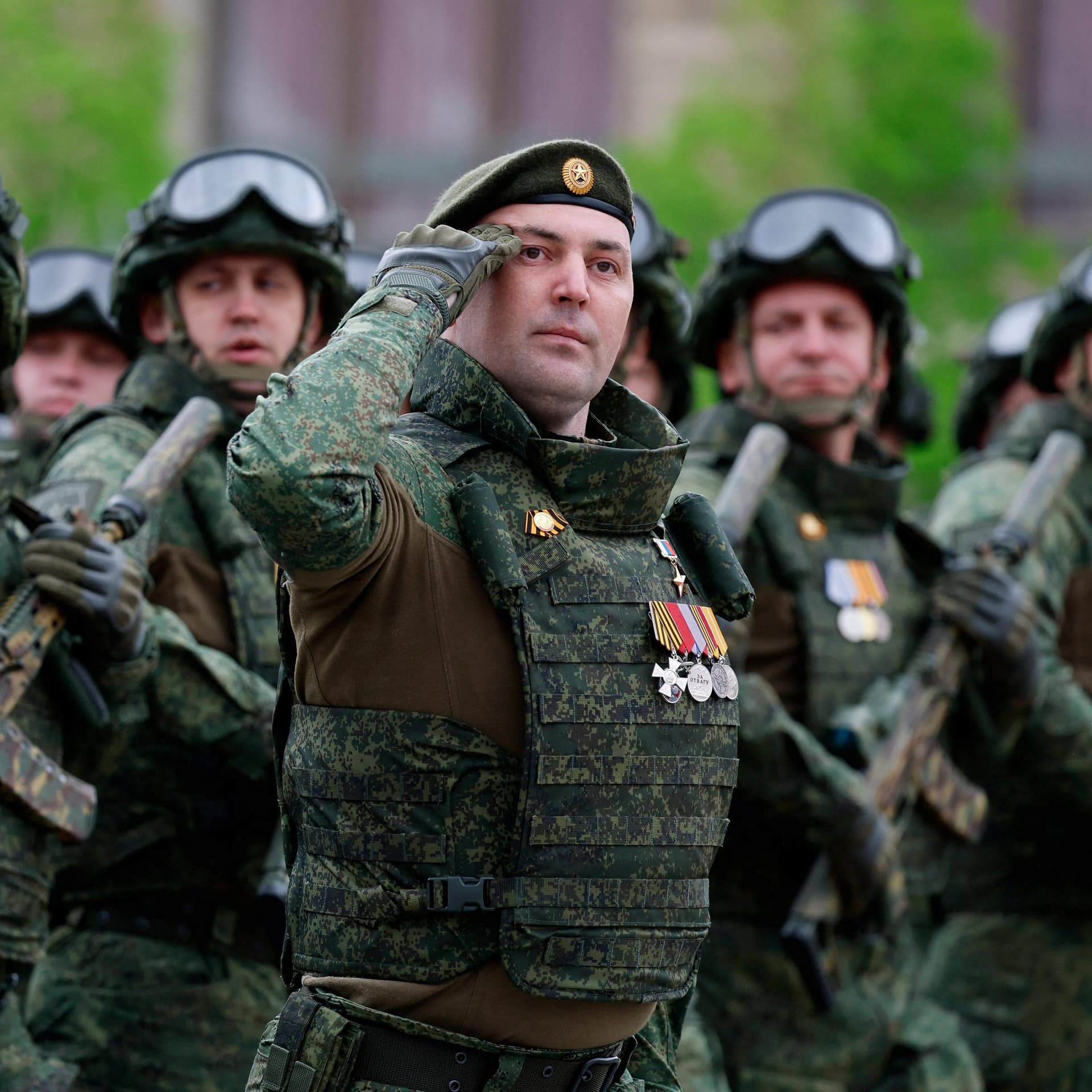
Photo: Russian soldiers who were involved in the country's military campaign in Ukraine march during a military parade on Victory Day in central Moscow, Russia, May 2026. Credit: Sputnik/Dmitry Astakhov/Pool via Reuters