In short
Spain’s Prime Minister Pedro Sánchez openly confronts President Donald Trump over the US-led war on Iran, including Spain’s refusal to let the US use two Spanish bases (Rota and Morón de la Frontera) and Trump’s threat to cut off trade with Spain. The episode also profiles Sánchez’s rise and policies (Palestine recognition, Gaza/Iran criticism, NATO spending stance, immigration and economic growth).
Guests/backgrounds
Guy Hedgcoe, BBC journalist based in Madrid covering Spain; Asma Khalid, BBC host/interviewer.
Key claims
Sánchez “relishes the fight” with Trump; Spain’s stance is “No to war” while supporting Ukraine against Russia; Trump’s trade threat is a reprisal tied to base access; Spain’s economy has rebounded strongly (tourism, immigration legalization) despite high unemployment.
Notable examples
Sánchez’s 10-minute televised rebuttal; Spain’s May 2024 recognition of Palestine; NATO 5% GDP spending dispute (Spain as the “laggard”); legalization pathway for ~500,000 undocumented workers; reference to Spain’s 2003 anti-war protests against Iraq.
Written by AI. May contain mistakes. Listen to the episode to check what was said.
Chapters
Tap a time to open that second in VOPedro Sanchez's Challenge to Trump
0:45 to 2:14
Discussion on Pedro Sanchez's public rebuttal of President Trump's threats.
“When some world leaders try to navigate President Trump, they flatter, they praise, they avoid picking a fight.”
Understanding Pedro Sanchez
2:14 to 6:16
A look into the life and political career of Spanish Prime Minister Pedro Sanchez.
“I'm a journalist based in Madrid in Spain and I cover Spain for the BBC.”
Sanchez's Political Rise and Promises
6:16 to 8:10
Discussion on how Sanchez became Prime Minister and his initial promises.
“And what did he promise Spain he was going to do when he was elected?”
Sanchez's Governance and Challenges
8:10 to 11:15
Exploration of the challenges Sanchez faces in governing without a majority.
“He promised progressives of classic left-wing reforms in the areas of, for example, women's rights, LGBTQ rights.”
Sanchez's Foreign Policy and Recognition of Palestine
11:15 to 14:00
Discussion on Sanchez's recognition of Palestine and its significance.
“That had been a phenomenon which the country had been seeing for some years, really since the turn of the century.”
Sanchez's Position on Palestine and Gaza
14:00 to 18:04
Explore Pedro Sanchez's recognition of Palestine and his stance on Gaza.
“The opposition is constantly calling on him to resign and call a general election.”
NATO Spending and Tensions with Trump
18:04 to 20:55
Discuss the pressures on Spain regarding NATO spending and Trump's criticisms.
“That goes back to last year when the Sanchez government originally said it was not going to be able to meet these NATO spending demands for defence.”
Spain's Economic Boom and Immigration
20:55 to 23:19
Analyze the factors behind Spain's economic growth and immigration policies.
“Partly it's because of people who are out of work during certain seasons down in the south of the country, for example.”
Sanchez's Bold Stance Against Trump
23:19 to 26:51
Consider the implications of Sanchez's ideological opposition to Trump.
“In February, he wrote an op-ed in The New York Times in English about why the West needs migrants.”
Exploring U.S. Interventions and Their Impact
28:05 to 28:44
Learn about U.S. historical interventions and their long-term effects on countries.
“The title of the episode is Could Iran Be the Next Forever War?”
Transcript
Automatic transcript. May contain errors.0:00This BBC podcast is supported by ads outside the UK.
0:30to music moguls and celebrity CEOs. We'll be taking a closer look at the lives and fortunes of some of the world's richest people. And asking you to decide if they're good, bad, or just another billionaire. Good, bad, billionaire from the BBC World Service. Listen now or search for Good, Bad, Billionaire wherever you get your BBC podcasts.
0:53When some world leaders try to navigate President Trump, they flatter, they praise, they avoid picking a fight. But Pedro Sanchez, he seems to relish the fight. The other day, the prime minister of Spain gave a 10-minute televised address to publicly rebut the president of the United States, who threatened to cut off trade to Spain because its government doesn't support the war in Iran.
1:26Sanchez was clear in his message that Spain repudiates the regime of Iran, but his stance on the war, he said, can be summed up in three words. No to war. La posición del gobierno de España se resume en cuatro palabras, no a la guerra.
2:13Europe. I'm Guy Hedgcoe. I'm a journalist based in Madrid in Spain and I cover Spain for the BBC. Well, Guy, we're here today to talk about the Spanish Prime Minister Pedro Sanchez and what is turning into an animated relationship that he's having with Donald Trump. Now, Sanchez is a socialist, so he's politically opposed, you might say, to Donald Trump. But since the United States and Israel began their joint war on Iran at the start of this month, a war that Sanchez has made clear he doesn't support, the two have been ramping up something of a war of words. Can you explain to us what's been going on?
2:55Well, immediately after the United States began its offensive against Iran, Spain, the Spanish government of Pedro Sánchez, expressed its opposition to it. En contra de una intervención militar injustificada, peligrosa y fuera de la legalidad internacional. Saying that it was an illegal war, there was no legal rationale for this law. And on the back of that, it said that the United States would not be able to use two military bases in the south of Spain, which the United States has used in the past and which it has access to in Rota and Morón de la Frontera. One is an air base, another is a naval base.
3:36They want to use them to launch their attacks because they're very strategically well placed for the United States because they're pretty much more or less midway between the United States and the Middle East region. So that has been at the root of this latest flare-up between Pedro Sánchez and Donald Trump. President Trump here in Washington has made it clear he doesn't agree with Spain's position. In fact, just the other day at the White House, we had the leader of Germany paying a visit to President Trump, and Trump was asked a question about whether he was going to, you know, take the heat off the Europeans, potentially in terms of the pressure to help them in this war.
4:20Well, some of the European nations have been helpful and some haven't. And I'm very surprised. Germany's been great. He's been terrific. And he singled out the behavior of Spain. Like Spain has been terrible. In fact, I told Scott to cut off all dealings with Spain. Well, I mean, Trump used some very strong language over this whole affair. So we're going to cut off all trade with Spain. We don't want anything to do with Spain. So this seemed to be specifically an economic threat against Spain in response to Spain's refusal to let the United States use the military bases. I also just want to be clear, though, isn't it that the EU as a whole has a tariff trade relationship with the United States?
5:06So I don't really understand how they'd be able to unilaterally punish Spain separately than the EU as a whole. This is the big question, because as soon as Trump said that, you know, I'm going to punish Spain by cutting off its trade. The question was, how would he do that? It's part of the EU and any action taken against Spain would have to be taken against the whole bloc. How was it received in Spain, all of this? It was big news in Spain for obvious reasons, because the idea of the United States singling out Spain for some kind of economic punishment or reprisal is going to be headline news here.
5:44So I think there was a certain amount of shock. But at the same time, I think people realized that the relationship between Donald Trump and Pedro Sánchez had been pretty poor for some months now. They had clashed over other issues, whether it was Gaza or spending of NATO countries. And so I think people weren't altogether surprised by this, even though it made for a very shocking headline. Guy, we'd love to understand a little bit about who Pedro Sanchez actually is. Where does he come from? How did he become prime minister? And what did he promise Spain he was going to do when he was elected?
6:23Well, Pedro Sanchez, he's from Madrid. He's an economist. He played basketball to quite a high level in his early 20s. And he worked in European and international institutions as a young man. He's tall and pretty athletic looking. He's better looking than your average prime minister, a bit more athletic looking than your average prime minister. You know, some people call him El Guapo, you know, the handsome one. And I think that that has sort of encouraged this idea that perhaps there's not much substance behind the looks. He got into politics. He joined the Socialist Party in 1993, and he worked his way up.
7:05And by 2014, he ran as a candidate in the Socialist Party primary for the party's leader. and to many people's surprise, he won that primary and he sort of defeated other candidates who were sort of seen as the candidates of the socialist old guard. So he was very much seen as a dark horse who'd kind of come out of nowhere. And at the same time, we didn't know a great deal about his politics. He certainly didn't give the impression that he was particularly radical, even though he was an unknown and he was upsetting the sort of old school of the socialist party. And Guy, can you remind us when he was first elected and what was the climate like, not only in Spain, but in Europe broadly at that time?
7:51Well, he was quite unusual in that the first time he became prime minister in 2018, he was not elected. 2018. He was not elected as prime minister. He won a no-confidence motion against Mariano Rajoy, the conservative leader, who was bogged down in corruption scandals. And when he came into power, one of his big promises was that he was going to clean up politics because the party that had been governing, the conservatives, was so swamped in corruption scandals. That had really been their downfall. He promised progressives of classic left-wing reforms in the areas of, for example, women's rights, LGBTQ rights.
8:33He also said that he would tackle the issue of historical memory, the legacy of the country's civil war, which was from 1936 to 1939, which was then followed by a four-decade dictatorship under General Francisco Franco, a brutal right-wing dictatorship, which ended in the late 1970s after the death of General Franco. And after his death, Spain made the transition to democracy, to a parliamentary democracy with a monarchy. But it has remained a very thorny subject because during that transition in the late 70s, early 80s, there was a sort of agreement by all the political parties and players not to use the past as a political weapon.
9:21And as a result of that, a lot of these issues were not discussed. So, you know, people were not tried for war crimes, for example, for human rights abuses, even though there were a lot of human rights abuses during the dictatorship. So it's been a very thorny subject. And this government is really the first to deal with the issue of historical memory in what you could call a thorough way. Prior to his leadership, I recall that Europe was wrestling a lot with the issue of migrants, of immigrants coming in. Where did he sit on that particular key issue? And it's one I want to ask you about because it's been a key point of disagreement and tension between him and President Trump now.
10:03Well, Spain was quite unusual at that time throughout the 2010s in that it really didn't have a far right party of note, let's say. Whereas, you know, you had in France, you know, Marine Le Pen was on the way up. As Europeans across 27 EU member states prepare to vote, the hard right is set to make significant gains. Far-right parties in nine countries, including France, the Netherlands, Austria and Poland, are leading in the polls. In Germany, you had the AFD. According to an exit poll by ARD, Merkel's CDU saw their vote drop to 32%. The far-right party, AFD, took second place. In Italy, a bit later, you had Meloni, but you had other, you know, other populist movements.
10:45Tonight, Italy is preparing for its first ever female prime minister and its first leader from the far right since the Second World War. In Spain, it wasn't. The far right would arrive, but a bit later on. And Spain had been seeing quite a lot of immigration from sub-Saharan Africa, people arriving in small boats, for example, to the Canary Islands. In 24 hours, 17 boats were intercepted off the Canary Islands. More than 17 ,000 migrants have arrived here this year. It's a 1 ,000 % spike on 2019. That had been a phenomenon which the country had been seeing for some years, really since the turn of the century.
11:25But it hadn't been a major issue in Spanish politics. And the position of the socialists and of Pedro Sánchez was really not to see it as a priority for Spain, certainly not to see it as a problem for Spain, as long as the borders could be secured, it wasn't something that Spaniards should be worried about. When he got the top job finally in 2018, I was covering European politics at that time and I remember the moment quite well. He was seen as this kind of the hot new thing in European politics, hot off the heels of Emmanuel Macron, a kind of new generation of young politicians. He's a handsome guy, handsome family.
12:03Has he lived up to that early promise? Well, I think overall, certainly since the pandemic, Pedro Sanchez's time in power has been full of drama. He's a politician who likes to take risks. That can be polarizing. Now, he pushed through a lot of reforms fairly early on in his tenure. He followed up on his promises to pursue issues such as historical memory, feminist policies, to promote LGBTQ rights. In some cases, that angered the right, certainly the far right, which was gaining support at the time. Pedro Sanchez, his socialists have not had a majority of their own in parliament. They've had to get the support of a lot of other smaller parties, either to their left or these smaller regional nationalist parties, for example, in the Basque country up in the north or up in Catalonia in the northeast.
13:02So that has meant that his governments have been quite unstable. He's been constantly trying to keep his parliamentary majority together because his own socialist party does not have enough seats in Congress to be able to govern alone. It's constantly looking for the support of other parties. A number of times, it's looked like his government has been about to collapse, for example, when Catalan nationalists have threatened to withdraw their support. For several years now, he hasn't been able to approve an annual budget, a new budget. So this has made things very difficult for him. And also when you add to that the fact that over the last year or two, his socialist party and a number of his political allies have become embroiled in quite serious corruption scandals as well.
13:57That has made the latter part of his tenure something of a roller coaster. He's constantly under pressure. The opposition is constantly calling on him to resign and call a general election. Guy, we want to talk about some specific issues that have been key during Sanchez's time in office and policy positions that he has staked out that put him in direct ideological opposition, let's say, to the Trump White House, but even to some in Europe. And let's start with his formal recognition of a Palestinian state in May of 2024. This took place before a number of other Western European countries did.
14:34The government of Spain will approve the official recognition of Palestine as a state. With this decision, Spain joins the more than 140 countries that already recognize Palestine. He made a speech announcing this all, and he made a speech in English. How significant was that? Giving the speech in English, that's, you know, that's something that no other Spanish prime minister has been able to do in the past. He's the first Spanish prime minister to speak fluent English. The recognition of the state of Palestine is not only a matter of historical justice with the legitimate aspirations of the Palestine people, but it is also an imperative need to achieve peace.
15:14I think in the last few years, what we've seen from Pedro Sanchez is him wanting to take more of a leadership role within Europe. And I think his position on Gaza was an example of that. Very soon after the October 7th attacks in 2023 on Israel, and once Israel was responding to that militarily, Pedro Sanchez and his government were being very vocal about warning Israel against violating human rights. I mean, I'd say he was really one of the first European leaders to be vocal on that. But would it be fair to say that Pedro Sanchez is an anti-war prime minister? He's been critical of the war in Gaza and Iran.
15:58He's been critical of calls to increase NATO spending. Is that fair? Well, I'm not sure if I'd call him anti-war in the sense that, for example, in terms of Ukraine's response to the Russian invasion, he's been very vocal in supporting Ukraine. Very vocal support and solid military support as well. So in that sense, he's been saying that the military response to Russia is legitimate. It was interesting that when he was responding to Donald Trump a few days ago, he did cite 2003, the response of the Spanish people in 2003, when their conservative government supported the invasion of Iraq then. And that was a very unpopular decision.
16:43It was a decision that drew hundreds of thousands of Spaniards out onto the street who were opposing the war. And nonetheless, the conservative government went ahead and offered its support to the United States and to the UK. And Pedro Sánchez mentioned that quite explicitly. For many people, that's a sort of, you know, a notorious episode in Spain's diplomatic history. Can I follow up, though, on this question of his overall philosophy to defense? because the Trump administration has been pressuring European partners to step up their spending and their contributions to NATO. Mark Ruta, secretary general of NATO.
17:21They feel like the United States has been paying more than its fair share. And we've had some very good discussions today and things are going along pretty well. And so there has been pressure to increase this to 5 % of GDP. As you know, I requested that they pay 5%, not 2%. And most people thought that was not going to happen. and it happened virtually unanimously. We had one laggard. It was Spain. And Spain has made it clear that they're not going to do that. Spain. You have to call them and find why are they a laggard? And they're doing well too, you know, because of a lot of the things we've done.
17:56They're doing fine. Yeah, that really is at the root of these tensions between Pedro Sanchez and Donald Trump. That goes back to last year when the Sanchez government originally said it was not going to be able to meet these NATO spending demands for defence. NATO members have agreed to boost the overall defence spending target to 5 % of GDP, but one nation has opted out. 2.1 % of GDP, nothing more, nothing less, as what the Spanish prime minister said last night in a national TV address. And Spain was the only country which was refusing to raise its spending to 5%. and Pedro Sánchez said that it was simply because it couldn't do so Trump has constantly said well Spain has been terrible they haven't fulfilled their duty in this sense he even said at one point maybe you should throw them out of NATO frankly well maybe they should be thrown out of NATO
19:27Good Bad Billionaire.
19:43podcasts. Guy, I'm interested by you mentioning Pedro Sanchez's reticence to spend more money on defence because the Spanish economy has been booming, has it not? You wrote a piece for the BBC with the headline, How Spain's Economy Became the Envy of Europe. So how has Sanchez managed this boom in the Spanish economy. Well, that's right. I mean, economic growth in Spain last year was the equivalent to growth in the UK, Germany, France, and Italy combined. So of the big economies in the European Union, Spain is by far the best performer at the moment. Now, Spain's economy had a terrible COVID. It was perhaps the most heavily affected economy in the European Union, certainly in the Eurozone by COVID.
20:36But it's bounced back incredibly well. It's been growing strongly ever since each year. Unemployment has been a huge problem in Spain. It's just dipped below 10 % for the first time. Gosh, that feels so high. Asma looks astounded. I mean, those are not good unemployment numbers by an American political standard. Partly it's because of people who are out of work during certain seasons down in the south of the country, for example. But unemployment is coming down, even though it's still very high. Now, the reasons for this strong performance, well, the most obvious one is tourism. Spain is hot on the heels of France to becoming the biggest foreign tourist destination in the world.
21:17It's got nearly 100 million foreign visitors coming every year. And the government says that immigration has been very important for this economic performance over the last few years. And one report that came out recently, done by a conservative think tank, said that nearly half of the economic growth of the last four or five years can be directly linked to foreign workers and their input into the Spanish economy. And so the government is in the process of approving a mass legalization of foreign workers, which will allow at least half a million immigrants who are currently undocumented to get residency papers and join the workforce.
22:05Now, critics of Pedro Sanchez will say, well, you know, this is this has nothing to do with your handling of the economy. It's just, you know, it's basically because you've been lucky because lots of people are visiting the country. Tourism is doing well and it's not going to last. But I think that the government says, you know, we've had, you know, half a decade now where we've been performing very well. the outlook remains strong. You described this new law to create some sort of pathway towards permanent residency for people who are not in the country legally. That's something that many in my country here in the United States would certainly see as a political liability.
22:39Is it not there in Spain? Well, immigration is a concern for Spaniards. It's become more of a concern certainly over the last year or so. I think it's the fourth biggest concern for Spaniards now, according to opinion polls. But what he's trying to do is to say, OK, we have a challenge with immigration, but as a left-wing government, we're going to take the initiative on this. We're not just going to make vague comments about, oh, let's keep the borders secure. He's saying, OK, we're going to do something quite bold here. Yes, my country has offered a path to regulate half a million undocumented migrants.
23:14We're going to legalize people who want to work and give them papers. Half a million people we live with every day, at the market, on the bus, at our children's school, people who care for our parents, work in the fields, who have built hand in hand with us the progress of our country. In February, he wrote an op-ed in The New York Times in English about why the West needs migrants. And I'm just going to quote a sentence here where he's talking about immigrants. And he says some leaders have chosen to hunt them down and deport them through operations that are both unlawful and cruel. My government has chosen a different way.
23:51What did you think when you saw that message? Well, I mean, his government has given two arguments to support its own policy on immigration. One is the economic argument. We need these immigrants to sustain our social security system and our pensions and our economy in general. The other argument is a humanitarian argument. Now, the Minister for Migration, Elmer Saith, just a few days ago told me that we need to treat these people in a humanitarian way. It's the right thing to do. Now, you mentioned Pedro Sanchez and his op-ed in the New York Times. That's a very clear example of him taking a stand, not just within Spain, but presenting himself as a left wing figure in Europe who is representing many left wing values, who's trying to sort of fight this tide of radical right wing politics that we're seeing elsewhere.
24:50because he is the only left-wing leader of a major European economy at the moment. He's very conscious of that. And so I think he feels he has to step up and play that role to the full. Whatever the reasons for Spain's current economic good news and strong growth figures, is it a good idea for Pedro Sanchez to be taking on Donald Trump ideologically? because Donald Trump has threatened to cut Spain off economically. Is Sanchez taking a risk with these public pronouncements? I think many people feel this is a rational, strategic move by Sanchez. He's taking a stance against a US president who is not popular in Spain.
25:44I mean, one recent poll showed that 77 % of Spaniards have a bad or very bad opinion of Donald Trump. So that would appear to cut across party lines. So there might even be people on the political right there who don't like Donald Trump and may possibly even approve of what Pedro Sanchez is doing. What could this perceived boldness by Sanchez taking a stand on different issues, what could that mean for other European leaders? Are they wanting to follow him on that path or not so much? Well, it might be a tempting path to follow for other European leaders who've seen Pedro Sanchez's lead on this, because if you're falling into line with the United States, for example, on Iran, we've seen how difficult it is to maintain a stable relationship with Donald Trump.
26:35You look at Keir Starmer in the United Kingdom. He seemed to have a very good relationship with Trump. and then just in the last few days, it seems to be in tatters, that relationship. The route that Pedro Sanchez has taken, in some ways, seems much more straightforward. You simply say, I'm in opposition to Trump, certainly on the issue of Iran and his policy in the Middle East. I'm going to speak out against it. If you do that right from the start, in a way, it makes things much easier. So I think it certainly might be tempting for other European leaders to follow him.
27:18It sounds like we'll see whether his position then on the war in Iran makes him a leader or an outlier perhaps in the coming weeks. Thanks so much, Guy. It's a pleasure, Asma.
27:37That was Guy Hedgko, who covers Spain for the BBC. And a big thank you to all the listeners who've sent in questions about the war in Iran. Yes, thank you very much indeed, especially Brittany from Seattle, who wrote to us to ask if the United States has ever bombed a country or had a war in which it successfully led to a change in leadership that America wanted. Now, Brittany, we did an episode last Thursday with the brilliant BBC security analyst Gordon Carrera. Now, with Gordon, we looked at something like this question. The title of the episode is Could Iran Be the Next Forever War? And you can find it in our feed.
Read the full transcript
28:13But I'm going to give you a little bit of bonus information here, which is that in December 1989, President George H.W. Bush, the father, led a U.S. invasion of Panama to unseat the then President General Noriega. and they established another government, which 35 years or so onwards is now leading a relatively prosperous and stable country, which is friendly with the United States. So that's one example. Thanks for your question. Thanks for listening, Brittany. And if you all have any additional questions or story ideas for us, we would love to hear from you. You can send us a message at theglobalstory at bbc.com.
28:49Our show today was produced by Hannah Moore, Valerio Esposito and Chris Benderev. It was edited by Bridget Harney and mixed by Travis Evans. Our senior news editor is Chyna Collins, and I'm Tristan Redman. And I'm Asma Khalid, and that's it for The Global Story today. Thanks as always for tuning in, and we'll talk to you again tomorrow. Cheerio.
29:24Billionaire. The podcast exploring how some of the wealthiest people on the planet made their money. And we are back with a new season. From sporting superstars to music moguls and celebrity CEOs. We'll be taking a closer look at the lives and fortunes of some of the world's richest people. And asking you to decide if they're good, bad or just another billionaire. Good, bad billionaire from the BBC World Service. Listen now or search for Good, Bad, Billionaire wherever you get your BBC podcasts.
29:54Amen.
From the publisher
As European leaders have struggled to find a unified response to the US-Israel war in Iran, Pedro Sanchez has stood out as a voice of dissent. He said in a televised address last week: “The position of the government of Spain can be summarised in three words: no to war.”
The Spanish Prime Minister and US President have butted heads on many issues; the war in Gaza, immigration and defence spending among them, but in the past week their relationship got even more fiery, with Donald Trump threatening to cut off all trade with Spain. What makes Sanchez willing to stand up to Trump? And will his gamble be worth it?
Guy Hedgecoe, a reporter for the BBC based in Madrid, joins us to discuss.
Producers: Hannah Moore, Valerio Esposito and Chris Benderev Executive producer: Bridget Harney Mix: Travis Evans Senior news editor: China Collins
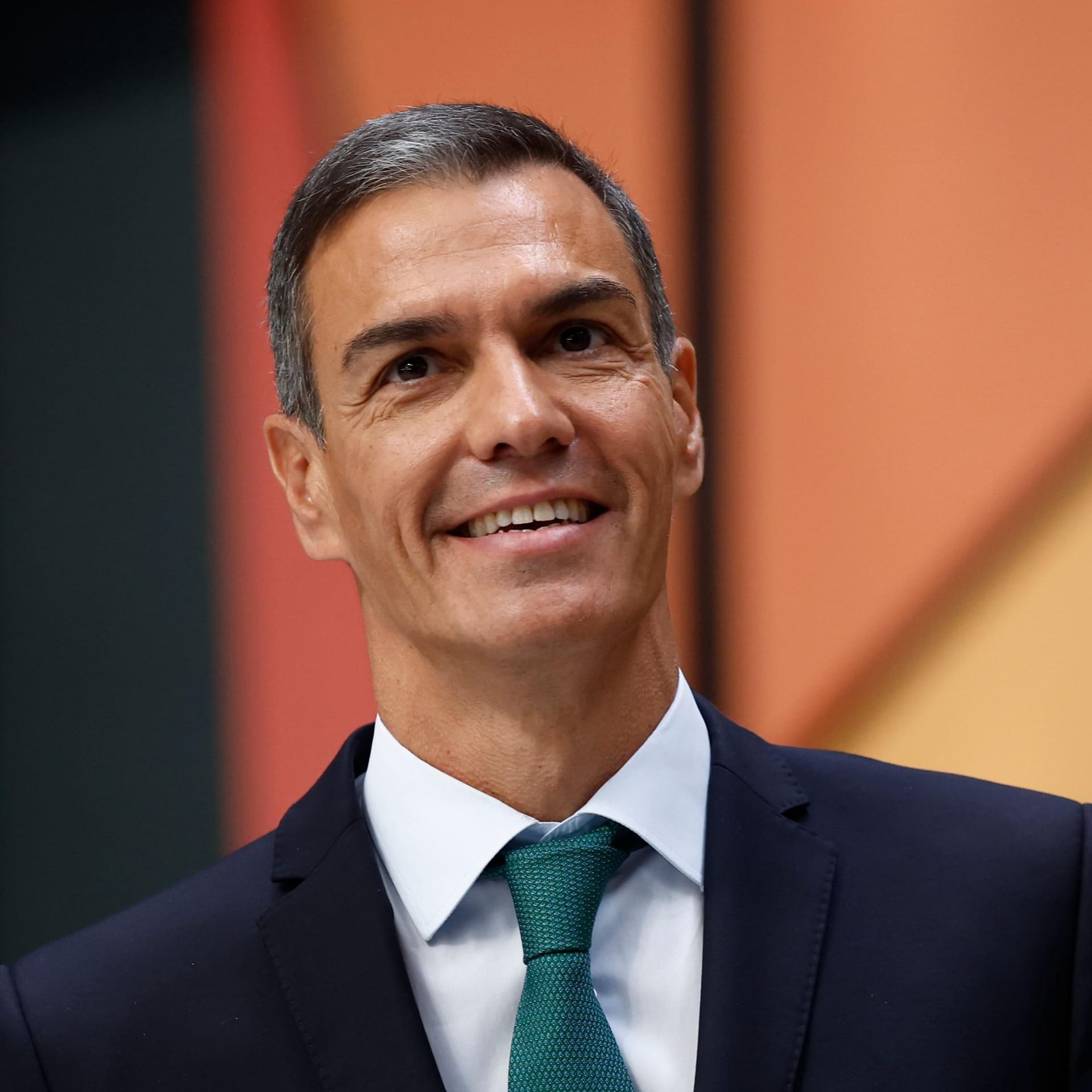
Photo: Spanish Prime Minister Pedro Sanchez delivers a speech during closing ceremony of the 'Spain, Vanguard in the Green Industry', in Madrid, Spain, 08 September 2025. Credit: Daniel Gonzalez/EPA/Shutterstock.