
In short
The “air conditioning culture wars” in Europe vs. the US, sparked by extreme heat and political debate in France, and weighing AC’s health benefits against environmental and cost concerns.
Guests
Greya Jackson, host of BBC Climate Question (climate/energy-focused journalist; uses a fan and sometimes wet-sheet or bucket-of-water cooling methods). Also featured as a discussion participant: Tristan Redmond (Global Story host) and Sumi Somaskanda (filling in as host).
Key claims
Europe’s low AC adoption (UK ~4%, France ~25%) is being challenged by longer, hotter heatwaves. France’s debate has split political camps: Marine Le Pen supports more AC; Jean-Luc Mélenchon warns it shifts heat outdoors and harms poorer city residents. AC emissions depend on electricity grids and refrigerant leakage; UN estimates cooling demand could triple by 2050. Alternatives include passive cooling, green spaces, and building design.
Notable examples
Paris heat at night due to stone buildings; French “red alert” up to 41°C, school closures, wildfire outbreaks, excess deaths (~2,000 in late June), and funeral homes running out of cold storage. Greya’s “yogurt on windows” film reflecting ~80% thermal energy.
Written by AI. May contain mistakes. Listen to the episode to check what was said.
Chapters
Tap a time to open that second in VOThe Air Conditioning Culture Wars
0:48 to 2:14
Overview of the prevalence of air conditioning in the U.S. compared to Europe.
“When you walk pretty much anywhere in the U.S.”
Political Debates Over AC in France
2:14 to 4:48
Discussion on the political implications of air conditioning in France during heat waves.
“And today on The Global Story, the air conditioning culture wars.”
Heat Waves and Social Impact
4:48 to 11:44
Exploration of heat waves in France and their social and economic impacts.
“Sometimes it's charming for a very short period of time and then it gets a bit much.”
Alternative Cooling Solutions
11:44 to 13:00
Exploring unconventional ways of staying cool without air conditioning.
“So I think it's kind of those two things together.”
Cultural Attitudes Towards Air Conditioning
13:00 to 14:00
Examining European attitudes towards air conditioning compared to American views.
“Well, Sumi, in all of this, one of the questions is, is air conditioning actually a one-size-fits-all solution that works for everything?”
Introduction to Air Conditioning Discussions
14:00 to 14:36
The hosts introduce the topic of air conditioning and its cultural implications.
“Our American listeners right now are going like, What are these people doing?”
Rising Demand for Air Conditioning
14:36 to 15:42
Discussion on the increase in air conditioning sales globally and regionally.
“conversation in a way that I don't really remember.”
Environmental and Economic Concerns
15:42 to 18:20
Exploration of the arguments against air conditioning related to cost and environmental impact.
“many people of which you would obviously never be able to afford air conditioning or might not even have access to electricity.”
Arguments For and Against Air Conditioning
18:20 to 19:39
The hosts weigh the necessity of air conditioning against its environmental consequences.
“There are lots of solutions that help us bring down the amount of power and electricity we need.”
Alternatives to Air Conditioning
19:39 to 20:53
Discussion of alternatives and strategies for cooling without air conditioning.
“People cannot live at these sorts of temperatures and indeed lots of people die in these sorts of temperatures.”
Show all 13 chapters
Innovative Cooling Solutions
20:53 to 24:24
Exploring creative and cost-effective cooling methods, including unusual materials.
“Well, I want to zoom out a little bit, if that's OK, because I don't want the onus just to be on what individuals should or could do, because there's lots that town planners and governments can do.”
Heat-Related Risks and Perspectives
24:24 to 26:43
The hosts discuss the alarming statistics on heat-related deaths and the evolving view on air conditioning.
“I was really sceptical because I was like, smell, flies, you know, whatever.”
Final Notes and Transcription
28:29 to 29:03
Information about the transcription and a final message.
Transcript
Automatic transcript. May contain errors.0:00This BBC podcast is supported by ads outside the UK. If you are currently overpaying on software to run your business, remember this number, 10 ,000. That's the number of new businesses that join Odoo per month. Join Odoo today at odoo.com. That's O-D-O-O dot com. Hi there, I'm Asma Khalid. And I'm Tristan Redmond and together we're the hosts of the Global Story podcast from the BBC. For those of you who might be new to our show, we here at The Global Story dive deep every weekday on one big story at the intersection of where the world and America meet. And you can now watch The Global Story on the iHeart app.
0:42Catch every brand new episode every weekday. Just tap into iHeart to start watching. And we hope you enjoy the show.
0:53When you walk pretty much anywhere in the U.S. in the heat of the summer, there is something so ubiquitous you've probably never really thought about it. Any store or building you walk into is cool or often downright freezing. It's air conditioning, of course. It's not just stores and buildings. Nearly 90 % of American homes have it. But not so in Europe. In Spain and Italy, only 50 % of homes have AC. In France, it's even less, at 25%. And in the UK, it plummets to as low as 4%, according to some researchers. Which, when the continent has been experiencing record-breaking high temperatures this summer, has led to a surge in demand.
1:39Right, this hot weather isn't fun anymore. I've spent 600 quid on fans. Listen, this is too much. This is too hot. I can't do this anymore. I've just had to get off this bus because it's set fire to itself. The battery is overheated. Give me snow, give me ice, give me rain, give me anything but this. And in France, where temperatures have hit 104 degrees Fahrenheit in some parts in the last week, the question over whether to AC or not to AC has become one of the hottest political debates. From the BBC, I'm Sumi Somaskanda in Washington, D.C. filling in for Asma Khaled. And today on The Global Story, the air conditioning culture wars.
2:23So a bit later in the podcast, we're going to be speaking to one of the hosts of the BBC's Climate Question podcast. I saw from the UN was something like 489 ,000 people have died as a result of heat-related deaths. I found that figure shocking. 489 ,000 people. That's nearly half a million people dying from heat every single year. But before that, we're zooming in on France with a guest that you probably know pretty well by now, Tristan Redman, host of The Global Story. Hello. Thank you for inviting me on your show, Sumi. Well, actually, it's your show, but I'm happy to talk to you about what an interesting topic, isn't it?
3:01Air conditioning. It might seem innocuous, Tristan, but I think you and I know it is anything but. It is anything but. I can tell you on this side of the Atlantic, there has been so much media coverage of late, not just about the heat wave in the U.S., but about air conditioning and the lack thereof in Europe. And there are a lot of strong feelings. Many Americans don't know this. And if they do know it, we nevertheless don't understand it. But European countries are very opposed to air conditioning. Imagine having to have a political debate and discussion about air conditioning. Europeans still don't have AC.
3:35And then they pat themselves on the back for their own stupidity. Get over it. You air conditioning your home so you don't suffer is not selfish. It's fine. I want to give you just a taste of the headlines in some of the main publications here. There was an editorial in The Washington Post that claimed that European hostility towards air conditioning is suicidal. A Wall Street Journal editorial called Alternative Cooling Solutions Green Virtue Signaling. New York Magazine called the debate in Europe bewildering. There's been a lot of focus on the picture in France. And Tristan, you live in Paris, so paint this picture for us then.
4:09What is it like to live in Paris during a heat wave? Well, it can be a nightmare. And it doesn't cool down really very much at night because there's a lot of stone, heavy stone buildings, and they just radiate heat at night. And people get used to this feeling. You sleep with your windows open because you most likely don't have air conditioning. And the feeling of being in Paris in the summer is the feeling of listening and hearing all of your neighbors and all the things that they're doing as you try to go to sleep. So sometimes they're cooking, sometimes they're arguing, sometimes they're snoring.
4:45I find it charming. Yeah. Well, yes and no. Sometimes it's charming for a very short period of time and then it gets a bit much. I would say that the conversation that happens inside my family is something like a microcosm of the conversation about air conditioning, maybe all the way across Europe. So just to give you an example of like me and my wife. So a couple of years ago, we invested in a very shoddy little air conditioning unit. Now in the United States, you'd laugh at it. It's barely big enough to cool one room. But we put it in our bedroom. And then on really hot nights, my daughters, two of them will come in and sleep in the room with us.
5:28So there are four of us, just huddling in one room. But the difference between my wife and I comes from the fact that I grew up in the United States. So I'm quite attached to air conditioning as a concept. So I will sneak down the corridor like maybe two or three hours before we're going to go to bed and I'll turn on the air conditioning and I'll close the door in the bedroom because I want the room to be cool when we come to bed. And if my wife gleans that I have done this, she will tend to then sneak down the corridor and then turn it off again. Oh, no. Because she thinks I'm being irresponsible.
6:00And she'll look at me and she will think that I am some sort of profligate wastrel. And I will look at her and think that she is preaching at me. And those are the divisions that exist. And that you can extrapolate throughout European society in some ways. Yeah, so why has the debate, do you think, been so loud this year? Well, I think the reason ultimately is change. Europe is changing. Temperatures are creeping up faster than any other continent on Earth. Historically, you haven't needed air conditioning in Europe. So, you know, maybe five or six nights a year where it was unbearably hot. Now it can be weeks and weeks at a stretch.
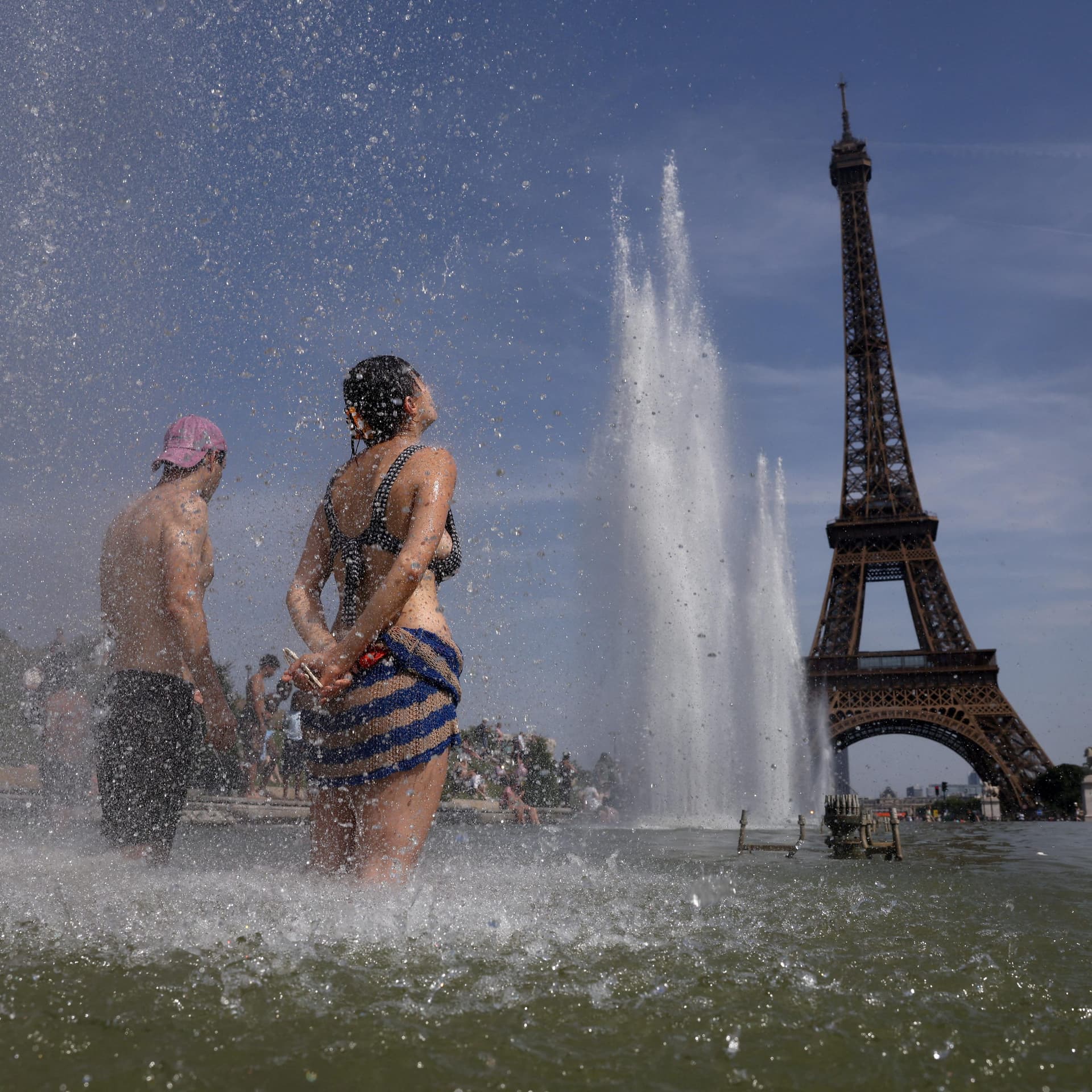
6:43But let me run you through, Sumi, some of the things that have happened. So the first heatwave was in May, but there was a second heatwave in June. In France, half of the country is now under red alert, as temperatures are expected to climb to 41 degrees Celsius amid a fierce heatwave. France actually experienced the three hottest days in its recorded history. France experienced its hottest night since records began almost 80 years ago. Southern France is being hit by an outbreak of wildfires. They're earlier than usual and they're following hot on the heels of a record-breaking heat wave. Schools have been closed and trains cancelled as people desperately try to stay cool in the face of temperatures that have topped 40 degrees Celsius.
7:34A lot of schools and hospitals are not air conditioned. So thousands of schools have had to close, thousands more had to adjust their schedules. French teaching unions called a strike and said this was all unacceptable. There was, you know, social media videos of people in supermarkets fighting over air con units because people just desperately wanted to buy them.
8:05At the beginning of July, the French National Public Health Agency said that it recorded an increase of more than 2 ,000 deaths during the last week of June. And one issue now emerging is the pressure that there has been on funeral homes. To be blunt, many are now reporting that they are running out of cold space to store bodies of those who have died. Now, we don't know how many of those were attributed to the heat, but that's 2 ,000 excess deaths in that period. All of this then transformed into a political debate. so the French government the government of Sébastien Lecornu who's the Prime Minister of Emmanuel Macron has been criticised for not doing enough but political camps are kind of coalescing on this issue so Marine Le Pen notably who is a hard right leader in France the favourite to become the next president of France so her party has traditionally been climato-sceptic as they would call themselves and And now they're saying they're sort of saying climate change is a real thing and we need to deal with it.
9:20And the way we need to deal with it is by investing properly in air conditioning. Some critics of the hard right National Rally Party said that they were jumping on a crisis and trying to make political capital from it. Her opponent on the hard left is a guy called Jean-Luc Mélenchon, who he's taken the opposite position. He says climate change is a real thing and it's going to become worse if people, especially in cities where lots of people are concentrated together, start using air conditioning a lot. and the people who would be affected most in cities would be the poorest people who cannot afford air conditioning because all you're doing when you put air conditioning into your building is you're taking heat from inside your building and you're shoving it outside the building.
10:07And for the first time, the leader of the Green Party in France, this woman called Marine Tondelier, she has started saying that the situation is so serious that air conditioning needs to be part of the solution, which is not something you would have expected just a few years ago. And it's been a kind of whole political ding-dong ever since then, really. I wonder, Tristan, what do people in France then think of the US and how Americans are addicted to really cold indoor spaces in the summer? So there was a headline that you read out earlier on, which I'd just like to just address. So it was an editorial that called alternative cooling solutions, quote, green virtue signaling.
10:52I can't speak for all Europeans, but I don't know about that. I mean, I'm not sure that many Europeans are choosing to swelter in their houses just to prove a point to people in the United States. But it is fascinating to us over here in Europe that people in the United States are so interested. Why do you think it is? I'm in two minds and two hearts about this because I spend a decade and a half living in Berlin, which is pretty similar to what you described to Paris. There is no AC to be found anywhere. That is partly because in Germany, you also haven't seen the type of temperatures that Europe is experiencing now.
11:28Here in the U.S., there is a sense that convenience is the most important thing. And why would you suffer in the heat when you can be cool inside? So I think part of what the concern is, I would say, about Europeans here is a bit of head scratching. And actually, there are Americans, I've talked to many of them, who say, well, the Europeans just think they're better than us, that they don't need air conditioning and that they can be more green than we can here in the U.S. So I think it's kind of those two things together. I think one point Americans do make is when you have such extreme heat, that would really reduce the productivity of society here.
12:09Because in the summer, that means there are people who perhaps could not go to work. maybe their kids could not go to school, so they would have to stay home. That kind of conversation is being had in France as well. So Marine Le Pen says that it's an economic imperative to cool temperatures down for people in France. And, you know, if you listen to people on the endless radio debates that are raging on this topic right now, there will often be people who say, OK, yes, installing air conditioning in buildings which are very old and not meant to have air conditioning can be extortionately expensive.
12:44But what can be even more expensive is losing productivity in the economy. So we're just trying to make the best of a difficult situation over here because things have suddenly got a lot hotter than they used to be. And we're doing the best we can. I think Americans would be very understanding of that. Well, Sumi, in all of this, one of the questions is, is air conditioning actually a one-size-fits-all solution that works for everything? So I wanted to know a little bit more about this. So I got in touch with our colleague Greya Jackson, who's the host of the BBC podcast The Climate Question. And I wanted to start off by asking Greya if she actually had air conditioning herself.
13:28And she told me that she had a much more unusual solution to the problem. I have a fan. Yeah. So I'm not entirely with that means. If it gets really hot, I sleep under a wet sheet. That's my other technique. But when I was pregnant and having to work, I was living in a 70s house that was really poorly insulated. So I used to sit with a big bucket of water under the desk with my feet in the bucket of water. And that was the best thing I could find to keep cool and do some work. Does that work? It works really, really well. Our American listeners right now are going like, What are these people doing?
14:06They've got buckets of water under their desks. All right. Well, Greya, it's so great to have you with us. Here at The Global Story, as you know, we look at stories where the world and America meet. And one of the things that has amazed some of the Americans on our team is that some of the Europeans on our team don't have air conditioning at home. and somehow this summer it feels like air conditioning has become part of the conversation in a way that I don't really remember. Have you noticed more people buying air conditioning units in the UK? Somewhat. I mean people have mentioned it to me but mostly I think because they're British they just complain about how hot it is and if they got air con then they wouldn't be able to complain about how hot it is.
14:56We love complaining about the weather here. Yeah. That sort of anecdotally, air conditioning units have been on the rise for a long time. I was looking at some data, 1990 to 2016, saw a fourfold increase in air conditioning units sold during that period. That's globally. So people are... But fourfold of not very much could also be not very much, or is it genuinely a lot now? I mean, if you look at China, there are hundreds of millions of units installed. It's the same in the US, South Korea, Japan, a sort of third and fourth on the list. And then there are some emerging markets where maybe something like 27 million units are installed in places like India and Brazil.
15:38So there are still hundreds of millions of units. Granted, there are many more people than that, many people of which you would obviously never be able to afford air conditioning or might not even have access to electricity. So that kind of puts it into perspective. But that is expected to rise. I have some data here that the UN says the need for air con could triple by 2050 compared to today. And that's from 2025. Well, I think probably deep down in the British psyche, there is the idea that succumbing to air conditioning somehow shows weak moral fibre. but what are some i mean apart from the kind of sense of guilt that some british people or europeans feel what are the arguments against using air conditioning well it's expensive to install right i think that puts a lot of people off energy prices are soaring so expensive to buy expensive to run but if you look at the environmental side there are also some issues around the climate.
16:42So these air conditioning units use refrigerant gases, things like CFCs, and those, if they leak, are really, really potent planet warming gases, or if they're not disposed of at end of life, they're really problematic. There is quite a big push for those to be edged out or phased out. But the main bulk of emissions that come from air conditioners are actually how they're powered, the electricity they use. So that really depends on how the grid is powered and where you live in the world. So if you take two air conditioning units and you run one in China and one in Brazil, they will have totally different carbon footprints or climate footprints.
17:24So in China, that's because around 50 % of the grid is powered with coal. So huge amount of fossil fuel energy and coal is the dirtiest of the fossil fuels that we have. Brazil, on the other hand, 80 % renewables on the grid. So the carbon footprint is far, far less. So it really depends on where you are in the world. So environment, cost, those are the sort of the main sort of cons, if you like. But there's a trade-off because people need to stay cool. People can't live in some of the conditions that they're experiencing. I mean, India in May was seeing temperatures sort 40, 50 degrees. That's unlivable, really.
18:03In theory, it would be possible to have a carbon neutral air conditioning system in your house if all of the energy that you burnt in your house were renewable. Yes, in theory. I mean, nearly zero. It depends on the refrigerant gases that we've talked about. The UN has actually published a report last year that said we could get to nearly zero emissions in the cooling sphere. There are lots of solutions that help us bring down the amount of power and electricity we need. Because don't forget, if we install so much air conditioning, we're going to have to grow our grids exponentially to keep up with that power demand.
18:42I mean, maybe 20 % more of the power that we're using today in 2050 just for cooling alone. And there's lots of other industries that are going to need renewable power like cement and steel and the aviation industry to produce sustainable fuels. So there's going to be much higher demand on the grid. So we need to reduce our energy consumption and make it much more energy efficient when we do need to. Are air conditioning units as bad for the environment as some people would have us believe? So it's hard to weigh in whether they're really bad or not because like we've said, it depends on how your grid is being powered.
19:20It depends on how energy efficient your unit is.
19:28Or even the standards in your country are very different depending on government laws and rules. So I think it's hard to say whether it's quote unquote good or bad because I think it's also necessary for a lot of people. People cannot live at these sorts of temperatures and indeed lots of people die in these sorts of temperatures.
20:22Transcription by CastingWords into iHeart to start watching. And we hope you enjoy the show.
20:33What are some of the alternatives? I mean, you've suggested putting a tub of cold water under the desk. But for people who don't want to or cannot install air conditioning as we enter times of the year where it's just unbearably hot, what are some of the best tips and tricks? Well, I want to zoom out a little bit, if that's OK, because I don't want the onus just to be on what individuals should or could do, because there's lots that town planners and governments can do. So I talked about before how the UN said we could get emissions down to nearly zero from cooling systems. And that is through energy efficiency, as I mentioned, but also how we build our cities.
21:14that's where the majority of us live and there's also something called the urban heat island effect which is where our cities are much much hotter than the surrounding areas and that's because we use lots of materials like concrete and asphalt which are dark so they absorb more sunlight but because of the nature of the material they also hold on to that heat much much more there's much less vegetation which makes it much much warmer so cities are just much much hotter as a result so why don't we think about redesigning and rebuilding our cities or when we're building new cities or extending them?
21:47How do we design cities in a way that are much more climactically comfortable? And one of the main solutions is green spaces. Lots of co-benefits, you know, they keep our air cleaner, they make us happy as well, but they also keep us cooler because they provide shade. But also the buildings that we build, think about a glass skyscraper in the middle of Dubai, that's going to require a lot of cooling because glass is not a very good material for thermal regulation. Conversely, in somewhere like the UK in winter, it also needs a lot of heating. So how do we build our buildings that are much more sort of thermally efficient?
22:24And we know how to do this. It's called passive cooling. It's where we use natural solutions to cool our homes. And we've been doing it for hundreds of years. So have you been to Morocco before? Yes. So you've Stood outside and then walked into a Riyadh. Those beautiful shaded courtyards. And I bet you noticed the temperature difference. That is a way that you can design a building really cleverly so that it's cool. And again, that's water features, help cool the air plants. And using shading, thick walls as well help keep the heater and narrow windows. In Egypt, they use those sorts of techniques.
23:00But they also use something called a wind catcher. Really, really beautiful. so on the tops of buildings they have almost like a gazebo like they're beautiful they're often beautiful wooden lattice work or brick work and it's got lots of holes and so as the wind blows across the top of the city the wind catchers are then caught in these in these little gazebos and they get diverted the air gets diverted down into the building so it keeps it keeps ventilation but it also keeps that cool air ventilating around the building and keeping the building cool so there's lots of interesting ideas about how you can do this at low cost with materials that are widely available that don't cost the moon to do so that's sort of how you can think about at top level but there are lots of things that we can do and i've gone out and done and seen lots of interesting things including would you believe it painting windows with yogurt go on dairy or non-dairy although there's probably a slightly lower carbon footprint to the non-dairy version But basically, I met a guy called Tom who's been looking at low cost solutions to stopping heat traveling through windows.
24:05And he found that with yogurt and a bit of a paint roller, he painted yogurt onto the window. And he then measured that that yogurt film could reflect 80 % of the sun's thermal energy, which meant that your room was much, much cooler as a result. I was really sceptical because I was like, smell, flies, you know, whatever. No flies, no smell, he says. And when it's the heatwave saver, you can just wash it off. I mean, you say that, but we're not doing a very good job of convincing our American cousins that we are not insane. That's true. I mean, something that I like to do, and I learnt this, I was doing a bit of reporting about the Little Ice Age, which was conversely a very cold time in England.
24:55It's where, have you ever seen pictures of the frost fairs on the River Thames where it freezes over? Yes. That period of time. And this building called Hardwick Hall in the north of England was built. It's a stunning piece of architecture. And what was really interesting about that is they had designed the building to be used based on the sun's position in the sky. So kitchen in the cold northern area. They have their breakfast where the sun rises and their dinner where the sun sets. So they literally followed the sun around the house. Yes. And I then went home and I moved my desk where I spend the majority of my day to follow the sun in winter and to hide from the sun in summer.
25:37And I can notice there's about a two degree temperature difference from moving from back and forth from my house. So you can do these like little weird quirky things And all these little differences, they might not sound like much, but I think collectively they can add up. We've been talking a little bit about France in this episode. And last week, Marine Tondelier, who's the leader of the French Green Party, who, you know, the orthodox thinking would be that they would be against air con. Now, Marine Tondelier acknowledged that it's now becoming necessary to have air conditioning as part of the solution.
26:16Do you think we're at a turning point in Europe? Quite possibly. I mean, if you look back over the last couple of decades, I saw from the UN was something like 489 ,000 people have died as a result of heat-related deaths. I found that figure shocking. 489 ,000 people. That's nearly half a million people dying from heat every single year, that is. And so, actually, it's very hard to put a cost of life against a cost to the environment. There are always going to be trade-offs, at least in the short term. And maybe, you know, the raising awareness of the fact that climate change is making heatwaves more intense, more frequent.
Read the full transcript
27:02we've seen this one massive heat wave in June and we're in the midst of the next one. So I wouldn't be surprised if Aircon, at least in the UK and Europe, became a much more normal convention. But we'll have to wait and see.
27:21Greiner, thank you so much. You're welcome. It's been great to have you. It's been nice to be here.
27:32That was Greya Jackson, the host of the BBC podcast, The Climate Question. You can find them wherever you listen to your BBC podcasts and on YouTube. As always, our email is theglobalstory at bbc.com. Please send us your thoughts and ideas. We always love to hear from you. And here at The Global Story, as you know, we look at one topic every day. But for the very latest news headlines, listen to our sister show, The Global News Podcast, in all the regular places that you listen to podcasts. You can also find me once a week on our politics podcast, The President's Path, also wherever you get your podcasts.
28:08The producers on the show today were Sam Chantarassak and Valerio Esposito. Our senior news editor is Chyna Collins. The show was mixed by Travis Evans. Our digital producer was Tom Bage. Our studio manager was Ben Andrews. And I'm Tristan Redman. I'm Sumi Samaskanda. Thank you for listening. See you again tomorrow. Cheerio.
29:00Transcription by CastingWords watching and we hope you enjoy the show
From the publisher
A series of record-breaking heatwaves in Europe this summer has led to a surge in demand for air conditioning units. As Europeans search for a way to stay cool, attitudes and policies towards air conditioning have led to a heated political debate in France, which has baffled some Americans
Tristan explains to Sumi Somaskanda how air conditioning became part of the culture wars, and we ask Graihagh Jackson, the host of the BBC podcast The Climate Question, how bad AC actually is for the environment.
Producers: Sam Chantarasak and Valerio Esposito
Executive producers: China Collins and Bridget Harney
Mix: Travis Evans
Digital producer: Tom Bage
Senior news editor: China Collins
Photo: Heating engineers work on installing an air conditioning unit in the home of a local resident in Mericourt, northern France on June 19, 2026. Credit: Francois Lo Presti/AFP via Getty Images.