
In short
The BBC Global Story interviews New Yorker editor David Remnick about Israeli politics ahead of an election in which Benjamin Netanyahu could lose, focusing on Gadi Eisenkot—portrayed internationally as an “anti-Netanyahu” challenger—and what would change if he became prime minister.
Guest backgrounds
David Remnick is editor of The New Yorker and has reported on Israel for over 25 years.
Key claims
Eisenkot’s appeal is shaped by the televised loss of his son, Gal Eisenkot, killed in Gaza while retrieving bodies of two dead hostages. Remnick says Eisenkot is Moroccan (unlike Netanyahu’s Ashkenazi lineage) and is a non-charismatic “uncle” type, but a hardline military figure who originated the “Dahiya Doctrine.” He joined Netanyahu’s war cabinet after Oct. 7, argued against opening a Lebanon front, prioritized getting hostages home, and later left. Eisenkot’s platform emphasizes pro-democracy reforms, ending judicial reform, and broader civic service (including for Arab citizens), while avoiding vivid Palestinian-policy specifics.
Notable examples
televised IDF funeral; opposition to a second front in Lebanon; war-cabinet dispute over vengeance vs hostage deals; U.S.-Israel relationship deterioration and Eisenkot’s need to address it.
Written by AI. May contain mistakes. Listen to the episode to check what was said.
Chapters
Tap a time to open that second in VOThe Rise of Gadi Eisenkot
0:51 to 2:14
Discussion on Gadi Eisenkot's background and potential impact on Israeli politics.
“Benjamin Netanyahu's been on the scene for a long time.”
Personal Tragedy and Public Perception
2:14 to 4:10
Exploration of Eisenkot's personal loss and its significance in his political narrative.
“David, thank you for taking the time to join us on The Global Story.”
Eisenkot's Military Background
4:10 to 6:24
Delving into Eisenkot's military career and its implications for his political stance.
“But Eisenkot has a long backstory in Israeli public life.”
The Context of October 7th
6:24 to 8:31
Analyzing the political and social atmosphere in Israel post-October 7th attacks.
“In other words, if there are attacks coming from Hezbollah, from the Dahiya neighborhood of Beirut, that it is doctrine to attack with great ferocity, even civilian infrastructure, from where those attacks are emanating.”
Eisenkot's Role in the War Cabinet
8:31 to 10:32
Discussion on Eisenkot's involvement in the war cabinet and the disagreements within.
“This was a huge issue in internal Israel.”
Coalition Politics in Israel
10:32 to 12:30
Explanation of Israel's coalition system and its impact on political dynamics.
“More consequentially, Eisenkott thought the strategy should be, first and foremost, get all the hostages home.”
Eisenkot's Political Platform
12:30 to 14:01
Overview of Eisenkot's proposed policies and political vision for Israel.
“After the election, the president, which is largely a ceremonial office, gives somebody the first chance to do it.”
Eisencott's Political Stance
14:01 to 17:50
Explore Eisencott's platform and his stance on democracy and military service.
“My kid's going to go into the army and get killed to protect you, and you're going to read Torah and Talmud and call it a day.”
Eisencott's Political Stance
17:51 to 18:19
Explore Eisencott's platform and his stance on democracy and military service.
“You can fill your reusable tote with a bit of everything.”
Political Dynamics Post-October 7th
18:24 to 27:14
Discuss the implications of Eisencott's leadership on Israeli politics and U.S.-Israel relations.
“It sounds like there is some daylight between Eisencott and Netanyahu, perhaps not a chasm of political daylight between the two of them.”
Transcript
Automatic transcript. May contain errors.0:00This BBC podcast is supported by ads outside the UK.
0:30How to Change, as she shares true stories from Nobel laureates, authors, athletes and everyday people about why we make the choices we do and how to make better ones to help avoid costly mistakes. Listen to choiceology at schwab.com slash podcast or wherever you listen.
0:51Benjamin Netanyahu's been on the scene for a long time. You could have just turned 30 years old and never known a time when he wasn't either prime minister or somewhere near the top of Israeli politics. But that could be about to change. Israel is less than three months away from a high-stakes general election in which Netanyahu could lose. And it could be to a man who's little known outside of Israel by the name of Gadi Eisenkot. He's the former top general in the Israeli military. He served in Netanyahu's war cabinet. His son was killed in the war in Gaza. And now he's being talked about by some in the international press as the anti-Netanyahu.
1:39But is that really true? Today on the show, we talk to David Remnick, editor of The New Yorker magazine and a man who's been reporting on Israel for more than 25 years. He recently spent time with Eisenkot and wrote an extensive profile of him. From the BBC, I'm Tristan Redman. And I'm Asma Khaled. And today on The Global Story, who is Gadi Eisenkot? And if he were to become the Israeli prime minister, would anything actually change?
2:14David, thank you for taking the time to join us on The Global Story. We really appreciate it. Pleasure to be here. It's great to have you with us, David. You've written this long profile for The New Yorker of Gaddy Isencott. We're talking to you today to try to understand who this man is because he's one of the front runners for the upcoming Israeli election, which is a big deal. When Asma and I both read your piece, which we really enjoyed, we were really struck by one story in it in particular, which is the story of how Gaddy Eisencott lost his son not so long ago. What happened and why has this story become so central to his election run?
3:00Everybody's kids served in the military. And one of his five children was called up as a reservist. He was an army medic. And he was sent on a mission with his small group to retrieve the bodies of two hostages who had been killed in Gaza. Not two living hostages, but the bodies. And during that mission, it is likely he either was shot or more likely stepped on an IED, an explosive device. Everybody heard about this because of who Gadi Eisenkart is. At the funeral of IDF soldier Gal Eisenkart, wails of sorrow. The funeral was on television. Senior officials mourned with the family in the most high-profile loss for the IDF so far.
3:50Eisenkot's eulogy was televised.
3:58People felt this very acutely. So it sounds like this story of losing his son is really central to how the Israeli public views Eisenkot. But Eisenkot has a long backstory in Israeli public life. And you write about that as well. Can you tell us what that story is? So, Eisenkot is Moroccan. Every prime minister since Ben-Gurion has been Ashkenazi. In other words, the descendant of Eastern European Jews. When he goes to a town that has a lot of Moroccan Jews, people who came from Morocco or from other Muslim states, Iraq, Syria, These are Jews who left in the 40s and the 50s and into the 60s. They use a Moroccan Arabic phrase indicating one of us.
4:57And that's not something that Netanyahu can challenge. But Gadi Isencot is a military man. He's a very high-ranking military officer. He was even at one point chief of staff under Netanyahu. So he worked his way up to the very top of the IDF and became this kind of almost celebrity status that you have when you become the head of the Israeli military. But if I can point out, though, I will say this. Yes, celebrity. Maybe celebrity status gives him a certain glamour that he does not have. He is not a magnetic personality. You know, Bibi Netanyahu, think of him what you will. And I certainly think of him as I do.
5:41I'm no fan and have been covering him since the 90s. He is extremely fluid. He's a great political campaigner, a very cynical one. His English is famously perfect, having spent so many years in the United States as a young man. Eisenkott's English, it's like my Russian. It's a bit rough. And he's not a magnetic speaker. He's a kind of, if you don't mind a little Yiddish, a little kind of a schlumpy, menschy, your favorite uncle type person, unthreatening. At the same time, as a military man, it should be pointed out, he was the key originator of what's called the Dahiya Doctrine, which has to do with a kind of asymmetrical warfare, if you will.
6:24In other words, if there are attacks coming from Hezbollah, from the Dahiya neighborhood of Beirut, that it is doctrine to attack with great ferocity, even civilian infrastructure, from where those attacks are emanating. He's not a bleeding heart. He's a military tough guy. Is that a fair description? This is a man of his institution. Okay, well, by the time October the 7th happens, David, Eisencott is in the Knesset. He's left the military. So he's an MP in parliament. He's a relatively new politician. He's only been there for a year. He's not a supporter of Netanyahu, but when the attack happens, Netanyahu nonetheless asks him to join a war cabinet.
7:14Correct. Why does he agree to that? And what is his role in that cabinet? In the light of what's happened in Gaza and the scale of the horror there, it should be recalled the atmosphere in Israel right after October 7th. I can't begin to describe the sense of shock in Israeli society and grief and disorientation. In other words, the entire purpose of the state, in some sense, which is the security of people that for centuries had been defenseless, essentially, to anti-Semitism, violent anti-Semitism culminating with the Holocaust. And suddenly one day, hundreds and hundreds of Israelis are killed.
8:02Over 200 are taken hostage and brought back to Gaza. The state collapsed. And so suddenly it was quite clear that that was going to need to be answered. This was a very disunified moment in Israeli history. It had been preceded by endless demonstrations about what was called judicial reform, which was really a Netanyahu government attempt to disempower the Supreme Court and the Attorney General. This was a huge issue in internal Israel. So he needed this show of unity in the most important decisions being made, namely the military decisions. And so he brought in. Eisencott, he is by the standards of present day, post-October 7th, Israeli politics, and it's important to point that out, somebody of the center, center left.
8:59I think he's probably of the center left in today's Israel because it's moved so far to the right. Center, center left. Can you define that in American political terms? Well, maybe it's not translatable, but It is translatable, but we're speaking in different tongues. In other words, the issue that Americans and Brits and almost everybody else thinks about first and foremost when they're thinking about Israeli politics is the Palestinian question. Like it or not, that is not the central issue in the Israeli election campaign. In fact, I would say none of the major contenders except for Yair Golan of the Democrats dares to speak about a resolution, a solution to the terrible conflict that's been going on for now so many decades.
9:55And so I thought Eisenkot and another general, Benny Gantz, were asked to join this essentially national unity war cabinet of very experienced generals. And they fell into argument pretty quickly. Over what exactly? The first thing that happened is Eisenkot helped stave off an immediate attack against Lebanon, against Hezbollah. There were generals that wanted immediately to open a second front in the north. Eisenkott successfully argued against this and helped stave that off. More consequentially, Eisenkott thought the strategy should be, first and foremost, get all the hostages home. First and foremost.
10:44People in the cabinet, not just Ben Gavir and Smotrich, but also eventually Netanyahu himself, really wanted vengeance in a completist way to defeat Hamas as if this could be done in some totalist way. and if that meant some hostages would have to remain behind or that those deals would not happen as quickly as possible then so be it and after a while isenkatt could not countenance that and he and and gans left the war cabinet and then shortly after he left the war cabinet and that was I believe, in the summer of 2024. So a little while later, he decides to form his own political party. And David, if we can just explain that Israel has a coalition system of governance, it's not anything like our two-party system here in the United States.
11:46If you're not up to date on Israeli politics, you think of labor as this big party, and it's this big party. Uh-uh. Labor is now tiny. So you have to form coalition with other parties, which makes things very, shall we say, interesting and chaotic. So new parties are being formed with rather stunning irregularity. And sometimes they form around one person and sometimes around a political impulsive or a particular moment. Somebody's going to have to form a coalition to form a government come this election. It is unlikely that any one party will get 61 mandates on its own in the Knesset. What has to happen is X number of parties have to come together and form a coalition.
12:31After the election, the president, which is largely a ceremonial office, gives somebody the first chance to do it. It's usually the leading vote getter. So if it's Isenot, then he will try to form a coalition. If it's Netanyahu, he will do the same. the coalition that Isenot would be likely to lead is his party, which is called Yashar, which means straightforward or honest or something like that. And then you have a party led by Naftali Bennett, who's a man of the right and was briefly prime minister. And he's together with Yesh Atid, which is a party of the kind of center left. And then you have the Democrats, it's more of the left.
13:14Am I confusing everybody? Have I succeeded in confusing absolutely everybody? this point. No, no, you're doing great. Carry on. And on the right, you have Likud, but then you have these other parties. And most vividly, you have these religious parties, religious nationalists, and then religious religious. And what Netanyahu does to keep feeding that coalition is to make all kinds of concessions to the orthodox, the ultra-orthodox, so that they don't have to go into the draft. I have a big community of ultra-Orthodox Israelis, who by the way were not Zionists long ago, who A, refuse to serve in the military or try to, and B, are the recipients of enormous amounts of essentially social welfare programs.
14:00This infuriates most Israelis. My kid's going to go into the army and get killed to protect you, and you're going to read Torah and Talmud and call it a day. This is a very, very divisive thing. Cynically, the extremely secular Bibi Netanyahu is willing to make these deals all the time for the sake of building coalitions. And what is Eisencott's platform in this party that he founds? What's he offering Israeli voters? Well, he thinks that everybody should serve in one way or another, even the Arab community. In the military? Not necessarily. In other words, if you want to do some sort of social service, you know, the equivalent of a domestic AmeriCorps or Peace Corps or something like that, okay.
14:46In other words, he has answers for that. An end to this so-called judicial reform, a greater emphasis on democracy, the separation of powers. He sees and recognizes that the Netanyahu of now, unlike the Likud of many years ago, is not a particularly democratically inclined party, to say the least. And he is pro-democracy. Now, I would argue you don't have a democracy unless all your citizens have equal rights. And that brings in the Palestinian question. I don't believe that my country was a true democracy until arguably the mid-60s, until black voters were in power the way they were by the Civil Rights Act.
15:29So, again, a resolution to the Palestinian question is not in the center of the debate, to put it mildly. That is so striking to hear you say, David, because that does feel like the central question so many Americans think about when they think about Israel. And I have seen a number of profiles of Eisenhower. He is being framed, by and large, I would say, in the Western press as sort of the anti-Netanyahu. But you're describing a man who it sounds like, at least on some substantive foreign policy issues, Is it necessarily all that different? Insofar as Eisencott is the anti-Beebe, what does that mean?
16:13It's a question of character, his behavior. He's not considered corrupt. Beebe in many circles is considered corrupt. He's not giving the world away to the religious. Beebe gives the world away to the ultra-Orthodox. He will fight back against settler violence. Beebe does not dare to do that. And when he talks about it, he talks about it in preposterous euphemisms. He will fight for internal democracy insofar as Bibi was trying to disempower the Supreme Court and the attorney general. And on the Palestinian question, I don't think you're going to ever hear him in this campaign talk about anything vividly specific, like a two-state solution or anything of the like.
17:03But you will hear language about moving forward, progress, you know, try to end violence, etc., etc. The most modest, one could call mealy-mouthed rhetoric to mainly not to inflame anybody, mainly to not have it be at the center of the conversation. Netanyahu wants it to be at the very center of the conversation. insofar as he wants to make sure everybody knows he would never compromise with the Palestinians at all, ever.
17:50Investing with Schwab is like spending a Saturday at a great farmer's market. You can fill your reusable tote with a bit of everything. Maybe you go for some free-range, self-directed investing. or perhaps you pick up a few farm fresh trades while you peruse. You can even get help from a dedicated advisor. That's full service wealth management. Mix, match and change your mind whenever you want. Because at Schwab, you can invest your way. No matter your goals or appetite for investing, Schwab has everything you need all in one place. Visit schwab.com to learn more.
18:24It sounds like there is some daylight between Eisencott and Netanyahu, perhaps not a chasm of political daylight between the two of them. But let me present you, I hope you'll indulge us if I present you with a counterfactual to help us understand where he stands on things. If Eisencott had been prime minister in the aftermath of October the 7th, what's your sense of what might have gone differently? Like what would have been different and what would have been the same? I don't know that today we'd be sitting here with the landscape of Gaza being an absolute ruin with at the very minimum 70 ,000 people, including 20 ,000 children dead.
19:11Would there have been a war? Yes. How would it have been prosecuted? some of your listeners will quickly say, yes, but this is the architect of the Dehia Doctrine. But I don't know what that would imply, and I would be a fool to predict it in any specificity. But I don't want to be naive. It's not as if October 7th would have been answered with a laurel branch. David, we saw the Israeli Prime Minister, Benjamin Netanyahu, rejecting a plan from Donald Trump's Board of Peace for the disarmament of Hamas. What would Eisencott have done had he been in office, in your best estimation? I don't know.
19:53Bibi, his image in the United States, and I assume in the UK, could not be more miserable. But he's not running for president of the United States. He's running to remain as prime minister of Israel, which has gotten increasingly right-wing. He needs to keep his base, which is the religious nationalists, the ultra-Orthodox, the traditional Likud, and that kind of soft right that I've talked about that's kind of up for grabs. so in his view he needs to say no palestinian state end to security threat look what i've done by dealing with threats all over although that argument has gotten much shakier right a year ago he might have argued you could argue with him but you know okay we bombed the nuclear i've gotten the united states to bomb nuclear reactor in um nuclear facilities in Iran.
20:52We had this incredible James Bond-like success with Hezbollah. Sinwar is no longer alive to lead Hamas in Gaza. Nasrallah is no longer alive in Beirut and might have called it a day there. But now this war that was supposed to take three weeks or whatever it was going to It would be now six months later, the Iran leadership was, quote, I hate this phrase, taken out, but then replaced by an even more hardline Iranian leadership. And it's in control of Formuz and much else. And the Israelis see this failure. And so Netanyahu has to create the imagery of strength or rebuild this imagery of strength and security in the face of the facts.
21:48He's in trouble, but I would emphasize to your listeners this. He is behind in the polls. The opposition coalition is about at 60. He's at about at 50, which is quite far from winning. But he is an incredibly crafty campaigner, and it's 80 days until the election, and that's a lifetime in Israeli politics. David, our show is about where the world and America meet. And I've heard you talk about both Netanyahu and Eisenhower in the context of a domestic Israeli political dynamic. But it is, in my view, important to note that, you know, Israel's longstanding closest ally has been the United States and that this election in Israel is happening at a moment when U.S.
22:37politics on Israel have shifted dramatically. I mean, we see this if we look at, you know, a Pew research poll from this spring that shows 60 percent of U.S. adults now have an unfavorable view of Israel. These numbers are numbers we have not historically seen. We saw also recently an unprecedented number of Democrats in Congress vote to block billions of dollars in military aid. And this leads, I guess, to my fundamental question here, which is, do you have a sense that Isenot has a plan for salvaging the U.S.-Israel relationship? Because it strikes me that in the United States, being not Netanyahu is not necessarily enough anymore in our political climate.
23:19No, but I think he's right to think it will be a law. The dynamics of how Americans feel about Israel, about spending money on Israeli defense and doing it reflexively, I think that is Netanyahu's most catastrophic loss that is recognized in Israel. that they're not going to have automatic American support anymore. It's no longer considered taboo to speak up against Israeli behavior or AIPAC or people routinely talk about war crimes, genocide, all kinds of descriptions of what was transpired in the last three years. And it is horrific and it has transformed the U.S.-Israeli relationship, not only in the Democratic Party, but you're seeing it as a divisive issue in the Republican Party.
24:19Now, look, has anti-Semitism grown in horrific ways in the U.S. and in Britain and elsewhere? Absolutely. But I think it is possible, and people right in thinking, people are able to recognize that there's a difference between criticism and even condemnation of Israeli political and military behavior. And I don't think that's automatically anti-Semitism. The reason I guess I want to understand what Isenot's thinking on this is, is that I did, you know, some reporting a few years ago, pre-October 7th, on the shifting dynamics in the relationship. And amongst many Democrats at the time, I heard about Netanyahu.
25:03Netanyahu was, in their view, the catalyst, the reason for this deteriorating relationship. Now, when I talk to folks, particularly on the left, on the Democratic side, I hear a more fundamental shift of the relationship. As we said, people saying that they want to wholeheartedly block military aid. It feels like there is a beginning of a reimagining of the entire relationship. How does Eisenhower, does he know how he's dealing or does he have a plan for how to deal with that? He has to win in order to confront that, but it is essential. They're not naive. And I think only when they're lying to themselves do they ascribe every tendency about that shift to anti-Semitism.
25:43I've written about two foreign places my whole career. I'm now an elderly gentleman, 67. And when I would write about Russia, where I lived for four years, the reaction to pieces in the New Yorker or the Washington Post where I used to work, it was generally, that is so interesting, or I didn't know X, or let me tell you about what I think. It was, you know, sometimes hostile, but when I write about this, you can't win. So I've been called, you know, too soft or a self-hating Jew. Every insult imaginable, that is part and parcel of the emotional, historical quality of this. And I've never seen it as bad, as volatile, as filled with legitimate concern and fury, but also at the same time, racial hatred.
26:48And to think that everything will get better by magic, I think, is naive. It's going to be affirmative imagination and political bravery all around. And that's not going to happen overnight.
27:15David Remnick, thank you so much. It's been a pleasure to talk this through with you. Thank you. I really appreciate the opportunity. Thank you so much.
27:28That was David Remnick, editor of The New Yorker magazine. And as always, if you're looking for a way to stay in touch, you can always reach us at our email address, theglobalstory at bbc.com. Thank you to Maria for the nice message about our episode on the school strike in Iran. And we also want to let you know that the BBC is closely following the moving story in the West Bank. If you want to catch up on the very latest news headlines from there, then you can always check out our sister show, The Global News Podcast. We here on The Global Story dive deep every weekday on one big story. And we're also, in fact, working on an episode about the West Bank that we hope to bring to you soon.
28:08But that's it from us for this time for The Global Story. Today's show was produced by Zandra Ellen. It was edited by James Shield and mixed by Travis Evans. Our digital producer is Tom Bage. Our senior news editor is China Collins. and I'm Tristan Redman. And I'm Asma Khalid. Thanks as always for spending some time with us and we'll talk to you again tomorrow. Cheerio.
From the publisher
Benjamin Netanyahu has been a major figure in Israeli politics for a long time. You could have just turned 30 years old and never known a time when he wasn’t either prime minister or somewhere near the top of Israeli politics. But could that be about to change?
With less than three months until the Israeli general election, Netanyahu is struggling in some polls. His rival is a man who is little known outside of Israel – former Israeli military chief Gadi Eisenkot. In some international media, Eisenkot is being dubbed the ‘anti-Netanyahu’. But is that accurate?
We speak to David Remnick, the editor of The New Yorker, who has spent time with Eisenkot for a major profile piece.
Producer: Xandra Ellin Executive producer: James Shield Mix: Travis Evans Digital producer: Tom Bage Senior news editor: China Collins
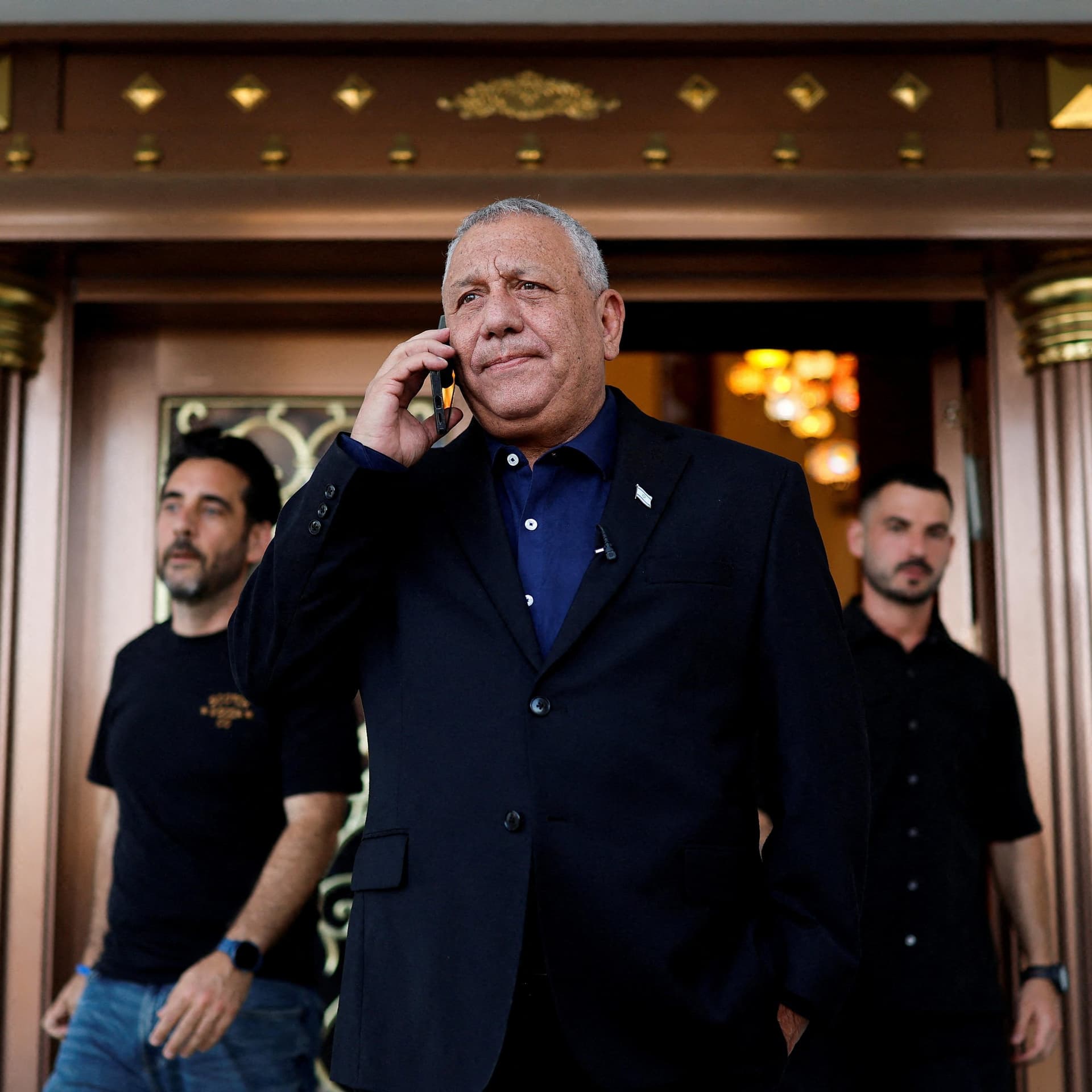
Image: Israeli opposition leader and former Israeli military chief Gadi Eisenkot speaks on a phone outside a conference for his campaign ahead of Israeli elections, in Dimona, Israel, July 6, 2026. Reuters/Amir Cohen