
In short
Southeast Asia “scam compounds” (notably Shweikoku in Myanmar) that run large-scale online fraud, human trafficking, and money laundering, profiting from weak enforcement and regional war.
Guests
Jonathan Head, BBC Southeast Asia correspondent; visited Shweikoku and has reported on scam centers for years.
Key claims
Scam compounds provide utilities and protection for organized online fraud; Chinese organized-crime syndicates build and rent compounds to other scam groups. Estimates: Cambodia’s scam economy may be over half of GDP; Myanmar’s could be 20–30%. Scams target English- and Chinese-speaking people globally, using romance/chat teams and AI to impersonate others.
Notable examples
Shweikoku built in under 10 years by Shuzi Zhang; Starlink dishes; forced labor with passports taken and 15–16 hour shifts. A Chinese actor was trapped after a “film shoot” and triggered crackdowns. Victim Aryan escaped via the Thailand–Myanmar river; some escape attempts fail, including being sold back by Thai officials.
Written by AI. May contain mistakes. Listen to the episode to check what was said.
Chapters
Tap a time to open that second in VOIntroduction to Scam Centers
1:12 to 2:18
Exploration of the phenomenon of scam centers in Southeast Asia.
“Have you ever received a call from a stranger regarding student loans you do not owe?”
Listener's Suggestion and Context
2:18 to 3:33
Discussion about a listener's suggestion to cover scam operations and victim perspectives.
“and how they're making money by duping people around the world.”
Interview with Jonathan Head
3:33 to 4:24
Introduction of Jonathan Head and his experiences with scam cities.
“For those who may not know who you are, could I just have you briefly introduce yourself?”
Shweikoku: A Scam City Unveiled
4:24 to 6:28
Description of the city of Shweikoku and its scam operations.
“were denying that and they would never have let us in if they didn't think they could have got that point across.”
Understanding the Scam Economy
6:28 to 9:07
Insight into the operations of scam compounds and their impact.
“And the person who founded Shue Koku, this man called Shuzi Zhang, was one of these people.”
Scam Methods and Targets
9:07 to 14:00
Examination of the methods used in scams and who the targets are.
“Your only access is Thailand and the Thais have also cut it off too.”
Inside Scam Compounds: Recruitment and Coercion
14:00 to 17:04
Explore how individuals are recruited and coerced into scam operations.
“I haven't heard of anyone speaking any of the European languages in these scam centres, which is interesting that they don't seem to see that as a target.”
Arian's Escape: A Survivor's Story
17:04 to 19:54
Hear the harrowing journey of a young man who escaped a scam compound.
“which sparked off a real crackdown under Chinese pressure at the beginning of last year because he came to Thailand thinking he was on a production shoot.”
The Complexity of Scam Workers
19:54 to 23:01
Understand the complexities and motivations of individuals working in scams.
“How common is it for people to be able to escape from one of these scam compounds?”
The Global Response to Scams
23:01 to 25:57
Learn about the international efforts and challenges in combating scams.
“I'm struck by the fact that you're describing a really sophisticated ecosystem.”
Show all 11 chapters
Future of Scams: Evolution and Adaptation
25:57 to 27:16
Discuss the future of scams in a globalized and digital world.
“And so that makes me wonder, well, what's the future of this business?”
Transcript
Automatic transcript. May contain errors.0:00This BBC podcast is supported by ads outside the UK.
0:30business needs in one place, saving you time, headaches, and serious money. Stop paying for missing pieces. Go to odoo.com. That's O-D-O-O.com to learn more. Self-directed investing, trading, full-service wealth management, automated investing, financial planning, thematic investing, retirement planning. Phew. And to think, that's just a small taste of what Schwab offers. because Schwab knows that when it comes to your finances, choice matters. No matter your goals, investing style, life stage or experience, Schwab has everything you need all in one place so you can invest your way. Visit schwab.com to learn more.
1:14Jonathan Head:Have you ever received a call from a stranger regarding student loans you do not owe? An unpaid parking ticket for a car that you don't own. Well, I certainly have, and I've wondered where those calls come from. Today, we are going to take you there. Picture a compound in Southeast Asia, maybe Cambodia or Myanmar, surrounded by lush jungle. It looks fairly ordinary. Apartment complexes, streets, shops, all recently built, Some half-constructed. But look closer. And you'd see bars on the windows. Armed security standing guard. Generators humming. This whole place is hiding a dark secret. An entire industry of scams, human trafficking, corruption, and money laundering.
2:04Jonathan Head:And it's not the only place like this. From the BBC, I'm Asma Khalid in Washington, D.C. And today on The Global Story, an inside look at the highly lucrative scam factories of Southeast Asia and how they're making money by duping people around the world.
2:25Jonathan Head:Before we dive into today's episode, I just want to shout out one of our listeners who reached out to us named Hans. Hans wrote us a message suggesting that we make an episode about scam centers in Southeast Asia. In that message, Hans wrote us that an interesting perspective would be the views of the victims, both people who've lost their money in one of these scam operations, but also one of the people who've been trafficked to perform the work. And Hans asked, how are victims coping and how are the perpetrators brought to justice? And then wrote this line that has stuck with me, saying, I am writing this as a victim myself.
3:03Jonathan Head:Now, Hans, we had in fact already been planning to make an episode on this. We, in fact, had recorded this recently and were just waiting for the right moment to run it amidst all the craziness happening in the world. But then we heard from you and realized that there are probably loads of other listeners who would really benefit from hearing this story. So just a reminder that we do read those emails that you all sent. You can drop us a line at theglobalstory at bbc.com. And thank you in particular to Hans for reaching out. Jonathan, it's a pleasure to have you back on the show. For those who may not know who you are, could I just have you briefly introduce yourself?
3:40Yeah, I'm Jonathan Head. I'm the BBC Southeast Asia correspondent.
3:44Jonathan Head:Well, Jonathan, we have you on the show today because we want to talk about scam centers, a phenomenon that you've been following for years. And well, I think we are all familiar with scams. I will say I've certainly been on the receiving end of receiving a good amount of phone scams, voice text scams, we don't really know where they originate from. And we're going to explain throughout our conversation what exactly scam centers are. But first, Jonathan, my understanding is you are one of the few journalists who have actually visited a place which there is strong evidence to suggest is actually a scam city.
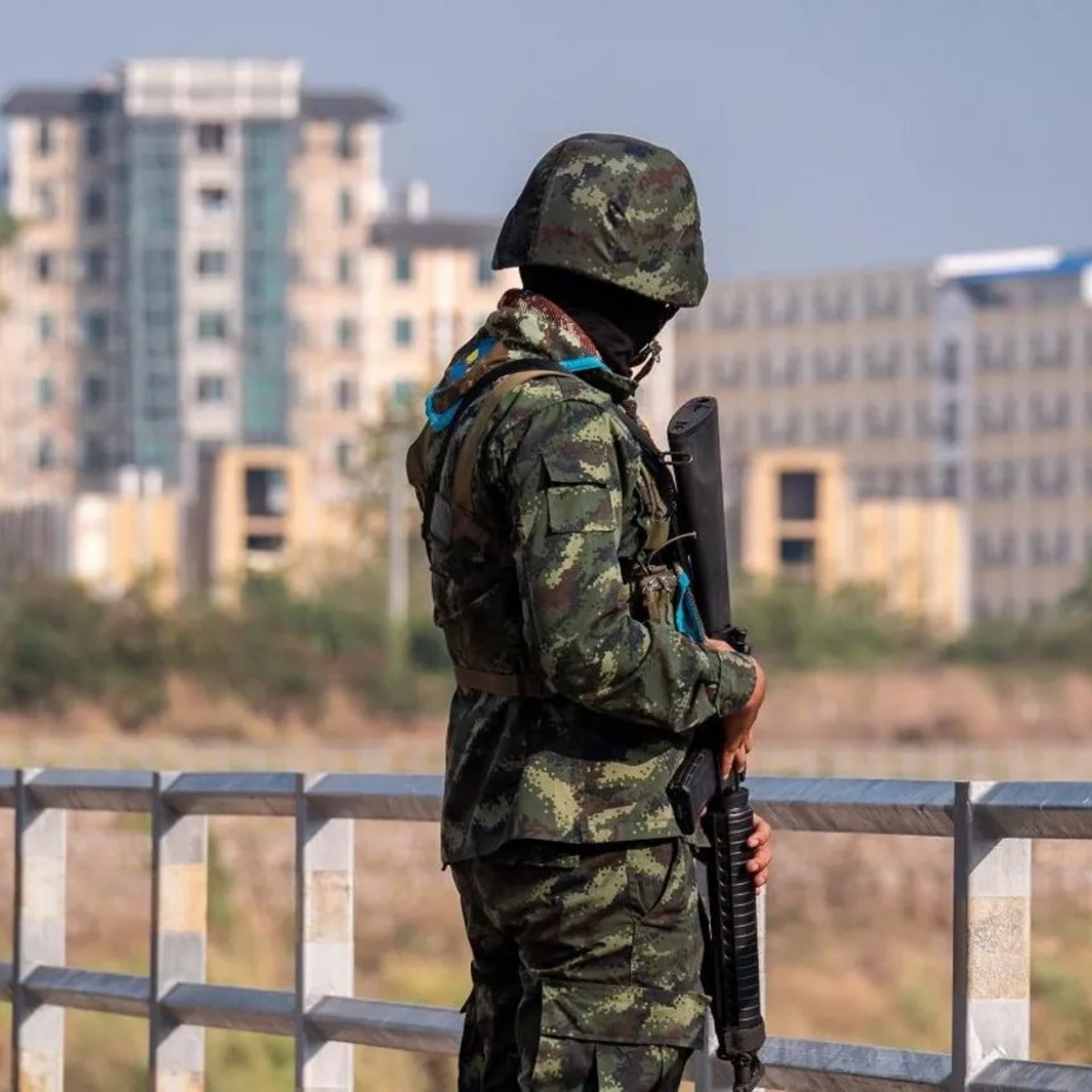
4:23Yeah, there's no question it is a scam city, although the people running it were denying that and they would never have let us in if they didn't think they could have got that point across. We went to a place called Shweikoku. Well, there are few places on earth stranger than this one. It is the most bizarre place. Yet I had invited us to see Shweikoku, as they call their city, to show they hoped a different side. The whole time I was there, I was kind of shaking my head as though I was in a dream. It's actually inside Myanmar, on the border with Thailand, in an area called Karen State. It's a very remote, war-torn area.
5:00It's been war-torn for decades. And as long as I've known Karen State, when you look across from the Thai side of the border, it is just jungle and mountains and sometimes gunfire and artillery. We are in the middle of a war zone in Myanmar, and yet the scale of the building, the ambition of this project is breathtaking. So to see this shimmering, almost like a mirage of a city that just appeared, and it really did, it was built in less than 10 years, sitting on the other side of the very narrow river that divides the two countries is extraordinary. Everywhere they've put up these huge billboards promising in three languages that forced labour and human trafficking are no longer permitted.
5:38There was, unexpectedly, a library and even a not entirely convincing branch of Starbucks, but we saw few customers.
5:53I mean, it was built by a Chinese syndicate.
5:56Jonathan Head:When you say syndicate, what do you mean exactly? Well, think of organized crime, because that's what it is. This is a bit like the mafia. OK, it's Chinese mafia. I mean, China is a massive country. It's always had on the southern coast of well-known organized crime. That's nothing new. But given the size of China and the fact that China enforces its laws very strictly indeed these days. It's quite hard to be an organized criminal there now. And in the last 10 years, we've seen huge numbers of Chinese wanting to make money through questionable methods coming into Southeast Asia. And the person who founded Shue Koku, this man called Shuzi Zhang, was one of these people.
6:34He started in the Philippines where gambling is legalized, moved to Cambodia where it really took off. And then he decided to build this city.
6:42Jonathan Head:When you say city, Jonathan, just to be clear, can you describe what you saw? It is a proper city. Shining tower blocks in the midst of this jungle and this war zone, high-rise hotels, casinos. You just don't see that anywhere else in that region. And there's no question that the only business model there by the time we saw it, which is just over a year ago, was through illegal business. There's nothing. It's very hard to get to. You have to cross the border illegally. We had to be smuggled across in a boat. And I think they genuinely thought that they could turn their scam city into something bigger.
7:15They had entertainment parks, amusement parks. They had a go-kart track. Although there was no access at all there to flights, tourists or anything like that. I mean, they talked to us and said, we want it to be like Las Vegas. And I said, but how's anyone even going to get here? So it was very unusual because actually there are dozens and dozens of what we call scam compounds in the same area on this other side of the river from Thailand. Most of them don't look like cities. Most of them look like industrial estates. They're much, much more low profile. The reason they put themselves there is on the Myanmar side, it's a complete lawless zone.
7:51There are competing armed groups, warlords who need to make money and are very happy to let people do whatever they want so long as they get paid. But Shue Koku was on a whole different scale. And I think the only reason they allowed us to go there was because the boss, Shue Zee Zhang, this young Chinese man, had actually been arrested in Thailand. And we realized when they brought us over there that they actually thought that perhaps Western media coverage might help to get them released. And we had to say to them, we really don't think it will, but that was their view.
8:21Jonathan Head:Did you go inside buildings? What did you see? And how was it clear to you that scamming is the primary business here? They actually wouldn't allow us to go into any of the buildings. But we already knew that scamming was going on there because we already had met people who'd come out of Shweikoku, as had many other groups who were rescuing people. There was no question was going on. And the other reason that we knew it was scams is you looked at the amount of power. And by the time we got there, the Thais had cut off power. They cut off telecoms. Telecoms is important. If you're going to do online scamming, you need good internet.
8:55So they're all using Elon Musk's Starlink service. They're Starlink satellite dishes littered across the roofs. This part of Myanmar is completely cut off from the rest of Myanmar. It's a complete war zone. Your only access is Thailand and the Thais have also cut it off too. So, you know, it's only illicit businesses that can work there. And we've spoken to enough people who'd done scamming inside Shweikoku to know that that was the main business there.
9:20Jonathan Head:Jonathan, it is an extraordinary scene to imagine. And I want to understand better how these centers actually work. What is a scam compound? It's very simply a place that provides the facilities you need to run organized online fraud on an industrial scale. A Chinese syndicate will make an arrangement where they're given protection, they get access to utilities, and they build their compounds. And they then rent out to other syndicates quite often to come in and run scams. And they run them ruthlessly to make money. And they make masses of money. We're talking tens of billions of dollars a year.
10:01Jonathan Head:Tens of billions of dollars. Wow. Jonathan, you've alluded to the fact that this is happening in Myanmar. And it seems like this opportunity to create a scam city is possible in Myanmar because it's particularly lawless, at least in that region of Myanmar that you visited. And I'd really like to get a better sense of the context here. Can you remind us what is happening in Southeast Asia that make it possible for criminal gangs to build these compounds, and in some cases, keep people hostage there to carry out these scams? I think Myanmar's a special case because it's collapsed into a civil war since the military seized power in 2021 in a very unpopular coup and provoked a popular uprising, which has become an armed uprising.
10:50So the country's at war. But Karen State, where these scams have been established, actually has been at war longer than that. It's desperately poor. It's got competing warlords. It's very easy for anyone who's got money to do deals with these warlords. But there are also extensive scam networks in Cambodia, which is notionally a properly governed country with a stable government. And there it's to do with collusion with the ruling elite in Cambodia. One party has run that country ever since the end of the Civil War in the 1990s as one strong man that dominates in a man called Hun Sen. But in practice, Cambodia also has tolerated huge amounts of scam activity.
11:32Jonathan Head:You mentioned that it's a lucrative business. How lucrative are we talking about? You had said tens of billions of dollars. Say, what percentage of the GDP of Myanmar are these scams? Is it possible to quantify it in that way? Well, people have tried. I mean, it's pretty difficult to quantify anything in Myanmar right now. It's so much chaos. But in Cambodia, which is a smaller economy than Myanmar, admittedly, some estimates put the scam economy at more than half of the entire national economy. These are informed estimates by good researchers. In Myanmar, it might be 20 or 30 percent of the economy.
12:04And Myanmar is enormous. That's huge. It makes it hard to stamp out because very powerful people are making huge amounts of money out of it.
12:12Jonathan Head:What sorts of scams are we talking about? They've become increasingly sophisticated. They've moved on from the classic, this is a great investment opportunity, you can't miss it, to targeting vulnerable people, people who are lonely, people who are elderly, and building a relationship and they have different teams and we've talked to people involved in it. They have the chatting team, they have the romance team that builds a romance. So usually somebody, often an attractive young woman, will build up over quite a number of weeks, a relationship on WhatsApp or other social media messaging apps with somebody, really sort of build a friendship and then start talking about the amazing amounts of money they're making.
12:53And then they'll pass them on to the next team who will be saying, look, this is an incredible opportunity. You know, what's-her-name has passed you on to us. It'll just keep on evolving. Some of the people we've spoken to said they use AI to make them into completely different people. And AI is so good now. You can have a big, dirty South Asian man who comes across as a very pretty Southeast Asian woman to whoever's on the receiving end of that. It's endlessly inventive, and they will keep on coming up with more and more ways. So, you know, what we think of as the most obvious scams, you know, a message telling you to click on a link, they understand that people are now wising up to that.
13:32Jonathan Head:Scams are undoubtedly a global phenomenon, but who are the primary targets of these scam compounds? Who are they trying to deceive? It's interesting looking at the people who work in the scam centres because that tells you a lot about the victims. They pick people who've got language skills. So you get a lot of East Africans who can speak English well. You get a lot of South Asians who can speak English well. A lot of Chinese, quite a few Indonesians. It's a big country with a large population. I haven't heard of anyone speaking any of the European languages in these scam centres, which is interesting that they don't seem to see that as a target.
14:07But it is the English-speaking world, the Chinese-speaking world, primarily that they're targeting.
14:21Jonathan Head:So I feel like we have a better sense of what's happening inside these scam compounds, but I'd like to get a better sense now of who is working in these compounds. Well, they come from all over the world, and it's striking that the business has grown particularly since the pandemic. That left huge numbers of people in Africa and Asia no longer able to get work, young people in particular, desperately looking for jobs. A lot of Ethiopians, a lot of South Asians, Bangladeshi, Pakistani men who might have gone to the Gulf, for example, and really struggled to get a job in somewhere like Dubai or Qatar.
14:58And these seemed like golden opportunities to them. And they see these offers.
15:04Jonathan Head:When you say offers, there's advertisements? Do these scams compounds advertise in newspapers? Or how do they find these people? Not in newspapers, but you'll get them on social media, on Facebook, a lot of Facebook pages, certainly on messaging apps. A lot of the people we've spoken to were hired after recommendations from people they thought were friends. And that's why they trusted them. And they'll usually say the job's in Thailand, which is an attractive place. Most people feel it's a good place to go. They will have tickets booked for them. They will arrive in Bangkok and then they get taken in a car.
15:39They don't know where they're going. Going into Myanmar, they won't even know when they've crossed the border because they'll go across an illicit route. By that stage, coercion usually starts. Their passports will have been taken away.
15:50Jonathan Head:And what job do they think they're getting? They always think it's going to be telephone work, you know, sales work, basic computer work. That's what they think they're going to be doing. And so they're coerced, you say, in many cases, across the Thai-Myanmar border. And then what happens? Well, then you are inside the scam compounds that have armed guards in Myanmar, especially because it's these armed insurgent groups who are actually enabling the scam centers by guarding them on the outside. And you will have guards on the inside, too, who enforce the routines and discipline. They run a very, very harsh ship.
16:30You don't step out of line. And they told us when they arrive, they're usually very exhausted. They're allowed to sleep that night. But they say the next morning you're going to have to work. And when they go in, they're usually presented with a contract that says you have to work for us for maybe 18 months or two years. And if they don't want to sign the contract, that's when they'll get beaten or given electric shocks and warned that things will get much worse if they don't. And they're also told they've got targets they've got to hit. How many hours are you going to have to work a day? You take your meals at specific times.
16:57You often work 15, 16 hours a day. It's a very, very harsh routine. There's the famous case of the Chinese actor, which sparked off a real crackdown under Chinese pressure at the beginning of last year because he came to Thailand thinking he was on a production shoot. You know, he was a bit short of work. Somebody said, there's a film shoot. We'd like you to take part in it. He had no idea that he'd be getting to Myanmar.
17:18Jonathan Head:So a Chinese actor ended up in one of these scam compounds. That was a particularly celebrated case because he was reasonably well-known. And once he disappeared and his friends had known what he was doing. People were wondering what happened. Well, and more than that, they kicked up a huge social media fuss. And the Chinese government was embarrassed because they'd already shut down the scam centers on the Myanmar-Chinese border very effectively. And they told their population, we've got it under control. And suddenly, a reasonably well-known actor finds himself caught on the Thai-Myanmar border.
17:47So it escalated the pressure to do something about the scams. His was an unusual case because he was well-known. Most of the people who go in, of course, are anonymous. They've got one or two family members. I mean, I still get the messages pretty much all the time. I've got a friend, I've got a relative who's trapped in this compound or that compound. They're being beaten, they can't get out. And it's much harder to get any action for those people because they're not well known. We met one young Bangladeshi man called Arian. And his was an interesting story because he'd escaped, but he'd come back to the border to try to get his friends out.
18:22And his case was interesting because he told me that he'd actually been rather good at scamming. and he described his feelings about it. He said, I was masquerading as a young woman, even though he was clearly a young man. Through AI.
18:35Jonathan Head:Through AI. They put a different image up on the screen for the people receiving his calls. They changed his voice. And he said the turning point for him came when he'd become very friendly with this older Middle Eastern man in the Gulf. And he got this man to part with huge amounts of his savings. But this man was so beguiled by him and by his promises of getting rich, that he told him he was going to sell his wife's jewelry to hand more money over. And this young Bangladeshi man said to me, at that point, I felt really bad. But he said, I couldn't tell him. I couldn't warn him because we're being supervised the whole time.
19:11I knew if I tried to warn him, I'd be beaten or worse. But he said, after that, I was determined to get away. And because he was a very good worker, he was asked to escort one of the workers they'd beaten up very badly to a hospital that was very, very close to the river that divides Thailand and Myanmar. And after he dropped this person off, he sneaked across the river and had a very hair-raising journey. But finally, he was rescued by Thai soldiers. And because he persuaded them he was a victim of trafficking, they processed him and he was allowed to leave. But he'd come back to Thailand because he said, I left friends in this place.
Read the full transcript
19:47And he did manage to get them out. There were a lot of people being brought over.
19:50Jonathan Head:He did manage to get them out. He managed. It took him a couple of months. But finally, he was reunited with his friends. How unusual is Aryan's story? How common is it for people to be able to escape from one of these scam compounds? A lot of people do, but it can be a really hairy experience and it's very risky. We know of another young man we spoke to, and he tried to escape, I think, about three or four times. One time when he escaped to the Thai side, the Thai immigration officials sold him back to the traffickers. They made money out of him. So even when he got to the Thai side, he wasn't safe.
20:26He did eventually get out and he disappeared. We don't know whether he was taken to China because he knew a lot about the scam centers. And we think the Chinese authorities would have wanted him or whether he would have gone back to Malaysia, where he came from. But other people who can't get out do get desperate. And we know of a number of cases of people who've actually taken their own lives because they were in such despair. I mean, it can be an absolutely grueling and appalling experience. It's completely inhuman in that the gangs running these scam compounds are simply out to make money. And people are a commodity.
21:00You're only as good as the money you're making for them. And if you can't do it, then you're expendable. And the people who are not good at it or can't bear the conditions or want to get out often suffer terribly.
21:09Jonathan Head:We've discussed the situation of workers as a situation of human trafficking, right, of forced labor. But I'm also wondering, Jonathan, are there people working in these scam compounds who have come to this life of crime of their own volition, who just think it's a good way to make money? Unquestionably, there's all different kinds of people there. There are some people who are good at it and they tend not to get beaten. And there are some who are making enough money because they are really good at it where they don't mind doing it. So people who are quite good at their jobs or are valuable in some way will get transferred almost as though they're a professional soccer player to another scam center.
21:49They get moved around. I mean, it was interesting that a couple of months ago we were on the border and one of the very new scam compounds had been taken over by one of the rebel groups in Karen State that's against scams. And they wanted to showcase to the outside world. They're looking for Western support. We're against scams. So they invaded the scam center, took it over and started booting the scam workers out and sending them across into Thailand. But several hundred of the Chinese scam workers there didn't want to leave. Now, I don't know if they were trafficked or not, but what happens to the Chinese is when they get out, China charters planes to bring them back.
22:28And they arrive in Thailand. They are zip tied. Their hands zip together with police from either side taken back. And they're often put on trial back in China. If they're thought to be involved in organizing the scams, they face extremely severe punishment, including death. A number of scam bosses have been executed by China recently. So in this scam compound, the Chinese who were there didn't want to go back to Thailand. And these Karen rebels who've taken it over said, come on, we'll go back to Thailand. You can go back to China. They said, we don't want to go back to China. We want to go to another scam compound.
22:56So there are plenty of people doing it willingly who've adjusted to the lifestyle there.
23:01Jonathan Head:I'm struck by the fact that you're describing a really sophisticated ecosystem. And that makes me wonder, how do you actually root out this problem? You've mentioned that at one point the Thai cut off the power, right, to some of these scam compounds. So what is being done to combat this? And how effective have any of those efforts been? I mean, at a local level, the government in Myanmar, it's a military government that is trying to make itself respectable now, is putting a very impressive show of demolishing scam compounds. But that's just the most visible infrastructure. In Cambodia, we're seeing the government there.
23:34The top levels of the Cambodian government have close ties to Cambodian tycoons who are deeply implicated in scams. They've been making money out of it, but they're now claiming all we didn't know about it. They're closing down some of the scam centres. They're bringing journalists. They're showing it off. This is really quite superficial stuff. The key thing to remember about scam compounds and scamming is money. They have to launder their money. and an adjunct to these visible scam centers has been huge illegal money flows, particularly using cryptocurrencies to launder the money out. We're now seeing international pressure.
24:09If you've got the United States engaged, which it is now because so many American citizens are victims of these scams and are losing their savings, but you've also got the Chinese government. Hundreds of thousands of their citizens have either been scammed or have been lured into these horrific work camps to do the scamming. that double pressure is starting to show, particularly in Cambodia, where the government, I think, is very, very worried about pressure from both these superpowers.
24:34Jonathan Head:But it sounds like people in power are also benefiting in some cases. They have been. Right? Yeah. And in Myanmar, you mentioned that there's armed guards outside these compounds. So, I mean, are all sides in the Myanmar war profiting from this all? Most sides are, yeah. I mean, that's wild if you think about it, Jonathan. It's like scams that are being sent halfway across the world. to unknowing Americans are in some indirect way actually helping fund this conflict in Myanmar then. And the government in Cambodia, which actually the prime minister's just been visiting the United States. They really want to improve relations.
25:09They're doing a trade deal with the US. I've no doubt behind the scenes, US officials are saying to the Cambodians, you've got to do something. But the links to the scams and the scam money go right to the top in Cambodia. And everyone's watching now to see whether this current operation, the Cambodians are making a a big song and dance about to shut down scam centres, whether they're serious about it or not. The problem for this ruling elite is that's a big source of their money. It's how they buy off their allies. And it's going to be extremely difficult to eradicate.
25:39Jonathan Head:Jonathan, you've described an environment in which regional law enforcement in Southeast Asia is weak. And we're living in a global economic environment in which there will continue, and there are continuously, young people in parts of Africa, parts of South Asia, who need the money, who are lured into this. And so that makes me wonder, well, what's the future of this business? Is there really a way to end this business model? I don't think so. But then we've always had scams, haven't we? I mean, this is just, it's a very contemporary evolution of the scams that we've known for generations. I don't think you're ever going to stop it.
26:20What's changed is globalization, the ease of travel. I mean, it's amazing to meet people from 30 or 40 different countries who found a way to get there. 20 or 30 years ago, they'd never have dreamt of that because they wouldn't have heard about it. The telecoms wouldn't have been good enough and they couldn't have got there. So you've got a combination of easy travel, huge amounts of young unemployment. And then you've got, on top of that, the social media revolution, the digital revolution that can put this stuff out there. And the communications revolution that allows these sophisticated scams to operate on this massive scale.
26:54And then, of course, you've got digital money, crypto, easy ways to filter the money out, clean it up, move it into legitimate sources. Scams are not new, but the scale and sophistication of them and the constant changing of them through the technology that's available now, that is new.
27:16Jonathan Head:Well, thank you so much, Jonathan, for bringing your reporting and your expertise to us. I really appreciate it. It was great to talk to you.
27:26Jonathan Head:That was the BBC's Southeast Asia correspondent, Jonathan Head. And that's it for the global story for today. If you have any questions or story ideas for a future episode, you should email us. We love to hear from listeners. You can send us a message at theglobalstory at bbc.com. Also, a quick note before we go. Our show, The Global Story, as many of you all may know, we look at one story in depth every weekday at the intersection of where the world and America meet. If you're also looking for a way to catch up on the latest news from around the world, then check out our sister show, the BBC's Global News Podcast.
28:01Jonathan Head:You can find it wherever you listen. Today's episode was produced by Zandra Allen and Viv Jones. It was edited by Bridget Harney and mixed by Travis Evans. Our studio managers were Hannah Montgomery and Mike Regard. Our senior news editor is Chyna Collins. And I'm Asma Khalid. Thanks as always for listening, and we'll talk to you again tomorrow.
From the publisher
Have you ever received a call from a stranger regarding student loans you don’t owe? An Amazon order you never placed? An unpaid parking ticket for a car you don’t own? If so, it’s possible that you’ve been the target of a scam orchestrated by a criminal syndicate thousands of miles away.
The so-called “scam centres” of Southeast Asia bring in billions of dollars a year, expertly swindling unsuspecting foreigners out of their savings. Today, BBC Southeast Asia correspondent Jonathan Head offers an inside look at these formidable hubs of corruption and human trafficking, and explains how governments around the world are working to intervene.
Producers: Xandra Ellin and Viv Jones Executive producer: Bridget Harney Mix: Travis Evans Senior news editor: China Collins
Photo: New high rises in the city of Shwe Kokko, Myanmar, visible from Thailand's border. Credit: Jonathan Head/BBC.