
In short
A late-stage debate over a proposed US 28-point “peace plan” for Ukraine—reportedly favorable to Moscow—amid battlefield pressure, possible Russian advances (including Pokrovsk), and a Ukrainian corruption scandal weakening Zelensky. Guests argue Ukrainians may reject any deal they didn’t draft, and that Russia’s demands amount to forced concessions.
Guests and backgrounds
Mstislav Chernov, Ukrainian documentary filmmaker; Oscar winner (2024) for 20 Days in Mariupol; new film 2,000 Meters to Andrivka. James Waterhouse, BBC Kyiv correspondent.
Key claims
Ukraine could keep fighting without the US but it would be “tough.” Ukrainians want peace but won’t accept territorial handovers. Russia uses bombings to pressure civilians and leaders. Zelensky faces leverage from US politics due to alleged $100m infrastructure-contract skimming by minister-level figures linked to him; recordings allegedly show cash being divided.
Notable examples
Mariupol’s maternity hospital bombing and journalists’ escape via a humanitarian corridor; Andrivka retaken after advancing 2,000 meters through mined forest; mention of cities shifting from Mariupol/Bakhmut/Avdiivka to Pokrovsk.
Written by AI. May contain mistakes. Listen to the episode to check what was said.
Chapters
Tap a time to open that second in VONew Peace Plan Overview
0:37 to 1:25
Discussion on the U.S. peace plan for Ukraine and its implications.
“The United States has a new 28-point peace plan for Ukraine.”
Difficult Choices for Ukraine
1:25 to 2:34
Analysis of the tough decisions facing Zelensky in light of U.S. pressure.
“We're recording on Sunday evening at the start of a week which could decide the future of Ukraine.”
Guest Introduction
2:34 to 2:46
Introducing Mstislav Chernov, a Ukrainian filmmaker and his work.
“either loss of dignity or the risk of losing a key partner.”
Ukrainian Perspectives on Peace
2:46 to 4:28
Mstislav shares insights on Ukrainian views regarding the peace deal.
“what the proposed peace plan means for Ukrainians who are living and fighting in their homeland.”
Ukrainian Spirit Amidst Conflict
4:28 to 7:10
Discussion on the enduring spirit of Ukrainians in the face of war.
“And the BBC's Kiev correspondent just happened to be in town too.”
The Reality of War in Mariupol
7:10 to 9:16
Mstislav recounts his experience as a journalist in Mariupol during the invasion.
“How do you feel about the potential possible loss of those two places to Russia?”
Escape from Mariupol
9:16 to 11:34
Mstislav shares the harrowing details of escaping from besieged Mariupol.
“Someone once told me, wars don't start with explosions.”
Documenting the Front Line
11:34 to 13:17
Discussion on Mstislav's second film about the Ukrainian counter-offensive.
“I want to move on to your second film which came out earlier this year.”
Modern Warfare and Storytelling
13:17 to 14:01
Exploration of how soldiers document their experiences and the nature of modern warfare.
“And you just stuck there with our protagonists.”
Battlefield Insights and War Film Challenges
14:01 to 17:32
Explore the experience of capturing a war film and the complexities of conflict representation.
“If they would capture Andriyivka, they would cut the supply road to Bakhmut, which was, again, very symbolic.”
Show all 15 chapters
The Futility of War vs. Self-Defense
17:32 to 18:52
Discuss the complex nature of war, courage, and the struggle for Ukrainian survival.
“But also, it's just inspiring to see that irrational optimism of those men.”
Negotiations and the Struggle for Peace
18:52 to 19:55
Analyze Zelensky's balancing act between public opinion and geopolitical pressures.
“We debate about food, deep dish, tavern style, who's got the best beef.”
The War of Attrition in Ukraine
19:56 to 21:31
Understand the ongoing war's toll on Ukraine and the challenges faced in resistance.
“a question of who has the most material, finances, men, to just keep going.”
Domestic Challenges and External Pressures
21:31 to 23:12
Examine the impact of corruption scandals on Ukraine's political landscape and external negotiations.
“is there anything for you that Ukraine should give up in exchange for peace?”
Insights from Ukrainian Filmmaker and Correspondent
23:12 to 27:30
Discuss current scenarios affecting Ukraine through insights from experts.
“In the last few days, it's become clear that the Americans are still negotiating with the Russians.”
Transcript
Automatic transcript. May contain errors.0:00Mstyslav Chernov:This BBC podcast is supported by ads outside the UK.
0:30Mstyslav Chernov:so you can monitor and engage with the account while your teen learns how to invest and manage money. Learn more at schwab.com. The United States has a new 28-point peace plan for Ukraine. And it's so favorable to Moscow that Secretary of State Marco Rubio was even forced to deny that the peace plan was written by Russians. Even Republican senators had their doubts. It was our request. One of our members made contact and said, hey, can you tell us the rest of the story here? This doesn't look like normally something that would come out of our government, particularly the way that it was written.
1:05Mstyslav Chernov:It looked more like it was written in Russian to begin with. If Ukraine signed this deal, it would get a promise of protection from the United States against another Russian invasion. But it would also be forced to hand over parts of the country to Russia that Moscow doesn't even control right now. We're recording on Sunday evening at the start of a week which could decide the future of Ukraine. Donald Trump says he wants a deal by Thursday, that's Thanksgiving, and that the options for his Ukrainian counterpart, Vladimir Zelensky, are narrowing fast. He'll have to like it, and if he doesn't like it, then, you know, they should just keep fighting, I guess.
1:46Mstyslav Chernov:The suggestion that you made, though, was that if he doesn't accept it, that the U.S. would pull back its support for Ukraine. Well, at some point he's going to have to accept something. He hasn't accepted, you remember, right, in the Oval Office not so long ago. I said, you don't have the cards. It was all starting to sound a bit like February, back when Trump and Zelensky had that shouting match. As U.S., Ukrainian and European officials gathered late on Sunday for last-minute talks in Switzerland, Trump posted that Ukraine's leadership had, quote, expressed zero gratitude for our efforts. Zelensky says Ukraine could keep fighting without the United States, but it would be tough.
2:30Mstyslav Chernov:Now is one of the most difficult moments in our history. Now Ukraine may find itself facing a very difficult choice, either loss of dignity or the risk of losing a key partner. From the BBC, I'm Tristan Redmond in London. And today on The Global Story, what the proposed peace plan means for Ukrainians who are living and fighting in their homeland.
2:59James Waterhouse:The fields and the roads around were mined by the Russians. The forest is the only way.
3:07Mstyslav Chernov:This is Mstislav Chernov, our guest on the show today. He's a Ukrainian documentary filmmaker. He won an Oscar in 2024 for his film 20 Days in Mariupol. And his new documentary about the war is called 2 ,000 meters to Andrivka. And it's been hailed as one of the greatest war films ever made.
3:26James Waterhouse:The village is 2 ,000 meters ahead. A two-minute drive, a 10-minute run. But here, time doesn't matter. Distance does. And it's measured by pauses between the explosions.
3:42Mstyslav Chernov:As the war seems to be reaching an endgame, Mstislav spoke with a global story in London. He told us that Ukrainians can't accept a deal they had no part in drafting. When we say Ukraine, what is Ukraine? Ukraine is its people who hold dearly to their homes,
4:02James Waterhouse:to the places where their grandfathers and grandmothers are buried. They have agency. So what I think should be done is that we should ask Ukrainians what they think about it. What I know for sure is that there is no nation on the planet right now who wishes peace more than Ukrainians.
4:24Mstyslav Chernov:It's not every day that one of Ukraine's most celebrated journalists is in the studio with us. And the BBC's Kiev correspondent just happened to be in town too. So we asked him to join us. I'm James Autohaus, the BBC's Ukraine correspondent and not an Oscar winner. Maybe one day. Introduced that way. You don't like it? No. There's a lot of pressure. Mr. Slav, it's a really big moment for Ukraine right now. There are three big things happening. First of all, the Americans are reportedly devising a plan which could give Putin many of the things that he wants. Secondly, we have the possible fall of this town called Pokrovsk in the east of Ukraine.
5:05Mstyslav Chernov:And then third is that there is this huge corruption scandal that's unfolding in Ukraine, which has put President Zelensky in a weak position. He's under huge pressure. If a war like this is about breaking your opponent's spirit, how is Ukrainian spirit right now?
5:26James Waterhouse:It's an interesting question. And all things you mentioned are really big, but also it's like another day in Ukrainian's life. there is always a city that is about to fall because Russia keeps attacking and keeps moving. There was Mariupol, there was Bakhmut, there was Avdivka, there is Pokrovsk. So there is always a city to fight for. And it's constant stress. Since the beginning of 2025, there is always an American plan for Ukraine to give something away to Russia. Very little of that actually translates into something tangible on a battlefield. It is so difficult and so deadly right now that all the words, all the geopolitical discussions are just words until they actually have some result on a battlefield.
6:29James Waterhouse:And so there is a lot of skepticism on the front line and among the civilians that any of these conversations will ever result into something real.
6:40Mstyslav Chernov:So you have made these films about two cities. One is Mariupol, which is a city in eastern Ukraine, which has been under Russian control since 2022. And the second, a smaller place called Andrivka in eastern Ukraine, which has been under Russian control since 2024. In the current situation, we have the development of a Russian-American plan, potentially, which could hand both of those places permanently to Russia. How do you feel about the potential possible loss of those two places to Russia?
7:18James Waterhouse:For me, those are places of my childhood. Those are the places I was running on a plane with my friends. Those are the places where I went to see my grandmother. Those are the places where my grand-grandfather was fighting during the Second World War and almost died. Exactly those places. Donbass was the frontline back then. And it's burnt. And it's my home. It's painful for me. But imagine also people who lost their friends, who lost their families in those places. How would they feel? I think it's just important to think about that as a context. Maybe for sake of saving lives, there will be some sort of agreement.
7:59James Waterhouse:But I know that the bitterness of that, I believe that people would fight until the end to make sure that doesn't happen.
8:06Mstyslav Chernov:You know, I remember reading wires, looking at your pictures. It's interesting hearing what you say. You clearly are worried about these places being forgotten. Because for journalists like us, we go, I've gone to Procroft's countless times, Konstantinivka, Kramatorsk, Kupiansk. these places gradually get reduced to rubble. And there is a human exodus. And by the time it makes a news bulletin, you have a crumpled, without fail, a damaged apartment block, piles of brick, soldiers moving around, and you lose the idea of these places being home to people and may well for a very long time. Mr Slab, can you tell us the story of 20 Days in Mariupol?
8:49Mstyslav Chernov:For people who haven't seen the film, How did it come about and what actually happened to you over those 20 days?
8:56James Waterhouse:In short, 20 Days in Mariupol is a story of a group of journalists who are working in the besieged city of Mariupol in the first days of the full-scale invasion, which was one of the first places to be invaded and surrounded. And a story of the survival of these journalists and gradual destruction of Mariupol.
9:22James Waterhouse:Someone once told me, wars don't start with explosions. They start with silence. What was so important to talk about in the beginning of the invasion, the war crimes that are being committed, and the discrepancy between what the Russians have been saying, that they're there to liberate Russian-speaking population, and the fact that they're not targeting civilians and the reality. If the world saw everything that happened in Mariupol, it would give at least some meaning to this horror. There was another filmmaker, Mantas Kvidaravichus, that unfortunately was executed on the Russian checkpoint. And they killed more than 50 ,000 people in Mariupol.
10:14Mstyslav Chernov:I mean, I remember right at the beginning of the war, I was in Kiev and James, I remember you were as well. And I remember watching Mr. Slav's reports coming in from Mariupol. And, you know, you're reporting on the maternity hospital that was bombed. How did you make it out of Mariupol? Because the film tells the story of you being almost under siege in Mariupol. How did you get out?
10:38James Waterhouse:We got surrounded once by Russian forces in one of the hospitals. and then we have been saved by special forces that extracted us from there. But then we had to make it out of a city with all the footage. And so when the first day of the humanitarian corridor was open, we just got in a car with a policeman who was our friend and his family and we hid all the cameras and we hid all the cards and we sort of just prayed that we will not be noticed because thousands of people were leaving for the first time. they could leave the city and we were just lucky.
11:19James Waterhouse:That was just chaos in those days and we went unnoticed. If we did it later, a week later, the same thing that happened to Mantas would happen to us. We would be captured and we just would be executed right there.
11:41Mstyslav Chernov:I want to move on to your second film which came out earlier this year. It's called 2 ,000 Meters to Andrivka. It's a very different film. 20 Days in Mariupol is about the civilians in a city under siege and 2 ,000 Meters to Andrivka is about soldiers on the front line. Ukrainian forces have now launched their much-talked-about counter-offensive expected to be the biggest military operation in Europe since World War II. It tells an extraordinarily simple story. It's about a unit of the Ukrainian army that has to advance 2 ,000 meters across a very sparse strip of forest to a small town called Andrivka.
12:23Mstyslav Chernov:The soldiers are trying to retake the village that's completely destroyed, but it's strategically important. And it contains some of the most vivid footage from front lines that I've ever seen. How did you actually make it?
12:38James Waterhouse:That was a strange time. That summer, I felt like this military operation that Ukraine was preparing for, the counteroffensive, biggest military operation since Second World War, put everything at stake. if that was to succeed, Ukraine would liberate its territory and would probably be able to win the war. And if they were to lose, it was common within expert society to say that then it will probably have to make some land concessions, which we actually see now, the demands that are coming. So that was very important turning point, results of which we're seeing now and the question was how do you make that story because well at that point i was uh going around the world screening 20 days in mariupo and then i would fly to poland cross the border get a car get a train get in the trench so those two worlds collided as they are colliding now and it was very weird everything you see in a film happens in that small, narrow forest that is squeezed between two minefields.
13:56James Waterhouse:And you just stuck there with our protagonists. By that time, they've been already fighting two months to get to Andriyivka. If they would capture Andriyivka, they would cut the supply road to Bakhmut, which was, again, very symbolic. It was lost and occupied in the spring. So liberating it during the counteroffensive was a major task. Two months in, we came in and we started watching everything they've shot with their helmet cameras for the battlefield analysis and for their YouTube channel. So they were filming anyway with helmet cams? Yes, that's what soldiers do now these days. First of all, it is very important for them to know what happens on a battlefield to analyze and to improve.
14:42James Waterhouse:But also, modern warfare is immediate warfare. It's a full production. and it's a full production. They put out their films and their stories on their YouTube to have a direct connection with their audience that supports them. And so they filmed a lot and we started filming ourselves in headquarters with mortar men, with drone pilots and ultimately with them walking through that space and carrying the flag to the liberated Andreevke.
15:13Mstyslav Chernov:Well, by the end of the story, they have advanced 2 ,000 meters to Andrivka and they've arrived in this small village. But when they do so, they realize that there isn't really much left to capture. I mean, really, the only thing they find there is a cat. The whole experience really makes you kind of reflect on the grinding futility of a conflict like this, Particularly because the story you tell in the film is that many of the central protagonists in the film, some of the couldn't die in the war.
15:46James Waterhouse:Making a war film is difficult. Not just because you need to survive to actually finish making it. But also because there is a paradox in every war film. the paradox of both honoring the courage, honoring their sacrifice and honoring loss of their families and their pain is what I want. That's my flag to carry. Okay. At the same time, war is futile. War is the worst thing that humanity ever did to itself and is doing to itself. But there is a difference between war and self-defense. And I think what Russians are successfully doing now, they're spinning this narrative. They say that supporting Ukraine is supporting war.
16:43James Waterhouse:It's a mind trick that they do by equalizing the victim of invasion and invader. And I think self-defense is not futile. Self-defense is vital for the survival of the country. So yes, it is a statement on the futility of war, but it is also a statement on the courage and admiration of people who, despite knowing that they're fighting against the country that has nuclear weapons, that that flag they set over the village that is destroyed might someday fall and it will be occupied again. Despite the fact they know that some of their friends will never make it to that village, They still make a choice to do it.
17:30James Waterhouse:And I think it's beautiful. It is very sad because war is terrible and sad. But also, it's just inspiring to see that irrational optimism of those men. Because that's the only reason why Ukraine still exists.
17:50James Waterhouse:the fact that ukrainians managed to not give away more than 25 of the country is amazing and it's
17:58Mstyslav Chernov:still standing and it's still standing i understand how you straddle the futility of war and the and the courage but it's true when when you see a counter-offensive on the ukrainian side it does give a renewed impetus it's an inject and you see it in the troops right there is a kind of injection of purpose. But it's such an uncomfortable equation for Zelensky in that these counter offensives, as we talk here now in a studio with distance, failed. And that is now feeding into this very difficult negotiation. It drives Ukraine to have to both not alienate America while standing firm on making sure that the sacrifices they've made have not been for nothing.
18:52Mstyslav Chernov:Chicago talks a lot. Hold on, let me step over here. People are talking too much. We debate about food, deep dish, tavern style, who's got the best beef. We yell across rooms, across blocks, across generations. Yes, nice earrings, Grammy. And now we're doing it on our phones too. Video calls from the L train, group chats that never shut up. Neighbors texting you the score before your TV catches up. Come on. Get a load of this guy. Catch up on a dog. Yeah, we've got thoughts. Too loud? In Chicago, you're gonna hear it. Because nothing here gets built without conversation. Nothing moves without connection.
19:30Mstyslav Chernov:So if you think you know AT &T, it might be time to rethink that. Because their network has improved, like a lot. So Chicago can keeps speaking its mind with AT &T Wireless and AT &T Fiber. Chicago won't stop talking. Our improved network backs it up. AT &T, connecting changes everything. AT &T Fiber, limited availability in select areas.
19:54Mstyslav Chernov:The war in Ukraine has really turned into a war of attrition, a question of who has the most material, finances, men, to just keep going. from what you've seen, who can endure more of this, the Russians or the Ukrainians?
20:09James Waterhouse:It's a war of attrition for Russians and it's a war for survival for Ukrainians. Because if you surrender, you're dead. And of course, how long Ukrainians will be still able to resist is a question of right political decisions to keep society within Ukraine united. And it's a question of what resources that Russia has to continue this war and what pressure is applied on Russia to have less of those resources. But the thing is that Russia is a big country. They feel that they're winning. So I don't see how they go for any peace deal that doesn't favor only their demands because they feel emboldened.
20:59James Waterhouse:all the bombings, the bombings that we know happened yesterday, dozens of people dead. It's not a coincidence. They violently kill part of the population to pressure the remaining part of the population to pressure its leaders to give away everything they've been asked to surrender. But it's not going to work because that's not who Ukrainians are. You can't pressure them by killing or threatening them.
Read the full transcript
21:30Mstyslav Chernov:Given everything you've seen, is there anything for you that Ukraine should give up in exchange for peace?
21:41James Waterhouse:I think we've heard over and over since beginning of 25 that Ukraine is ready for peace and it wants peace and is ready to make certain concessions. We've heard it. It was accepted. The only thing that was missing is a will of Russian Federation to actually stop. If it was up to Ukrainians, the world would stop right now.
22:09Mstyslav Chernov:Mr. Slav, thank you so much for joining us. It's been really a pleasure to talk with you. Thank you for inviting me.
22:20Mstyslav Chernov:after we said goodbye to Mr Slav James stayed with us to talk about the chances for a peace deal that could finally end the war though there is a separation you can make are people tired and exhausted and want peace to happen soon yes of course they are before it was we'll fight until victory you don't hear that anymore that appetite for peace does not mean that this war is any less seen as any less existential because the idea of succumbing to Russia and being occupied is unfathomable. But ultimately, Zelensky has to balance the wants of his people with the geopolitical reality that Ukraine is not a major player.
23:03Mstyslav Chernov:And that is why Zelensky is having to dance to Donald Trump's tune to an extent. But he will not just sign anything. In the last few days, it's become clear that the Americans are still negotiating with the Russians. We thought the talks had completely stalled. It seemed like Donald Trump had maybe washed his hands of the whole affair. There was going to be this summit in Budapest. That never happened. What has happened in the last few weeks that's led us to a moment where there are some kind of talks happening? Last month, the senior Russian envoy Kirill Dimitrov, he travelled to America to meet Steve Witkoff, his American counterpart.
23:44Mstyslav Chernov:Billionaire golf buddy of Donald Trump made his money in real estate. Mr. Witkoff is hugely influential and Mr. Witkoff has in the past repeated Kremlin justifications for the war and Kremlin demands as to how it could end. They had this meeting and then we saw the leaks of this 28-point peace plan that's been presented to Ukraine. Mr. Wyckoff, Steve Wyckoff, tweeted saying, oh, he must have got this from K on X. I mean, this is totally intriguing. Can you just run us through what's actually happened here? So the American news outlet Axios, the reporter there, tweeted the scoop saying the US is going to tell Ukraine to accept this 28-point peace deal.
24:28Mstyslav Chernov:And Steve Wyckoff replied saying he must have got this from Kay. And many thought, oh, was that an accidental DM? Have we all been there where you thought you were sending someone a private message and you've just done a post? Kay is widely thought to be Kirill Dmitriev. And I think that is quite telling. But it might also be someone else, right? Because there are other Kay's involved in these talks, potentially. Yeah, of course. But it's the detail that comes with it. Halving the size of Ukraine's military, shelving political ambitions. It is tantamount to a capitulation and seen as such in the Ukrainian parliament.
25:04Mstyslav Chernov:Well, our colleague Jeremy Bowen, BBC's international editor, has been saying that his interpretation of what may be happening at the moment is that the White House senses a potential moment of leverage because the president of Ukraine, Volodymyr Zelensky, is in a weakened position because of a corruption scandal of quite some scale in Ukraine. Could you tell us what that corruption scandal is and explain to us why that might create a moment of leverage for the White House? Ukraine has a complicated history with corruption. It has come a long way in trying to clamp down on it, but it is one of the most corrupt, you know, it's seen the largest amount of corruption in public office.
25:49Mstyslav Chernov:This latest scandal alleges that you have several senior figures at minister level who are friends with Zelensky have skimmed off the top of government infrastructure contracts to the tune of$100 million. There are published recordings of these people stashing wads of cash into kit bags and deciding how it should be divided up. They deny it, but there is a growing anger in Ukraine being aimed at Zelensky's chief of staff, Andriy Yermak. He hasn't been accused, but he is widely seen as someone who surely would have known, say some. And so with Zelensky having to weather this domestic storm, I do think that Donald Trump has looked at this and thought, right, you're on less of a sure footing.
26:38Mstyslav Chernov:In the past, whenever whenever Zelensky was criticised from overseas, they rallied around him and his popularity soared. Now it's not. It is a grave political position he is in. And perhaps if Zelensky can't convince Parliament to not accept this US deal, then maybe Donald Trump's got a chance, but I still don't think Parliament would accept terms that would amount to a defeat anyway.
27:07Mstyslav Chernov:Thanks so much, James. Great to have you with us.
27:13Mstyslav Chernov:That was James Waterhouse, the BBC's Ukraine correspondent. And earlier, we spoke to the Ukrainian filmmaker Mstislav Chernov. His latest film, 2000 Meters to Andrivka, is on PBS in the United States from Tuesday, November the 25th, and on streaming platforms elsewhere. We'd love to hear your thoughts and ideas for the show. Please share them with us at theglobalstoryatbbc.com and rate us wherever you're listening, because that helps others find us. That's it for today's show, guys. This episode was produced by Kat Farnsworth and Lucy Paul. It was edited by James Shield and mixed by Travis Evans.
27:48Mstyslav Chernov:Our senior news editor is China Collins, and I'm Tristan Redman. Thanks very much for listening. We'll see you tomorrow. Cheerio.
From the publisher
American, Ukrainian and European negotiators met in Switzerland on Sunday to discuss a US-proposed peace plan to end the Russia-Ukraine war.
Ukraine’s president, Volodymyr Zelensky, was faced with a dilemma last week – either make concessions to Putin, or risk losing US support. But Zelensky said there were "signals that President Trump's team hears us", and US Secretary of State Marco Rubio said a "tremendous amount of progress" had been achieved.
We’re joined by the Oscar-winning Ukrainian film-maker Mstyslav Chernov, and by BBC Ukraine correspondent James Waterhouse, to discuss how Ukrainians feel about the leaked peace plan.
Producers: Cat Farnsworth and Lucy Pawle
Executive producer: James Shield
Mix: Travis Evans
Senior news editor: China Collins
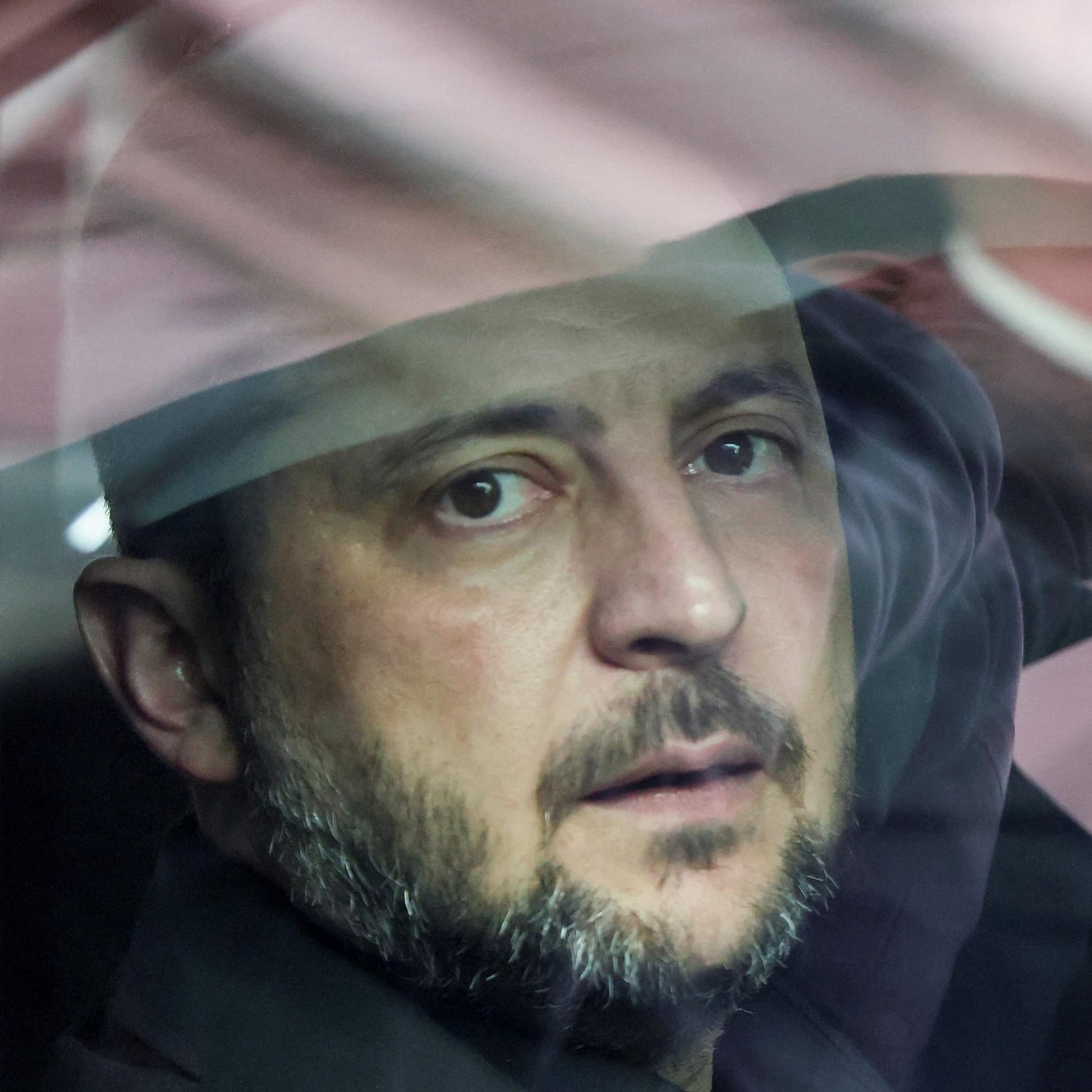
Photo: Ukraine's President Volodymyr Zelensky sits inside a vehicle. Credit: Susana Vera/Reuters.