In short
How autism misinformation about vaccines—especially the MMR “separate shots” idea—traces back to disgraced UK doctor Andrew Wakefield and later reappears in US political claims about Tylenol/paracetamol and autism.
Guest backgrounds
Adam Rutherford is a science journalist who has reported on vaccine-and-autism misinformation.
Key claims
There is “literally none” evidence linking childhood vaccines to autism. Wakefield’s 1998 Lancet paper was based on a small, correlative case series and his later press conference went beyond the paper. The paper was retracted; Wakefield was struck off in the UK for misconduct and conflicts of interest (including a patent on single vaccines). His ideas spread through parent communities and celebrity networks, then entered mainstream US politics.
Notable examples
Royal Free Hospital press conference (1998); investigative reporting by Brian Deer; Wakefield’s Texas autism clinic; appearances with Alex Jones; association with Elle Macpherson; Wakefield at Trump’s 2017 inaugural ball; RFK Jr. standing beside Trump during Tylenol/autism claims.
Written by AI. May contain mistakes. Listen to the episode to check what was said.
Chapters
Tap a time to open that second in VOThe Influence of Tylenol Claims
1:46 to 4:09
Discussion on the recent Tylenol claims and their historical context.
“There's a story that's probably come up over and over again this week.”
The Rise of MMR Concerns
4:09 to 6:00
Delve into the origins of the MMR vaccine concerns linked to Wakefield.
“It is one of the most studied medical interventions in the history of medicine, the history of humankind.”
Media's Role in Vaccine Misinformation
6:00 to 8:34
Explore how the press reported on Wakefield's claims and their impact.
“And to be clear, The Lancet is one of the best, most respected medical journals, not just in the UK, but in the world.”
Community Impact and Vaccine Uptake
8:34 to 11:00
Understand how community fears affected vaccination rates.
“No one was sceptical enough, I think, to really challenge it.”
Investigating Wakefield's Claims
11:00 to 13:13
Learn about the investigation into Wakefield's fraudulent research.
“suddenly given this, oh, well, maybe this was the thing that caused it.”
Consequences of Wakefield's Actions
13:13 to 14:03
Discussion on the fallout from Wakefield's discredited research.
“He did have a patent on a single vaccine at the time that in a press conference, he stated that the triple vaccine was possibly causative of autism.”
The Aftermath of Wakefield's Disgrace
14:03 to 16:15
Explore Andrew Wakefield's consequences post-retraction and his rise in Texas.
“And the ultimate outcome of that is that the paper is retracted.”
Interview Insights with Andrew Wakefield
17:40 to 23:54
Gain insights from a journalist's interview with Wakefield post-disqualification.
“just after he was disqualified from medical practice.”
The Rise of Vaccine Denialism
23:55 to 28:00
Analyze how Wakefield's actions contributed to the mainstreaming of vaccine denialism.
“But you see his media appearances in places that then were the preserve of conspiracy theorists growing in popularity.”
Impact of the Wakefield Saga on Vaccination
28:00 to 28:55
Explore how the Wakefield saga contributed to vaccine denialism and its consequences.
“What we saw during the Wakefield saga is a drop-off in vaccine uptake and as a result, an increase in suffering in individual people.”
Show all 11 chapters
Misinformation's Reach and CDC Update
28:55 to 29:21
Learn about the CDC's recent change regarding vaccine-autism claims and its implications.
“And that's it for the global story for today.”
Transcript
Automatic transcript. May contain errors.0:00This BBC podcast is supported by ads outside the UK.
0:30so you can monitor and engage with the account while your teen learns how to invest and manage money. Learn more at schwab.com. Hey there, it's Asma and Tristan here. Hey guys, as we reach the end of 2025, we wanted to bring you a few of our favourite episodes of the podcast since we relaunched in September. That's right, and we will be back in the new year with brand new episodes bringing you stories about where the world and America meet. And in the meantime, I should say we love to hear from you all. So please drop us an email if you've got thoughts about some of the episodes we've done or questions or suggestions for future topics.
1:07Our email address is theglobalstory at bbc.com. Today, we're bringing you one of my favorite episodes back from September, which is a deep dive into the world of anti-vaccine views. After President Trump said that Tylenol or paracetamol might lead to autism. And it's told through the fascinating story of a discredited, debunked and unlisted British doctor called Dr. Andrew Wakefield. And it's even more relevant now that we've seen how the Trump administration has taken very controversial public views about Tylenol. Enjoy, guys. If you've got kids or you're thinking about having kids or you know people with kids, basically if you're most people, There's a story that's probably come up over and over again this week.
1:58So taking Tylenol is not good. I'll say it. It's not good. In an extraordinary press conference on Monday, standing next to his health secretary, RFK Jr., the U.S. president shared unproven claims about the relationship between Tylenol and autism. Tylenol. during pregnancy can be associated with a very increased risk of autism. Doctors say Tylenol, which is known as acetaminophen or paracetamol in Europe, is the safest drug for pregnant women to take for fever and pain, and that not treating a fever can be dangerous for both the mother and the baby. And by the way, I think I can say that there are certain groups of people that don't take vaccines and don't take any pills that have no autism.
2:54And while the Tylenol bit has dominated the headlines, Trump has reiterated another thoroughly disproved theory. The MMR, I think, should be taken separately. This is based on what I feel, the mumps, measles, and the three should be taken separately. These words have a very specific history, and it can be traced back to a disgraced British doctor in the 1990s. In fact, you could argue that there's no way the US president says these words in 2025 without a man called Andrew Wakefield. I'm Tristan Redman, and this is The Global Story. Today on the show, the British backstory of a zombie idea that won't die.
3:58Before we fully dive into this, I think it's worth saying at the outset that science has found that there is no link between autism and childhood vaccines. There is literally none. It is one of the most studied medical interventions in the history of medicine, the history of humankind. And there is literally zero evidence that vaccines given to children are causative or even associated with the development of autism. I can say that with absolute confidence, the confidence of someone who understands how clinical trials are performed. This is science journalist Adam Rutherford, and over the years he's done a lot of reporting about vaccine and autism misinformation.
4:42The specific wording and the specific question that Trump appeared to be stating about the triple vaccine, measles, mumps and rubella, being given in one batch, is a 27-year-old claim that was first articulated by Andrew Wakefield in 1998. Well, we're hoping that today you can fill in the bizarre backstory of how this idea got into Donald Trump and RFK Jr.'s heads and the story of this one former doctor. Take us back to the late 90s. Where does it all start? It starts in the Royal Free Hospital, which is in northwest London. Andrew Wakefield at the time was a doctor who was interested in gastrointestinal problems in children.
5:37In a case study that was published in 1998, so that's a small paper with a small number of children, he was the lead author on this paper, which was not actually about autism at all, but it was an association between gut problems and the triple vaccine of MMR. So it's published in The Lancet. And to be clear, The Lancet is one of the best, most respected medical journals, not just in the UK, but in the world. The Lancet and the Royal Free organised a press conference. And a few members of the local press, of the broadsheet newspapers, came to this. in that press conference, Wakefield made a direct association between the triple vaccine, which is MMR given in one injection for measles, mumps and rubella, and the development of autism.
6:35Now, other people on the panel were shocked by this and freaked out. You mean at the press conference itself? At the press conference itself, because it wasn't in the paper, and this wasn't something that had been discussed amongst co-authors on this paper. and the the press picked up on this before you go to the press um can you explain to me just very quickly please um what did the research in the paper actually say and where did it end and where did wakefield going off script begin the paper itself was it was a case study of um small number of patients who all in the paper described as having severe autistic uh symptoms and various gastrointestinal, so gut problems associated with it.
7:20And it was based on, according to the paper, Wakefield's study of these children as they were coming through his clinic as a gastroenterologist, not as an autism specialist or a vaccine specialist, but as a gastroenterologist. And it's a correlative link between gut problems and the triple vaccine itself. Mm-hmm. What he said in the press conference afterwards was completely going off-piste, but it turned out was the beginning of this specific idea that was articulated by Trump on Monday. So you mentioned the press. How big was this story when it broke after the press conference? Well, it grew and it grew and it grew.
8:05The vaccine for measles, mumps and rubella given to most children over the age of one has been linked with autism. The research is published today in The Lancet. It was based on an initial study of only 12 children but the doctors have since seen many more. And it became the dominant press story for medicine for maybe the next five, maybe even ten years. No one in the press, across the mainstream press, was untouched by this. No one was sceptical enough, I think, to really challenge it. And that was on the left and right-wing press, various champions in the press, columnists in particular, latched onto it as a serious potential issue, despite the lack of evidence.
8:52There was a time when, you might recall, where the Prime Minister at the time, Tony Blair and his wife, Sherry Blair, refused to answer the question about whether one of their sons had been vaccinated. Look, we have made our position clear on disclosing details of medical treatments our children have had right at the very outset. They opted not to reveal that information, which is perfectly within their rights, but it did nothing to dampen down the brewing storm.
9:27Why was there so much fear of autism at this moment? Well, it was growing in diagnosis. And so this is a period where the incidence of autism in young children was on the up. It's also a time where communities and people with autistic children who were looking for answers, But medicine did not have and does not have answers as to what are the direct causes of autism to this day. But vulnerable families with autistic children were developing into communities and information spreading between them. And in those unregulated spaces, what we saw was a massive increase in the popularity of this idea that had been seeded and popularized by Andrew Wakefield a few years before.
10:17Now, you've got to remember as well that autism diagnoses occurs when children are in their three or four or five. And that is also coincident with the time when certain vaccine regimens are given to children. It's also coincident with the development of key markers for autistic spectrum behaviours, which are things like the development of complex language. So you see a group of parents who are in a potentially vulnerable space with young children who are not following the trajectory of what we term typical development or normal development, who are suddenly given this, oh, well, maybe this was the thing that caused it.
11:06And so it grew, it grew and it became an enormously popular idea. And you saw a huge decrease in the uptake of the triple vaccine in this period. When do serious doubts about Wakefield's research start to become public? They begin to creep out during this period. So it's a long investigation, primarily led by one journalist called Brian Deer at the Sunday Times, who was a beat journalist, an investigative journalist, with no specific interest in medicine or vaccines. But he's quite dogged in pursuing Wakefield. And then the whole story begins to unravel because it turns out that the evidence in the paper itself was probably fraudulent.
11:53Well, I wanted to ask you about that because you said not just incorrect, you actually said fraudulent. Can you explain that, please? Yeah, sure. So the data that's actually in the paper is not supported by the case studies themselves. So some of the children, I think I'm right in saying that some of them had been diagnosed before they had received the vaccine. There were further stories of how Wakefield had performed extremely unethical behaviours, such as going to children's parties and paying children to get blood samples off them. What? Can you explain that to me? That's extraordinary. Well, it is extraordinary.
12:33There's not that much more to explain. It is an example of a grotesque breach of medical ethics, bypassing all of the standard, very, very strict and necessarily strict bioethical pathways that researchers are bound to in order to study patient cohorts. And he clearly wasn't doing those things. But it turned out in the full investigation that he had a patent on single vaccines at the time, which was not stated. Now, in academia, we refer to this as a conflict of interest, which needs to be stated up front before you publish. And had he stated that conflict of interest? Never had done. That was only revealed years later when the thorough investigation was underway.
13:17So the suggestion is that he was criticising the triple vaccine where three vaccines were combined into one, potentially because he had an interest in creating another vaccine where those three were separated from each other. Is that right? He did have a patent on a single vaccine at the time that in a press conference, he stated that the triple vaccine was possibly causative of autism. So eventually, following a lot of the Sunday Times reporting, the General Medical Council, which is the United Kingdom's medical regulator, begins what is still the longest investigation, the longest and most thorough investigation in their history into the claims made.
14:02by Wakefield and how they were counted by the press. And the ultimate outcome of that is that the paper is retracted. All but one of the authors, which is Andrew Wakefield, I think I'm right in saying, withdrew from it. Wakefield himself is struck off. His doctor's license is revoked in the UK. So he is no longer a doctor, according to the body that recognizes as medical practitioners. Okay. It sort of didn't matter though because he's already left the country by this point. Where is he? He's in Texas at this point, working in an autism clinic. How has that happened when he's been struck off the medical registry?
14:44He went to America where things are much less tightly regulated. Medicine tends to have state regulations for these types of things. And he was popular. There are plenty of autism clinics around the world who do sign up to these sorts of ideas that he was supporting. He has become something of a celebrity. How does he get famous? Well, it's front page news, right? The question that he is proposing to answer is front page news in the press, centred in the UK, but then it goes all over the world. He enters this sort of circuit, a celebrity circuit, of people who are vaccine sceptical or vaccine deniers.
15:22He's charismatic. He's charming. He spent a lot of time talking to audiences of parents. And I think he did something which I've witnessed. I've been to some of these talks years ago when he was still in the UK. And he offers hope to vulnerable parents, particularly vulnerable female parents. Most of the audiences were women who are at some of the most difficult times in their lives with children who are severely disabled by autistic behaviours and diagnoses. And there's a man, a charming man at the front saying, you've been abandoned by science who doesn't have answers for your problems, and I think there are answers, and I'm going to devote my life to helping you answer them.
16:05So he was a messianic figure.
16:13Up next, how Wakefield makes it big in Magaland and goes from disgrace to supermodel girlfriend to Trump's presidential inaugural ball.
16:54We'll be right back. Shut up. Neighbors texting you the score before your TV catches up. Come on. Get a load of this guy. Catch up. On a dog. Yeah, we've got thoughts. Too loud? In Chicago, you're gonna hear it. Because nothing here gets built without conversation. Nothing moves without connection. So if you think you know AT &T, it might be time to rethink that. Because their network has improved, like, a lot. So Chicago can keep speaking its mind with AT &T Wireless and AT &T Fiber. Chicago won't stop talking. Our improved network backs it up. AT &T, connecting changes everything. AT &T Fibre, limited availability in select areas.
17:39Adam, you interviewed Andrew Wakefield for the BBC just after he was disqualified from medical practice. That's right. This was 2011, I think. And he's in Texas at this point, working in an autism clinic. So as is journalistic practice, we fired off an email to the generic front desk of the Texas organization that we knew he was working at and said, we are doing a program about the MMR story and Andrew Wakefield. And often when you do those sort of right to reply emails, you never get anything back or, you know, they just ignore you or they take weeks. About 15 minutes later, we get an email. My producers get an email from Wakefield himself.
18:26saying that in two weeks' time, I'm going to be in the UK on Tuesday. I'm free from, you know, one till three. I'd happily come in and talk to you. Can I just say, journalistically speaking, these are things that never happen. Never happen, right? So we then, in some of the happiest professional times of my life, we locked ourselves in a room with piles and piles of papers. It was like a scene in All the President's Men when you're being, you know, Woodward and Bernstein. And it was so much fun for me. Did you have a board on the wall with bits of string attached with little pins? I think it was before that became a meme.
19:03But basically, yeah, you know, you cover every single angle, rehearsing the interview, right? And then on the day, we had this whole thing choreographed. But it became very apparent to me, something which I hadn't really considered. Clever and informed, though I hope my questions were, he'd heard them all before.
19:28I accept none of the findings of the General Medical Council, nor did my legal counsel, and we were most surprised at their findings. And he'd answered them all before and had well-rehearsed answers to every single one of those questions. We know from the findings of the General Medical Council that at the time that you were conducting this study, you were receiving funding from litigation against the triple vaccine. How do you respond to that? In 1996, I was approached by lawyers to ask if I would help in assessing whether there were merits to a case against the MMR vaccine manufacturers. He used techniques that I think we're much more familiar with now, which is to divert the question or answer a different question to the question you've just asked.
20:10And I thought about it very hard and I looked at the prospects of these children. They were some of the sickest children I've ever seen in my life. Nobody wanted to believe that they had a vaccine-induced problem. We didn't know, but it certainly needed. Or, you know, what aboutery, the technique of saying, I'm not going to address this question, but what about this which appears related but may not be? But you felt confident enough to stand up and discuss work that was unpublished and that wasn't in the paper that was published that had a major effect on public confidence in vaccines. That doesn't seem like very good scientific practice to me.
20:42No, it was supported by an analysis, a formal analysis of the published literature. And that's what I based my position on. He knew how to talk to me because he knew what I was going to ask, because he knew the types of scientific challenges that were part of his grand narrative.
21:03There's another thing which is worth mentioning, which is a celebrity was growing at this time as well in various bizarre, I mean, genuinely bizarre interactions. he became associated at one time with a model she was the bra model for the original wonder bra adverts do you mean l mcpherson no that comes later still in an even more bizarre twist so hang on he has a long history with models apparently so again it was one of those bits of the story where you go, right, that seems absolutely surreal, but it was reflective of the fact that there was a celebrity culture around this idea. Later still, who does he hook up with?
21:51Elle Macpherson. Elle Macpherson. Extraordinary. One of the great supermodels of this era. Is she into, shall we say, alternative medicine? Yes, and sees him, as many did, in this sort of celebrity circuit, as a hero of The Voiceless. Well, good evening, everybody. Nice to be up here. I feel very honoured to be sharing the stage with you. There's an extraordinary clip of Elle Macpherson introducing him at some kind of public event. I first heard about Andy in 1998. I was living in London and I had... Where she is describing him as the... should be the most famous person on stage rather than this, you know, extremely famous supermodel that you had pictures on your bedroom wall of.
22:43It's quite unusual. We walked down the street and more people recognised him than me, which goes to show you how long my career is. When does he get into Donald Trump's orbit? Trump has made no statements at this point in his first presidency or the first run for president about health or medicine. in particular. But the Wakefield klaxon for the interested goes off when he is seen at Trump's inaugural ball. That's surprising to me because although we all know a certain amount now about the anti-vax community, it certainly wasn't something that was on my radar really in 2016, 2017. So is it surprising to you that he turns up at Trump's inauguration?
23:34Well, it was definitely surprising, but I suppose it's looking at the networks. You know, you mentioned the conspiracy board with the red string between all of the parties involved. Wakefield has entered this world and has continued to thrive off this world. Incidentally, worth pointing out that in the first instance back in the 90s, he wasn't anti-vaccine per se. He was anti-triple vaccine. But as he proceeds through the years and into the 2010s and onwards, he keeps going down that line until eventually he is all vaccines are bad. But you see his media appearances in places that then were the preserve of conspiracy theorists growing in popularity.
24:16But with the advent of Trump became mainstream. What's really going on, what the real science is. Dr Wakefield, thanks for joining us. Alex, thank you very much. Great pleasure to be here. Absolutely. Well, tell us about your research. So he appeared on the Alex Jones podcast many times. Research into safety concerns about vaccines, because that's what this is about. It's about taking the messenger and shooting him because it doesn't fit. I've watched many interviews with Wakefield, and if he's talking to serious journalists, he's quite circumspect and quite medical sounding. But if he's talking to Alex Jones, He'll say things which appear to be the opposite of what he said in other interviews or much more extreme versions.
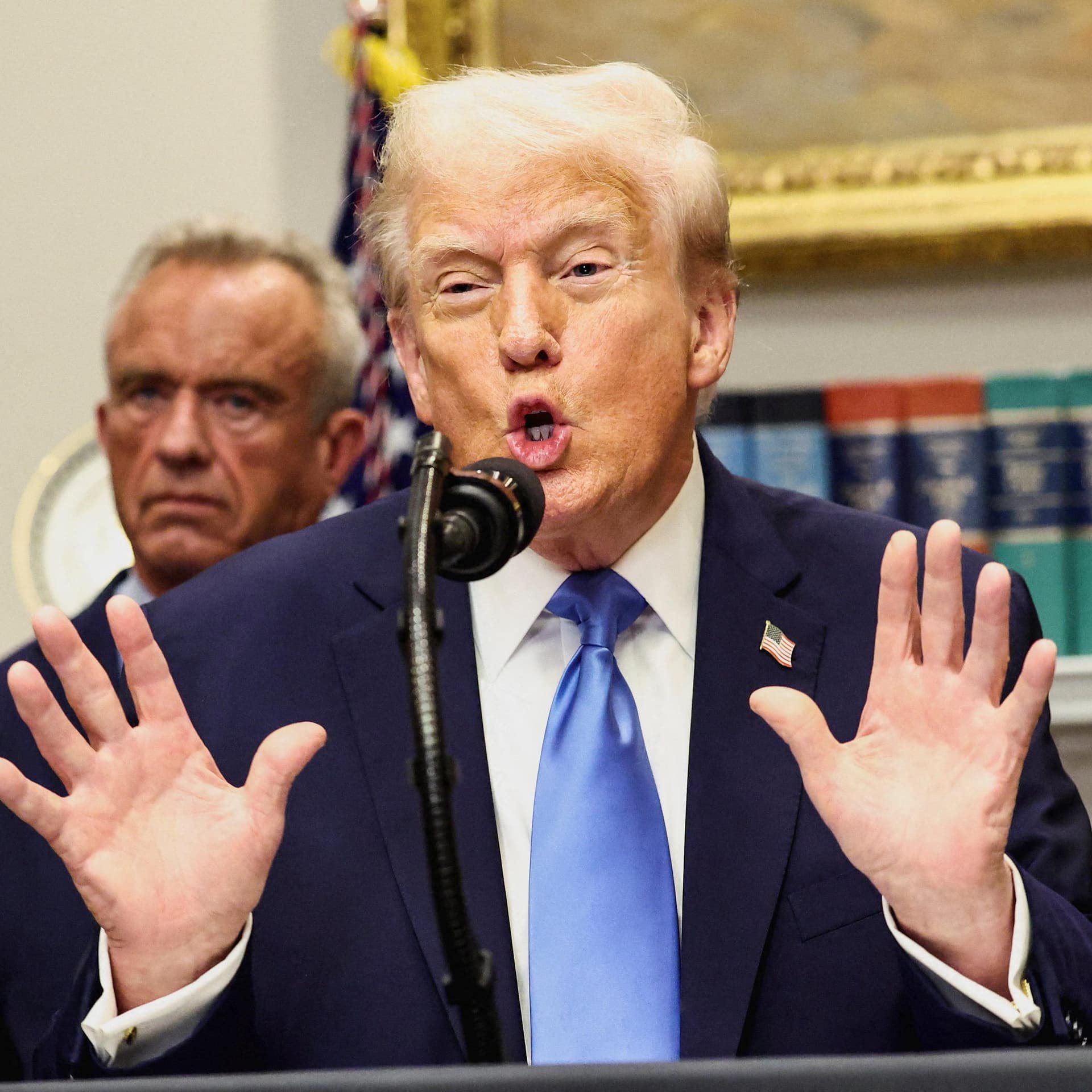
24:56Don't get it wrong. This is the government and the pharmaceutical industry telling us what we can say, what we can see, what we can think, and ultimately what we will inject into our children's bodies and our own. There is something gone horribly wrong with democracy in this country. But I suppose this is just a growing conspiracy ecosystem that Trump's election tapped into, because this now, you know, struck off doctor, minor doctor from the UK is now at the inaugural ball with Elle Macpherson of the president of the United States. Well, on Monday, when we saw Donald Trump make this announcement about Tylenol, just behind him was standing RFK Jr., who's now the health secretary in the United States.
25:40What is Wakefield's relationship with RFK Jr. and how significant is it at this stage? RFK Jr. has been a vaccine denialist for many years. Whilst I don't know whether, you know, how RFK has interacted directly with Wakefield, I think it's reasonable to say that he has been directly influenced just because Wakefield was such a significant player in the evolution of these types of ideas in the States, but also them going mainstream. So to see RFK Jr. standing behind Trump when Trump is parroting things that Wakefield specifically said more than 20 years ago is, again, surprising, but kind of sadly predictable.
26:27Adam, when we look at the complete span of this story, it strikes me that it's kind of bookended by two press conferences. On the one hand, in 1998, you have this press conference with Andrew Wakefield announcing his study for the Lancet Medical Journal. And then we have at the other end Donald J. Trump on Monday, flanked by RFK Jr., making this announcement on autism. When you look at that span and all the installments in between, what are your reflections on it? I think the MMR hoax, I think it's valid to call it a hoax, is the most significant biomedical issue in probably in my lifetime, but certainly in the last 30 years.
27:20What happened in 98 at that press conference is a singular point which lit a touch paper, which 20 odd years later has culminated in this bizarre statement by the president.
27:41I find this hard because vaccines, along with sanitation and clean water, are the most effective health interventions in human history. The evidence for that is unequivocal, robust, undeniable, whatever word you choose. What we saw during the Wakefield saga is a drop-off in vaccine uptake and as a result, an increase in suffering in individual people. But the long-term repercussions were the huge growth of vaccine denialism. and the spread of this fallacious, this specious idea, which, I don't know, 10 years ago, maybe we thought this was confined to the internet or to social media. Those ideas, as you see, the term you used was zombie ideas.
Read the full transcript
28:37They didn't die. But not only did they not die, they thrived and they went mainstream. And so that is the most heartbreaking aspect of this story.
28:55Thank you so much, Adam. Pleasure talking to you.
29:02That was Adam Rutherford. And since we recorded this conversation, the Centers for Disease Control and Prevention, the CDC, has altered its website to reflect RFK Jr.'s beliefs and now says, quote, studies have not ruled out the possibility that infant vaccines cause autism. And that's it for the global story for today. Thanks for listening. If you're enjoying the show, please take a second to rate us wherever you're listening. Cheerio.
From the publisher
We are away for Christmas, so this is a repeat of a previous episode.
In September, President Trump and the U.S. Health Secretary Robert F. Kennedy Jr. held a press conference in which they made extraordinary new claims about autism. They suggested a potential link between the use of Tylenol during pregnancy and the development of autism. They also advocated spacing out childhood vaccinations.
The two men's interest in the link between vaccines and autism goes back decades but these claims did not originate in the US. They trace back to the UK in 1998, when disgraced former doctor Andrew Wakefield first published his now-debunked theory linking MMR vaccines to autism cases in children.
The science journalist Adam Rutherford explains to the Global Story how the Wakefield vaccine conspiracy became the biggest medical disinformation disaster in recent history, and how these ideas found fertile ground in the Trump administration.
Producers: Viv Jones, Valerio Esposito
Executive producer: Annie Brown, James Shield
Mix: Travis Evans
Senior news editor: China Collins
Photo: President Trump & Robert F. Kennedy Jr. Kevin Lamarque/Reuters