
In short
Roger Carstens, former U.S. Special Presidential Envoy for Hostage Affairs (SPIHA), explains how the U.S. negotiates hostage releases with Russia and other adversaries, arguing that effective deals require human listening, relationship-building, and sometimes expanding negotiations beyond one-to-one swaps.
Guest backgrounds
Roger Carstens is a former special forces operator who led U.S. efforts to free “wrongfully detained” Americans worldwide. He was appointed SPIHA in 2020 (role created after a 2012–14 Syria/ISIS failure) and worked for about five years on complex, multi-year hostage recovery deals.
Key claims
U.S. policy distinguishes terrorist groups from nation-states; families must be kept informed; identifying which Russian agency controls a jail cell (e.g., FSB) shapes strategy; personal leader-to-leader contact can help (he praises Trump’s Putin meetings).
Notable examples
Paul Whelan; Trevor Reed (released in Istanbul 2022 for Konstantin Yershchenko); Viktor Bout (“Merchant of Death”) swapped for Brittany Griner; a 2023 multi-country prisoner swap including Evan Gershkovich and Vadim Krasikov; discussion of risks of “moral hazard” and why it doesn’t match observed “math.”
Written by AI. May contain mistakes. Listen to the episode to check what was said.
Chapters
Tap a time to open that second in VOOverview of Hostage Negotiations
1:11 to 2:09
Discussion on Roger Karstens' background and role in negotiations.
“Donald Trump has prized himself on being the president who ends wars.”
The Approach to Negotiation
2:09 to 3:05
Roger shares his approach to negotiating with adversaries.
“Roger Carstens, it's such a pleasure to have you with us in the studio.”
The Nature of Negotiating with Terrorists
3:05 to 4:24
Discussion on America's stance on negotiating with terrorists and nation states.
“Yeah, I think they have a lot in common.”
Changing U.S. Hostage Policies
4:24 to 6:35
Explaining the evolution of U.S. policies regarding hostage negotiations.
“So I think the tagline that we had in my office was essentially that, like, you know, the United States doesn't talk to terrorists, but we do.”
Special Forces Training Impact
6:35 to 8:13
Roger discusses how his special forces training influenced his negotiation style.
“So President Obama initiated a hostage policy review.”
Focus on U.S.-Russia Relations
8:13 to 9:11
Introduction to the discussion on U.S.-Russia hostage situations.
“That means I have to be honest with my enemy, my opponents.”
Case Study: Paul Whelan
9:11 to 11:03
Roger explains the case of Paul Whelan and his wrongful detention.
“We were focused at that time on Paul Whelan.”
Trevor Reed's Detention and Release
11:03 to 12:18
Details on Trevor Reed's wrongful detention and the negotiation for his release.
“His girlfriend was able to get a video film of the police car.”
Logistics of the Swap
12:18 to 14:09
Roger details the logistics and emotional aspects of the hostage swap.
“I want to understand what it's like to be on the plane, on the tarmac as this all transpires.”
Ambassador Carstens' Mission Overview
14:09 to 16:08
Learn about Ambassador Roger Carstens' mission to bring Trevor Reed home from Russia.
“And so I jump on a plane and put my hand out and say, hey, Trevor Reed, I'm Ambassador Roger Carstens.”
Show all 17 chapters
Brittany Griner's Arrest and Negotiation
16:08 to 18:29
Explore the details surrounding the arrest of Brittany Griner and the negotiations for her release.
“It's in our new podcast series, PostGeorge, the criminal behind Farage.”
Moral Challenges in Prisoner Swaps
18:29 to 19:31
Discuss the moral implications of negotiating prisoner swaps, particularly involving notorious criminals.
“And I wonder if you had any moral qualms about this swap.”
Complexities of Recent Hostage Cases
19:31 to 22:01
Understand the complexities behind recent hostage negotiations including Evan Gershkovich's case.
“The moral hazard being taking a chance that the person that you're trading may go back to a life of crime.”
Political Prisoners and Strategy
22:01 to 23:29
Examine how American foreign policy strategies have evolved in negotiating for political prisoners.
“President Eisenhower famously said that if you can't solve a small problem, then enlarge it, and then it might be more solvable.”
Encouraging Hostage-Taking?
23:29 to 24:30
Debate whether negotiating prisoner swaps encourages further hostage-taking by nations.
“Number one, strangely, except for one or two countries, the logic doesn't fit.”
The Importance of Personal Relationships in Negotiations
24:30 to 28:03
Learn about the role of personal relationships in negotiating with foreign leaders like Putin.
“We're at this point now where President Trump is trying to broker a deal to end the war between Russia and Ukraine.”
Insights from a Hostage Negotiator
28:03 to 28:47
Learn about the emotional challenges and strategies of a hostage negotiator.
“I feel like I was an absent husband and father because I spent my time on the road.”
Transcript
Automatic transcript. May contain errors.0:00This BBC podcast is supported by ads outside the UK.
0:30Search for PostGeorge The Times wherever you get your podcasts.
1:00Listen now or search for Good Bad Billionaire wherever you get your BBC podcasts.
1:11Donald Trump has prized himself on being the president who ends wars. But there is one conflict he has failed to make much progress on so far. That's Russia's war with Ukraine. The Russian leader Vladimir Putin keeps stonewalling American efforts. One man who has experienced successfully negotiating with Russia and many other U.S. adversaries is Roger Karstens. He was, until earlier this year, the special presidential envoy for hostage affairs. In plain speak, that means he was the guy in charge of bringing home Americans wrongfully detained around the world. He was first appointed to the job by President Trump in 2020.
1:57He spent five years working to free dozens of Americans in often complex deals that took years to negotiate. From the BBC, I'm Asma Khalid in Washington, D.C. And today on The Global Story, we speak to Roger Carstens on what it takes to successfully make deals with Russia.
2:27Roger Carstens, it's such a pleasure to have you with us in the studio. Thank you so much for stopping by. My pleasure. Thank you. Glad to be with you. You have sat down with some of the United States' greatest adversaries, Putin's Russia, the Iranian regime, the Taliban. And you've done all this in an effort to ensure that Americans who were taken hostage or wrongfully detained could come back to the United States. I want to know what's your approach when you're in the room. And do any of these negotiations, meetings in the rooms with any of these folks have anything in common? Yeah, I think they have a lot in common.
3:08I think when you sit down with someone who might be an opponent of the United States, it's important to bring your full self. You know, you can't just go in with a mathematical diagram in your head of what you're going to try to offer and what you think they may offer and where you might go. Instead, you also have to bring your intuition. You have to bring your humility. You have to come in and be ready to listen. Because at the end of the day, everyone wants to be heard, to include a dictator who may be holding a U.S. citizen arbitrarily. They still have a story to tell. and if they don't tell that story and they don't feel like they're being heard or listened to, then the negotiation doesn't go that well.
3:48It's something that they taught me in special forces training. It's got to be about listening, engaging, establishing a relationship, and in a way it doesn't matter who's on the other side of that conversation. Whether they're a partner, an ally, a friend, an enemy, an opponent, your goal is to make a very human connection. So you're talking about being in the room and negotiating, as we say, with sometimes some rather unsavory characters. I remember this phrase that America does not negotiate with terrorists. But isn't that what you ended up doing in this role? Can you walk me through how the United States approach to hostage negotiation changed?
4:30So I think the tagline that we had in my office was essentially that, like, you know, the United States doesn't talk to terrorists, but we do. Oh. And there's a difference between terrorists, and that would be a non-state armed group that, like, you know, JNIM, Al-Qaeda, ISIS, and a nation state that's holding your citizens, like Russia, Iran, Venezuela. And with nation states, we're always much more willing to talk to them. But I think in terms of talking to the terrorist groups, my position was built, I should say my former position, the Special Presidential Envoy for Hostage Affairs, or as we call it, SPIHA.
5:08It was built so that they could— Because everything in this town has a great acronym. You have to give it an acronym. But it's such a long—you choke on saying the title. So you have to truncate it. But yeah, if SPIHA was going to go— So your position was built when? 2015. You spent some time on this with us. as to what the situation was prior to 2015 and what changed or why it changed. In 2012 to 2014, the United States absolutely failed in getting some American citizens out of Syria.
5:39They were taken by ISIS. Okay. And we refused to negotiate with ISIS. We refused to really talk to the families as to what we knew about their loved ones and what we were doing to try to get them back. And by the way, what we were doing was about nothing. We begin with some grim news from Syria. Intelligence officials are investigating a video that was posted online purportedly by ISIS that claims to show that captured U.S. aid worker Peter Kasich has been killed. ISIS released a video. It hasn't yet been verified by U.S. intelligence, but it does appear to show the execution of journalist Stephen Sotloff.
6:15The ISIS video is simply too horrific to show. The man being executed by beheading is James Foley, a freelance journalist kidnapped in northwest Syria on November 22nd, 2012, Thanksgiving Day. By about 2014, all these Americans had been murdered by ISIS. So President Obama initiated a hostage policy review. And we came up with the idea that, look, we need a single focal point. that person must be empowered to talk to all the bad guys or the opponents, the adversaries. Even terrorist organizations. Even terrorists. Even the Islamic State. 100%. And the mandate was that we kept families fully informed to the extent that we could.
6:59And so with that, my office was born, this hostage recovery enterprise, which is what we named it. I want to get into your personal story. You mentioned the special forces a moment ago. I just want to understand how that experience may have translated to what you ended up doing. Yeah, so in special forces, you know, they're looking for someone who, of course, as you might imagine, is comfortable in a chaotic and ambiguous environment. And so there's a selection process that you go through. And selection is not just this three - or four-week-long period where, you know, in my mind, you think you're being evaluated and I'm being an Olympic athlete.
7:35Instead, they're really trying to get into your personality. You might test someone and take them through all these physical efforts. But what you're really trying to do is take a look at a person to see how they interact with other people, how they make decisions, what their mindset is when things are going wrong. And at the end of the day, if you can get someone who's not rigid and linear, who's ethical, even when things are challenging and they have opportunities to not be ethical, someone who can make friends with anyone, but also someone who can flip a switch and try to be a world-class soldier in that split-second moment, then you're looking in a way a jack-of-all-trades.
8:12And so I think the training and then the execution of any special forces missions I had, I think, in a way, kind of strangely well suited me for SPIHA. And that whether you're talking to the Taliban or you're talking to the Venezuelans or the Russians or the Iranians, when I'm trying to get an American citizen out of one of their jails, I want a personal relationship with that person if I can get it. I want them to trust me. And they really have to trust me. That means I have to be honest with my enemy, my opponents. And if we can get there, then we have a fighting chance to come up with an agreement that will eventually result in bringing someone home.
8:49Roger, we want to focus a bulk of our conversation here on the United States' relationship with Russia and what your experience as the hostage envoy can tell us about the U.S.-Russia relationship. I know when you stepped into that job in 2020, there were a couple of Americans who were still being held hostage in Russia. We were focused at that time on Paul Whelan. Paul Whelan. And Paul Whelan wasn't yet designated as a wrongful attainee when I took the job. He was a former U.S. Marine, became a business executive. And he would travel to Russia as part of his business duties and went back to Russia to attend the wedding of a colleague that he'd met over there.
9:32And during that period, the Russians arrested him and accused him of being a spy. He was the first one while he was in the job that was actually officially declared wrongfully detained by the secretary of state. So early on, the Russians had indicated that they would be willing to trade Victor Boot, who was a very notable arms dealer, arrested in Thailand and sentenced to U.S. jail. Konstantin Yerushchenko, convicted and sentenced for narcotics trafficking. And at a certain point, Maria Butina detained on espionage-like activities. And the Russians wanted them back. And I think early on when I took the job, I could see some paperwork, like in our files, indicating that the Russians were hinting about a swap between all three, two, or one for Paul Whelan.
10:18And shortly afterwards, Trevor Reed was taken. Trevor was arrested in what might be seen as a barroom brawl that took place in Moscow. And the Russians charged that he also became violent with the police officers while en route to the police station. And who is Trevor Reed? Trevor Reed, former U.S. Marine, was visiting his girlfriend on just a personal trip. And I think when something like that happens, you don't just take the case immediately because you actually want to try to figure out the facts. You don't want to take a case and find out later that that person was guilty of what they're being charged with.
10:55But at a certain point, we were able to piece together enough information to come to the conclusion that he was wrongfully detained. How did you determine he was wrongfully detained? Just all the facts of the case. His girlfriend was able to get a video film of the police car. And in taking a look at it, you can see that there was never a moment where the car looked like there was a brawl taking place in the car. witness statements. Eventually, you can paint a picture as to what happened. And then also, you might get a sense of what the Russians are going to use them for political leverage. How does the manner in which they were taken tell you what the Russians may have wanted and who you might negotiate with?
11:33It's important to figure out who actually has the key to the jail cell because the conversation is going to be different. If someone's taken in Russia, are you going to be dealing with their Ministry of Foreign Affairs, with their Department of justice, with the intelligence services. If the intelligence services, are you going to be dealing with the FSB, the GRU, or the SVR? I think we determined early on in my office that it was going to be the FSB, the intelligence channels. And so we started to reach out to the Russians and the other side to get a sense of, you know, what it is they want. Now, the other side, a lot of times doesn't tell you what they want.
12:07They want to just see what you offer, and then they respond. So if we fast forward, Trevor Reed does eventually get released. He has swapped for a drug dealer. And I recall it took place, that swap, in Istanbul, Turkey in 2022. What were the logistics of that swap? I want to understand what it's like to be on the plane, on the tarmac as this all transpires. On the plane flight out, there were people from, of course, my office. There were people from the law enforcement side of the house. Konstantin Yerushenko was there, of course. And that's the drug dealer who is being exchanged. Correct. You know, Mr.
12:42Yerschenko, how's your English? He speaks perfect English. And I said, hey, do you have an idea what's going on? I think so, but please tell me. You're being swapped for this person. We're going to this country. We're going to land in the city. When we land, it's probably going to happen like this. You'll stay here until you're told this. At a certain point, you'll be handed a piece of paper, and you'll be escorted to the other side of the tarmac to link up with your side. So you kind of explain the ground scheme maneuver so that there's not a lot of confusion. So the planes land. You get off the plane and— They're waiting for us.
13:16Okay. And what do you say to your Russian counterpart? Get off the plane and introduce yourself and say, look, here's what we're thinking about doing. What are your thoughts? You know, can we integrate what we're both thinking of and then make this happen in the next, like, 10 or 20 minutes? And that's the conversation we had. And then you see in that movie with Tom Hanks, The Bridge of Spies, where, you know, you settle everything. And then at a certain point, both sides start moving together at the same time to cross each other in the middle and then go off to their respective planes. Did you see Trevor Reed first?
13:49Did you talk to him at all? I did. I saw him first. He's on the Russian plane. Can you share anything about that? I think there's always a little shock. And you have to think that when you see Trevor Reed or you see Brittany Griner, whoever else, hours earlier, they were in a Russian prison with maybe some idea that something might be happening, but maybe not fully comprehending. And so I jump on a plane and put my hand out and say, hey, Trevor Reed, I'm Ambassador Roger Carstens. I'm coming from the U.S. Department of State. On behalf of President Joe Biden and Secretary of State Anthony Blinken, I'm here to take you home.
14:23here's what's going to take place in the next 10 minutes.
14:30And I can explain to him what's about to happen. And at that point, you know, you depart the plane and, you know, go do a few other logistical maneuvers. And then shortly, Trevor gets off the plane and Konstantin Yerushiko gets off the plane and they cross in the center part. Breaking overnight, we can tell you now, former Marine Trevor Reed has been released after being imprisoned in Russia since 2019 in exchange for a Russian pilot convicted of drug trafficking. As he crosses a tarmac to board a flight home to America, Reed walks right past Konstantin Yaroshenko, who the U.S. agreed to return in exchange for Reed.
15:11You mentioned on the tarmac there in Istanbul, you met your Russian counterpart. What was the Russian Roger Carstens, if I may call him that, what was he like? Very professional. I'd say he was not much different than me in its own way. I mean, we didn't show up with hardened faces and animus. We actually showed up as two people asked to do a job on behalf of their countries. And so, you know, with a handshake and a conversation, we got down to business.
16:07and crime. It's in our new podcast series, PostGeorge, the criminal behind Farage. Search for PostGeorge The Times wherever you get your podcasts.
16:37richest people. And asking you to decide if they're good, bad, or just another billionaire. Good, bad, billionaire from the BBC World Service. Listen now or search for Good, Bad, billionaire wherever you get your BBC podcasts.
16:57Roger, I want to ask you about a case in 2022, which is when the US basketball player, Brittany Greiner was arrested. WNBA star Brittany Greiner convicted today on drug charges in Russia, a judge sentencing her to nine years in a penal colony. Greiner, detained in Russia for more than five months, found guilty of intentionally smuggling vape cartridges of hashish oil into the country. She was eventually released in exchange for a notorious arms dealer whose nickname was the Merchant of Death. And I want to understand how that deal unfolded. And I've got a lot of follow-ups, but please go ahead.
17:37Brittany was arrested right before Trevor Reed was released. And then we go ahead and conduct the Trevor swap. And now the math doesn't add up. We have Brittany Griner and Paul Whelan. And on their side, they only have Victor Boot, the Merchant of Death. And so the negotiations at that point rightfully focused on, can we somehow make a two-for-one swap happen? They were hinting very strongly that they were going to use Brittany Griner for leverage. And based on Victor Boot, they were very clear, not just during the small short period, but going back years that they wanted to obtain Victor Boot's release.
18:15So Brittany Griner does get released in a one-to-one prisoner swap for Victor Boot. And there was some criticism at the time that the U.S. government agreed to release this notorious arms dealer. And I wonder if you had any moral qualms about this swap. I would say almost every swap we ever did at the very completion of it at the end of the night, after I've seen someone who's innocent, wrongfully detained, getting off in U.S. soil, collapsing into their arms, their loved ones, reconnecting after years of poor treatment. it's such it's like a 30 second high that you cannot really be replaced by anything else.
18:54But by that night, when you look in the mirror after that swap, you never really feel great because you have to do something tough to get your Americans back. It would be nice if the Russians took an American and to get that American back, they demanded that we changed a post office name in Minot, North Dakota to the Vladimir Putin post office. We'd be like, well, that's an easy deal. We'll do that. Instead, they have a maximalist demand to get someone like Victor Booth, the merchant of death. That's hard. And a friend of mine came up with a way of putting it together. He said, look, the moral imperative, meaning getting your innocent American out, outweighs the moral hazard.
19:31The moral hazard being taking a chance that the person that you're trading may go back to a life of crime. Well, can I ask you about that? Because there There has been reporting in the interim now that suggests Victor Boot has resumed arms dealing. I don't think he's been very successful. I've read it all. Yeah, the Wall Street Journal has been reporting about it. He's gone from being one of the most successful, notorious arms dealers to being a very not good, not switched on yet. With Yemen and the Houthis as much. But what you're doing is you're taking someone who was captured in 2007, back when they had flip phones.
20:01By the time he gets out of prison, they've already carved up his network. Other people are doing it. breaking back into the network is going to be ridiculously hard, if not impossible. But I think when making these cases, again, the moral imperative in the president's mind, certainly in mine, outweighed the moral hazard. And I should note that Viktor Buh reportedly told a Russian news agency that the claims made by The Wall Street Journal are unsubstantiated. Roger, I want to ask you about another very prominent case. Russia's security agency says it has arrested a U.S. journalist working for the Wall Street Journal in Moscow on charges of espionage.
20:40Evan Gershkovich, who was arrested in March of 2023, he is eventually released. Good morning. We are coming on the air with breaking news. Four American citizens detained in Russia have just been released as part of a prisoner swap involving multiple nations. Among those now free, Wall Street Journal reporter Evan Gershkovich and Marine veteran Paul Whalen. It's a sweeping deal involving 24 prisoners in at least six different countries. And among the Russians freed from Western jails, Vadim Krasikov, an FSB hitman, who brazenly gunned down an opponent of the Kremlin in broad daylight in Berlin.
21:17The deal that made this possible was a feat of diplomacy and friendship. In total, 16 political prisoners, including Russian opposition figures, some human rights activists, were released as part of this prisoner swap. And I'm wondering if you can help us understand what was going on at this moment. Was this a situation where hostage release and American foreign policy merged? I might be considered that. I know that we tried to work bilaterally, one-on-one with the Russians, to come up with a solution for Evan Gershkovich and also Kermisheva, Vladimir Karamirza, Paul Whelan. So we're four people that we were very interested in getting back.
21:56But we could find no way that the Russians were going to do that on a one-to-one basis. And that's when we started to look more broadly, where there are people that were our partners and allies who might be willing to take Russian spies that they'd caught and throw them on the negotiating table on our behalf to pull out a bigger deal. President Eisenhower famously said that if you can't solve a small problem, then enlarge it, and then it might be more solvable. So by making the problem bigger, we were able to come up with a solution, whereas if we kept it smaller and bilateral between us and the Russians, it never would have worked.
22:29And so that's when we had to start using, in a way, the foreign policy efforts of the United States government to talk to other countries in an effort to pull this all together. Why were you so keen to get some of these Russians out? And I'm curious. I mean, one leading Russian opposition figure who eventually died in prison, Alexei Navalny. Was he on that list at all? Yeah, so Navalny was someone that we thought about very early on, but were really unable to put him on the big list because of the belief that President Putin would never accept him as a part of a swap. There did come a time when we figured out that President Putin would consider him as a part of a swap where he eventually jumped onto the list.
23:07And sadly, he passed away before we could execute a swap of that nature. And so I'd say some of the political opponents that came out of Russia, in a way, were trying to counterbalance and account for the loss of Navalny in what could have been maybe a smaller swap. But in a way, you have to be glad that so many people were freed on that one day. So there are, as we speak here, still other Americans being detained by Russia. As you spend more effort, resources in trying to get citizens back to the United States, there might be someone who would say, well, doesn't that actually encourage countries to take them more, knowing that you're so committed to bringing them back?
Read the full transcript
23:48So three things. Number one, strangely, except for one or two countries, the logic doesn't fit. If you look at the mathematics, Venezuela, the math doesn't work because the Venezuelans have taken more Americans. The Russians certainly have. But if you look at the other countries that you might say are the usual suspects, once you've made a swap deal, for the most part, they're not rushing back to take more Americans. Number two, there is that moral imperative to get your citizens back. And number three, you still have to make these deals while coming up with a deterrence effort. And that may take 10 years.
24:23But in that 10-year period, you're going to still have to sit down with the other side and talk to them about how to solve it. We're at this point now where President Trump is trying to broker a deal to end the war between Russia and Ukraine. He seems to put quite a lot of stock in his personal relationship with President Putin as a way of potentially breaking some sort of deadlock. Based off of your experience in dealing with the Russians, I want to know what you've learned about the way Russia operates and what you've come to understand about how best to get what you want out of the Russians.
25:00I'd like to take a bite of humble pie here and say I'm not sure that I figured it all out. I can tell you that I think personal relationships matter. So the fact that President Putin and President Trump have some sort of relationship, I see that as very positive. You see that as positive because notably President Biden refused to meet with Putin over the last several years. He did not want to sit down. I think that the relationship that leaders have with each other, I'd say that's of great value. Having said that, I think you're at times still required to come up and find shared interests and identify what those interests are and then start fighting your way to take both sides and keep pressing them together to the point that you can make an agreement.
25:42Now, the Ukraine war is going to be very hard because there are other people involved. Of course, there's Ukraine, naturally, and there are other people with vested interests, whether it's Germany or, you know, pick your country. But at the end of the day, it's probably going to come down to, you know, President Trump and President Putin making a deal, one that I'm hopeful that President Zelensky is fully brought in on. But this is not this is definitely not easy stuff, obviously. So you left your post in January and in February with the new administration, President Trump's special envoy, Steve Wyckoff, went to Moscow and met with Putin personally in negotiations that end up securing the release of an American named Mark Fogle.
26:28Wykov has also met on other occasions since then with Putin in Moscow to try to end the war in Ukraine. What do you make of that style of negotiating? Because you never met with Putin personally yourself. Is that correct? I've never met with Putin. But I think that's exactly the kind of relationship you want to have. So I fully salute how he did it. This style of negotiating is pretty much the same one that I used. And that is just show up and have the conversation because I just don't think you really can progress if you're not talking to the other side. I have one final question here. You did this job for several years meeting and spending a huge amount of time with families and committing to working very hard to bring their loved ones home.
27:19Did you ever feel like you made a promise to a family that you were not able to keep? Do you ever have regrets? Yeah, there's one time. One time early on, we were so close to a deal. This thing was a done deal. It was going to happen. And I told the family member, I said, look, I'm going to go on a limb here and say, you know, clear off your schedule in two weeks. You're going to want to travel. I think we're going to be able to give you some good news and put this whole case to rest. And, you know, less than two weeks later, I had to call that person and say, hey, that good news that we were hoping to deliver, that's not going to happen.
27:54It fell apart. And that right there solidified my understanding that in this business, you can never promise the result. All you can do is say, you have 100 % of me. And I feel bad. I feel like I was an absent husband and father because I spent my time on the road. I spent my time with these hostage families. I spent my time with the opponents who take our citizens, and they got pretty much 100 % of me. But the one thing I couldn't promise them was the end result. I would say at a certain point, I'd say, look, we know how it ends. You know, it is going to end well. I just don't know if it's going to happen in the timeline that we want.
28:36But eventually, you do solve these problems. But the last thing you want to do is walk in and say, hey, look, this is going to be easy.
28:47In fact, my chief of staff would always say to the families, like, look, you guys need to strap in because this is going to be a long, hard ride.
29:00Well, Roger, thank you so much for taking so much time to speak with us. We really appreciate it. My pleasure. Thank you.
29:11That was Roger Carstens. He's the former Special Presidential Envoy for Hostage Affairs. Our episode today was produced by Lucy Paul. It was engineered by Travis Evans. Our executive producer was James Shield. And our senior news editor is China Collins. By the way, if you all have any story ideas, questions, comments for us, drop us a line at theglobalstory at bbc.com. And that is a wrap for today's show. Thank you all so much, as always, for listening, and we'll talk to you again tomorrow.
29:59In 2016, a 22-year-old known as Posh George was jailed in the US for wire fraud. Standing by his side when he was arrested was Nigel Farage. Join me, Gabriel Pogan, from the Sunday Times for a wild ride through the worlds of politics, crypto, and crime. It's in our new podcast series, Pos George, the criminal behind Farage. Search for Pos George The Times wherever you get your podcasts.
From the publisher
Donald Trump has spent this year trying to negotiate a deal to end the war in Ukraine. So far, Vladimir Putin doesn’t seem interested in the US’s proposals.
One man who has successfully negotiated with Russia – and with many of America’s adversaries – is Roger Carstens, former Special Presidential Envoy for Hostage Affairs. From 2020 to 2025 he worked to free dozens of US citizens taken hostage and wrongfully detained around the world, including in Russia. Securing their release often required complex deals that took years to put together.
What does it take to successfully negotiate with Putin’s Russia?
Producer: Lucy Pawle
Executive producer: James Shield
Senior news editor: China Collins
Mix: Travis Evans
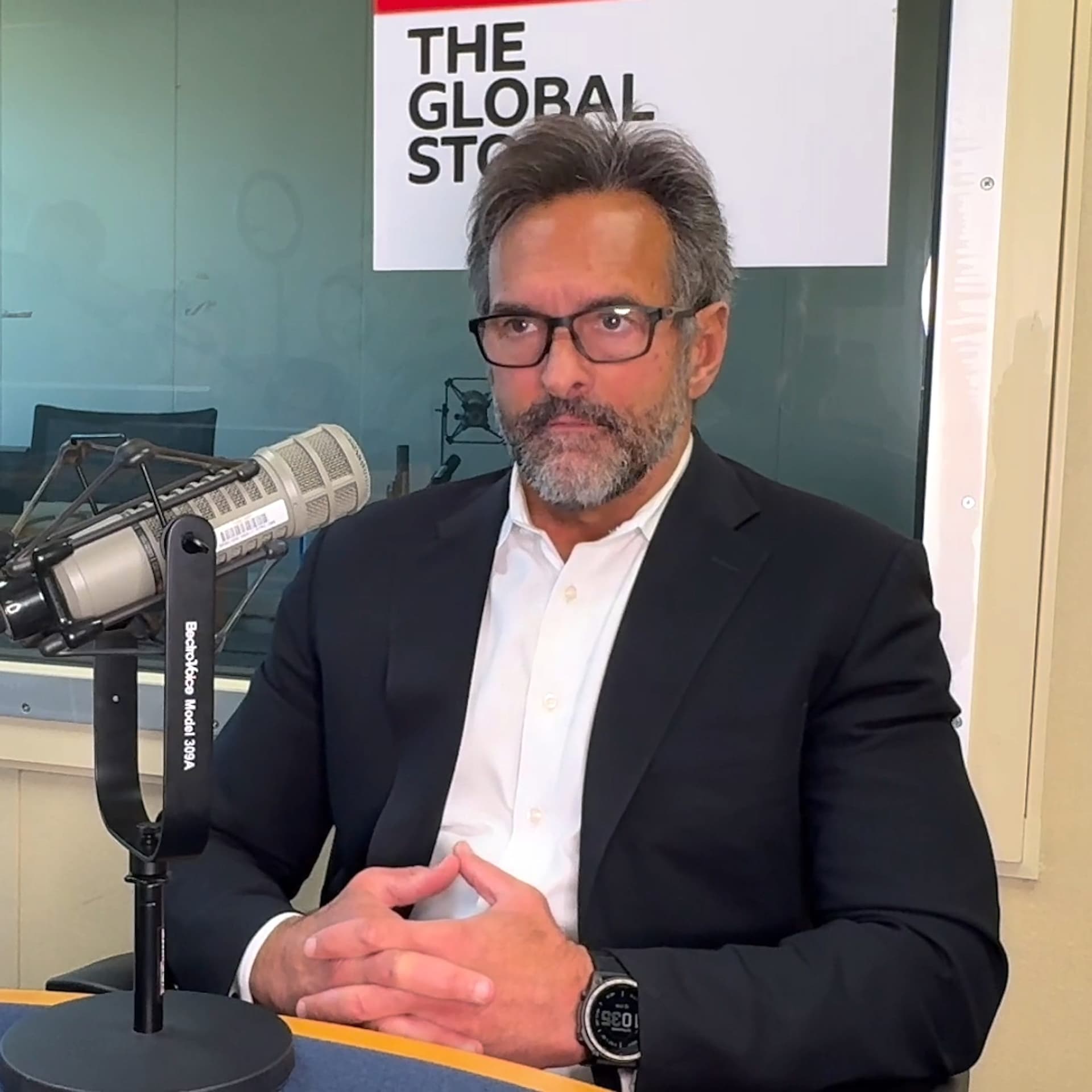
Photo: Roger Carstens. Credit: BBC