
In short
The episode argues that U.S. “soft power” functioned like a hidden empire by exporting standards and cultural stories, especially through World War II-era manufacturing and global standardization.
Guests
Roman Mars, host of 99% Invisible and author of BBC’s A History of the United States in 100 Objects; he explains how mundane design choices shaped global systems. Hosts are Asma Khaled and Tristan Redmond (BBC Global Story).
Key claims
The U.S. became a “quartermaster for the world” after WWII, enforcing global standards without formal colonies. Herbert Hoover pushed U.S. standardization (e.g., paving stones, glassware) to enable interchangeable parts and national commerce. WWII forced allies to adopt U.S. screw-thread standards (60-degree angle), making British 55-degree standards obsolete.
Notable examples
60-degree screw threads; Anglo-U.S. meetings (1943–45) over retooling; stop-sign design shifting from yellow octagons to red; “stopper” entering French.
Written by AI. May contain mistakes. Listen to the episode to check what was said.
Chapters
Tap a time to open that second in VOReflecting on American Influence
0:45 to 2:14
Discussion on America's global influence and the significance of its 250th anniversary.
“They liberated most of Europe in World War II.”
The American Dream and Its Challenges
2:14 to 4:33
Exploration of the American Dream and the upcoming stories focused on U.S. power.
“Asma, as we celebrate the 250th birthday of the United States, I want to start with a big question for you.”
Introducing Roman Mars
4:33 to 6:00
Introduction of Roman Mars and his insights on American soft power.
“And we're also going to be doing an episode on how American power has been used in somewhat surprising and shadowy ways.”
The Nature of American Empire
6:00 to 7:50
Discussion on how the U.S. wields soft power differently than traditional empires.
“It's not glamorous, it's not obvious, but it really did literally shape the world in America's image.”
The Power of Standardization
7:50 to 9:29
Examination of how America's screw standardization exemplifies soft power.
“And through that, we ended up enforcing our will of the sort of global standards of things.”
Herbert Hoover's Legacy
9:29 to 12:03
Analysis of Herbert Hoover’s impact on American standards and commerce.
“So the problem was, is that a screw is a very simple device.”
The Global Impact of U.S. Standards
12:03 to 14:00
Investigating how U.S. standards became global following World War II.
“Like what are the examples of inefficiencies as a result of non-standardization?”
Historical Context of Standardization
14:00 to 16:46
Explore how historical events shaped standards and practices worldwide.
“Like, I put it to you, but it's not the first time that this was attempted.”
The Power Dynamics of Screw Thread Standardization
16:46 to 19:20
Understand the implications of the Anglo-American meetings during WWII on global standards.
“worry, it is just for the purposes of the war.”
The Impact of American Cultural Exports
19:20 to 23:16
Learn about the soft power of the U.S. through cultural influence and design.
“though, was actually a greater result of the Second World War?”
Show all 11 chapters
Evaluating America's Global Role
23:16 to 25:58
Discuss the complexities of America's influence and the debate over its global role.
“And this is just an unstoppable force, the United States.”
Transcript
Automatic transcript. May contain errors.0:00This BBC podcast is supported by ads outside the UK.
0:30Just tap into iHeart to start watching. And we hope you enjoy the show.
0:38The United States is about to mark 250 years since its founding. Most Americans know that their country has profoundly shaped the world that we all live in. They liberated most of Europe in World War II. They invented things like the electric pencil sharpener, the atom bomb, the internet, the personal computer, breakfast cereal. I admit, I didn't know we actually invented all those things. But like many big birthdays, this is a moment of celebration over here in Washington and across the country. It is also, though, a moment of angst and introspection. A moment to reflect on America as an idea, as a country, as a people.
1:15So we're stepping back from the news to dedicate a whole week of episodes to the surprising tales of American influence on the world stage and in ordinary people's lives across the globe. since we are a show about where the world and America meet. We have been looking into some gripping stories about how, over the years, the United States has shaped the world. People think in stories, and we have this ability to export our story. And a lot of people have bought it. And today, with the help of the podcaster Roman Mars, we tell the story of the United States as an innovator and how being inventive isn't just about creating things.
1:56From the BBC, I'm Asma Khaled in Washington, D.C. And I'm Tristan Redman in London. And today on The Global Story, how America used soft power to build a hidden empire.
2:14Asma, as we celebrate the 250th birthday of the United States, I want to start with a big question for you. What does the United States mean to Asma Khaled? Oh, that is a big question. You know, I know that this is a moment in which many people in the United States are feeling really polarized. But I will also say, as you all who work with me have probably gleaned, I am somebody who believes deeply in the promise of the United States. And in major part, that's because my family's story here in the United States is so fundamentally linked to opportunities and inventions in the United States. My uncle had polio as a small child living in Pakistan, and they moved to the United States in 1962 for polio treatment.
3:02The best polio treatments in the world were here. The polio vaccine was invented in the United States. And yes, I'm clear eyed that there are many debates now happening with an administration that has cut support for funding, has raised questions about trust in vaccines and science. I know that those are the debates we are having in this moment. But you're also speaking to somebody whose life has been fundamentally reshaped because of the opportunities that the United States could provide her family. I hear you, Asma. And as you know, but maybe some of our listeners don't, I am actually American in spite of my accent, which makes me sound very British.
3:41I was born in Detroit and I've lived a lot of my life outside of the US. But I'm enormously proud of my American nationality and my American identity. But it's also difficult to be an American in the world. People have questions about the United States in all sorts of ways. And when you're an American in the world, you feel like some of those questions are being aimed at you. So it's complicated. It's a complicated thing. I think that that's one of the things, though, that I also love about the United States. This idea of America, it's an experiment. And there is a sense, not always, but for many people, of optimism and striving and trying to make this American project better.
4:21And I love that optimism. Well, Asma, this podcast is not all about us. We've got some fascinating stories lined up for our listeners this week. Asma, you've been looking at the American dream and whether it's still attainable. That's right. And we're also going to be doing an episode on how American power has been used in somewhat surprising and shadowy ways. We're also looking into how the United States helped create a rival superpower. And you, our listeners, you've been sending us your questions and stories about what's next for America and its role in the world. and we'll be putting them to some of the BBC's top foreign correspondents, like our international editor, Jeremy Bowen.
5:00Please keep your questions and stories coming on our email, which is theglobalstory at bbc.com. But today, Asma, we are going to be looking at the question of US soft power. What do you think about when you think about American soft power, Asma? I guess it's all the ways the United States has sought to project its values around the globe, whether that's through Hollywood or hip hop, whether it's through sports stars who sparked political change or fashion icons, all of that. Well, we didn't want to focus on the big things in American history. Yeah. We want to focus on something small and surprising that tells us about the bigger picture.
5:44And no one does that better than Roman Mars. He's made a career of that on the hit podcast 99 % Invisible, which is a show about design and all the little facets of life that we rarely think about that make the world work. And there's a story I found out about when making this episode that is just one of those stories. It's not glamorous, it's not obvious, but it really did literally shape the world in America's image. because sometimes what makes you powerful might be absolutely tiny. Fantastic. I feel like I need to lean into my mic a little bit more. Otherwise, Roman is going to tell me I'm an amateur.
6:29Oh, it's not that. This is mic. This is like what I like. Roman joined us in our London studio and he was in town working on his new BBC series, A History of the United States in 100 Objects. All right. Over to you guys.
6:50Roman, we are here today to talk a little bit about U.S. soft power, because that's one of the things that you touch on in the show. These days, we live in something of a world of American empire, empire with a small e, but it looks very different to the British empire capital E. Why do you think that is? I mean, throughout the 20th century, we just figured out something in the United States that we didn't have to put governors and colonies and put down insurrections and armies that we could use our global manufacturing power in particular to control the earth in these ways that were way more effective.
7:36It's not free of coercion. It's not free of power. But it is so effective. What have you learned during the journey you've been on about what American soft power actually looks like in the world? Well, it is really pervasive. and one of the things that we did was we have a kind of manufacturing might that is a consequence of planning but also just the luck of history like World War II destroyed a lot of the manufacturing power of a lot of the world. We were mostly free of having that on our shores and so our factories could keep running and people needed us and we became the sort of quartermaster for the world in terms of providing all the different bits and pieces of, you know, Jeeps and tanks and things like that.
8:25And through that, we ended up enforcing our will of the sort of global standards of things. And one of the stories that we do on A History of the United States and 100 Objects is about the 60-degree angle screw, which is the angle of threading on a screw, which was the U.S. standard that was developed. And it was not the global standard. but we told everyone in the world essentially like if you want our jeeps you have to adopt our standard and therefore it really just changed the the nature of our relationship with the world standardization of screws yeah is not a topic that i thought i was going to be as interested in that's what we we excel in like we i want to take these mundane objects and make you care about them and think about the world differently because of it yeah okay we'll take us to the beginning then What was the problem with screws that needed solving?
9:19And what did the United States do so effectively that not only solved it, but created greater U.S. influence in the world? So the problem was, is that a screw is a very simple device. In fact, it's one of the simple machines that have existed for millennia. And the threading of the screw, where you're trying to fasten two hard things together, it has to be at a certain angle so that it fits together. But there's a problem that was developing, which was as the world was industrializing, as the United States was industrializing, certain people were noticing that if we just had greater efficiency and more interchangeable parts, that we could excel in our manufacturing.
10:02And one of those people was the Secretary of Commerce, Herbert Hoover, who was a standards fanatic. I am perhaps one of the few living Americans who had full opportunity from high places to see intimately the moving tragedy of that world war. Hoover became famous for being a logistics guy who saved a lot of Belgium from starving. actually, during World War I. I saw it from its beginnings in 1914 all the way down through the long years, which have not yet ended. And I saw it not only in its visible ghastliness, but I lived with the invisible forces that moved in its causes and its consequences.
10:52And later he became Secretary of Commerce in the United States. Much later than that, he became president that presided over the Great Depression and became one of history's kind of villains because of it. Well, I mean, what I found really interesting is the revisionist history job you've done for Herbert Hoover here. I mean, you've brought him back from a certain ignominy. Why was he the man for the job? He just was a man who believed in systems. He was a classic bureaucrat before that term got tainted by someone who didn't get things done. He was like a professional. who believed that if we just had the proper systems in place, the proper thought about how to build a system of manufacturing, that everyone would prosper through it.
11:40And so he made it his mission in the 1920s to standardize all kinds of things, paving stones, the type of glassware. If we just made the system more efficient, everyone got richer and it was better. And that was his solution to things. Can you spell out, though, what the consequences would be of not standardizing things like paving stones and glassware? Like what are the examples of inefficiencies as a result of non-standardization? Well, what ends up happening is you have to sort of custom do everything at a certain point. So like if you have 11 paving stone sizes instead of 65 paving stone sizes, when something breaks or something needs to be replaced, now you can go to a shelf and sort of get them.
12:27and having interchangeable parts does so much for you to increase the efficiency of any system. And also it's sort of like, you know, the United States, you know, we think of them as one body, but the different states had lots of different standards of things. And so just like a bushel of corn was more in one state than another, just in terms of weight. There's like a truck sizes were allowed in one state versus not allowed in another on a road. And you just cannot have a national system of commerce if these different parts don't talk to each other. And so he was really interested in making all that stuff smooth and standard and making kind of one nation out of our system of commerce.
13:09You know, this part of this soft power, a requirement is a government that functions and thinks strategically. Whereas up to that point, Like you could donate enough money and become a general in the Civil War. Like there was nonsense about how we ran things. And it really was about currying favor and giving jobs to your friends and stuff like that. But through this era of the 1880s on and culminating this period, was it just a sense that a scientific method of doing things was going to make the country more powerful and also make the world a better place. There was just a commitment to that, and people were on board for it.
13:48Okay, so that's Herbert Hoover's remit. Our remit on this show is to talk about stories where the world and America meet. So rationalization of things and standardization in the United States, when does that start creeping into the rest of the world? Like, I put it to you, but it's not the first time that this was attempted. So in the French Revolution, that's something that they did. They standardized a meter. You can go and see it in a museum in Paris. They standardize temperature, centigrade, for example. I mean, France has had a certain amount of success because, you know, kilometers are used throughout the world.
14:24But how is it that the United States had so much more success? What ended up happening, which really enforced our standards on the world, was World War II. On this 10th day of June 1940, the hand that held the dagger has struck it into the back of its neighbor. President Roosevelt wanted us involved to save the world from the Nazis. We will extend to the opponents of force the material resources of this nation.
15:06And there was this argument that he made that was, if somebody's house is burning, if you could lend a garden hose to them, you would. That's just good neighbors. But, well, you have to make sure your garden hose actually fits their hydrant for it to actually work. our factories were working we're turning stuff out becoming part of the war and as we were like building and building and building and becoming part of things you don't just send whole jeeps you send parts of jeeps and when they break you have to have other parts that they don't work with them and it was becoming clear that very few of our parts were working no bullet worked in a gun across the ocean and so what you what we had to do is we had to have these series of meetings with the British government that was like, we need to figure this out because the inefficiency of having things fixed in the field was costing people lives.
16:04And so there are a series of Anglo-U.S. meetings between 1943 and 1945, and I just sort of went through them all. Daniel Emerwar, who I talked to, describes these series of meetings where the British Empire, very unused to taking orders from anybody, and especially not these upstart Americans. They go used to it eventually. Yeah. And, you know, they begin to go, well, we'll hear you out. So the first meeting they have, like meeting one, they say we would be willing to talk about screw thread standardization. And there's a meeting about that. Second meeting, they say we would agree to consider retooling.
16:45And then there's another meeting that's like, okay, we are retooling, but it is just temporary. worry, it is just for the purposes of the war. Don't think that you own us. And then there's another set of meanings where it's just like, okay, we're just capitulating completely. Because the UK had a 55-degree screw angle. And the insidious thing about a screw is that you cannot look at it and say that's 55 degrees versus this is 60 degrees. You have to like, you only figure that out when you put it in and it doesn't quite work. You have to see the symbolic humiliation. You know, it's one thing for the United States to declare independence.
17:21This is the British declaring dependence. This is the British basically saying that in the realm of objects, which turns out to be a really important economically determinative realm, we're going to take orders from you rather than the other way around.
17:42Hi there, I'm Asma Khalid. And I'm Tristan Redmond, and together we're the hosts of the Global Story podcast from the BBC. For those of you who might be new to our show, we here at the Global Story dive deep every weekday on one big story at the intersection of where the world and America meet. And you can now watch the Global Story on the iHeart app. Catch every brand new episode every weekday. Just tap into iHeart to start watching. And we hope you enjoy the show.
18:14once you get the British Empire and all the sort of associated territories in the U.S. on one standard, then everyone else falls in line. From there, it just locks in and we were just in the lead of that. But we were in the lead of that because we had people like Herbert Hoover deciding that stuff for us, you know, like a generation earlier. And then, you know, one of the things about having that type of power and our ascendancy in the 20th century is like, not only do we get to impose our standards on others we get to decide to not take part of standards that we don't like which is like the metric system which for some reason i don't know why but we just it doesn't feel good in our gut i don't even know why the metric system doesn't feel good in america i don't know we just got used to it and then and there's a certain part of like once you start feeling your power of like people are going to do what you want to do you start capriciously sort of exercising that power.
19:10And that seems to be one of them. So the Second World War is definitely a demonstration of US hard power. Yeah. Is there a case that the US soft power extension around the world, though, was actually a greater result of the Second World War? Again, it's not free of coercion and force. It's not all benevolent. But it is so much better than guns and bombs. And I argue it's so much more effective as proof of the fact that the 20th century was very much the American century by the time it was done. And it was done in a way that was really new. Like its empire was a small e empire of influence. But then the other part of that, of our equation, was that the cultural exports of the United States are second to none.
20:03the rock and roll and the music and stuff like this. We painted ourselves as the heroes of the world. And, you know, just getting English around the world, which is like, I don't know, the UK did a good job getting that going. But people think in stories and we have this ability to export our story. And a lot of people bought it in ways that benefited the United States in so many ways. Well, not everyone loves it. No. You speak with a historian, Daniel Imawar, and he says a thing to you which really made me sit up in my chair. He says, that little thing, the screw thread, is such a potent, hard to notice, but nevertheless deeply consequential symbol of the way in which the United States has remade the world or the world has had to remake itself to accommodate the United States.
20:57I imagine it's annoying, at the least, and infuriating. The world has bent to accommodate English speakers all around the world and English desires, like American desires. And I think everyone's acting rationally in some ways. Like, that's a good choice to make for tourism and for all kinds of reasons. but I imagine having that sort of cultural hegemony like rolling over you at all times it has its miseries. What are the other examples of American design? I mean you're so immersed in the world of design what are the other examples that have stood out to you as well as the screw? A lot of stuff gets developed in terms of design haphazardly and when it came to stop signs and most traffic signals and stuff like this.
21:53Every location had their own traffic signals. The octagonal stop sign was invented by a Detroit police officer. There used to be a yellow square was a stop sign. He didn't feel like that was different enough from other signs. So we clipped the corners off and made an octagonal sign. Everyone recognized that that's a good idea. But it was a yellow octagonal sign. And we put that down as one of these standards that we conformed to. And it was spread across the world. But at a certain point, chemists came up with a nice reflective red color. And they just thought, you know what? Red would be better.
22:28Red would be a better color as a stop sign because it would match traffic lights. And all of a sudden, this became a better standard. And right when everyone in the world had agreed that a yellow octagonal sign would be a stop sign, a few months later, the U.S. was like, no, never mind. We're going to do red ones. And then the rest of the world just got in line. And it even goes on to change language because, for example, you know, a stop sign in France is exactly the same as a stop sign in the United States. And stopper, S-T-O-P-P-E-R, has entered the French language to mean exactly that. And I'm sure there were people who fought rearguard actions against stopper ever entering the French dictionary, but it is there to stay now.
23:13It's an amazing thing, that influence. And this is just an unstoppable force, the United States. I mean, we've arrived at a place now where the focus on soft power is maybe not quite what it was. Yeah, I think so. I mean, this soft power, this influence in these ways was an incredible invention. It was a new kind of imperialism that saved lives and maybe made some people's lives a whole lot better. It's probably the greatest thing America has ever done. Well, I mean, it's not just happening in the United States, though. It's happening all over the world where leaders are pulling back from engagement with other countries and focusing on inward concerns.
24:00yeah and this is you know it's not being responsive to people and their needs you know leads to people's discontent and that's the big cost of this is like maybe in the effort to become global manufacturers of the world and or to have this type of globalism we left behind a lot of people that react poorly to those notions i'm going to ask you a kind of journalistic two-part question. Is the world a better place for having 60-degree screws in it? And by extension, is the world a better place for having the United States in it? Huh. I would say 60-degree screws, yes. Our machines across the world should talk to each other.
24:49And that makes the world a better place, a more efficient place. Is the world a better place for having the united states in it interesting question i think i have to have enough pride in my country to say yes there's having a a place built around an idea of all men are created equal and having that moment where we knew that we didn't mean all men But it was because we had that idea to point to. Like there was a lot of people, you know, in the sort of in the course of American history who looked at our hypocrisy and said, what does the 4th of July mean to an enslaved person? Like it means nothing.
25:39And there's some people who looked at it and said, if you really believe this stuff, it includes us. It includes women. It includes people of color. And having a place built on an idea like that is a powerful thing in the world and worth paying attention to and preserving. Part of me, the reason why it is fun for me to tell these stories is because I believe in those ideals. And it's fun to talk about how we deviated from them and how we lived up to them.
26:12And there's fun stuff to talk about, our influence on the world. I mean, you know, just like rock and roll alone. Elvis takes black music, turns it into rock and roll. Heartbreak Hotel comes out. Paul McCartney hears Heartbreak Hotel, decides he wants to make music. That is a great arrow of things happening in the world. That is a good thing to talk about and preserve and to celebrate.
26:43Roman Mars, thank you so much. It's been a pleasure. Thank you. It's been great to be here.
Read the full transcript
26:54That was Roman Mars. You can find his fantastic series, A History of the United States in 100 Objects, on bbc.com or wherever you get your podcasts. And tomorrow, our special series on the US at 250 will continue. I grew up in a civil war. I did not see America as a place. I saw it as an idea, the idea of freedom. I'll be speaking to one man who moved to the United States in search of the American dream, about whether he was able to ultimately find it. And remember, later in the week, we'll be doing a Q &A with an expert panel of BBC correspondents. We've already had some wonderful emails from you all with your stories about what America means to you and your questions too.
27:38We really appreciate hearing from listeners. And if you all have questions as well about the United States' place in the world in this moment and what might come next, you can send us a note. Our email address, as always, is theglobalstory at bbc.com. Today's episode was produced by Sam Chantarassak and it was edited by James Shield. It was mixed by Travis Evans. Our digital producer is Matt Pintus. Our sound engineers were Johnny Hall and Mike Regard. Our senior news editor is China Collins. And I'm Tristan Redmond. And I'm Asma Khaled. Thanks for tuning in, and we'll talk to you again tomorrow.
28:13Cheerio.
28:17Hi there, I'm Asma Khaled. And I'm Tristan Redmond, and together we're the hosts of the Global Story podcast from the BBC. For those of you who might be new to our show, we here at the Global Story dive deep every weekday on one big story at the intersection of where the world and America meet. And you can now watch the global story on the iHeart app. Catch every brand new episode every weekday. Just tap into iHeart to start watching. And we hope you enjoy the show.
From the publisher
As the United States approaches its 250th anniversary, all this week The Global Story is exploring the surprising and often hidden ways the US has shaped the modern world.
Today, we are joined by Roman Mars – the host of 99% Invisible and the new BBC series A History of the United States in 100 Objects – who sets out his theory of how the US used design to shape the world in its image.
Producer: Sam Chantarasak
Executive producer: James Shield
Sound engineer: Travis Evans
Senior news editor: China Collins
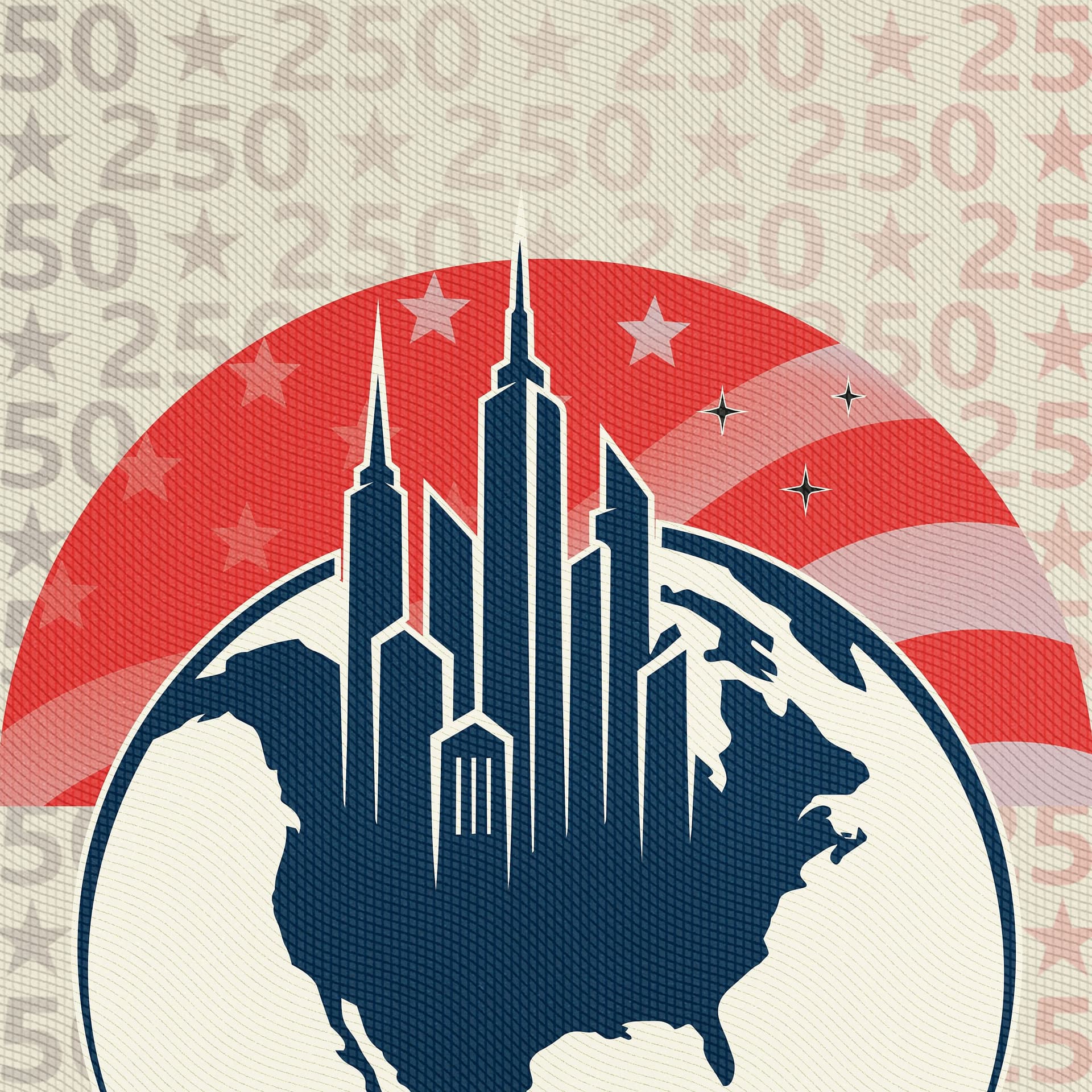
(Image: An illustration of a US city rising high above the world’s surface)