In short
The BBC Global Story episode explains what a “Super El Niño” is, why it’s happening in the Pacific, and the likely global knock-on effects (drought, floods, wildfires, hurricane shifts) plus how climate change amplifies the risks. It also discusses uncertainty in forecasting, early-warning systems, and whether governments are preparing.
Guest backgrounds
Tom DiLiberto, climate scientist. Former U.S. NOAA forecaster and spokesperson; later worked at nonprofit Climate Central to communicate extreme-weather expectations.
Key claims
El Niño is driven by trade winds weakening, warm water shifting east, and thunderstorms shifting—triggering “dominoes” worldwide. This year’s event is among the strongest on record and is occurring on top of climate change, increasing heat mortality risk. El Niño can reduce Atlantic hurricanes but increase Eastern Pacific storms.
Notable examples
Panama Canal low water risk; reduced Indian monsoon; drought/wildfires in Philippines/Indonesia and Australia; heavy rains in Horn of Africa; drought in Central America/northern South America; fewer/no Atlantic hurricanes; multiple Category 5 storms in the Eastern Pacific; heat-related deaths estimate of 450,000 (methodology not reviewed).
Written by AI. May contain mistakes. Listen to the episode to check what was said.
Chapters
Tap a time to open that second in VOIntroducing Tom DiLiberto and the Super El Nino
0:29 to 2:24
Meet climate scientist Tom DiLiberto and discuss the upcoming Super El Nino.
“That's schwab.com slash Washington Wise.”
Tom's Journey in Meteorology
2:24 to 3:15
Tom shares his lifelong fascination with meteorology and extreme weather.
“Today on The Global Story, what's El Nino about to do to us?”
Understanding El Nino
3:15 to 5:48
Tom explains the mechanics of El Nino and its global implications.
“And that was kind of the jumping off point for a variety of other things.”
Global Impacts of El Nino
5:48 to 10:41
Discussion on how El Nino affects different regions and global agriculture.
“So it's important to kind of get a frame about what you know and what you don't know, especially when you're communicating the risks of something that might happen.”
Economic Consequences of El Nino
10:41 to 13:05
Exploring the economic effects of El Nino on global markets and commodities.
“When you talk about the situation in Central America being really bad, I was reading that this could affect the Panama Canal, just with ships getting through.”
The Alarming Heat Projections
13:06 to 14:01
Tom discusses alarming projections of heat-related deaths due to Super El Nino.
“An organization called the Climate Impact Lab said that possibly as many as 450 ,000 people were projected to die from the additional heat brought on by the super El Nino.”
Climate Change and El Nino's Impact
14:01 to 14:58
Learn how climate change amplifies the effects of El Nino on global temperatures and health risks.
“So the idea here that if you're going to increase the temperatures in certain places of the world, that will have definite impacts on the amount of people who unfortunately could pass away due to heat-related illness.”
Climate Change and El Nino's Impact
15:20 to 16:03
Learn how climate change amplifies the effects of El Nino on global temperatures and health risks.
“This is Troy Millings from Earn Your Leisure.”
Understanding the Current El Nino Phenomenon
16:14 to 22:09
Explore the historical context and current impacts of the strongest El Nino recorded.
“This is something we do not see very often.”
Challenges in Government Response to El Nino
22:10 to 24:18
Discuss the challenges and partisan issues in government responses to climate events like El Nino.
“But there is a difference with this El Nino is that when I mentioned the first thing that I did was with the FAM and Early Warning System Network, that was run through the U.S.”
Show all 12 chapters
Preparing for Extreme Weather Events
24:19 to 28:00
Learn essential preparation tips for residents facing the impacts of El Nino.
“I've been lucky enough in my career at NOAA to be able to work with so many other scientists around the world who get provided information by NOAA.”
Conclusion and Credits
28:00 to 29:15
The hosts wrap up the episode with thanks, credits, and an invitation for audience engagement.
“I'd much rather be looking at it from afar.”
Transcript
Automatic transcript. May contain errors.0:00This BBC podcast is supported by ads outside the UK. Decisions made in Washington can affect your portfolio every day, but what policy changes should investors be watching? Washington Wise is an original podcast from Charles Schwab that unpacks the stories making news in Washington right now and how they may affect your finances and portfolio. Listen at schwab.com slash Washington Wise. That's schwab.com slash Washington Wise.
0:55fans ready to add John Deere certified pre-owned equipment and more options to their lineup can shop at machinefinder.com. Oh, yeah.
1:06There's a family story that we have that even back to two, when I was two years old, my mom had to stop me from walking out in the thunderstorms. No. Like whenever there was a thunderstorm, I would just want to walk outside into it. I will say as a mother of young children, that's not normal. Most children, I will say, are very scared of thunderstorms. scared. It's just weird. It's hard to explain. And where I grew up, I love snow and we got really big snowstorms. I distinctly remember when I was like 10 or 11, we had this huge blizzard. I was able to tell my friends, I don't think we're going to have school for two days.
1:37And they're like, I don't believe you. And I was like the hero for telling them we wouldn't. And we were right. And I just remember like, oh, I could do this. I like this. This is great. Our guest on the show today is the climate scientist Tom DiLiberto. Tom likes wild weather. He likes telling people about wild weather. But even Tom is apprehensive about the so-called Super El Nino that everyone's talking about. Of course I'm worried because I know these impacts. I know these extremes impact people. And you can't not be worried about that. This extreme weather event is brewing in the Pacific Ocean right now.
2:13And Tom says it's already starting to hit the world. From the BBC, I'm Tristan Redmond in London with Asma Khaled in Washington, D.C. Today on The Global Story, what's El Nino about to do to us?
2:33I was somebody who, from a very young age, was fascinated with the atmosphere. I said I wanted to be a meteorologist when I was, I think I was seven or eight years old. And I had a realization when I was in grad school that part of the reason for it was I hate suspense. So I always like having some sense of what was going to come. But also, I just really like being able to tell other people about stuff that was coming so that they could be prepared for it. And Tom got a job doing just that. For years, he worked for the United States government's National Oceanic and Atmospheric Administration, or NOAA, monitoring coming storms.
3:07And now he works for a nonprofit called Climate Central, helping to let people know what to expect from extreme weather events. When I was at NOAA, the first job I had was working with a famine early warning system network, which basically we provided weather and climate forecasts for the world so we would know where there might be food security or insecurity problems. And that was kind of the jumping off point for a variety of other things. I got involved with El Nino. I was one of the El Nino and La Nina forecasters for the government for a long time and a government spokesperson. And what did that mean in terms of how you did your job day to day?
3:43I'm just imagining you, Tom, at your desk with like three different computer screens that monitor the climate around the world. Maybe this is absolutely not what your job looked like. But what did it entail? Can you paint a picture for us? Yes, I would have I had two monitors and usually it was. Yeah, not three. That's that's too crazy. But it's funny because El Nino is not like a weather pattern. So it wasn't like I had a satellite up looking at it. Now, oftentimes I would have the monitors up and I'd be looking at whether we have these climate forecasts. I would be doing usually one side up would be I would be coding and trying to do some investigation about the way certain things were either appearing or I'd look back at past events.
4:26Sorry, coding. Can you pause and explain that? Yeah, so one thing I don't think I fully appreciated when little Tom was trying to walk out into a thunderstorm was how much being a scientist actually requires learning how to code and take giant data sets and run it through code to give you additional information and then plot it so you can understand what you're looking at. So a lot of my time was spent doing that sort of work in front of a computer and then also discussing it with other colleagues about what they think is going on. That was always my favorite part, was that we all would take a look at the exact same data, the exact same maps, the exact same forecasts, but we all would come to a slightly different conclusion about what was going on.
5:06And once a month, when we were forecasting El Nino, we would all get together and we would discuss what we're thinking. And it was always incredibly fascinating to see what other people are seeing, because it's almost too much data for your brain to comprehend. and you know that it's all going to be wrong because you can't perfectly predict the future. So you need to have like a variety of viewpoints to come together to be able to give the best forecast, which is why even with something like this El Nino, which is incredibly strong, there's still uncertainty about the impact. So you're never going to have like 100 % certainty about something happening.
5:43So that kind of illustrated when you're actually having this conversation with other experts and you're seeing like, oh, you all, oftentimes I'd say like, you're all smarter than me and even you don't agree. So it's important to kind of get a frame about what you know and what you don't know, especially when you're communicating the risks of something that might happen. Tom, can you walk us through exactly what an El Nino is? And you have to do this with the challenge of having no visual aids for our audio listeners. But this is the test we're setting you. And I should say for our listeners and viewers that you actually make explanatory cartoons for kids to understand climate and science issues.
6:26So think of me as a child. It shouldn't be too hard. And please take it away. What is El Nino? So El Nino, it's so it's such a cool thing, which is why I'm obsessed about it. So it exists because the world turns, the world spins. And that means we kind of have these specific ways that the wind blows in different parts of our planet. And across the huge amount of the Pacific Ocean, we have what's called the trade winds, which basically blow from the eastern side of the Pacific Ocean to the western side of the Pacific Ocean. So if you can imagine, you have the ability to stand on water. The western Pacific Ocean is actually higher than the eastern Pacific Ocean because the winds are constantly pushing the water to the west.
7:13Now, that also means that the Western Pacific Ocean is often warmer than the Eastern Pacific Ocean because it has all that tide to move across the tropics and the equator, and it gets really hot. So it gets hotter, and then you bring colder water at depth up to replace all that water that's moving to the west. So what's El Nino? But none of that I said so far is El Nino. It's like the normal thing that happens in the Pacific Ocean. And El Nino is what happens when things don't get normal anymore. The trade winds can slow down. So when the winds slow down, all of that warm water in the Western Pacific Ocean can begin to slosh back to the eastern side.
7:54And that's the first telltale sign of an El Nino. But El Nino is not just an ocean thing. You may not realize this, but in the Pacific Ocean, you can literally create thunderstorms just by how warm the water is. As all that water from the ocean goes up into the atmosphere and comes down as rain, if you're moving all of this warm water from the western Pacific Ocean to the central and eastern Pacific Ocean, you're tugging where all those thunderstorms happen. And that's the key for how something in the Pacific Ocean doesn't stay in the Pacific Ocean. By moving where those thunderstorms happen, you're taking what normally is the way the atmosphere works and you jumble it up completely across the entire tropics.
8:35It's a seemingly small change, right? You're just shifting where thunderstorms tend to occur. That one small shift is all you need to create this huge tumbling of dominoes around the entire world. Well, let's talk about the dominoes, Tom. Which are the dominoes that we should be most apprehensive about falling? Yeah, there are certain areas of the world that when there's an El Nino that forms are always kind of at risk for some extremes in climate. that includes drought in the Western Pacific Ocean, including in the Philippines and Indonesia, which can lead to there being wildfires. You also tend to see the bee drier than average in Australia too, which can lead to there being an increased chance of brush fires across that part of the world.
9:20India tends to see a reduced Indian monsoon. And in a place that gets all of their rainfall in a very specific season of the year, having a reduction in Indian monsoon can have really long-lasting effects for the rest of the year. then moving continents to africa you tend to see heavy rains across the greater horn of africa and east africa now this is the part of the world that right now has been suffering through drought for the better part of the last decade and now you're kind of flipping it with a potential risk for there being floods both of which are not good if you're trying to grow crops now if we shift even further closer to el nino i guess on the eastern side but like let's think about south america and Central America, this usually leads to being a really bad drought across Central America and northern parts of South America, which we have many historic cases of there being massive droughts in this part of the world leading to a lot of issues.
10:16It tends to be drier in the Amazon too, which can lead to there being wildfires spreading across what people call the lungs of our planet. So it's a huge portion of the planet. It's also a huge portion of the planet that provides a lot of agriculture and literally the air, fresh air that we breathe to the planet. So huge, huge impacts globally. When you talk about the situation in Central America being really bad, I was reading that this could affect the Panama Canal, just with ships getting through. And I don't know, it's been on my mind because already we hear so much about blockages and global shipping and whatnot.
10:57Is that one of the worst areas that could be affected? Do we have a sense of what places could be particularly hard hit. Yeah. Panama as a country has already declared an El Nino emergency. They were one of the first countries on the planet to declare an El Nino emergency. They can see significant impacts. The water levels can get too low. If it doesn't rain a lot, you can have a reduced flow around the Panama Canal, which can slow ship traffic through the Panama Canal. So that's a huge impact. But a study came out, I'm trying to think like five or 10 years ago, that looked at the global market and which forecasts of weather and climate affect the global market.
11:34And there are two forecasts that do that, at least in the United States. And I think this is a global thing. One is the forecast of El Nino. If you forecast that, the global markets shift because they know of the impacts on certain commodities across the planet, especially global financial markets, global financial markets will shift because of a forecast of El Nino, because they know that certain yields of crop yields will distinctly change. And they also know that certain things, like if you're a coffee drinker, the coffee belt is across the tropics. And unfortunately, the coffee belt is primed to be impacted by El Nino.
12:11And I know coffee prices are already very high. Already high, yes, yes. So the expectations, there's no reason for me to believe, based upon what we'd normally see with El Nino, that you would expect those prices to go down anytime soon. If anything, we're going to see more climate impacts on places that produce coffee around the world, whether that's in Africa, whether that is in South America, whether that is in Asia. So because of the span of El Nino, it can have so many impacts on different sorts of goods that are sent around the world, which added on to everything else that's going on can lead to there being even higher prices.
12:47The atmosphere is very much reflecting El Nino now, and we're not even close to the peak. The peak of this event is probably going to happen around, let's say November or December of this year. So we still have a long ways to go and we're already seeing pretty substantial impacts on a globe that is already kind of dealing with a lot of impacts. Tom, we saw this quite alarming headline last week that was doing the rounds. An organization called the Climate Impact Lab said that possibly as many as 450 ,000 people were projected to die from the additional heat brought on by the super El Nino. 450 ,000 people, really?
13:25I mean, how can they predict that? Is that accurate? Yeah, I haven't been able to look at the exact methodology for it, but we do know that excessive heat, extreme heat, is incredibly dangerous. And it's one huge reason why climate change is such a dangerous thing around the world because we've already seen, let's say, over the summer in Europe, That heat was not caused by El Nino, but we saw excessive heat mortality across much of Western Europe, in France and in Spain and even in the UK, too, because temperatures are so warm. And we know those temperatures were amplified because of climate change.
14:03So the idea here that if you're going to increase the temperatures in certain places of the world, that will have definite impacts on the amount of people who unfortunately could pass away due to heat-related illness.
14:22El Nino is a natural climate phenomenon. It's going to happen every two to seven years, but it's happening on top of climate change. So you have climate change doing a whole bunch, and then El Nino is like that kid piggybacking on top and leading that little bit extra risk for so many people around the planet.
14:51John Deere is putting in work and putting up highlights. Oh man, look at those passes. Tillage, planting, harvesting. Three years in, and these pre-owned machines are still at the top of their game. We're talking reliability, performance, and long-term potential. And get this, these veteran machines can pick up the latest precision tech with ease. You know it, and fans ready to add John Deere certified pre-owned equipment and more options to their lineup can shop at machinefinder.com. Booyah! This is Troy Millings from Earn Your Leisure. On Earn Your Leisure, we're all about smart money moves.
15:24And here's one most people skip, and it starts with Insurify. Most of us never shop our car insurance. The policy renews every year, the rate creeps up a little at a time, and nobody calls you to tell you. You stay with the same company because it's easy, and that convenience costs you real money. That's what Insurify fixes. Real quotes from more than 120 top insurance companies side by side. About two minutes, free, no phone calls, no pressure. And if there's nothing better for you right now, Insurify keeps watching and tells you when that changes, so you're never stuck overpaying. Millions of people have used Insurify to shop for their car insurance.
16:01So insure with Insurify. Go to Insurify.com. That's I-N-S-U-R-I-F-Y.com. Insurify.com.
16:13Tom, last week, scientists confirmed that this year's El Nino phenomenon is the strongest in recorded history. Can you put that into context for us? This is something we do not see very often. If we go back to previous events that are talked about almost in mythical stature, The event of 1982-83, the event of 1997-98, this event is among those. So we know those events had huge, massive global impacts. There is literally nothing that we're seeing right now with this event, how strong it is now, how strong it's expected to be, that is changing that viewpoint that what we're seeing is something that is an historic event.
17:02But we know it's coming, right? I mean, I was not alive in 82 to date myself. So I do not know the scope of what happened. But did scientists, were they on the news warning people of this in the way that you are now? No. In fact, the famous thing. It became a surprise. Yeah. The 1982-83 El Nino caught the world and scientists by surprise. And the reason for that is that the Pacific Ocean is a huge place and we didn't have observations set up across the Pacific Ocean. So we didn't know that was coming until after the event was almost at its peak. And then at that point, that's too late. So after that event, they actually put in, the global community came together, and they actually put in something called the Tau Buoys, which are these buoys across the Pacific Ocean that now serve as the warning sign for what's going on in the Pacific Ocean.
17:54So from that mistake led to this gargantuan effort that has now led to our ability to be able to predict the El Ninos we predict today. The only reason we're able to predict this El Nino so far in advance as we did is because of efforts that we put into place in the 1980s. Tom, we've been talking about El Ninos for a while. Back on this show, back in June, we spoke to the climate historian Peter Frankopan. And for any of our listeners and viewers who haven't heard that episode, strongly recommend. He was talking about how you can trace the possible shortage of food which led to the French Revolution to a possible El Nino and various different parts of history which historians believe may have been affected by El Nino.
18:38All of which is to say we've been talking about El Nino for a little while now, all through the Northern Hemisphere summer. But what impacts have already started from it? Because the stuff we're talking about right now is stuff that's happening maybe next year or later this one. But like what's happened already? Is it true, for example, that there are fewer hurricanes this September because of El Nino? Or is that a misunderstanding? Oh, yeah, that's it's exactly right. We've already seen so many impacts from El Nino. So usually El Nino means less hurricanes in the Atlantic Ocean. And this year, when we say less hurricanes, we mean no hurricanes.
19:16There is yet to be a single hurricane. And we're in hurricane season. We're past the peak. of hurricane season. This is the longest drought to start a season on record. The previous record was, I believe, the 10th or the 11th of September. So I will say, Tom, I mean, as someone who has family in Florida, like that's also candidly a blessing for some people who live through hurricane season after hurricane season to think, well, hey, this year, for some folks who live in the path of hurricanes, I can imagine there's a sense of relief. Oh, for sure. And we've seen so many years in the past where we've seen the exact opposite of this year, where we've seen record-breaking number of hurricanes.
19:55But on the flip side, you just go into the Eastern Pacific and they are seeing an overactive year of overactive years. We've had Category 5 storms form in 36 hours, going from 30-mile-an-hour winds to 150, 160, 170. We've seen Hawaii be impacted by not one, but multiple hurricanes. In fact, they might be impacted by another one coming up, dropping up to three feet of rain on the big islands. Okay, so fewer hurricanes in the Atlantic, but more in the Pacific. More in the Eastern Pacific. So, Tom, are you more optimistic about the world's ability to handle and navigate the effects of this El Nino because we know it's coming, because we have these monitoring systems?
20:40Yeah. At no point in our previous global history have we had the ability to monitor our planet like we do now. we have no excuse. So I am optimistic that with the amount of knowledge we have and the forecast time that we've provided for this El Nino, that we can mitigate some of the largest impacts, but there's still a lot of work to be done. And as someone who has been tracking how popular and viral the El Nino phrase is over many El Ninos, I have never seen more people talking about El Nino than I've seen in any year previous to this one. Even compared to the event in 2015, 2016, which is where the phrase Godzilla El Nino came to be.
21:27Now, that's good and bad. I feel like they were probably, I always say, like in an El Nino year, people blame literally everything on El Nino. Like it'll rain on their picnic and they're like, oh, El Nino caused that. It's El Nino. That's probably not the case. But there's enough places around the planet where that is the case, so I'm okay with it. But yeah, you can't blame El Nino for not bringing in your homework. It's not something you can do. Okay, well, Tom, awareness is one thing, though, but action is another. Are governments taking action, doing things to mitigate and plan for the worst that could be coming?
22:00That's a big question. And there is enough awareness among countries who've implemented early warning systems, helped develop early warning systems with other countries or in a lot of the places we've already noted in Africa and Central America and across Asia. But there is a difference with this El Nino is that when I mentioned the first thing that I did was with the FAM and Early Warning System Network, that was run through the U.S. Agency for International Development or USAID. The USAID doesn't exist anymore. So I think that's part of the reason why governments and agencies like the World Meteorological Organization are being so vocal about this right now is because we are existing in a different landscape with this sort of major global event than we have in the past.
22:43Tom, you worked previously in the government. You were part of the U.S. National Oceanic and Atmospheric Administration until last year when your job ended. You were fired as part of the Doge campaign. I'm sure many of our listeners are familiar with that. That was the initiative by the Trump administration, as well as Elon Musk at the time. who said that they were trying to limit and deal with government inefficiencies and curb costs. That was the Trump administration's perspective. There are, of course, a number of civil servants who have been outspoken also disagreeing with that assessment around government efficiencies.
23:20I know that you have spoken out criticizing the current administration's dealing with climate change. You also spoke at a roundtable on Capitol Hill led by Democrats last year about this all. And this makes me wonder to what degree you feel like the conversations here have become rather partisan in this moment. It sounds like you're ringing the alarm bells about El Nino. You see governments around the world ought to be paying attention. And yet this conversation, it seems, has fallen along somewhat partisan lines here in the United States. And does that affect how we think about El Nino? Yeah, the one thing that I always emphasize is that during my entire time at NOAA, at no point did I ever think about who a part of the United States voted for before giving them information.
24:07I think part of the reason why I've been so outspoken is that I know that the laws of physics don't care who you voted for. Climate change doesn't care where you live. It's going to affect everybody, and we've seen so many impacts. I've been lucky enough in my career at NOAA to be able to work with so many other scientists around the world who get provided information by NOAA. So I also know that there was fear after all the cuts to know about whether those international relationships would keep going as they go. And when it comes to these impacts, the difficulty for me is that, like, you're just saying what the science is.
24:45It's difficult as people who are, let's be frank, a bunch of nerds who just are spending like their this is their career. Like I fell in love with the sky well before I understood politics. And we're just obsessive people who just want to study this and tell people about it. And this idea that like that aspect has become partisan is really is scary. And because of the impacts in the United States and on people who got fired, it's led to a reduction number of people who work at NOAA, which has led to there being less people who work for the National Weather Service, which has led to there being issues over the last year and a half or so of certain offices not having enough staff certain times of the year.
Read the full transcript
25:26There's been less trust in the public in the National Weather Service offices because of that. And once you break trust, it's really, really hard to rebuild. And that's what it scares me because a weather forecast, a climate forecast, these El Nino forecasts are only as good as whether people trust you. Okay, well, Tom, you don't work for the government anymore, but you're still in the telling people about science and climate game. There was a thing you just said there where you said all you can do is provide the information so that people can make the best decisions for themselves. What are the best decisions that people should be making right now?
26:04Yeah, so if you're in the United States right now, let's say you live in Southern California, live along the Gulf Coast, you should be expecting there to be some pretty heavy rain coming this wet season. So if you know you live in an area that's prone to flash floods, if you know you live in an area that could be impacted by mudslides, you should be thinking ahead. Do you have an emergency kit to be able to deal with power being knocked out? Do you know your evacuation routes? These are things that you can plan ahead of time. We always say the most important time to plan for extreme weather is when the extreme weather is not happening.
26:40It's in the off season. It's right now for a lot of places because you don't want to be having these questions while you're actually dealing with these impacts. And we've already seen in the West Coast from all these hurricanes, we've seen massive beach erosion in so many places. We've seen buildings fall into the sea. So coastal flooding is also a huge issue. So a lot of these factors that you might probably have in the back of your head in any given year might be rising more to the front of your head as we move now into the peak time for El Nino. Tom, how are you feeling about it all? At the start of this conversation, you described us going out into the thunderstorms when you were a kid.
27:19Do you think you could be going out into the thunderstorms when this El Nino starts hitting the US? Or do you feel more of a sense of trepidation or anxiety about it all. You know, I think I... And I should say to our listeners that we don't encourage anyone to go out into thunderstorms because it could be dangerous. My mom grabbed me. She did not let me go out into the thunderstorm. So I just, I looked through a window. You know, I'd be lying to you as someone who's a climate scientist who's been looking at how things are that I don't, I exist in this world with a bit of trepidation, El Nino or not, just based upon the trends we've seen in extreme weather around the planet.
27:57You know, as someone who grew up loving extreme weather, as I've gotten older and now I have two kids, like I don't, you're not going to find me chasing tornadoes or trying to go into a hurricane or anything like that. I'd much rather be looking at it from afar. But of course I'm worried because I know these impacts, I know these extremes impact people and you can't not be worried about that.
28:23Tom, thank you so much for joining us. It's been a total pleasure talking with you, Tom. Thank you. Yeah, thanks for having me.
28:34That was Tom DiLiberto from Climate Central, a non-profit news organization that reports on climate science. If you have any questions or ideas for us, you can reach us anytime by sending us an email, as always, theglobalstory at bbc.com. And you all know that here on The Global Story, we go in-depth every weekday on one big story from around the world where the world and America meet. If you're also looking for a way to catch up on the latest news headlines from around the world, then we recommend checking out our sister show, the Global News Podcast. Today's program was produced by Hannah Moore and Vari McKenzie.
29:10It was mixed by Travis Evans and the studio manager was Philip Bull. Our digital producer was Tom Bage. Our executive producer was Bridget Harney. Our senior news editor is Chyna Collins. The episode was presented by Asma Khaled and me, Tristan Redman. Thanks as always for spending some time with us. We'll be back again tomorrow. See you then. Cheerio.
29:35Tom Di Liberto:It felt like everything I believed in was suddenly collapsing. This is the story of an Islamic boarding school in Indonesia with a dark secret of the school's head teacher. This was someone I respected above anyone else. and the investigation led by students he's trying to silence. If this is leaked to the media, I'll be destroyed. This is World of Secrets, catching my teacher. Listen on BBC.com, the BBC app, or wherever you get your BBC podcasts.
From the publisher
Climate scientists have put out a dire warning about this year’s El Niño; that it will likely be the worst in recorded history. And if previous ‘super’ El Niños are anything to go by, that means that this cycle will bring extreme weather - flooding, drought, wildfires, and hunger- across the world.
But how do scientists know what the effects of an El Niño will be? And how do they communicate that information to governments and the public in a way that causes calm preparedness instead of panic?
Tom Di Liberto is a former climate scientist for the US government’s National Oceanic and Atmospheric Administration (NOAA) and a science communicator, who specialises in monitoring El Niño phenomena. He joins us on today’s show.
Producers: Hannah Moore and Mhairi MacKenzie
Executive producer: Bridget Harney
Mix: Travis Evans
Senior news editor: China Collins
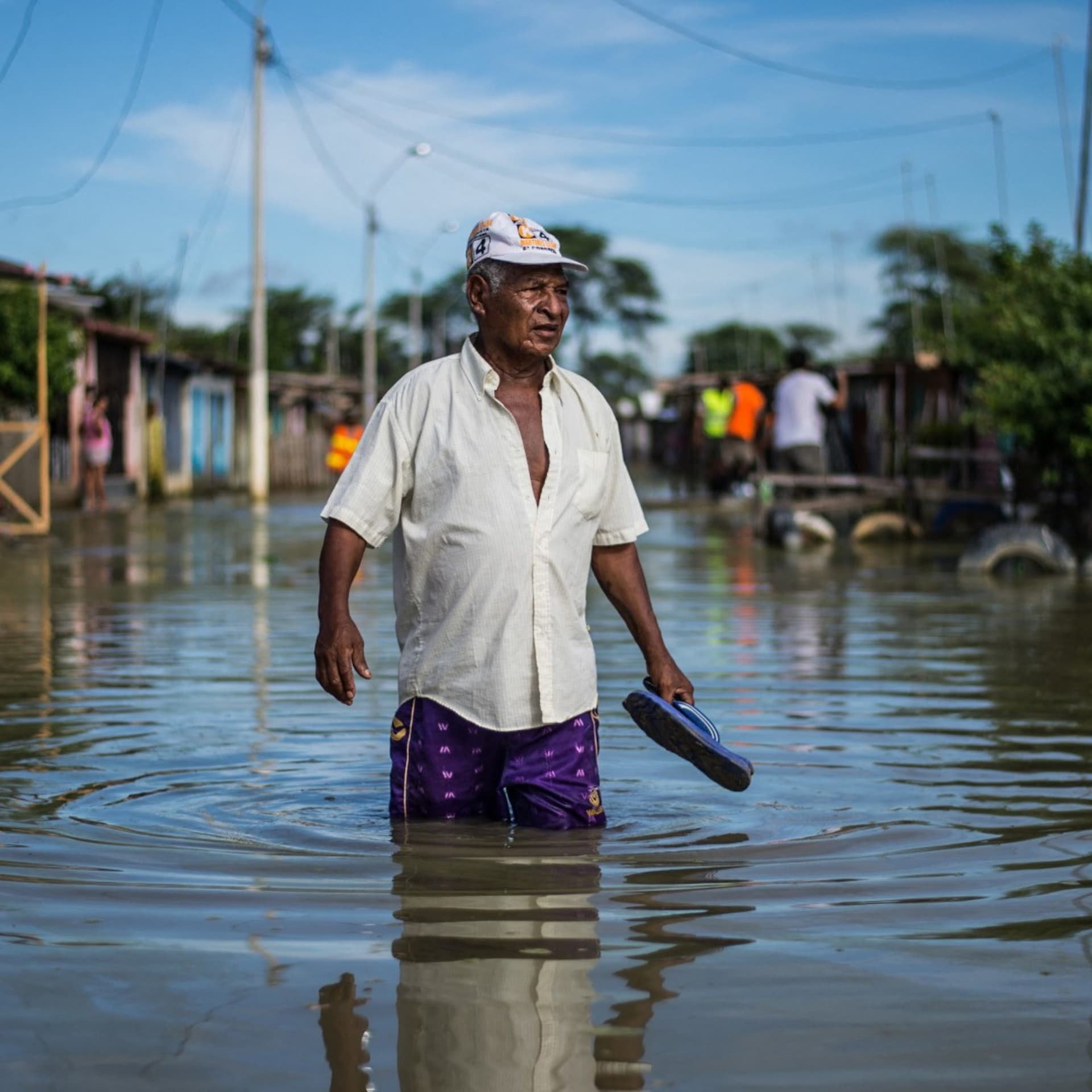
Photo: A man wades through water in northern Peru, in 2017, during that year’s El Niño. Credit: Ernesto Benavides/AFP.