
In short
The Supreme Court case over whether President Trump can impose sweeping import tariffs using a 1977 emergency law (IEEPA/AIPA). The episode traces how Trump’s tariff approach evolved, shows mixed business impacts, and explains what’s at stake legally and economically.
Guests and backgrounds
Asma Khalid (BBC host in Washington, covered White House/economic policy for NPR earlier); Tristan Redman (BBC co-host in Paris, covered Trump’s first term); Natalie Sherman (BBC online business writer in New York, covering tariffs since Trump’s first term); Drew Greenblatt (Baltimore wire-basket/steel products maker, fan of tariffs); Dan D. Diggory (CEO of MISCO Minneapolis Speaker Company, frustrated by tariff-driven supply-chain costs).
Key claims
Tariffs are central to Trump’s policy since the 1980s; April 2 “Liberation Day” expanded tariffs massively; small businesses and states argue tariffs exceed presidential authority under the emergency statute; Yale/Budget Lab estimates households pay far more than in Trump’s first-term China tariffs.
Notable examples
Oprah/ABC-era Trump comments criticizing Japan; Rose Garden April 2 remarks including 25% auto tariffs; Drew’s factory hiring/robot purchases; Dan’s shift to Indonesia/Vietnam/Taiwan parts now facing tariffs; price increases cited (coffee, bananas, tomatoes, toys, electronics).
Written by AI. May contain mistakes. Listen to the episode to check what was said.
Chapters
Tap a time to open that second in VOThe Supreme Court Case on Tariffs
0:26 to 1:54
Discussion on the significance of the Supreme Court case regarding Trump's tariffs.
“It's no exaggeration to say that President Trump loves tariffs.”
Trump's Longstanding Admiration for Tariffs
1:54 to 3:56
Exploring Trump's consistent belief in tariffs from the 1980s to today.
“There's a major Supreme Court case this week where President Trump's tariffs are on trial, essentially.”
Tariff Policy in Trump's First Administration
3:56 to 5:48
Overview of tariffs imposed during Trump's first term and their impact.
“So what did he actually do on this front in the first time he was in the White House?”
Widespread Tariffs in Trump's Second Term
5:48 to 8:02
Analysis of the expansion of tariff policies in Trump's second term.
“At one point, he singled out specific examples.”
Effects of Tariffs on American Businesses
8:02 to 11:00
Insights from businesses on the impact of tariffs on their operations.
“I think, in other words, they charge us, we charge them, we charge them less.”
Different Perspectives on Tariff Policies
11:00 to 14:00
Contrasting views from supporters and critics of the tariff policies.
“And I recall even at that time you were a fan, I believe, of the tariffs.”
Impact of Tariffs on Businesses
14:00 to 16:33
Learn about how recent tariffs have affected American businesses and their competitiveness.
“And prior to this past spring, did you face tariffs at all on things you were importing from Vietnam and Indonesia?”
Legal Challenges to Tariffs
17:21 to 19:29
Explore the legal arguments against the tariffs imposed by the Trump administration.
“And so I called her up to understand this case.”
Presidential Authority and Tariffs
19:29 to 21:47
Discuss the implications of presidential powers concerning tariff imposition.
“He used it first with Canada, Mexico and China, and then again in April on Liberation Day.”
Consequences of Supreme Court Ruling
21:47 to 24:28
Understand the potential outcomes if the Supreme Court rules for or against the Trump administration.
“I've spoken to several legal experts at this point, and I would say that the case opens up a lot of questions and that it's likely that the court will try to sort of narrow its ruling.”
Show all 11 chapters
Implications for Trump's Policies
24:28 to 26:54
Examine how the court's ruling might affect President Trump's economic policies and negotiations.
“There's been a lot of debate about how to use it.”
Transcript
Automatic transcript. May contain errors.0:00This BBC podcast is supported by ads outside the UK.
0:07150 years ago, they were hunting us down to kill us, and now they're hunting down immigrants to deport them. This is First America, the true story of how the United States came to be and how we got to this present moment. Listen to First America wherever you get your podcasts.
0:36Natalie Sherman:It's no exaggeration to say that President Trump loves tariffs. And since he's returned to the White House, he's imposed sweeping tariffs on imports from countries around the globe. But on Wednesday, here in Washington, the Supreme Court will hear a case that threatens that favorite foreign policy of his. I think it's one of the biggest decisions in the history of the Supreme Court. The big case in front of America's highest court is not just about trade and tariffs. It's ultimately a test of presidential power. From the BBC, I'm Asma Khalid in Washington, D.C., with Tristan Redman in Paris. And today on The Global Story, the fate of President Trump's tariffs hangs in the balance.
1:36Natalie Sherman:So, Tristan, you know that before I started hosting this show with you, I used to cover the White House for NPR. And a good chunk of my time over the last several years was spent covering economic policy and specifically trade and tariffs. And this week is a big week here in Washington, D.C. for trade and tariff news. So I hear. There's a major Supreme Court case this week where President Trump's tariffs are on trial, essentially. And we're going to get into that all later in this episode. But I think the thing that's worth understanding about this is that in a world in which Trump's partisan politics may have evolved over the years, his admiration for tariffs seemed to be one of the most consistent, long -held beliefs that he has had.
2:20Well, I mean, I do know that he has a long-held interest in tariffs that goes back to the 80s, doesn't he? It feels like. I feel like he used to be very concerned specifically about Japanese imports of cars into the United States. But I don't know fully where he got this philosophy that tariffs were the answer from.
2:39Natalie Sherman:I mean, he was a New York City real estate man. This was the late 1980s. And to your point, Tristan, he was fascinated with tariffs. In fact, he did this interview with Oprah, legendary talk show host, and he specifically critiqued Japan. We're a debtor nation. Something's going to happen over the next number of years with this country because you can't keep going on losing 200 billion. And yet we let Japan come in and dump everything right into our markets. And he said that, you know, it wasn't fair that Americans can't sell stuff in Japan because Japanese companies, he says, they come here to the United States and they sell their cars, their VCRs.
3:13Natalie Sherman:And in his words, they knock the hell out of our companies. It's not free trade. If you ever go to Japan right now and try to sell something, forget about it. Just forget about it. It's almost impossible. In 1989, he gives this interview to ABC News here. And in it, he says, I believe very strongly in tariffs. We're a debtor nation and we have to tax. We have to tariff. We have to protect this country. That was more than 30 years ago. And when you read those words, when you hear what he was saying, it sounds so akin to Donald Trump's economic message today. I know that you covered the first Trump administration, so you must have spent quite a bit of time on the trade question.
3:53He had this great love of tariffs then, but he didn't bring them in in the same way. So what did he actually do on this front in the first time he was in the White House?
4:01Natalie Sherman:So when he first won, it seems like he was targeting specific industries that he feels are really critical to American national security, things like steel and aluminum. And he put tariffs on those specific sectors. He also went on to put widespread tariffs on a majority of goods coming in from China, some$300 billion worth of Chinese imports. But that was on just the country of China. What we are seeing now is on a totally, totally different scale. If like last time in the first term, let's say it was the size of a pebble, the tariffs, what you are looking at now is like Mount Everest. It is multiples and multiples of what we saw during his first administration.
4:45Okay, so explain to me then how we got Trump tariffs unleashed in the second term then, please. The moment I would say that tariffs really became central to his second term was April 2nd. Liberation Day, is that right?
4:59Natalie Sherman:That is what it was dubbed here by the Trump administration. Trump gave remarks in the Rose Garden of the White House, And he spoke for about 50 minutes as he announced widespread tariffs on nearly every country around the world. Thank you. Nice crowd. What a good looking group of people. Well, we have some very, very good news today and a lot of good things are happening for our country. Please sit down. His argument was that other countries had been taking advantage of the United States economy. They had been subsidizing their industries and that it was time for the United States to fight back.
5:38April 2nd, 2025 will forever be remembered as the day American industry was reborn, the day America's destiny was reclaimed, and the day that we began to make America wealthy again.
5:55Natalie Sherman:At one point, he singled out specific examples. He talked about motorcycles and the auto industry. That's why effective at midnight, we will impose a 25 percent tariff on all foreign made automobiles.
6:13Natalie Sherman:And he went on to call up this guy, Brian, to the stage. Brian, I'd like to have you come up here for a second, OK? I just see him sitting. He's been a fan of ours. And he understands this business a lot better than the economists. economist. Brian was wearing a Trump hat and a yellow construction vest. He was from Macomb County, just north of Detroit, known for its manufacturing auto industry. I have watched my entire life. I have watched plant after plant after plant in Detroit and in the metro Detroit area close. And he singled out the fact that Trump was going to revive, in his view, the automobile sector.
6:52And in six months or a year, we're going to begin to see the benefits. I can't wait to see what's happening three or four years down the road.
6:59Natalie Sherman:He calls on the Commerce Secretary, Howard Lutnick, to bring up a chart. I'd like to see the chart. If you have it, could you bring it up, Howard? And so you see the Commerce Secretary walk up on stage with this giant poster board that reads reciprocal tariffs. And interesting, it looks like this giant color-coded spreadsheet in one column. You see countries listed, China, Vietnam, etc. And in the other column, you saw the perceived tariff rate, right, which also included, in their view, some, say, non-tariff things that were hurting the U.S. economy. So if you look at that, China, first row, China, 67 percent, that's tariffs charged to the USA, including currency manipulation and trade barriers.
7:45So 67 percent, I think you can, for the most part, see it. Those with good eyes.
7:49Natalie Sherman:And in the final column, you saw a list of what they said they were going to charge these countries in retaliation. So it's 67 percent. So we're going to be charging a discounted reciprocal tariff of 34 percent. I think, in other words, they charge us, we charge them, we charge them less. So how can anybody be upset? The president gave a nod to American history and said that for decades and decades, the U.S. was a tariff-backed system and that it was so wealthy at some points that it didn't know what to do with all that money. Then in 1913, for reasons unknown to mankind, they established the income tax so that citizens rather than foreign countries would start paying the money necessary to run our government.
8:34Natalie Sherman:So he's very nostalgic for this era of widespread tariffs across the board. Okay, so there was a sort of economic orthodoxy that Trump was facing that suggested that tariffs would be a bad idea. Trump imposed his tariffs, what, like six months ago now, more than that. So we've had a bit of time to actually see how they've ended up working. What are you seeing there in the U.S.? Well, look, a lot of American consumers have been really anxious about what tariffs might mean in terms of the price of goods. But I would say the key groups that I really, really wanted to hear from were small businesses, because arguably they've had to change up their operations.
9:17Natalie Sherman:The BBC has spoken to a number of businesses who feel a lot of economic angst and have had real financial struggles navigating this new terrain. But to start with, I really wanted to hear from someone who I've known over the years who is a big fan of Trump's tariff policies. His name is Drew Greenblatt. His company makes wire baskets and other steel products at a couple of different facilities. So I went up to go visit him in Baltimore the other day.
9:53Let's take a walk through.
9:55Natalie Sherman:Okay. Did I bring the glasses? Yes, they're on my head. I was like, did I get the safety glasses? Welcome to Marlin. We're so glad you're here. It's a factory that makes everything, and it starts off with a coil of wire that weighs more than a car. We take this wire and we bend it, and then we make it into baskets or racks, and then we ship it to our clients in 45 countries. We use stainless steel and plain steel. Our biggest industries are medical devices, aerospace, food processing. When you eat a potato chip, the potato chips are made on this basket. And right now you could hear the 120-ton press brake coming down, bending the basket.
10:46We make the baskets for the biggest olive companies in the world, the biggest potato chip companies in the world.
10:53Natalie Sherman:So, Drew, we first met a couple years ago. I was working on this story about what it means to make things in America. And I wanted to come back to you because I know that you are very proud of making things here in the U.S. And I recall even at that time you were a fan, I believe, of the tariffs. So how are you feeling about tariffs? We are thrilled with the tariff policy. This tariff policy is going to grow American jobs. It's going to make our nation more resilient and thrive. In our company, we have been hiring people. Our sales have gone up. We've been buying robots and technology, and we've been hiring talent.
11:28And you attribute that to the tariffs. The tariff policy is very helpful because it enables our factory workers to have a shot, to be competitive against China, to be competitive against Mexico, to be competitive against Europe. Let me put it to you this way. The Baltimore Ravens is our football team. And when we go on the field, it's only fair that on the beginning of the game, it's zero to zero. For decades, whenever the equivalent of our American factory workers went on the field, it was 21 to zero at the kickoff because the tariff policy was so unfair in the past. Finally, we have a situation where we can go on the playing field where it's level.
12:06I live in a very challenged neighborhood here in Baltimore. We got to give these people a path to prosperity. We got to give these people a lane to get into the middle class, to get off food stamps, to buy a car. How do you do that? You got to have$80 ,000 a year jobs without a high school education. How do you do that? You got to make it so that it makes more sense to hire a person from Sandtown than hire a person from Shanghai. That's the key. Well, Drew seems like a big fan. But one of the criticisms of the tariffs has been that it's something of a one-size-fits-all policy and that what works for one industry might not work for another.
12:48So who else have you been speaking to who has a different view on this?
12:53Natalie Sherman:Yeah, I mean, to that point, Tristan, I also spoke to this guy, Dan D. Gray. I first met him also a couple of years ago. And he makes speakers here in the United States, in Minnesota. and he's had real frustrations with the tariff policy and the unpredictability of it all. I'm Dan Diggory, and I'm CEO of MISCO, Minneapolis Speaker Company. We make speakers for commercial aircraft, gaming devices in casinos. We make speakers for the military. And by the way, we recently helped the U.S. House of Representatives change the speakers that sit at each member's desk. So we hope that also improves overall communication.
13:36It's been challenging. You know, when the tariffs were put on during the first Trump administration, the message to all of us was, if you have your supply chain running through China, you should be diversifying it. So that's what we did. So we moved to Indonesia, we moved to Vietnam, We've set up some parts suppliers in Taiwan, things like that. So now with the broader tariffs, of course, now there's tariffs on all those countries, too.
14:06Natalie Sherman:And prior to this past spring, did you face tariffs at all on things you were importing from Vietnam and Indonesia? Or were they at a zero percent tariff rate? Yeah, we weren't paying any tariffs. And that, of course, was the incentive, right? high tariff rate on goods coming from China, no tariff rate from some of these other countries. So now we're paying tariff from almost everywhere. And so these are products made in the USA, but you say you need the parts from Asia, that you cannot buy these parts, you say, from the United States. They are not made here. That's correct. They were 20 years ago.
14:44But over time, as more companies relocated their manufacturing, then the supply chain goes with them. And so a lot of the supply chain either moved over to Asia or went out of business because there was no industry here to support them. Now, the challenge for us, of course, is our competitors in other countries don't have the same tariff situation.
15:08Natalie Sherman:Dan, how much more would you say you've paid since April in tariffs? Oh, I don't know. Hundreds of thousands of dollars. Does it feel punitive right now? Well, it is to the extent that you're paying a higher tax, right, than your global competitors are paying. And that results in American business being less competitive. So I think that's not a good situation for American businesses. That's not a good situation for American workers. I've had a factory in America for 75 years, right? You don't have to preach to me about the value of American manufacturing. I want to do it, but I'm going to need some different conditions for it to continue to be successful.
15:56Dan sounds a lot less happy about the whole thing than Drew, who we heard from earlier is. I mean, I guess if you have a complex supply chain like Dan does, maybe the one size fits all criticisms of tariffs apply more in his case. So, I mean, his frustration is maybe understandable.
16:18Natalie Sherman:And Tristan, a number of small businesses have been frustrated with the economic impacts of these tariffs. And in fact, some of them are so frustrated that they are at the center of the Supreme Court case here in Washington this week. They are challenging whether it's actually legal for Trump to impose these sweeping tariffs.
16:50150 years ago, they were hunting us down to kill us, and now they're hunting down immigrants to deport them. This is First America, the true story of how the United States came to be and how we got to this present moment. Listen to First America wherever you get your podcasts.
17:20Natalie Sherman:Our colleague, Natalie Sherman, she has been covering this case, and she is in fact going to be inside the Supreme Court for this major case on Wednesday. And so I called her up to understand this case. Hi, I'm Natalie Sherman. I am an online business writer for the BBC. I'm based in New York and have been covering tariffs since the president's first term. How much are Americans feeling the effects of these tariffs in their everyday lives when they go shopping? I mean, if you look at, as the government does every month, how prices are changing at the grocery store or in the toy store or on Amazon, you can see prices for some items go up.
18:01So we've seen coffee prices go up. We've seen banana prices go up. We've seen tomato prices go up. Toy prices go up. Electronics. So businesses have been raising prices a little bit so far and will raise prices moving forward. What we know from Trump's first term, when we saw a much more limited, smaller tariff go into place on goods from China, is that within a year, it had increased annual costs for the typical American household by about$400.
18:33Natalie Sherman:So you're saying that the average American household paid about$400 extra per year as a result of tariffs put in place on China during President Trump's first term. And to be really clear, those were a tiny, minuscule amount of tariffs compared to the huge enormity of tariffs we're looking at this time. That's right. This time, the estimates are much larger. The Budget Lab at Yale, which has looked at these tariffs extensively, thinks that you're essentially paying$1 ,800 more because of the tariffs than you would have otherwise. So, Natalie, we have spent a bulk of this episode talking about the economic impact of these tariffs.
19:11Natalie Sherman:But the big question in front of the Supreme Court this week is not one about economics. It's a legal question. It's about whether or not these tariffs are legal. What's at stake here? So this case does not challenge every single tariff that the Trump administration has announced. It's specifically aimed at tariffs that the president has imposed using a 1977 emergency law called AIIPA. He used it first with Canada, Mexico and China, and then again in April on Liberation Day. And what that law does is it authorizes the president to respond to an unusual and extraordinary threat by investigating, regulating imports.
19:54And AIP has been used by many presidents in the past for sanctions on countries like Iran, but it really hasn't been used for tariffs before.
Read the full transcript
20:04Natalie Sherman:Is AIP often used for national security concerns? Yes, national security is often the sort of motivating, it's a foreign policy threat. But there's no indication that this has been used for tariffs. It's certainly not at the scope that we're seeing now from President Trump. No. So can you help us understand what the specific case is that's in front of the court this week? So we have a group of small businesses and some states who have brought this case. There's five small businesses that kind of filed suit together. And they have argued that IEPA does not authorize the president to impose tariffs.
20:38The word does not show up anywhere in the law. And tariffs and taxes are responsibilities of Congress. and that there are limits to what extent Congress can hand over that authority to the president. And then a bunch of states. Got it.
20:54Natalie Sherman:And so the central argument that they have is that the president does not have the legal authority to enact these tariffs and that tariff policy is under the purview of Congress in their view. That's right. The real question at hand is, does AIIPA authorize the president to impose tariffs or does that authority rest somewhere else? And how would you characterize the Trump administration's argument here? They say that the law authorizes the president to regulate foreign goods to respond to an unusual, extraordinary threat. And in this case, he's identified threat as being the trade deficit, as being countries not doing enough to help stem the flow of illegal drugs into the U.S.
21:37And they say that this is really a foreign policy and national security case and that those issues have historically been the president's purview to decide. I've spoken to several legal experts at this point, and I would say that the case opens up a lot of questions and that it's likely that the court will try to sort of narrow its ruling. How it will do that, we don't know. So it could it could strike down the tariffs. It could say the tariffs are OK. It could hand the suit back to lower courts and say, actually, you need to think about it this way and then we'll maybe take it up again. What I've heard, what people are sort of speculating is that you could decide very narrowly, IEPA does not authorize these tariffs, but then avoid some of the other questions like, is a trade deficit a national emergency that would sort of more directly challenge the president?
22:32Natalie Sherman:Well, what's the timeline for the Supreme Court to make a decision? They are hearing the case this week. How long before there might be a verdict? In theory, they can take until the end of June. But they agreed to hear this case on an expedited basis. And so a lot of folks are hoping a decision will come in the next few months, sort of by December, January. So there's a lot here at stake, Natalie. and maybe we can break this down into what it would mean if President Trump and his administration wins and what it would mean if they lose. I think if the Trump administration were to win this case, it would really empower him to continue using tariffs the way he has done so far.
23:14It's been his all-purpose tool for any number of issues, whether it's trade negotiations or other kinds of negotiations or revenue raising. And it will really empower him to move forward. And businesses will be paying a lot of tariffs going forward. I think we can expect that. And I think we can expect to see more of the fast changes in policy that have created so much uncertainty this year.
23:39Natalie Sherman:And what do you foresee if the Trump administration loses? If the Trump administration loses, the Trump administration will probably have to to refund the tariffs. That's a lot of money. That's just through September. Businesses have paid about$90 billion worth of AIPA tariffs. And if we look through June, that would be$1 trillion. $1 trillion, Natalie, has been paid to the U.S. government as a result of these tariffs. $1 trillion if the tariffs were to stand until June. $90 billion through September. And that$1 trillion that or certainly tens of billions of dollars that are being collected from tariffs, that goes back to the Treasury, to the General Fund.
24:28There's been a lot of debate about how to use it. The Trump administration has floated using it for various items like help for farmers, for example, who have been impacted by the trade war. But again, those kinds of decisions have usually been the responsibility of Congress. And so that's a huge amount of money at stake. And the Supreme Court probably will not decide how that money gets refunded. But if the tariffs are illegal, you can expect a lot of businesses and certainly a lot of trade lawyers to be filing cases trying to get some of that money back. if the Trump administration decides to fight those cases as it would be expected to, that can be a very long, drawn-out process.
25:13So I think there would be more legal battles over the tariffs, and probably the Trump administration would be turning to other tools, other tariff laws, as it looks to enact its policies.
25:29All right. Well, I mean, that's fascinating, because there I was thinking that this was a court case about tariffs. But what Natalie is saying is that it's actually a Supreme Court case about the limits of executive power. And it strikes me that if Trump doesn't win, then he's really hamstrung in two ways because on the one hand, he's had his wings clipped in terms of executive power. Then on the other, he loses the ability to use tariffs as a carrot or a stick for his opponents on the world stage. Does that sound about right?
26:06Natalie Sherman:Yeah, I mean, Tristan, this is the president's signature economic tool. And if his ability to unilaterally impose these tariffs is struck down by the courts, you can make the argument that that signature policy could go up in flames. It is why you've seen the president himself refer to this case as one of the most important in the history of the country. If he loses the ability to carry out his tariff agenda on his own, it will be a major setback for him. Here on the domestic front, right? Because it was a major promise to his supporters during the campaign. And it could weaken his ability to negotiate with countries around the world.
26:54Natalie Sherman:That's it for today's show. If you enjoyed today's episode, please take a moment to rate us wherever you listen to the show. It really helps other people find us. This episode was made by Valerio Esposito, Hannah Moore, and James Shield. It was engineered by Travis Evans. And our senior news editor is Chyna Collins. Thank you all so much for listening to The Global Story, and we'll talk to you again tomorrow.
27:31150 years ago, they were hunting us down to kill us, and now they're hunting down immigrants to deport them. This is First America, the true story of how the United States came to be and how we got to this present moment. Listen to First America wherever you get your podcasts.
27:58to let go.
From the publisher
The Trump administration faces a Supreme Court challenge on Wednesday over its use of tariffs, an economic policy that has upended global trade.
This case, which has been described by the President in epic terms, questions the legality of Trump’s signature economic policy - and poses one of the biggest existential threats to his second term so far.
In today’s episode, we speak to small business owners across the US, and to BBC business reporter Natalie Sherman, who will be at the Supreme Court this week.
Producers: Hannah Moore and Valerio Esposito
Executive producer: James Shield
Mix: Travis Evans
Senior news editor: China Collins
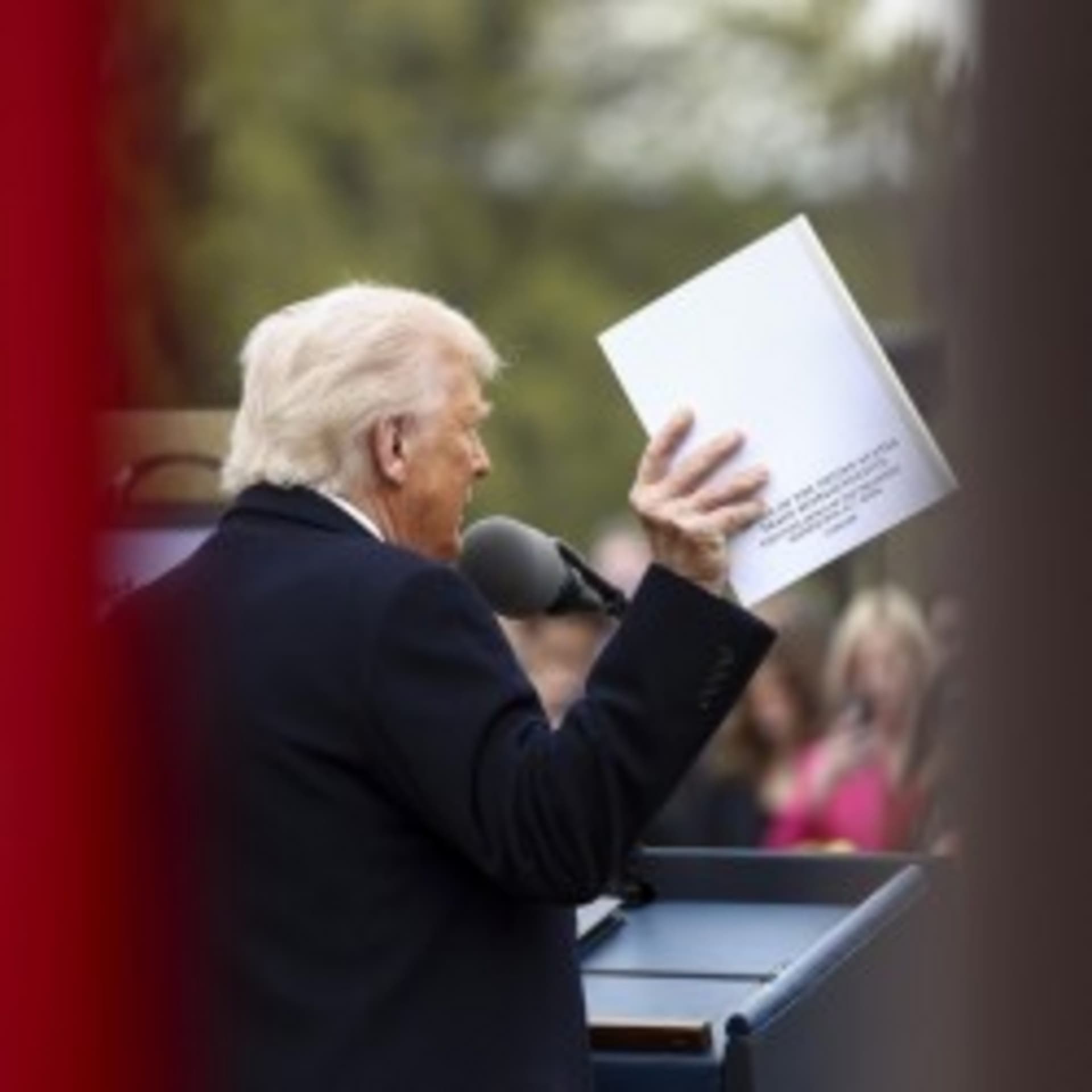
Image: US President Trump unveils new tariffs on so-called Liberation Day. Jim Lo Scalzo/EPA-EFE/REX/Shutterstock