In short
The BBC Global Story episode examines a proposed US-Saudi nuclear deal that could allow Saudi Arabia to enrich uranium for civil power, and asks whether it could destabilize the Middle East—especially alongside ongoing, stalled US negotiations over Iran’s nuclear program.
Guest backgrounds
Frank Gardner, BBC security correspondent since 2002, covering global security from the Arctic to Ukraine, Iran, and the Gulf.
Key claims
The US treats Saudi Arabia as an ally and Iran as an enemy, so their nuclear policies differ. The Saudi deal was announced via the US Department of Energy and is politically entangled with Trump’s demand that Saudi join the Abraham Accords and recognize Israel. Enrichment is the most controversial risk because a future Saudi regime could over-enrich; Saudi could also buy a bomb “off the shelf” from Pakistan. Iran would likely accelerate its own program in response.
Notable examples
Iran’s enrichment to ~60% (and possible 90%); Israel-Gaza war effects on Saudi willingness to recognize Israel; the 2015 JCPOA (Vienna deal) taking 20 months; Strait of Hormuz negotiations; Iran’s underground enrichment fears (e.g., “Pickaxe Mountain”); worst-case regional arms race involving Saudi, Egypt, Turkey, Qatar, and Pakistan/India.
Written by AI. May contain mistakes. Listen to the episode to check what was said.
Chapters
Tap a time to open that second in VOThe Context of Nuclear Deals
1:23 to 2:59
Understanding the historical context of U.S. nuclear deals in the Middle East.
“Once upon a time, there was a country in the Middle East with a pretty good relationship with the United States.”
Contradictions in U.S. Policy
3:39 to 6:00
Exploring the conflicting nuclear policies towards Iran and Saudi Arabia.
“or appears to be negotiating separate deals in the Middle East, which seem to be running in opposite directions from each other.”
Financial and Strategic Motivations
6:01 to 8:30
Examining the financial and strategic reasons behind the U.S. nuclear deal with Saudi Arabia.
“What if the Islamists take over and suddenly you've got people who are possibly closer to Al-Qaeda and ISIS way of thinking in charge of a country that could theoretically produce its own nuclear weapons?”
The Recognition of Israel
8:31 to 11:28
Discussing the implications of Saudi Arabia recognizing Israel for the nuclear deal.
“This was getting Bahrain, UAE, Morocco, and Sudan to all sign up to recognize Israel, to basically stop their hostility to Israel.”
Current Status of the Deal
11:29 to 12:42
Assessing the current status and challenges of the U.S.-Saudi nuclear deal.
“one, not just a sort of bit of lip service to get the deal over the line and then just punt it into the long grass.”
Comparing Nuclear Programs
12:43 to 14:00
Analyzing the differences and risks between Saudi and Iranian nuclear programs.
“is the fact that it has a provision for domestically enriched uranium.”
Risks of the Saudi Nuclear Deal
14:00 to 17:41
Explore the potential risks and implications of Saudi Arabia's nuclear program.
“Well, what's so interesting, Frank, if you look at the Saudi proposed nuclear program and the Iranian one side by side, the Americans actually gave Iran their first test nuclear reactor back in 1967.”
Regional Reactions and Concerns
17:41 to 22:11
Discuss how other Middle Eastern countries might respond to Saudi Arabia's nuclear ambitions.
“If there were an arms race in the Middle East, a nuclear arms race, What could that actually look like?”
US and Iran Negotiations Context
22:11 to 27:00
Analyze the complexities of US negotiations with Saudi Arabia and Iran.
“That said, how likely do you think it is that we might actually see this deal come to pass between the United States and Saudi Arabia on uranium enrichment?”
Show Closing and Credits
27:00 to 27:53
Wrap-up of the episode and acknowledgment of contributors.
“Great to talk all that through with you.”
Transcript
Automatic transcript. May contain errors.0:00This BBC podcast is supported by ads outside the UK. This advertisement feature is paid and presented by GoTurkiye. Istanbul takes food seriously. Very seriously. And Meyhaner restaurants are where it all comes to life. These traditional establishments are all about community. Shared plates, loud conversations, and ruckus served as part of the ritual. But take a small detour and the food starts doing something different. As innovators in the kitchen, like Chef Deniz, continue to rewrite the menu. In Istanbul, new young chefs like me develop the Turkish cuisine, but we don't replace tradition. We give it new life.
0:47Because in Istanbul, food never stands still. Old flavors, new ideas. It evolves. Slowly, confidently, one plate at a time. Plan your next detour at goturkiye.com today. If you are currently overpaying on software to run your business, remember this number, 10 ,000. That's the number of new businesses that join Odoo per month. Join Odoo today at odoo.com. That's O-D-O-O dot com. Once upon a time, there was a country in the Middle East with a pretty good relationship with the United States. It wanted to develop nuclear power, and the US president encouraged it, thought it could help build peace between nations.
1:38Against the dark background of the atomic bomb, the United States does not wish merely to present strength, but also the desire and the hope for peace. He called it Atoms for Peace. To devote its entire heart and mind to find the way by which the miraculous inventiveness of man shall not be dedicated to his death, but consecrated to his life. So the U.S. gave that country its first test nuclear reactor and trained its scientists. Washington was clear-eyed about the risks. It saw that the foreign dictatorship could collapse and that, quote, an aggressive successor might be more ambitious about this nuclear program.
2:26But the thing is, that country was Iran. And the prediction came true. Could history repeat itself? It might do. The United States has signed a nuclear deal with Saudi Arabia and is considering letting the kingdom enrich uranium for energy purposes. From the BBC, I'm Tristan Redmond in Paris. And today on The Global Story, the US nuclear deal with Saudi Arabia. Could it all go wrong?
3:08Frank, could you introduce yourself, please, for the few listeners out there who don't already know you? I'm sure there are plenty. I'm Frank Gardner, BBC security correspondent, which I've been doing since 2002. So I cover global security from the Arctic to Ukraine to Iran to the Gulf, everywhere. Well, we're delighted to have you with us, Frank. I certainly am because I am somewhat confused and many of our listeners may also be confused as to why the United States is negotiating separate deals right now or appears to be negotiating separate deals in the Middle East, which seem to be running in opposite directions from each other.
3:51So on the one hand, you have the case of Iran, where the United States is looking to negotiate a deal that would limit Iran's nuclear program. And on the other hand, you have Saudi Arabia, where the United States appears to be thinking about a deal that might actually promote Saudi Arabia's nuclear program. We're going to unpick this apparent contradiction with you today, Frank. What is the Saudi deal, and why might it be happening now? So first of all, I think the context to view this in is that as far as the United States is concerned, Saudi Arabia is a close ally. Iran is an avowed enemy. So it's not inconceivable that they would have two different nuclear policies for them.
4:35The deal was announced through the US Department of Energy, and this caused consternation. For many people, it came out of nowhere, even though discussions have been going on for many, many years. That was then followed by a post by President Trump on his Truth Social platform saying there will be no enrichment and nothing's going to happen in this deal until and unless Saudi Arabia joins the Abraham Accords and recognizes the state of Israel, which the Saudis are not going to do. And the most startling point about the announcement was that it was going to include a two-year study period for enrichment of uranium on Saudi soil under US guidance, but nevertheless domestic enrichment.
5:20Now, that's a really hot topic and very controversial because at the heart of the whole dispute over Iran, and one of the reasons why they went to war back in February, is that Iran has been highly enriching its uranium to a purity well beyond the point you need for civil nuclear power and very close to the point you need for nuclear weapons. They've enriched 441 kilos at least to 60 % purity, and it's a short hop from there to 90%. Now, for Saudi Arabia, of course, that rings alarm bells in places like Israel, but also in Congress. Is this really sensible? What if there's a change of regime in Saudi Arabia?
6:03What if the Islamists take over and suddenly you've got people who are possibly closer to Al-Qaeda and ISIS way of thinking in charge of a country that could theoretically produce its own nuclear weapons? I don't go along with that because it takes a huge amount of work to make this highly enriched uranium. There are much easier ways that Saudi Arabia could get a nuclear bomb, should it choose to, it could effectively, in theory, buy it off the shelf from Pakistan. What's the history of this possible proposed deal, Frank? So it goes right back to 2008. This talking has been going on for a long time.
6:45The Saudis have, they've blamed slightly hot and cold on America because they didn't like the Biden administration. Biden didn't like the Saudis. Before he became president, he said, we're going to make Saudi Arabia the pariah that it is. and MBS, who is the de facto ruler of Saudi Arabia, that's Crown Prince Mohammed bin Salman, he never forgave Biden for that. So despite all of that, these conversations have been going on, been taking place. There are essentially two reasons why the US is looking to do this nuclear deal with Saudi. When I say nuclear deal, it's not about nuclear weapons. It's about civil, peaceful nuclear power.
7:25And I don't think the Saudis have any intention of turning any domestic nuclear energy program into military purposes, not right now, at least. The two reasons are money. The Trump administration is very much about deals and about money. And Donald Trump thinks this will be good for US industry. And the other is strategically to keep Saudi Arabia within the orbit of US influence. Because if America won't do this, the Saudis are quite capable of going to the South Koreans, to the French, to the Russians, or the Chinese. And the State Department and the White House don't want that. There is a possible third reason.
8:11The stumbling block to this deal has always been Donald Trump's insistence that Saudi Arabia establishes full diplomatic relations with Israel and join something called the Abraham Accords, which were in his first term as president, the sort of crowning glory of his foreign policy in 2020. This was getting Bahrain, UAE, Morocco, and Sudan to all sign up to recognize Israel, to basically stop their hostility to Israel. And Donald Trump wants Saudi Arabia to join that. The Saudis have made it very clear they can't do that until there is an irrevocable and clear path to Palestinian statehood. And there is anything but that.
8:55There is quite the opposite to that as more and more settlers take over the West Bank. Well, Frank, you've explained to us in the past how controversial it might be within Saudi Arabia if Mohammed bin Salman were to recognize Israel. It might be difficult for many people in Saudi Arabia to accept. Since Saudi Arabia doesn't currently recognize Israel, how do they actually view the land on which Israel sits and the Israeli government? So just prior to the October the 7th Hamas-led raid from Gaza into Israel, the Saudis were making preparations to possibly be in a position to recognize Israel. There were even unconfirmed reports that Netanyahu had visited Saudi Arabia.
9:44I'd never seen any evidence of it, but it was certainly reported. And they have a joint common enemy, Iran. Iran has been firing missiles this year at both Israel and Saudi Arabia. And of course, my enemy's enemy is my friend. But the Saudis have cooled on this a lot, mainly because of the appalling death toll in Gaza, the Israeli reaction to the atrocities of October the 7th, the flattening of most of Gaza, the mass killing of Palestinians, the displacement, the hunger, etc. That plays very badly with a domestic audience. It wouldn't just be difficult, it would be dangerous for Crown Prince Mohammed bin Salman or any Saudi ruler to recognize Israel at the moment, because Saudi Arabia, unlike the other states has got a very large, and it used to be, and it still is in some places, quite radicalized, very devout Muslim population.
10:43And they see the Palestinians as brothers and sisters. They simply wouldn't accept that. It would put MBS at risk of assassination, to put it bluntly. So if there was a suggestion that a nuclear deal with the United States would be wrapped up, go hand in hand with a necessity to recognize Israel and be part of Abraham, of course. Where are we now with that? Is that a deal breaker for Saudi Arabia or are talks still ongoing? I'm sure talks are still ongoing, but it's also a deal breaker. Unless the Saudis do a complete U-turn and every conversation I've ever had with them, from foreign ministers to advisors to ambassadors, they have made that crystal clear that there's got to be a clear path to a Palestinian, independent Palestinian state, an irrevocable one, not just a sort of bit of lip service to get the deal over the line and then just punt it into the long grass.
11:41They want to see that happen. And Israel's Prime Minister, Benjamin Netanyahu, of course, faces elections in October, is absolutely opposed to that on the basis that he says, look, we gave them back Gaza and they used it as a springboard to attack us. If we give them the West Bank, they will use it as a springboard to attack us. Okay, so is it sort of in a holding pattern right now, Frank, to be absolutely clear? I think the US needs to get its house in order because the right hand is not necessarily seeing what the left is saying. So the messages coming out of the US Department of Energy is this is all going ahead.
12:20You know, this was amazing. This was huge news a week ago. and then it seems to have cooled because of the posts being put out by Donald Trump on his Truth Social saying there'll be no enrichment and there'll be no deal unless Saudi Arabia joins the Abraham Accords, which it's not going to do in present circumstances. Well, as you've said, Frank, what's unusual about this potential deal is the fact that it has a provision for domestically enriched uranium. But just so that we all understand, imagine, say, I were a hypothetical country and I have a peaceful nuclear program. I have no nuclear weapon of my own.
13:04Where would I normally be getting my uranium for my energy program if I'm not enriching it myself? Well, there's a number of countries that produce it, but the actual refining of it is something that is very closely watched and guided by the UN's nuclear watchdog, the IAEA, the International Atomic Energy Agency. And just as a reminder that while this war is raging in the Gulf, okay, it might be a brief pause, but it's still raging. The IAEA has not been able to get their inspectors down into those tunnels since June last year, since Operation Midnight Hammer. And I interviewed Rafael Grossi, who's the head of that organization.
13:46And he said, we are ready and waiting and willing to go down there in the tunnels perfectly safely to go and get that, to assess it and get that highly enriched uranium out. The fear now is that, I'm sure you've heard about this place, Pickaxe Mountain, that is a granite mountain where, according to a lot of reports now appearing in the media, Iran has got a very sophisticated complex of tunnels deep below ground, and it's perfectly possible that the Iranians are spinning their centrifuges and enriching more uranium down there. We don't know. Well, what's so interesting, Frank, if you look at the Saudi proposed nuclear program and the Iranian one side by side, the Americans actually gave Iran their first test nuclear reactor back in 1967.
14:41This was pre-Iranian revolution when Iran was ruled by the Shah, who was close to the United States. As you said, we don't know who's going to be running Saudi Arabia, you know, in 30, 40, 50 years from now. Is it risky to consider striking a nuclear deal for enrichment like this with Saudi Arabia? Um, potentially, yes. I mean, I think it's perfectly possible that in 30 or 40 years time, Saudi Arabia will still be ruled by Prince Mohammed bin Salman, or King Mohammed bin Salman, as he will become when his father dies. MBS is only about 40. So, you know, he's, he's unusually young for a Saudi ruler.
15:25And he's fascinated, almost obsessed with longevity and looking into ways to trying to live to 150. So I think it's perfectly possible he'll still be on the throne long after you and I have hung up our microphones.
15:41But is it risky? Yes, it is. And it's the enrichment side of this deal that is the most controversial. The idea of having US civil nuclear contractors in there helping Saudi Arabia develop its civil peaceful program isn't such a big, it's not such a big thing. Plenty of countries have got, you know, civil nuclear programs, but it's the enrichment of it because take your eye off the ball and a rogue country can start over-enriching as Iran has done. Now, you could argue that Iran has enriched all this uranium simply as a bargaining chip to get sanctions lifted. Others would say this is the hardliners positioning themselves for when they want to race for a bomb, which some are even suggesting could be going on underground right now.
16:33Well, setting aside Iran for a second, Frank, because we'll come back to them. If you look around the Middle East, are there other countries that are looking at this potential deal between Saudi and the United States and thinking that's a better deal than we have? And I'm thinking particularly, for example, of the United Arab Emirates, who've also had a relationship with the United States on nuclear energy. Yeah, so the 2009 UAE deal does not include enrichment. Other nations in the region that have got civil nuclear programs are Egypt, UAE you mentioned, and Turkey. And of course, Israel has got undeclared nuclear weapons.
17:14And I think both Turkey and Egypt will be looking with some concern at this. One of the fears of all of this is that it triggers, not by any actions of the Saudis, but the mere idea of Saudi Arabia having its own domestic indigenous enrichment program, potentially triggers an arms race, because the UAE and Saudi are not friends anymore. I hate to ask you a worst case scenario, Frank, but unfortunately, this is sometimes our job. If there were an arms race in the Middle East, a nuclear arms race, What could that actually look like? How many nuclear-armed states could emerge from it? Well, an unlimited number, to be honest.
17:56Worst case scenario, you have Saudi Arabia, Egypt, Turkey, possibly Qatar, all wanting nuclear weapons.
18:09And remember that not very far away, you've got Pakistan and India. Pakistan and Saudi Arabia have a very close relationship and if they decided that Iran was on the fast track to get a nuclear weapon they would definitely want to have one of their own as a deterrent not to use it but under the principle of MAD, of mutually assured destruction which has been in place since the 1940s whereby NATO has nuclear weapons and Russia has nuclear weapons and it would be so horrific if we all went to nuclear war that it doesn't happen, God forbid. So that would be an extremely worrying situation in the Middle East because, you know, there's so many wars erupt there.
18:55There is so much volatility.
19:08Right at the beginning of this conversation, I told you that I was somewhat confused as to how the United States could be negotiating one thing with Saudi Arabia and another thing with Iran. And I totally get what you're saying, that Saudi Arabia is the United States ally and Iran is not. It's their adversaries. Nonetheless, the timing of a potential Saudi Arabia deal is interesting to me here because it's being announced at precisely the same moment that this negotiation with Iran is at an incredibly sensitive moment. It's a high stakes question for Donald Trump. He wants to come out of this with a deal with Iran so he can put an end to the conflict, which polls suggest is increasingly unpopular in the United States.
19:54why would you risk announcing something like this potential Saudi deal at the same moment as you're negotiating with Iran? Doesn't one put the other in jeopardy? I don't know what the thinking was in the White House or the Department of Energy but it could be that this was to put added pressure on Iran to come to some kind of a deal. I mean let's be clear the nuclear negotiations with Iran that were supposed to be taking place during this 60-day period since the ceasefire that isn't a ceasefire anymore, they're going nowhere. The whole issue has been sidetracked by the Strait of Hormuz, a problem which didn't exist before Israel and the United States went to war with Iran on February the 28th.
20:43Traffic was flowing perfectly freely through the Strait of Hormuz in both directions. But all the effort now is in trying to reach a deal on that vital waterway that stops Iran having control of it. But Iran is feeling emboldened every day that it survives US airstrikes. It feels stronger and less inclined to make any concessions. So all of that has pushed into the long grass any kind of a long-term deal over Iran's nuclear program. And I think the Americans have been extraordinarily over-optimistic and to some extent naive when it comes to thinking how easily a nuclear deal can be struck with Iran.
21:26It took 20 months to negotiate a really hard negotiation with top expert negotiators to do the JCPOA, the Joint Comprehensive Plan of Action, otherwise known as the Vienna deal in 2015. And Donald Trump tore that up, or at least he withdrew the US from it and essentially torpedoed it. Why? Because it didn't include the two things that Israel was really concerned about, and that was Iran's ballistic missile program and its support for proxy militias around the region. Nobody's talking about those at all at the moment. Not only are they not talking about those, they're not even talking about a nuclear deal.
22:06It's all about the Strait of Hormuz. So in trying to deal with one problem, Trump and his administration have initiated another, which is totally preoccupying them. That said, how likely do you think it is that we might actually see this deal come to pass between the United States and Saudi Arabia on uranium enrichment? I think it's very unlikely that we're going to see an enrichment deal. I think it's still possible that the deal could go through without enriching on Saudi soil. It could make a lot of US companies very rich. Donald Trump likes that idea. And it keeps Saudi in the US sphere of influence.
22:51For Saudi Arabia, it provides an alternative source of energy to oil, which they know will eventually run out. But for now, the sticking point, unless it changes, is Donald Trump's insistence that Saudi Arabia join the Abraham Accords, which the Saudis can't afford to do that. That would be an invitation to a coup or, at the very least, some pretty angry reaction from the population. If you're sitting in Tehran and you see an announcement of a possible deal between Saudi Arabia and the United States on nuclear uranium enrichment, are you likely to climb down at that point? Or are you more likely to think, oh, well, we better tool up and push forward with our own enrichment program?
23:42What would be their expected response? It will be the latter, almost certainly. The removal by assassination on February the 28th of Ayatollah Ali Khamenei has, in a way, taken the bricks off the Iranians. What we do know is that the hardliners of the Islamic Revolutionary Guards Corps are in the ascendant. They are the ones in charge now. They're the ones in power. Do you remember, Tristan, we had this conversation prior to this war and on this program. And we discussed what would happen if Trump went to war with Iran. And we concluded, well, I concluded, but I think that - I don't conclude anything, Frank, on this show.
24:28Well, you asked the right questions anyhow. But my point was that if that happens, the most likely result is that the IRGC will become stronger and that it will essentially be a military dictatorship rather than one by the Ayatollahs. So nominally, Moshtab al-Khamenei is still the supreme leader, although no one's seen him, but the IRGC are in charge. And people tend to think of Iran being a sort of homogenous state, you know, with one policy, unified, joined up government. It's not like that at all. You've got the more outward-facing foreign ministry. People like Abbas Arachi, the foreign minister, these are a Bain, well-educated, often Western-educated, sophisticated, multilingual people who want to see Iran back on the world stage.
25:24But behind them is a whole coterie of hardliners, many of whom have never spent any time in the West. They are pathologically avowed against everything the West stands for. And there are almost certainly some of them now who will be saying, guys, it's time to take the gloves off. We need to push for a nuclear weapon.
25:49Not necessarily to use it, although there will be some apocalyptically who think that's a good idea, but to view it as a deterrence, because often people look at the difference between Libya and North Korea. Gaddafi, he allowed the defanging of his weapons of mass destruction. He agreed to give the whole lot up and sanctions were lifted and he ended up getting knife to death in a gutter in Libya in 2011 because he had no deterrent. North Korea, the most hideous, oppressive regime that has broken every norm of civilized behavior, starved its own people, threatened its neighbors, has managed to develop, right under the noses of the work global community, a very advanced nuclear weapons program with probably up to 60 nuclear warheads now, and the means to deliver them to the continental United States, something that Donald Trump said in his first term, that's never going to happen.
26:51So when Donald Trump says Iran's never going to have a nuclear weapon, I'm thinking, yeah, you said that about North Korea, and they do have one, several.
27:07Thank you so much, Frank. Great to talk all that through with you. Thank you, Tristan.
27:18That was Frank Gardner, the BBC security correspondent. And that's it for today's show. Our email, as always, is theglobalstory at bbc.com. We love to hear from you, so please don't be strangers. Today's show was produced by Valerio Esposito and Zandra Ellen. It was mixed by Travis Evans and edited by James Shield. Our technical producer was Mike Regard. Our digital producer is Matt Pintus. Our senior news editor is China Collins. And I'm Tristan Redman. Thanks so much for listening. We'll be back again tomorrow. See you then. Cheerio.
From the publisher
When the Trump administration announced last week that it had signed a nuclear deal with Saudi Arabia, the agreement was held up by US Energy Secretary Chris Wright as evidence that ”the American nuclear renaissance is underway”. Although the text of the deal has not yet been made public, US media report that it could allow Saudi Arabia to enrich uranium in the future.
But shortly after the announcement, President Trump took to Truth Social to qualify the news – saying that the deal hinges on Saudi Arabia’s willingness to recognise the state of Israel.
Is that likely? And could the deal derail ongoing negotiations between the US and Iran? We speak to BBC security correspondent Frank Gardner.
Producers: Valerio Esposito and Xandra Ellin
Executive producer: James Shield
Mix: Travis Evans
Studio manager: Mike Regaard
Digital producer: Matt Pintus
Senior news editor: China Collins
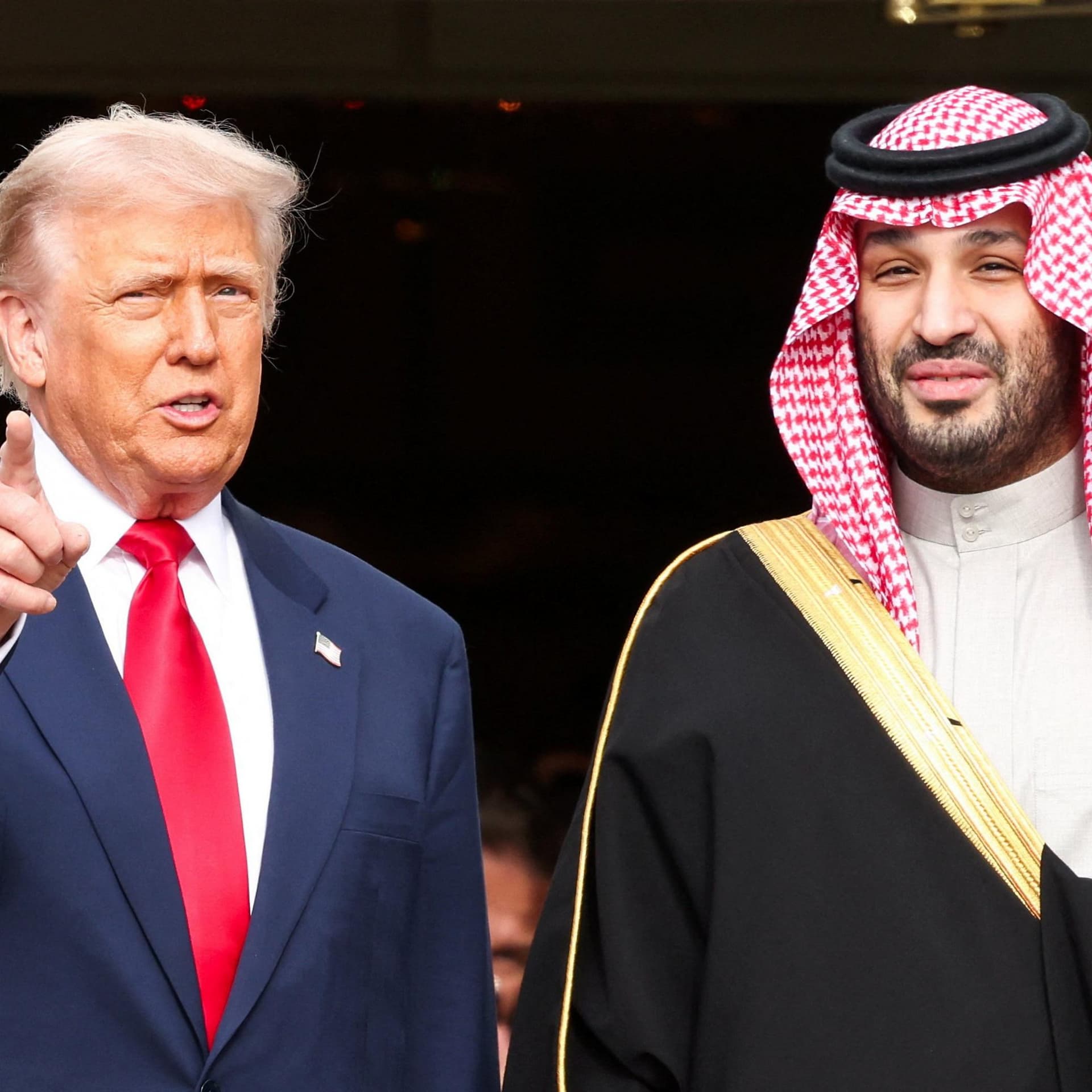
Photo: U.S. President Donald Trump meets Saudi Crown Prince Mohammed bin Salman at the White House in Washington. Credit: Kevin Lamarque / Reuters