In short
BBC Global Story examines the “Venezuela model” of US-backed regime change after Nicolas Maduro’s ouster, focusing on Delcy Rodriguez’s interim rule, US-Venezuela rapprochement, and a US “three-point plan” (stabilisation, recovery, transition).
Guests
Ioni Wells, BBC South America correspondent based in São Paulo; recently returned from a two-week trip to Venezuela (first since 2024). She reports on pro-government rallies, opposition activists, and political prisoners.
Key claims
Caracas still displays Maduro propaganda while Delcy Rodriguez is sworn in and effectively governing without a clear election timeline. US Interior Secretary Doug Burgum met Rodriguez at Miraflores alongside Diosdado Cabello, signaling economic dealmaking (oil/mining) and reconciliation steps. Opposition fears elections are delayed; US and Rodriguez benefit from continuity.
Notable examples
pro-Maduro rallies with state-paid workers bonuses; amnesty law releasing hundreds but leaving “hundreds” jailed; oil sales with US oversight; Trump calling Venezuela a “perfect scenario” before Iran.
Written by AI. May contain mistakes. Listen to the episode to check what was said.
Chapters
Tap a time to open that second in VOCaracas: A Return to Political Life
0:00 to 0:45
Insights from a correspondent's recent trip to Venezuela and the political climate.
“This BBC podcast is supported by ads outside the UK.”
Caracas: A Return to Political Life
2:04 to 4:05
Insights from a correspondent's recent trip to Venezuela and the political climate.
“And today on The Global Story, what is the so-called Venezuela model?”
Rally Observations: Loyalty and Fear
4:05 to 5:17
Analysis of a government rally and the mixed sentiments among attendees.
“one 22-year-old woman, for example, who worked for the government, who didn't want to use her real name in my reporting.”
Delcy Rodriguez's Leadership
5:17 to 7:00
Examination of Delcy Rodriguez's role and the complexities of her leadership.
“So on the one hand, they might be calling for the return of President Maduro.”
US-Venezuela Relations: A Cozy Meeting
7:00 to 10:01
Details of a meeting between US officials and the Venezuelan government.
“The US Secretary of the Interior, Doug Burgum, what was that meeting like with Delcy Rodriguez?”
The Three-Point Plan for Venezuela
10:01 to 12:28
Discussion of the US's plan for stabilizing Venezuela and its implications.
“It shows just how much I suppose the US has been willing to put aside and Venezuela has been willing to sort of put aside to allow this economic relationship to develop.”
Opposition Voices: Activism and Dangers
12:28 to 14:00
Interviews with Venezuelan opposition activists and their challenges.
“So that side of this is all, I think, very unclear at the moment.”
The Venezuelan Opposition's Struggles
14:00 to 18:06
Learn about the challenges faced by the Venezuelan opposition and their leadership struggles.
“So, yeah, and I also have been one of the leaders of the Venezuelan opposition.”
Political Prisoners and the Government's Contradictions
18:06 to 21:08
Explore the complexities surrounding political prisoners and the Venezuelan government's actions.
“political prisoners who were jailed under Nicolas Maduro's government to be released.”
US Intervention and Oil Dynamics
21:08 to 25:42
Understand the implications of US interventions in Venezuela and Iran and the oil trade.
“I want to understand with you, Ione, what links, if any, there are between the US government intervention in Venezuela back in January and what we're seeing now with the United States intervention in Iran.”
Show all 11 chapters
Evaluating Changes in Venezuela
25:42 to 27:54
Assess the tangible changes in Venezuela and their impact on the populace.
“way of saying, I guess the answer to your question is, is success for who?”
Transcript
Automatic transcript. May contain errors.0:00This BBC podcast is supported by ads outside the UK.
0:31Because Schwab knows that when it comes to your finances, choice matters. No matter your goals, investing style, life stage or experience, Schwab has everything you need, all in one place, so you can invest your way. Visit schwab.com to learn more. In Caracas, the capital city of Venezuela, there are huge posters around the city with a slogan, Los Queremos de Vuelta. We want them back. The posters are calling for the return of the former president, Nicolas Maduro, and his wife, Celia Flores. The two have been in US custody since January, and they'll appear in court in New York on Thursday. And yet, at the same time, in Caracas...
1:18The Secretary, we've given the welcome to the Secretary of Interior, and also responsible for everything that has to do with the Energy Dominion Council of the United States. The interim president, Delcy Rodriguez, welcomes U.S. officials like old friends. It's a great day to welcome you here today to meet at Flores Palace, to welcome Secretary Bergham. There was a moment when people wondered if Donald Trump would try to do in Iran what he's done in Venezuela. But that moment has gone. Venezuela is a unique case. Almost three months on from Nicolas Maduro's ousting, we go inside Venezuela to find out how Trump's first attempt at regime change is going.
2:03From the BBC, I'm Tristan Redmond in London. And today on The Global Story, what is the so-called Venezuela model? And is it working?
2:17I'm Ioni Wells, the BBC's South America correspondent. and I'm based here in Sao Paulo, but I've just got back from a two-week trip to Venezuela, which is the first time I've been since 2024. So it was very, very nice to be back. So you reported when you were in Caracas from a pro-government rally. What was that like and who did you speak to? What did they tell you? Yeah, that's right. It was interesting landing in Caracas because when you arrive there, it could seem like nothing's really changed. There's still billboards of Nicolás Maduro everywhere in the airport. And the day that I landed in Caracas was exactly two months after the US seized Nicolas Maduro.
2:57So this rally had been put on by the government to essentially mark that anniversary and call for his return. Now, quite similar to rallies of his that I've been to in the past, there were buses that had been put on by the government to get people there. There were crowds of people all wearing T-shirts with his face on, waving Venezuelan flags. There's a lot of very public displays of affection for Nicolás Maduro. And certainly a lot of the people I spoke to in the crowd repeated quite loyalist slogans, saying that he's the constitutional president, that they want him back, that he's a prisoner of war.
3:40Interestingly, though, when I spoke to people on the sidelines of it, or even some people in the crowd, I immediately got this sense from quite a lot of people there that they weren't really telling me exactly how they really felt. Quite a lot of those people were public sector workers, employees of the state who felt that they had to go, otherwise they might face some kind of repercussions in their work, in their job. And what I found was interesting was particularly some of the young people I spoke to, one 22-year-old woman, for example, who worked for the government, who didn't want to use her real name in my reporting.
4:14but she told me very explicitly that, in her words, everything at this rally was false, was a lie, that these were all public sector employees who had been told to go to these rallies. Otherwise, they wouldn't get a government bonus. They wouldn't get a top up to their salary, which is already very, very low. It's only about$150 in her case a month. She mentioned actually that the month before they had been offered, I think it was about$120, $150 bonus. So essentially, nearly a doubling of the salary if they attended these pro-government rallies. She said to me that she had two friends who didn't go and they didn't get it.
4:51Interestingly, though, I think we shouldn't underestimate how significant it is in itself that she felt, even if anonymously, she was able to express that to me. And I think it's one of the biggest changes that I've certainly noticed since going there a year and a half, two years ago, that many people were starting to feel more emboldened to criticise the government in a way that for some of these people, they've never felt able to do in the past. One of the things I find fascinating about this story is that it's difficult to square some of the things that the Venezuelan government is saying about the United States with other things they're saying about the United States.
5:27So on the one hand, they might be calling for the return of President Maduro. and yet on the other hand when you were there you reported on the visit of a member of the US government who came to meet Delcy Rodriguez and I want to ask you about that but I also want to understand before we get onto that what is the actual status of Delcy Rodriguez at the moment is she the official president has she you know taken on all the trappings of that job what's her role. Yeah, she's been sworn in as the interim president. But for all intents and purposes, she is ruling the country now. There has been no timeline, no process spelled out for any kind of formal elections or democratic process.
6:13But I think you touched on an interesting point there in your question about this sort of mismatch, because I think she's towing this very delicate line at the moment, because on the one hand, there is all these signs internally in the country of continued loyalty to Nicolás Maduro. You know, her certainly, I think, still trying to satisfy Venezuelans who might be loyal to him, including some of those in her own government, including some of those in the military, for example, while also on the world stage, very much cozying up to Trump administration officials, talking about how great this relationship between the two countries is, which again is just extraordinary given how this change in relationship started, which was the US bombing Caracas and seizing its leader.
6:59Well, what actually happened when this member of the US government came? The US Secretary of the Interior, Doug Burgum, what was that meeting like with Delcy Rodriguez? Well, it was certainly very cozy. I was there, I went to Mirafroes, which is the presidential palace. And it was fascinating because, again, when you walk into the presidential palace, on the surface, nothing's changed. There's still Maduro's face everywhere, slogans about him working for the people, even though he's currently in jail in the US, banners about different achievements he's done in government. And then you see what's actually taking place there, which is this meeting between his former vice president, now interim president, Delcey Rodriguez and a Trump administration official.
7:49Just months ago, the US and Venezuela were sort of arch enemies. Now there are these warm handshakes, smiles being exchanged between Doug Burgum and Elsie Rodriguez.
8:10Ione Wells:And we're here today for really only two reasons. We're here because of the courage of President Donald J. Trump. And we're here because of the collaboration that has already been established under your leadership, Elsie, with the US to move forward for peace and prosperity. He came with this delegation of oil and mining companies, including some from the US. He met with some from Venezuela as well. The whole purpose of his visit was to try and essentially make contacts and shore up investment opportunities, both in Venezuela's oil sector, but also in its mining sector too. Venezuela is a rich, rich country filled with both oil and gas resources, but also rich in critical minerals.
8:55Both of them, I think, keen to publicly show that they are on good terms.
9:00Ione Wells:There's been a long history between our two countries of synergy between Venezuela production and US investment. And the opportunities right now are greater than ever. I've got this image in my head from what you're describing, Ioni. Is Doug Burgum in the presidential palace in Caracas in the same place as images of Nicolas Maduro and slogans about Nicolas Maduro? Are those two things sitting alongside each other? Exactly that. And also, maybe more significantly as well, in that meeting with Delcio Rodriguez and Doug Burgum, another figure was there, which was Diosdado Cabello, who is the interior minister in Venezuela.
9:42Now, he's the man who oversaw the armed paramilitaries who operated in Venezuela, who were responsible for cracking down on anti-government dissent. And to see this image of a US minister sat next to him and Elcy Rodriguez is quite extraordinary. It shows just how much I suppose the US has been willing to put aside and Venezuela has been willing to sort of put aside to allow this economic relationship to develop. Marco Rubio, the US Secretary of State, announced back in January one of those things, Ione, that governments all around the world love, a three-point plan for the future of Venezuela.
10:23Well, there's a lot of operational details that can't be discussed publicly, obviously, for obvious reasons. So as we move forward, we'll describe our process, which is a threefold process in Venezuela. I've described it to them now. Step one is the stabilisation of the country. We don't want it descending into chaos. He talked about three things. He talked about stabilisation, recovery and then transition. But can you explain to us what this all actually means and where we are on the arc of this plan? Yeah, so to sort of take it step by step, I think stabilisation, what he means by that, is not immediately having elections, not immediately, I suppose, rupturing the status quo, because, as I say, both I think the US and Venezuela made the calculation that that could lead to potentially a lot of instability, maybe even some kind of coup or uprising.
11:12So stability, continuity is what they mean by stabilisation. The second phase will be a phase that we call recovery, and that is ensuring that American, Western and other companies have access to the Venezuela market a way that's fair. Also, at the same time, begin to create the process of reconciliation nationally within Venezuela so that the opposition forces can be amnestied and released and from prisons or brought back to the country and begin to rebuild civil society. Economic recovery is this idea of liberalizing Venezuela's economy, injecting more investment again, trying to revive, for example, the oil industry that's been neglected and underinvested in for many, many years.
11:54And then the third phase, of course, will be one of transition. Some of this will overlap. I've described this to them in great detail. We'll have more detail in the days to follow. But we feel like we're moving forward here in a very positive way. And I think that is a reference to future elections and a democratic process taking place. But that's the bit, I think, which we've heard least about. And that's what's kind of concerning a lot in the opposition in Venezuela, because while we've heard quite a lot about stabilisation, we've heard a lot about economic recovery and all these new oil and mining deals that the US and Venezuela want to strike.
12:25We've not really heard anything about elections. So that side of this is all, I think, very unclear at the moment. And I think a lot of people think that at the moment, it's neither in the US's or Delcy Rodriguez's interest to rock the boat to change things again. It's not in Delcy Rodriguez's interest, because she probably knows that if there was an election now, judging by past opinion polls, that the opposition, you know, if it manages to get united around a single candidate, that the opposition would have quite a good chance of winning. the US knows that if it weren't to have Delcey Rodriguez in power, someone who they can sort of dangle this threat over, that they might not have as compliant a government or a government they can kind of threaten into submission.
13:09And that's what is most worrying to figures on the opposition because they do wonder, well, hang on, how long is this democratic transition part going to take? What's the status of the political opposition right now? Did you meet with them and what did they tell you? Yeah, I mean, I met with certainly quite a lot of opposition activists and figures. I met with Jesus Armas, who's an opposition activist who kind of worked on essentially running the, in part, the opposition's campaign at the last election. So firstly, just for people who might not know the background of your story, can you explain a bit about your work, your activism and your case?
13:47So I have been a political activist for the last 22 years and actually also a human right defender. I was the campaign manager of Venecorina Machado in el municipio Libertador de Caracas in the capital of Venezuela. So, yeah, and I also have been one of the leaders of the Venezuelan opposition. And how did your work end up leading to what was described as a disappearance, a detention? Can you talk us through just what happened and when that took place? So the people started to protest on July 29, and I was part of this protest. And also I was part of the team that collected the tallies that helped us to show to the world that Edmundo González Urrutia is the legitimate president of Venezuela.
14:45Every leadership that could organize a protest or that just were part of the election of the electoral team of María Corina del Mundo was a target for the Maduro's government. So that's why they started to follow me, to pressure me and finally to jail me. He said that while, of course, he's very, you know, he feels a lot's changed since the 3rd of January. He's regained his own freedom. I think that President Trump has been really supportive to the Venezuelan cause and that what happened in January 3rd was a really big step. He said it doesn't go far enough because there are still people in jail.
15:30And he said for the opposition to have a sort of fair chance at an election, you know, we couldn't, in his words, we couldn't really have an election until everyone's free. We want the investment of the US. We want the investment of the international companies. We want more free markets in Venezuela. But at the same time, we want democracy and we want democracy now. The thing that they want is elections. In terms of what those elections might look like, though, I think there is still a big question mark about them, because who would the opposition candidate be? Because at the moment, the most prominent opposition leader, María Corina Machado, is still, as far as we know, not back in Venezuela.
16:11She has been somewhat snubbed by the Trump administration, who, as we know, have chosen to work with Delcey Rodriguez rather than sort of endorse her and her movement, for example. Then there's the candidate from the last election, Edmundo Gonzalez, who's still living in exile. And as I say, there are still wanted posters for him all around Venezuela, accusing him of crimes against the state and offering$100 ,000 in reward for any sighting of him. So I don't think he's got any plans to come back to Venezuela necessarily anytime soon. So I think the opposition is in a bit of a difficult place right now.
16:53There's a lot of optimism among them. There's a lot of hope that finally Maduro has gone, which is something they've wanted for a long time. that there's potentially a path now for change in the country. But in terms of them actually seeing a path towards them being elected, I think that is still quite unclear, both in terms of the timescale of elections, but also in terms of who a possible candidate would be. And also, would their candidate be considered palatable to the United States? Because interestingly, when I spoke to people both on the left and the right in Venezuela, both conceded that now, whoever the candidates are at the next election, if they are to succeed, will probably need that sort of backing of the United States, given how much the US is essentially calling the shots on a lot of economic decisions at the moment.
17:40I mean, there are, as you mentioned, members of the political opposition who are still in exile, but there are other members of the political opposition who are still sitting in jail in Venezuela, and they've been there since the Maduro days. What's happening with them? Well, one of the ways in which Delce Rodriguez has sort of showed to the US, I suppose, that she's willing to comply with their demands is introducing this new amnesty law, which essentially paves the way for a lot of these political prisoners who were jailed under Nicolas Maduro's government to be released. And we have already seen signs of that.
18:17There have been hundreds of people who have been released so far. And I spoke to quite a lot of them, including some prominent opposition activists and politicians, but also ordinary people who had basically been caught up in a lot of the crackdown on anti-government sentiment. But there are still hundreds of people who are behind bars. And I think there is still, yeah, there is a lot of uncertainty really about whether or not all political prisoners will be released. Venezuela's government has never actually accepted that it's held political prisoners. It's always denied that. But the opposition has long said that these detentions have been a way for the government to crack down on opposing voices and movements.
18:59Well, I mean, it also strikes me as another one of these contradictions in the sense that if the government is releasing some political prisoners, that does appear to be a positive move in a democratic light. It's a move towards potentially more political freedom in Venezuela. But then at the same time, as you've said, there is some evidence that the government's also paying people to attend pro-government rallies. How do you square those two things? You can't really. And that's the thing. I think there is still a big mismatch between some of what's being said and done publicly and other things.
19:33On the one hand, yeah, we've seen steps towards a more free society, people feeling they can speak more freely. There are more protests that have been taking place, which months ago I think people would have been very scared to do, both university protests, but also, you know, I went to protests taking place outside prisons where people were protesting for their loved ones to be released. We've seen the release of some political prisoners. On the other hand, much of the state infrastructure still exists. we're still seeing many of the same figures who are associated with that crackdown on dissent still in power, whether that's Diosdado Cabello, the powerful interior minister, or whether it's the new defence minister in the country.
20:18Interestingly, Delcy Rodriguez has just got rid of her defence minister, Vladimir Padrino López, who was also wanted in the US on drug charges. but she's replaced him with a man called Gustavo González López, which I don't think will be potentially much of a reassurance to critics because he's still a very hardline figure. He was the director of Venezuela's most notorious intelligence service, which was seen often as a sort of quite hostile arm of the state, again, that would crack down on dissent in the country.
20:55so i can see why many people still feel distrust still feel nervousness even though on the one hand you know political prisoners and others are being released a nervousness that that actually quite a lot hasn't changed still
21:18I want to understand with you, Ione, what links, if any, there are between the US government intervention in Venezuela back in January and what we're seeing now with the United States intervention in Iran. One of the things that Doug Burgum said when he was leaving Caracas for that trip that you covered for us. He told reporters on the tarmac as he was leaving that it was a, quote, brilliant strategic move to intervene in Venezuela before the US intervened in Iran. What did you understand by that? I think he was, yes, sort of saying the quiet bit out loud there in the sense that he essentially seems to be saying that in his words, doing Venezuela before Iran, the US has opened a new channel of oil to come to the US from Venezuela at a time when global supplies are now being squeezed because of the US action and the subsequent war that has started in Iran.
22:25So I think, while I don't think the flow of oil from Venezuela to the United States is necessarily going to be enough to compensate for wider economic chaos. I think there's a deliberate move here, which is that the US does now have that supply from Venezuela, which it has oversight over as well. But I think there is a very likely chance that Venezuela will benefit, I suppose, from the situation in the Middle East right now, because at a time when oil prices are spiking, this is a country that has a huge amount of oil and has just been essentially allowed by the US to start selling it again. Is there a lot of oil going from Venezuela to the United States right now?
23:10The US certainly says so, that there's been millions of barrels of oil that have been headed towards the United States. They've also got this slightly strange and unprecedented new agreement where the US is also allowing Venezuela to now sell oil that was previously sanctioned, as long as the US has oversight of it. So essentially, the arrangement that they seem to have come to is that proceeds from that will go into this account, which the US would then have oversight over how that money is spent. And the idea is it will be spent on the infrastructure that the country needs, whether that's public services or health services funding police, other institutions, for example, that might need it, medicines, for example, too.
23:55So as far as we understand, there is a lot of oil flowing from Venezuela to the US, but also Venezuela is being allowed solely to sell some of that oil again. Well, Doug Burgum is not the only US government official who's linked the intervention in Venezuela with the intervention in Iran. Back at the beginning of March, President Trump was speaking to the New York Times on a phone call when he was discussing Iran. And he said, what we did in Venezuela, I think, is the perfect scenario. You've just been to Venezuela. Is it the perfect scenario? Well, I'll kind of answer this in two parts, because I think, firstly, maybe we should unpack what Trump is sort of saying there, which is that I think what he means by perfect scenario is, for him, it's a perfect scenario because he has essentially managed to successfully install, to be blunt about it, a puppet government for the US right now in Venezuela.
24:54It's a government that now complies with him. I'm not an expert on Iran, but I think it's very clear that despite parallels that Donald Trump tried to make, Iran is not Venezuela. And what we're seeing right now is potentially a situation where maybe critics of Trump would argue that he got quite buoyed by the, quote unquote, success of Venezuela. And yet capitulating Iran's leader was far from that simple. Iran has a mechanism to leverage the most important oil route in this conflict with the US. Venezuela does not. Venezuela had oil that actually was being essentially kind of strangled by the US under its sanctions regime before.
25:34So the two situations are very, very different. But I think Donald Trump certainly wants a scenario that he can see as a success. So this is a long way of saying, I guess the answer to your question is, is success for who? For the United States, I think, yes, they would argue this is a perfect model in Venezuela for them.
25:56In terms of has this been a great successful people in Venezuela, I think it's much, much too early to stay at this point. Where the changes are most tangible are things like the release of political prisoners and the fact that people feel they can speak more freely now without risking repercussion. That is definitely a tangible change. Economically, though, I went to parts of the country which are still living in absolute destitution, chronic water shortages, gas shortages, constant power cuts. So I would say that at this stage, it's very early to say whether actually any of this promise of economic change is going to make a real difference to people's lives in Venezuela.
Read the full transcript
26:38I think after years of corruption, of mismanagement of the economy, of underinvestment, of sanctions, the sign of real change for many people still feels incredibly distant, even with all this talk of new investment.
26:57Thank you so much, Ione. It's such a fascinating story. Thank you so much for deciphering it for us, Ione. Thank you.
27:08That was Ionee Wells, the BBC's South America correspondent. You can read more about Ionee's work in Venezuela and the people she spoke to when she was there at bbc.com. And later this week, we're hoping to look at the US intervention in Cuba. So listen out for that. If you enjoyed this episode, please leave us a rating and review us wherever you listen. It helps others to find us. Our producers today were Sam Chantarac, Valerio Esposito and Hannah Moore. And our executive producers were Bridget Harney and James Shield. The episode was mixed by Travis Evans. Our digital producer is Matt Pintus.
27:45Our studio manager is Philip Bull. Our senior news editor is China Collins. And I'm Tristan Redman. And we'll be back tomorrow. See you then. Cheerio.
From the publisher
Nicolas Maduro, the deposed president of Venezuela, is due to appear in court in New York this week alongside his wife, Cilia Flores. The pair face charges of cocaine trafficking and possession of machine guns, which they deny.
Meanwhile in their home country, the Trump-approved interim president, Delcy Rodriguez, has been making deals with the US government over Venezuela’s oil and critical minerals.
The BBC’s South America correspondent, Ione Wells, has been in Caracas to find out how much life has altered under Rodriguez’s leadership, and to what extend Donald Trump may see this regime change as a blueprint for US intervention elsewhere.
Producers: Sam Chantarasak, Valerio Esposito and Hannah Moore
Executive producers: Bridget Harney and James Shield
Mix: Travis Evans
Senior news editor: China Collins
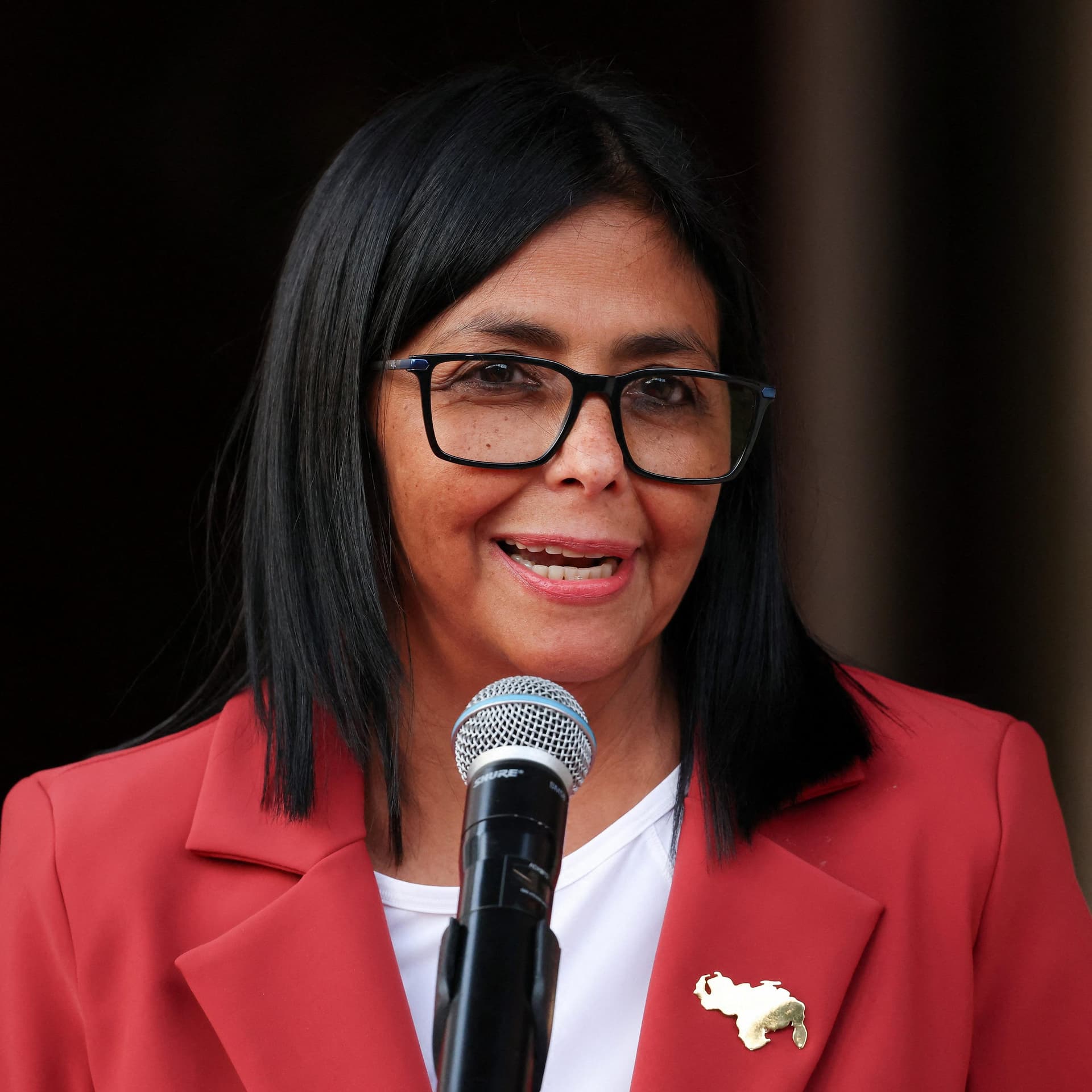
Photo: Venezuela's interim President Delcy Rodriguez. Credit: Reuters/Leonardo Fernandez Viloria