
In short
A BBC interview examining how Marco Rubio, now U.S. Secretary of State in Donald Trump’s second term, views the world and whether he’s shaping or merely executing Trump’s foreign policy, with focus on Latin America, China, NATO, and conflict escalation.
Guests
Tom Bateman, BBC State Department correspondent and traveling journalist who has spent significant time with Rubio in this administration.
Guest background
Covers U.S. diplomacy for the BBC; previously followed Secretary of State Antony Blinken during the late Biden period.
Key claims
Rubio is unusually comfortable with reporters and appears to have autonomy and ambition to build a presidential profile. His positions have shifted with the MAGA revolution, yet he remains hawkish on China and Russia. He often deflects tough questions back to Trump, using plausible deniability.
Notable examples
Venezuela and Cuba policy; a U.S. raid involving Nicolás Maduro and critics citing UN Charter breaches; Panama Canal tensions tied to Chinese control; Rubio’s China trip despite Chinese sanctions (name altered on documents); NATO “adult in the room” role at Munich; Rubio’s response to questions about an alleged U.S. missile strike on an Iranian school.
Written by AI. May contain mistakes. Listen to the episode to check what was said.
Chapters
Tap a time to open that second in VOMarco Rubio's Evolving Role
1:14 to 2:25
Discussion on Marco Rubio's current position within the Trump administration.
“Marco Rubio was once a fierce critic of Donald Trump.”
Rubio's Political Background
2:25 to 4:40
Exploration of Marco Rubio's background and rise in politics.
“Tom, the reason I wanted us to have this conversation today is because Marco Rubio's name has begun to bubble up more in the political conversations here in the U.S.”
Shift in Positions
4:40 to 7:10
Analysis of Rubio's changing stances and his relationship with Trump.
“But I think before we dive into that, it is worth just a brief exploration of why Marco Rubio got into politics.”
Rubio's Influence on Policy
7:10 to 9:21
Discussion on Rubio's impact on U.S. foreign policy, particularly in Latin America.
“I mean, it's extraordinary when you look back at the clips now, because, yes, it's widely remembered, of course, Trump was calling him Little Marco.”
China Relations and Diplomacy
9:21 to 14:00
Examination of Rubio's stance on China and his recent diplomatic travels.
“His dominant role, I think, as Secretary of State has been over what they call the Western Hemisphere, you know, Latin America.”
Marco Rubio's Foreign Policy Stance
14:00 to 19:02
Explore Rubio's evolving foreign policy and his adaptability within the Trump administration.
“The degree to which he opposed China's behavior when he was a senator was signified by the fact the Chinese sanctioned him.”
Rubio's Position on NATO and Global Alliances
19:37 to 28:01
Discuss Rubio's stance on NATO and how he is perceived by European allies.
“Another key part of the Trump administration's foreign policy has been challenging traditional U.S.”
Rubio's Campaign Strategy
28:01 to 28:34
Explore how Marco Rubio approaches contentious issues in his pursuit of the presidency.
“and Trump will often talk about Rubio in the same breath as J.D.”
Listener Engagement and Show Overview
28:34 to 29:16
Learn how listeners can engage with the show and what The Global Story aims to achieve.
“That was the BBC's State Department correspondent, Tom Bateman.”
Transcript
Automatic transcript. May contain errors.0:00This BBC podcast is supported by ads outside the UK.
0:34Thank you.
1:00of thousands of dollars in cash, bundles, and gift cards every week. So yeah, keep playing games. Just maybe get rewarded for it? Download MistPlay today and enter for your chance to win. Our foreign policy is one that's solely focused on the national interest of the United States of America, on the defense of our country, both its military defense and our security, but also our economic security and the vibrancy of our economy, our sovereignty, and our future. Marco Rubio was once a fierce critic of Donald Trump. But now he's the loyal secretary of state, the face of American diplomacy, and even a possible heir to the Trump legacy.
1:44President Trump's second term in the White House has been defined in part by his global interventions, his focus on the world. And Rubio is a key man in the middle of it all. From the BBC, I'm Asma Khalid in Washington, D.C. And today on The Global Story, how does Marco Rubio really see the world? And is he simply executing Trump's foreign policy or shaping it?
2:20Tom Bateman, it's such a pleasure to have you in studio, in person with us on The Global Story. Thanks for stopping by. It's great to be here, Asma. Thank you for having me. Tom, the reason I wanted us to have this conversation today is because Marco Rubio's name has begun to bubble up more in the political conversations here in the U.S. as a possible presidential candidate. And I covered the 2016 election. I remember being at events covering Marco Rubio. And that version of Marco Rubio sounds different than the Rubio we see today in the Trump administration. And you do a lot of things, Tom, but one of your primary responsibilities is covering the State Department.
3:00You've spent a lot of time with Marco Rubio in this second Trump administration. What's he like? How would you describe him? I think the first thing I'd say, you know, from the perspective of one of the traveling journalists is he is incredibly at ease with being in front of reporters. You guys go, all right, let's go. Come on. What? Thank you. I'm sorry. My son graduated high school last night. Thank you. My kind of comparison was covering the tail end of the Biden administration, where I had just over a year. That's when Blinken was the Secretary of State then. Yeah. Exactly. Traveling around and following Blinken.
3:36He's very comfortable with the press around him in a way that I found Anthony Blinken never was. I mean, Blinken, they used to prep him for ages. He'd spend an hour and a half often doing prep before a press conference. Rubio, on the other hand, is completely different. He's very comfortable just strolling to the back of the plane and chatting. He is very comfortable just arriving on the tarmac, getting out and talking to the reporters there. I mean, I guess in a way it's quite in keeping with the administration. That's quite Trumpian. It's what the president does all the time. And I think it's sort of interesting that Rubio, as one of the very senior cabinet members, does feel a sense of autonomy to speak his mind and to basically build up his profile.
4:18And I think that's why, in a sense, what struck me is you really have to see just about everything that Rubio does in this role as part of his wider ambition, which is to become president and run for the Republican nomination. So, Tom, we want to spend a bulk of this conversation looking at how Marco Rubio sees the world and how the world sees him. But I think before we dive into that, it is worth just a brief exploration of why Marco Rubio got into politics. Well, he is this mold breaker, you know, not just in the Republican Party and the Republican movement, but in American politics at large.
4:53I mean, he's the first Hispanic Secretary of State, he's the first Cuban-American Secretary of State. They did everything they could to make a better life. But living in an increasingly unstable country with limited education and no connections, they just couldn't. You know, he was born in 1971 in Miami, the son of Cuban immigrant parents, but who had left Cuba actually before the Castro Communist Revolution in the late 1950s. So they saved as much as they could. And on May 27th of 1956, they boarded an airplane to Miami. They came to America in search of a better life. Although he had, according to the biographies you read of him, very much lent into that sort of Cuban Miami exile experience, you know, anti the Castro regime, really pushing hard against it.
5:44The truth is they were discouraged. And they were homesick for Cuba too. In fact, in the early days of Castro's rule, before he came out as a Marxist, they even entertained going back permanently. But of course, communism took root in Havana and that became impossible too. That became a core part of his identity. And you talk about the immigration stuff. I mean, certainly he did work with the son of undocumented migrant laborers. That was part of his early work as a local politician as he worked his way up that system. And then became a representative in the Florida House for the Republican Party.
6:19And I think the first Cuban-American speaker of the House there. So another first. The other key part of his identity has been his Catholicism. So he's raised a Catholic in Florida, actually converted to Mormonism when the family spent a few years in Las Vegas and his extended family there. Some of them were Mormons. But then he returns to Florida later and they became Catholics again. And I think there is something there. And again, it's in some of the biographies of that early phase about this idea of sort of needing to fit in identity wise. But that idea that he is able to kind of shape shift and to shift position and then being swept along with the MAGA revolution in the Republican Party and now a secretary of state.
7:04You've seen a lot of changing positions, particularly as he's become secretary of state under Trump. Yeah, I mean, it's rather remarkable to me that he is the Secretary of State in this second Trump administration, just given the amount of, I think it's fair to say, sort of like bad blood that felt between the two of them during the 2016 election cycle. I mean, it's extraordinary when you look back at the clips now, because, yes, it's widely remembered, of course, Trump was calling him Little Marco. You know that in Florida, they hate Little Marco Rubio so much. He was calling Trump a con man and a con artist continually throughout that campaign and was then humiliated totally by Trump because he was trounced in Florida in his own state in the primary.
7:48We are not going to turn over the conservative movement to a con artist who was telling people one thing but has spent 40 years sticking it to working Americans and now claims to be their champion. And then obviously had to drop out as Trump took the nomination. In Florida, Trump's victory silenced Senator Marco Rubio's campaign. While we are on the right side, this year, we will not be on the winning side. But I think in terms of that transition, it has been incredibly striking in this first year and a half of the Trump presidency on all of the key issues where, as a senator and on the Foreign Relations Committee in the Senate, Rubio is extremely outspoken, really hawkish on China.
8:32really hawkish on Russia, calling for some of those punitive US sanctions against Russia under Putin. So on a whole range of issues, and you mentioned immigration, USAID, you know, foreign aid development, which has been abandoned almost, completely disintegrated under the Trump administration. He was one of his biggest champions in the past. So on all these issues, you've seen him sort of swept along under the Trump MAGA revolution and has really shifted position quite notably. So, Tom, you describe him having shifted positions, but I'm curious about the opposite end of that question. And that is, has he also personally affected U.S.
9:13government policy? Are there ways in which you feel Rubio has really put his stamp on what the Trump administration is doing? And if so, how? His dominant role, I think, as Secretary of State has been over what they call the Western Hemisphere, you know, Latin America. That may be one reason why Trump appointed him because of his expertise and his background in that area. And that has particularly been on the issue of Venezuela. So remember, we saw Nicolás Maduro, the president of Venezuela. We saw a military raid by the US military at the start of this year into the country. Maduro snatched away and put in a New York jail cell.
9:51Now, Rubio says this is about US law enforcement. Critics say this is a blatant breach of the United Nations Charter. You know, you're just going to basically invade another country. And how did you see Rubio's fingerprints on that? Well, because largely it's something Rubio has always been very vocal on, the issue of Venezuela, but also because it feeds into his positions on Cuba. Cuba is a disaster. It's run by incompetent, senile men, and in some cases, not senile, but incompetent nonetheless. It has no economy. It's in total collapse. And he has always seen Cuba's ability to keep operating its economy has been helped by the sourcing of energy in the form of Venezuelan oil.
10:34So his purchases were largely Russia and Cuba and a few other places. This poor island took over Venezuela in some cases. One of the biggest problems that Venezuelans have is they have to declare independence from Cuba. They tried to basically colonize it from a security standpoint. That's been cut off as Trump has taken control of the Venezuelan oil industry. So I think Rubio has a key role there. I mean, you heard people calling him the viceroy of Venezuela. And I think, you know, the first trip he did as Secretary of State was to Latin America. We started in Panama. They're chanting Panama, one territory, one flag.
11:09And they want Marco Rubio out of Panama. I spoke to just lots of ordinary Panamanians. And people were really worried about what Trump was saying. Because remember, one of the things is, like, we're going to take over the Panama Canal. Another thing that just sort of gets forgotten because of the way the administration just kind of moves on.
11:28As he arrived at the presidential palace, there was a thumbs up from Marco Rubio. But the two hour meeting with President Molino didn't call tensions. Afterwards, the secretary of state issued an ultimatum saying if Panama didn't take immediate action to end Chinese control of the canal, the US would take measures to protect its rights. People were really scared. And I remember talking to one woman who remembered the 1989 invasion under H.W. Bush when Noriega was deposed by that Republican administration. And that was a full-scale invasion. Hundreds of people were killed. And people were very scared and thinking, is this going to happen again?
12:10Because the administration has its sights on the canal. So it was reigniting all these old fears. And suddenly Rubio appeared. And the first sight we got of him was at the canal. The press had been sort of kettled into this area by a lock. Now, the other side of the lock was this very large lock building. Rubio disappears over a bridge and wondered where he'd gone. And suddenly he appears at the top of this building, overlooking the Panama Canal. And I just had this image of, you know, here was the Trump administration overlooking its new dominion. Secretary, is China's president of the canal of threats to U.S.
12:48national security? Are you threatening military action against Panama, Mr. Secretary? The administration will say this was all about pushing back a Chinese influence in the Latin Americas, and that in the end, they had sort of constructive conversations with President Molino there, who was a conservative and agreed not to do so much work with the Chinese, but had always said, we're not going to hand over the Panama Canal to the Americans. So they were pushing back. You mentioned China there in the context of Latin America. And the Marco Rubio, I recall as a senator, was known for being a China hawk.
13:21And I'm curious how much of that has translated into how he operates as Secretary of State. I mean, he was on that trip just recently, right, with President Trump to China. Well, I think very little is translated, basically, because Trump has a very focused position on China, which is he, yes, sees it as a rival. Yes, he has launched a trade war with it using tariffs, but Trump has this soft spot for basically foreign autocrats in that he admires people who exert unilateral power. And President Xi is one of the people that is at the receiving end of that often with President Trump. Whereas Marco Rubio has been a far more traditional Republican place on China and has been incredibly hawkish as a senator.
14:04The degree to which he opposed China's behavior when he was a senator was signified by the fact the Chinese sanctioned him. He was banned from travel to China. Now, that then raises an interesting issue when he traveled with the president to China a few weeks ago, which was a trip I was on, on Air Force One. Rubio was on the plane as well and was traveling there. But of course, he's got to get into China. So how did that happen? Well, the story goes that the Chinese, on all their official documents, changed his name by altering a couple of the letters in Mandarin so that he had a slightly different spelt name as Marco Rubio in Chinese.
14:42So that got him into the country. And he does travel on the diplomatic passport. So we've alluded to this a couple of times that Marco Rubio has had to kind of shapeshift and morph into being the man who carries out Donald Trump's foreign policy agenda. And I want to ask you about one other key part of this, and that is Donald Trump's foreign interventions. We talked about it in the context of the Western Hemisphere, but, you know, let's be real, it's not just Venezuela or Cuba. We've seen the Trump administration very involved in Iran. We've heard the President of the United States famously claim that he has ended, is it nine wars he's now said he ended?
15:18I've lost count. I think we're around nine. You get a quarter being added. But there are still a lot that are going on, right? We talk about Sudan. Gaza has not actually been fully resolved at all. Ukraine. How involved does Marco Rubio want the United States to be in foreign conflicts? I think he comes from the Reaganite wing of the party, which did sort of invent this idea of peace through strength. So there is ultimately with him an acceptance of the need for foreign interventions, but certainly not in any kind of aggressive way like under the George W. Bush administration. And obviously, Iraq has sat over the Republican parties, it has over Western politics in general.
15:58But I, you know, the thing that really strikes me is when you really press Rubio on elements of Trump's foreign policy that are people, their opponents would argue so egregious that Rubio himself would have opposed this kind of thing as a senator. So if you look at Trump's threat to use force against Greenland, you know, which is the territory of a NATO ally of Denmark, and for example, the boat strikes in the Caribbean, which is very hard to see any way in which they fit in with international law. What he'll tend to do is, and I've seen him do this so many times, is to basically bounce it all off to Trump as clearly giving him ownership of it but making it sound like a compliment.
16:40And he does this a lot. And I'm reminded of, I think it was on Megyn Kelly where he was asked about Greenland and about the use of force. So when President Trump said he might use economic or military coercion, what does that mean? Well, I don't remember him saying military coercion. He did. He was asked, you know, what would you rule out? Would you rule it out? Right. I don't think he's in the—listen, he also brings to this— He said, no, I won't rule it out. Because he brings to this, this is a businessman who's involved in politics, not a politician involved in politics. So he approaches these issues from a transactional business point of view.
17:17So he is not going to begin what he views as a negotiation or a conversation by taking leverage off the table. Now, that is a way of saying this is nothing to do with me, Gov, but actually making it sound like a compliment to President Trump. He does that a lot. And I've noticed it, for example, again, it was actually in the Senate right at the start of the Iran war. and I'd asked about the Manab school strike, you know, where the Iranians say more than 110 school children were killed in what is now almost universally accepted to be an American missile strike, but the administration still has not accepted responsibility saying it's investigating.
17:55But I put that to him about that strike. Can you tell us what you know, can you tell us what you know, Mr. Secretary, or the administration knows about the strike on a building in southern Iran that the Iranians are saying was a school, reports of large numbers of civilians, including children killed. I've seen those reports. I would refer you, not because I'm not trying to answer your question, but I don't want to get it wrong. And his almost immediate response was to say, well, this is an issue for the Department of War. The Department of War would be investigating that if that was our strike, and I would refer your question to them, and I'll make sure they're aware that you have that.
18:27Are there indications this was an American missile? Well, clearly, the United States would not deliberately target a school. And he's very effective at that, actually, sort of putting himself in a position where it gives him a sort of plausible deniability. And I do wonder if that is because there is a longer game being played here, which of course is the Republican nomination for the presidency.
19:02Hi, I'm Simon Jack. I'm Zing Zing. And together we host Good Bad Billionaire. The podcast exploring how some of the wealthiest people on the planet made their money. And we are back with a new season. From sporting superstars to music moguls and celebrity CEOs. We'll be taking a closer look at the lives and fortunes of some of the world's richest people. And asking you to decide if they're good, bad or just another billionaire. Good Bad Billionaire from the BBC World Service. Listen now or search for Good Bad Billionaire wherever you get your BBC podcasts.
19:37Another key part of the Trump administration's foreign policy has been challenging traditional U.S. alliances, alliances, say, with Europe, with NATO, with the United Nations. How interested is Rubio in doing the same and carrying this out? Well, I mean, he has had to become very interested in it because that's the administration's policy. But again, it's not what he has said or appeared to believe in the past. And I think on NATO, it's striking that here you have a Secretary of State that just three years ago, as a senator, co-authored the act of Congress that was designed to prevent any US president unilaterally pulling the United States out of NATO.
20:21And some people refer to that as Trump-proofing NATO back in 2023, when it looked as though he might be running for the nomination, but they didn't know if he was going to get it at that point. And Rubio co-sponsored this, you know, believes in NATO to the extent that he was so concerned that a Trump presidency or another Republican president might try and pull the US out that they made this act of Congress that meant that can't actually happen now. And here you have the same individual, Secretary of State, who is having to go on globetrotting tours, ticking off NATO allies for all the reasons that Trump says.
20:54But I would say more broadly with Rubio, one thing I've sensed, particularly on engagements when it comes to Europe, is there is often a sort of sigh of relief when they know they're dealing with Marco Rubio as opposed to J.D. Vance or Pete Hexeth, for example, the Defense Secretary. because I think the feeling, and I remember talking to European officials at G7 meeting and at NATO meetings about this, that they see him as something like the adult in the room in the administration and somebody that they can still do business with and who will speak in their language. And the most striking example of that was the Munich Security Conference this year when after J.D.
21:33Vance had gone last year and basically sort of castigated Europe, told them that they were denying their own voters, the will of their own voters, that the enemy was not the Chinese and the Russians, but the enemy within in Europe. So Rubio went this year and gave them... Actually, it was still very critical of Europe. Thank you very much. We gather here today as members of a historic alliance, an alliance that saved and changed the world. You know, when this conference began in 1963, it was in a nation, actually it was on a continent, that was divided against itself. in a way that would have been newsworthy in its own right if it hadn't been for the bar that had been set by J.D.
22:15Vance the year before. But he basically told, you know, it was critical, but told them that Europe and the U.S. still belong together. And he got a standing ovation. We should be proud of what we achieved together in the last century. But now we must confront and embrace the opportunities of a new one. Because yesterday is over. The future is inevitable. and our destiny together awaits. Thank you. But when he got back and Trump was asked about how well he'd done, I think it was the Board of Peace meeting he had soon after that, and Trump didn't like it, you know, and he said... And Marco, you really did yourself proud two days ago in Munich.
23:00In fact, so proud that I almost terminated his employ because they were saying, why can't Trump do this? I do, but I say it differently. But Marco, don't do any better than you did, please. Because if you do, you're out of here. So, you know, it gives you a sense of how you have to be very careful in the Trump administration as he sets up some of his senior officials sort of vying against each other. Who's going to get the nomination ahead of the next presidential election? You mentioned that he received a standing ovation when he spoke at the Munich Security Conference. But what's he like in conversations with foreign counterparts?
23:39And how do they view him, especially in comparison, let's say, to some of the other key members of the Trump administration, we're talking about like Wyckoff, Kushner, J.D. Vance even now, who's playing a more prominent role, let's say, in possible Iran talks, the vice president. Well, he tends to be very, very at ease, but he can be pretty tough. And I noticed that most recently with Mark Rutter, the head of NATO, when we were in Helsingborg in Sweden for this meeting a few weeks ago. And I'm not sure if this is just his general mannerism, but he does not crack a smile often. All right, let's go.
24:13I didn't even want to talk to you guys. They told me you have to talk to the press. All right, let's do it. You know, Rubio was there to deliver a tough message from the president. Trump is aggrieved at NATO at the moment because he perceives they didn't help him when it comes to the war in Iran. But if you kind of get to a question that he doesn't like, he will start to push back and it can feel a bit aggressive. I mean, again, I asked him about the fact that the war had been started against Iran during the daytime on a Saturday, which is the start of the working week. Now, that was a choice, presumably because they had intelligence about the whereabouts to the supreme leader.
24:48What do you say to those who will accuse the administration of unleashing a reckless action because of when this war was begun? What it meant was that millions of children were in schools in Iran. Now, if you were trying to minimize civilian casualties, you would not start a massive Arab bombardment campaign during the daytime. You would do it at night and go after your military strategic objectives. And I put that question to him. That was a long question and said a lot of things I don't agree with. And I'm not going to speak to military tactics simply because that's not my department. Rubio did answer the question and rejected the premise of it and so on.
Read the full transcript
25:25but then said, well, I think the BBC and other media should be concentrating on all the evil things that the Iranian regime is doing. That's what the BBC should be covering. And that's what these other media outlets should be covering, is how evil these people are in Iran and the damage they've done to people all over the world. Now, the irony with that is actually that the BBC's Persian service is one of the very few international broadcasters that can be received inside Iran and does extraordinary work on what the Iranian regime is doing. But it just gives you a sense of how I think he, you know, if the question gets to a point he doesn't like it, it'll bite back.
26:02Tom, we're having this conversation also in the context of American domestic politics in which Marco Rubio's name is being tossed around amongst some, you could say, and the political class as a possible candidate for president in 2028. We've seen President Trump suggest that Marco Rubio and J.D. Vance could run together in the 2028 election. Of course, you mix raises all sorts of questions about which one of them will be on top or not. But you've described a Rubio who has shifted. And that makes me wonder if he were in a more powerful position. What would he be like? Well, I think we know where his instincts are because we've seen those over time when he's had more freedom of maneuver as a senator.
26:48And those are the things I've talked about. You know, he is hawkish. He's traditionally hawkish on Russia. He's traditionally extremely hawkish. You get the sense he truly still believes in this. On China. Yeah, absolutely. But I think the wider question is hard to answer because it depends on what is going to happen with the Republican movement in the United States. And that is not unique in any way to Rubio because we've seen this dilemma with politicians of all stripes where you've had populist revolutions basically within Western democracies, both on the right and left, you know, where do those more traditional figures sit?
27:22And they either often have to adapt or die in that environment. I think we've seen Rubio adapt and in a very high profile and prominent and powerful position.
27:34the question then becomes you know what happens to the republican party and its supporters post trump and we don't know the answer to that question that's going to be an absolutely sort of key moment but you can see how trump was already setting up which he always did in his companies vying chief executives and others off against each other keeps him in a powerful position but it also makes an interesting question about the succession so Rubio's clearly in the mix and Trump will often talk about Rubio in the same breath as J.D. Vance as the successors but again I would sort of come back to this point that I would see most of the way that Rubio operates particularly on some of the most contentious and difficult issues through the prism currently of this being an elongated campaign for the Republican nomination so he wants to be president I think that's almost inevitable
28:29Well, Tom, thank you so much. And thanks for coming into the studio. I really appreciate it. Thank you so much for having me.
28:40That was the BBC's State Department correspondent, Tom Bateman. And listeners, just a reminder that we do really love hearing from you all. Send us your suggestions, your questions, your story ideas. Hey, even your complaints. We take it all. Our email address is theglobalstory at bbc.com. We want to know what you're thinking about the show and if you've got ideas for us. A quick reminder also that we here on The Global Story go deep, as you loyal listeners know, every day beyond the headlines on one big story that tells us about where the world and America meet. If you're also looking for a way to catch up on the latest news headlines, then you should check out our sister show, The Global News Podcast.
29:19Our episode today was produced by Hannah Moore and Aaron Keller. It was edited by Bridget Harney and mixed by Travis Evans. Our digital producer is Matt Pintus. Our senior news editor is Chyna Khalids. And I'm Asma Khalid. Thanks as always for tuning in, and we'll talk to you again tomorrow.
29:53The podcast exploring how some of the wealthiest people on the planet made their money. And we are back with a new season. From sporting superstars to music moguls and celebrity CEOs. We'll be taking a closer look at the lives and fortunes of some of the world's richest people. And asking you to decide if they're good, bad or just another billionaire. Good, bad billionaire from the BBC World Service. Listen now or search for Good, Bad, Billionaire wherever you get your BBC podcasts.
30:23Thank you.
From the publisher
As a Florida senator, Marco Rubio seemed to hold an opposing world view to Donald Trump; on Russia-Ukraine, on China, on USAID, and more. He notably called Trump a “con man”, and Trump in turn dubbed him, “little Marco”.
And yet now, as US Secretary of State, Rubio has made himself indispensable to the president on foreign affairs, bringing his own background to play in policy on Venezuela and Cuba, and shaping the US’ approach to further interventions abroad. Trump has even indicated that he wants Rubio to run on a joint ticket with JD Vance for the next US presidency.
How has Rubio tailored himself to Trump’s world view? And what difference would he bring as a potential presidential candidate? Tom Bateman, the BBC’s State Department correspondent, regularly travels with Rubio, and he joins Asma on today’s show.
Producers: Hannah Moore and Aron Keller
Executive producer: Bridget Harney
Mix: Travis Evans
Senior news editor: China Collins
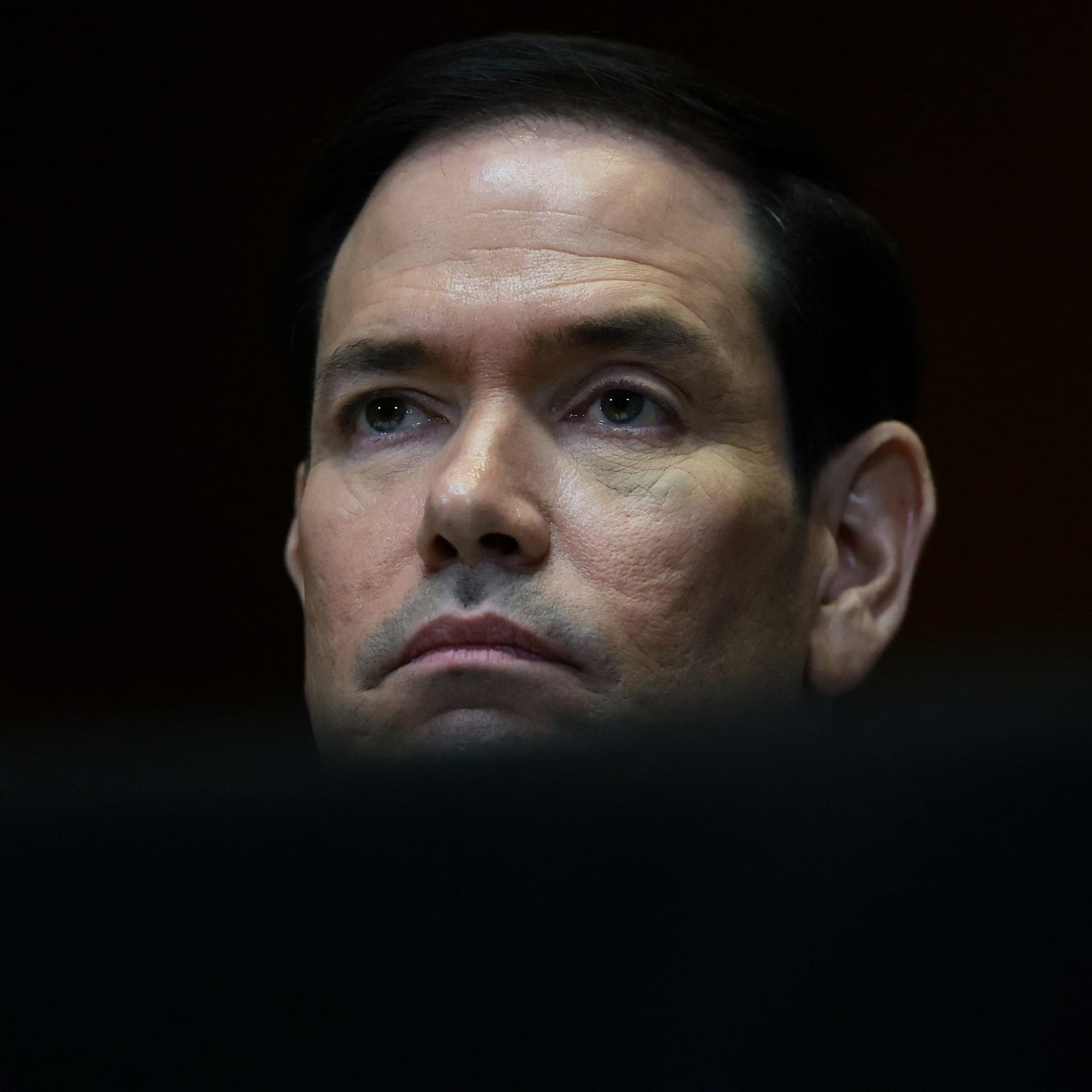
Photo: Marco Rubio attends a Senate Appropriations subcommittee to testify about the proposed 2027 budget for the Department of State, June 3, 2026. Credit: Reuters/Evelyn Hockstein.