In short
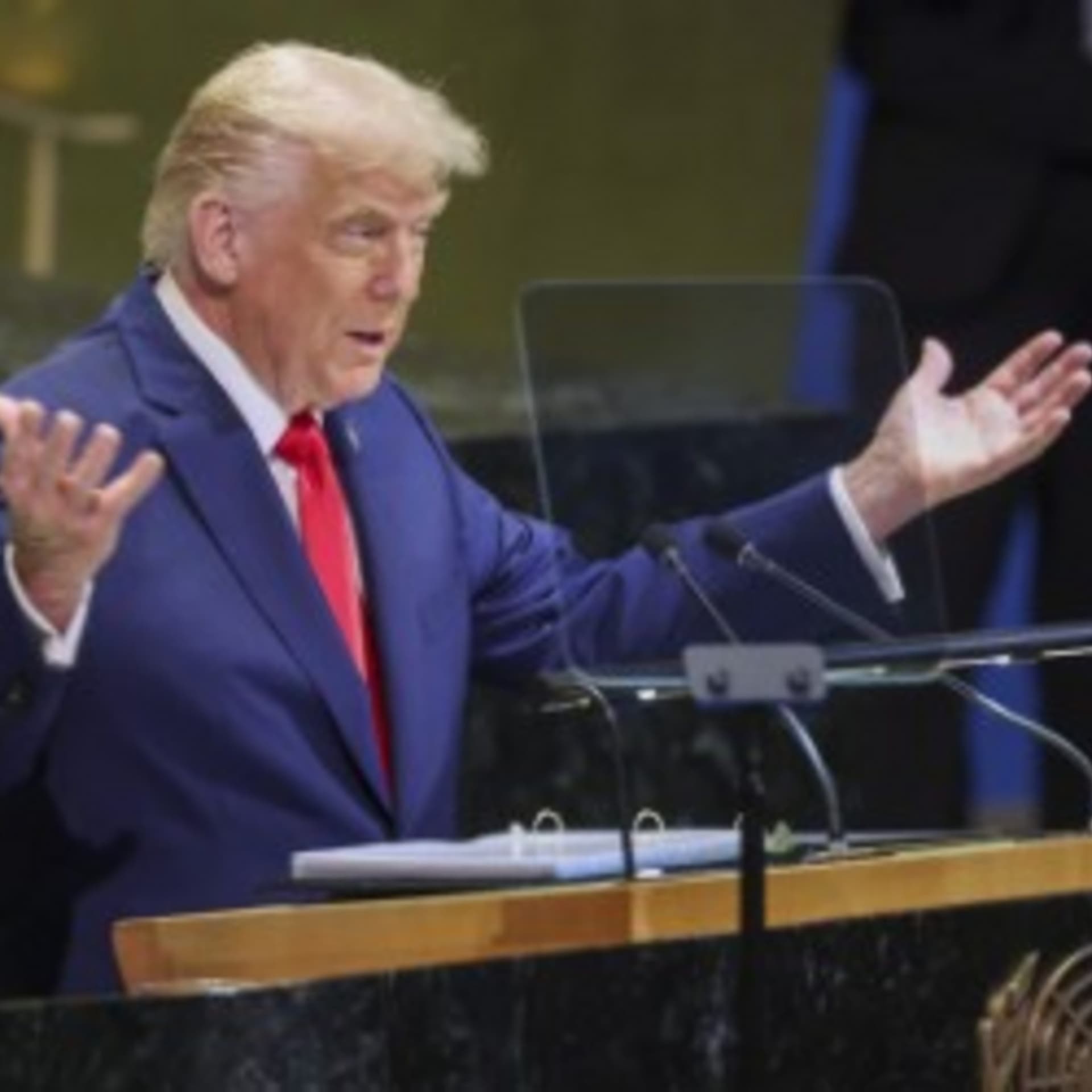
The episode (BBC Global Story) is about Donald Trump’s UN speech at the UN’s 80th anniversary and what it signals for the UN’s future. Hosts Asma Khaled and Tristan Redmond report from UN headquarters in New York, framing the day as a “dysfunctional family” moment: cash-strapped, questioned relevance, and major conflicts (Gaza, Ukraine, Sudan) unresolved. Key claims from Trump: the UN is ineffective and mostly issues “strongly worded letters”; he cites a “broken escalator” and “broken teleprompter” as metaphors; he says he ended “seven unendable wars” without UN help; he links UN activity to US border migration, alleging UN support like food/shelter/transport and “debit cards”; he calls “green energy” a second threat, blaming UN-driven climate messaging, citing UN predictions from 1982 and 1989.
Notable examples
UNRWA funding cuts; UNESCO withdrawal; US freezes congressional peacekeeping money; UN budget cut of $500 million and 20% staff reduction.
Guests
Neda Taufik (BBC UN reporter, long-time coverage); James Landell (BBC diplomatic correspondent, explains UN “World Cup” diplomacy and claims China may fill US influence).
Written by AI. May contain mistakes. Listen to the episode to check what was said.
Chapters
Tap a time to open that second in VOUN's 80th Anniversary: Celebratory Mood?
1:05 to 2:00
Discuss the current state of the UN on its 80th anniversary amidst challenges.
“I call to order the high-level plenary meeting to commemorate the 80th anniversary of the establishment of the United Nations.”
Trump's Upcoming Speech: Expectations and Concerns
2:06 to 3:38
Explore the anticipation and skepticism surrounding Trump's speech at the UN.
“There are questions over how relevant this organization is in this moment.”
Trump's Critique of the UN: Broken Promises and Symbolism
3:38 to 9:11
Analyze Trump's speech where he critiques the UN's effectiveness and relevance.
“There are really intractable problems in Gaza, Ukraine, Sudan, and the United Nations has been unable to solve any of them.”
Immigration and Energy: Trump's Key Concerns
9:16 to 12:00
Delve into Trump's views on immigration and energy as major global threats.
“That That being said, Tristan, he has been unable, as we all know, to solve the war in Ukraine or the war in Gaza, despite campaign promises to do so.”
Trump's Blame on the UN: Immigration and Green Energy
12:00 to 14:06
Examine Trump's claims that the UN supports immigration and promotes energy policies harming nations.
“will be the death of Western Europe if something is not done immediately.”
Trump's Critique of the UN
14:06 to 16:32
Trump blames the UN for exacerbating global threats like immigration and green energy.
“He did not miss his words at all on that.”
Trump's Relationship with the UN
16:33 to 19:39
A discussion on Trump's shifting stance towards the UN compared to his first term.
“But in reality, though, what we have seen with President Trump's actions over these last several months is that his actions do not match the words, that optimistic tone.”
Financial Impact of US Withdrawal
19:40 to 21:40
Analyzing how Trump's withdrawal policies financially strain the UN and its effectiveness.
“the biggest difference is that he is systematically withdrawing the United States from the UN.”
China's Rising Influence
21:41 to 24:21
Exploring how China's involvement grows as the US withdraws from the UN.
“I mean, if I were a UN diplomat in New York right now, I would be, you know, maybe doing some freaking out slightly about the future of my institution.”
The Purpose of the UN
24:22 to 25:55
Understanding what the UN achieves beyond the headlines during General Assembly week.
“But I think a lot of people wonder, well, OK, well, what's the point?”
Show all 11 chapters
Trump's Stance on Ukraine's Future
25:56 to 27:48
Discussion of Trump's unexpected remarks on Ukraine's potential to reclaim territory.
“I think we're just going to keep an eye.”
Transcript
Automatic transcript. May contain errors.0:00This BBC podcast is supported by ads outside the UK. Decisions made in Washington can affect your portfolio every day. But what policy changes should investors be watching? Washington Wise is an original podcast from Charles Schwab that unpacks the stories making news in Washington right now and how they may affect your finances and portfolio. Listen at schwab.com slash Washington Wise. That's schwab.com slash Washington Wise. Hi there, I'm Asma Khaled. And I'm Tristan Redmond. And together we're the hosts of the Global Story podcast from the BBC.
0:41Asma:For those of you who might be new to our show, we here at the Global Story dive deep every weekday on one big story at the intersection of where the world and America meet. And you can now watch the Global Story on the iHeart app. Catch every brand new episode every weekday. Just tap into iHeart to start watching and we hope you enjoy the show.
1:05I call to order the high-level plenary meeting to commemorate the 80th anniversary of the establishment of the United Nations. I would like to warmly welcome all of you to this anniversary of our United Nations.
1:30Asma:I'm here at the United Nations headquarters in New York, where I've been seeing journalists and diplomats line up all this morning underneath a row of flags from countries all over the world. The United Nations is turning 80 years old this year. And, you know, you would think that there would be a celebratory mood, but it frankly feels like a party with a dysfunctional family.
2:00The UN is strapped for cash.
2:06Asma:There are questions over how relevant this organization is in this moment. And the big headline that we are waiting for today is that President Trump is about to speak, and so we're eager to hear what his message is. From the BBC, I'm Asma Khalid in New York. And today on The Global Story, Donald Trump's strange lecture to the world and what it means for the future of the United Nations.
2:42Asma, you are the Global Story New York bureau today. Talk me through your morning. How's it going?
2:48Asma:Yeah, I've been up here in New York City with two of the producers on our team. And we're here, you can probably hear a bit of the hubbub behind us. We're at the United Nations headquarters in New York City. I got here pretty early. It was what, 7.30, 8 o 'clock this morning, because we were pretty concerned about the security lines just being a mess to get in because President Trump is speaking here today. and the streets of New York City already, you'll hear local New Yorkers complaining about the traffic every time the UN comes to town. They're curmudgeonly about the fact that all the traffic gets really snarled.
3:23Well, what's the vibe there today? What are the kind of big questions swirling around on everyone's minds?
3:29Asma:I think the big question swirling around my mind is what the efficacy and relevance of the United Nations is in this moment. You know, you look around the world, There are really intractable problems in Gaza, Ukraine, Sudan, and the United Nations has been unable to solve any of them. And so what's the point of this big gathering? Sure, meetings will be had, speeches will be given. People are wearing incredible fashion around, I will say. You see people really dressed up to the nines to some degree, but you're like, what's the point of this all? And that's been a big question on my mind. Well, the big main piece event of the day was Donald Trump's speech.
4:10You were there when he arrived, weren't you? What was that like?
4:13Asma:Yeah, well, I was in a pretty large gaggle scrum of reporters as he walked into the UN building. We tried to shout questions at him. I tried to ask him about why he's cut funding to the United Nations. Mr. President, Mr. President, why are you pulling funding for the UN? Mr. President. Other journalists asked about Zelensky, Palestinians. I'm going to push Zelensky for peace, president. He walked in with the first lady. I hope he remembered you, Asma, when you threw him the question. Do you remember you? I was so in the back, Tristan. You know, I'm not tall enough in these scrubs. This is the challenge of not being as tall as you.
4:54Asma:We should get you a little stool, maybe, Asma. A little stool to stand up in the back. But he just sort of looked at the press, acknowledged us and moved on. And then he made his way up the escalator. And it seemed like he stopped again because a bunch of people started shouting more questions at him. I couldn't see it in the moment, but apparently the escalator broke down, as we later learned. Oh, Asma, is this the second big moment in Donald Trump's career, which involves an escalator in New York City? You know, we were just talking about that. You and Zandra, our producer, are similar thinking.
5:25Asma:But Donald Trump and escalators, there's quite the moment. You can have a through line story on that. OK, so then he goes into the big hall, the plenary hall, and I watched the speech from London. I mean, it's nothing like being there as you were. It was super interesting. Thank you very much for being here. Madam President, Mr. Secretary General, First Lady of the United States, distinguished delegates, ambassadors and world leaders. What was it like seeing the speech up close? Well, he started off with acknowledging that the teleprompter wasn't working for him. I can only say that whoever's operating this teleprompter is in big trouble.
6:09Asma:You know, I think, Tristan, there have been a lot of questions about whether the UN is working in this moment. Is it broken? And I think it's sort of a metaphor for how the UN is perceived, that President Trump said the only things he's gotten out of the UN is a broken escalator and a broken teleprompter. All I got from the United Nations was an escalator that on the way up stopped right in the middle. If the first lady wasn't in great shape, she would have fallen. He made a joke about that, you know, he made a few jokes. And then a teleprompter that didn't work. This is these are the two things I got from the United Nations, a bad escalator and a bad teleprompter.
6:48Asma:You know, but then he went on touting all the successes he says he's achieved over the last several months. back in the White House. He talked about the economy. He talked about closing down illegal immigration coming through the southern border. And he basically said that the U.S. is on top right now. One year ago, our country was in deep trouble. But today, just eight months into my administration, we are the hottest country anywhere in the world. And there is no other country even close. Sorry, Tristan. You do not live in the hottest country. I'm just a journalist. I have no feelings either way.
7:29Likewise, in a period of just seven months, I have ended seven unendable wars. They said they were unendable.
7:38Asma:You've probably heard him talk a lot about the fact that he says he has solved seven wars over the course of the last seven months. It's too bad that I had to do these things instead of the United Nations doing them. And sadly, in all cases, the United Nations did not even try to help in any of them. I ended seven wars, dealt with the leaders of each and every one of these countries, and never even received a phone call from the United Nations offering to help in finalizing the deal. He said he did that without the help of the United Nations. And look, Tristan, there are others who might agree with that.
8:19What is the purpose of the United Nations? The UN has such tremendous potential. I've always said it. It has such tremendous, tremendous potential. But it's not even coming close to living up to that potential. I thought this was a really interesting turn. I mean, he asked very, very outright, what is the purpose of the United Nations? For the most part, at least for now, all they seem to do is write a really strongly worded letter and then never follow that letter up. It's empty words and empty words don't solve war. The only thing that solves war and wars is action.
8:59Asma:Exactly. In a nutshell, he feels like the UN has essentially just been a body of symbolism in a lot of ways, that it's not a body of action. He, in his view, has taken action to actually solve some of the big crises of the moment. That That being said, Tristan, he has been unable, as we all know, to solve the war in Ukraine or the war in Gaza, despite campaign promises to do so. OK, so, I mean, he really focused on this idea of two big threats facing the world right now. And the first one that he really hammered hard was immigration. Not only is the U.N. not solving the problems it should too often, it's actually creating new problems for us to solve.
9:44The best example is the number one political issue of our time, the crisis of uncontrolled migration. It's uncontrolled. Your countries are being ruined. I just wondered if you could talk us through what he said about that.
9:59Asma:Yeah, I mean, he began by talking about the great successes he's had. His victory, he says, in stemming the flow of migrants crossing into the United States southern border. And frankly, that is that is indeed accurate. He has stemmed the flow of illegal immigration coming through the southern border. But then he blasted Europe. He warned them that their countries are going to hell. I see it and I can call every single one of them out. You're destroying your countries. They're being destroyed. Europe is in serious trouble. They've been invaded by a force of illegal aliens like nobody's ever seen before.
10:36The other thing he said that I thought was super interesting was that he made a direct link between the United Nations on the one hand and the threat of immigration on the U.S. southern border on the other. The U.N. is supporting people that are illegally coming into the United States and then we have to get them out. The U.N. also provided food, shelter, transportation and debit cards to illegal aliens. Can you believe that? on the way to infiltrate our southern border. He makes these very specific allegations about figures of money that the UN is supposedly spending to help. But I noticed that and I was like, how true is that?
11:20And I had a little dig. And so the United Nations says that it does not help or facilitate migration in Latin and Central America. It says that its activity in Latin and Central America is to help people who are in dire need. so to help people with food or medical treatment who are in need of it and that it does not do anything to encourage or facilitate migration. The UN is supposed to stop invasions, not create them and not finance them. So I thought it was interesting the way he was grouping those things together to suggest that the United Nations was part of the threat to the US. Both the immigration and their suicidal energy ideas will be the death of Western Europe if something is not done immediately.
12:07Asma:Yeah, he really railed into immigration. But he also brought up this other big concern he has, particularly with European countries, and that is green energy. Energy is another area where the United States is now thriving like never before. We're getting rid of the falsely named renewables. By the way, they're a joke. They don't work. They're too expensive. They're not strong enough to fire up the plants that you need to make your country great. The wind doesn't blow. Those big windmills are so pathetic and so bad, so expensive to operate. And they have to be rebuilt all the time and they start to rust and rot.
12:49Asma:He feels like that is a second big colossal threat. And he singled out Europe again for that. I'm the president of the United States, but I worry about Europe. I love Europe. I love the people of Europe. And I hate to see it being devastated by energy and immigration. This double-tailed monster destroys everything in its wake, and they cannot let that happen any longer. I thought it was very interesting, the example he gives. Again, he ties it back to the UN, just like with migration, because he suggests that the United Nations is actually in some way responsible for kind of catastrophizing about the threat of climate change.
13:29In 1982, the executive director of the United Nations Environmental Program predicted that by the year 2000, climate change would cause a global catastrophe. He said that it will be irreversible as any nuclear holocaust would be. This is what they said at the United Nations. What happened? Here we are. Another UN official stated in 1989 that within a decade... So he really knows how to make the stage work for him because he ties both of these main ideas back to the UN.
14:05Asma:He was very clear that he sees green energy and immigration as these twin threats destroying the world. He did not miss his words at all on that. OK, so in summary, Trump blames the UN for supporting these two main threats to global peace and stability. On the one hand, he says the UN has been pro-immigration, supporting migrants coming into the United States and into Europe, and then that the United Nations is specifically pushing green energy, which is bankrupting whole nations. And at this point, it felt really quite bleak, and I was half expecting him to say, I'm out. The United States is withdrawing from the United Nations.
14:46So I was quite surprised that it didn't end with that. Is that kind of what you were thinking?
14:50Asma:That's so striking to hear you say, Tristan. I had expected to hear more of a blatant takedown of global institutions, of the United Nations. And we didn't hear as much of a takedown explicitly of the United Nations. Oh, I mean, from where I was sitting, it seemed like a pretty big takedown to me. I hear what you're saying, Tristan. But I do think there's a sense that he could have gone even further. I mean, there's a level of confidence we saw from President Trump today. I mean, think about it. He spoke for longer than he ever did in his first term, longer than I believe any American president has spoken ever at this organization.
15:29Asma:And I think that there was a bit of fear that maybe he would go further in withdrawing the United States from the U.N. He certainly ridiculed it and questioned its efficacy. But, you know, after Trump delivered that speech here at the U.N., he met with the secretary general. Thank you very much. It's always an honor to be here. We've done this before, and this was a little more exciting because of the escalator and the teleprompter. These things happen. You sounded so optimistic and so hopeful about the potential of the United Nations. But I will tell you that your people have treated us with great respect.
16:10Our country is behind the United Nations 100%. I think the potential of the United Nations is incredible. really incredible. It can do so much. So I'm behind it. I may disagree with it sometimes, but I am so behind it because I think that the potential for peace with this institution is so great.
16:31Asma:Our country, the United States, he says, is behind the United Nations 100%. But in reality, though, what we have seen with President Trump's actions over these last several months is that his actions do not match the words, that optimistic tone.
17:04Hi there, I'm Asma Khalid. And I'm Tristan Redmond. And together we're the hosts of the Global Story podcast from the BBC.
17:12Asma:For those of you who might be new to our show, We here at The Global Story dive deep every weekday on one big story at the intersection of where the world and America meet. And you can now watch The Global Story on the iHeart app. Catch every brand new episode every weekday. Just tap into iHeart to start watching. And we hope you enjoy the show.
17:38All right, so Donald Trump makes this claim in his speech about the UN basically only writing strongly worded letters and not taking any serious actions to stop wars. Now, when the UN was founded in the wake of the Second World War, that was kind of its stated aim was to be an organization that stopped wars. But these days, you've got all these intractical conflicts. These things are being negotiated without the UN. So in some ways, Trump is not wrong. But why is it? Why is it that the UN is seen to be so ineffective at this point?
18:13Asma:There are a few reasons. And I would say one of the major ones is Donald Trump. He's not a believer in multilateral institutions like the United Nations. And I think in order to really understand how he has changed this institution, let's start with his approach during his first time in the White House. I think let's move over a little bit. You know, I bumped into a colleague, Neda Taufik, who's based here in New York. She's reported on the United Nations for years for the BBC. And she told me that this is a fundamentally different approach even than how Trump navigated and dealt with the United Nations in his first term.
18:55Republican administrations, you know, they can have a pullback from the UN. So we saw that in the first term. But during the first term, you hear this from the secretary general's people. They felt they had a great relationship with Donald Trump. They felt like they had a warm relationship with Nikki Haley, his first U.N.
19:11Asma:ambassador, who was cabinet level, which was a big deal for Republican administrations to make their U.N. ambassador cabinet level. And before Donald Trump came back in this time, I remember distinctly having a conversation with a U.N. official who said, look, he's going to be so preoccupied with U.S. domestic issues that I think the UN will kind of just skate by. And just like the first term, we're going to be OK. We're going to manage this. But it's really different this time. And I will say, Tristan, the biggest difference is that he is systematically withdrawing the United States from the UN.
19:48Asma:And some would even argue trying to break it from within by starving it of cash. Go on. Well, this all begins on Inauguration Day when President Trump signed an executive order withdrawing the U.S. from the World Health Organization. That was just a first step. A couple of weeks later, he signed another executive order that ended funding for certain U.N. organizations. And he pulled support from the U.N. Human Rights Council. He stopped funding UNRWA, which is the U.N. Relief and Works Agency for Palestinian refugees. And then in July, President Trump announced that the U.S. was again withdrawing from UNESCO.
Read the full transcript
20:29Asma:His administration accused it of having woke and divisive policies. What happens when a country as big as the United States withdraws money from the United Nations? It really puts a huge financial strain on these organizations. For the U.N., they are in a position now where they quite literally have to cut$500 million from next year's budget. They also need a 20 percent reduction of staff. That's just to cope with the funding cuts. In addition to that, all of the congressional kind of appointed money that goes to the U.N. for peacekeeping or other purposes, Donald Trump has also frozen that. So there has been on the second term a harsher stance toward the U.N.
21:15that has put it largely in this fiscal crisis that the U.N. is currently in. I mean, so it strikes me that on the one hand, he's complaining about the fact that the UN is ineffective without actually acknowledging that he may be contributing to that ineffectiveness. Is that fair?
21:31Asma:Exactly. Well, I guess the other side of this argument would be that if the UN hasn't been effective enough, then why should the US fund the UN? That's certainly an argument you hear from Trump and his allies and other conservatives. I mean, if I were a UN diplomat in New York right now, I would be, you know, maybe doing some freaking out slightly about the future of my institution. What happens to the UN if the US pulls out further? That's a question that has been on my mind. And it is a question that I will say has been on a lot of journalists' minds here in New York. You know, the BBC has a really sizable footprint here covering the United Nations.
22:12Asma:See, folks, we've ratted to our colleague James Landell here. Is it Landell or Landell? Well, it depends where you are. The British way. Well, if you're English, you would say Landell. If you're Scottish, which is where my family are originally from, you'd say more Landell. An American, we can say. You can say what you want. Well, why don't you introduce yourself for us? I'm James Landell. I'm the BBC's diplomatic correspondent. I'm so glad we caught you. We just were wrapping up our conversation. He covers diplomacy. And he said something that I've heard from a couple of different people. And that is that if the U.S.
22:44relinquishes its influence here at the United Nations, we are seeing already, he says, signs that China is stepping up ready to fill that void. But he says they likely will do this in a different way. China has a really complex and nuanced approach to this. it wants to shape the world to the extent that it can do its own thing and it can decide what it wants to do in the South China Sea and it can decide what it wants to do in the trading system all of that what it doesn't want to do is to take on a sort of hegemonic role that the Americans used to have that involves kind of global leadership and going around saying you know we believe in liberty democracy China doesn't want that so what the Chinese are doing is as the Americans step back, they are trying to get all their people and all the key positions and, you know, committees here and positions there.
23:37And whenever there's an election for, you know, some role in some obscure UN body, you'll quite often find a Chinese candidate or at least a Chinese supported candidate in the running, which sort of challenges and belies the argument that the multilateral order is old and it's gone and it's history, because China, one of the world's biggest powers, both economic and political, is still interested so they can influence it in the way they want.
24:06Asma:With all this tumult at the United Nations, I think a lot of people are wondering, I mean, probably folks even listening to this conversation are wondering, okay, well, what's the point of the United Nations? So I actually asked James Landl about this. The last question I have for you is, every year this big hoopla happens in New York here at the UN General Assembly. But I think a lot of people wonder, well, OK, well, what's the point? What are they achieving? The UN, and specifically this week of the high level week of the UN General Assembly, it's basically sort of the World Cup of diplomacy.
24:44Everybody's here. Actually, perhaps more important than the speeches on the floor of the chamber where, you know, declarations are made. What matters is the thousands and thousands of conversations that are going on right now between ministers, between officials from around the world. Diplomacy requires human connection and that's what we see here. What really matters is the conversations that take place in the corridors, in the restaurants, in the hotels, sometimes very late at night and suddenly you think okay that means conversations can happen that bear fruit in months to come where sort of ideas have been, you know, placed in people's minds.
25:27I'm not talking about grand deals and things, but this is where the ebb and flow of diplomatic discourse happens.
25:34Asma:Well, James, thanks so much. It sounds like you're a true optimist and a true believer in the merits of the UN. Well, the thing is, I'm a diplomatic correspondent, so I'm paid to be skeptical. But the problem is I spend too much time with diplomats who are paid to be optimistic. So clearly some of that's rubbing off on me. OK, so you've said that the main action at the UN happens on the sidelines. Is anything going to come out of the bilat meetings after the big speeches? I think we're just going to keep an eye. I'm just looking, monitoring the lines. Trump has said that. I think Ukraine, with the support of the EU, is in a position to fight and win all of Ukraine back.
26:10Asma:Oh, wow. In its original form. When did he say that? Hold on, when did he say that? Let me just put that in the room. Let me just skim it real quick. Putin and Russia are in big economic trouble. Wow. Read it out to us then, Asma. Let's hear it. Well, one of the meetings that President Trump had here was with Ukraine's President Zelensky. And he posted on his social media account, President Trump just a bit ago, that he believes Ukraine, with the support of the European Union, is in a position to fight and win all of Ukraine back in its original four. Whoa. I don't know that I've ever heard him say that before.
26:49That's a bit of a 180, isn't it?
26:52Asma:I mean, you know, in the past he suggested that Ukraine needs to be okay with possibly relinquishing some territory. So this feels like an entirely, this feels like a major ship from where he was before. He went on to say that Ukraine would be able to take back their country in its original form. And who knows, maybe even go further than that. Putin and Russia are in big economic trouble, and this is the time for Ukraine to act. Wow. So he's actually suggesting that Ukraine could go into Russia and maybe start causing problems for Putin? I mean, this feels like not the back end of an episode. I think we're going to have to deal with this properly maybe in the coming days, Asma.
27:39Asma:Yeah, there's a lot in here. I guess we'll see how it all shakes out. Ah, yes. Okay. Thank you so much, Asma. It's been great to have you there. Bye.
27:52And that's it for the Global Story today. See you tomorrow. Cheerio.
From the publisher
Heads of state and high-level diplomats have descended on New York to attend the 80th annual United Nations General Assembly. During a meandering address, President Trump railed against immigration and green energy, claimed credit for a spate of recent diplomatic victories, and questioned the legitimacy of the UN as an institution. How right is the president about the diminishing power of the UN? And what is his vision for a path forward?
Today, Asma reports from the United Nations General Assembly in New York, where she speaks to BBC Diplomatic Correspondent James Landale and BBC New York Correspondent for the United Nations Nada Tawfik.
Producers: Samantha Chantarasak and Xandra Ellin Executive producer: Annie Brown Sound engineer: Travis Evans Editor: China Collins
(Photo: Donald Trump speaks during the general debate of the 80th session of the United Nations General Assembly (UNGA). Credit: Sarah Yenesel/EPA/Shutterstock)